Summary
Table of Content

Europe Heat Meters Market
Get a free sample of this report
Form submitted successfully!
Error submitting form. Please try again.
Thank you!
Your inquiry has been received. Our team will reach out to you with the required details via email. To ensure that you don't miss their response, kindly remember to check your spam folder as well!
Request Sectional Data
Thank you!
Your inquiry has been received. Our team will reach out to you with the required details via email. To ensure that you don't miss their response, kindly remember to check your spam folder as well!
Form submitted successfully!
Error submitting form. Please try again.
Europe Heat Meters Market Size
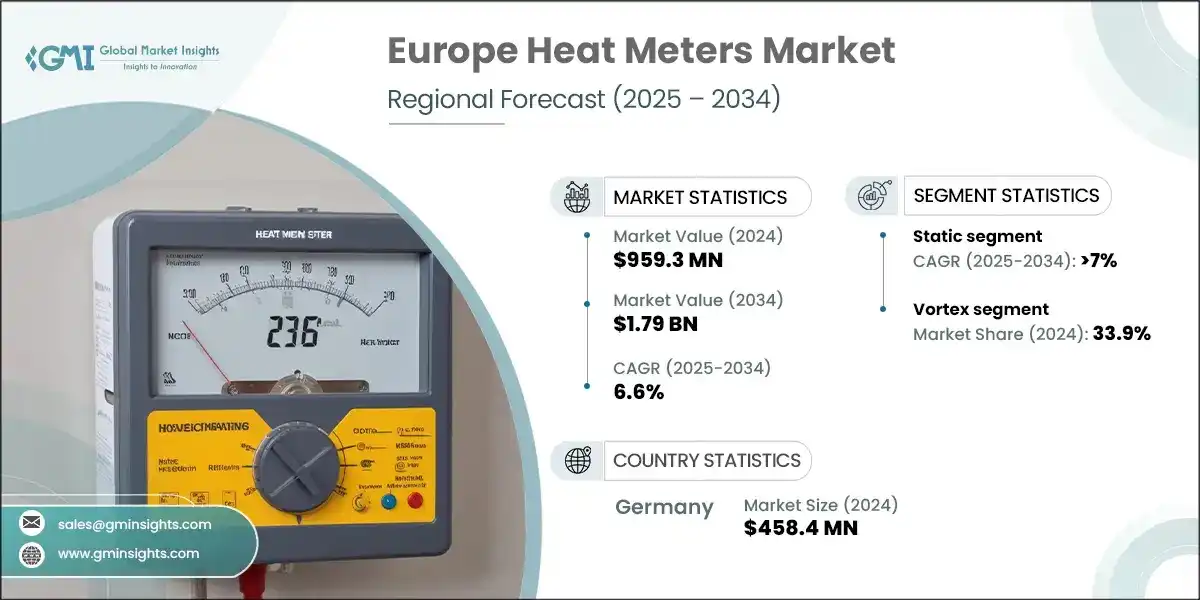
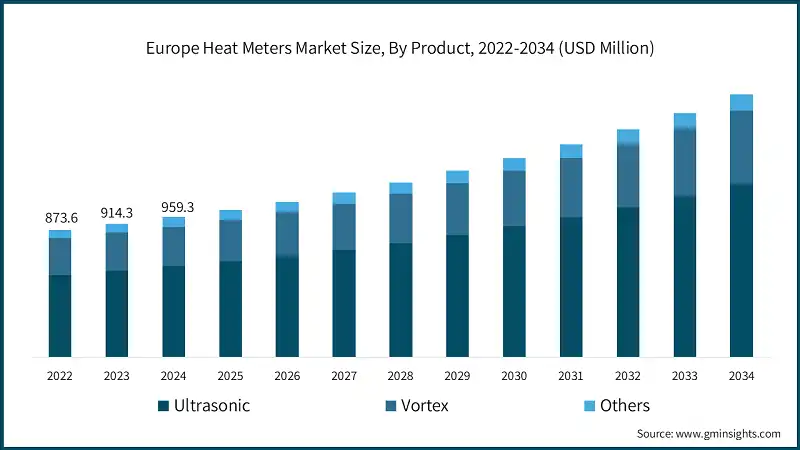
The Europe heat meters market size was valued at USD 959.3 million in 2024. The market is expected to grow from USD 1 billion in 2025 to USD 1.79 billion by 2034, at a CAGR of 6.6% from 2025 to 2034.
Europe Heat Meters Market Key Takeaways
Market Size & Growth
- 2024 Market Size: USD 959.3 Million
- 2034 Forecast Market Size: USD 1.79 Billion
- CAGR (2025–2034): 6.6%
Key Market Drivers
- Government incentives toward adoption of district heating systems.
- Extreme climatic conditions along with growing focus on clean energy directives.
Challenges
- Privacy concerns.
Opportunity
- Rising decarbonization targets across the region.
- Expansion of district heating network.
- Emerging retrofit market in the existing building infrastructure.
- Introduction of smart metering systems.
Get Market Insights & Growth Opportunities
- Regulatory mandates and policies, energy efficiency initiatives, and increasing awareness about the benefits of accurate energy measurement will augment the business landscape. Europe's ambitious climate targets, including the goal of reducing greenhouse gas emissions and improving energy efficiency, are driving the adoption of heat meters.
- Technological advancements enable modern heat meters to provide detailed insights into consumption patterns, thereby helping users to identify opportunities for energy savings. In addition, they enable better energy management by allowing users and utilities to monitor consumption in real-time and adjust usage accordingly.
- Growing consumer demand for fair and transparent billing in line with Awareness of potential cost savings through better energy management is encouraging more households and businesses to adopt heat meters. Heat meters help in optimizing district heating systems by providing accurate data on energy flows and losses, thereby improving overall system efficiency, leading to enhanced market statistics.
- Many European countries are expanding their district heating networks as a sustainable and efficient way to provide heating and cooling. Heat meters are essential for these systems to monitor and bill individual consumption accurately. Heat meters provide detailed insights into energy usage patterns, thereby helping users identify areas for energy savings, reducing overall consumption and costs.
- Increasing share of renewable energy and alleviating energy bills are the major factors influencing the decarbonization policy. Moreover, advanced design and construction techniques, introduction of energy-efficient technologies including smart meters & energy management solutions and use of sustainable materials for construction & renovation of buildings will stimulate the demand for smart heat meters across the region.
- Heat networks facilitate hot water, process heating, and space heating & cooling services across residential, commercial, and industrial sectors and have the potential to reduce carbon emissions from heating. Growing adoption of district heating systems coupled with favorable regulatory policies pertaining to emission reduction will foster the Europe heat meters market landscape.
- Rapid industrialization along with increasing investments toward the development of manufacturing facilities across the emerging economies will favor the business growth. Technological advancements along with the extensive use of IoT platforms have paved favorable business scenarios for the industry players.
- Government funded incentives pertaining to the integration of heating systems with renewable power generating units will augment the heat meter industry landscape. Financing schemes including ESIF, Horizon 2020, European Fund for Strategic Development, Green Heat Network Fund Scheme (GHNF) and others have led to the development of sustainable heating systems, thereby, paving favorable business scenario for the industry players.
- Strict government regulations pertaining to decarbonization of buildings along with energy-efficient and clean technology will propel the heat meter market. For instance, Germany, in 2021, adopted a major new climate legislation which sets higher national emissions reduction targets at minimum 65% and 88% for 2030 and 2040 respectively along with the target of achieving net GHG neutrality by the year 2045.
- Furthermore, the rising demand for ambient temperatures across industrial, commercial, and residential premises owing to the harsh climate will augment the heat meter market growth. Adverse economic effects coupled with unfavorable working conditions on account of low temperatures will influence the demand for effective heat supply across the region. Shortage of fossil fuels, high heat extraction cost, and environmental concerns will boost the heat meters demand.
To get key market trends
Europe Heat Meters Market Trends
- Mature district heating networks and increasing decarbonization efforts primarily across North and Western European economies comprising Denmark, Sweden, and Germany will boost the industry growth. For citation, Germany plans to deploy 550,000 smart heat meters with adaptive pricing and grid integration by 2030.
- Wireless or battery powered smart heat meters will continue to gain momentum owing to ease of installation and maintenance. Further, various pilot programs Brno, Dresden, and Kraków among others will improve reliability and enhance deployment, especially in comparison with wired systems.
- In June 2022, Kamstrup introduced a new generation of smart heat meters featuring full IoT connectivity supporting wireless communication for real-time energy consumption monitoring across the remote areas along with integration into smart grid systems. Additionally, the company focused on its role to support energy security with the introduction of district heating digitalization, thereby driving growth in heat meters market.
- The key players in the industry are dominated by global manufacturers with strong market share, innovation, and distribution. In addition, there are many regional players with strong regional and product-specific presence. Further, smaller players often specialize in wireless technologies, secure communications, or system integration pilots.
- For illustration, in April 2024, the European Council adopted the revised Energy Performance of Buildings Directive (EPBD), with new rules aimed at reducing energy use and emissions from buildings across the EU, including targets for all new buildings to be zero emissions by 2030, and to phase out the use of fossil fuels in building heating systems by 2040.
- The rising demand for automation and controls to complement flexible heat systems will stimulate the product adoption across the region. In addition, changing regulatory scenario has also led to an upsurge in investments in technological advancements and product innovations, thereby influencing the industry growth.
Europe Heat Meters Market Analysis
Learn more about the key segments shaping this market
- Based on product, the industry is segmented into ultrasonic, vortex, and others. The vortex segment dominated the Europe heat meters industry accounting for 33.9% revenue share in 2024 and is anticipated to grow at a CAGR of over 6.5% through 2034.
- The heat meters are being integrated with digital technologies, including smart sensors, IoT connectivity, and advanced data analytics enabling real time monitoring and remote diagnostics, making them attractive for modern energy management systems. Further, growing emphasis on energy efficiency and conservation will drive the adoption of heat meters.
- The vortex heat meters market will project at a CAGR of over 6.2% till 2034. Large scale utilization across applications in various industries owing to its non-movable parts and minimal maintenance cost in comparison with other available products will drive the Europe heat meters market scenario.
- Further, the available customization of heat meters depending on requirements of different industries along with product availability in brass, plastic, and industrial grade construction will complement the business landscape. Adoption of advanced features including digital output signals comprising detailed information in addition to the flow rate will stimulate the market growth.
- To cite an instance, in September 2022, Axioma Metering invested USD 42.66 million in the construction of a new facility in Kaunas Free Economic Zone (FEZ). The plant will be operational in 2024 with four new production lines, enabling the production of over 4 million smart meters annually.
- Rising shift from mechanical to ultrasonic meters primarily across district heating networks along with growing industrialization and expansion of the commercial sector will positively impact the business landscape. The technological evolution across the industry has led to the development of innovative devices and metering solutions, accelerating the industry potential.
- The ultrasonic heat meters market will grow at over 6.5% CAGR through 2034. Key characteristics including highly precise measurement technology and compact design will stimulate the ultrasonic heat meters market. The need for data accuracy across industries including oil & gas, power, pharmaceuticals, chemicals, and metal will enhance the Europe heat meters market outlook.
- Shifting trends toward smart buildings and smart cities is driving the adoption of ultrasonic heat meters. These meters can be integrated into building management systems to optimize heating and cooling, thereby improving comfort, and reduce energy costs. Ongoing retrofitting of the existing buildings driven by energy efficiency goals and government incentives will contribute to the business scenario.
- For instance, in June 2022, BMETERS Srl introduced HYDROCAL-M4, a thermal energy meter. The meter is the updated version of HYDROCAL-M3 in terms of performance and functionality. With features, such as integrated communication protocols, configuration freedom during installation, and the ability to add on wired connectivity, it measures the amount of energy needed to heat or cool the supplied water. The product launch reinforced the company's position in the sector.
Learn more about the key segments shaping this market
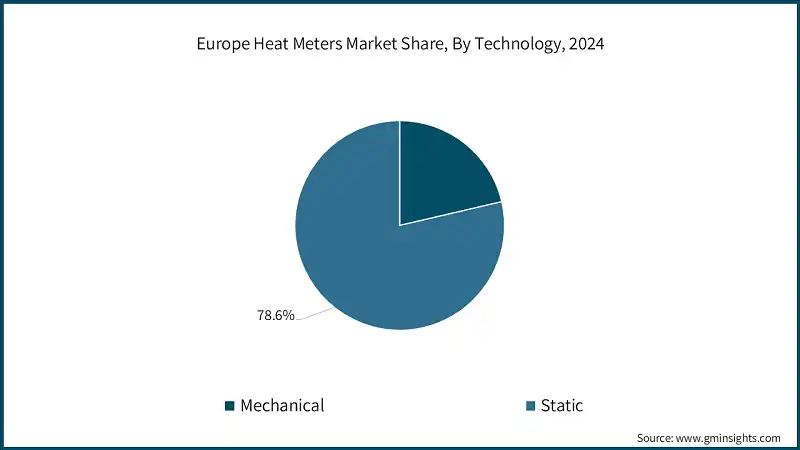
- Based on technology, the Europe heat meters market is segmented into mechanical and static. The static segment dominated the Europe heat meters industry accounting for 78.6% in 2024 and is expected to grow at a CAGR of over 7% through 2034, due to their enhanced accuracy and reliability.
- These technologies enable precise measurement of flow rates and temperature differences without mechanical wear and tear. Increasing integration with smart home and building management systems allows for remote control, real-time monitoring, and data analytics, which optimize the energy consumption and improve overall efficiency, driving the Europe heat meters market scenario.
- Moreover, the lack of moving parts in static heat meters results in lower maintenance costs and longer lifespans, which are highly valued by both residential and commercial users. Numerous benefits comprising remote monitoring, real-time data collection, and two-way communication with central systems offering accurate billing, data analytics and proactive maintenance is set to stimulate the product penetration.
- Further, the meters are being integrated into Internet of Things (IoT) systems and building management platforms, thereby allowing for remote monitoring, data analytics, and real-time control of heating and cooling systems in smart buildings. Additionally, integration of the meters with the increasing use of heat pumps for heating and cooling to accurately measure energy consumption and optimize their operation is set to stimulate the product demand.
- For instance, in December 2022, Kamstrup was awarded a contract by Silkeborg Forsyning to deliver approximately 40,000 remotely read heat and water meters. The delivery involved access to wireless communication network and collection system ensuring high-quality data.
- Mechanical heat meters will grow at over 4% CAGR till 2034. Technological advancement and extensive research and development activities across various regions has favored the technology adoption. Furthermore, flexible integration with advanced metering systems on account of multiple read out interfaces is anticipated to provide a favorable business scenario for the industry players.
Looking for region specific data?
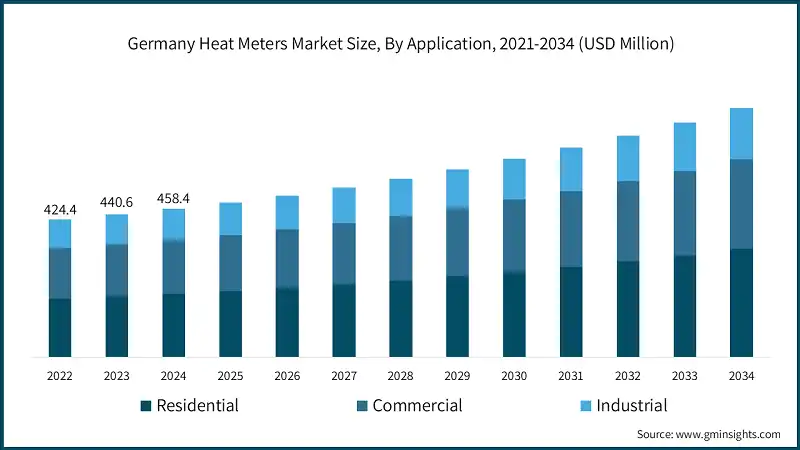
- Germany dominated the Europe heat meters market with around 47% revenue share in 2024 and generated USD 458.4 million in revenue. Strong regulatory frameworks and advanced district heating systems, advanced metering technologies and integrating them with smart grids and other energy management systems will complement the business landscape.
- Various funding and support programs support the economy upgrade their heating systems and install heat meters, which will drive the business scenario. Furthermore, implementation of the EED and national energy efficiency plans will drive the increase in heat meter installations.
- The increasing promotional activities along with strategic marketing by the leading industry players will enhance the product adoption in the coming years. In addition, the changing surface temperature and regulatory inclination toward sustainable building solutions across various countries has instituted a favorable scenario for the development of the technology.
- The UK heat meters market is projected to surge over USD 24 million by 2034. The heat metering in the UK is at a developing stage, where the commercialization is still at a nascent stage and its untapped potential can prove as a hotspot for the market entrants, similar to the case of other utility metering systems.
- The heat networks account for a small proportion of the UK heating systems, resulting in unspecified locations and unregulated operation till 2014. However, the introduction of Heat Network (Metering and Billing) Regulations in 2014 will support reduce carbon emissions. Further, the regulations were amended in 2015 with the latest revision in November 2020.
- Rigorous research, and development investments along with integration of advanced IoT platforms will positively cater to the product differentiation. For instance, the launch of remote sensors units by Meters UK, a utility heat meter manufacturer. The smart units for use with heat meters allow a maximum distance of one km between the calculator and the sensors.
- For instance, in January 2022, Huizhong Instrumentation Co., Ltd. introduced a heating IoT metering solution for the household heat management. The smart & advanced solution offers a wide range of functions including NB-IoT & LoRa technologies, along with big data processing and analytics and the real time monitoring & analysis of online devices.
Europe Heat Meters Market Share
- The top 5 companies in the Europe heat meters industry are Kamstrup, Diehl, Landis+Gyr, Itron, and Sontex contributing around 70% of the market in 2024.
- Kamstrup continues to expand its end to end service offerings across Europe, combining OEM certified heat meters, IoT connectivity, and long term maintenance contracts with performance analytics. In 2024 the company reinforced its global organizational structure into three integrated business units to strengthen customer focus and resilience.
- The company’s intelligent heat meters are distinguished by superior remote connectivity, data analytics, and integration with energy efficiency platforms—enabling utilities to optimize billing and network performance, particularly in ageing district heating systems.
- Danfoss integrates heat meters, hydronic balancing, valves, controls, and large scale heat pumps to optimize district heating networks end to meet EU Fit for 55 decarbonization mandates. At MCE Milan 2024, Danfoss featured AI based services, connected sensors, smart radiator thermostats, and hydronic balancing devices tailored for high-performance heat pump systems, enabling actionable energy savings in residential, commercial, and industrial buildings.
- Diehl delivers automated, fixed network data collection plus analytics with the support of IZAR software platform that help utilities detect high return temperatures, leaks, and inefficiencies in district heating networks. It positions its smart heat metering solutions as key enablers for 4th Generation District Heating and Cooling (4GDHC), supporting EU energy efficiency directives requiring remote readable meters and quarterly consumer access to usage data.
- Industry collaborations play a crucial role in fostering innovation, expanding market reach, and enhancing product offerings. Further, collaborations focusing on integrating heat meters with renewable energy sources comprising solar thermal and geothermal systems, enable better management and optimization of the heating systems.
Europe Heat Meters Market Companies
- In April 2025, Kamstrup reported record-breaking demand for its smart heat metering solutions across Europe, with year-over-year order growth exceeding 45%. It further maintained a book-to-bill ratio above 1.4, thereby reflecting constant demand outpacing deliveries, and contributing to a historic high backlog of orders for its IoT-enabled MULTICAL series and Return Temperature Optimizer platform.
- In May 2025, Diehl Metering secured USD 1.4 billion in orders, marking a 47% year-over-year increase. The company further sustained a book-to-bill ratio of 1.4, contributing to a new record order backlog of USD 5.38 billion, backed by strong commitments from energy providers implementing EU compliant smart infrastructure upgrades.
Eminent players operating in the Europe heat meters market are:
- Apator
- Axioma
- BMETERS
- Danfoss
- Diehl Stiftung
- Emerson Electric
- ista
- Itron
- Kamstrup
- Landis+Gyr
- Micronics
- Meters
- Norstrom Metering
- Premier Control Technologies
- Secure Meters
- Schneider Electric
- Siemens
- Sontex
- Stockshed
- Vital Energi
- ZENNER
Europe Heat Meters Market Report Attributes
| Key Takeaway | Details |
|---|---|
| Market Size & Growth | |
| Base Year | 2024 |
| Market Size in 2024 | USD 959.3 Million |
| Forecast Period 2025 - 2034 CAGR | 6.6% |
| Market Size in 2034 | USD 1.79 Billion |
| Key Market Trends | |
| Drivers | Impact |
| Government incentives toward adoption of district heating systems | Provision of direct grants, tax breaks, and incentives linked to housing subsidies and loans, leading to market growth. |
| Extreme climatic conditions along with growing focus on clean energy directives | Boosts product adoption owing to rising demand for ambient temperatures across industrial, commercial, and residential premises. |
| Pitfalls & Challenges | Impact |
| Privacy concerns | Poses severe concerns regarding data infringement due to significant implications pertaining to cyber threats associated with these products. |
| Opportunities: | Impact |
| Rising decarbonization targets across the region | Governments and municipalities are pushing for low-carbon heating solutions that need heat metering to track performance and savings. |
| Expansion of district heating network | Large and expanding district heating network especially in economies like Germany, Denmark, Sweden, and the Netherlands. |
| Emerging retrofit market in the existing building infrastructure | Creates numerous opportunities for smart metering systems in commercial and residential buildings. |
| Introduction of smart metering systems | Provides detailed usage insights for utilities needing real-time data leading to demand-side management & grid optimization. |
| Market Leaders (2024) | |
| Market Leader |
|
| Top Players |
Collective market share in 2024 is 75% |
| Competitive Edge |
|
| Regional Insights | |
| Largest Market | Germany |
| Fastest growing market | Austria |
| Emerging states | Sweden, UK, Italy, Estonia, and Switzerland |
| Future outlook |
|
What are the growth opportunities in this market?
Europe Heat Meters Industry News
- In March 2023, Diehl Stiftung & Co. KG entered into a partnership with STACKFORCE GmbH for embedded software for communication of water and thermal energy meters. STACKFORCE also provided LPWAN standard miot, an innovative technology. The strategic collaboration further expanded their leading positions across the high-performance smart heat meters market.
- In June 2022, BMETERS Srl introduced HYDROCAL-M4, a thermal energy meter. The meter is the updated version of HYDROCAL-M3 in terms of performance and functionality. With features, such as integrated communication protocols, configuration freedom during installation, and the ability to add on wired connectivity, it measures the amount of energy needed to heat or cool the supplied water. The product launch reinforced the company's position in the sector.
- In September 2022, Axioma Metering invested USD 42.66 million in the construction of a new facility in Kaunas Free Economic Zone (FEZ). The plant will be operational in 2024 with four new production lines, enabling the production of over 4 million smart meters annually. The company aims to stabilize supply chain and interrupted orders of smart heat & water meters in the market. The company’s strategic investment strengthened its product portfolio across the industry.
The Europe heat meters market research report includes an in-depth coverage of the industry with estimates & forecast in terms of revenue and volume in “USD Million & ‘000 Units” from 2021 to 2032, for the following segments:
Market, By Product
- Ultrasonic
- Vortex
- Others
Market, By Technology
- Mechanical
- Static
Market, By Application
- Residential
- Commercial
- Industrial
The above information has been provided for the following countries:
- Germany
- Poland
- Sweden
- Denmark
- Finland
- Russia
- Italy
- UK
- Norway
- Czech Republic
- Estonia
- Latvia
- Lithuania
- Switzerland
- Austria
- Spain
Frequently Asked Question(FAQ) :
What was the market size of the Europe heat meters in 2024?
The market size was USD 959.3 million in 2024, with a CAGR of 6.6% expected through 2034 propelled by regulatory mandates, energy efficiency initiatives, and increasing awareness of accurate energy measurement benefits.
What is the projected value of the Europe heat meters market by 2034?
The market is expected to reach USD 1.79 billion by 2034, supported by decarbonization targets and the expansion of district heating networks.
What was the revenue share of the vortex segment in 2024?
The vortex segment accounted for 33.9% of the revenue share in 2024 and is anticipated to grow at a CAGR of over 6.5% through 2034.
How much revenue is the UK heat meters market projected to generate by 2034?
The UK heat meters market is projected to generate over USD 24 million by 2034.
What is the growth outlook for ultrasonic heat meters from 2025 to 2034?
Ultrasonic heat meters are projected to grow at a CAGR of over 6.5% through 2034, driven by their precise measurement technology and compact design.
Which country dominated the Europe heat meters market in 2024?
Germany led the market with a 47% revenue share in 2024, generating USD 458.4 million, supported by strong regulatory frameworks and advanced district heating systems.
What are the upcoming trends in the Europe heat meters market?
Key trends include the integration of digital technologies like IoT and smart sensors, the push for energy efficiency, and the adoption of smart metering systems for real-time monitoring and grid optimization.
Who are the leading players in the Europe heat meters market?
Key players include Kamstrup, Diehl, Landis+Gyr, Itron, Sontex, Apator, Axioma, BMETERS, Danfoss, Emerson Electric, and Siemens, among others.
Europe Heat Meters Market Scope
Related Reports