Summary
Table of Content

Europe District Heating Market
Get a free sample of this report
Form submitted successfully!
Error submitting form. Please try again.
Thank you!
Your inquiry has been received. Our team will reach out to you with the required details via email. To ensure that you don't miss their response, kindly remember to check your spam folder as well!
Request Sectional Data
Thank you!
Your inquiry has been received. Our team will reach out to you with the required details via email. To ensure that you don't miss their response, kindly remember to check your spam folder as well!
Form submitted successfully!
Error submitting form. Please try again.
Europe District Heating Market Size
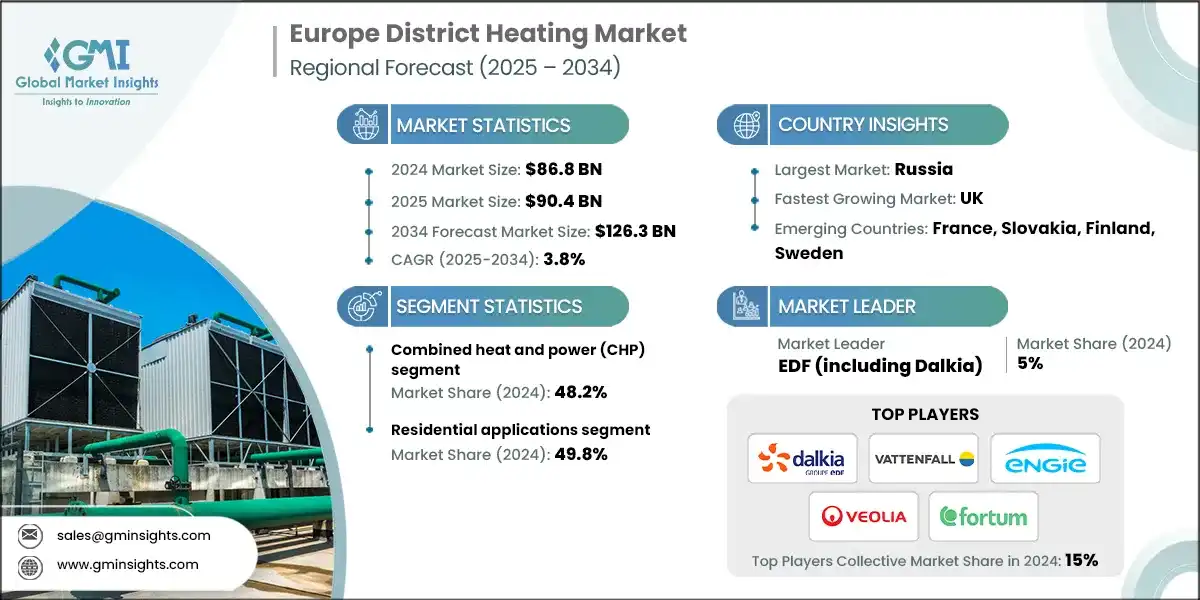
According to a recent study by Global Market Insights Inc., the Europe district heating market was estimated at USD 86.8 billion in 2024. The market is expected to grow from USD 90.4 billion in 2025 to USD 126.3 billion in 2034, at a CAGR of 3.8%.
To get key market trends
- Increasing policy driven decarbonization initiatives across the countries is propelling industry growth. The European Commission's Fit for 55 Package formally recognizes district heating as critical for the EU energy transition, with the Revised Energy Efficiency Directive establishing a decarbonization pathway for heating networks to be CO2-neutral by 2050. This regulatory framework is driving significant investment in renewable heat sources and network modernization across European markets.
- The market is witnessing rapid adoption of advanced technologies including large heat pumps, waste heat recovery systems, and 5th generation district heating and cooling networks. Over 200 fifth-generation systems are operational in Europe, with geothermal leading at 39% share, demonstrating the sector's technological evolution toward more efficient and sustainable solutions.
- The Renewable Energy Directive (RED III) elevates waste heat to parity with renewable heat and sets a 2.2% points annual increase target for district heating and cooling systems. Moreover, the implementation of comprehensive climate policies including the Net Zero Industry Act and Repower EU initiative, which mobilized approximately EUR 234.8 billion for energy transition, is driving market expansion.
- Geopolitical tensions and energy independence objectives are accelerating the shift toward domestic renewable heat sources and efficient distribution systems. The EU's strategic focus on reducing fossil fuel dependence is creating substantial demand for district heating infrastructure. Additionally, new regulatory requirements mandate cities with populations over 45,000 inhabitants to create heating and cooling plans, creating a structured demand pipeline for district heating projects across European urban centers.
- The development of municipal heat planning directives along with new regulatory requirements mandate cities with populations over 45,000 inhabitants to create heating plans, creating a structured demand pipeline for district heating projects across European urban centers.
- The development of large-scale heat pumps, enhanced geothermal systems, and waste heat recovery technologies is improving system efficiency and reducing operational costs. For instance, over 360 geothermal district heating projects are in development or consideration across the EU, thereby enhancing the business landscape.
- The district heating infrastructure requires substantial upfront investment, with network development costs varying significantly by geography and population density. This challenge is partially offset by EU funding mechanisms including the Recovery and Resilience Facility. Moreover, varying national regulations and complex permitting processes across European jurisdictions create development delays and increased project costs. The introduction of heat network regulation and zoning frameworks, such as the UK's Energy Security Bill is aiming to address these challenges.
Europe District Heating Market Report Attributes
| Key Takeaway | Details |
|---|---|
| Market Size & Growth | |
| Base Year | 2024 |
| Market Size in 2024 | USD 86.8 Billion |
| Market Size in 2025 | USD 90.4 Billion |
| Forecast Period 2025 - 2034 CAGR | 3.8%% |
| Market Size in 2034 | USD 126.3 Billion |
| Key Market Trends | |
| Drivers | Impact |
| EU Climate Policy Implementation | Stringent government regulations including Repower EU, and Net Zero Industry Act toward decarbonization. |
| Rising Energy Security Concerns | Geopolitical tensions driving domestic renewable heat |
| Technological Advancement in Heat Sources | Development of 5th generations district heating systems, along with integration of renewable energy technologies. |
| Pitfalls & Challenges | Impact |
| High capital investments | District heating infrastructure requires substantial upfront investment, with network development costs varying significantly by geography and population density. |
| Opportunities: | Impact |
| Renewable energy integration | Growing market potential by development of sustainable technologies |
| Modernization of existing district heating network | Creating demand for advanced, efficient and upgraded solutions. |
| Adoption of digital monitoring and smart control systems | Enhancing operational efficiency, reducing losses, and enhancing service reliability. |
| Waste heat recovery from facilities | Unlocking cost-effective heat supply options along with reducing environmental impact. |
| Market Leaders (2024) | |
| Market Leaders |
5% market share |
| Top Players |
Collective market share in 2024 is 15% |
| Competitive Edge |
|
| Regional Insights | |
| Largest Market | Russia |
| Fastest Growing Market | UK |
| Emerging Country | France, Slovakia, Finland, Sweden |
| Future outlook |
|
What are the growth opportunities in this market?
Europe District Heating Market Trends
- The Europe district heating industry is experiencing transformative trends driven by regulatory mandates, technological innovation, and evolving energy security priorities. These trends are reshaping the industry landscape and creating new opportunities for market participants across the value chain.
- The implementation of the European Green Deal and associated legislation is fundamentally altering the district heating landscape. The Revised Energy Efficiency Directive establishes mandatory decarbonization pathways requiring heating networks to achieve CO2-neutrality by 2050. This regulatory framework creates a clear timeline for industry transformation and provides investment certainty for long-term infrastructure projects.
- In 2024, the European Commission strengthened formal recognition of district heating and cooling as critical for EU energy transition through the Fit for 55 Package implementation. The Revised Energy Efficiency Directive established decarbonization pathways for heating networks to achieve CO2-neutrality by 2050. These policy developments provide long-term regulatory certainty and investment frameworks for industry participants.
- Municipal heat planning mandates represent another significant regulatory trend. Cities with populations exceeding 45,000 inhabitants must now develop comprehensive heating and cooling plans, creating a structured pipeline of district heating opportunities across European urban centers. This systematic approach to heat planning is expected to drive consistent market growth and improve project coordination between public and private stakeholders.
- The introduction of carbon pricing mechanisms, including the ETS2 system entering force with carbon pricing on building fossil fuels from 2027, is accelerating the economic competitiveness of district heating systems. This pricing structure creates favorable economics for renewable heat sources and incentivizes the retirement of fossil fuel-based heating systems.
- Fifth-generation district heating systems are emerging as a key technological trend, with over 200 systems operational across Europe. These advanced networks operate at lower temperatures, enabling higher efficiency and greater integration of renewable heat sources including geothermal, solar thermal, and waste heat recovery systems.
- Large-scale heat pump integration is becoming increasingly prevalent, with these systems expected to become key heat providers in many markets. Technology’s ability to utilize ambient heat sources and provide both heating and cooling services aligns with the sector's efficiency and sustainability objectives.
- Waste heat recovery is gaining significant traction, with approximately 300 TWh/year of technically feasible industrial waste heat potential identified across the EU. Recent projects, such as A2A's collaboration with DBA Group and Retelit in Milan, demonstrate the practical implementation of data center waste heat recovery for district heating applications.
- The market is witnessing accelerated renewable energy integration, driven by the Renewable Energy Directive (RED III) and other policies. For instance, according to State of Green, 40% of European district heating utilizes renewable sources, with leading countries like Denmark achieving 75% renewable integration in 2024.
- Geothermal energy is experiencing growth momentum, with 346 geothermal district heating systems operational by end-2023, representing total capacity of approximately 6 GWth. Over 360 additional geothermal projects are in development or consideration across the EU, supported by government guarantee schemes and favorable regulatory frameworks.
- Solar thermal integration is also expanding rapidly, reflecting technology’s improving economics and policy support. The integration of seasonal thermal energy storage systems is enhancing solar thermal's contribution to district heating networks, particularly in Nordic markets with significant seasonal heating demand variations.
- The industry is also benefiting from unprecedented levels of public and private investment. The Repower EU initiative mobilized approximately USD 352.2 billion for energy transition projects, with substantial allocations directed toward district heating infrastructure. National programs, including Germany's EUR 3 billion heat network support programme and the UK's USD 388.1 million Green Heat Network Fund, provide structured financing for market development.
- Private sector investment is increasing through innovative financing mechanisms including green bonds, blended finance structures, and public-private partnerships. The establishment of government guarantee schemes for geothermal projects demonstrates the evolution of risk-sharing mechanisms to accelerate project development.
Europe District Heating Market Analysis
Learn more about the key segments shaping this market
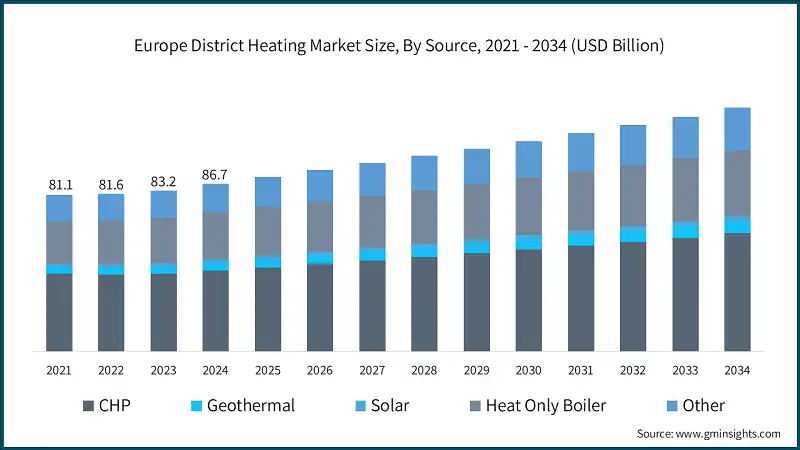
- Based on sources, the industry is segmented into CHP, heat only boilers, geothermal, solar, and other sources. The combined heat and power (CHP) systems maintain market leadership with 48.2% market share in 2024, reflecting the technology's established infrastructure base and operational efficiency advantages. CHP systems provide both electricity and heat generation, offering superior energy efficiency compared to separate production systems. The segment's 3.8% CAGR aligns with overall market growth, supported by ongoing modernization of existing facilities and integration of renewable fuel sources including biomass and biogas.
- The CHP segment benefits from substantial policy support, particularly in countries with established industrial bases requiring both heat and power. Recent developments include the integration of power-to-heat technologies and thermal storage systems, enhancing operational flexibility and grid integration capabilities. The segment's growth is further supported by the EU's recognition of high-efficiency cogeneration as a key technology for achieving energy efficiency objectives.
- The heat only boilers represent 28.1% of market share in 2024, while growing at a 3.3% CAGR through 2034, reflecting the segment's role in providing dedicated heating services in residential and commercial applications. While traditional fossil fuel boilers face regulatory pressure, the segment is experiencing transformation through biomass integration, heat pump hybridization, and renewable fuel adoption. Modern heat-only boiler systems increasingly incorporate advanced control systems and thermal storage to optimize efficiency and grid integration.
- Geothermal systems demonstrate strong growth potential with a 4.1% CAGR till 2034, reflecting the technology's expanding feasibility and policy support. The segment benefits from around 346 operational systems with 6 GWth total capacity and over 360 projects in development. Geothermal systems provide baseload renewable heat with high-capacity factors, making them particularly valuable for large district heating networks.
- Solar thermal systems exhibit the growth rate of over 5.7% from 2025 to 2034, driven by declining technology costs and improved integration with seasonal thermal energy storage. The segment's growth is supported by favorable solar resources in southern European markets and increasing adoption of large-scale solar thermal installations. Integration with heat pump systems and thermal storage is expanding solar thermal's contribution to year-round heating supply.
Learn more about the key segments shaping this market
- Based on application, the industry is segmented into residential, commercial, and industrial. The residential applications dominate the market with 49.8% share and growing at a 3.6% CAGR through 2034, reflecting district heating's established role in European residential heating markets. The segment benefits from high connection rates in countries like Denmark and strong policy support for residential heat decarbonization. The new residential development in urban areas, retrofit of existing buildings, and replacement of individual heating systems with district heating connections will propel the business outlook.
- Residential segment growth is supported by favorable economics in high-density urban areas and policy incentives for heat pump integration and building efficiency improvements. The segment increasingly benefits from smart heating controls, individual metering systems, and demand response capabilities that optimize energy consumption and reduce costs for end users.
- Commercial applications represent 29.1% market share in 2024, encompassing office buildings, educational institutions, healthcare facilities, and government buildings. The segment benefits from large, consistent heat demand profiles and increasing focus on corporate sustainability objectives. Commercial applications often serve as anchor customers for new district heating networks, providing stable revenue streams that support system expansion to residential areas.
- The commercial segment is experiencing growth through green building certification requirements, corporate net-zero commitments, and public sector decarbonization mandates. Large commercial users increasingly participate in demand response programs and thermal storage systems that provide grid services and optimize system operations.
- Industrial applications account will grow at a growth rate of 3.9% up to 2034, serving process heating requirements in manufacturing, chemical, and food processing industries. Industrial applications provide high-temperature heat demand and often serve as sources of waste heat for district heating networks. The segment benefits from industrial decarbonization requirements and the integration of industrial symbiosis concepts that optimize heat utilization across multiple users.
- Industrial segment growth is driven by regulatory requirements for energy efficiency improvements, carbon pricing mechanisms, and the development of industrial clusters that share heating infrastructure. The segment increasingly incorporates thermal storage systems and flexible heating systems that provide grid balancing services.
Looking for region specific data?
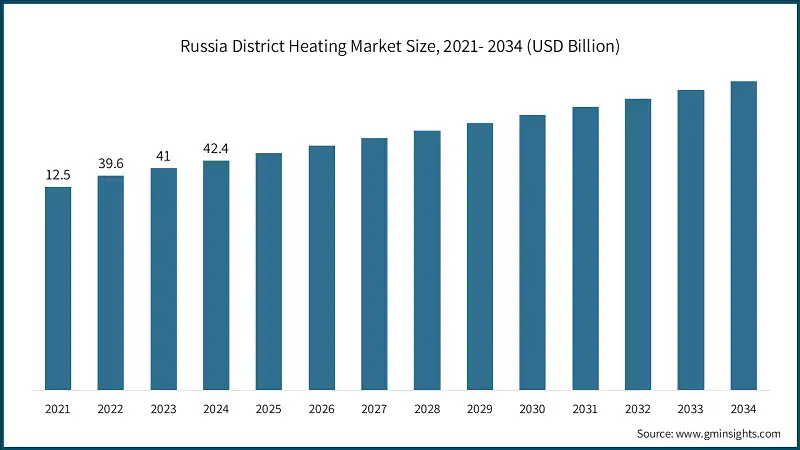
- Russia district heating market the accounted for over 48.9% share in 2024 and is set to grow at over 3% CAGR through 2034, reflecting the market's maturity and existing extensive district heating infrastructure. The Russian market benefits from established urban heating networks and substantial heat demand in cold climate regions. However, growth is constrained by economic factors and limited investment in system modernization and renewable integration.
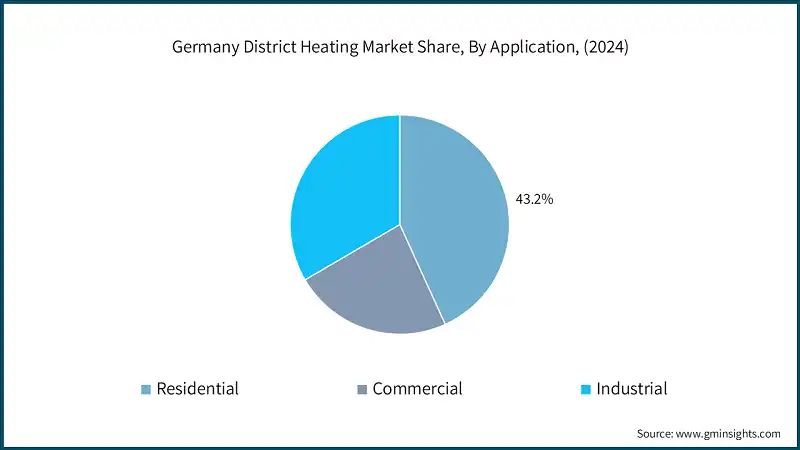
- Germany district heating market captured 14.3% market share in 2024, with a CAGR of 4.3% expected through 2034, supported by the country's USD 3.5 billion heat network support programme and strong policy commitment to heating sector decarbonization. The German market demonstrates leadership in technology innovation, renewable integration, and system efficiency improvements. Urban densification, building retrofit programs, and integration with renewable electricity systems are some of the key parameters driving business growth.
- The German market benefits from advanced regulatory frameworks, substantial public funding, and strong industrial participation in waste heat recovery projects. The country's Energiewende strategy provides long-term policy certainty that supports investment in district heating infrastructure and renewable heat sources.
- The Nordic Countries including Sweden and Finland demonstrate strong performance driven by cold climate conditions, established district heating traditions, and leadership in renewable integration. Sweden achieves 66.4% renewable energy share, while Finland demonstrates rapid growth through geothermal development and biomass utilization.
- The emerging markets including the UK, Slovakia, and France exhibit high growth rates reflecting early-stage market development and strong policy support. These markets benefit from learning from established district heating countries and implementing advanced technologies from project inception.
- The UK market is supported by the USD 388.2 million Green Heat Network Fund and comprehensive heat network regulation introduced through the Energy Security Bill. France benefits from urban heat planning requirements and integration with nuclear baseload electricity generation. Slovakia demonstrates growth through EU structural funds and regional development programs.
Europe District Heating Market Share
- The top 5 companies in the Europe district heating industry are EDF (including Dalkia), Fortum, ENGIE, Vattenfall, and Veolia. The industry demonstrates a highly fragmented structure among utility companies and regional operators, with the top five players controlling around 15% of total market share in 2024. This fragmentation reflects the localized nature of district heating infrastructure and the predominant role of municipal utilities, regional energy companies, and specialized operators across European markets.
- EDF (including Dalkia) has a strong position in district heating markets and comprehensive European operations through its Dalkia subsidiary. The company benefits from integration with nuclear baseload electricity generation, enabling efficient combined heat and power operations and favorable economics for electric heating technologies. EDF's stems from its extensive French municipal contracts and expanding presence in other European markets through strategic acquisitions and partnerships.
- Vattenfall has an extensive Nordic operations and strong presence in Germany and the Netherlands. The company maintains significant operational scale with comprehensive district heating portfolio spanning over 50 systems serving more than 1.5 million customers. Vattenfall's competitive advantage includes advanced system integration capabilities, renewable energy expertise, and substantial investment in heat pump technologies and thermal storage systems.
- ENGIE through its diversified European energy services portfolio and district heating operations across multiple countries. The company's market position benefits from comprehensive energy solutions capabilities and strategic focus on renewable energy integration and system modernization projects.
- Veolia through its environmental services portfolio and district heating operations across European markets. The company's competitive advantages include waste-to-energy integration, comprehensive energy management services, and expertise in system optimization and efficiency improvements.
- Fortum with strong positions in Nordic markets and expanding operations in Central and Eastern Europe. The company's competitive advantage includes extensive experience in cold climate operations, renewable energy integration, and system optimization technologies. Fortum's recent investments include the USD 330.95 million Espoo Clean Heat programme, featuring emissions-free electric heating systems and advanced thermal storage.
- The competitive landscape is evolving toward greater emphasis on sustainability credentials, system efficiency, and integrated energy services. Leading companies are developing comprehensive heating solutions that combine district heating with building efficiency services, renewable electricity supply, and demand response capabilities that provide enhanced value to customers and support grid stability objectives.
Europe District Heating Market Companies
- Major players operating in the Europe district heating industry include a diverse range of utility companies, technology providers, and specialized heating system operators that collectively serve the continent's extensive district heating infrastructure. The market encompasses both large multinational utilities and regional specialists that provide comprehensive heating solutions across residential, commercial, and industrial applications.
- Engie maintains substantial European district heating operations through its comprehensive energy services portfolio. The company realized a revenue of USD 44.3 billion in the first half of 2025, representing a 2.9% growth organically and 1.4% on a reported basis. EBITDA was USD 9.6 billion, declining 7.4% on a reported basis and 5.5% organically.
- Vattenfall AB is operating extensive district heating systems across Nordic countries, Germany, and the Netherlands. The company realized the net sales of USD 12.6 billion in the first half of 2025, declining by 8%. EBITDA accounted for USD 2.7 billion and operating profit accounted for USD 1.5 billion over the first half of 2025.
- Veolia operates district heating systems across multiple European countries through its comprehensive environmental services portfolio. The company reported revenue of USD 25.6 billion, up by 3.8% excluding energy prices. EBITDA USD 3.9 billion and increase of 5.5% when compared with last year.
Major players operating in the Europe district heating market are:
- ALFA LAVAL
- Danfoss
- E.ON SE
- ENGIE
- EnBW
- EDF (including Dalkia)
- Fortum
- Goteborg Energi
- Hafslund AS
- Kamstrup
- KELAG Energy & Heat GmbH
- LOGSTOR Denmark Holding ApS
- Ørsted A/S
- Ramboll Group A/S
- RWE
- Statkraft AS
- STEAG GmbH
- SUEZ
- Uniper SE
- Vattenfall AB
- Veolia
Europe District Heating Industry News
- In August 2024, A2A in collaboration with DBA Group and Retelit launched Italy's first project to recover heat from data centers for district heating in Milan. The initiative, powered by the "Avalon 3" data center, will provide heat to 1,250 additional households annually. This project will result in energy savings equivalent to 1,300 TOE and prevent 3,300 tonnes of CO2 emissions, contributing environmental benefits equal to planting 24,000 trees. This project effectively utilizes the excess heat produced during cooling, which would otherwise go to waste, aligning with future energy demands and sustainability goals.
- In March 2024, Fortum began constructing an emissions-free, electricity-based district heat plant in Espoo, Finland. The facility will include a 50 MW electric boiler and an 800 MWh heat accumulator, boosting heat production flexibility and optimizing electricity usage through variable pricing. Part of the Espoo Clean Heat programme, this initiative aims for carbon-neutral district heating by 2030. Fortum is investing USD 330.95 million in the region, with USD 28.68 million for the Nuijala plant, which will reduce fossil fuel use and improve network efficiency.
- In June 2024, E.ON collaborated with Lendlease to deploy a cutting-edge low-carbon heat network in East London, targeting 6,500 new homes and commercial units. The project, which debuted at the 760,000m² Silvertown development, introduced E.ON's innovative 'ectogrid' energy-sharing system in the UK. This system aimed to optimize local energy sources for heating with an estimated annual reduction of 4,000 tonnes in CO2 emissions, representing an 88% decrease.
- In April 2024, EnBW commissioned a 24 MW large heat pump at the Stuttgart-Münster power plant, providing climate-neutral heating for around 10,000 households. This installation boosted EnBW's climate-neutral share in Stuttgart's district heating network from 15% to 25%. By harnessing waste heat from the cooling water of a neighbouring waste incineration plant and utilizing certified green electricity, the heat pump supported Stuttgart's climate protection goals by reducing CO2 emissions by approximately 15,000 tons.
The Europe district heating market research reports include in-depth coverage of the industry with estimates & forecast in terms of USD Million and PJ from 2021 to 2034, for the following segments:
Market, By Source
- CHP
- Geothermal
- Solar
- Heat only boiler
- Other
Market, By Application
- Residential
- Commercial
- College/University
- Office
- Government/Military
- Others
- Industrial
- Chemical
- Refinery
- Paper
- Others
The above information has been provided for the following countries across the regions:
- Germany
- Poland
- Russia
- Sweden
- Finland
- Italy
- Denmark
- UK
- Slovakia
- Austria
- Czech Republic
- France
Frequently Asked Question(FAQ) :
Which region leads the Europe district heating market?
Russia held 48.9% share in 2024 and is set to grow at over 3% CAGR through 2034, benefiting from extensive existing district heating infrastructure and substantial heat demand in cold climate regions.
What is the market size of the Europe district heating in 2024?
The market size was USD 86.8 billion in 2024, with a CAGR of 3.8% expected through 2034 driven by EU decarbonization policies, renewable energy integration, and energy security concerns.
What is the projected value of the Europe district heating market by 2034?
The Europe district heating market is expected to reach USD 126.3 billion by 2034, propelled by technological advancements, fifth-generation systems, and mandatory municipal heat planning requirements.
How much revenue did the CHP segment generate in 2024?
CHP systems maintained market leadership with 48.2% market share in 2024, driven by superior energy efficiency and integration of renewable fuel sources including biomass and biogas.
What was the market share of residential applications segment in 2024?
Residential applications dominated with 49.8% share in 2024, reflecting district heating's established role in European residential markets with high connection rates in countries like Denmark.
What is the growth outlook for solar thermal systems from 2025 to 2034?
Solar thermal systems are projected to grow at over 5.7% CAGR till 2034, due to declining technology costs and improved integration with seasonal thermal energy storage.
What is the current Europe district heating market size in 2025?
The market size is projected to reach USD 90.4 billion in 2025.
What are the upcoming trends in the Europe district heating market?
Key trends include deployment of fifth-generation district heating systems, large-scale heat pump integration, waste heat recovery from industrial facilities, and accelerated renewable energy integration achieving 40% renewable sources across European networks.
Who are the key players in the Europe district heating market?
Key players include EDF (including Dalkia), Vattenfall, ENGIE, Veolia, Fortum, E.ON SE, EnBW, Danfoss, Ørsted A/S, RWE, Statkraft AS, Uniper SE, ALFA LAVAL, Kamstrup, STEAG GmbH, SUEZ, Goteborg Energi, Hafslund AS, KELAG Energy & Heat GmbH, LOGSTOR Denmark Holding ApS, and Ramboll Group A/S.
Europe District Heating Market Scope
Related Reports