Summary
Table of Content

Europe Automatic Door Market
Get a free sample of this report
Form submitted successfully!
Error submitting form. Please try again.
Thank you!
Your inquiry has been received. Our team will reach out to you with the required details via email. To ensure that you don't miss their response, kindly remember to check your spam folder as well!
Request Sectional Data
Thank you!
Your inquiry has been received. Our team will reach out to you with the required details via email. To ensure that you don't miss their response, kindly remember to check your spam folder as well!
Form submitted successfully!
Error submitting form. Please try again.
Europe Automatic Door Market Size
- Europe has many regulatory requirements such as EN 16005 that require automatic doors in commercial, healthcare and public buildings to comply with. These regulations promote safety, accessibility and energy efficiency and create large-scale demand for upgrade and retrofitting. CEN confirmed that EN 16005 compliance will ensure automatic doors have safety features such as obstacle detection systems and emergency breakout systems; both would be very important for high-commercial use areas.
- Additionally, infrastructure development is one of the major forces behind increased deployment of automated entry systems across Europe. The ACI stated there were over 2 billion passengers travelling through airports in Europe during 2023, highlighting the need for efficient ways to manage crowds, such as using automated doors for expediting passenger flow.
- Lastly, modernization of the large amount of outdated infrastructure in Europe is another key area creating demand for upgrading existing systems. With much of Europe’s building stock being built before the 1980’s, many buildings need improvements to current building codes to be compliant with accessibility and safety requirements.
- Automated door systems are a key component of these modernization efforts, offering enhanced functionality, energy efficiency, and compliance with evolving regulations. For example, manufacturers like ASSA ABLOY have reported a steady increase in sales of retrofit solutions, driven by the need to upgrade older buildings to meet modern standards.
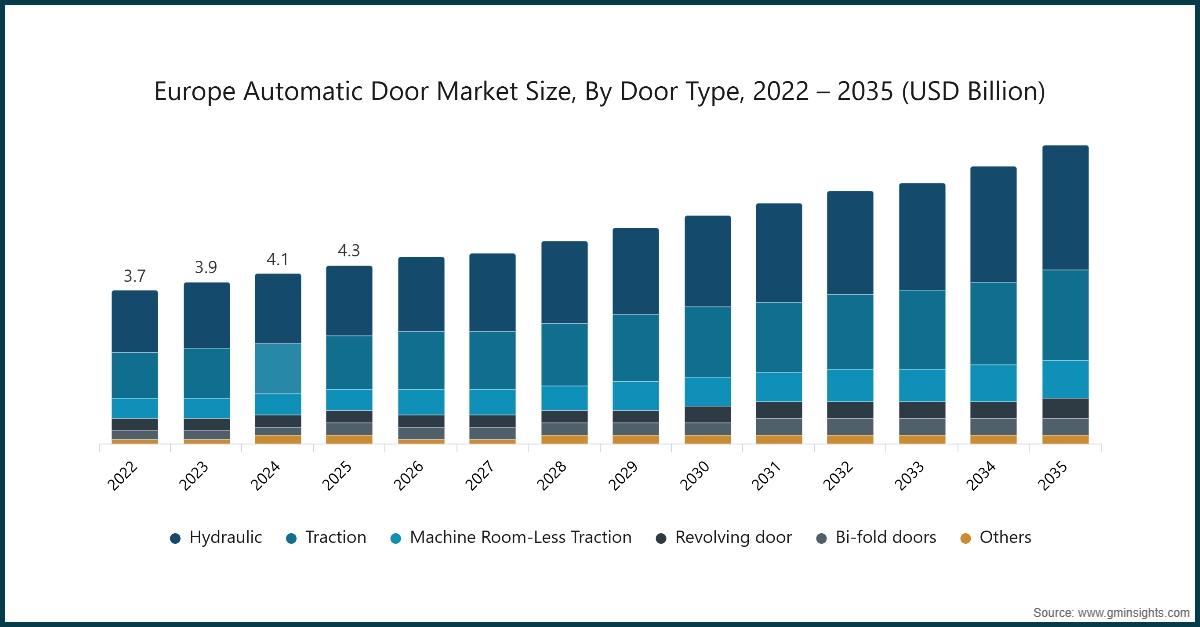
The Europe automatic door market was estimated at USD 4.3 billion in 2025. The market is expected to grow from USD 4.5 billion in 2026 to USD 7.2 billion in 2035, at a CAGR of 5.3% according to latest report published by Global Market Insights Inc.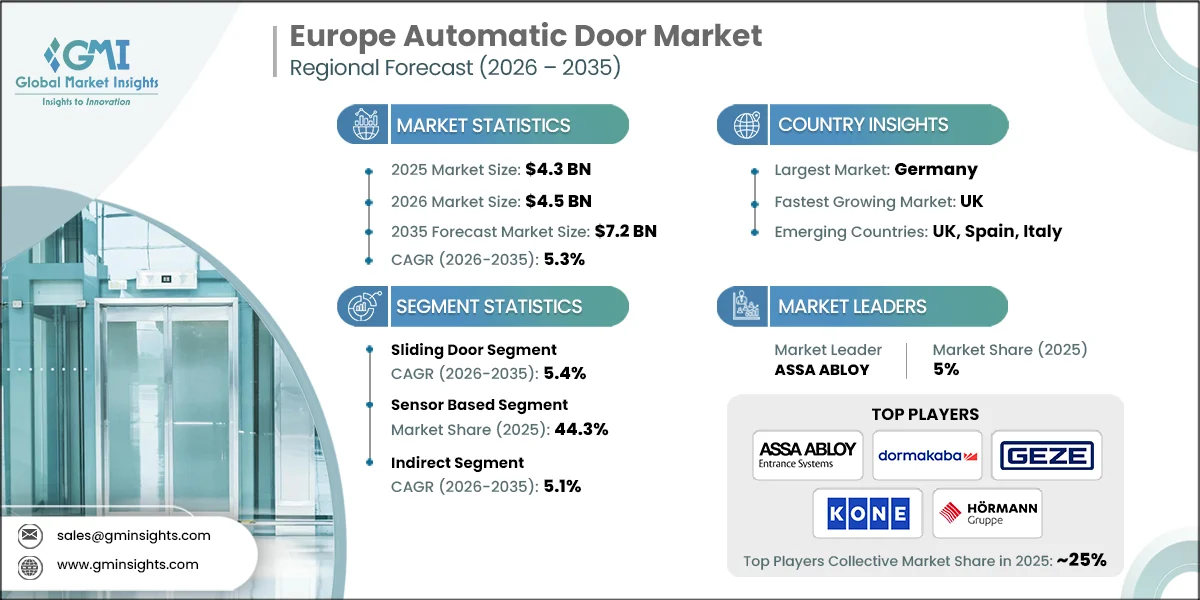
Europe Automatic Door Market Key Takeaways
Market Size & Growth
- 2025 Market Size: USD 4.3 Billion
- 2026 Market Size: USD 4.5 Billion
- 2035 Forecast Market Size: USD 7.2 Billion
- CAGR (2026–2035): 5.3%
Regional Dominance
- Largest Market: Germany
- Fastest Growing Country: UK
Key Market Drivers
- Strict EU safety & accessibility regulations.
- Expansion of commercial infrastructure.
- Rising focus on hygiene and touchless access.
Challenges
- High installation and maintenance costs.
- Complexity of retrofitting historic European buildings.
Opportunity
- Growing demand for smart building integration.
- Rapid growth in healthcare and cleanroom applications.
Key Players
- Market Leader: ASSA ABLOY led with over 5% market share in 2025.
- Leading Players: Top 5 players in this market include ASSA ABLOY, Dormakaba Group, GEZE GmbH, KONE Corporation, Hörmann Group, which collectively held a market share of 25% in 2025.
Get Market Insights & Growth Opportunities
To get key market trends
Europe Automatic Door Market Trends
- Automatic doors will increasingly integrate with IoT platforms, building management systems (BMS), and AI-driven analytics. This allows real-time monitoring of foot traffic, energy optimization, and predictive maintenance. As European commercial buildings move toward full digitalization, automatic doors will function as active nodes within the smart building ecosystem rather than standalone systems.
- With Europe’s strict climate goals and energy directives, demand for thermally insulated, low-energy, and high-performance automatic doors is accelerating. Future products will focus on minimizing heat loss, improving building airtightness, and supporting certifications like BREEAM and LEED. Manufacturers are also moving toward recycled materials and energy-efficient motors to align with EU sustainability policies.
- Sensor technology is evolving from basic motion detection toward AI-powered recognition, enabling doors to respond more intelligently to traffic patterns, mobility-impaired users, and security threats. These next‑gen sensors reduce false triggers, improve safety, and optimize opening/closing cycles to save energy. AI-enabled systems will be especially important in high-traffic spaces like airports and hospitals.
- The push for touchless environments—initially driven by the pandemic—remains a strong long-term trend. Future systems will use gesture control, facial recognition, voice activation, and mobile-based access, especially in offices, healthcare, and hospitality. This shift enhances hygiene, user convenience, and accessibility, making touchless doors a standard rather than a luxury.
- Europe’s healthcare infrastructure upgrades are fueling demand for hermetically sealed, fire-rated, and contamination‑controlled automatic doors. Future innovations will focus on antimicrobial coatings, airtight sealing, and pressure‑control integration. With increasing investment in pharma and biotech cleanrooms, this segment will remain one of the fastest-growing high-value niches.
- As Europe’s commercial and public buildings age, the market is shifting toward retrofit-friendly automatic doors with modular components and wireless controls. Upgrading older buildings to meet EN 16005 safety standards and accessibility requirements will be a major growth driver. Manufacturers are responding with adaptable designs that minimize structural changes and installation time.
Europe Automatic Door Market Analysis
Learn more about the key segments shaping this market
Based on product type, the Europe automatic door market is categorized into sliding door, swinging door, folding door, revolving door, bi-fold doors and others. The sliding door segment accounted for revenue of around USD 1.7 billion in 2025 and is anticipated to grow at a CAGR of 5.4% from 2026 to 2035.
- The sliding door segment is driven by strong demand across commercial, residential, and industrial applications as users increasingly prefer space‑efficient and aesthetically appealing door solutions. Sliding doors offer functional advantages such as smooth operation, improved space utilization, and enhanced accessibility, making them suitable for retail stores, hospitals, offices, and modern homes. The segment is further supported by trends toward minimalist architectural design and energy‑efficient building structures, where sliding systems help reduce air leakage and maintain controlled indoor environments.
- Technological advancements in materials such as tempered glass, aluminum frames, and soft‑closing mechanisms are improving the durability, safety, and user experience of sliding doors. Manufacturers are focusing on advanced noise‑reduction systems, thermal insulation properties, and automation‑ready frames to align with evolving customer expectations. The segment also benefits from increasing renovation and refurbishment activities, particularly in urban areas, creating steady replacement demand.
Learn more about the key segments shaping this market
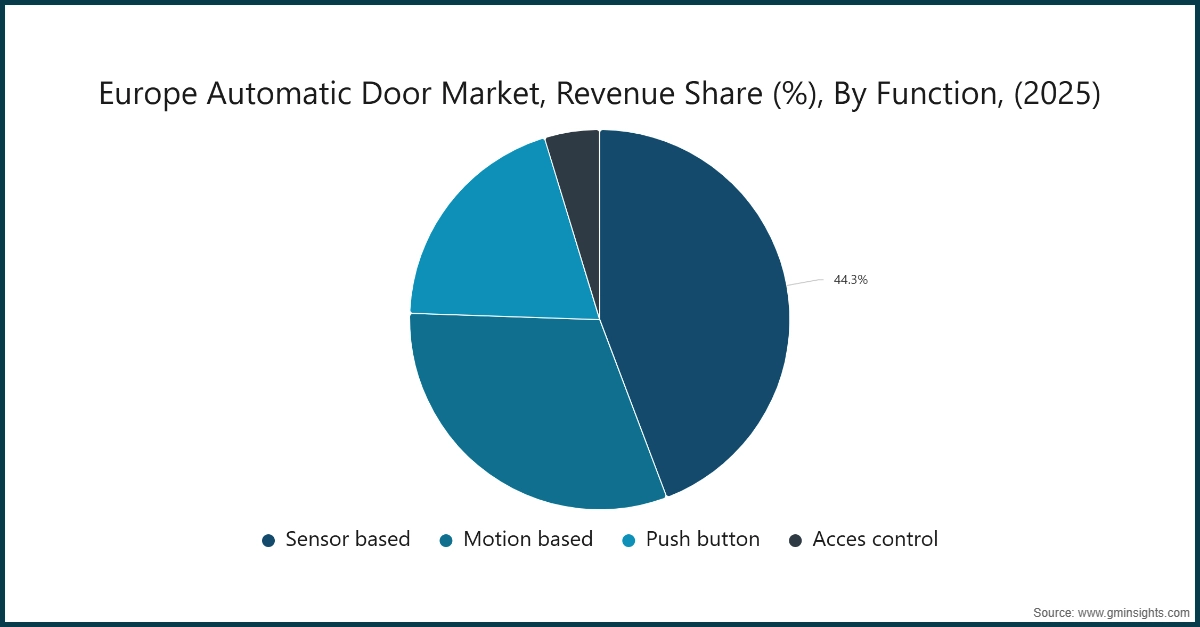
Based on function of Europe automatic door market consists of sensor based, motion based, push button and access control. The sensor based segment emerged as leader and held 44.3% of the total market share in 2025 and is anticipated to grow at a CAGR of 5.2% from 2026 to 2035.
- The sensor‑based door segment is experiencing significant growth as businesses prioritize hygiene, automation, and contactless accessibility. These doors, commonly used in hospitals, airports, retail outlets, and hospitality environments, enhance safety by minimizing physical contact and enabling seamless entry and exit. The rising adoption of smart infrastructure and IoT‑enabled building management systems is further accelerating demand for sensor‑based door solutions, which provide operational efficiency and improved visitor flow management.
- Technological innovation is central to the segment’s expansion, with advancements in motion sensors, infrared sensors, and AI‑enabled detection improving accuracy and responsiveness. Energy‑efficient operation, integration with access control systems, and compatibility with security frameworks add value for high‑traffic facilities.
Based on distribution channel, the Europe automatic door market consists of direct and indirect. The indirect segment emerged as leader and is anticipated to grow at a CAGR of 5.1% from 2026 to 2035.
- The indirect sales segment plays a crucial role in expanding market reach through distributors, dealers, system integrators, and channel partners. This model is particularly valuable in regions where direct manufacturer presence is limited or where customers rely on trusted local partners for installation and maintenance services. Indirect channels help manufacturers scale rapidly by leveraging partner networks, enabling broader coverage across Tier‑2 and Tier‑3 cities, commercial clusters, and emerging markets.
- Indirect sales also create opportunities for bundled solutions, where partners integrate doors with complementary products such as access control systems, security equipment, or building automation technologies. Channel partners provide localized expertise, faster delivery, and after‑sales support, enhancing customer satisfaction and overall market penetration.
Looking for region specific data?
Germany Automatic Door Market
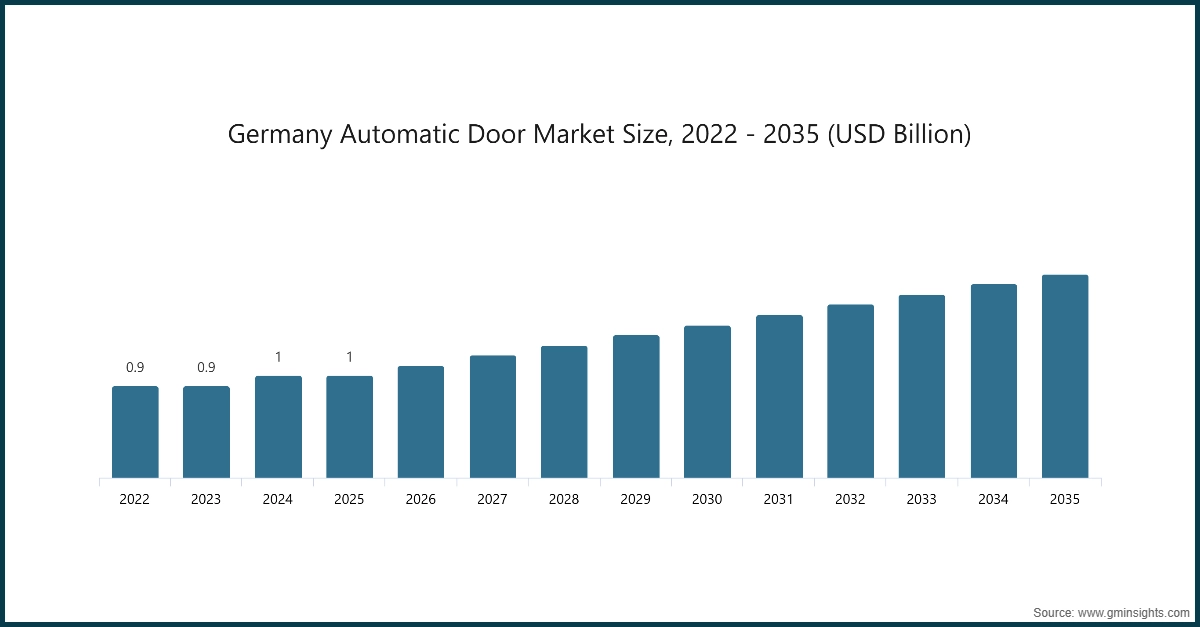
The Germany market is estimated to grow at a CAGR of 5.9% from 2026 to 2035.
- Germany’s automatic sliding door market continues to expand, supported by the widespread adoption of advanced automation technologies across both commercial and residential spaces. Growth in sensor‑based and motorized systems reflects a national shift toward hygienic, contactless access solutions that align with modern building requirements.
UK Automatic Door Market
In the UK market, it is estimated to grow at a CAGR of 5% from 2026 to 2035.
- The United Kingdom’s sliding automatic door industry is evolving rapidly, influenced by the growing incorporation of AI‑based automation, sustainability objectives, and increasingly strict regulatory expectations.
- As organizations across retail, infrastructure, and commercial sectors adopt digital‑first strategies, the demand for smarter, more responsive door systems continues to rise. AI integration enhances predictive maintenance, customization, and energy efficiency, while Industry 4.0 initiatives enable smoother interoperability with IoT platforms and building management systems.
Europe Automatic Door Market Share
- In 2025, the prominent manufacturers in market are collectively held the market share of ~25%.
- ASSA ABLOY holds a strong competitive edge in Europe through its comprehensive and customizable portfolio of automatic sliding, swing, and revolving door systems, offered under a unified brand that integrates decades of expertise and reliable performance. The company emphasizes intelligent building integration, energy‑efficient solutions, and advanced access automation, making its products widely adopted across retail, healthcare, hospitality, transportation, and public infrastructure.
- Dormakaba’s competitive strength lies in its wide‑ranging, design‑focused, and energy‑efficient automatic door systems that combine advanced engineering with high flexibility across sliding, swing, telescopic, and revolving configurations. The company differentiates itself through strong integration capabilities, offering tailored solutions compatible with access control, safety requirements, and modern architectural expectations.
- GEZE’s competitive edge comes from its deep specialization in smart building automation, offering highly innovative door, window, and safety technologies that integrate seamlessly into digitally networked building ecosystems. As a long‑standing, globally recognized family‑run company, GEZE excels in early‑stage project involvement, long‑term customer support, and high‑quality engineering that emphasizes comfort, safety, and design.
Europe Automatic Door Market Companies
Major players operating in the Europe automatic door industry include:
- Allegion
- ASSA ABLOY
- Automatic Systems
- Deutschtec GmbH
- Dormakaba Group
- ERREKA
- FAAC
- GEZE GmbH
- Gilgen Door Systems
- Hörmann Group
- KONE Corporation
- Manusa
- Portalp
- Royal Boon Edam International B.V.
- TORMAX
KONE’s competitive edge in the European automatic door market is rooted in its strong heritage in vertical transportation combined with a full portfolio of advanced automatic sliding, swing, revolving, hermetic, and high‑performance industrial doors. The company focuses on smooth people‑flow management, energy efficiency, safety, and reliability making its solutions highly attractive for hotels, offices, medical facilities, transit hubs, and retail spaces.
Hörmann maintains a competitive advantage through its vertically integrated manufacturing model and exceptionally broad product portfolio, spanning residential, commercial, and industrial doors, operators, and smart‑home‑ready systems all developed and produced in highly specialized facilities using advanced technologies.
Europe Automatic Door Market Report Attributes
| Key Takeaway | Details |
|---|---|
| Market Size & Growth | |
| Base Year | 2025 |
| Market Size in 2025 | USD 4.3 Billion |
| Market Size in 2026 | USD 4.5 Billion |
| Forecast Period 2026-2035 CAGR | 5.3% |
| Market Size in 2035 | USD 7.2 Billion |
| Key Market Trends | |
| Drivers | Impact |
| Strict EU safety & accessibility regulations | EU standards such as EN 16005 and building accessibility laws are pushing commercial buildings, hospitals, and public spaces to upgrade to compliant automatic door systems. This regulatory pressure continues to fuel replacement and retrofit demand. |
| Expansion of commercial infrastructure | Europe’s growth in airports, retail complexes, hotels, and office spaces increases the need for automated entry systems for efficiency and crowd management. Modernization of older buildings also boosts demand. |
| Rising focus on hygiene and touchless access | Post pandemic preferences for contactless entry in healthcare, hospitality, and corporate environments are accelerating adoption. Automatic doors help maintain hygiene standards and streamline foot traffic. |
| Pitfalls & Challenges | Impact |
| High installation and maintenance costs | Advanced sensors, energy efficient materials, and compliance requirements raise total system costs. Smaller businesses and older buildings often delay adoption due to budget constraints |
| Complexity of retrofitting historic European buildings | Many European cities have protected or old architectural structures where installing automatic doors is technically difficult. Structural constraints slow down adoption in heritage zones. |
| Opportunities: | Impact |
| Growing demand for smart building integration | Automatic doors integrated with IoT, access control, and building automation systems offer strong growth potential. Smart offices and energy efficient buildings are key adoption hotspots. |
| Rapid growth in healthcare and cleanroom applications | Europe’s expanding healthcare infrastructure requires hermetic, hygienic, and fire-rated automatic doors. This specialized segment is one of the fastest-growing premium opportunities. |
| Market Leaders (2025) | |
| Market Leader |
5% market share |
| Top Players |
The collective share in 2025 ~25% |
| Competitive Edge |
|
| Regional Insights | |
| Largest Market | Germany |
| Fastest growing market | UK |
| Emerging countries | UK, Spain, Italy |
| Future outlook |
|
What are the growth opportunities in this market?
Europe Automatic Door Industry News
- In 2025, the launch of ASSA ABLOY’s Insight Mobile App has meaningful implications for the automatic‑door market, as it shifts door automation from a purely mechanical operation to a digitally managed, smart‑building asset. By enabling remote monitoring, control, and access management directly through a mobile platform, the app enhances operational efficiency, reduces downtime, and strengthens building security. It allows to make real‑time adjustments, diagnose issues remotely, and optimize door performance without being physically present capabilities that directly increase the value proposition of automatic doors in high‑traffic environments such as hospitals, airports, and commercial complexes.
- In 2025, ASSA ABLOY demonstrated the strongest acquisition activity completing a series of strategic deals that expanded its technological capabilities and geographic footprint. The company acquired Sargent and Greenleaf to reinforce its position in high‑security locking.
The Europe automatic door market research report includes in-depth coverage of the industry, with estimates & forecast in terms of revenue (USD Billion) and volume (Thousand Units) from 2022 to 2035, for the following segments:
Market, By Product type
- Sliding door
- Swinging door
- Folding door
- Revolving door
- Bi-fold doors
- Others
Market, By Material
- Aluminum
- Glass
- Steel
- Wood
- PVC / UPVC
- Composite / Hybrid
Market, By Function
- Sensor based
- Motion based
- Push button
- Access control
Market, By End Use
- Residential
- Commercial
- Industrial
Market, By Distribution channel
- Direct sales
- Indirect sales
The above information is provided for the following countries:
- Europe
- Germany
- UK
- France
- Italy
- Spain
- Rest of Europe
Frequently Asked Question(FAQ) :
What was the market size of the Europe automatic door in 2025?
The market size was USD 4.3 billion in 2025, with a CAGR of 5.3% expected through 2035. Regulatory requirements like EN 16005 and the demand for safety, accessibility, and energy efficiency are driving market growth.
What is the projected value of the Europe automatic door market by 2035?
The market is poised to reach USD 7.2 billion by 2035, driven by advancements in IoT integration, AI-powered sensors, and sustainability-focused designs.
What is the expected size of the Europe automatic door industry in 2026?
The market size is projected to reach USD 4.5 billion in 2026.
How much revenue did the sliding door segment generate in 2025?
The sliding door segment generated approximately USD 1.7 billion in 2025 and is anticipated to grow at a CAGR of 5.4% till 2035.
What was the market share of the sensor-based segment in 2025?
The sensor-based segment held 44.3% of the total market share in 2025 and is set to expand at a CAGR of 5.2% up to 2035.
What is the growth outlook for the indirect sales segment from 2026 to 2035?
The indirect sales segment is projected to observe around 5.1% CAGR through 2035.
Which country is leading the Europe automatic door sector?
Germany leads the market with a expected to witness 5.9% CAGR till 2035.
What are the upcoming trends in the Europe automatic door market?
Key trends include IoT and AI integration, energy-efficient insulated doors, intelligent sensors, touchless access systems, antimicrobial solutions, and retrofit-friendly designs.
Who are the key players in the Europe automatic door industry?
Key players include Allegion, ASSA ABLOY, Automatic Systems, Deutschtec GmbH, Dormakaba Group, ERREKA, FAAC, GEZE GmbH, Gilgen Door Systems, Hörmann Group, and KONE Corporation.
Europe Automatic Door Market Scope
Related Reports