Summary
Table of Content

Environmental Sensors Market
Get a free sample of this report
Form submitted successfully!
Error submitting form. Please try again.
Thank you!
Your inquiry has been received. Our team will reach out to you with the required details via email. To ensure that you don't miss their response, kindly remember to check your spam folder as well!
Request Sectional Data
Thank you!
Your inquiry has been received. Our team will reach out to you with the required details via email. To ensure that you don't miss their response, kindly remember to check your spam folder as well!
Form submitted successfully!
Error submitting form. Please try again.
Environmental Sensors Market Size
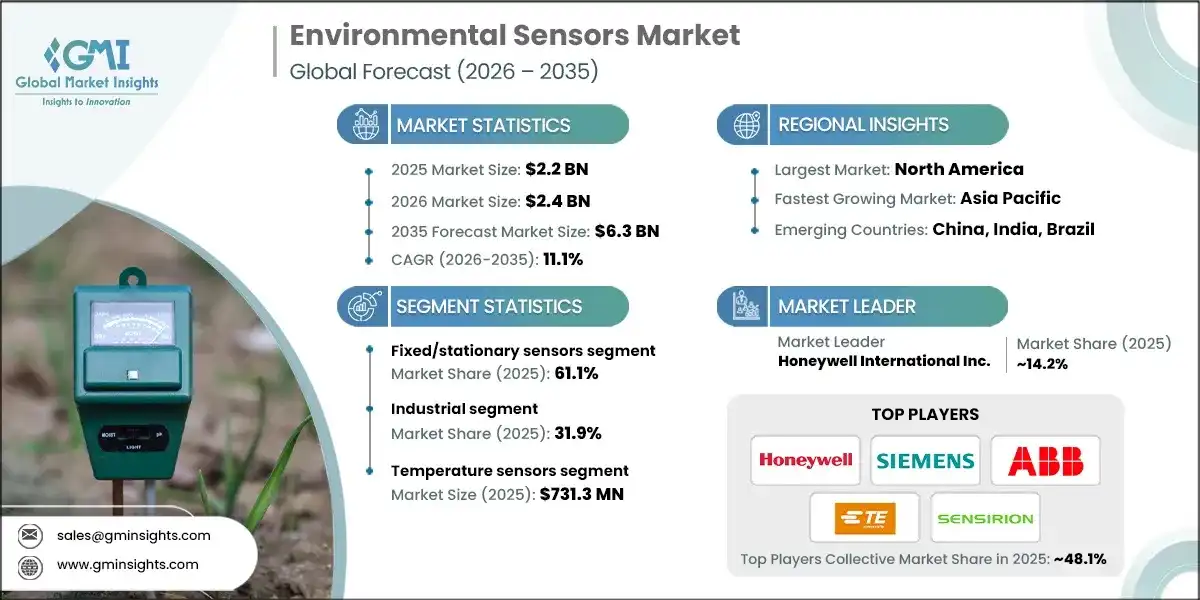
The global environmental sensors market was valued at USD 2.2 billion in 2025. The market is expected to grow from USD 2.4 billion in 2026 to USD 4 billion in 2031 & USD 6.3 billion in 2035, at a CAGR of 11.1% during the forecast period according to the latest report published by Global Market Insights Inc.
Environmental Sensors Market Key Takeaways
Market Size & Growth
- 2025 Market Size: USD 2.2 Billion
- 2026 Market Size: USD 2.4 Billion
- 2035 Forecast Market Size: USD 6.3 Billion
- CAGR (2026–2035): 11.1%
Regional Dominance
- Largest Market: North America
- Fastest Growing Region: Asia Pacific
Key Market Drivers
- Expansion of industrial emissions and safety regulations.
- Growth of connected/wireless industrial sensing platforms.
- Increasing adoption of environmental sensing in agriculture.
- Rising demand for air and water quality compliance monitoring.
- Smart city and IoT infrastructure deployment growth.
Challenges
- High cost of precision and multi-parameter sensing solutions.
- Limited interoperability and calibration complexities.
Opportunity
- Integration of AI-driven predictive analytics in environmental sensing.
- Expansion of portable and wearable sensing devices.
Key Players
- Market Leader: Honeywell International Inc. led with over 14.2% market share in 2025.
- Leading Players: Top 5 players in this market include Honeywell International Inc., Siemens AG, ABB Ltd., TE Connectivity Ltd., Sensirion AG, ~48.1% in 2025, which collectively held a market share of 48.1% in 2025.
Get Market Insights & Growth Opportunities
The growth of the environmental sensors market is attributed to, expansion of industrial emissions and safety regulations, growth of connected/wireless industrial sensing platforms, increasing adoption of environmental sensing in agriculture, and the accelerating deployment of smart city initiatives and IoT-enabled infrastructure.
The environmental sensors market is driven by the adoption of environmental monitoring in agriculture. The increasing awareness about the adoption of sustainable agriculture and precision agriculture is motivating the adoption of advanced sensors for monitoring soil, water, and biological diversity. Moreover, in November 2025, Tesco revealed its large-scale investment of more than USD 2 million in on-farm environment monitoring in the UK food supply chain to improve food security and sustainability. This initiative highlights the rising importance of sensor-driven data for optimizing agricultural productivity and sustainability.
The growth of environmental sensors is driven by the expansion of smart city initiatives and IoT infrastructure deployment. The increasing need for data-driven urban management and real-time monitoring is driving the use of connected sensors in transportation, energy, and public safety systems. The U.S. Department of Transportation's SMART Grants Program, which offers up to USD 500 million over five years to fund projects advancing smart community technologies, including connected vehicles, sensor networks, systems integration, and smart grids, demonstrates the critical role environmental sensors play in enabling intelligent urban infrastructure.
Between 2022 and 2024, the market witnessed considerable growth, increasing from USD 1.6 billion in 2022 to USD 2 billion in 2024.Tighter regulations for environmental protection, greater acceptance of wireless sensing solutions, and a growing concern for sustainability are the main factors driving this market growth. Other factors contributing to market penetration during this phase included the widespread adoption of smart city initiatives, the acceptance of IoT technology, and the use of sensors in environmental and agricultural applications.
To get key market trends
Environmental Sensors Market Trends
- The integration of IoT-enabled sensor networks is driving smart monitoring across industries, cities, and agriculture. Adoption accelerated in 2022, with more smart city projects and connected infrastructure. Based on real-time environmental data collection, predictive analysis, and optimized operations of IoT sensors. Most cities and industrial facilities will be utilizing fully connected sensor networks by 2030 for greater sustainability, safety and efficiency.
- AI-driven predictive analysis is changing environmental monitoring by enabling early detection of pollution, emissions, and system problems. This trend began to pick up speed in 2021 as industries sought to reduce compliance risks and save money. Ongoing improvements in machine learning algorithms and the integration of sensor data will likely make predictive monitoring standard by 2028. This shift will significantly improve decision-making and results in environmental management.
- The use of portable and wearable environmental sensors is increasing, allowing monitoring on the go in agriculture, construction, and industrial settings. Early adoption kicked off around 2020 with precision farming pilots and worker safety programs. By 2030, broad usage is expected as these devices provide real-time, location-specific insights, aiding in regulatory compliance, resource use, and proactive environmental risk management across various sectors.
Environmental Sensors Market Analysis
Learn more about the key segments shaping this market
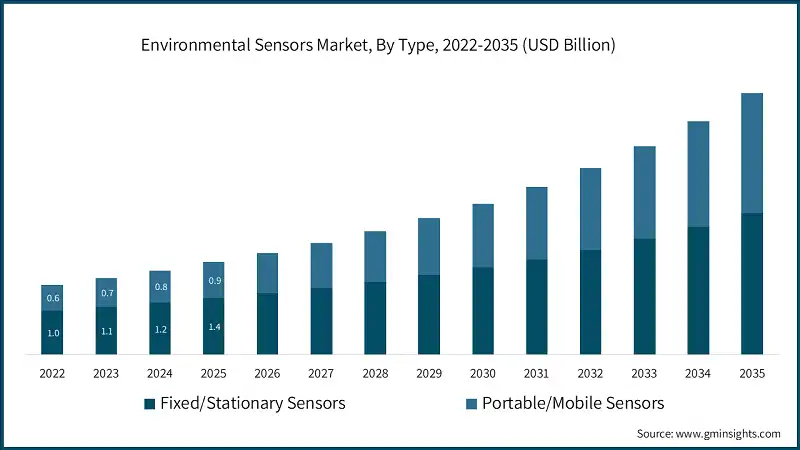
The global market was valued at USD 1.7 billion and USD 1.8 billion in 2022 and 2023, respectively. The market size reached USD 2.2 billion in 2025, growing from USD 2 billion in 2024.
Based on the type, the global environmental sensors industry is divided into fixed/stationary sensors and portable/mobile sensors.
- The fixed/stationary sensors segment accounted for 61.1% of the market in 2025. Fixed and stationary sensors leads the environmental sensors market because it provides continuous and accurate monitoring in industrial plants, water and wastewater facilities, and urban infrastructure. These sensors provide real-time data for purposes of compliance, process control and environmental management. They are essential for extensive application to accomplish reliable, sustainable operations and facilitate automatic tracing system incorporation requirements.
- The portable/mobile sensors segment is anticipated to grow at a CAGR of 12.9% over the forecast period. This growth is driven by the rising need for flexible, on-the-go environmental monitoring in agriculture, construction, and field operations. Their straightforward deployment, ability to collect real-time data, and adaptability for remote or hard-to-reach areas support precision agriculture, emergency response, and meeting regulations. This drives quick adoption among industries looking for cost-effective, scalable, and versatile sensing options.
Learn more about the key segments shaping this market
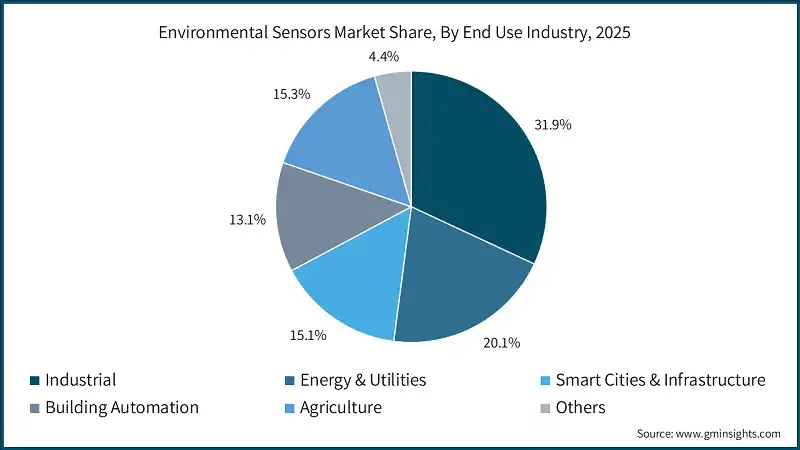
Based on the end use industry, environmental sensors market is classified into industrial, energy & utilities, smart cities & infrastructure, building automation, agriculture, and others.
- The industrial segment led the market in 2025 with a market share of 31.9% as environmental sensors are extensively used across the industry to monitor processes, control emissions, and comply with safety regulations. Industries such as chemical manufacturing, food processing and metals lean heavily on sensors to optimize their operations, keep them compliant with regulations and mitigate risks. This high demand ensures that they remain leaders in the market.
- The building automation segment is expected to witness growth at a CAGR of 12.4% during the forecast period. The growth is driven by the increasing use of smart HVAC, energy efficiency measures, and indoor air quality monitoring systems. Rising urbanization, a focus on sustainable buildings, and the integration with IoT-enabled infrastructure are speeding up deployment. This makes building automation a high-growth area for environmental sensors in the forecast period.
Based on the sensor type, the environmental sensors market is segmented into pressure sensors, temperature sensors, humidity sensors, gas sensors, noise & acoustic sensors, vibration & seismic sensors, and others.
- The temperature sensors segment dominated the market in 2025 and valued at USD 731.3 million owing to their significant applications into industrial processes, HVAC systems and environment monitoring. Their broad application in manufacturing, energy, agriculture and smart infrastructure helps maintain demand. Due to high precision, reliability and compatibility with automatic systems, temperature sensors are the precondition of real-time monitoring and complying with standards.
- The humidity sensors segment is expected to witness growth at a CAGR of 11.9% during the forecast period to increasing use in smart buildings, agriculture, and industries sensitive to climate. The rising demand for managing indoor air quality, precision irrigation, and controlled environments in pharmaceuticals and food processing drives their use. Compact, wireless, and IoT-compatible designs also improve flexibility in deployment, boosting market growth during the forecast period.
Looking for region specific data?
North America Environmental Sensors Market
North America held a market share of 29.8% of market in 2025.
- In North America, the market for environmental sensors is growing because of the increased regulatory focus and concern over emissions, safety in the workplace, and air quality in urban areas. There is a growing cross-industry adoption of wireless as well as IoT-enabled sensors, and in urban planning, the use of smart sensors is growing as well.
- Governments and private companies are investing in advanced monitoring systems that use AI and predictive analytics for real-time decisions. The region is likely to lead in tech adoption, with industrial, agricultural, and municipal uses driving steady growth through 2035.
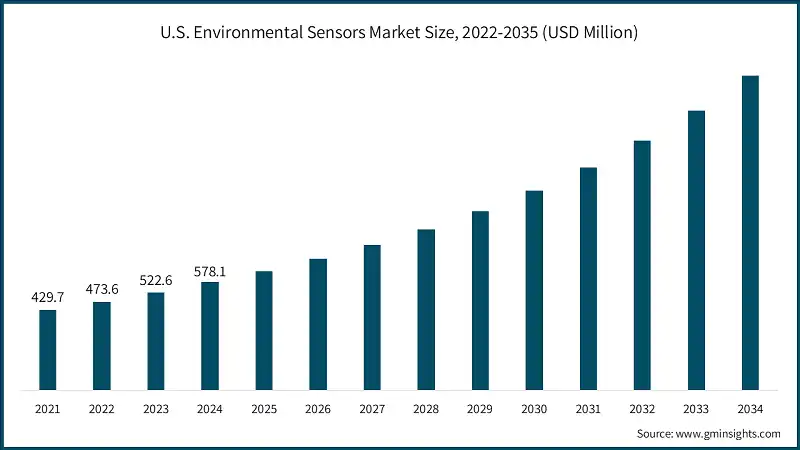
The U.S. environmental sensors market was valued at USD 429.7 million and USD 473.6 million in 2022 and 2023, respectively. The market size reached USD 578 million in 2025, growing from USD 522.6 million in 2024.
- The growth of the market for environmental sensors in the U.S. is particularly strong because of the new agricultural monitoring and the new sustainability programs. The USDA's investment in monitoring and measuring greenhouse gas emissions in sustainable agricultural practices is over 3.1 USD billion, and it is driving growth in this market.
- Along with the new smart city programs and new regulatory requirements, these investments are leading to the increased market adoption of sensors for water and air quality monitoring, and soil and for monitoring precise agriculture practices, making the U.S the Leader in North America.
Europe Environmental Sensors Market
Europe market accounted for USD 617.8 million in 2025 and is anticipated to show lucrative growth over the forecast period.
- Europe’s environmental sensors industry is expanding and growing because of stringent regulations on emissions, actions on climate, and smart city initiatives. There is an increasing use of networked environmental sensing in air, water, and soil sensing in various industries. There is emphasis on sustainable practices, renewable resources, and smart sensing in environment management.
- Countries such as Germany, France, Britain are investing in monitoring infrastructure, predictive analytics, and industrial-compliance solutions. This would guarantee the sustained high adoption of environmental sensing technologies in Europe.
Germany dominates the Europe environmental sensors market, showcasing strong growth potential.
- Germany leads Europe in environmental sensor adoption due to strict emissions standards, industrial automation, and energy efficiency efforts. Industrial sectors, smart infrastructure, and urban air monitoring projects use connected and stationary sensors widely.
- Government incentives and sustainability rules support deployment in manufacturing and municipal applications. The integration of IoT and predictive analytics in environmental management improves real-time monitoring and compliance. Germany’s focus on clean energy, water quality monitoring, and industrial efficiency makes it a major growth market in the European environmental sensors field.
Asia Pacific Environmental Sensors Market
The Asia Pacific market is anticipated to grow at the highest CAGR of 12% during the forecast period.
- The Asia Pacific environmental sensors industry is growing rapidly because of urbanization, industrialization, and enforcement of environmental regulations. Smart city initiatives, industrial safety norms, and agricultural farm mechanization have helped boost the adoption of IoT-based and wireless sensors.
- Increasing concerns related to rising air and water emissions within nations like China, India, and Japan drive the adoption of monitoring solutions. Growing investments by governments and foreign companies, along with the integration of technology, will assist in fueling the growth of this industry during the forecast period.
China environmental sensors market is estimated to grow with a significant CAGR, in the Asia Pacific market.
- China is witnessing strong adoption of environmental sensors due to stringent government regulations on air quality, water pollution, and industrial emissions. Smart city initiatives and IoT infrastructure projects drive demand for connected real-time monitoring sensors.
- Industrialization, urbanization, and agricultural sustainability initiatives open additional market segments. The government’s focus on environmentally optimal practices, such as pollution regulation and abatement, promotes the use of these sensors and makes China the fastest-growing market among the Asia-Pacific countries.
Latin American Environmental Sensors Market
Brazil leads the Latin American market, exhibiting significant growth during the 2026-2035.
- Brazil’s market is expanding, due to rising interest in environmental compliance and agricultural and water quality monitoring. Large agricultural enterprises have been showing interest in the use of environmental sensors for precision agriculture practices.
- Nationwide government regulations with respect to industrial emission and pollution are pushing the use of sensors in urban and industrial areas. Portable and IoT-enabled sensors are also finding much use as remote real-time monitoring systems in distant areas. Upcoming infrastructure and climate change adaptation spending will help increase market growth in the next ten years in Brazil.
Middle East and Africa Environmental Sensors Market
South Africa environmental sensors industry to experience substantial growth in the Middle East and Africa market.
- South Africa is experiencing steady growth in environmental sensors driven by industrial emissions monitoring, water quality management, and urban air pollution control. Mining, agriculture, and energy sectors are key adopters of connected and stationary sensors.
- Government initiatives to improve environmental compliance and sustainability are supporting investments in real-time monitoring technologies. Rising awareness of climate change and the need for efficient resource management is further driving adoption of IoT-enabled and portable sensors across industrial, agricultural, and municipal applications throughout South Africa.
Environmental Sensors Market Share
The environmental sensors industry is led by players such as Honeywell International, Siemens, ABB Ltd., TE Connectivity, and Sensirion AG. These five companies cumulatively accounted for 48.1% market share in 2025. These companies have strong business bases in terms of diversified product offerings, technological capabilities, and geographical operations in the industrial, agricultural, and smart city sectors. Their broad product offerings in air, water, soil, and multi-parameter measurement solutions enable them to dominate the market.
These companies ensure competitive edge with advanced sensing solutions, IoT platform integration, and focus on the regulations for environmental monitoring. Additionally, investments in R&D, AI-based analytics, and multi-parameter sensors also make them stronger to capture substantial market share with the rise in demand for environmental monitoring, especially from various geographies.
Environmental Sensors Market Companies
Prominent players operating in the environmental sensors industry are as mentioned below:
- ABB Ltd.
- Amphenol Advanced Sensors
- ams OSRAM AG
- Analog Devices, Inc.
- Bosch Sensortec GmbH
- Emerson Electric Co.
- Hach Company
- Honeywell International Inc.
- Murata Manufacturing Co., Ltd.
- NXP Semiconductors
- Omron Corporation
- Renesas Electronics Corporation.
- Sensirion AG
- Siemens AG
- STMicroelectronics N.V.
- TE Connectivity Ltd.
- Texas Instruments Incorporated
- Vaisala
- Zebra Technologies
- Honeywell International Inc.
Honeywell provides comprehensive environmental sensing products for industries, commercial, and smart city projects. Honeywell environmental sensing products and solutions encompass gas, temperature, humidity, and multi-parameters.
Siemens offers environmental sensors that are integrated into industrial automation and Smart Infrastructure solutions. By combining IoT connectivity, Predictive Analytics, and Real-time Data Collection, Siemens environmental sensors provide industries with increased operational efficiency, sustainability, and compliance to regulations.
In the sensors segment, ABB provides high precision environmental sensors used in the industry and utility markets. The company’s portfolio for this business includes pressure sensors, temperature sensors, flow sensors, and multi-parameter sensors.
TE Connectivity's rugged sensors are designed specifically for industrial use and are used for measuring temperature, pressure, humidity, and vibration. These IoT-enabled sensors are used in critical applications in energy, transportation, and industry, where their durable, reliable construction and flexible integration options provide unparalleled performance for environmental monitoring.
Sensirion specializes in the MEMS-based development of compact, precise low-power environmental sensors. These sensors are used throughout the IoT ecosystem as well as in many other industrial and agricultural settings for real-time environmental monitoring.
Environmental Sensors Market Report Attributes
| Key Takeaway | Details |
|---|---|
| Market Size & Growth | |
| Base Year | 2025 |
| Market Size in 2025 | USD 2.2 Billion |
| Market Size in 2026 | USD 2.4 Billion |
| Forecast Period 2026-2035 CAGR | 11.1% |
| Market Size in 2035 | USD 6.3 Billion |
| Key Market Trends | |
| Drivers | Impact |
| Expansion of industrial emissions and safety regulations | Drives 22% growth by enforcing stricter monitoring requirements across industries, boosting demand for sensors to track air, water, and soil pollutants in compliance with regulatory standards. |
| Growth of connected/wireless industrial sensing platforms | Supports 20% growth by enabling real-time monitoring, remote data access, and predictive maintenance, increasing adoption of industrial environmental sensors in smart manufacturing and process control. |
| Increasing adoption of environmental sensing in agriculture | Contributes 18% growth as precision farming and sustainable agriculture practices drive the deployment of sensors for soil, water, and biodiversity monitoring, enhancing productivity and regulatory compliance |
| Rising demand for air and water quality compliance monitoring | Adds 17% growth by mandating continuous monitoring in urban and industrial areas to meet environmental safety standards and public health requirements. |
| Smart city and IoT infrastructure deployment growth | Accounts for 23% growth through integration of environmental sensors in urban infrastructure, traffic systems, and smart grids, facilitating data-driven city management and sustainability initiatives. |
| Pitfalls & Challenges | Impact |
| High cost of precision and multi-parameter sensing solutions | Restrains market growth due to significant upfront investment requirements, limiting adoption by smaller enterprises and in cost-sensitive applications. |
| Limited interoperability and calibration complexities | Limits growth as lack of standardized protocols and complex calibration requirements slow deployment and integration across multiple systems and platforms. |
| Opportunities: | Impact |
| Integration of AI-driven predictive analytics in environmental sensing | Presents significant growth potential by enabling real-time data analysis, anomaly detection, and predictive insights, enhancing operational efficiency and regulatory compliance. |
| Expansion of portable and wearable sensing devices | Offers opportunity by facilitating flexible, on-the-go environmental monitoring across industries, agriculture, and smart city applications. |
| Market Leaders (2025) | |
| Market Leaders |
14.2%market share in 2025 |
| Top Players |
|
| Competitive Edge |
|
| Regional Insights | |
| Largest Market | North America |
| Fastest growing market | Asia Pacific |
| Emerging countries | China, India, Brazil, |
| Future outlook |
|
What are the growth opportunities in this market?
Environmental Sensors Industry News
- In October 2025, Sensirion expanded its global distribution network by partnering with Avnet, a major technology solutions distributor, to enhance access to its smart sensor solutions for customers worldwide.
- In August 2025, OMRON introduced a new high precision Weather Sensor aimed at enabling climate smart decisions across agriculture, smart cities, and infrastructure. The device is positioned as a compact, rugged, multi parameter environmental node for localized, real time weather intelligence.
- In August 2024, Renesas launched the RRH62000, an ultra-compact, all in one sensor module aimed at smart indoor air quality monitoring in homes, schools, and public buildings. The device targets applications like purifiers, HVAC, detectors, and building automation systems.
The environmental sensors market research report includes in-depth coverage of the industry with estimates and forecast in terms of revenue (USD Million) and volume (Units) from 2022 – 2035 for the following segments:
Market, By Sensor Type
- Pressure sensors
- Temperature sensors
- Humidity sensors
- Gas sensors
- Noise & acoustic sensors
- Vibration & seismic sensors
- Others
Market, By Type
- Fixed/stationary sensors
- Portable/mobile sensors
Market, By Connectivity
- Wired sensors
- Wireless sensors
Market, By Application
- Air quality monitoring
- Water quality monitoring
- Soil & land monitoring
- Noise & vibration monitoring
- Weather & meteorological monitoring
- Others
Market, By End Use Industry
- Industrial
- Chemical manufacturing
- Food & beverage processing
- Pharmaceutical manufacturing
- Metals & mining
- Pulp & paper
- Oil & gas
- Others
- Energy & utilities
- Power generation
- Water & wastewater treatment
- Renewable energy facilities
- Others
- Smart cities & infrastructure
- Urban air quality networks
- Smart water systems
- Traffic & transportation monitoring
- Others
- Building automation
- Commercial buildings & offices
- Residential buildings
- Hospitals & healthcare facilities
- Data centers
- Others
- Agriculture
- Precision farming
- Greenhouse & controlled agriculture
- Livestock management
- Aquaculture
- Others
The above information is provided for the following regions and countries:
- North America
- U.S.
- Canada
- Europe
- Germany
- UK
- France
- Spain
- Italy
- Netherlands
- Asia Pacific
- China
- India
- Japan
- Australia
- South Korea
- Latin America
- Brazil
- Mexico
- Argentina
- Middle East and Africa
- South Africa
- Saudi Arabia
- UAE
Frequently Asked Question(FAQ) :
What is the environmental sensors market size in 2025?
The global market size for environmental sensors was valued at USD 2.2 billion in 2025. Growing enforcement of industrial emissions regulations, expansion of smart city initiatives, and increasing adoption of IoT-enabled monitoring systems are supporting market growth.
What is the market size of the environmental sensors industry in 2026?
The environmental sensors market reached USD 2.4 billion in 2026, reflecting steady expansion driven by connected sensing platforms and rising demand for air, water, and soil quality monitoring.
What is the projected value of the environmental sensors market by 2035?
The market size for environmental sensors is expected to reach USD 6.3 billion by 2035, growing at a CAGR of 11.1%. Growth is fueled by smart city deployment, AI-driven analytics, industrial compliance needs, and precision agriculture adoption.
How much revenue did the fixed/stationary sensors segment generate in 2025?
The fixed/stationary sensors segment accounted for 61.1% of the market in 2025, making it the dominant type. Continuous real-time monitoring requirements across industrial plants, utilities, and urban infrastructure support its leadership.
What was the valuation of the temperature sensors segment in 2025?
The temperature sensors segment was valued at USD 731.3 million in 2025, driven by extensive use in industrial processes, HVAC systems, agriculture, and smart infrastructure applications.
What is the growth outlook for the portable/mobile sensors segment during the forecast period?
The portable/mobile sensors segment is projected to grow at a CAGR of 12.9% through 2035. Rising demand for flexible, on-the-go monitoring in agriculture, construction, and emergency response is accelerating adoption.
Which region leads the environmental sensors market?
North America led the market with a 29.8% share in 2025, supported by stringent regulatory standards, smart city investments, and widespread adoption of IoT-enabled sensing technologies.
What are the upcoming trends in the environmental sensors industry?
Key trends include integration of IoT-enabled sensor networks, AI-driven predictive analytics, expansion of portable and wearable sensors, and increased deployment across smart cities, agriculture, and industrial compliance monitoring.
Who are the key players in the environmental sensors market?
Key players include Honeywell International Inc., Siemens AG, ABB Ltd., TE Connectivity Ltd., and Sensirion AG. These companies are strengthening their market presence through advanced sensing technologies, IoT integration, and AI-based environmental monitoring solutions.
Environmental Sensors Market Scope
Related Reports