Summary
Table of Content

EMEA Bagging Machines for Mineral Industry Market
Get a free sample of this report
Form submitted successfully!
Error submitting form. Please try again.
Thank you!
Your inquiry has been received. Our team will reach out to you with the required details via email. To ensure that you don't miss their response, kindly remember to check your spam folder as well!
Request Sectional Data
Thank you!
Your inquiry has been received. Our team will reach out to you with the required details via email. To ensure that you don't miss their response, kindly remember to check your spam folder as well!
Form submitted successfully!
Error submitting form. Please try again.
EMEA Bagging Machines for Mineral Industry Market Size
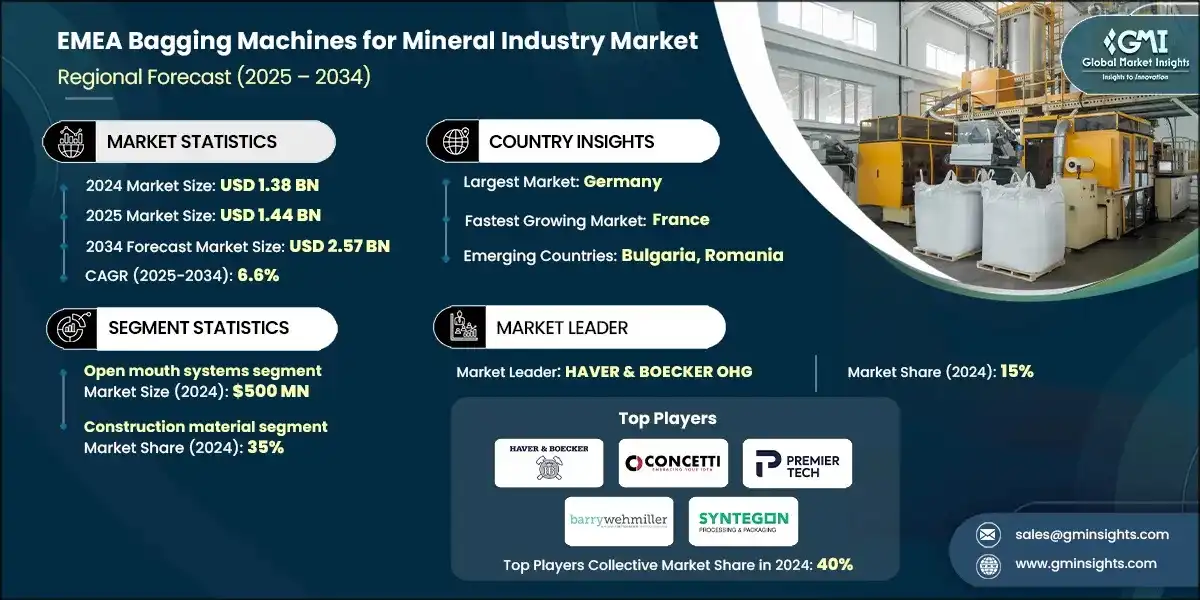
The EMEA bagging machines for mineral industry market was estimated at USD 1.38 billion in 2024. The market is expected to grow from USD 1.44 billion in 2025 to USD 2.57 billion in 2034, at a CAGR of 6.6%, according to latest report published by Global Market Insights Inc.
EMEA Bagging Machines for Mineral Industry Market Key Takeaways
Market Size & Growth
- 2024 Market Size: USD 1.38 billion
- 2025 Market Size: USD 1.44 billion
- 2034 Forecast Market Size: USD 2.57 billion
- CAGR (2025–2034): 6.6%
Key Market Drivers
- Rising Mineral Production Across EMEA.
- Automation and Efficiency in Packaging Operations.
- Stringent Safety and Dust Control Regulations.
Challenges
- High Initial Capital Investment.
- Maintenance and Operational Complexity.
Opportunity
- Integration of Smart Technologies.
- Growth in Sustainable Packaging Solutions.
Key Players
- Market Leader: HAVER & BOECKER OHG led with over 15% market share in 2024.
- Leading Players: Top 5 players in this market include HAVER & BOECKER OHG, Premier Tech Systems, Concetti S.p.A., Barry-Wehmiller, Syntegon Technology, which collectively held a market share of 40% in 2024.
Get Market Insights & Growth Opportunities
The bagging machine market for minerals is gradually transforming in response to the industry's continuous push for more efficiency, safety, and accuracy in the handling of bulk materials. As operations grow and evolve, the mining community is increasingly seeking packaging systems that can provide equivalent production speeds without generating dust waste. Bagging machinery, which was once considered to be relatively simple equipment at the very end of the production line, is now being introduced into operations at the process level.
They offer an easy and efficient packaging solution for the minerals industry, such as cement, lime, and various ores, of consumer bags for future storage, shipments, and resale. A significant trend towards automation has occurred, with newer bagging machines offering sensors and controls to reduce labor and improve consistency. Dependability in an aggressive environment is critical. In the bagging machinery industrial sector, an emerging trend is flexibility; more manufacturers are serving to requests for filling systems that can change with bag size and with bagging high mineral content materials into different bags, such as valve bags and open mouth bags. An emerging trend to environmentally friendly packaging has resulted in increased demand for bagging machinery for recyclable bagging systems and reduced waste. With the growing trend to offer equipment with better dust control in many locations, manufacturers are modifying existing processes.
More generally, the market is not just for machinery. It is about enabling easier logistics and workflows, improving presentation of the product, and ensuring a safer working environment. As mineral producers continue to seek leaner operations and greater production, bagging machines can become a stealthy strategic item instead of merely being a packaging machine. The future is optimistic as we innovate for greater speed, flexibility and sustainability.
To get key market trends
EMEA Bagging Machines for Mineral Industry Market Trends
The market are experiencing change fueled by various regulatory needs, technology, and industry demands.
- Integration of Industry 4.0 Technologies: Internet of Things (IoT), AI, and data analytics, are changing the way bagging operations are conducted. Smart technologies allow for real-time monitoring of bagging systems, predictive maintenance, and optimization of performance. This allows EMEA mineral companies to achieve higher operational efficiency, limit downtime, and improve performance and productivity in their respective operations.
- Improved Dust Control and Safety Features: Fine mineral powders sometimes pose health and safety risk for an operator. Manufacturers are employing advanced dust extraction systems, sealed environments, and safety interlocks in their new machines to protect the worker, reduce emissions from the machinery, and achieve compliance with health and safety standards in the EMEA region.
- Greater Automation and Robotics: Companies in the mineral processing sector in EMEA are implementing fully automated bagging machines and robotic palletizers to fulfill better efficiencies, limit labor, and produce consistently, all while responding to increasing labor costs and greater throughput processed with different products.
- A Focus on Sustainability and Eco-Friendly Packaging: Utility & Environmental Companies are more able to meet stricter environmental regulations, as well as corporate responsibility initiatives. This increases the need to purchase bagging machines that can switch to sustainable packaging materials that are recyclable, reusable, or lower amounts of plastic from their source of bagging material. It concurrently also limits waste along with improving energy efficiency in the packaging process.
- Increasing Demand for Higher Capacity and High Speed: Expanding markets and timelines from the supply chain require bagging machines to operate faster, as well as to continuously bag at higher capacities. Manufacturers are innovating bagging machines to fill bags faster, machines that are now able to continuously bag longer, and bags that are more efficient as well at the output.
EMEA Bagging Machines for Mineral Industry Market Analysis

Learn more about the key segments shaping this market
Based on product type, the market is divided into FFS systems, open mouth systems, valve systems, others. In 2024, open mouth systems held the major market share, generating a revenue of USD 500 million.
- Open-mouth bagging systems are the primary type of bagging systems used in the mineral industry because they are versatile and easy to use. They can manage many styles and capacities of bags, and they work well in environments that are handling different types of minerals or packages. They are particularly helpful when product presentation matters because open-mouth bags can be easily and neatly sealed, and branded, in situations where a more retail or export scenario is present.
- The added benefit of being able to visibly inspect the product before you sewn the top up adds another level of quality assurance. In situations where the minerals don't flow naturally, or levels of accuracy are an issue, controlling the filling and closure more easily with open-mouth bagging systems can be more advantageous. Open-mouth bagging systems are also easier to maintain as the designs are simpler, and they allow for easy changeovers of products without requiring major adjustments, which tends to be valuable in high-change production areas.
- Valve bagging systems are a close second in bagging systems in mineral space, and they are tightly held in high regard as they offer an increased speed for filling and dust control ability. They operate more efficiently than open-mouth systems, especially when filling capacity is not an issue to consider (i.e.) free-flowing products such as cement and fine powders. Because of their valve design, products will fill the bags quickly and automatically seal the process - ultimately minimizing labor and remaining mindful of your exposure to dust in mineral environments. They also tend to be smaller package environments and ultimately allow for more efficiency on the production floor, leading to increased impact overall.
Learn more about the key segments shaping this market
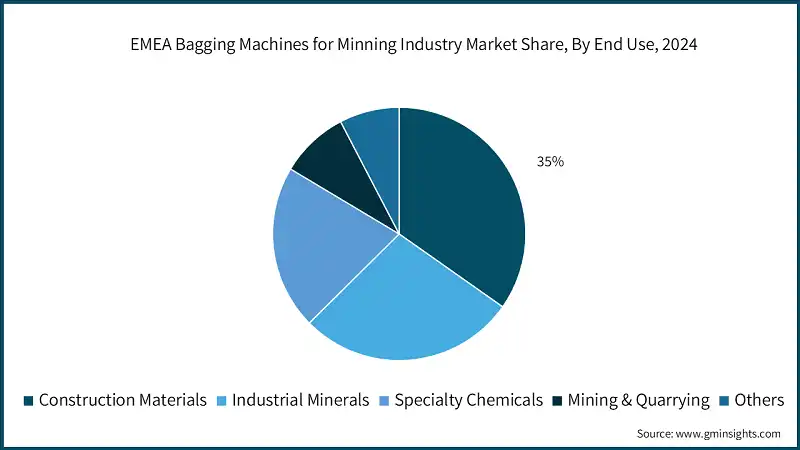
Based on end use, the EMEA bagging machines for mineral industry market are segmented into construction materials, industrial minerals, specialty chemicals, mining & quarrying, and others. The construction material segment held the largest share, accounting for 35% of the global market in 2024.
- The construction materials sector is the largest bagging machine market segment in the mineral industry due to the volume and steady demand for construction products, such as cement, sand, gravel, and lime, which are fundamental for infrastructure and building projects worldwide, typically dependent on high production speed and reliable packaging machinery with built-in automation and durability. Construction materials are packaged in large quantities every day, and they are typically packaged in standardized bags and sizes, allowing manufacturers to optimize their machinery for speed and production efficiency. The simple operational process and constant demand make the construction segment the largest and most dominant market segment of bagging machinery for the mineral industry.
- The industrial minerals segment is a close second and features a strong market outlook due to the various specialized applications and associated growth of industrial minerals in manufacturing and technology. Minerals such as kaolin, talc, barite, and bentonite are used in manufacturing industries, including ceramics, paints, electronics, and pharmaceuticals, and subsequently require a greater emphasis on precision since some industrial minerals require greater handling care due to their fineness or chemical treatment, which adds variability to the bagging system design process. Even though industrial minerals possess a smaller overall volume than construction materials, the price levels or total values of the packaged materials created can sometimes be sold per unit for much higher values than construction materials.
Based on the distribution channel, the EMEA bagging machines for mineral industry market is segmented into direct sales and indirect sales. Indirect sales dominate the market with highest market share.
- Currently, the most widely used method of sales in EMEA for bagging machines for mineral industry is the indirect sales channel. The widespread of indirect sales is largely due to its extensive network of distributors, resellers and retailers giving manufacturers an opportunity to reach a large customer base.
- Where indirect sales channels are best in responding to requirements from small and medium sized enterprises (SMEs) and regional markets, indirect sales channels are also able to provide local support and local availability for sales. Moreover, indirect sales channels often provide additional value-added services to end-users, such as installation plus after sales support, etc.
- Conversely, the direct sales channel is significant in regards of responsibility for large-scale projects and high-value client accounts. Manufacturers utilize direct sales to ensure communication is direct with customers, to factor bespoke/human elements into the sales process, as well as have responsibility for outcome, price, and service.
- Direct sales is beneficial for complex projects requiring integrated/human bagging machines for mineral industry and solutions, whilst at the same time closer working relationships are developed between manufacturers and client/facilities managers rarely seen for other types of sales methods.
- As with other distribution channels and methods of sale, indirect and direct sales channels provide an element of vendor experience to their clients and end-users for the independent sale channel. Both distribution channels are significant and complementary in terms of the level of responsibility for manufacturers and differences in the bagging machines for mineral industry channels in Europe and Middle East and Africa.
- While indirect sales provide market penetration to the full, direct sales are responsible for higher-level, niche, and specialized project/client cases. Together, we both create a distribution channel of balance during responsive product placements, and vendor experiences, to market.
Looking for region specific data?
Europe Bagging Machines for Mineral Industry Market
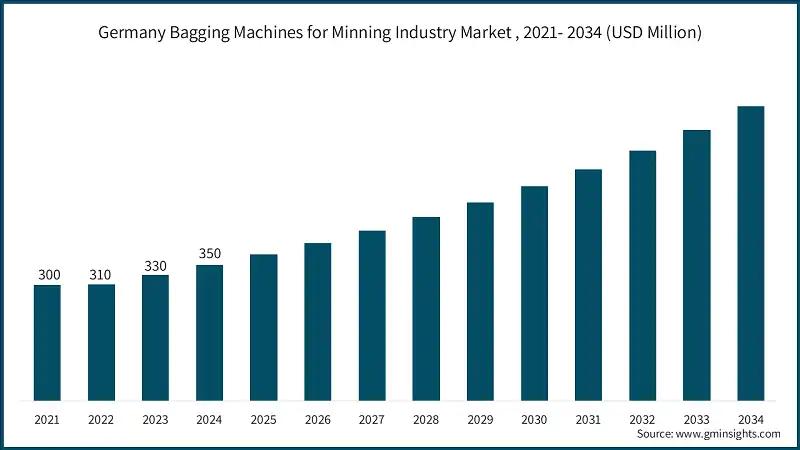
Europe bagging machines for mineral industry market, Germany leads the market 27% share in 2024 and is expected to grow at 6.9% during the forecast period.
- The mineral industry's bagging machine market is mostly in Europe due in part to a robust industrial base, commitment to environmentally sustainable practices, and investment in automation technology.
- For example, Germany, Italy and France have strong & long engineering and machinery manufacturing experience, giving them a competitive advantage in manufacturing advanced systems. The focus on sustainability and worker safety has also increased the need for machines that control dust, recyclable packaging, and energy-efficient machines.
MEA Bagging Machines for Mineral Industry Market
MEA bagging machines for mineral industry market, South Africa leads the market 20% share in 2024 and is expected to grow at 5.6% during the forecast period.
- The Middle East, including regions like Saudi Arabia, South Africa and the UAE, has begun making inroads into the bagging machine market, but due to the relatively new industrial emphasis and infrastructural growth in the region, has not become a central player.
- Many countries are investing heavily in construction and mining, which has driven demand for bagging machines related to specialty cement and other bulk material markets. There continues to be a higher level of equipment imports in the region, but the local manufacturing capability for these machines remains in development.
- The growth is exciting as large project funding continues and diversified growth beyond oil expands, but the lack of established machine expertise and regulatory location means the Middle East has not obtained a position of sustainability leadership seen in Europe.
EMEA Bagging Machines for Mineral Industry Market Share
HAVER & BOECKER OHG. is leading with 15% market share. HAVER & BOECKER OHG, Premier Tech Systems, Concetti S.p.A., Barry-Wehmiller and Syntegon Technology hold around 40%, indicating moderately fragmented market concentration. These prominent players are proactively involved in strategic endeavors, such as mergers & acquisitions, facility expansions & collaborations, to expand their product portfolios, extend their reach to a broad customer base, and strengthen their market position.
- HAVER & BOECKER OHG is a German-based company that specializes in the design and manufacture of bagging and filling machines for bulk materials like minerals. The company's bagging machines are regarded as one of the premier brands in Europe, the Middle East and Africa because of their accuracy and reliability. They have developed a complete automated bagging line for cement, gypsum and other challenging mineral materials.
- Premier Tech is a global organization that specializes in advanced bagging and packaging solutions for many industries. Their bagging systems are automated and utilize advanced technology to provide the most effective and reliable means of managing fine-grained and powdery minerals. Premier Tech is an important supplier of bagging and palletizing solutions for customers in Europe, the Middle East and Africa.
- CONCETTI S.P.A. is a leading manufacturer of automatic bagging and palletizing systems for a variety of products, including minerals. The company's highly innovative and very rapid equipment is designed to provide very accurate weighing and to accommodate bagging of heavy material. As a result of this experience and proficiency, the company is a top competitor in the mineral bagging and palletizing market throughout Europe, the Middle East and Africa.
EMEA Bagging Machines for Mineral Industry Market Companies
Major players operating in the market are:
- HAVER & BOECKER OHG
- Premier Tech Systems
- Concetti S.p.A.
- PAYPER S.P.A.
- Wolf Verpackungsmaschinen GmbH
- STATEC BINDER GmbH
- Premier Tech Chronos
- BW Flexible Systems
- All-Fill International
- Rennco LLC
- Arodo
- Pronova AB
- Rovema GmbH
- Dolzan Impianti
- Matrix Packaging Machinery
Barry-Wehmiller owns and supports a comprehensive range of packaging machinery solutions through its subsidiary, BW Flexible Systems. BW Flexible Systems designs High-Public Delivery equipment for a wide range of industries including the highly regulated and demanding environments of the mineral industry. Having a global footprint and providing adaptable, efficient systems are key factors in BW Flexible Systems' position as one of the largest suppliers to the EMEA region for mineral bagging machines.
Syntegon Technology GmbH is focused on providing process and packaging technology solutions to all industries. Its wide-ranging array of High-Public Bagging Machines are designed to be robust and precise for use within the mineral industry. Syntegon Technology GmbH's continued technological advancements, and their extensive High-Public Delivery Service Network ensure their continued success within the European, Middle Eastern and African Market.
EMEA Bagging Machines for Mineral Industry Market Report Attributes
| Key Takeaway | Details |
|---|---|
| Market Size & Growth | |
| Base Year | 2024 |
| Market Size in 2024 | USD 1.38 billion |
| Market Size in 2025 | USD 1.44 billion |
| Forecast Period 2025 - 2034 CAGR | 6.6% |
| Market Size in 2034 | USD 2.57 billion |
| Key Market Trends | |
| Drivers | Impact |
| Rising Mineral Production Across EMEA | Increasing demand for minerals in construction, automotive, and energy sectors is driving the need for efficient bagging solutions to handle bulk materials. |
| Automation and Efficiency in Packaging Operations | Manufacturers are adopting automated bagging machines to reduce labor costs, improve accuracy, and enhance throughput in mineral packaging processes. |
| Stringent Safety and Dust Control Regulations | Compliance with health and environmental standards is pushing companies to invest in advanced bagging systems that minimize dust emissions and ensure safe handling. |
| Pitfalls & Challenges | Impact |
| High Initial Capital Investment | Advanced bagging machines require significant upfront costs, which can be a barrier for small and medium-sized mineral processors. |
| Maintenance and Operational Complexity | Frequent wear and tear due to abrasive mineral materials increases maintenance requirements, impacting operational efficiency and cost. |
| Opportunities: | Impact |
| Integration of Smart Technologies | Incorporating IoT and AI for predictive maintenance and real-time monitoring offers opportunities for manufacturers to differentiate and add value. |
| Growth in Sustainable Packaging Solutions | Rising focus on eco-friendly materials and energy-efficient machines creates scope for innovation in sustainable bagging systems for the mineral industry. |
| Market Leaders (2024) | |
| Market Leaders |
15% market share |
| Top Players |
Collective market share in 2024 is Consolidate share of 40% |
| Competitive Edge |
|
| Regional Insights | |
| Largest Market | Germany |
| Fastest Growing Market | France |
| Emerging Country | Bulgaria, Romania |
| Future Outlook |
|
What are the growth opportunities in this market?
EMEA Bagging Machines for Mineral Industry Market News
- In March 2025, HAVER & BOECKER announced showcasing new packing, palletizing and digital optimization solutions at bauma 2025 (April 7-13, Hall B2, Munich). This gonna help the company in demonstrating Industry 4.0-integrated sustainable packaging technologies and strengthening its position as a full-line supplier for EMEA mineral and cement sectors
- In November 2024, Premier Tech acquired the technological portfolio, products and brand of IMECO, an Italian weighing and bagging equipment company. This helps the company in expanding its European footprint, strengthening market position across EMEA, and offering enhanced service capabilities through its international aftermarket network.
- In May 2025, HAVER & BOECKER launched intelligent bagging solutions featuring Industry 4.0 connectivity, IoT sensors, remote diagnostics and OEE monitoring for mineral processors. This gonna help the company in enabling predictive maintenance, reducing downtime, improving fill accuracy and meeting EMEA regulatory demands for dust control and traceability across cement and aggregate operation
The EMEA bagging machines for mineral industry market research report includes in-depth coverage of the industry with estimates & forecasts in terms of revenue (USD Billion) and volume (Thousand Units) from 2021 to 2034, for the following segments:
Market, By Product Type
- FFS systems
- Vertical ffs systems
- Horizontal ffs systems
- Pre-made bag ffs systems
- Integrated sealing systems
- Open mouth systems
- Net weighing systems
- Gross weighing systems
- Combination weighing systems
- Manual/semi-auto/fully auto placement
- Valve bagging systems
- Rotary valve systems
- Linear valve systems
- Pneumatic valve systems
- Electronic valve systems
- Others (hybrid system, specialized mineral equipment)
Market, By Automation
- Manual bagging machines
- Semi-automatic bagging machines
- Fully automatic bagging machines
Market, By Capacity
- Low Capacity (less than 300 bags/hr)
- Medium Capacity (300 to 800 bags/hr)
- High Capacity (more than 800 bags/hr)
Market, By Material Handled
- Fine powder
- Granular materials
- Coarse materials
- Mixed materials
Market, By End Use
- Construction materials
- Industrial minerals
- Specialty chemicals
- Mining & quarrying
- Others
Market, By Distribution Channel
- Direct sales
- Indirect sales
The above information is provided for the following regions and countries:
- Europe
- Germany
- UK
- France
- Italy
- Spain
- Russia
- Middle East and Africa
- Saudi Arabia
- UAE
- South Africa
Frequently Asked Question(FAQ) :
What is the market size of the EMEA bagging machines for mineral industry market in 2024?
The market size was USD 1.38 billion in 2024, with a CAGR of 6.6% expected through 2034 driven by automation and efficiency in packaging operations.
What is the current EMEA bagging machines for mineral industry market size in 2025?
The market size is projected to reach USD 1.44 billion in 2025.
What is the projected value of the EMEA bagging machines for mineral industry market by 2034?
The market is expected to reach USD 2.57 billion by 2034, supported by rising mineral production and adoption of advanced automated packaging lines.
How much revenue did the open-mouth systems segment generate in 2024?
Open-mouth bagging systems generated USD 500 million in 2024. Their dominance is supported by versatility, ease of use, and suitability for varied mineral packaging formats.
What was the valuation of the construction materials segment in 2024?
The construction materials segment held 35% market share in 2024. High-volume demand for cement, sand, gravel, and lime drives the need for reliable and automated bagging equipment.
Which region leads the EMEA bagging machines for mineral industry market?
Germany leads the EMEA market with a 27% share in 2024. Growth is driven by strong engineering capabilities, high automation adoption, and stringent sustainability and safety regulations.
What are the upcoming trends in the EMEA bagging machines for mineral industry market?
Key trends include increasing adoption of Industry 4.0-enabled systems, greater demand for high-speed and high-capacity bagging equipment, and rising focus on eco-friendly, dust-controlled packaging technologies.
Who are the key players in the EMEA bagging machines for mineral industry market?
Key players include HAVER & BOECKER OHG, Premier Tech Systems, Concetti S.p.A., Barry-Wehmiller, Syntegon Technology, PAYPER S.P.A., Wolf Verpackungsmaschinen GmbH, STATEC BINDER GmbH, Rovema GmbH, All-Fill International, Rennco LLC, Arodo, Pronova AB, and others.
EMEA Bagging Machines for Mineral Industry Market Scope
Related Reports