Summary
Table of Content

Electronic Chemicals Market
Get a free sample of this report
Form submitted successfully!
Error submitting form. Please try again.
Thank you!
Your inquiry has been received. Our team will reach out to you with the required details via email. To ensure that you don't miss their response, kindly remember to check your spam folder as well!
Request Sectional Data
Thank you!
Your inquiry has been received. Our team will reach out to you with the required details via email. To ensure that you don't miss their response, kindly remember to check your spam folder as well!
Form submitted successfully!
Error submitting form. Please try again.
Electronic Chemicals Market Size
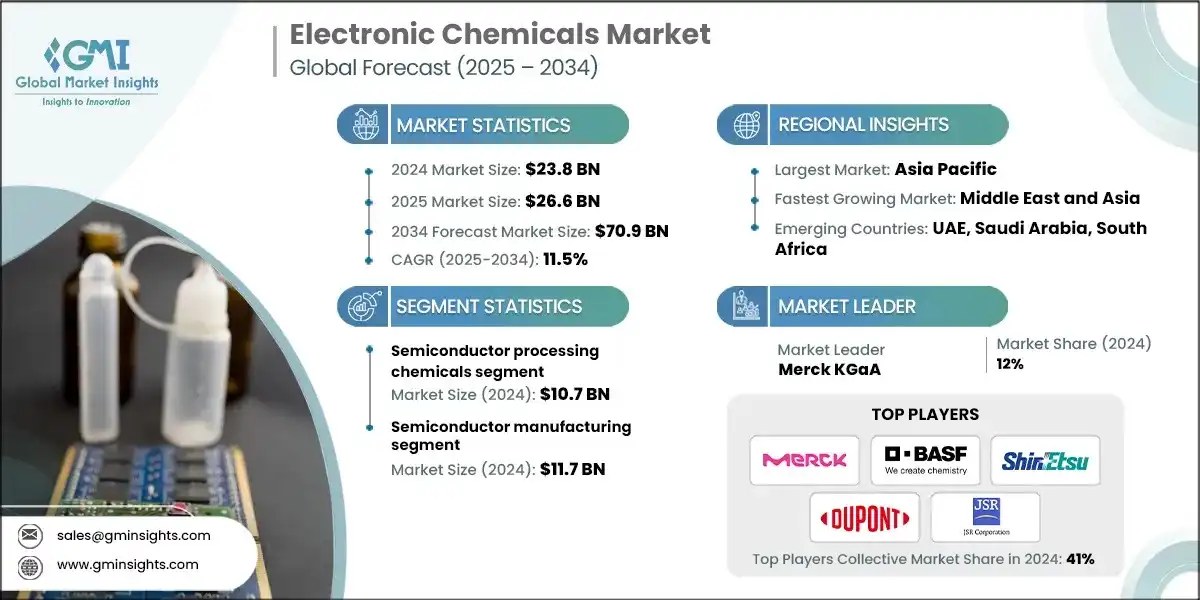
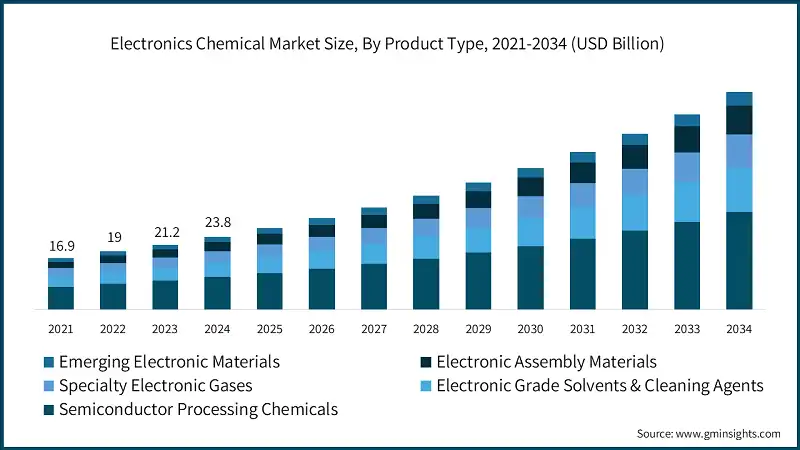
The global electronic chemicals market was valued at USD 23.8 billion in 2024. The market is expected to grow from USD 26.6 Billion in 2025 to 70.9 billion in 2034, at a CAGR of 11.5% according to the latest report published by Global Market Insights Inc.
Electronic Chemicals Market Key Takeaways
Market Size & Growth
- 2024 Market Size: USD 23.8 Billion
- 2025 Market Size: USD 26.6 Billion
- 2034 Forecast Market Size: USD 70.9 Billion
- CAGR (2025–2034): 11.5%
Regional Dominance
- Largest Market: Asia Pacific
- Fastest Growing Region: Middle East and Asia
Key Market Drivers
- Increasing semiconductor fabrication demand.
- Advancements in chip miniaturization.
- Growth of display and photovoltaic manufacturing.
Challenges
- Technological obsolescence risk.
- High dependency on semiconductor and electronics cycles.
Opportunity
- Development of PFAS-free and green chemical alternatives.
- Specialty chemicals for advanced packaging and 3D integration.
- Emerging applications in energy storage and batteries.
Key Players
- Market Leader: Merck KGaA led with over 12% market share in 2024.
- Leading Players: Top 5 players in this market include Merck KGaA, BASF SE, Shin-Etsu Chemical Co. Ltd., DuPont de Nemours Inc., JSR Corporation, which collectively held a market share of 41% in 2024.
Get Market Insights & Growth Opportunities
- Electronic chemicals include specialized chemical products used for manufacturing or assembling electronic devices and semiconductors. Photoresists, etchants, solvents, deposition precursors, and specialty gases constitute electronic chemicals used in almost all the critical processes, such as lithography, etching, cleaning, or packaging. These chemical agents assure precision, reliability, and performance for present-day electronics and support the structure on which semiconductor fabrication and assembly rests.
- The electronic chemicals market is developing along with semiconductor technological advances with chip miniaturization, 3D integration, and flexible electronics. As the semiconductor device geometries shrink down, the components are becoming more complex, so the manufacturers require ultra-pure high-performance chemicals to ensure yield, accuracy, and functionality. This technological shift creates ever-growing requirements for innovative chemical formulations designed for next-generation electronics.
- Sustainability and environmental responsibility are emerging as major factors in the manufacturing of chemicals for electronics. Firms are focusing on PFAS-free, low-toxicity, and recyclable chemicals to comply with regulations and global environmental standards.
- The rapid growth of electric vehicles, energy storage, and renewable technologies is further widening the scope of electronic chemical applications beyond traditional semiconductors and consumer electronics.
To get key market trends
Electronic Chemicals Market Trends
- There are growing demands for specialty chemicals such as photoresists, etchants, and deposition materials for advanced manufacturing in semiconductors. These ultra-pure, high-performance chemicals have begun replacing standard chemicals in semiconductor manufacturing because chip geometry is shrinking and devices are becoming more complicated.
- Eco-friendly products are increasing the demand and thus growing market of electronic chemicals. Manufacturers develop PFAS-free, low toxicity, and recyclable chemicals to meet both regulatory requirements and sustainability goals, indicating a general shift across the industry toward greener manufacturing.
- An increasing adoption of electronic chemicals can be seen in the flexible electronics, OLED and advanced display technologies, and energy storage. With such expansion, it opens new avenues for specialty chemicals in bonding, encapsulation, conductive inks, and coatings to drive innovation across sectors.
- EVs and renewable energy solutions demand has accelerated the market for electronic chemicals. These high-purity chemicals enable the manufacture of lithium-ion, solid-state, and alternative battery technologies involving electrode fabrication, electrolyte formulation, and encapsulation. As battery technologies grow, the need for precision chemical solutions keeps increasing. In this growing trend, energy storage appears to be an emerging application pushing the growth of the market.
Electronic Chemicals Market Analysis
Learn more about the key segments shaping this market
The market by product type is semiconductor processing chemicals, electronic grade solvents & cleaning agents, specialty electronic gases, electronic assembly materials, emerging electronic materials. Semiconductor processing chemicals hold the largest market value of USD 10.7 Billion in 2024.
- The electronic chemicals market is currently undergoing a fast change in all segments of electronic product line, spurred on by technologies and the growing sophistication of electronic devices. Semiconductor processing chemicals are currently witnessing strong momentum because of the increasing complexity of designs for the chips and the continuous miniaturization of the components themselves. Electronic-grade solvents and cleaning agents are also gaining importance with increasing manufacturing precision, ensuring defect-free surfaces and increasing device reliability. Specialty electronic gases are growing to meet the demand for advanced processes in etching, deposition, and doping required in next-generation semiconductor fabrication.
- The electronic assembly materials will continue to expand because of the surged demand for advanced packaging technologies and the increased production of consumer and automotive electronics. New electronic materials that are quickly gaining strength are such as advanced photoresists, conductive polymers and dielectric materials which have shown promise with innovations in flexible electronics IoT devices and small sensors. All these segments reflect higher purity, sustainability, and performance efficiency of the industry in consonance with increasing digitalization and automation held by industries across the globe.
Learn more about the key segments shaping this market
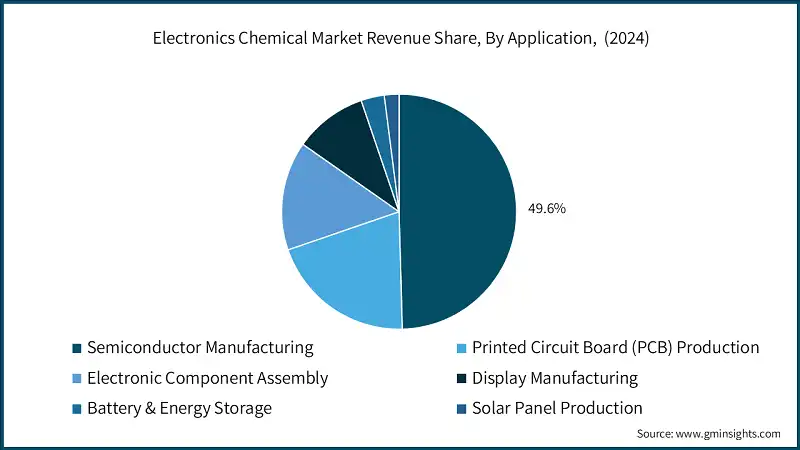
The electronic chemicals market by application is segmented into semiconductor manufacturing, printed circuit board (PCB) production, electronic component assembly, display manufacturing, battery & energy storage and solar panel production. Semiconductor manufacturing holds the largest market value of USD 11.7 billion in 2024.
- The electronic chemicals market by application exhibits varying growth dynamics across a variety of technology-driven sectors. Semiconductor manufacturing leads the market, due to its diverse application modern electronics, and is witnessing growth through the establishment of chip fabrication facilities along with the infusion of AI, 5G, and advanced computing technologies. Demand for printed circuit board (PCB) production remains keys for all electronic devices, with its requirement being stimulated by the surge of smart consumer products and automotive electronics. Electronic component assembly remains a steadily growing area going forward, with miniaturization and automation trends creating demand for more precise assembly materials and chemicals.
- Display manufacturing results in higher growth due to innovations in OLED-, QLED-, and micro-LED-related specialized coatings and etchants. Batteries and energy storage applications gain traction, with the global shift towards electric vehicles and renewable power, forcing the demand for high-performance and safe chemical materials. Lastly, solar panel production is an emerging yet promising area, driven by investments in clean energy infrastructure. All the applications highlighted here convince us that the market is aligned with global trends of digitalization, sustainability, and energy transformation.
Looking for region specific data?
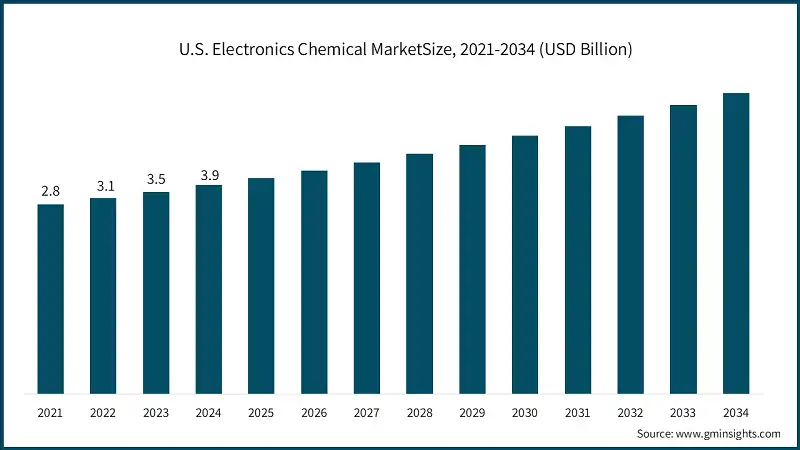
The U.S. electronic chemicals market accounted for USD 3.9 billion in 2024.
- The electronic chemicals industry in North America is strongly supported, particularly with the expansion of semiconductor manufacturing, with investments and initiatives by the government such as the CHIPS and Science Act. Specialty chemicals, solvents, and materials are in demand due to this region's active electronics ecosystem with advanced research and development facilities and high adoption of electric vehicles and renewable energy technologies. The U.S. is at the technological forefront, pushing advances in chip miniaturization, cleanroom manufacturing, and material purity standards. Meanwhile, Canada contributes through its growing renewable energy and battery material industries, helping the overall growth of the market in the region.
The market in the Germany is expected to experience significant and promising growth 10.9% from 2025 to 2034.
- Germany has a stronghold in the electronic chemicals market, it is primarily because of its semiconductor and automotive electronics industries built on advances in manufacturing technologies focused on high-purity, sustainable materials. Demand for specialty chemicals in chip fabrication and circuit production is further boosted by the country's innovation policies along with green technology aspirations. These trends are adopted across Europe, with semiconductor capacity investments, renewable energy technologies, and EU initiatives like Chips Act to enhance regional supply chains. All these trends crystallize Germany and Europe as important growth areas for the market in the next few years.
The electronic chemicals market in China is expected to experience significant and promising growth from 2025 to 2034.
- The Asia Pacific market is booming because of increasing demand from consumer electronics, electric vehicles, and renewable energy. Increased production of smartphones, batteries, and display panels creates high demand in China for advanced materials and precision chemical formulations used in manufacturing processes. The geopolitical push of the country toward smart production and automation and clean energy technology further helps in expanding the markets. Other APAC regions instance of rapid industrialization, infrastructure development, and shifting toward energy-efficient and miniaturized electronic components were the prime movers of demand for high-performance electronic chemicals.
UAE electronic chemicals market is expected to experience significant and promising growth from 2025 to 2034.
- The Middle East and Africa are driven by several development initiatives for electronics assembly investment, renewable energy projects, and diversification into industries. Such programs are available in gulf countries, particularly in the UAE and Saudi Arabia. Government initiatives for local manufacturing and technology development naturally create opportunities for specialty chemical suppliers. In Africa, increased adoption of consumer electronics, telecommunications infrastructure, and solar energy systems is progressively driving the steady demand for high-purity materials and process chemicals. Overall, the MEA region is an emerging but promising market, and future growth is most likely as industrial capabilities expand and develop technological ecosystems.
Brazil electronic chemicals market is expected to experience significant and promising growth from 2025 to 2034.
- The electronic chemicals sector in Brazil and Latin America is showing tremendous growth, due to increasing electronics manufacture, renewable energy projects, and rising investments in automation and digital infrastructure. With Brazil being the largest economy in the region, the demand for chemicals used in consumer electronics, electric vehicles, and solar technologies is increasing, thus leading this growth. Across Latin America, government incentives for enhancing local production and growing adoption of smart devices further complement the market growth prospects, thereby rendering the region an emerging opportunity for global electronic chemical suppliers.
Electronic Chemicals Market Share
Electronic Chemicals markets are moderately consolidated with players like Merck KGaA, BASF SE, Shin-Etsu Chemical Co. Ltd., DuPont de Nemours Inc., JSR Corporation, holding 41% market share and Merck KGaA being the market leader holding the market share of 12% in 2024.
- The leading players in electronic chemicals keep their competitive advantage intact by continuously investing in research and development. Their focus is on developing high-purity, high-performance chemicals for advanced applications other than semiconductor applications, including display panels, electric vehicles, and renewable energy systems.
- Competitive strategies in the electronic chemicals sector with technological advancement is highly influenced by sustainability. Greener production methods are being adopted by companies to increase resource efficiency and reduce waste and carbon footprints. These attributes make the companies highly attractive to electronic manufacturers in need of reliable, high-quality materials for achieving sustainability objectives and levels.
- Stringent environmental and safety regulations give competitive edge to market leaders. Chemical safety, handling and labelling requirements not only increases consumer and client trust but also provide opportunity for smoother entry into the international market. Transparent documentation, traceability, and regulatory alignment assure that the companies align with the demand of high-quality and sustainability-conscious customers.
Electronic Chemicals Market Companies
Major players operating in the electronic chemicals industry are:
- Air Liquide S.A.
- Arkema S.A.
- Avantor Inc.
- BASF SE
- Brewer Science Inc.
- Cabot Microelectronics Corporation
- Chemours Company
- Covestro AG
- Dongjin Semichem Co. Ltd.
- Dow Inc.
- DuPont de Nemours Inc.
- Entegris Inc.
- Evonik Industries AG
- Fujifilm Electronic Materials
- Honeywell International Inc.
- Huntsman Corporation
- JSR Corporation
- KMG Chemicals Inc.
- Linde plc
- Merck KGaA
- Shin-Etsu Chemical Co. Ltd.
- Solvay S.A.
- Sumitomo Chemical Company
- Technic Inc.
- Tokyo Ohka Kogyo Co. Ltd.
- Wacker Chemie AG
Merck KGaA of the United States is a science and technology company dealing with medicine, life sciences, and electronic devices on global scales. The electronics division is an essential supplier, providing production materials, including photoresists, CMP slurries, specialty gases, and deposition materials for the semiconductor and display manufacture processes. Merck has penetrated the market for advanced chip fabrication and future electronics applications by consistent innovations and strategic acquisitions.
BASF SE is largely focused upon electronic materials for semiconductor and display production. The portfolio covers ultra-pure process chemicals, wet chemicals, and advanced materials, all tailored to meet the stringent requirements of the electronics industry. BASF´s wide R&D facilities and its global production network are used to drive innovation in electronic materials and sustainability.
Shin-Etsu Chemical Co. Ltd. It is one of the leading Japanese chemical manufacturers that have strong semiconductor materials. The company offers a wide variety of products such as silicon wafers, photoresists, photomask materials, pellicles, and synthetic quartz. Shin-Etsu is deeply involved in the modification and development of extremely advanced lithography and semiconductor miniaturization technology.
DuPont de Nemours Inc. , is a science-based organization focused on specialty materials for high-performing markets, encompassing electronics. This electronic solutions segment supplies key materials such as photoresists, dielectric materials, CMP pads, and semiconductor packaging materials. Working on the basis of innovation, sustainability, and partnership with leading chip makers, DuPont pushes the frontiers of semiconductor and display manufacturing technologies.
JSR Corporation a Japanese materials group deals in electronic materials and semiconductor solutions. Products offered include photoresists, CMP materials, advanced lithography chemicals, and others. JSR plays a vital role in making continuous R&D and partnerships with global manufacturers in supporting the semiconductor industry in the transition to smaller, more efficient, and powerful devices.
Electronic Chemicals Market Report Attributes
| Key Takeaway | Details |
|---|---|
| Market Size & Growth | |
| Base Year | 2024 |
| Market Size in 2024 | USD 23.8 Billion |
| Market Size in 2025 | USD 26.6 Billion |
| Forecast Period 2025 - 2034 CAGR | 11.5% |
| Market Size in 2034 | USD 70.9 Billion |
| Key Market Trends | |
| Drivers | Impact |
| Increasing semiconductor fabrication demand | The rapid growth of AI, 5G, and IoT applications is fueling semiconductor production, directly boosting demand for high-purity electronic chemicals. |
| Advancements in chip miniaturization | As chip designs become smaller and more advanced, manufacturers increasingly rely on high-purity and specialized chemicals to maintain production efficiency, quality, and performance. |
| Growth of display and photovoltaic manufacturing | OLED, flexible displays, and solar technologies is stimulating the need for advanced coatings, photoresists, and deposition chemicals. |
| Pitfalls & Challenges | Impact |
| Technological obsolescence risk | Rapid innovation in semiconductor and display technologies can render existing chemical formulations outdated, impacting long-term product viability. |
| High dependency on semiconductor and electronics cycles | Demand for electronic chemicals closely follows the semiconductor and electronics industry; slowdowns or overcapacity can sharply reduce sales. |
| Opportunities: | Impact |
| Development of PFAS-free and green chemical alternatives | Sustainability trends create strong potential for eco-friendly, low-toxicity chemicals that comply with evolving global regulations. |
| Specialty chemicals for advanced packaging and 3D integration | The rise of 3D chip packaging and heterogeneous integration drives demand for specialty chemicals used in bonding, planarization, and encapsulation processes. |
| Emerging applications in energy storage and batteries | The EV and renewable energy markets fuel demand for high-purity chemicals used in lithium-ion, solid-state, and alternative battery technologies. |
| Market Leaders (2024) | |
| Market Leaders |
12% |
| Top Players |
Collective market share of 41% in 2024 |
| Competitive Edge |
|
| Regional Insights | |
| Largest Market | Asia Pacific |
| Fastest growing market | Middle East and Asia |
| Emerging country | UAE, Saudi Arabia, South Africa |
| Future outlook |
|
What are the growth opportunities in this market?
Electronic Chemicals Industry News
- In January 2025, Evonik's Silica and Silanes launched Smart Effects, a business line that evolved from strategically merging Evonik's Silica and Silanes units in the Smart Materials division. This merger augments the company´s proficiency in molecular silane chemistry and silica particle design to deliver innovative solutions across electronics, automotive, tires, consumer health, and building protection. Smart Effects is concentrated on sustainable and circular solutions based on high-purity materials for lithium-ion batteries, semiconductors, and green tires, and employs a global asset network and regional technology centres to bolster customer relations and drive innovation across industries.
- In October 2023, FUJIFILM Corporation consolidated its strong position in the global electronic chemicals market by acquiring Entegris' electronic chemicals business, now renamed FUJIFILM Electronic Materials Process Chemicals. This move enhances Fujifilm's technological platform, increases its scope in global manufacturing, and expands its product portfolio in high-purity process chemicals. As such, the acquisition complements the company's strategic focus on innovation, supply chain resilience, and sustainable growth in the manufacture of advanced semiconductor materials.
The electronic chemicals market research report includes an in-depth coverage of the industry with estimates and forecast in terms of revenue in USD Billion and volume in terms of kilo tons from 2021–2034 for the following segments:
Market, By Product Type
- Semiconductor processing chemicals
- Photoresists & photochemicals
- Etchants & cleaning agents
- Chemical mechanical planarization (CMP) Slurries
- Dopants & ion implantation materials
- Deposition precursors & CVD materials
- Electronic grade solvents & cleaning agents
- Ultra-pure solvents
- Flux removers & degreasers
- PFAS-free cleaning solutions
- Specialty electronic gases
- Process gases & carrier gases
- Dopant gases & ion sources
- Etching gases & plasma chemistry
- Electronic assembly materials
- Conductive inks & pastes
- Adhesives & encapsulants
- Thermal interface materials
- Surface treatment chemicals
- Emerging electronic materials
- Flexible electronics chemicals
- 2D materials & quantum dots
- Biocompatible electronic materials
- Sustainable electronic chemistries
Market, By Application
- Semiconductor manufacturing
- Wafer processing & fabrication
- Advanced packaging & 3D integration
- Memory device production
- Logic device manufacturing
- Printed circuit board (PCB) production
- Substrate materials & laminates
- Plating chemicals & surface treatments
- Flexible & rigid-flex PCB materials
- Electronic component assembly
- Surface mount technology (SMT)
- Wire bonding & interconnect materials
- Component packaging & encapsulation
- Display manufacturing
- LCD production chemicals
- OLED materials & processing
- Flexible display technologies
- Battery & energy storage
- Lithium-ion battery chemicals
- Solid-State battery materials
- Alternative battery chemistries
- Solar panel production
- Photovoltaic cell processing
- Encapsulants & protective coatings
- Emerging solar technologies
The above information is provided for the following regions and countries:
- North America
- U.S.
- Canada
- Europe
- Germany
- UK
- France
- Spain
- Italy
- Rest of Europe
- Asia Pacific
- China
- India
- Japan
- Australia
- South Korea
- Rest of Asia Pacific
- Latin America
- Brazil
- Mexico
- Argentina
- Rest of Latin America
- Middle East and Africa
- Saudi Arabia
- South Africa
- UAE
- Rest of Middle East & Africa
Frequently Asked Question(FAQ) :
What is the market size of the electronic chemicals industry in 2024?
The market size was USD 23.8 billion in 2024, with a CAGR of 11.5% expected through 2034 driven by increasing semiconductor fabrication demand and adoption of high-purity materials.
What is the current electronic chemicals market size in 2025?
The market size is projected to reach USD 26.6 billion in 2025.
What is the projected value of the electronic chemicals market by 2034?
The market size for electronic chemicals is expected to reach USD 70.9 billion by 2034, fueled by semiconductor miniaturization, renewable energy expansion, and demand for PFAS-free eco-friendly materials.
How much revenue did the semiconductor processing chemicals segment generate in 2024?
The semiconductor processing chemicals segment generated USD 10.7 billion in 2024.
What was the valuation of the semiconductor manufacturing application in 2024?
The semiconductor manufacturing segment was valued at USD 11.7 billion in 2024.
What is the market size of the U.S. electronic chemicals industry in 2024?
The U.S. electronic chemicals market accounted for USD 3.9 billion in 2024. Growth is supported by semiconductor investments under the CHIPS and Science Act and rising demand for high-purity materials across EV and clean energy sectors.
What are the upcoming trends in the electronic chemicals market?
Key trends include increasing adoption of eco-friendly and recyclable materials, advancements in chip miniaturization and flexible electronics, and the rise of high-purity chemicals for EV batteries and renewable technologies.
Who are the key players in the electronic chemicals industry?
Major players include Merck KGaA, BASF SE, Shin-Etsu Chemical Co. Ltd., DuPont de Nemours Inc., and JSR Corporation, along with Air Liquide, Avantor, Entegris, Honeywell, and Fujifilm Electronic Materials.
Electronic Chemicals Market Scope
Related Reports