Summary
Table of Content

Electric Vehicle (EV) Taxi Market
Get a free sample of this report
Form submitted successfully!
Error submitting form. Please try again.
Thank you!
Your inquiry has been received. Our team will reach out to you with the required details via email. To ensure that you don't miss their response, kindly remember to check your spam folder as well!
Request Sectional Data
Thank you!
Your inquiry has been received. Our team will reach out to you with the required details via email. To ensure that you don't miss their response, kindly remember to check your spam folder as well!
Form submitted successfully!
Error submitting form. Please try again.
Electric Vehicle Taxi Market Size
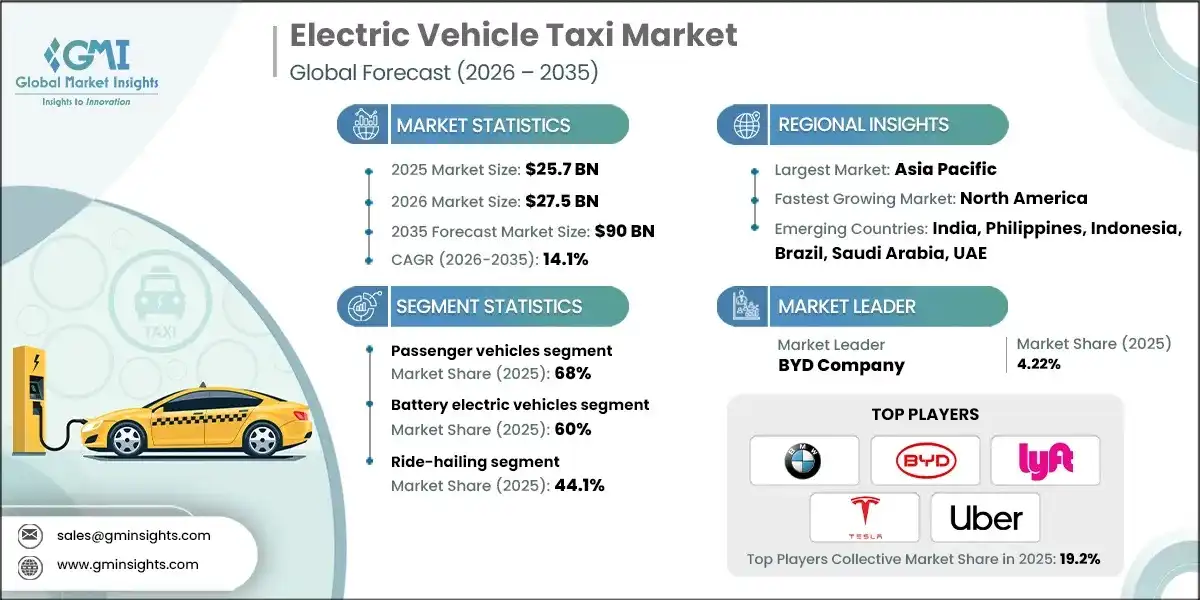
The global electric vehicle taxi market was estimated at USD 25.7 billion in 2025. The market is expected to grow from USD 27.5 billion in 2026 to USD 90 billion in 2035, at a CAGR of 14.1%, according to latest report published by Global Market Insights Inc.
Electric Vehicle (EV) Taxi Market Key Takeaways
Market Size & Growth
- 2025 Market Size: USD 25.7 Billion
- 2026 Market Size: USD 27.5 Billion
- 2035 Forecast Market Size: USD 90 Billion
- CAGR (2026–2035): 14.1%
Key Market Drivers
- Government incentives and stricter emission norms.
- Rising fuel prices of gasoline-powered vehicles.
- Growing awareness about climate change and sustainable transportation.
- Rapid urbanization and smart city initiatives.
Challenges
- High initial costs of electric vehicles.
- Limited charging infrastructure.
Opportunity
- Expansion of charging infrastructure.
- Integration with smart city initiatives.
- Fleet electrification programs by corporations.
- Technological advancements in batteries and EV components.
Key Players
- Leading Players: Top 5 players in this market include BYD Company, BMW, Lyft, Tesla, Uber Electric, which collectively held a market share of 19.2% in 2025.
Get Market Insights & Growth Opportunities
The accelerating transition toward clean mobility, intelligent fleet management, and electrified transportation ecosystems is redefining the EV Taxi market. Modern EV taxi platforms integrate high-density battery systems, smart charging networks, AI-based fleet optimization, and real-time vehicle health monitoring. These capabilities allow operators to minimize operating costs, enhance route efficiency, reduce emissions, and improve passenger safety standards. Governments, urban mobility providers, and ride-hailing platforms are increasingly shifting toward electric taxis to comply with sustainability mandates, reduce fuel dependency, and modernize city mobility grids. This transition eliminates fuel volatility, supports predictive fleet maintenance, and strengthens the overall efficiency of urban transportation networks.
For instance, in October 2025, many European cities expanded their Zero-Emission Taxi Zones, requiring new taxi registrations to be electric, while large-scale mobility operators introduced AI-controlled charging schedules and energy-availability forecasting to reduce downtime and extend vehicle life cycles.
Strategic investments, partnerships, and platform consolidation are shaping the evolution of the EV Taxi landscape. Leading EV manufacturers and mobility-tech companies are developing long-range EV taxi models, integrating solid-state batteries, and setting up ultra-fast charging corridors to support high-mileage taxi operations. Charging network providers, battery suppliers, and digital mapping companies are jointly creating interoperable platforms that enable seamless payments, optimized trip allocation, and energy-efficient routing.
For instance, in September 2024, India officially approved a new incentive scheme for electric vehicles (EVs) with a budget of 109 billion (approximately $1.3 billion). This initiative, named the PM Electric Drive Revolution in Innovative Vehicle Enhancement (PM E-DRIVE), was approved during a Union Cabinet meeting chaired by Prime Minister Narendra Modi.
The strong adoption of EV taxis is driven by rising urban pollution levels, the need for low operating costs, expansion of ride-hailing services, and government subsidies for EV ownership. Electrified taxi fleets offer long-term cost savings through reduced fuel expenses, fewer moving parts, and extended warranty systems. AI-powered mobility platforms can now evaluate driver behavior, optimize idle-to-drive ratios, predict demand hotspots, and manage energy consumption without manual decision-making.
EV taxi solutions are also gaining popularity in airport fleets, intercity mobility, and tourist transport segments. Operators are deploying rugged EV models, telematics units, digital fare meters, and cloud dashboards to ensure predictable operations, lower maintenance costs, and compliance with green mobility regulations. This integrated setup increases fleet uptime, supports cleaner transportation, and strengthens long-term service reliability.
North America and Europe represent high-value EV taxi markets due to strong EV incentives, strict emission regulations, and advanced charging infrastructure. Mature telematics ecosystems, reliability-focused fleet programs, and supportive city mobility policies further accelerate adoption. Key areas of development include solid-state battery taxis, vehicle-to-grid (V2G) integration, and AI-driven predictive charge management.
The Asia-Pacific region shows the highest growth potential, driven by expanding urban populations, aggressive EV policies, falling battery prices, and widespread adoption of affordable EV taxi models. China leads the high-volume deployment of EV taxis across metropolitan regions, while India, Japan, and South Korea adopt long-range EV sedans, compact urban taxis, and multi-purpose EV fleet solutions for ride-hailing, corporate mobility, and shared transport applications.
To get key market trends
Electric Vehicle Taxi Market Trends
The rapid deployment of ultra-fast chargers and commercial battery-swapping stations is reducing EV taxi downtime dramatically. Fleets can recharge or replace depleted batteries within minutes, ensuring continuous service availability. This infrastructure evolution supports higher productivity, longer operating cycles, and smoother fleet rotations, making EV taxis operationally feasible even in high-demand urban corridors.
For instance, in October 2025, Dubai announced rollout of 208 ultra-fast EV charging stations for taxis. This supports the trend and opportunity around “surge in ultra-fast charging infrastructure,” enabling taxi fleets to recharge quickly and maximize utilization.
Purpose-built EV taxis designed with high-capacity batteries, durable drivetrains, and passenger-optimized cabins are becoming mainstream. Automakers and mobility players are investing in dedicated electric taxi platforms to improve up time, reduce charging frequency, and enhance comfort. This trend boosts operational efficiency and ensures EV taxis meet the demanding requirements of continuous urban fleet operations.
AI-powered fleet automation is reshaping EV taxi operations by optimizing dispatching, predicting demand hotspots, and minimizing idle time. Intelligent algorithms support real-time route adjustments, driver assistance, and automated scheduling. These capabilities enhance utilization rates, cut operational costs, and improve responsiveness, making EV taxi fleets significantly more efficient and competitive in urban mobility markets.
Global cities are introducing zero-emission taxi mandates, requiring fleets to transition to EVs within specific urban districts. These policies reduce pollution, support sustainability goals, and accelerate fleet electrification. As regulations tighten, operators are increasingly adopting EV taxis to comply with clean-air requirements and maintain unrestricted access to high-demand urban service zones.
Electric Vehicle Taxi Market Analysis
Learn more about the key segments shaping this market
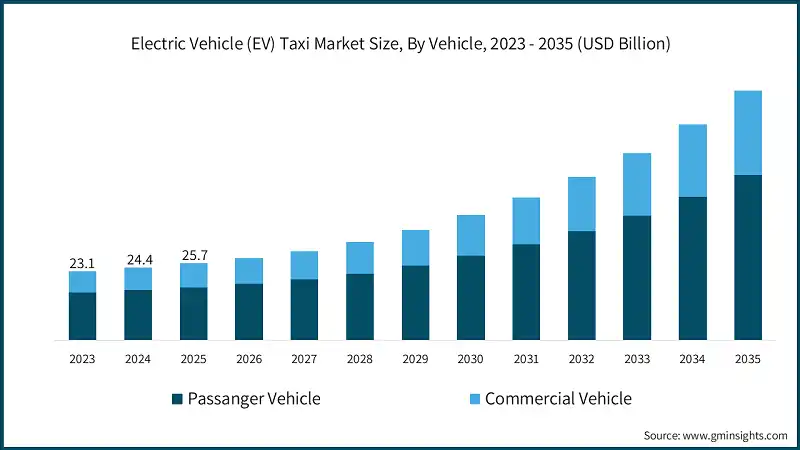
Based on vehicle, the market is divided into passenger vehicles, and commercial vehicles. The passenger vehicles segment dominated around 68% market share in 2025 and is expected to grow at a CAGR of more than 13.6% through 2035.
- The passenger cars segment dominates the electric vehicle taxi industry because most urban taxi fleets primarily use compact and mid-sized cars for efficient city transportation. These vehicles offer lower purchase and operational costs, extended driving ranges suitable for daily taxi routes, and easier maintenance compared to larger vehicles. Their adaptability to EV powertrains allows taxi operators to benefit from government incentives, reduced fuel expenses, and lower emissions.
- Additionally, passenger EVs provide sufficient comfort and space for passengers while supporting rapid deployment of charging infrastructure across urban areas. Leading ride-hailing companies prefer passenger cars for fleet electrification, enabling scalability, operational efficiency, and compliance with urban clean-air initiatives, reinforcing this segment’s dominance in the EV taxi market.
- In November 2025, Uber committed to EV adoption with USD 4,000 rebates for drivers switching to electric vehicles. This incentive helps overcome upfront cost barriers and accelerates EV taxi fleet electrification.
- The commercial vehicle segment will grow at over 15% CAGR through 2035, due to rising demand for electric vans, minibuses, and fleet vehicles in urban mobility and logistics services. Increasing government incentives, lower operational costs, and expanding ride-hailing fleets are accelerating adoption. Advanced EV models with longer range, fast charging, and telematics integration make commercial EV taxis more viable for high-utilization routes. Fleet operators benefit from reduced fuel expenditure, maintenance savings, and compliance with strict emission regulations. The shift toward e-logistics, corporate shuttle services, and airport transit solutions further boosts the market potential for commercial EV taxis globally.
Learn more about the key segments shaping this market
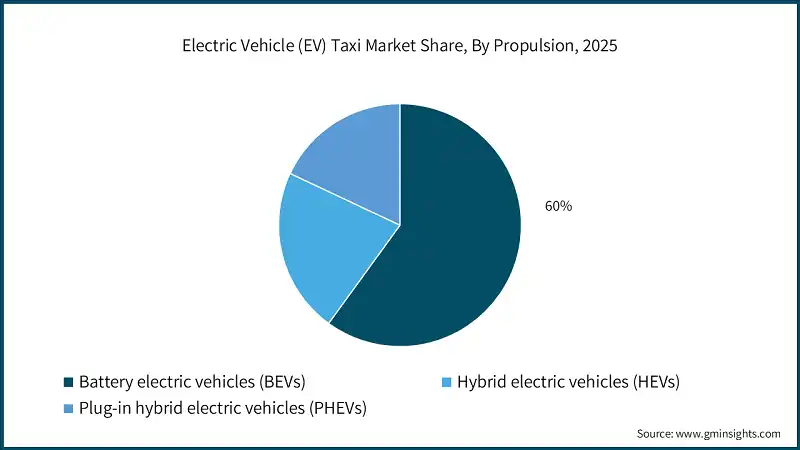
Based on propulsion, the electric vehicle taxi market is segmented into battery electric vehicles (BEVs), Hybrid electric vehicles (HEVs), and Plug-in hybrid electric vehicles (PHEVs). The battery electric vehicles segment dominates the market accounting for around 60% share in 2025 and is expected to grow at a CAGR of over 14.4% from 2026 to 2035.
- The battery electric vehicles (BEVs) segment dominates the electric vehicle (EV) taxi market due to their zero-emission operation, lower running costs, and compatibility with urban sustainability goals. BEVs offer longer ranges, faster charging infrastructure, and enhanced safety features, making them ideal for high-utilization taxi fleets in metropolitan areas. Government policies and subsidies promoting clean mobility further accelerate BEV adoption among taxi operators and fleet managers. Additionally, the growing availability of public and private charging stations ensures operational continuity, reducing downtime and improving fleet efficiency.
- Moreover, BEVs support integration with intelligent fleet management and telematics systems, enabling real-time tracking, predictive maintenance, and optimized route planning. Major EV manufacturers are prioritizing BEV models for ride-hailing and taxi applications, reinforcing the segment’s market leadership and fostering sustainable urban transportation globally.
- In December 2023, BluWave-ai and Dubai Taxi Corporation launched an AI-driven EV fleet optimization solution for a 200-car Tesla taxi fleet underscoring integration of smart telematics, EV fleet management, and optimized charging/usage for EV taxis.
- Hybrid electric vehicles (HEVs) segment will grow at a higher rate of over 15.3% due to increasing fuel efficiency regulations, rising fuel prices, and growing demand for low-emission taxis. HEVs combine internal combustion engines with electric motors, reducing operational costs for fleet operators while offering extended driving range, making them attractive for urban taxi services with high daily mileage.
Based on service, the electric vehicle taxi market is segmented into ride-hailing, cab services, fleet operator services, and robotaxi services. In 2025, ride-hailing segment dominated with around 44.1% share due to lower operational costs, reduced emissions, and government incentives supporting green mobility. Ride-hailing companies are increasingly integrating EVs into their fleets to meet sustainability goals and respond to rising consumer demand for eco-friendly transportation.
- The ride-hailing segment is the most dominant market segment in the electric vehicle (EV) taxi market due to its widespread adoption by urban commuters and the strong push for sustainable transportation. Ride-hailing companies are increasingly integrating EVs into their fleets because of lower operating costs, reduced fuel expenses, and environmental benefits, which align with global efforts to reduce carbon emissions. Furthermore, government incentives, subsidies, and supportive policies for EV adoption encourage ride-hailing platforms to expand their electric fleets, making this segment more attractive than traditional cab or fleet services.
- Moreover, cab services, fleet operator services, and robotaxi services currently hold smaller shares. Cab operators often face high upfront EV costs and limited charging infrastructure, while robotaxis are in early development stages. Despite these challenges, the expansion of charging networks and ongoing technological advancements are expected to gradually boost adoption across all service types, sustaining growth in the overall EV taxi market.
- For example, in March 2025, Uber announced a partnership with Refex Green Mobility to deploy 1,000 electric vehicles (EVs) across major Indian cities (including Chennai, Bengaluru, Hyderabad, Mumbai) by 2026.
- The Robotaxi services segment is expected to grow with a CAGR of more than 15.6% due to advancements in autonomous vehicle (AV) technology and increasing investments from both automotive and tech companies. The rapid development of AI-driven navigation systems, LiDAR sensors, and real-time data analytics enables safer and more efficient operations of robotaxis. Companies are piloting autonomous fleets in urban areas, targeting high-demand zones such as airports, business districts, and city centers. The integration of electric powertrains further aligns with global sustainability goals, making robotaxis cost-effective and eco-friendly alternative to conventional taxi services.
Based on range, the electric vehicle taxi market is divided into short range (<150 km per charge), medium range (150-250 km per charge), and long range (250+ km per charge). The short range (<150 km per charge) segment dominated the electric vehicle etaxi market.
- The short-range segment dominates the electric vehicle taxi market due to its suitability for urban commuting and high-frequency ride-hailing operations. Most EV taxis operate within city limits, where daily distances are relatively low, making short-range EVs more cost-effective and practical. These vehicles have lower upfront costs compared to long-range EVs and benefit from reduced energy consumption, shorter charging times, and easier integration with existing urban charging infrastructure. Taxi operators prefer short-range models as they allow for higher fleet utilization and quicker turnaround between trips, minimizing downtime for charging.
- Furthermore, government incentives and subsidies for low-range electric vehicles in many countries make them financially attractive for fleet operators. As cities expand and charging networks continue to grow, short-range EV taxis remain the preferred choice for operators seeking operational efficiency, lower maintenance costs, and alignment with sustainability goals, maintaining their dominant position in the market.
- The long-range (250+ km) segment is expected to grow at a CAGR of 15.1% due to increasing demand for intercity and high-use taxi operations that require extended driving ranges. Long-range EVs reduce the need for frequent charging, enabling operators to serve longer routes efficiently, including airport transfers, out-of-city rides, and regional commuting. Technological advancements in battery density, fast-charging capabilities, and vehicle energy management systems are making long-range EVs more reliable and cost-effective, thereby encouraging fleet operators to adopt them for high-mileage applications.
Looking for region specific data?
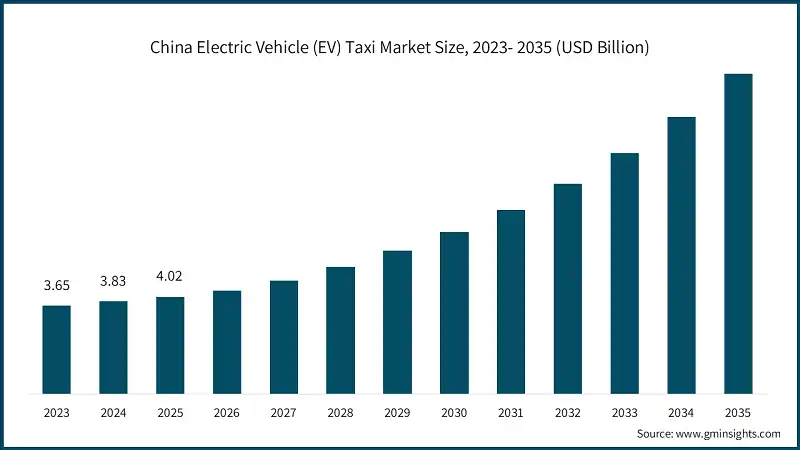
China dominated the electric vehicle taxi market in Asia Pacific with around 37% share and generated USD 4.02 billion revenue in 2025.
- China’s electric vehicle (EV) taxi market is experiencing robust growth due to rapid fleet electrification initiatives, strong governmental policy support, and aggressive emission-reduction targets. Major cities such as Beijing, Shenzhen, Guangzhou, and Shanghai have mandated large-scale replacement of ICE taxis with EV counterparts, accelerating adoption. Subsidies, reduced license fees, and preferential charging rates encourage taxi operators to transition. Additionally, China’s strong domestic EV ecosystem led by BYD, SAIC, and Geely ensures affordable EV models optimized for commercial taxi use, boosting large-volume procurement.
- The expansion of nationwide fast-charging networks and innovative battery-swapping systems is further fueling market expansion. Companies like NIO, CATL, Aulton, and State Grid are deploying high-density infrastructure tailored for high-utilization taxi fleets, reducing downtime and increasing operational efficiency. Ride-hailing giants such as Didi and CaoCao Mobility are electrifying their fleets, creating sustained demand. Strong advancements in telematics, AI-based fleet management, and smart-city integration enable real-time monitoring, improved safety, and lower operating costs positioning China as the global leader in EV taxi innovation and deployment.
- For instance, in August 2024, Shanghai announced a plan to convert all taxis and buses to new-energy vehicles (NEVs) by 2027, including 11,000 cabs and 6,200 buses significantly boosting EV-taxi adoption and infrastructure transformation.
- India is projected to grow at a significant CAGR in the EV taxi market due to strong policy support, rising fuel costs, and the government’s aggressive electrification roadmap. Initiatives such as FAME-II subsidies, reduced GST on EVs, and state-level incentives for fleet electrification are pushing mobility operators toward electric taxis. Expanding charging infrastructure and declining battery prices are further improving operational viability for fleet owners.
The electric vehicle taxi market in Germany is expected to experience significant and promising growth from 2026 to 2035.
- Europe accounts for over 27% of the market share in 2025 and is expected to grow at a CAGR of around 13.5% through 2035, due to strict emission regulations, aggressive decarbonization goals, and widespread EV adoption across major cities. Government mandates such as zero-emission zones, urban clean-air initiatives, and subsidy programs for electric fleets have significantly accelerated EV taxi deployment across the region.
- Germany is a strong electric vehicle taxi market leader due to its robust automotive ecosystem, strict emissions regulations, and strong government incentives supporting fleet electrification. The country has implemented ambitious climate targets, including the reduction of urban emissions and promotion of zero-emission transport. Major cities such as Berlin, Munich, and Hamburg are enforcing clean-air zones, pushing taxi operators to transition from diesel fleets to electric alternatives. Subsidies for EV purchases, reduced operating costs, and tax benefits further accelerate adoption.
- Additionally, Germany’s advanced charging infrastructure, high consumer trust in EV technology, and strong presence of global OEMs such as Volkswagen, BMW, and Mercedes-Benz strengthen its leadership. These companies actively collaborate with ride-hailing platforms and taxi associations to deploy electric fleets, boosting availability and reliability. Continuous innovation in battery efficiency, fast-charging technology, and integrated mobility services positions Germany as a key driver of EV taxi market expansion in Europe.
- For instance, In August 2025, the German government launched a draft master plan to expand nationwide EV charging infrastructure and fast-charging access. Improved charging coverage reduces operational hurdles for taxi fleets and supports EV-taxi expansion.
- The UK is emerging as a strong growth market for electric vehicle (EV) taxis due to supportive regulatory mandates, expanding low-emission zones, and aggressive government electrification targets. Cities such as London, Birmingham, and Manchester are enforcing clean-air policies that compel taxi operators to shift from diesel fleets to electric alternatives. The UK government’s incentives such as plug-in taxi grants, charging-infrastructure subsidies, and exemptions from congestion and ULEZ charges significantly reduce operating costs and improve EV-taxi adoption.
The electric vehicle taxi market in U.S. is expected to experience significant and promising growth from 2026-2035.
- North America accounts for over 20% of the market share in 2025 and is expected to grow at a CAGR of around 15.6% till 2035, owing to strong government incentives, widespread charging infrastructure expansion, large ride-hailing fleets transitioning to EVs, and rising consumer demand for clean, low-emission urban mobility solutions.
- The U.S. is the leader in the electric vehicle taxi market due to a mature ride-hailing ecosystem, early adoption of EVs, and strong government incentives promoting zero-emission vehicles. Federal and state-level programs, including tax credits, rebates, and grants for fleet electrification, encourage operators to replace diesel and gasoline taxis with electric alternatives. Major cities such as New York, Los Angeles, and San Francisco are implementing low-emission zones, congestion reduction programs, and EV-friendly infrastructure, further accelerating adoption.
- Additionally, leading ride-hailing companies like Uber and Lyft are committing to fully electrified fleets by 2030, while OEMs such as Tesla, Ford, and General Motors are supplying EV models tailored for taxi operations. Expanding fast-charging networks, declining battery costs, and growing consumer demand for sustainable urban transportation consolidate the US as the EV taxi market leader.
- Canada is becoming one of the fastest-growing markets in the electric vehicle (EV) taxi sector due to government incentives for fleet electrification, growing urban adoption of EVs, expansion of charging infrastructure, supportive provincial policies, and increasing ride-hailing partnerships prioritizing clean, low-emission taxi services.
The electric vehicle taxi market in Brazil is expected to experience significant and promising growth from 2026-2035.
- Latin America holds around 7% of the market and is growing steadily at a CAGR of around 12.7% till 2035, due to rising urbanization, increasing fuel costs, supportive government policies for sustainable transportation, expanding EV infrastructure, and growing partnerships between ride-hailing companies and local EV manufacturers, promoting electrification of taxi fleets across major cities.
- Brazil dominates the electric vehicle taxi market in Latin America due to its rapidly growing urban population, increasing demand for sustainable transportation, and government incentives promoting electric mobility. Key cities like São Paulo, Rio de Janeiro, and Brasília are introducing low-emission zones, offering tax benefits, and providing subsidies for EV fleet adoption. These measures reduce operating costs and encourage taxi operators to transition from conventional vehicles to electric alternatives.
- Additionally, Brazil benefits from an expanding charging infrastructure network, growing partnerships between ride-hailing companies and EV manufacturers, and rising consumer preference for eco-friendly transportation. Local EV production and assembly initiatives also enhance vehicle availability, making Brazil the leading EV taxi market in the region.
- The electric vehicle taxi market in Mexico is experiencing high growth due to rising urbanization, increasing environmental awareness, government incentives for fleet electrification, expanding EV charging infrastructure, and growing adoption of ride-hailing platforms prioritizing electric taxis, driving sustainable and cost-efficient urban mobility solutions.
The electric vehicle taxi market in UAE is expected to experience significant and promising growth from 2026-2035.
- MEA holds around 4% of the market share in 2025 and is growing steadily at a CAGR of around 11.7%, due to increasing government initiatives for clean mobility, investment in EV charging infrastructure, rising fuel costs, supportive policies for fleet electrification, and expanding urban ride-hailing services adopting electric taxis for sustainable transportation.
- The UAE dominates the MEA electric vehicle taxi market due to strong government initiatives promoting sustainable transportation and the adoption of zero-emission vehicles. National programs such as the Dubai Clean Energy Strategy and Abu Dhabi’s EV incentives encourage fleet operators to transition to electric taxis. Subsidies, tax benefits, and preferential licensing for EV taxis reduce operational costs, making adoption economically attractive for taxi companies.
- Additionally, the UAE has invested heavily in charging infrastructure, including fast-charging networks across major cities, enabling efficient EV operations. Partnerships between ride-hailing platforms, taxi operators, and EV manufacturers further accelerate market growth. Rising environmental awareness among residents and the government’s vision for smart, green cities consolidate the UAE’s leadership in the MEA EV taxi sector.
- Saudi Arabia is expected to grow at the fastest CAGR in the MEA electric vehicle taxi market owing to strong government investment in EV infrastructure, supportive policies for fleet electrification, adoption of clean-energy initiatives, growing urbanization, and partnerships between ride-hailing services and EV manufacturers driving rapid taxi electrification.
Electric Vehicle Taxi Market Share
- The top 7 companies in the electric vehicle taxi industry are Uber Electric, BYD Company, Tesla, BAIC, BMW, Didi Chuxing, and Lyft contributed around 24% of the market in 2025.
- Manufacturers and solution providers in the electric vehicle taxi market are increasingly adopting digital design, connected telematics, and cloud-based monitoring platforms to enhance vehicle security, operational efficiency, and recovery performance. Integration of IoT sensors, GPS tracking, AI-powered analytics, and predictive theft detection algorithms allows real-time monitoring of passenger cars, commercial fleets, and specialty vehicles. These technologies enable rapid detection of unauthorized usage, automated immobilization, route deviation alerts, and improved recovery rates, while also providing data-driven insights for fleet optimization and insurance risk management.
- Strategic collaborations and ecosystem partnerships are reshaping the SVR industry. Alliances between telematics providers, OEMs, insurers, and fleet operators accelerate innovations in high-precision GPS tracking, AI-driven behavioral analytics, and standardized connectivity protocols. These partnerships strengthen global supply chains, enhance service interoperability, and facilitate the integration of SVR into connected-vehicle ecosystems, smart fleet management platforms, and insurance telematics programs, driving the transition toward a fully data-driven, real-time vehicle security network worldwide.
Electric Vehicle Taxi Market Companies
Major players operating in the electric vehicle taxi industry are:
- BAIC
- BMW
- BYD Company
- Didi Chuxing
- EV Capital
- EVERA Auto
- Lyft
- OLA
- Tesla
- Uber Electric
- Uber Electric focuses on electrifying its global ride-hailing fleet through partnerships with automakers, rental providers, and charging companies. It offers driver incentives for EV adoption, expands EV-only ride categories, and collaborates with governments for zero-emission regulations. Uber also invests in charging infrastructure access and long-term sustainability goals targeting 100% electric rides in major cities.
- BYD’s strategy centers on producing affordable, high-range electric sedans, hatchbacks, and MPVs optimized for taxi and ride-hailing fleets. It is partnered with mobile operators worldwide, offers fleet leasing models, and expands battery technology leadership. BYD also invests heavily in blade battery safety, cost efficiency, and overseas manufacturing to scale EV taxi adoption across global emerging markets.
- Tesla supports the EV taxi market by offering long-range, low-maintenance EVs and expanding its global Supercharger network, which is crucial for high-usage taxi fleets. It promotes fleet sales of Model 3 and Model Y, develops autonomous driving capabilities for future robotaxi services, and focuses on reducing battery costs to make EV operation increasingly profitable for mobility providers.
- BAIC Group emphasizes developing cost-effective EVs for large taxi and public mobility fleets, particularly through its Beijing Electric Vehicle (BJEV) subsidiary. Its strategy includes high-volume production, government-backed fleet programs, and focusing on durable batteries suited for continuous urban operation. BAIC collaborates with city authorities and fleet operators across China to deploy standardized EV taxi models at scale.
- BMW promotes premium electric models for high-end taxi and ride-hailing services, focusing on efficiency, safety, and fleet reliability. It expands its i-series EV lineup, offers fleet subscription and leasing programs, and collaborates with mobility providers. BMW invests in battery innovation, digital fleet management solutions, and charging ecosystem partnerships to enhance its presence in the EV mobility sector.
- Didi Chuxing focuses on building one of the world’s largest EV ride-hailing ecosystems through partnerships with automakers and battery-swapping providers. It operates its own EV models via collaborations (e.g., D1), develops intelligent fleet management systems, and expands charging and battery-swap infrastructure. Didi prioritizes cost reduction, driver adoption programs, and eventually integrating autonomous EVs into its platform.
- Lyft’s EV taxi strategy revolves around a transition to 100% electric rides by partnering with automakers, rental fleets, and charging providers. It offers EV rental programs for drivers, promotes low-cost charging access, and incentivizes sustainable ride categories. Lyft invests in data-driven fleet optimization, encourages long-range EV usage, and supports policy advocacy for zero-emission mobility.
Electric Vehicle (EV) Taxi Market Report Attributes
| Key Takeaway | Details |
|---|---|
| Market Size & Growth | |
| Base Year | 2025 |
| Market Size in 2025 | USD 25.7 Billion |
| Market Size in 2026 | USD 27.5 Billion |
| Forecast Period 2026-2035 CAGR | 14.1% |
| Market Size in 2035 | USD 90 Billion |
| Key Market Trends | |
| Drivers | Impact |
| Government incentives and stricter emission norms | Governments worldwide are offering subsidies, tax benefits, and incentives for EV adoption while implementing stringent emission standards. These policies encourage taxi operators to shift from conventional vehicles to electric fleets, reducing pollution and aligning with national sustainability goals. |
| Rising fuel prices of gasoline-powered vehicles | Increasing gasoline and diesel prices raise operational costs for traditional taxis. EVs, powered by electricity, offer a cost-effective alternative with lower per-kilometer energy costs, making them attractive to fleet operators and individual drivers seeking long-term savings. |
| Growing awareness about climate change and sustainable transportation | Rising environmental consciousness among consumers and regulators pushes the demand for eco-friendly mobility. EV taxis contribute to lower greenhouse gas emissions and cleaner urban air, appealing to environmentally responsible passengers and cities aiming for sustainable transit solutions. |
| Rapid urbanization and smart city initiatives | Expanding urban populations increase transportation demand, while smart city projects focus on reducing congestion and emissions. Integrating EV taxis into public mobility frameworks supports efficient, low-emission transit systems and complements infrastructure developments like charging stations and intelligent traffic management. |
| Pitfalls & Challenges | Impact |
| High initial costs of electric vehicles | Electric vehicles typically have higher upfront costs compared to conventional taxis due to expensive batteries and advanced technology. This initial investment can discourage fleet operators and individual taxi owners from adoption, despite lower long-term operational costs, creating a financial barrier to large-scale EV deployment. |
| Limited charging infrastructure | The availability of public and private charging stations is still limited in many cities, restricting EV taxi operations. Insufficient infrastructure leads to range anxiety, longer downtime for charging, and operational inefficiencies, making it challenging for taxi operators to rely exclusively on electric vehicles for continuous, urban transportation services. |
| Opportunities: | Impact |
| Expansion of charging infrastructure | Increasing investments in public and private charging stations, including fast chargers, allow EV taxis to operate more efficiently with minimal downtime. Improved infrastructure reduces range anxiety, supports fleet expansion, and opens new urban areas for operations, creating a significant growth opportunity for taxi operators and EV manufacturers. |
| Integration with smart city initiatives | Smart city projects focusing on intelligent transportation systems offer EV taxis opportunities to integrate with IoT platforms, optimize routes, and improve traffic management. Data-driven mobility solutions enhance operational efficiency, passenger experience, and sustainability, positioning EV taxis as a key component of modern, technology-enabled urban transit networks. |
| Fleet electrification programs by corporations | Corporations and ride-hailing companies are adopting fleet electrification programs to reduce carbon emissions and operational costs. This trend offers EV manufacturers and operators large-scale contracts, encouraging fleet upgrades, boosting sales, and supporting the transition to sustainable urban mobility solutions, particularly in high-density metropolitan areas. |
| Technological advancements in batteries and EV components | Advancements in battery energy density, fast-charging capabilities, and vehicle efficiency extend EV taxi range and reduce operational costs. Enhanced vehicle performance and reliability make EVs more viable for long-distance and urban transportation, creating opportunities for taxi operators to adopt electric fleets with improved profitability. |
| Market Leaders (2025) | |
| Market Leaders |
4.22 % market share |
| Top Players |
Collective market share in 2024 is Collective Market Share in 2025 is 19.2% |
| Competitive Edge |
|
| Regional Insights | |
| Largest Market | Asia Pacific |
| Fastest Growing Market | North America |
| Emerging Country | India, Philippines, Indonesia, Brazil, Saudi Arabia, UAE |
| Future Outlook |
|
What are the growth opportunities in this market?
Electric Vehicle Taxi Market News
- In January 2025, Uber Technologies announced a major expansion of its electric vehicle (EV) incentive program to 25 additional cities worldwide. The company committed USD 150 million in new funding for driver subsidies and charging-access support. The enhanced package includes up to USD 9,000 in direct EV purchase incentives and guaranteed minimum earnings for drivers transitioning to electric models.
- In December 2024, BYD Company commenced operations at its new manufacturing plant in Thailand, with an initial annual capacity of 150,000 vehicles. The facility is designed to serve Southeast Asia's growing taxi and ride-hailing markets and includes production lines for batteries and charging-infrastructure equipment.
- In November 2024, Tesla Inc. secured regulatory approval in California to broaden its autonomous vehicle testing program. The approval allows deployment of a 100-vehicle robotaxi pilot in San Francisco, marking a significant milestone toward commercializing autonomous electric taxi services.
- In October 2024, The European Union finalized updated regulations governing commercial EV operations, establishing standardized charging-infrastructure requirements for taxi fleets. The framework also introduces preferential urban access policies for zero-emission taxis across EU member states, aiming to accelerate fleet electrification.
- In June 2024, ChargePoint Holdings partnered with Uber Technologies to install 1,000 dedicated fast-charging stations for ride-hailing drivers across North America. The partnership includes preferential charging rates for Uber drivers.
The electric vehicle taxi market research report includes in-depth coverage of the industry with estimates & forecasts in terms of revenue ($Bn), and shipment (Units) from 2022 to 2035, for the following segments:
Market, By Vehicle
- Passenger vehicles
- Hatchbacks
- Sedans
- SUV
- Commercial vehicles
- Light commercial vehicles (LCV)
- Medium commercial vehicles (MCV)
- Heavy commercial vehicles (HCV)
Market, By Propulsion
- Battery electric vehicles (BEVs)
- Hybrid electric vehicles (HEVs)
- Plug-in hybrid electric vehicles (PHEVs)
Market, By Service
- Ride-Hailing
- Cab Services
- Fleet Operator Services
- Robotaxi Services
Market, By Ownership Model
- Fleet-Owned
- Individual Driver-Owned
- Subscription
- Cooperative Models
- Others
Market, By Range
- Short Range (<150 km per charge)
- Medium Range (150-250 km per charge)
- Long Range (250+ km per charge)
Market, By Charging Infrastructure
- Fast charging
- Slow charging
- Wireless charging
The above information is provided for the following regions and countries:
- North America
- US
- Canada
- Europe
- Germany
- UK
- France
- Italy
- Spain
- Russia
- Asia Pacific
- China
- India
- Japan
- Australia
- South Korea
- Philippines
- Indonesia
- Latin America
- Brazil
- Mexico
- Argentina
- MEA
- South Africa
- Saudi Arabia
- UAE
Frequently Asked Question(FAQ) :
What was the market size of the electric vehicle taxi market in 2025?
The market size was USD 25.7 billion in 2025, with a CAGR of 14.1% expected through 2035, driven by the shift toward clean mobility, intelligent fleet management, and electrified transport ecosystems.
What is the projected value of the electric vehicle taxi market by 2035?
The electric vehicle taxi market is expected to reach USD 90 billion by 2035, supported by advancements in battery technology, AI-based fleet optimization, and sustainability mandates.
What is the expected market size of the electric vehicle taxi market in 2026?
The market size is projected to reach USD 27.5 billion in 2026.
What was the market share of the passenger vehicles segment in 2025?
The passenger vehicles segment held a 68% market share in 2025, dominating the electric vehicle taxi market.
What is the growth outlook for the BEVs segment from 2026 to 2035?
The BEVs segment is projected to grow at a CAGR of over 14.4% during the forecast period, supported by government incentives and expanding charging infrastructure.
Which region led the electric vehicle taxi market in 2025?
China dominated about 37% the Asia Pacific electric vehicle taxi market share with generating USD 4.02 billion revenue in 2025.
What are the key trends shaping the electric vehicle taxi market?
Key trends include the adoption of AI-driven fleet optimization, expansion of zero-emission taxi zones, and integration of smart charging networks to enhance operational efficiency.
Who are the major players in the electric vehicle taxi market?
Key players include BAIC, BMW, BYD Company, Didi Chuxing, EV Capital, EVERA Auto, Lyft, OLA, Tesla, and Uber Electric.
Electric Vehicle (EV) Taxi Market Scope
Related Reports