Summary
Table of Content

Electric Vehicle Charging Load Management System Market
Get a free sample of this report
Form submitted successfully!
Error submitting form. Please try again.
Thank you!
Your inquiry has been received. Our team will reach out to you with the required details via email. To ensure that you don't miss their response, kindly remember to check your spam folder as well!
Request Sectional Data
Thank you!
Your inquiry has been received. Our team will reach out to you with the required details via email. To ensure that you don't miss their response, kindly remember to check your spam folder as well!
Form submitted successfully!
Error submitting form. Please try again.
Electric Vehicle Charging Load Management System Market Size
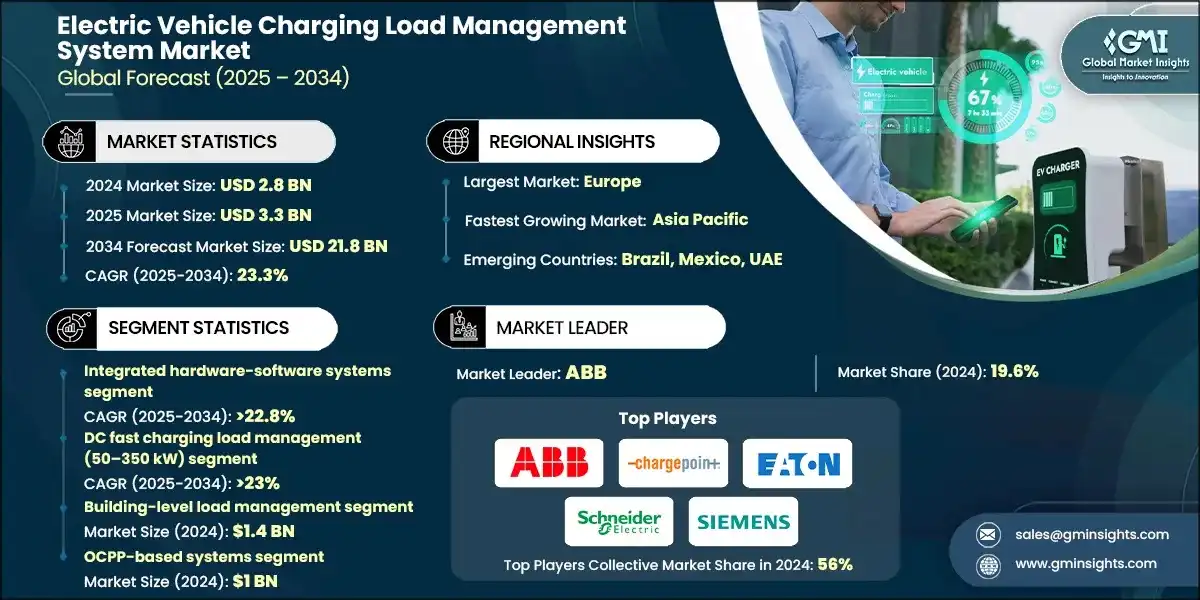
The global electric vehicle charging load management system market size was valued at USD 2.8 billion in 2024. The market is expected to grow from USD 3.3 billion in 2025 to USD 21.8 billion in 2034, at a CAGR of 23.3%, according to latest report published by Global Market Insights Inc.
Electric Vehicle Charging Load Management System Market Key Takeaways
Market Size & Growth
- 2024 Market Size: USD 2.8 Billion
- 2025 Market Size: USD 3.3 Billion
- 2034 Forecast Market Size: USD 21.8 Billion
- CAGR (2025–2034): 23.3%
Key Market Drivers
- Rising EV Adoption & Fleet Expansion.
- Advanced Charging Infrastructure.
- IoT & AI Integration.
- Grid Reliability & Energy Efficiency.
Opportunity
- Predictive & Remote Management Services.
- Sustainability & Circular Economy Initiatives.
Key Players
- Market Leader: ABB led with over 19.6% market share in 2024.
- Leading Players: Top 5 players in this market include ABB, ChargePoint Holdings, Eaton Corporation, Schneider Electric SE, Siemens AG, which collectively held a market share of 56% in 2024.
Get Market Insights & Growth Opportunities
The electric vehicle charging load management system market is projected to witness significant growth over the coming years, driven by the rapid adoption of electric vehicles, expanding EV fleets, and the increasing need for intelligent energy management solutions. As EV charging infrastructure, grid connectivity, and energy storage systems become more advanced, stakeholders are prioritizing operational efficiency, smart grid integration, and optimized load distribution to ensure reliable, scalable, and cost-effective charging networks. The market is transitioning toward data-driven, connected, and automated charging operations, redefining traditional energy management approaches.
The growing integration of IoT-enabled charging stations, AI-driven load balancing algorithms, and cloud-based energy management platforms is reshaping the EV charging landscape. These technologies enable real-time monitoring of grid demand, predictive load scheduling, and seamless coordination between utilities, charging network operators, and fleet managers. By leveraging smart meters, telematics, and AI-powered analytics, providers can enhance energy efficiency, reduce peak load stress, and optimize operational costs, supporting the evolution toward intelligent and resilient EV charging ecosystems.
Digital transformation in the EV charging domain is further accelerated by the deployment of automated demand-response systems, vehicle-to-grid (V2G) integration, and digital twin models for charging infrastructure and grid components. These solutions enhance precision in load forecasting, streamline energy distribution, and enable simulation-based planning for future network expansion. Integration between energy management platforms, utility ERP systems, and cloud-based monitoring tools also strengthens grid coordination, regulatory compliance, and sustainability tracking within the charging ecosystem.
For example, in 2024, leading companies including Siemens, Schneider Electric, and ABB expanded their charging load management solutions to incorporate AI-based predictive algorithms, dynamic pricing integration, and real-time energy optimization features. Similarly, utility-backed charging networks such as Enel X and EVgo are investing in smart load balancing, grid-responsive charging, and V2G-enabled infrastructure to ensure reliable and scalable charging services. These developments underscore the growing emphasis on connected, technology-driven solutions across the global EV charging ecosystem.
The market continues to advance technologically, driven by the convergence of AI, IoT, cloud analytics, and high-voltage system safety standards. Providers are increasingly focusing on interoperable, scalable platforms that integrate real-time monitoring, predictive load management, and sustainability-driven energy optimization. These innovations are redefining the EV charging load management system market, enabling faster, safer, and more efficient energy distribution while supporting the global transition toward smart mobility, carbon-neutral transportation, and sustainable energy ecosystems.
To get key market trends
Electric Vehicle Charging Load Management System Market Trends
The demand for advanced electric vehicle (EV) charging load management solutions is rapidly increasing, driven by growing collaboration among utilities, charging network operators, technology providers, and EV OEMs to enhance grid reliability, energy efficiency, and sustainability. These partnerships focus on developing scalable, data-driven, and interoperable energy management ecosystems integrating AI-powered load optimization, IoT-enabled real-time monitoring, predictive energy scheduling, and cloud-based management platforms. The shared goal is to minimize grid stress, optimize energy distribution, and ensure compliance with evolving smart grid and EV charging standards.
In 2024, ABB and Siemens initiated a joint program to advance AI-driven load balancing and predictive energy management for EV fleets, improving grid stability, dynamic demand response, and charger utilization efficiency. Similarly, Schneider Electric and ChargePoint are collaborating to deploy region-specific smart charging networks across North America and Europe, focusing on real-time monitoring, telematics-based scheduling, and renewable energy integration. These initiatives underscore a shift toward intelligent, connected charging frameworks that combine automation, real-time analytics, and sustainable energy management.
Regional localization of EV charging services is also becoming a key trend. Utilities and network operators, including Eaton and Siemens, are establishing region-specific energy hubs to meet local grid requirements, renewable energy targets, and regulatory standards. These centers integrate local data infrastructure and cloud platforms to deliver faster response times, improved load balancing, and seamless coordination with smart meters and grid operators. Such initiatives strengthen regional energy resilience while supporting ESG and sustainability objectives.
The entry of emerging technology startups offering modular, AI-based charging optimization and predictive energy management solutions is reshaping the competitive landscape. Companies specializing in V2G integration, high-voltage system monitoring, and cloud-based load scheduling are introducing flexible and cost-effective tools. These innovations enable utilities, fleet operators, and charging networks to enhance energy efficiency, reduce peak load stress, and improve user experience.
The development of standardized, interoperable, and modular load management platforms is revolutionizing the EV charging ecosystem. Leading players such as ABB, Schneider Electric, and ChargePoint are deploying cloud-integrated platforms that support multiple EV models, charger types, and grid configurations. These solutions enhance operational transparency, enable real-time energy tracking, and ensure compatibility across networks. The growing adoption of modular architectures is reducing energy management costs, improving grid stability, and fostering a future-ready, connected EV charging landscape.
Electric Vehicle Charging Load Management System Market Analysis
Learn more about the key segments shaping this market
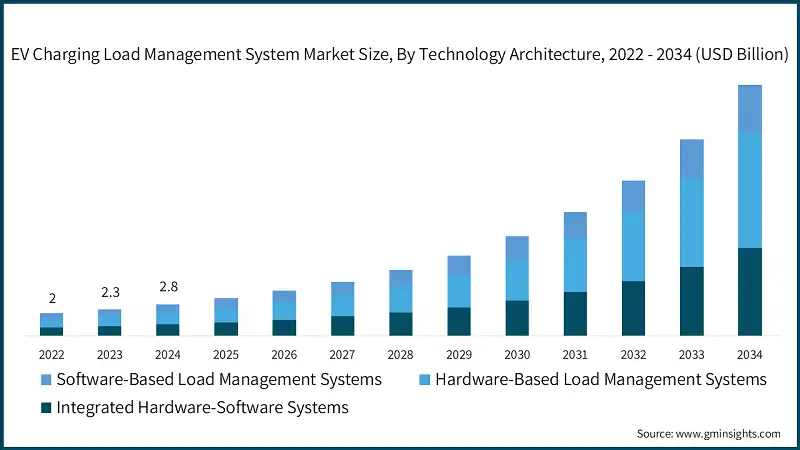
Based on technology architecture, the electric vehicle charging load management system market is divided into integrated hardware-software systems, hardware-based load management systems and software-based load management systems. The integrated hardware-software systems segment dominated the market accounting for around 37% share in 2024 and is expected to grow at a CAGR of over 22.8% from 2025 to 2034.
- The integrated hardware-software systems segment plays a crucial role in ensuring optimal EV charging performance, grid stability, and energy efficiency. This segment combines smart chargers, energy storage interfaces, dynamic load controllers, and communication modules into a unified platform. The increasing complexity of EV charging infrastructure and high-voltage loads has driven demand for advanced monitoring, AI-based control algorithms, and skilled operators capable of managing precision energy distribution.
- Hardware-based load management systems are witnessing steady growth, driven by the deployment of dedicated load controllers, switchgear, and energy distribution panels for EV charging networks. High-capacity chargers, fast-charging hubs, and V2G-enabled infrastructure require specialized hardware solutions and certified installation practices. Ensuring grid reliability and peak load management through hardware solutions has fueled investments in advanced designs and operator training programs.
- Meanwhile, software-based load management systems, including cloud-connected energy management platforms, AI-driven predictive algorithms, and remote monitoring tools, are emerging as a key growth driver. By integrating software with hardware controllers, providers enable real-time load optimization, predictive scheduling, and enhanced energy efficiency. The integrated hardware-software systems segment dominates the market, offering superior scalability, operational efficiency, and automation for large-scale EV charging deployments.
Learn more about the key segments shaping this market
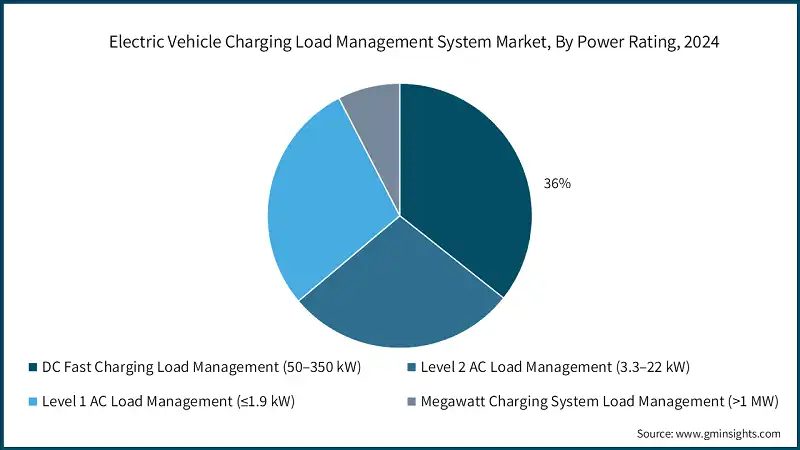
Based on power rating, the electric vehicle charging load management system market is divided into DC fast charging load management (50–350 kW), Level 2 AC load management (3.3–22 kW), Level 1 AC load management (≤1.9 kW) and megawatt charging system load management (>1 MW). DC fast charging load management (50–350 kW) segment dominates the market accounting for around 36% share in 2024, and the segment is expected to grow at a CAGR of over 23% from 2025 to 2034.
- The DC fast charging load management (50–350 kW) segment dominates the market, driven by the rapid deployment of high-capacity chargers for passenger EVs, the need for reduced charging times, and growing demand for grid-efficient, smart load balancing solutions. Charging network operators and utilities are investing heavily in AI-driven load optimization, real-time monitoring, predictive energy scheduling, and cloud-based management platforms to enhance charger utilization, reduce peak demand stress, and improve operational efficiency.
- The Level 2 AC load management (3.3–22 kW) segment is witnessing steady growth, supported by the widespread adoption of home and workplace charging solutions. Increasing penetration of residential and commercial EVs, coupled with regulatory incentives and energy efficiency mandates, is driving demand for software-controlled load management, IoT-enabled monitoring, and predictive scheduling to optimize energy distribution and minimize electricity costs for users.
- While DC fast charging load management currently leads the market in adoption and revenue, Level 2 AC and Level 1 AC load management are expected to grow steadily as residential, workplace, and public charging infrastructure expands. Additionally, megawatt charging system load management (>1 MW) is emerging as a high-potential growth area for fleet depots, heavy-duty trucks, and public transport, reflecting the broader shift toward high-power electrification and intelligent energy management across both passenger and commercial EV applications.
Based on power management level, the electric vehicle charging load management system market is divided into building-level load management, panel-level load management, circuit-level load management and grid-level load management. The building-level load management segment dominated the market and was valued at USD 1.4 billion in 2024.
- The building-level load management segment dominated the market, driven by the increasing deployment of smart charging solutions in residential, commercial, and mixed-use buildings. This segment plays a critical role in ensuring energy efficiency, peak load optimization, and grid stability within individual facilities. Utilities, charging network operators, and building managers are increasingly deploying AI-enabled predictive load management, IoT-based monitoring, and cloud-connected energy platforms to optimize electricity usage, reduce operational costs, and ensure reliable EV charging across multiple charging points, reinforcing the dominance of building-level load management in the market.
- The panel-level load management segment is witnessing steady growth as organizations focus on managing energy distribution at the substation or distribution board level. This approach enables efficient allocation of power to multiple circuits or charging clusters, leveraging predictive scheduling, telematics-based monitoring, and automated load balancing to reduce energy waste and improve system reliability. The rising adoption of workplace, fleet, and public charging hubs is fueling demand for panel-level solutions and specialized management platforms.
- Meanwhile, circuit-level and grid-level load management are emerging as high-potential segments. Circuit-level solutions provide granular control over individual chargers, while grid-level management supports broader coordination with utilities, renewable energy integration, and demand-response programs. These technologies are critical for large-scale EV deployment and intelligent energy management, ensuring scalability, operational efficiency, and sustainable electrification of transportation networks.
Based on communication protocol, the electric vehicle charging load management system market is divided into OCPP-based systems, ISO 15118-based systems, proprietary protocol systems, and IEEE 2030.5-based systems. The OCPP-based systems segment dominated the market and was valued at USD 1 billion in 2024.
- The OCPP-based systems segment dominated the market, driven by the growing adoption of open, standardized communication protocols that ensure interoperability, flexibility, and scalability across diverse charging networks. OCPP (Open Charge Point Protocol) enables seamless integration between chargers, network management platforms, and utilities, supporting remote monitoring, predictive load management, and real-time fault detection.
- Service providers and network operators are increasingly leveraging AI-enabled analytics, cloud-connected management platforms, and IoT-based monitoring to optimize charging efficiency, reduce downtime, and enhance operational performance, reinforcing the dominance of OCPP-based systems in the market.
- The ISO 15118-based systems segment is witnessing steady growth as EVs and chargers adopt advanced vehicle-to-grid (V2G) communication, secure plug-and-charge capabilities, and bidirectional energy transfer features. ISO 15118 provides standardized messaging for authentication, energy flow optimization, and smart charging coordination, enabling utilities and fleet operators to manage loads efficiently while supporting emerging grid-responsive applications. The increasing focus on high-power charging and integration with renewable energy sources is driving adoption of ISO 15118 protocols.
- Meanwhile, proprietary protocol systems and IEEE 2030.5-based systems are emerging as niche but high-potential segments. Proprietary protocols offer custom functionality for specific networks or OEMs, while IEEE 2030.5 supports smart grid interoperability and residential energy management integration. These protocols are critical for enabling specialized features, secure communications, and scalable deployment in complex EV charging ecosystems, complementing the broader shift toward standardized and connected energy management solutions
Based on application, the electric vehicle charging load management system market is divided into public charging, fleet charging, residential charging and others. The public charging segment dominated the market and was valued at USD 900 million in 2024.
- The public charging segment dominated the market, driven by the rapid expansion of public EV charging networks, high utilization rates, and growing urban EV adoption. Network operators and service providers are investing in AI-enabled load management, real-time monitoring, predictive scheduling, and cloud-connected platforms to optimize energy distribution, minimize peak demand stress, and ensure reliable, scalable charging services. The increasing deployment of fast chargers and V2G-enabled infrastructure further reinforces the dominance of public charging in the market.
- The fleet charging segment is witnessing steady growth, fueled by the electrification of commercial vehicles, buses, and delivery fleets. Fleet operators are adopting specialized load management platforms, IoT-enabled monitoring, and predictive energy scheduling to ensure operational up time, reduce energy costs, and improve overall fleet efficiency. Regulatory mandates for emissions reduction and the need for centralized, cost-effective energy management are driving the expansion of fleet-focused charging solutions.
- The residential charging and other applications are emerging as key growth areas. Residential charging solutions leverage smart home energy management, Level 1 and Level 2 chargers, and software-based scheduling tools to optimize household electricity usage. Other applications, including workplace and mixed-use facility charging, are gaining traction by providing flexible, localized energy management solutions. These segments support broader adoption of EVs while complementing public and fleet charging networks, ensuring a comprehensive and scalable EV charging ecosystem.
Looking for region specific data?
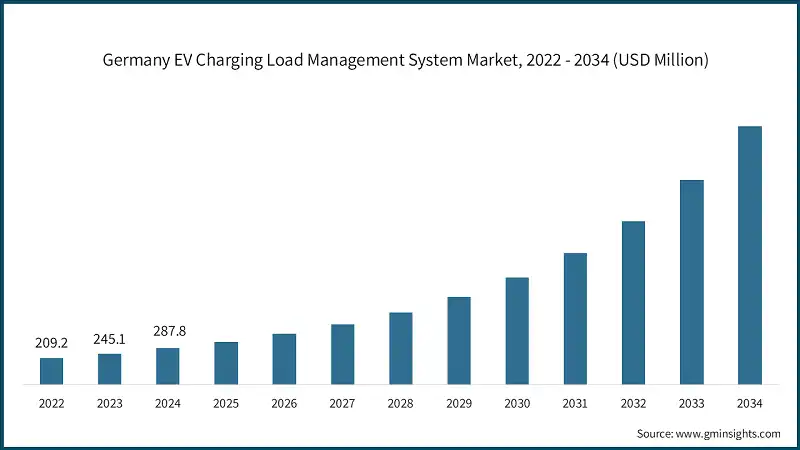
In 2024, Germany dominated the Europe electric vehicle charging load management system market with around 31% market share and generated approximately USD 287.8 million in revenue.
- Europe dominated the market in 2024, driven by strong regulatory frameworks, advanced automotive manufacturing ecosystems, and growing adoption of sustainable, connected charging infrastructure. The region is witnessing steady growth as OEMs, charging network operators, and technology providers deploy AI-enabled load optimization, IoT-connected charging stations, predictive energy scheduling, and cloud-integrated management platforms to enhance operational efficiency, grid reliability, and regulatory compliance.
- Germany represents Europe’s largest EV charging load management market, supported by robust industrial capabilities, leadership in smart grid adoption, and technological innovation in high-power charging solutions. Key trends include the implementation of AI-driven load balancing, real-time monitoring of fast chargers, predictive energy management, and V2G integration across public, fleet, and commercial charging networks. German operators are leveraging interoperable, modular, and scalable platforms to ensure consistent energy efficiency, regulatory compliance, and reliable operations, positioning the country as the central hub for EV charging load management in Europe.
- Other European markets, including the UK, France, and Italy, are also witnessing growth, supported by investments in smart charging infrastructure, cloud-based management platforms, and technician training. The UK emphasizes residential and workplace load management, France focuses on fleet and commercial charging optimization, and Italy is advancing V2G-enabled and fast-charging solutions. These regions face challenges such as legacy grid integration, interoperability, and cost optimization, creating strong demand for flexible, scalable, and connected EV charging load management solutions across Europe’s diverse energy and transportation ecosystem.
US holds share of 88% share in North America electric vehicle charging load management system market and it will grow tremendously between 2025 and 2034.
- North America dominated the EV charging load management system market in 2024, led by the United States, which benefits from a strong automotive manufacturing base, rapid deployment of smart charging infrastructure, and a well-established presence of leading technology providers. The region has seen accelerated adoption of AI-driven load optimization, IoT-enabled real-time monitoring of charging stations, predictive energy scheduling, and cloud-based management platforms across public, residential, and fleet charging networks. Charging network operators and utilities in the U.S. are increasingly leveraging digital twin simulations, telematics-based analytics, and automated energy management tools to enhance operational efficiency, ensure grid reliability, and optimize energy distribution.
- Government initiatives promoting EV adoption, smart grid deployment, and sustainability targets, along with investments in clean energy transitions, are supporting market expansion. Federal and state-level regulations encourage the installation of interoperable chargers, advanced load management systems, and connected energy networks, enabling operators to reduce peak load stress, improve energy efficiency, and ensure compliance with environmental and safety standards.
- Key states such as California, Michigan, and Texas are emerging as innovation hubs for EV charging load management technologies, driven by collaborations among utilities, OEMs, and technology vendors. Leading companies including ABB, Siemens, Schneider Electric, ChargePoint, and Eaton are expanding their U.S. offerings, providing AI-powered load balancing, IoT-connected monitoring, predictive energy management, and cloud-integrated platforms, reinforcing the country’s dominant position in the North American EV charging load management market.
China holds share of 33% in Asia Pacific electric vehicle charging load management system market and it is expected to grow tremendously between 2025 and 2034.
- Asia-Pacific holds a major share of the market in 2024, supported by a rapidly growing automotive ecosystem, increasing adoption of connected EVs, and expanding investments in smart charging infrastructure, IoT monitoring, and predictive energy management technologies. The region is witnessing steady growth as OEMs, charging network operators, and technology providers deploy scalable, secure, and intelligent load management solutions to optimize energy distribution, enhance grid reliability, and ensure regulatory compliance.
- China represents the largest market in Asia-Pacific, driven by strong demand from OEMs, fleet operators, and energy providers for high-performance, AI-enabled, and connected charging solutions. Key trends include the adoption of AI-driven load balancing, IoT-enabled real-time monitoring of fast chargers, cloud-integrated energy management platforms, and predictive scheduling tools across public, residential, and commercial charging networks. Chinese operators are deploying modular, interoperable, and scalable platforms to meet national and regional energy regulations, enhance operational efficiency, and support the rapid expansion of electric mobility across the country.
- Other Asia-Pacific countries, including India, Japan, and South Korea, are emerging markets showing increasing adoption of advanced EV charging solutions across passenger and commercial networks. These markets are supported by government digitalization initiatives, smart grid modernization, and sustainability-focused policies, along with growing interest in connected load management, predictive energy analytics, and cloud-based monitoring platforms. These deployments enhance operational efficiency, ensure regulatory compliance, and facilitate large-scale, reliable, and cost-effective EV charging across the region.
The electric vehicle charging load management system market in Brazil will experience significant growth between 2025 and 2034.
- Latin America holds a smaller but growing share of the electric vehicle charging load management system market in 2024, supported by increasing adoption of AI-enabled load management, cloud-integrated energy platforms, IoT-based real-time monitoring, and predictive scheduling solutions. Demand is primarily driven by OEMs, fleet operators, and charging network providers seeking scalable, reliable, and intelligent systems to optimize public, fleet, and residential EV charging while ensuring grid stability, operational efficiency, and regulatory compliance.
- Brazil represents the largest market in Latin America, driven by strong investments in smart charging infrastructure, cloud-based load management platforms, and advanced energy analytics technologies. Network operators and service providers are deploying AI-powered load balancing, IoT-connected fast chargers, predictive energy management, and modular, interoperable platforms to improve grid efficiency, reduce peak demand, and optimize operational performance. These solutions enable accurate real-time monitoring, regulatory compliance, and enhanced energy utilization for passenger and commercial EV charging, reinforcing Brazil’s position as the regional leader in EV charging load management.
- Mexico is emerging as the fastest-growing market in the region, fueled by early adoption of cloud-based energy platforms, AI-driven predictive scheduling, and interoperable charging solutions. Increasing investments in EV infrastructure, smart grid integration, and operator training are driving market expansion, complementing Brazil’s established market leadership and supporting the overall growth of the Latin American EV charging load management ecosystem.
The electric vehicle charging load management system market in UAE will experience significant growth between 2025 and 2034.
- Middle East & Africa (MEA) accounted for a modest share of the electric vehicle (EV) charging load management system market in 2024, supported by increasing adoption of AI-enabled load management, cloud-based energy platforms, IoT-connected monitoring, and predictive scheduling solutions. The region is witnessing steady growth as utilities, charging network operators, and technology providers deploy scalable, secure, and intelligent systems for public, residential, and fleet charging, enhancing operational efficiency, grid stability, and regulatory compliance.
- UAE dominated the MEA market, driven by demand from OEMs, fleet operators, and service providers for high-performance, connected, and AI-enabled charging solutions. Key trends include the deployment of AI-powered load optimization, IoT-enabled real-time monitoring of fast chargers, cloud-integrated energy management platforms, and predictive scheduling tools across passenger and commercial charging networks. UAE-based operators are leveraging modular, interoperable, and scalable platforms to improve energy efficiency, ensure regulatory compliance, and optimize grid and charger utilization, positioning the country as the regional leader in EV charging load management.
- A notable trend in the UAE market is the adoption of advanced telematics-based monitoring, AI-driven predictive analytics, and cloud-connected management systems. Utilities, charging network operators, and technology vendors are increasingly deploying these solutions to enhance operational transparency, reduce peak load stress, and enable data-driven, sustainable, and efficient EV charging. These initiatives reinforce the UAE’s position as the leading MEA market, setting benchmarks in reliability, scalability, and connected charging excellence.
Electric Vehicle Charging Load Management System Market Share
The top 7 companies in the market are ABB, Siemens AG, Schneider Electric SE, ChargePoint Holdings, Eaton Corporation, Shell Recharge Solutions and Enel X. These companies hold around 60% of the market share in 2024.
- ABB Ltd. provides comprehensive EV charging and load management solutions, including high-power chargers, smart load controllers, and energy management platforms. ABB leverages AI-enabled load optimization, IoT-connected monitoring, predictive energy scheduling, and cloud-integrated management systems to enhance operational efficiency, reduce peak load stress, and ensure grid reliability. Its global solutions support interoperability, modular deployment, and compliance with regional and international energy standards.
- Siemens AG delivers advanced EV charging infrastructure, load management systems, and grid integration platforms. Siemens integrates AI-driven load balancing, predictive energy management, cloud-connected monitoring, and telematics-based analytics to optimize charging network operations, enhance reliability, and support utilities, OEMs, and fleet operators in scalable deployment. Its solutions emphasize modularity, interoperability, and regulatory compliance.
- Schneider Electric SE offers integrated hardware-software EV load management systems and smart energy platforms. Schneider focuses on predictive scheduling, IoT-enabled monitoring, AI-powered optimization, and cloud-based energy management to maximize charger utilization, minimize operational costs, and support sustainable energy integration. Its modular and scalable platforms enhance network efficiency across public, residential, and commercial charging networks.
- ChargePoint Holdings provides connected EV charging networks and intelligent load management platforms. ChargePoint emphasizes cloud-connected monitoring, AI-driven predictive scheduling, and dynamic load balancing to ensure reliable, cost-effective, and scalable charging solutions for passenger, fleet, and commercial vehicles. Its interoperable systems support seamless integration across diverse EVSE networks.
- Eaton Corporation delivers EV load management, energy distribution, and high-voltage system solutions. Eaton integrates AI-enabled load optimization, IoT-based real-time monitoring, predictive maintenance, and cloud-connected management platforms to improve energy efficiency, reliability, and safety across residential, fleet, and public charging networks.
- Shell Recharge Solutions provides intelligent EV charging and load management platforms for public, commercial, and fleet networks. Shell integrates AI-powered scheduling, predictive load control, IoT-enabled monitoring, and cloud-based energy management to optimize operational efficiency, minimize peak demand, and enhance user experience. Its solutions are modular, interoperable, and compliant with regional energy regulations.
- Enel X offers comprehensive EV charging and load management services, including smart chargers, energy management platforms, and grid-responsive solutions. Enel X leverages AI-driven predictive scheduling, IoT-enabled monitoring, and cloud-integrated management systems to optimize energy distribution, support demand-response programs, and enhance operational efficiency, scalability, and compliance across multiple charging applications.
Electric Vehicle Charging Load Management System Market Companies
Major players operating in the electric vehicle charging load management system industry include:
- ABB
- ChargePoint Holdings
- Eaton Corporation
- Enel X
- EV Connect
- Schneider Electric SE
- Shell Recharge Solutions
- Siemens AG
- Tesla
- Wallbox N.V.
- The EV charging load management system market is highly competitive, with leading technology providers, utilities, and OEMs such as ABB Ltd., Siemens AG, Schneider Electric SE, ChargePoint Holdings, Eaton Corporation, Shell Recharge Solutions, and Enel X occupying key segments across DC fast charging, AC load management, smart energy platforms, grid integration, and predictive load optimization.
- ABB, Siemens, and Schneider Electric lead the market with comprehensive solutions integrating AI-powered load balancing, IoT-enabled real-time monitoring, cloud-connected energy management, and predictive scheduling platforms. These companies focus on optimizing charging efficiency, reducing peak load stress, enhancing grid reliability, and supporting scalable deployments across public, residential, and fleet charging networks.
- ChargePoint, Eaton, Shell Recharge, and Enel X specialize in modular, interoperable, and cloud-based load management platforms spanning residential, fleet, and commercial charging applications. Their solutions emphasize predictive energy scheduling, real-time monitoring, demand-response integration, and sustainability-focused operations while ensuring compatibility across different chargers, OEMs, and network providers.
- The market is marked by intense competition, with players continuously innovating in AI-driven load optimization, IoT-connected monitoring, cloud-integrated management platforms, and predictive energy analytics. Companies are focused on delivering efficient, scalable, and reliable EV charging load management solutions that support operational efficiency, regulatory compliance, and sustainable electrification of transportation networks globally.
Electric Vehicle Charging Load Management System Market Report Attributes
| Key Takeaway | Details |
|---|---|
| Market Size & Growth | |
| Base Year | 2024 |
| Market Size in 2024 | USD 2.8 Billion |
| Market Size in 2025 | USD 3.3 Billion |
| Forecast Period 2025 - 2034 CAGR | 23.3% |
| Market Size in 2034 | USD 21.8 Billion |
| Key Market Trends | |
| Drivers | Impact |
| Rising EV Adoption & Fleet Expansion | Increasing sales of EVs and growth of commercial fleets are driving demand for intelligent load management solutions. |
| Advanced Charging Infrastructure | Deployment of fast chargers, V2G-enabled stations, and energy storage systems requires sophisticated load balancing. |
| IoT & AI Integration | Real-time monitoring, predictive scheduling, and AI-based load optimization enhance operational efficiency. |
| Grid Reliability & Energy Efficiency | Need to reduce peak load stress and integrate renewable energy sources promotes smart charging management. |
| Pitfalls & Challenges | High Infrastructure Investment Deploying AI-enabled, cloud-connected, and V2G-capable systems requires significant upfront costs. Complexity of Integration Interoperability with utilities, EVSE networks, and legacy systems can slow adoption. |
| Opportunities: | Impact |
| Predictive & Remote Management Services | Cloud-based platforms and digital twins enable proactive energy optimization and reduce operational downtime. |
| Sustainability & Circular Economy Initiatives | Smart load management supports renewable energy integration, carbon-neutral mobility, and efficient grid utilization. |
| Market Leaders (2024) | |
| Market Leaders |
19.6% market share |
| Top Players |
Collective market share in 2024 is 56% |
| Competitive Edge |
|
| Regional Insights | |
| Largest Market | Europe |
| Fastest Growing Market | Asia Pacific |
| Emerging Country | Brazil, Mexico, UAE |
| Future Outlook |
|
What are the growth opportunities in this market?
Electric Vehicle Charging Load Management System Industry News
- In March 2025, ABB expanded its EV charging and load management solutions across North America and Europe, deploying AI-powered load optimization, IoT-connected charger monitoring, and predictive energy management platforms. The initiative aims to improve grid stability, reduce peak demand stress, and optimize energy distribution across public, residential, and fleet charging networks.
- In February 2025, Siemens AG launched advanced load management systems for high-capacity DC fast chargers, smart AC networks, and V2G-enabled infrastructure. The solutions integrate cloud-connected energy management, real-time analytics, and AI-driven predictive scheduling to enhance operational efficiency, grid reliability, and regulatory compliance for utilities and charging network operators.
- In January 2025, Schneider Electric SE partnered with leading charging network operators to deploy modular, scalable load management platforms, including predictive energy scheduling, IoT-based monitoring, and cloud-integrated control systems. The collaboration focuses on enhancing charging efficiency, reducing operational costs, and supporting sustainable energy management across urban, commercial, and fleet networks.
- In December 2024, ChargePoint Holdings introduced AI-enabled load management tools and predictive scheduling solutions across key U.S. and European markets. The initiative enhances real-time energy monitoring, dynamic load balancing, and interoperability across multi-vendor charging stations, supporting the expansion of public and fleet EV infrastructure.
- In October 2024, Eaton Corporation expanded their EV load management offerings, implementing AI-driven optimization, cloud-connected monitoring, and predictive maintenance platforms. These deployments aim to improve operational efficiency, reduce downtime, and enable scalable, reliable, and sustainable EV charging services globally.
The electric vehicle charging load management system market research report includes in-depth coverage of the industry with estimates & forecasts in terms of revenue ($ Bn) from 2021 to 2034, for the following segments:
Market, By Technology Architecture
- Integrated hardware-software system
- Hardware-based load management system
- Software-based load management system
Market, By Power Management Level
- Building-level load management
- Panel-level load management
- Circuit-level load management
- Grid-level load management
Market, By Communication Protocol
- OCPP-based system
- ISO 15118-based system
- Proprietary protocol system
- IEEE 2030.5-based system
Market, By Power Rating
- DC fast charging load management (50–350 kW)
- Level 2 ac load management (3.3–22 kW)
- Level 1 ac load management (≤1.9 kW)
- Megawatt charging system load management (>1 MW)
Market, By Application
- Public charging
- Fleet charging
- Residential charging
- Others
The above information is provided for the following regions and countries:
- North America
- US
- Canada
- Europe
- UK
- Germany
- France
- Italy
- Spain
- Belgium
- Netherlands
- Sweden
- Asia Pacific
- China
- India
- Japan
- Australia
- Singapore
- South Korea
- Vietnam
- Indonesia
- Latin America
- Brazil
- Mexico
- Argentina
- MEA
- South Africa
- Saudi Arabia
- UAE
Frequently Asked Question(FAQ) :
What is the market size of the electric vehicle charging load management system in 2024?
The market size was USD 2.8 billion in 2024, with a CAGR of 23.3% expected through 2034. The growth is driven by the rapid adoption of electric vehicles, expanding EV fleets, and the increasing need for intelligent energy management solutions.
What is the projected value of the electric vehicle charging load management system market by 2034?
The market is poised to reach USD 21.8 billion by 2034, fueled by advancements in EV charging infrastructure, grid connectivity, and energy storage systems.
What is the expected size of the electric vehicle charging load management system industry in 2025?
The market size is projected to reach USD 3.3 billion in 2025.
How much revenue did the integrated hardware-software systems segment generate in 2024?
The integrated hardware-software systems segment accounted for approximately 37% of the market share in 2024 and is expected to witness over 22.8% CAGR till 2034.
What was the valuation of the DC fast charging load management segment in 2024?
The DC fast charging load management segment (50–350 kW) held a 36% market share in 2024 and is set to expand at a CAGR of over 23% up to 2034.
What is the growth outlook for the OCPP-based systems segment?
The OCPP-based systems segment was valued at USD 1 billion in 2024, led by the adoption of open, standardized communication protocols ensuring interoperability, flexibility, and scalability across diverse charging networks.
Which region leads the electric vehicle charging load management system sector?
Europe led the market in 2024, with Germany dominating the region with a 31% market share and generating approximately USD 287.8 million in revenue.
What are the upcoming trends in the electric vehicle charging load management system market?
Trends include AI-based load optimization, IoT monitoring, predictive scheduling, cloud management, modular systems, and regional energy hubs for better grid efficiency.
Who are the key players in the electric vehicle charging load management system industry?
Key players include ABB, ChargePoint Holdings, Eaton Corporation, Enel X, EV Connect, Schneider Electric SE, Shell Recharge Solutions, Siemens AG, Tesla, and Wallbox N.V.
Electric Vehicle Charging Load Management System Market Scope
Related Reports