Summary
Table of Content

Electric Commercial Vehicle Market
Get a free sample of this report
Form submitted successfully!
Error submitting form. Please try again.
Thank you!
Your inquiry has been received. Our team will reach out to you with the required details via email. To ensure that you don't miss their response, kindly remember to check your spam folder as well!
Request Sectional Data
Thank you!
Your inquiry has been received. Our team will reach out to you with the required details via email. To ensure that you don't miss their response, kindly remember to check your spam folder as well!
Form submitted successfully!
Error submitting form. Please try again.
Electric Commercial Vehicle Market Size
The electric commercial vehicle industry is experiencing rapid transformation, driven by technological advancements, regulatory pressures, and evolving business models. Using subsidies, tax credits, and policies, governments on all levels have been fostering the use of electric commercial vehicles. A charging infrastructure, for instance, allows for lower emission vehicles to be subsidized, and road taxes to be exempted. The efforts made in setting emissions standards and targets for carbon neutrality have also incentivized plenty of firms and fleet operators to consider the electric option.
Electric Commercial Vehicle Market Key Takeaways
Market Size & Growth
- 2025 Market Size: USD 84.2 Billion
- 2026 Market Size: USD 93.4 Billion
- 2035 Forecast Market Size: USD 222 Billion
- CAGR (2026–2035): 10.1%
Regional Dominance
- Largest Market: Asia-Pacific
- Fastest Growing Region: Middle East & Africa
Key Market Drivers
- Strict emission regulations enforcement.
- E‑commerce and last‑mile demand growth.
- Corporate fleet electrification mandates.
- Urban air quality improvement initiatives.
Challenges
- Insufficient charging infrastructure coverage.
- Raw material and battery shortages.
Opportunity
- High‑power fast charging deployment.
- Battery cost reduction advances.
Key Players
- Market Leader: BYD Company led with over 20% market share in 2025.
- Leading Players: Top 5 players in this market include BYD Company, Ford Motor, Mercedes-Benz, Volvo, YUTONG BUS, which collectively held a market share of 43% in 2025.
Get Market Insights & Growth Opportunities
ECV fleet operators are rewarded with credits for simultaneously incorporating carbon credit programs and ZEV mandates. The enhanced battery tech and lower production costs led to the drop in battery prices. Due to improved management of battery material, increased production, and better chemical composition, electric commercial vehicles have become more cost effective. For instance, Policies like India’s FAME II (Faster Adoption and Manufacturing of Hybrid and Electric Vehicles), the EU’s Fit for 55 Plan, and the US Inflation Reduction Act (IRA) 2022 provide direct financial benefits and regulatory assistance to manufacturers and buyers.
During the COVID-19 pandemic, commercial vehicle market encountered many obstacles, including temporary closures or slow production of new vehicles due to COVID-19. It has had a further impact on the disruption of supply chains and a delay in vaccinating to allow for the re-launch of fleet operations. While COVID-19 created some challenges, it also accelerated the adoption of electric vehicles due to the financial stimulus being provided by many governments around the world to support electric vehicle adoption as part of their Green Recovery strategies.
The Asia Pacific region leads globally in Electric Vehicle (EV) Sales, dominated primarily by China. According to the International Energy Agency (IEA), China accounted for over 60% of the total sales of electric buses and over 70% of the total sales of trucks sold worldwide in 2023. The success of China as an EV market can be attributed to several factors, including Government policies supporting Electric Fleet adoption, EV production capacity domestically, significant financial incentives provided by the Chinese government to support EV fleet adoption and a growing number of consumer preference towards EV fleet Vehicles.
Europe is another strong market for Electric Commercial Vehicles. According to the ACEA, the sales of petrol commercial vehicle models fell from 31.9% market share in 2025 to 4.4% of the total commercial vehicle market, while the sales of electrically chargeable vans increased from 6.1% to 11.2%. This reflects continued growth in the transition from petrol and diesel-fueled vehicles to fully plug-in electric vehicles and Europe's continued position as a significant EV sales market.
The global electric commercial vehicle market was estimated at USD 84.2 billion in 2025. The market is expected to grow from USD 93.4 billion in 2026 to USD 222 billion in 2035, at a CAGR of 10.1% according to latest report published by Global Market Insights Inc.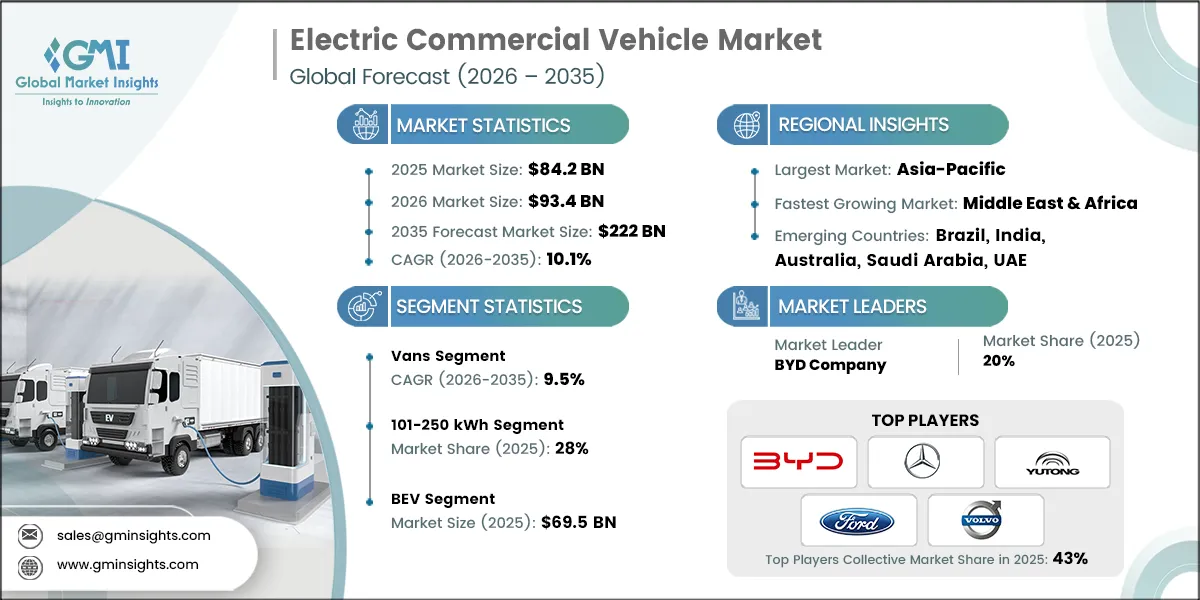
To get key market trends
Electric Commercial Vehicle Market Trends
Electric commercial vehicle adoption rates increase due to quick progress in establishing different charging networks from public stations to private and fleet-based charging systems. Various innovations including rapid charging systems plus wireless charging solutions as well as battery exchange platforms resolve problems with electric vehicle range and maintenance periods.
Public EV charging infrastructure in the United States reached more than 192,000 stations since the Biden-Harris administration began and this presidential period initiated the expansion of public charging stations. The installation pace of public chargers continues to speed up to one thousand weekly installations because government entities and businesses actively fund charging network development.
In 2023, the growth of worldwide public charging infrastructure reached 40% overall and fast chargers added to this expansion rate at 55% annually. Fast chargers became the key segment in public charging infrastructure networks through 2023 because they cut down commercial charging duration and achieved more than 35% of total station ownership. This trend further fuelled the market and increase adoption in emerging market such as Brazil, Mexico, and other African countries.
E-commerce growth together with online retail is creating rising demand for eco-friendly delivery solutions which electric commercial vehicles perfectly address last-mile logistics requirements. The growing demand for urban deliveries has propelled businesses to implement electric vans together with electric three-wheelers and mini trucks because of emission regulations.
Digital transformation of fleet management occurs through the implementation of artificial intelligence and IoT devices and telematics systems. Businesses can maximize their efficiency by using smart fleet solutions which give real-time data about vehicle performance along with route optimization and battery health monitoring along with predictive maintenance capabilities.
Electric Commercial Vehicle Market Analysis
Learn more about the key segments shaping this market
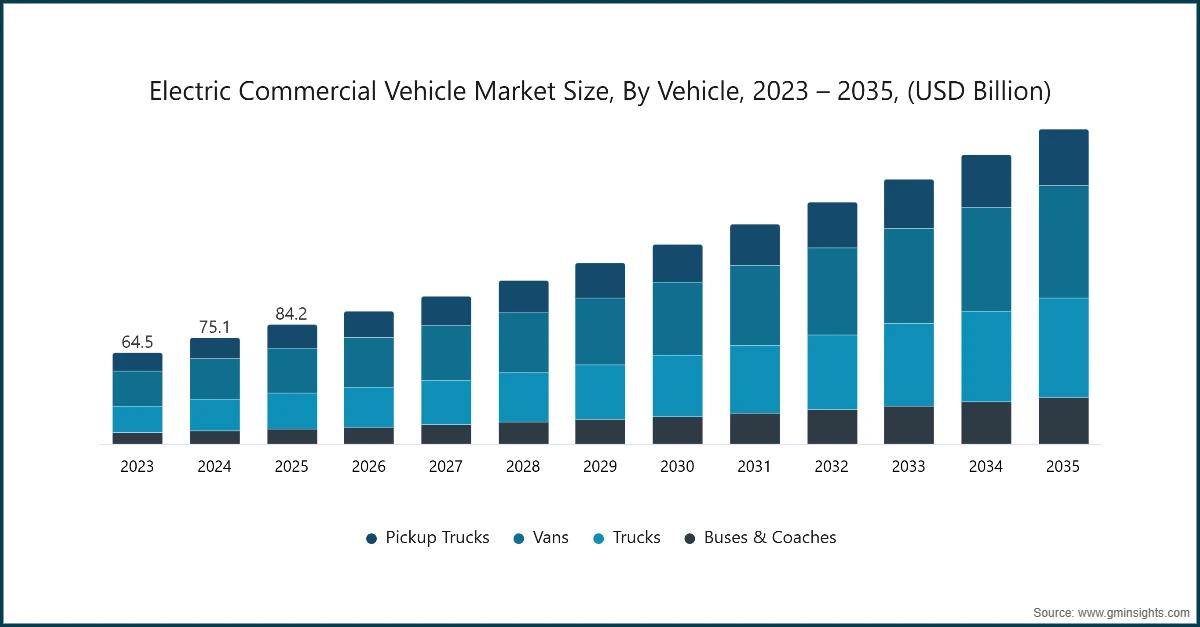
Based on vehicle, the electric commercial vehicle market is divided into pickup trucks, trucks, vans and buses & coaches. Vans segment dominated the market accounting by 37% in 2025 and is expected to grow at a CAGR of 9.5% from 2026 to 2035.
- Electric vans become optimal solutions for city operations because they provide a convenient vehicle size with strong maneuverability capabilities and efficient navigation through traffic-congested zones. Logistics companies choose electric vans as their preferred option because of e-commerce and same-day delivery services. Electric vans provide both reduced fuel and maintenance expenses compared to diesel vans resulting in improved long-term cost-effectiveness for operators.
- Government-provided financial advantages together with tax breaks coupled with low-emission zone tax exemptions make electric vehicles more affordable for fleet operators. In January 2025, Flexis is a joint venture of Renault and Volvo Group received 15,000 electric van purchase orders from European logistic providers including DB Schenker and Colis Privé as environmental demands mounted, and new emission regulations drove them to electrify their vehicle fleets.
- Fleet operators choose electric vehicles because they need to reduce greenhouse gas emissions according to their ESG performance standards. Businesses which adopt sustainable practices will fulfill their sustainability goals while gaining compensation and creating a larger charging infrastructure network through electric van adoption. This electrification drives sustainable growth in the market.
Learn more about the key segments shaping this market
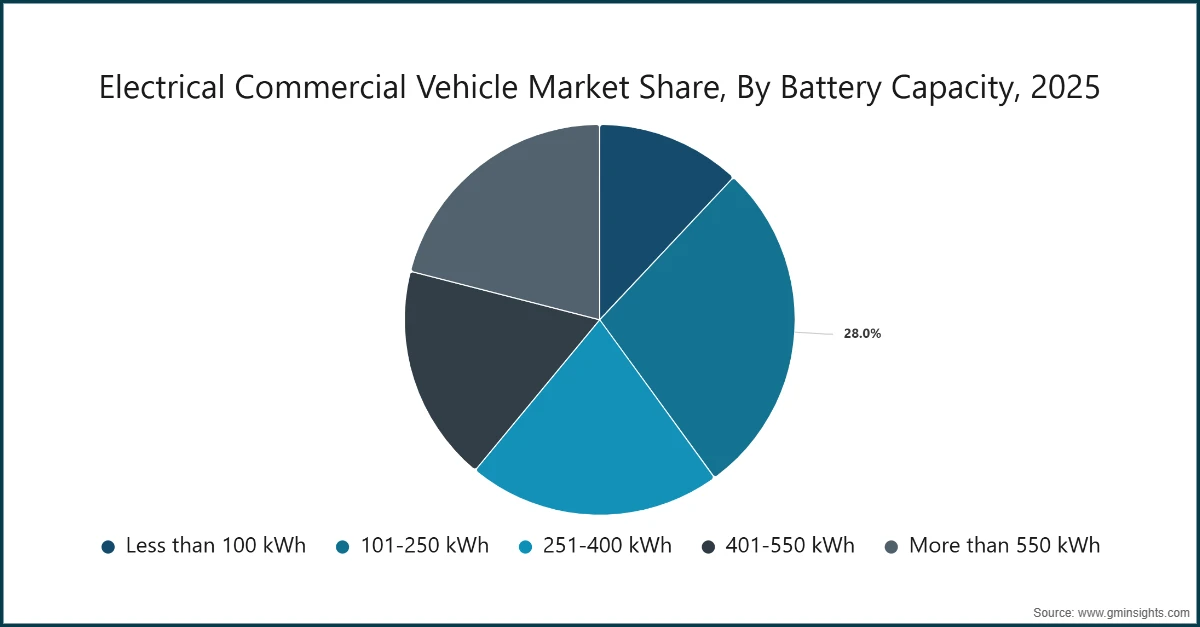
Based on the battery capacity, the electric commercial vehicle market is divided into Less than 100 KWH, 101-250 KWH, 251-400 KWH, 401-550 KWH and More than 550 KWH. 101-250 kWh segments dominated the market with 28% share in 2025, and the segment is expected to grow at a CAGR of 8.2% between 2026 to 2035.
- Batteries rated at below 101-250 kWh consume power more efficiently thus earning better usage advantages. A mid-size battery achieves full charge speed rapidly when charged either from home or public fast charging stations. Most charging networks operate with mid-sized battery capacities so vehicles equipped with 101-250 kWh batteries can exploit current charging stations more efficiently while providing quicker charging times and better usability.
- Because smaller battery packs lower the vehicle weight the resulting improvement in energy efficiency and handling becomes possible. According to Bloomberg NEF, the battery capacities of most modern EV models range from 50-90 kWh because this speed offers 250-400 miles of driving range which satisfies typical user needs at affordable weights. Most mainstream passenger vehicles together with commercial vans and urban mobility solutions choose batteries under 100 kWh since they strike the ideal balance of practicality and cost effectiveness.
Based on propulsion, the market is divided into BEV, FCEV, and HCEV. BEV dominate the market and were valued at USD 69.5 billion in 2025.
- BEVs require less parts during operation than either hybrid vehicles or fuel cell vehicles which reduces maintenance expenses and enhances operational efficiency. BEVs rely solely on stored energy to operate so users experience decreased long-term expenses both at the individual level and fleet management level. In February 2026, Under the call of the Directive for the Promotion of Alternative Drives in Passenger Transport Buses, 151 transport companies across Germany will receive support for the acquisition of battery-electric buses.
- Fuel Cell Electric Vehicle (FCEV) is fastest growing battery type in the market. Driven by heavy-duty decarbonization mandates, the market favors single-deck, 300–500-mile range vehicles. In Europe, 279 hydrogen buses were registered in the first half of 2025, a massive increase compared to previous periods. Similarly, according to data from the Korea Automobile & Mobility Association (KAMA) and Hyundai Motor, 380 hydrogen-powered buses were sold in the first five months of 2025. This trend highlights the potential adoption of segments in developing countries.
Based on application, the electric commercial vehicle market is divided into last-mile delivery, field services, distribution services, long-haul transportation and refuse trucks. Last-miles segment dominates the market and were valued at USD 32.7 billion in 2025.
- The surge of e-commerce and expedited delivery methods results in rising requirements for efficient lightweight, last-mile delivery solutions which are cost-effective along with being environmentally sustainable. A preference exists for last-mile delivery fleets to choose electric vehicles (EVs) because these vehicles demonstrate advantages such as low operating expenses and simple navigation in traffic-clogged areas and their ability to bypass low-emission zone restrictions.
- Electric delivery vans and three-wheelers driven by electricity show greater financial advantages than gasoline or diesel-powered traditional delivery vehicles since they require less maintenance and fuel expenses. In January 2022, Rivian announced a major contract with Amazon to deliver thousands of electric delivery vehicles which highlights the American lead in the market amidst growing environmental goals among companies.

Looking for region specific data?
The China dominated Asia-Pacific electric commercial vehicle market with revenue of USD 37.5 billion in 2025.
- The electric commercial vehicle industry in China is established and expanding quickly because there is more cost-effective commercial vehicle. The EV supply chain currently falls under Chinese corporate control because they both produce batteries and source raw materials. The combined control of key EV supply chain elements through vertical integration enables China to lower production expenses while cutting dependence on overseas suppliers making the country more competitive globally.
- The regional players are making substantial growth in the niche segment of electric commercial vehicles market across the different regions. For instance, in 2025, Yutong Bus delivered 49,518 vehicles, marking a 5.54% year-on-year increase. The Chinese company’s growth is driven by the global transition to low-carbon transportation and high demand for new energy.
- Similarly, in India the PM E-DRIVE scheme, with an outlay of ₹500 crore (5,000 USD Million), aims to support over 5,600 electric trucks sales, providing incentives up to ₹9.6 lakh (~USD 10,000) for electric medium- and heavy-duty trucks (e-MHDT). This drives, the Major players include Tata Motors and Mahindra leading in LCVs, while IPL Tech Electric and Energy in Motion have shown activity in the heavy-duty segment.
US electric commercial vehicle market will grow tremendously with CAGR of 9.5% between 2026 and 2035.
- The United States ranks among the world’s fastest-expanding EV charging networks because it attracts funding from both public institutions and private entities including Tesla along with ChargePoint and Electrify America. In US, Inflation Reduction Act of 2022, the government offers substantial benefits to both individuals who buy electric vehicles and commercial customers who switch their fleets to electric power. At the same time the Bipartisan Infrastructure Law devotes funds to installing EV charging stations nationwide, making the USA emerge as one of the top EV adoption countries globally.
- The Canada government operates a series of substantial policies which target EV adoption through tax credit provisions as well as grant programs and funding initiatives for infrastructure development. In the country, automotive sector led by Tesla, Rivian and General Motors uses its domestic base to develop high-tech electric vehicles among various segments. Major delivery companies including Amazon and UPS implement quick changes to their delivery vehicle fleets using electric power sources which boosts America's position in worldwide EV markets.
The Europe electric commercial vehicle market in Germany sold 62,357 units in 2025.
- The European market had a 24% share of the global market and grew at a rate of 8.5%. The existing automotive industry in Germany supports electric commercial vehicle development through top OEMs such as BMW, Daimler and Volkswagen. The government supports electric mobility through two key measures by providing financing incentives along with funding projects for charging stations. Through their initiatives both producers of commercial electric vehicles and their purchaser base receive encouragement to adopt electric transportation solutions.
- UK continues its commitment to minimize carbon emissions to support worldwide efforts in sustainable modern transportation development. The nation's dedication to environmental protection objectives leads to the adoption of electric commercial vehicles across the industry. In January 2025 Amazon completed its biggest electric truck purchase to date by obtaining 200 eActros 600 heavy goods vehicles from Daimler for service between Germany and the UK markets.
The Brazil electric commercial vehicle market accounted for 4,048 unit sales in 2025, and is expected to grow at a CAGR of 15.6% from 2026 to 2035.
- The automotive industry in Brazil which combines skillful labor and favorable trade agreements has successfully pulled in major investments from worldwide EV manufacturers. In December 2025, BYD is planning a new factory in Brazil to expand electric bus and truck production after demand exceeded the capacity of its existing plant.
- The Mexican government established two strategies to boost EV adoption through manufacturing support and tax benefits. The government implements these measures to establish Mexico as a global leader in developing sustainable transportation. The Chinese automotive company BYD revealed through a statement in October 2024 that it would build a production facility in Mexico to create inexpensive electric vehicles for Latin American consumers.
UAE electric commercial vehicle market will grow tremendously with CAGR of 5.8% between 2026 and 2035.
- In the UAE market, several electric commercial vehicle manufacturers are strategically entering the market with products for both light-duty and heavy-duty vehicles. The Fuso eCanter was launched in January 2026; it is designed for urban logistics and last-mile delivery. The Volvo FH Electric was introduced through FAMCO, and its use by Unilever represents the first heavy-duty electric truck in the country. Tesla Semi has also begun to gain traction in the UAE with a 50-unit order from Bee’ah in Sharjah to provide waste collection and recycling services.
- The commercial EV market in Saudi Arabia is being established through distribution and infrastructure initiatives as well. Electromin, a subsidiary of Petromin Corporation, distributes Quantron products and has taken an active role in supporting the establishment of a nationwide network of EV chargers. Eviq, a joint venture between Public Investment Fund of Saudi Arabia (PIF) and Saudi Electricity Company (SEC), is developing a fast-charging system throughout KSA.
Electric Commercial Vehicle Market Share
The top 7 companies in the market are BYD Company, Mercedes-Benz, Volvo, Tesla, Ford Motor, YUTONG BUS, and Scania. These companies hold around 44% of the market share in 2025.
- BYD is among the world's top electric vehicle makers, with significant expansion in its commercial vehicle lineup, including buses, trucks, and last-mile delivery vehicles. With the benefit of vertically integrated battery and powertrain technologies, BYD has rapidly established a strong foothold across Asia, Europe and the Middle East, particularly in the electrification of last-mile logistics and urban bus fleets.
- Mercedes-Benz has also targeted the premium segment of the electric commercial vehicle market with its e-truck and e-van offerings. With an established presence in Europe and a selected rollout in the Middle East, the brand places a major emphasis on high reliability and advanced telematics systems for its e-commercial vehicle users.
- Volvo is focused on providing electric commercial vehicles in the form of semi-trucks and buses, with a focus on electrifying long distance and urban transportation. The Volvo FH Electric features an advanced electric drivetrain and is complemented by fleet-focused telematics and charging solutions.
- Tesla has launched the Tesla Semi to target the heavy-duty truck segment with both high range and fast charge capabilities. While still in the early growth phase of global adoption, Tesla has received significant fleet orders in North America, Europe, and the Middle East for its Semi.
- Ford is focused on electrifying its light-duty and medium-duty commercial vehicle lines, including the E-Transit van and F-series pickup trucks. The company is leveraging its extensive dealer network and brand recognition to support its commercial electrification efforts.
- Yutong is a major power in the electric bus industry, offering a variety of urban and intercity transit solutions worldwide. Their ability to produce large volumes of vehicles and provide support for complete fleets of electric buses gives them a distinct competitive advantage in meeting the needs of large public transportation projects.
- Scania is focused on developing heavy-duty electric trucks and buses to meet the needs of long-haul, regional distribution networks and urban transit systems. Their strategy revolves around modular electric drivelines, operational efficiencies, and fleet management software integration.
Electric Commercial Vehicle Market Companies
Major players operating in the electric commercial vehicle industry include:
- BYD Company
- Mercedes-Benz
- Volvo
- Tesla
- Ford Motor
- YUTONG BUS
- Scania
- PACCAR
- Tata Motors Limited
- Dongfeng Motor Corporation
- The market leaders who dominate electric commercial vehicles (ECV) markets successfully leverage multiple development opportunities through building new partnerships and making acquisitions as well as developing innovative products and expanding research and development spending.
- The strategic initiatives help manufacturers deliver electric vehicles equipped with modern features and advanced technologies to become more efficient and cost-effective and environmentally friendly. Manufacturers who team up with industry leaders obtain stronger global electric commercial vehicle market reach and better resources while improving product traits which enhance their business performance in the electric vehicle market.
- Large corporations continue to maintain their market leadership by strongly increasing their research and development (R&D) activities. By focusing on innovation, companies achieve better battery performance and extended driving ranges and better charging capabilities which drive industrial growth for electrical commercial vehicles across different usage areas.
- The product range of companies extends to offer multiple electric commercial vehicles spanning from delivery vans to heavy-duty trucks and buses to support varied customer requirements. The manufacture of diverse electric commercial vehicles helps manufacturers fulfill upcoming environmental regulations and meet increasing consumer needs while developing sustainable transportation systems worldwide.
Electric Commercial Vehicle Market Report Attributes
| Key Takeaway | Details |
|---|---|
| Market Size & Growth | |
| Base Year | 2025 |
| Market Size in 2025 | USD 84.2 Billion |
| Market Size in 2026 | USD 93.4 Billion |
| Forecast Period 2026-2035 CAGR | 10.1% |
| Market Size in 2035 | USD 222 Billion |
| Key Market Trends | |
| Drivers | Impact |
| Strict emission regulations enforcement | CO₂ targets and low‑emission zones push fleets to electrify, accelerating EV adoption. |
| E‑commerce and last‑mile demand growth | Rising parcel volumes require scalable, quiet, zero‑emission commercial vehicles for urban deliveries. |
| Corporate fleet electrification mandates | Sustainability commitments and government programs drive fleet adoption of electric trucks and buses. |
| Urban air quality improvement initiatives | City regulations promoting clean air increase demand for zero‑emission commercial fleets. |
| Pitfalls & Challenges | Impact |
| Insufficient charging infrastructure coverage | Limited depot and highway chargers slow fleet electrification adoption. |
| Raw material and battery shortages | Supply constraints delay production and increase electric vehicle costs. |
| Opportunities: | Impact |
| High‑power fast charging deployment | Deployment of depot and highway DC chargers enables efficient fleet operations and reduces downtime. |
| Battery cost reduction advances | Falling lithium-ion battery costs and higher energy density improve range and economics. |
| Market Leaders (2025) | |
| Market Leader |
market share is 20% |
| Top Players |
Collective market share in 2025 is 43% |
| Competitive Edge |
|
| Regional Insights | |
| Largest Market | Asia-Pacific |
| Fastest growing market | Middle East & Africa |
| Emerging countries | Brazil, India, Australia, Saudi Arabia, UAE |
| Future outlook |
|
What are the growth opportunities in this market?
Electric Commercial Vehicle Industry News
- In January 2026, the Netherlands launched several grant programs to encourage the adoption of electric trucks and charging infrastructure to reach a carbon-free commercial transport sector. The four programs are called SPriLa, AanZET, SPuLa, and SWiM.
- In December 2025, DSV increased its European electric fleet by adding three new Volvo FM 4x2 8-ton electric trucks to its air and sea operations and five additional Volvo electric tractors to its road transport division. This is part of DSV's continued commitment to the global agreement with Volvo to purchase 300 electric trucks by 2024, bringing DSV's total fleet of EVs to approximately 500 units.
- In November 2025 in Australia, Toll Group has partnered with Coca-Cola Europacific Partners (CCEP) to replace diesel vehicles in CCEP’s delivery network with twelve Volvo FE Electric trucks; this is a major milestone in creating decarbonized last-mile logistics in Australia.
- January 2025: Workhorse Group Inc. announced that its E-GEN electric vehicle platform surpassed 10 million cumulative miles driven, demonstrating real-world reliability and performance, reinforcing the company’s commitment to emission-free commercial transport solutions.
The electric commercial vehicle market research report includes in-depth coverage of the industry with estimates & forecasts in terms of revenue ($ Bn) and Volume (Units) from 2022 to 2035, for the following segments:
Market By Vehicle
- Pickup Trucks
- Light-Duty Electric Pickups
- Heavy Light-Duty Electric Pickups
- Vans
- Compact Electric Vans
- Mid-Size Electric Vans
- Full-Size Electric Vans
- Trucks
- Medium-Duty Electric Trucks
- Heavy-Duty Electric Trucks
- Buses & Coaches
- Electric Transit Buses
- Electric Intercity Coaches
- Electric School Buses
Market By Battery Capacity
- Less than 100 kWh
- 101-250 kWh
- 251-400 kWh
- 401-550 kWh
- More than 550 kWh
Market By Propulsion
- Battery Electric Vehicle (BEV)
- Fuel Cell Electric Vehicle (FCEV)
- Plug-in Hybrid Electric Vehicle (PHEV)
Market By Application
- Last-Mile Delivery
- Field Services
- Distribution Services
- Long-Haul Transportation
- Others
The above information is provided for the following regions and countries:
- North America
- US
- Canada
- Europe
- UK
- Germany
- France
- Italy
- Spain
- Belgium
- Netherlands
- Sweden
- Russia
- Asia Pacific
- China
- India
- Japan
- Australia
- Singapore
- South Korea
- Vietnam
- Indonesia
- Latin America
- Brazil
- Mexico
- Argentina
- MEA
- South Africa
- Saudi Arabia
- UAE
Frequently Asked Question(FAQ) :
What is the market size of the electric commercial vehicle market in 2025?
The market was valued at USD 84.2 billion in 2025 and is projected to grow at a CAGR of 10.1% during 2026–2035, driven by regulatory mandates, fleet electrification initiatives, and advancements in battery technology.
What is the expected size of the electric commercial vehicle industry in 2026?
The industry is projected to reach USD 93.4 billion in 2026, supported by rising demand for zero-emission logistics fleets and expanding charging infrastructure worldwide.
What is the projected value of the electric commercial vehicle market by 2035?
The market is expected to reach USD 222 billion by 2035, fueled by strict emission regulations, corporate sustainability commitments, and rapid electrification of last-mile and heavy-duty transport.
How much revenue did the BEV segment generate in electric commercial vehicle market in 2025?
The Battery Electric Vehicle (BEV) segment generated USD 68.6 billion in 2025, leading the industry due to lower operating costs, reduced maintenance requirements, and increasing adoption in buses and delivery fleets.
Which battery capacity segment dominated the electric commercial vehicle market in 2025?
The 101–250 kWh battery capacity segment held a 28% share in 2025 and is expected to grow at a CAGR of 8.2% through 2035, driven by its optimal balance between range, efficiency, and charging convenience for commercial fleets.
How much revenue did the last-mile delivery segment generate in electric commercial vehicle market in 2025?
The last-mile delivery segment was valued at USD 32.7 billion in 2025, supported by e-commerce growth and increasing adoption of electric vans and light-duty vehicles for urban logistics.
Which region leads the electric commercial vehicle industry?
Asia-Pacific leads the industry, with China generating USD 37.5 billion in 2025. The region’s dominance is driven by strong government incentives, vertically integrated EV supply chains, and high electric bus and truck adoption rates.
What is the growth outlook for the U.S. electric commercial vehicle industry?
The U.S. market is expected to grow at a CAGR of 9.5% from 2026 to 2035. Growth is supported by the Inflation Reduction Act, expansion of EV charging infrastructure, and increasing fleet electrification by logistics companies.
Who are the key players in the electric commercial vehicle industry?
Key companies operating in the market include BYD Company, Mercedes-Benz, Volvo, Tesla, Ford Motor, YUTONG BUS, Scania, PACCAR, Tata Motors Limited, and Dongfeng Motor Corporation.
Electric Commercial Vehicle Market Scope
Related Reports