Summary
Table of Content

Elderly Walkers Market
Get a free sample of this report
Form submitted successfully!
Error submitting form. Please try again.
Thank you!
Your inquiry has been received. Our team will reach out to you with the required details via email. To ensure that you don't miss their response, kindly remember to check your spam folder as well!
Request Sectional Data
Thank you!
Your inquiry has been received. Our team will reach out to you with the required details via email. To ensure that you don't miss their response, kindly remember to check your spam folder as well!
Form submitted successfully!
Error submitting form. Please try again.
Elderly Walkers Market Size
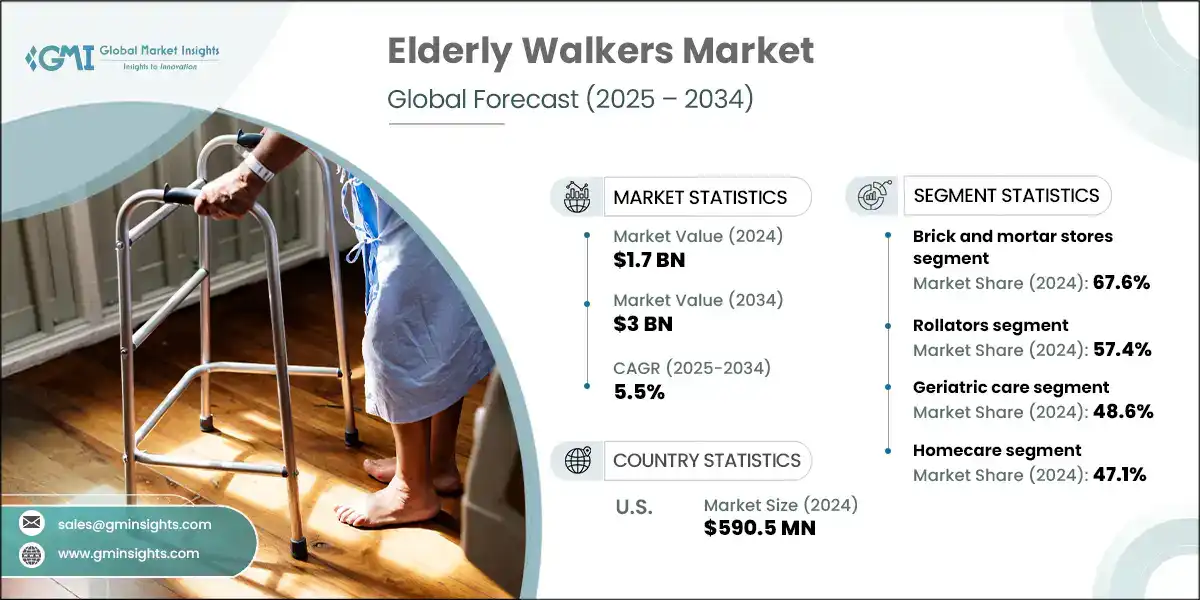
The global elderly walkers market was estimated at USD 1.7 billion in 2024. The market is expected to grow from USD 1.8 billion in 2025 to USD 3 billion in 2034, growing at a CAGR of 5.5%. This high growth is attributed to several factors including rise in number of orthopedic procedures, advancements in walkers and rollators, significant demand for at-home use and surging prevalence of mobility-related disorders among other contributing factors.
Elderly Walkers Market Key Takeaways
Market Size & Growth
- 2024 Market Size: USD 1.7 Billion
- 2034 Forecast Market Size: USD 3 Billion
- CAGR (2025–2034): 5.5%
Regional Dominance
- Largest Market: North America
- Fastest Growing Region: Asia Pacific
Key Market Drivers
- Growing prevalence of mobility-related disorders.
- Technological advancements in walkers.
- Increasing orthopedic procedures.
- Rising demand in home healthcare.
Challenges
- High cost of advanced walkers.
- Risk of accident and falls.
Opportunity
- Product customization and personalization trend.
- Integration of smart technologies.
Key Players
- Market Leader: drive DeVilbiss Healthcare led with over 5.3% market share in 2024.
- Leading Players: Top 5 players in this market include drive DeVilbiss Healthcare, MEDLINE, SUNRISE MEDICAL, INVACARE, CAREX, which collectively held a market share of 19% in 2024.
Get Market Insights & Growth Opportunities
A walker helps people walk safely by providing stability and support. It's an assistive device for those who have trouble with balance, patients suffering from arthritis, or weakness in their legs. Major players in the industry include MEDLINE, SUNRISE MEDICAL, drive DeVilbiss Healthcare, INVACARE, KARMAN, graham field, CAREX. Availability of sales of mobility products including elderly walkers through company websites by significant percentage of industry participants is fuelling the online channels segment growth.
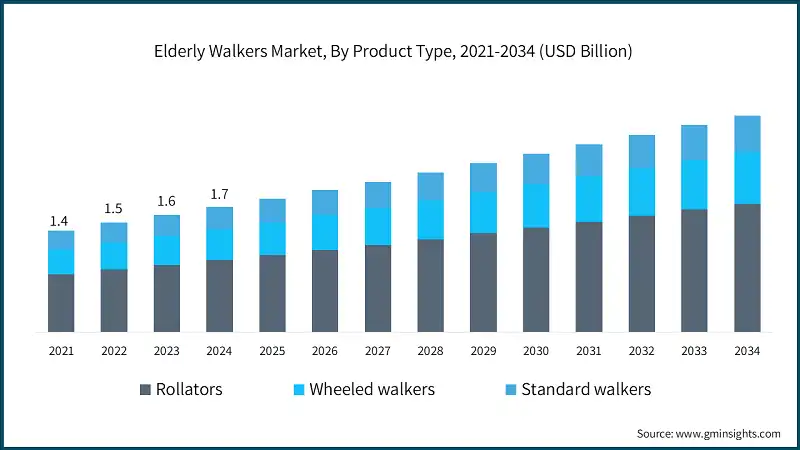
The market witnessed healthy growth from USD 1.4 billion in 2021 to USD 1.6 billion in 2023. This growth was primarily driven by increasing orthopedic procedures globally. For example, according to a published article, around 18.6 million total orthopedic procedures were performed in the U.S. in 2022. This includes range of procedures such as joint reconstruction, back surgery, and ACL reconstruction among others. Favorable reimbursement schemes, availability of well-equipped surgical facilities including the outpatient seetings such as ambulatory surgical centers are expected to support the market growth over the projected timeframe.
Home healthcare is expected to significantly push the product demand throughout the analysis period. Supportive government initiatives and strategies that enables the aged population to have a comprehensive care at the comfort of their own homes or at other healthcare facilities including geriatric homes, elderly care centers, etc. is fueling the industry growth. For instance, in year 2000, the Japanese government launched The Japanese Long-Term Care Insurance (LTCI) program to support the different care models for the geriatric population in the country. As reported in a 2022 report, more than 86 percent of the beneficiaries associated with this initiative provided positive feedback for home care services offered under this program. Thus, such initiatives and programs by different entities across the world is anticipated to fuel the market growth during projected period.
Further, technological advancements in different mobility products including rollators and walkers is expected to contribute significantly in the product demand. Rollators are an important aspect of mobility products to assist the person with disability or other conditions. The continuous advancements in these products are anticipated to shape the market growth positively. For instance, mobility aids with smart and connected capabilities are projected to be a regular aspect of elderly care. The users can connect and control the device remotely with the use of an app in their smartphone. It allows the user to check for remaining battery power, change the settings and even guide the device to visit them. In addition, these smart devices are integrated with GPS or navigation tools to aid the user towards his destination.
A walker is a mobility device that helps people walk safely by providing stability and support. It's an assistive equipment for those who have trouble with balance, arthritis, or weakness in their legs.
To get key market trends
Elderly Walkers Market Trends
Different trends impacting the global market include integration of smart technologies in the device, rise in awareness levels of patients about availability of different mobility aids, coupled with supportive government policies and programs for elderly age groups are anticipated to fuel the industry growth.
- The development of technologically advanced and patient friendly mobility aids that have the capability to offer several advantages such as safety features due to embedded sensors, collision prevention systems, are expected to pave the way for improved product offerings in the coming years.
- In addition, start-ups operating in the industry around the world are working with a vision of transforming the mobility devices future by offering innovative products for patients. For example, in 2024, Paiseec, a key mobility brand, launches its W3, a 3-in-1 device, that has the functionality of smart electric wheelchair, smart rollator and electric transport device. Thus, launching such advance and combination of products attract consumers, thereby fueling the product demand.
- Further, the necessary push for such a device is due to the increase in number of patients opting for home healthcare model. It offers an affordable option to both patients and caregivers, thus propelling the industry growth.
Elderly Walkers Market Analysis
Learn more about the key segments shaping this market
The global elderly walkers market increased from USD 1.4 billion in 2021 to USD 1.6 billion in 2023 and is estimated to witness a CAGR of 5.5% over the analysis period.
Based on the product type, the market is segmented into rollators, wheeled walkers and standard walkers. The rollators segment accounted for 57.4% of the market in 2024 due to growing product adoption, customizable features, and ability to provide better support for differently-abled patients. The segment is expected to exceed USD 1.8 billion by 2034, growing at a CAGR of 5.9% during the forecast period. On the other hand, the wheeled walkers segment is expected to grow with a CAGR of 5.2%. The growth of this segment can be attributed to their cost-effectiveness, ease of use, and coverage offered through reimbursement plans in different countries.
- Rollators segment is further bifurcated into 4-wheeler and 3-wheeler. Rollators are better suited for long-term use than walkers and are popular among patients for better mobility than various other aid devices. The 4-wheeled rollators offer better comfort to users as they provide improved reliability and versatility during their use.
- Technological advancements and upgradation in rollators by industry players are a key parameter fueling product growth. For example, Rollz Mobility UK, a mobility device specialist, has plans to introduce its world’s first activity companion, Rollz Fit, specifically for rollators in the market. Once integrated with the rollators and the smartphone app offered by the company, it can measure physical activity, including distance, calories burned, and active minutes of the user. Hence, such advanced products offer enhanced services to the user, improving the overall experience for mobility aid devices.
- On the other hand, wheeled walkers segment accounted for second largest share of 24.7% in 2024. The growing focus and demand for various rehabilitation equipment, post-surgical recovery devices, coupled with increasing geriatric population is anticipated to contribute to increased demand for market.
- However, the standard walkers segment accounted for around 17.9% share in the global elderly walkers market. This is primarily due to increased demand for basic mobility aids from emerging and under-developed countries.
Based on the application, the elderly walkers market is segmented into geriatric care, orthopedic care, emergency care and other applications. The geriatric care segment accounted for the highest market share of 48.6% in 2024 due to significant rise in geriatric population globally, increasing disposable income and surge in number of orthopedic procedures.
- The rise in the number of falls, especially among the geriatric patients, is a key parameter fueling product demand. Falls are the leading cause of injury for adults over the age of 65 years and older. For example, according to the data reported by Centers for Disease Control and Prevention (CDC), more than 14 million older adults report falling every year in the U.S.
- The same report also highlighted that around 12.2% of the adult citizens have a mobility disability with serious difficulty in walking in the U.S. Thus, the growing burden of people with mobility issues is anticipated to opt for mobility assist devices, thereby spurring industry growth over the forecast period.
- Further, the Orthopedic care segment accounted for the second largest share of around 20.7% in 2024 owing to significant rise in different orthopedic procedures including hip replacement, joint reconstruction, etc. across the world.
- Moreover, the emergency care segment is projected to record higher growth with a 6.2% CAGR during the analysis period. This growth is attributed to an increase in the number of trauma cases due to road accidents and mishaps.
Based on distribution channel, the elderly walkers market is segmented into brick and mortar stores and e-commerce. The brick and mortar stores segment accounted for the highest market share of 67.6% in 2024 owing to the convenience offered by this model, instant product delivery, and better after-sales services.
- Elderly individuals continue to prefer buying different mobility assistance devices from physical stores, valuing the ability to touch, feel, and test the products while receiving personal attention from staff.
- Many older adults find comfort in visiting local pharmacies, medical equipment stores, and mobility aid centers, where they can try different walker models to ensure they feel safe and comfortable using the products.
- Additionally, family members and caregivers often visit these stores with seniors, helping them choose the most suitable rollator or walker for their specific needs. Stores located close to long-term care centers, rehabilitation facilities, hospitals, and senior communities are particularly helpful for such customers. Further, in countries where many older adults are not yet comfortable with technology, these physical stores continue to be their go-to choice for purchasing any kind of mobility aids.
- Moreover, the e-commerce category is projected to witness the fastest growth with a 6.1% CAGR over the forecast timeline. Shopping through online channels is becoming more popular, offering the ease of doorstep delivery and a wide range of choices. Younger family members and caregivers often prefer shopping online, where they can easily opt for different models, compare prices, receive additional discounts, and also get reviews by other buyers about their purchases.
Learn more about the key segments shaping this market
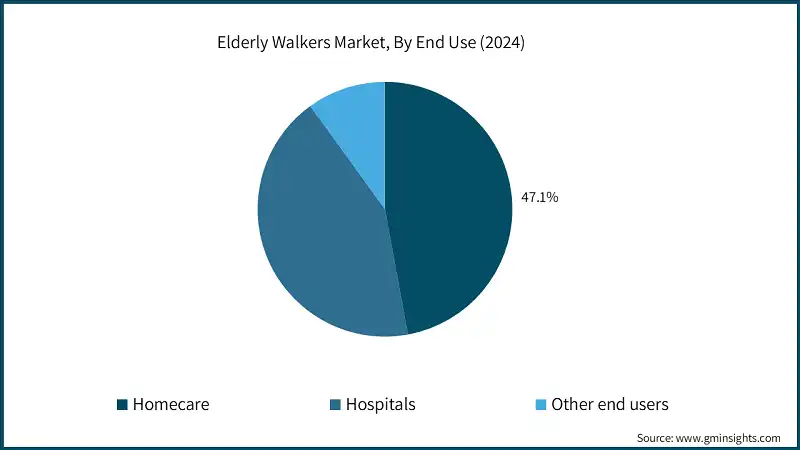
Based on the end use, the elderly walkers market is segmented into homecare, hospitals, and other end users. The homecare segment accounted for the highest market share of 47.1% in 2024 owing to the growing preference for home healthcare, cost-effective way of treatment for patients and supportive government policies to boost the homecare model.
- As more elderly individuals choose to age in their homes, combined with evolving healthcare delivery models, technological progress, regulatory updates, and the ongoing need to reduce healthcare costs, the demand for home healthcare continues to rise.
- Home healthcare has become increasingly important in post-acute care, helping people with essential needs such as mobility assistance and daily living support. For example, as per the data reported by the U.S. Bureau of Labor Statistics report the need for home health and personal care aides will grow by more than 21 percent from 2023 to 2033. This substantial increase in home health employment reflects the growing number of aging individuals who need care, driving the market's expansion.
- Further, the hospital segment accounted for around USD 741.6 million in 2024 and is anticipated to record healthy growth throughout the forecast period owing to rise in number of patients suffering from different orthopedic diseases that may need mobility assistance.
Looking for region specific data?
North America dominated the global elderly walkers market with the highest market share of 36.4% in 2024.
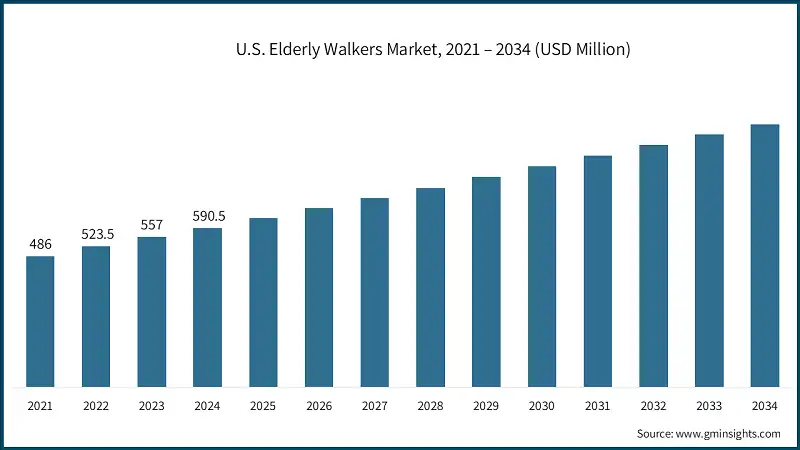
- The U.S. elderly walkers market was valued at 486 million and USD 523.5 million in 2021 and 2022, respectively. In 2024 the market size was valued at USD 590.5 million from USD 557 million in 2023. The high market growth was due to increasing prevalence of different mobility disorders coupled with favorable reimbursement plans for the U.S. adults.
- In North America, the growing number of older adults in the U.S. creates a strong demand for elderly walkers. Considerable percentage of the geriatric age group undergoing some kind of medical attention choose to stay in their homes as they age, resulting in the need for reliable mobility aids to help them live independently.
- The region's well-organized insurance systems, particularly Medicare's coverage of mobility assist devices, make it easier for people to obtain these essential devices.
- The increasing rates of obesity and sedentary lifestyles in the region underlines that people are experiencing mobility difficulties at younger ages, creating a broader demand for such products. The availability of a range of options including multi-wheel walkers, folding walkers, etc. is pushing the product demand.
- Further, the urban spaces in the region are designed to accommodate wheelchairs and walkers, making it easier for people to move around and use these mobility aids in their daily lives.
Europe elderly walkers market accounted for USD 517.2 million in 2024.
- Favorable regulatory policies in European countries have fueled product adoption, leading to enhanced features, better safety and efficacy standards by manufacturers, building confidence among patients.
- Countries such as Germany, UK and France are expected to experience significant growth over the forecast period due to their strong manufacturing base, aging population, and rise in number of road accidents.
- Further, people in Western Europe increasingly prefer staying active as they age, leading more individuals to choose walkers and rollators, as a preventive measure. These mobility aids are commonly used in homes, nursing care facilities, long-term centers and elderly settings throughout the region.
- The market continues to evolve as local manufacturers focus on the development of lighter, more user-friendly designs that better suit the regional population.
The Asia Pacific elderly walkers market is anticipated to witness high growth with a CAGR of 6.4% over the analysis timeframe.
- Asia Pacific is witnessing a significant rise in demand for elderly walkers as its aged population continues to grow, especially in countries such as Japan and South Korea.
- Japan has a significant percentage of older population that lead to widespread adoption of walkers supported by long-term care insurance plans. For instance, according to the data reported by Japan’s Ministry of Internal Affairs and Communications in 2024, the proportion of people aged above 65 years is around 30 percent in the country.
- Additionally, the changing social landscape in countries such as China and India, where more families are moving to cities and living in nuclear families, resulting in many elderly people to live on their own and need mobility support.
- Further, the growing disposable incomes in emerging economies are expected to push the demand for quality mobility aids including walkers and rollators.
The Latin America elderly walkers market is anticipated to witness healthy growth over the analysis timeframe.
- The demand for elderly walkers in Latin America continues to grow due to ageing population in major regional countries such as Brazil, Argentina, Mexico and Chile among other nations.
- In addition, due to the slight decline in birth rates in few regional countries and as the families move to urban areas, more elderly individuals have started living independently, creating a greater need for mobility aids.
- Moreover, the growing awareness by non-governmental organizations and local programs help ensure the distribution of mobility aids particularly in low-income communities.
- Further, local health initiatives and awareness campaigns are helping people understand the importance of preventing falls and supporting mobility among older adults, thereby driving the product demand.
Elderly Walkers Market Share
Leading companies such as drive DeVilbiss Healthcare, MEDLINE, SUNRISE MEDICAL, INVACARE, CAREX together hold between 19% of the market share in the fragmented global market. These players maintain their leading industry position by combining strong product lines, robust geographical presence, business partnerships, and ongoing innovation.
Leading companies in the elderly walkers market are opting for customers first approach by focusing on innovative products and user-friendly designs. The industry players understand the needs of older adults and are using lightweight materials, foldable frames, and other features to help them move around more easily. Modern walker models now come with smart features such as fall alerts, location tracking, and health monitoring systems.
Companies are also making their products more accessible by partnering with local manufacturers in new markets. They have a substantial focus on improving the customer’s online shopping experience from e-commerce platforms to help family caregivers and tech-comfortable customers find the right products. In addition, availability of personalized and tailored product option at affordable cost along with reliable after-sales support is another aspect of focus of industry players.
Elderly Walkers Market Companies
Few of the prominent players operating in the elderly walkers industry include:
- BESCO
- BETTER MEDICAL
- CAREX
- drive DeVilbiss Healthcare
- Evolution WALKERS
- graham field
- HUMAN CARE
- INVACARE
- KARMAN
- MEDLINE
- SUNRISE MEDICAL
- TOPRO USA
- TRIONIC
- tynor
- vive health
- MEDLINE
Medline brings its walker products into its broader home care and hospital supply network. The company stays competitive by delivering products efficiently, offering private label options, and making regular improvements while keeping prices affordable with a focus on both healthcare facilities and patients.
- drive DeVilbiss Healthcare
drive DeVilbiss offers many different types of walkers to help people with various mobility needs. The company invests in developing better features and grows internationally by joining forces with other companies and building strong partnerships with distributors.
- INVACARE
Invacare grows its worldwide reach by creating innovative products and building strong distribution networks. The company creates lightweight, user-friendly walkers and continuously improves its mobility aids to help aging populations with their rehabilitation and home care needs.
Elderly Walkers Market Report Attributes
| Key Takeaway | Details |
|---|---|
| Market Size & Growth | |
| Base Year | 2024 |
| Market Size in 2024 | USD 1.7 Billion |
| Forecast Period 2025 – 2034 CAGR | 5.5% |
| Market Size in 2034 | USD 3 Billion |
| Key Market Trends | |
| Drivers | Impact |
| Growing prevalence of mobility-related disorders | Driving demand for walkers, especially in aging populations with arthritis, osteoporosis, and Parkinson’s disease. |
| Technological advancements in walkers | Enhance and novel features promote product adoption rate, especially in high-income users and regions. |
| Increasing orthopedic procedures | Product demand is expected to rise as walkers are routinely prescribed post-surgery, supporting consistent market demand. |
| Rising demand in home healthcare | Strong growth driver as aging-in-place gains popularity coupled with supportive policies, with walkers used for daily mobility at home. |
| Pitfalls & Challenges | Impact |
| High cost of advanced walkers | Limits access to mobility products in low- and middle-income segments and uninsured populations. |
| Risk of accident and falls | Design limitations affect adoption rate, usability, reliability, and safety, lowering confidence among geriatric population. |
| Opportunities: | Impact |
| Product customization and personalization trend | High growth potential as manufacturers adopt modular and tailored design strategies. |
| Integration of smart technologies | It is anticipated to transform the market with features including fall detection, remote monitoring, and smart mobility. |
| Market Leaders (2024) | |
| Market Leaders |
5.3% market share in 2024 |
| Top Players |
Collective Market Share in 2024 is 19% |
| Competitive Edge |
|
| Regional Insights | |
| Largest Market | North America |
| Fastest Growing Market | Asia Pacific |
| Emerging Countries | India, China, Brazil, Mexico, etc. |
| Future outlook |
|
What are the growth opportunities in this market?
Elderly Walkers Industry News:
- In May 2024, Dash Rehab introduced two new power rollators in its product range for people facing mobility issues. This development may allow the company to enhance its sales prospects in the industry in the coming years.
- In May 2023, Drive DeVilbiss Healthcare announced the launch of its new rollator named as Nitro Sprint, to its popular line of Nitro mobility products. The rollator also features a patented slowdown brake to give users added control and confidence on declines and difficult terrain. This product launch may enable the company to improve its industry presence and expand the product range.
- In February 2023, Journey Health and Lifestyle, a manufacturer of innovative products for seniors, announced that they have acquired LifeWalker Mobility company, the manufacturer of UPWalker family of products. This acquisition enabled the company to expand its geographical and product range and improve its business performance.
The elderly walkers market research report includes an in-depth coverage of the industry with estimates and forecast in terms of revenue (USD Million) and volume (Units) from 2021 - 2034 for the following segments:
Market, By Product Type
- Rollators
- 4-wheeler
- 3-wheeler
- Wheeled walkers
- Standard walkers
Market, By Application
- Geriatric care
- Orthopedic care
- Emergency care
- Other applications
Market, By Distribution Channel
- Brick and mortar stores
- E-commerce
Market, By End Use
- Homecare
- Hospitals
- Other end use
The above information is provided for the following regions and countries:
- North America
- U.S.
- Canada
- Europe
- Germany
- UK
- France
- Italy
- Spain
- Netherlands
- Asia Pacific
- China
- Japan
- India
- Australia
- South Korea
- Latin America
- Brazil
- Mexico
- Argentina
- Middle East and Africa
- South Africa
- Saudi Arabia
- UAE
Frequently Asked Question(FAQ) :
What is the market size of the elderly walkers in 2024?
The market size was USD 1.7 billion in 2024, with a CAGR of 5.5% expected through 2034, driven by the rising prevalence of mobility-related disorders and increasing orthopedic procedures.
What is the projected value of the elderly walkers market by 2034?
The market is expected to reach USD 3 billion by 2034, fueled by advancements in walker and rollator technologies, growing demand for home healthcare, and supportive government policies.
What is the projected size of the elderly walkers market in 2025?
The market is expected to reach USD 1.8 billion in 2025.
How much revenue did the rollators segment generate?
The rollators segment generated USD 975.8 million in 2024, leading the market with a 57.4% share.
What was the valuation of the homecare segment?
The homecare segment held a 47.1% market share in 2024.
Which region leads the elderly walkers market?
North America held a 36.4% share in 2024, driven by a growing geriatric population, favorable reimbursement plans, and advanced healthcare infrastructure.
What are the upcoming trends in the elderly walkers industry?
Key trends include the integration of smart technologies like fall detection and GPS navigation, product customization, and increasing adoption of rollators for enhanced mobility and user comfort.
Who are the key players in the elderly walkers market?
Key players include drive DeVilbiss Healthcare, MEDLINE, SUNRISE MEDICAL, INVACARE, CAREX, BESCO, BETTER MEDICAL, Evolution WALKERS, graham field, HUMAN CARE, KARMAN, TOPRO USA, TRIONIC, tynor, and vive health.
Elderly Walkers Market Scope
Related Reports