Summary
Table of Content

E-Diesel Market
Get a free sample of this report
Form submitted successfully!
Error submitting form. Please try again.
Thank you!
Your inquiry has been received. Our team will reach out to you with the required details via email. To ensure that you don't miss their response, kindly remember to check your spam folder as well!
Request Sectional Data
Thank you!
Your inquiry has been received. Our team will reach out to you with the required details via email. To ensure that you don't miss their response, kindly remember to check your spam folder as well!
Form submitted successfully!
Error submitting form. Please try again.
E-Diesel Market Size
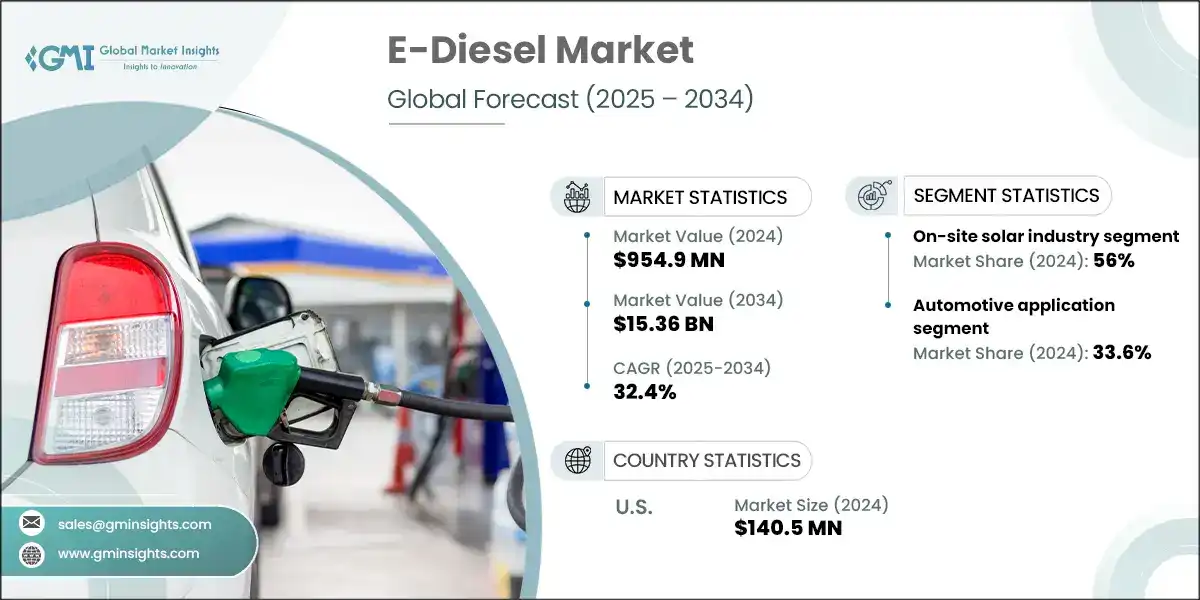
According to a recent study by Global Market Insights Inc., the global E-diesel market was valued at USD 954.9 million in 2024. The market is expected to grow from USD 1.23 billion in 2025 to USD 15.36 billion by 2034, at a CAGR of 32.4%.
E-Diesel Market Key Takeaways
Market Size & Growth
- 2024 Market Size: USD 954.9 Million
- 2034 Forecast Market Size: USD 15.36 Billion
- CAGR (2025–2034): 32.4%
Regional Dominance
- Largest Market: Europe
- Fastest Growing Region: Asia Pacific
Key Market Drivers
- Increasing integration with renewable energy.
- Favourable government policies & incentives.
Challenges
- Consumer awareness & price constraints.
Opportunity
- Expanding industrial applications.
- Global push for carbon neutrality.
Key Players
- Market Leader: ExxonMobil led with over 10% market share in 2024.
- Leading Players: Top 5 players in this market include ExxonMobil, Lanzajet, Norsk E-Fuel AS, Sunfire GmbH, INERATEC GmbH, which collectively held a market share of 30% in 2024.
Get Market Insights & Growth Opportunities
- E-diesel industry growth is based on policy support, infrastructure compatibility, falling renewable and electrolyzer costs, secure CO2 supplies, and successful scale-up of early commercial plants. These factors together create a pathway from niche pilots to meaningful volumes, provided investors, policymakers, and industrial buyers translate announcements into sustained offtake and completed projects.
- The e-diesel market is being driven by a confluence of regulatory, technological, and commercial forces that make synthetic, low-carbon diesel an attractive option, particularly for hard-to-abate transport and industrial sectors. Tightening emissions regulations and net-zero commitments from governments and corporations create direct market pull for drop-in low-carbon fuels.
- Policymakers in multiple jurisdictions are accelerating mandates and incentives for sustainable fuels, which increases demand visibility for producers and investors. This regulatory tailwind is a central growth lever for e-diesel projects. For instance, in March 2025, the Environmental Protection Agency (EPA) announced the deregulation of diesel emissions across the U.S., thereby spurring the adoption of sustainable fuels.
- E-diesel’s compatibility with existing diesel engines, supply chains, and distribution infrastructure is a major adoption facilitator. The product can be blended with conventional diesel and used in current fleets without engine modifications, thereby offering a lower risk decarbonization pathway for trucking, marine, and off-road applications where electrification is difficult. This practical advantage shortens the commercialization timeline relative to disruptive alternatives and supports incremental market uptake.
- Rapid scaling of green hydrogen and renewable electricity is lowering the input cost and environmental footprint of e-diesel production. E-diesel production is fundamentally a power-to-liquid value chain that requires low-cost, low-carbon electricity and electrolysis for hydrogen. As the cost of renewables and electrolyzers falls, project economics improve, and the market expands from pilot plants toward larger commercial facilities
- Availability and sourcing of low-carbon CO2 (direct air capture, industrial point sources) and investments in carbon management are critical enablers. Commercial e-diesel depends on reliable, traceable CO2 streams, partnerships between CO2 capture firms and fuel producers are therefore a common feature of new projects. For instance, in March 2025, Ucaneo and Aramco came into a strategic agreement to develop DAC technology owing to the seed funding of over USD 6.7 million.
- This vertical integration reduces feedstock risk and supports lifecycle carbon accounting required by regulators and buyers. In addition, technological maturation and early commercial projects are de-risking the market and attracting capital. Demonstration and first-of-a-kind commercial plants both validate technical pathways and create supply references for offtake agreements.
- For illustration, multiple commercial and commercial-scale PtL projects have reached operational or near-operational status in recent years, supporting the credibility of e-diesel as a scalable product. This includes the opening of early commercial e-fuel facilities and the deployment of modular PtL plants in Europe.
- Rising corporate offtake commitments and aviation/transport sector interest are augmenting the demand corridors and improving project finance ability. Airlines, logistics firms, and large industrial buyers signing advanced purchase agreements will bridge the gap between high initial production costs and long-term price parity.
To get key market trends
E-Diesel Market Trends
- Robust policy frameworks and targeted market-creation mechanisms are the catalysts for commercializing e-diesel. Governments and regional authorities that introduce low-carbon fuel standards, blending mandates, procurement set-asides, or capital support lower both demand and revenue risk for first-of-a-kind power-to-liquid projects. Such policies create predictable price or volume signals that allow developers to structure financing, secure long-term offtake contracts, and attract strategic corporate partners.
- For instance, in May 2025, the European Union awarded over USD 992 million to 15 projects to accelerate renewable hydrogen production, which in turn will add to the development of e-diesel production down the line. This strategic move is aimed at accelerating the production of nearly 2.2 million tons of renewable hydrogen over the next decade, offsetting more than 15 million tons of CO2 emissions.
- Increasing product demand from the end market, including hard-to-electrify sectors and pragmatic sectors, further proposes industry growth. Heavy-duty trucking, maritime, remote mining, off-road construction, and freight & logistics operations prioritize fuel solutions that avoid major vehicle or port infrastructure overhauls. This practical adoption path generates initial, high-value demand scenarios in which customers will pay a premium for verified lifecycle emissions reductions.
- Rapid global deployment of electrolyzer capacity and supportive public auctions/grants have driven component manufacturing scale-up and supply chain maturation, which together push down capex per MW. In addition, innovation in carbon sourcing, including procuring biogenic CO2, industrial point-source capture, and eventual co-location with direct air capture, is lowering feedstock transport penalties and enabling more concentrated, lower-risk project configurations.
- Proliferation of strategic alliances and agreements that enhance initial volumes will attract concessional and commercial capital, aligning the incentives across the chain. Long-term projects by airports and major corporations, structured financing instruments will create a favorable scenario for the investment in e-diesel production over the forecast timeline.
- The e-diesel market in North America is experiencing steady growth driven by supportive regulatory frameworks, increasing investments in renewable fuels, and the rising demand for low-carbon transportation solutions. For instance, in January 2025, the government of Canada announced over USD 11 million to support projects that will advance the technologies needed to further strengthen Canada’s clean fuels and alternative fuels sectors.
- Europe remains at the forefront of e-diesel market expansion, supported by the European Union’s ambitious climate policies and the Green Deal objectives targeting net-zero emissions by 2050. Countries including Germany, Sweden, and the Netherlands are leading the adoption through strong policy incentives, carbon taxation, and investments in Power-to-Liquid (PtL) projects.
E-Diesel Market Analysis
Learn more about the key segments shaping this market
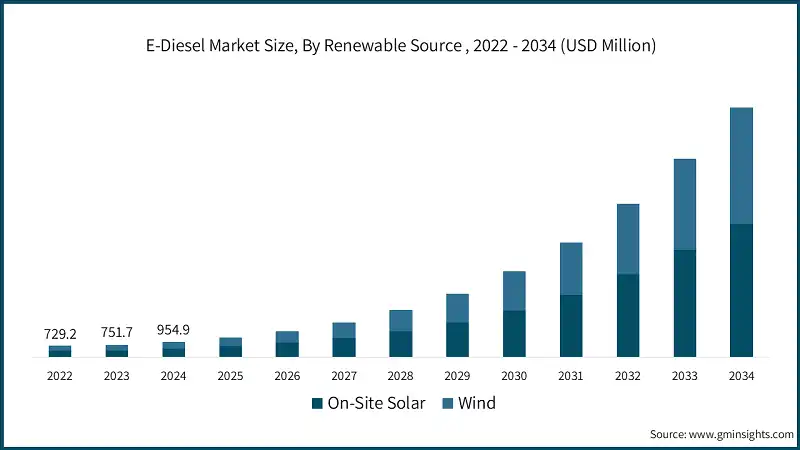
- Based on renewable sources, the market is segmented into on-site solar and wind. The on-site solar industry dominated with 56% revenue share in 2024 and will grow at a CAGR of 31.8% till 2034. Increasing adoption of on-site solar for energy autonomy is augmenting the producers to increasingly turn to on-site solar power systems to achieve greater operational independence from traditional grids.
- For instance, in May 2025, Lake Lucerne Navigation Company (SGV) AG used solar-derived synthetic diesel from Synhelion for its steamboat, Gallia. In addition, the navigation company plans to regularly purchase solar fuel from Synhelion in the future and has also signed a five-year offtake agreement. This in turn will further augment the industry outlook towards e-diesel consumption for various end uses in the future.
- The production of e-diesel is electricity-intensive, particularly in the hydrogen electrolysis stage, and solar arrays located directly at production sites enable a steady supply of clean power without relying on fluctuating grid tariffs. Facilities in regions with high solar irradiance including Southern Europe, Australia, the Middle East, and Latin America, are prioritizing solar integration to reduce operational costs and meet corporate sustainability targets.
- The continued drop in photovoltaic (PV) panel prices coupled with advancements in energy storage solutions is making on-site solar a more economically viable choice for e-diesel projects. For instance, the International Energy Conservation Code (IECC) in June 2025 stated that global prices of solar photovoltaic modules have fallen to less than USD 0.10 per watt. This in turn will further contribute to industry growth.
- The wind source industry will grow at a CAGR of 33% through 2034, driven by rising initiatives towards leveraging high-capacity wind power for industrial-scale production. Wind energy, especially in high-wind coastal and offshore regions, is becoming a preferred renewable source for powering large-scale e-diesel facilities.
- In addition, offshore wind projects are increasingly being paired with hydrogen and e-diesel production facilities targeted at the export market. The North Sea in Europe and coastal regions of Asia Pacific are emerging as hubs where large offshore wind farms feed directly into synthetic fuel plants. For instance, in October 2024, 9 European countries reaffirmed their ambition to transform the North Sea into Europe’s green power plant.
- Advancements in wind turbine technology, including larger rotor diameters, taller towers, and more efficient blade designs are lowering the cost per megawatt-hour of wind energy. This cost competitiveness is critical for e-diesel production, where electricity is the main cost driver. Modern wind farms are delivering higher output with fewer turbines, improving land and sea usage efficiency and strengthening the financial case for wind-powered e-diesel projects.
Learn more about the key segments shaping this market
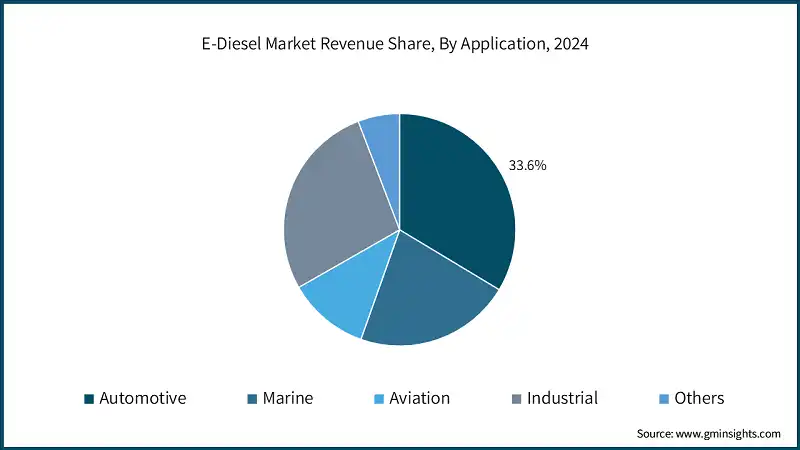
- Based on application, the market is categorized into automotive, marine, aviation, and industrial, among others. The automotive application industry caters to a market share of 33.6% in 2024. The automotive sector is witnessing growing adoption of e-diesel as manufacturers and fleet operators seek low-carbon alternatives to conventional fuels.
- Government policies, including low-emission zones in Europe and California’s stricter carbon standards, are accelerating their uptake. For instance, since January 2025, the Netherlands has designated an urban area where no polluting vans and trucks are allowed to drive, which in turn has increased the demand for sustainable fuel. Passenger vehicles, buses, and heavy-duty trucks benefit from e-diesel’s high energy density and cleaner combustion, which reduce particulate and NOx emissions.
- Marine application industry will witness a CAGR of 31% through 2034 and is gaining momentum as ship operators address International Maritime Organization (IMO) emission targets. Its drop-in compatibility with existing marine diesel engines makes it a practical choice for reducing lifecycle greenhouse gas emissions without costly retrofits.
- E-diesel is emerging as a supplementary fuel option for aviation, particularly in ground operations, auxiliary power units, and small aircraft segments. While sustainable aviation fuels (SAF) dominate decarbonization strategies, e-diesel offers a viable, renewable alternative for hybrid fuel blends. Regional airports and private aviation companies are exploring their use to lower carbon footprints without major engine modifications.
- The industrial application segment will cross USD 4 billion by 2034. The industrial applications for e-diesel are expanding as manufacturing plants, construction firms, and mining operations seek to reduce carbon emissions without disrupting operations. Heavy machinery, backup generators, and off-grid equipment benefit from e-diesel’s compatibility with existing diesel engines and its cleaner combustion profile.
- For instance, in May 2025, as per Organization of the Petroleum Exporting Countries (OPEC) stated that India's oil demand will rise by 3.4% in 2025, double the pace of China, which in turn will create a demand for oil, precisely synthetic diesel in order to fulfill the sustainable initiatives.
Looking for region specific data?
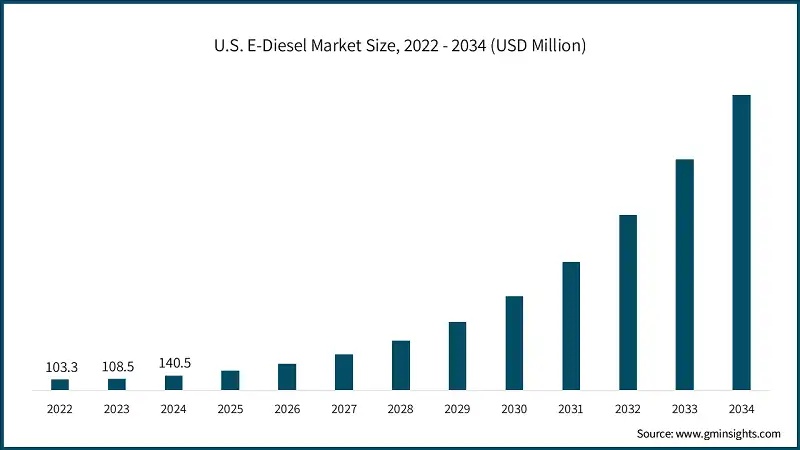
- The U.S. dominated the e-diesel market across North America with around 95% share in 2024 and generated USD 140.5 million in revenue. The integration of e-diesel into heavy-duty trucking, marine transport, and aviation is gaining momentum, particularly in states with stringent emission norms such as California. Moreover, collaborations between energy companies and technology developers are accelerating pilot projects and commercial-scale production facilities.
- The Canada e-diesel market will cross USD 140 million by 2034. The country is actively promoting alternative fuel adoption through federal and state-level incentives, blending mandates, and decarbonization targets for the transport sector. For instance, in January 2025, the government of Canada stated that as per its renewed CFF budget, over USD 770 million is allocated between 2024-2025 and 2029-2030 to support clean fuels projects.
- The Europe e-diesel market size exceeded USD 627 million in 2024. The growing focus on decarbonizing hard-to-electrify sectors including shipping, aviation, and heavy industrial transport is boosting e-diesel demand. Strategic collaborations between fuel producers, renewable energy providers, and automotive manufacturers are fostering a robust supply chain.
- For instance, in January 2024, Neste, in Finland, concluded the E-Fuel research project, showcasing progress in the development of electro fuels. The company completed a major E-Fuel research project under the Neste Veturi ecosystem, producing carbon-neutral synthetic e-diesel using captured CO2 and green hydrogen.
- The Asia Pacific e-diesel market will grow at a CAGR of 37% up to 2034, largely fueled by the increasing emphasis on energy diversification and carbon neutrality commitments by key economies including Japan, China, and Australia. Australia & Japan’s long-term hydrogen roadmap and investment in synthetic fuels are supporting early-stage e-diesel projects, thereby adding to the market growth.
- For instance, in April 2025, the government of Australia announced that it will tighten fuel standards from December 2025, which will enhance petrol & diesel quality and reduce emissions, along with aligning with the country's international fuel standards. In addition, the approval for a paraffin diesel standard will support the transition to cleaner energy sources, thereby augmenting market growth.
- The Middle East & Africa region is increasingly positioning itself as a potential production hub for e-diesel, leveraging its vast renewable energy potential, particularly solar and wind power. Countries including the United Arab Emirates and Saudi Arabia are investing in green hydrogen projects, which serve as a critical feedstock for e-diesel production.
- Latin America’s e-diesel market will grow at a CAGR of 30.4% through 2034 and is gradually developing, supported by abundant renewable energy resources, particularly in Brazil, Chile, and Argentina. Chile’s leadership in green hydrogen production is paving the way for integrated e-diesel projects, targeting both domestic and export markets.
E-Diesel Market Share
- The top 5 companies in the e-diesel industry are ExxonMobil, Lanzajet, Norsk E-Fuel AS, Sunfire GmbH, and INERATEC GmbH, which collectively contributed around 30% of the market in 2024. ExxonMobil, with its scale and global infrastructure, holds a dominant share due to its integrated energy operations. Sunfire GmbH and INERATEC GmbH are strong European solution providers, leveraging advanced electrolysis and modular reactor technologies to scale production.
- Lanzajet focuses on aviation fuels along with contributing to e-diesel innovation through strategic partnerships. Norsk E-Fuel AS is gaining traction with its Norway-based projects aligned with EU climate goals. Furthermore, Synhelion, with its solar-thermochemical approach, offers a unique pathway to e-diesel, positioning itself as a sustainable disruptor. Together, these firms shape a dynamic and rapidly evolving market, which in turn will augment the business outlook in forecast timeline.
E-Diesel Market Companies
Major players operating in the E-diesel industry are:
- Arcadia eFuels
- Ballard Power Systems, Inc.
- CAC Synfuel Plant
- Clean Fuels Alliance America
- Ceres Power Holding Plc
- Climeworks AG
- ExxonMobil
- eFuel Pacific Limited
- Electrochaea GmbH
- FuelCell Energy, Inc.
- HIF Global
- INERATEC GmbH
- Liquid Wind
- LanzaJet
- MAN Energy Solutions
- Norsk E-Fuel AS
- Nordic Electrofuel
- Porsche
- Sunfire GmbH
- Synhelion
- ExxonMobil reported USD 14.8 billion in earnings for the first half of 2025, with a strong cash flow of USD 24.5 billion. The company is actively expanding its renewable fuel portfolio, including e-diesel, through projects like the Strathcona Renewable Diesel facility in Canada and the Fawley Hydrofiner in the UK. These initiatives align with ExxonMobil’s broader strategy to lead in low-emission fuel production.
- Climeworks AG, a Swiss pioneer in Direct Air Capture (DAC) technology. Their captured CO2 is used in producing carbon-neutral fuels, including e-diesel, making the company a critical enabler in the synthetic fuel supply chain. Their modular plants are scalable and support negative emissions, vital for climate targets.
- With estimated annual revenue of USD 1.3 billion, MAN Energy Solutions is a major engineering firm focused on decarbonizing marine and industrial sectors. The company contributes to the e-diesel market through its advanced turbomachinery and carbon capture systems, supporting sustainable fuel production and energy efficiency.
- Porsche generated over USD 21 billion in revenue in the first half of 2025, with 36.1% of its vehicle deliveries being electrified. The company is investing in e-fuels, including e-diesel, through partnerships like HIF Global, aiming to power its iconic models sustainably. Porsche’s strategic realignment emphasizes resilience and innovation in clean mobility.
E-Diesel Market Report Attributes
| Key Takeaway | Details |
|---|---|
| Market Size & Growth | |
| Base Year | 2024 |
| Market Size in 2024 | USD 954.9 Million |
| Forecast Period 2025 – 2034 CAGR | 32.4% |
| Market Size in 2034 | USD 15.36 Billion |
| Key Market Trends | |
| Drivers | Impact |
| Increasing integration with renewable energy | E-diesel production is increasingly powered by renewable energy sources like solar and wind, enhancing sustainability and reducing lifecycle emissions. |
| Favourable government policies & incentives | Supportive regulations and subsidies across Europe and North America are accelerating investment in e-diesel technologies and infrastructure. |
| Pitfalls & Challenges | Impact |
| Consumer awareness & price constraints | Limited public understanding of e-diesel and its higher production costs compared to conventional fuels hinder widespread adoption. |
| Opportunities: | Impact |
| Expanding industrial applications | E-diesel offers a scalable solution for decarbonizing hard-to-electrify sectors like shipping, aviation, and heavy transport. |
| Global push for carbon neutrality | Rising demand for low-emission fuels under net-zero targets presents a major growth opportunity for e-diesel producers. |
| Market Leaders (2024) | |
| Market Leaders |
10% market share |
| Top Players |
Collective market share in 2024 is 30% |
| Competitive Edge |
|
| Regional Insights | |
| Largest Market | Europe |
| Fastest Growing Market | Asia Pacific |
| Emerging Countries | U.S., Germany, UK, China, Australia, Saudi Arabia, Brazil |
| Future outlook |
|
What are the growth opportunities in this market?
E-Diesel Industry News
- In August 2025, Rolls-Royce Power Systems partnered with Ineratec to begin rolling out synthetic e-diesel in emergency backup generators for German data centers. The fuel is produced at Ineratec’s ERA ONE facility in Frankfurt using renewable hydrogen and captured CO2 and can serve as a drop-in replacement for petroleum diesel.
- As of August 2024, Canadian Nuclear Laboratories announced government-backed funding of USD 4.9 million to develop low-carbon synthetic diesel and sustainable aviation fuel. This underscores North America’s increasing commitment to e-fuel development.
- In January 2024, The Norsk e-Fuel project in Norway supported by Norwegian Airlines and technology providers including Sunfire targeted industrial-scale e-fuel capacity of 200,000 tons/year by 2030 and has secured offtake commitments totaling over 140,000 tons from airlines like Norwegian and Cargolux.
This E-diesel market research report includes in-depth coverage of the industry with estimates & forecasts in terms of revenue (USD Million) from 2021 to 2034, for the following segments:
Market, By Renewable Source
- On-site solar
- Wind
Market, By Technology
- Fischer-tropsch
- eRWGS
- Others
Market, By Application
- Automotive
- Marine
- Aviation
- Industrial
- Others
The above information has been provided for the following region & countries:
- North America
- U.S.
- Canada
- Europe
- Germany
- UK
- France
- Spain
- Netherlands
- Asia Pacific
- China
- India
- Japan
- South Korea
- Australia
- Middle East & Africa
- Saudi Arabia
- UAE
- South Africa
- Latin America
- Brazil
- Argentina
Frequently Asked Question(FAQ) :
What is the market size of the E-diesel in 2024?
The market size was USD 954.9 million in 2024, with a CAGR of 32.4% expected through 2034 driven by policy support, infrastructure compatibility, and declining renewable energy costs.
What is the projected value of the E-diesel market by 2034?
The E-diesel market is expected to reach USD 15.36 billion by 2034, propelled by regulatory support, technological advancements, and increasing demand from hard-to-electrify sectors.
How much revenue did the on-site solar segment generate in 2024?
On-site solar dominated the renewable sources segment with 56% market share in 2024 and is projected to grow at a CAGR of 31.8% till 2034.
What was the market share of the automotive application segment in 2024?
The automotive application segment held 33.6% market share in 2024, fueled by fleet operators seeking low-carbon alternatives and supportive government policies.
What is the growth outlook for wind-powered E-diesel from 2025 to 2034?
Wind-powered E-diesel production is projected to grow at a CAGR of 33% through 2034, due to offshore wind integration and advancing turbine technology reducing energy costs.
Which region leads the E-diesel market?
Europe leads the E-diesel market with USD 627 million in 2024, supported by EU's ambitious climate policies, Green Deal objectives, and strong investments in Power-to-Liquid projects.
What are the upcoming trends in the E-diesel market?
Key trends include integration with renewable energy sources, modular reactor innovations, expansion into maritime and industrial sectors, and strategic partnerships for CO₂ capture and supply chain development.
Who are the key players in the E-diesel market?
Key players include CAC Synfuel Plant, Clean Fuels Alliance America, Ceres Power Holding Plc, Climeworks AG, ExxonMobil, eFuel Pacific Limited, Electrochaea GmbH, FuelCell Energy, Inc., HIF Global, INERATEC GmbH, Liquid Wind.
E-Diesel Market Scope
Related Reports