Summary
Table of Content

Dry Vacuum Pump Market
Get a free sample of this report
Form submitted successfully!
Error submitting form. Please try again.
Thank you!
Your inquiry has been received. Our team will reach out to you with the required details via email. To ensure that you don't miss their response, kindly remember to check your spam folder as well!
Request Sectional Data
Thank you!
Your inquiry has been received. Our team will reach out to you with the required details via email. To ensure that you don't miss their response, kindly remember to check your spam folder as well!
Form submitted successfully!
Error submitting form. Please try again.
Dry Vacuum Pump Market Size
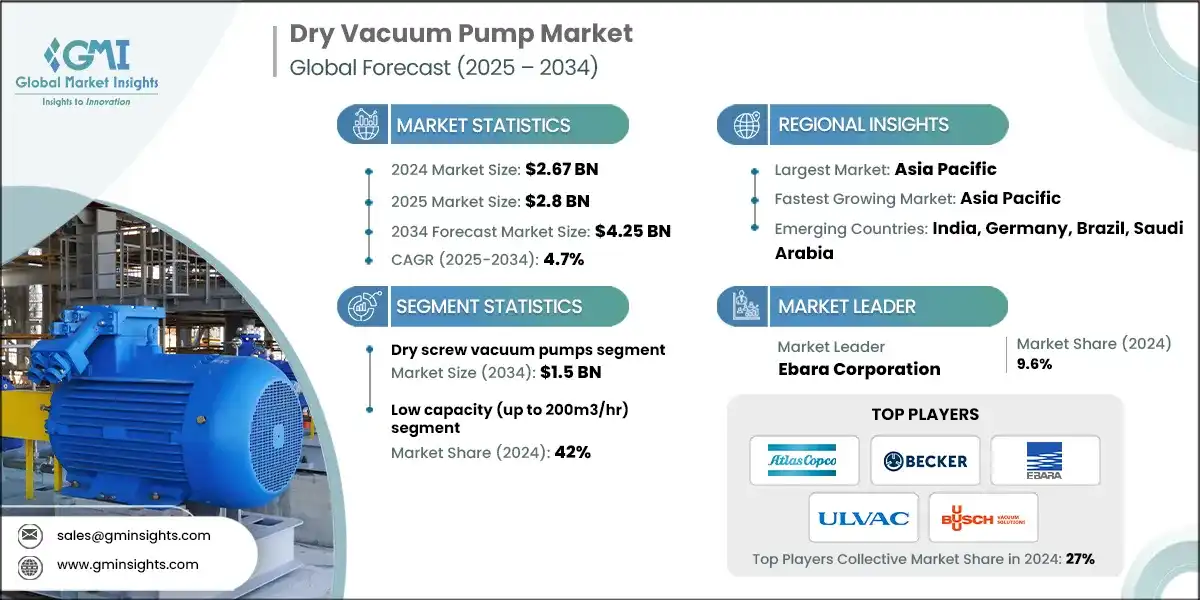
The global dry vacuum pumps market was estimated at USD 2.67 billion in 2024. The market is expected to grow from USD 2.80 billion in 2025 to USD 4.25 billion in 2034, at a CAGR of 4.7% according to latest report published by Global Market Insights Inc.
To get key market trends
- The global dry vacuum pump market is continuing to show vigorous growth, primarily due to the rapid growth of semiconductor and electronics industry. With many countries investing heavily towards the goals of digital transformation, deploying energy-efficient technologies, and increasing domestic chip manufacturing capability, the demand for modern vacuum systems that support high-precision contamination-free manufacturing processes has surged.
- Thus, dry vacuum pumps with oil-free operation, low maintenance requirements, and clean operation for applications such as wafer fabrication, thin film deposition, lithography, etching, and packaging, will be very much needed.
- Across the globe, governments are providing large amounts of funding to stimulate domestic semiconductor manufacturing capabilities to reduce import dependence and ensure supply chain resiliency. For instance, the United States Government, through the CHIPS and Science Act of 2022, pledged USD 52 billion in federal funds for semiconductor manufacturing, R&D, and workforce development, providing billions in grants and tax subsidies for new fabrication plants that are under construction in subjects including Arizona, Texas, and New York. Many of these plants will manufacture new chips that will require large quantities of dry vacuum pumps to sustain the clean room standards and process integrity required for advanced chip manufacturing.
- The Asia-Pacific region is a hub for semiconductor manufacturing and countries like Taiwan, South Korea, Japan, and China are raising manufacturing capacity for semiconductors to meet demand for semiconductors used in automobiles, smartphones, AI applications, and 5G infrastructure.
- Companies in the region like Taiwan’s TSMC, SK Hynix and Samsung from South Korea, and SMIC from China are also investing tens of billions of dollars in new fabs.
- Similarly, India recently announced a $10 billion semiconductor incentive plan to get global players to attract semiconductor fabrication units in India, which is a further driver for demand in vacuum pumps in the region. Europe has also entered the race with the EU Chips Act which has earmarked €43 billion in investment to establish Europe as a global producer of chips.
- In summary, the global transformation into reshoring chip production, electrification of vehicles, AI hardware development, and green electronics manufacturing have drastically increased the demand for dry pumps that can operate clean, quietly, and energy-efficiently.
- As fabrication technologies further develop and complexity increases, the demand for highly reliable, digitally integrated vacuum systems will continue to grow making the semiconductor and electronics industry one of the key long-term growth drivers for the dry pump industry.
Dry Vacuum Pump Market Report Attributes
| Key Takeaway | Details |
|---|---|
| Market Size & Growth | |
| Base Year | 2024 |
| Market Size in 2024 | USD 2.67 Billion |
| Market Size in 2025 | USD 2.80 Billion |
| Forecast Period 2025 - 2034 CAGR | 4.7% |
| Market Size in 2034 | USD 4.25 Billion |
| Key Market Trends | |
| Drivers | Impact |
| The increasing adoption of dry vacuum pumps in industries | The increasing adoption of dry vacuum pumps in industries such as semiconductors, healthcare, and chemical processing is driving market growth |
| Advancements in technology | Advancements in technology are enabling the development of more efficient and durable vacuum pumps, enhancing their adoption across various applications. |
| Pitfalls & Challenges | Impact |
| High initial costs and maintenance expenses | High initial costs and maintenance expenses associated with dry vacuum pumps pose significant challenges to market growth. |
| Lack of skilled professionals | The lack of skilled professionals to operate and maintain advanced dry vacuum pumps systems can hinder their adoption. |
| Opportunities: | Impact |
| Growing focus on renewable energy | The growing focus on renewable energy and the increasing use of dry vacuum pumps in solar panel manufacturing present lucrative opportunities for market players. |
| Expansion of industries in emerging economies | The expansion of industries in emerging economies and the rising demand for vacuum pumps in pharmaceutical and food processing sectors offer significant growth potential. |
| Market Leaders (2024) | |
| Market Leaders |
9.6% market share |
| Top Players |
Collective market share in 2024 is 27% |
| Competitive Edge |
|
| Regional Insights | |
| Largest Market | Asia Pacific |
| Fastest growing market | Asia Pacific |
| Emerging countries | India, Germany, Brazil, Saudi Arabia |
| Future outlook |
|
What are the growth opportunities in this market?
Dry Vacuum Pump Market Trends
- The global dry vacuum pumps industry is expected to achieve vigorous growth over the next few years, largely as a result of the growth of semiconductor and electronics manufacturing.
- Due to the rapidly increasing requirements for advanced microchips and electronic devices on a global scale, especially in the Asia Pacific and North American regions, there is a growing demand for high-performance vacuum pumps that can sustain clean, oil-free environments that are paramount to these manufacturing processes.
- Additionally, sustainability is an emerging factor in all industries, as they take responsibility for their environmental impact and consequently start to steer towards more energy-efficient environmentally friendly pump technologies in the market.
- Of these reliable pump options are dry vacuum pumps which use no lubricants and limit environmental contamination responsible for this increase to the demand for pump options that were considered sustainable and a global environmental goal for manufacturers. Therefore, manufacturers are speeding up their development of eco-friendly dry vacuum pumps to produce environmentally friendly designs that will follow stricter regulations.
- Another significant trend influencing the dry vacuum pump market is the increasing use of smart technology and automation. Smart technology solutions can include IoT (Internet of Things) features, which allow companies to monitor pumps in real time, allow for predictive maintenance and operate pumps more efficiently.
- All of this adds up to lower downtime and reduced energy costs and will improve the user's bottom line. The Asia Pacific market will see the strongest growth due to large investments in semiconductor manufacturing, solar power, and pharmaceuticals.
- Government programs supporting clean energy and automation will also play a role in increased demand for dry vacuum pumps. Southeast Asian countries are also expected to become significant markets as industrial activity ramp-up and companies move to improved vacuum solutions.
- While the opportunities are significant, challenges such as high upfront costs to purchase the devices and upkeep may affect the adoption by smaller enterprises or organizations.
- But manufacturers are taking the initiative and are designing more cost-effective, modular, and easy to use pump designs which are fit to better serve emerging economies as well as small to medium-sized businesses.
- Additionally, demand continues to be driven from industries such as food processing, biotechnology, and pharmaceuticals, as dry vacuum pumps are critical in lyophilization, distillation, and sterilization processes (among other applications).
- Technology advancements, sustainability initiatives, and regional industry growth will all combine to create a bright future for the global dry vacuum pumps market in general.
Dry Vacuum Pump Market Analysis
Learn more about the key segments shaping this market
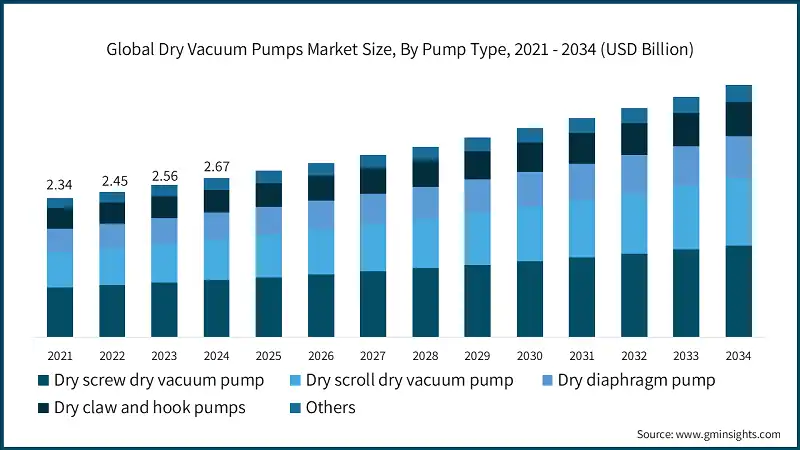
Based on pump type, the market is divided into dry screw vacuum pump, dry scroll vacuum pump, dry diaphragm pump, dry claw and hook pumps, others. In 2024, dry screw vacuum pumps exceeded USD 900 million and is expected to reach USD 1.5 billion by 2034.
- The dry screw vacuum pump is the most popular vacuum pump today especially in applications such as semiconductors, chemicals, and pharmaceuticals specifically because they can manage “dirty” gases without any contamination; there is no oil in the design.
- Dry screw vacuum pumps also maintain a high level of efficiency with less maintenance, longer service life creating attractive capital charges for continuous operations. As the demand for cleaner and energy-efficient processes increases, many companies are replacing their vacuum systems with screw-type pumps to meet stricter environmental criteria and improve system reliability.
- Dry scroll vacuum pumps are commonly used in applications that require a quiet, clean, compact vacuum source. Some applications include laboratories, medical equipment, and electronics manufacturing. Their oil-free operation is desirable, is low noise, low vibration, and requires little maintenance which makes them an ideal choice for small, indoor applications.
- Although dry scroll vacuum pumps lack the power of screw pumps, their operating cost, reliability, and compact designs make them a popular choice for light-duty or sensitive applications that must be kept clean and compact.
Learn more about the key segments shaping this market
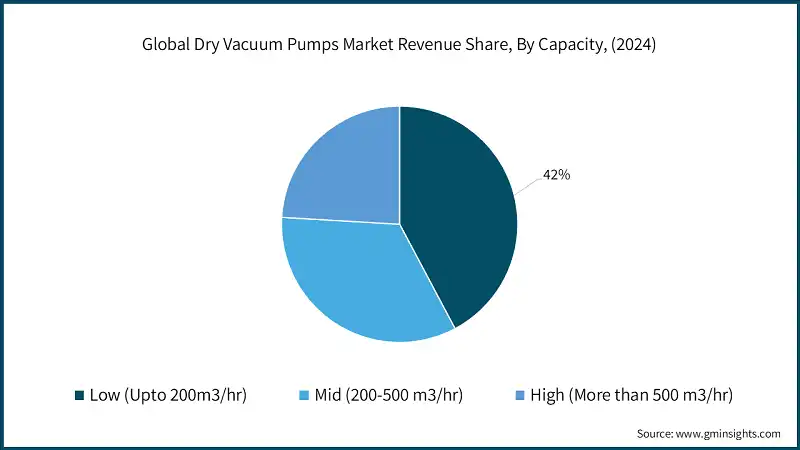
Based on capacity, the dry vacuum pump market is categorized into low (up to 200m3/hr), mid (200-500 m3/hr), high (more than 500 m3/hr). In 2024, low capacity held the dominant market share of 42% and is anticipated to grow through the years.
- Low-capacity dry vacuum pumps are pumps that have a pumping speed of 200m³/hr. or less. They serve small to medium-scale applications such as laboratories, medical devices, and manufacturing processes. Low-capacity dry vacuum pumps are convenient because of their small size, lower energy consumption and ease of implementation.
- Low-capacity pumps are suitable for smaller scale operations which can typically use a dry vacuum without concerns of possible issues because of a lack of vacuum levels. Low-capacity dry vacuum pumps are effective and reliable oil-free solutions, and their cost and benefits make them an attractive option for operations that are limited by space.
- Mid capacity dry vacuum pumps have pumping speeds from 200 to 500m³/hr. and are useful for a broader range of industrial applications that require moderate to high levels of vacuum.
- Mid capacity dry vacuum pumps are useful in industries such as chemical processing, pharmaceuticals and electronics manufacturing to name a few. Mid capacity dry vacuum pumps provide a wide range of sizes, power consumption/performance and are suitable for medium scale operations that need reliable, oil free vacuum solutions and that’s also energy efficient.
Based on end use, the dry vacuum pump market is divided into electronics and semiconductor industry, pharmaceutical industry, chemical and petrochemical industry, oil and gas industry, food and beverages industry, and others.
- The electronics and semiconductor industry is one of the largest markets for dry vacuum pumps as most manufacturing processes within the sector require contaminant-free, oil-free vacuum environments. Dry vacuum pumps represent a critical piece of equipment for applications ranging from wafer fabrication to chip packaging and testing. In these applications, any contaminant introduced into the process can lead to expensive defects. The additional value of dry vacuum pumps is that they provide precise vacuum controls, require less power, and have lower maintenance costs that suit the speed of manufacturing and high levels of quality control demanded by the electronics and semiconductor industry.
- The pharmaceutical industry too makes heavy use of dry vacuum pumps in processes that require freezing drying, distillation and filtering applications, for example. By design, dry vacuum pumps provide oil-free vacuums to guarantee the purity of their products, alongside precise control of the pressure in their process.
Looking for region specific data?
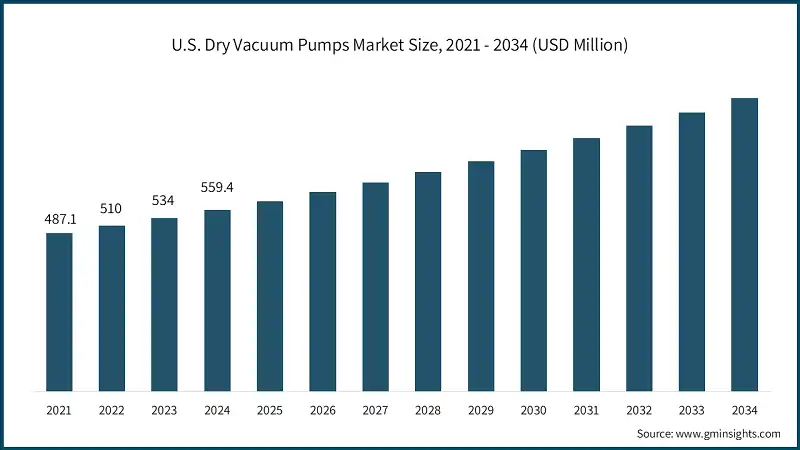
United States dominated with 83% of the North American vacuum pump market share and estimated USD 559.4 million in 2024.
- The United States represents the dominant force in dry vacuum pump demand, driven by the largest semiconductor investment in U.S. history through the CHIPS Act and comprehensive industrial policy support for strategic manufacturing sectors. The scale economy advantages of the largest industrial base in North America create demand volumes that justify significant manufacturing investments and advanced technology development.
- Canada's dry vacuum pump market is characterized by resource sector stability that provides consistent demand from oil sands and mining operations, which require specialized dry vacuum systems capable of operating in harsh environments. The strong research infrastructure, including world-class universities and government laboratories, creates steady demand for precision dry vacuum systems in research applications.
The Europe dry vacuum pump market was valued at USD 781.5 million in 2024 and is projected to grow at a CAGR of 4.4% between 2025 and 2034.
- Germany represents the industrial powerhouse of European dry vacuum pump demand, driven by its position as Europe's largest manufacturing economy and global leader in chemical and pharmaceutical production. The country's chemical-pharmaceutical industry, with USD 121 billion in sales, creates substantial demand for industrial vacuum systems, while companies like BASF, Bayer, and Merck KGaA operate world-class manufacturing facilities that require sophisticated dry vacuum solutions.
The Asia Pacific market for dry vacuum pump was valued at USD 900.1 million in 2024 and is projected to grow at a CAGR of 5.3% between 2025 and 2034.
- China represents the largest and fastest-growing dry vacuum pump market in Asia-Pacific, driven by unprecedented semiconductor manufacturing expansion and the world's largest industrial base. The "Made in China 2025" initiative prioritizes semiconductor independence and is driving massive investments in domestic manufacturing capabilities, with each advanced fab requiring extensive dry vacuum system installations for critical production processes.
- India's dry vacuum pump market is experiencing exceptional growth driven by the country's expanding industrial base. The country's "Make in India" initiatives are driving industrial expansion across multiple sectors, creating demand for dry vacuum systems in chemical processing, electronics manufacturing, and diverse industrial applications.
The Middle East and Africa market was valued at USD 138.7 million in 2024 and is projected to grow at a CAGR of 3.9% between 2025 and 2034.
- Saudi Arabia represents the largest dry vacuum pump market in the Middle East & Africa region, driven by the country's massive oil and gas operations and ambitious economic diversification initiatives under Vision 2030.
- Saudi Aramco's position as the world's largest oil company creates substantial demand for vacuum systems through upstream oil production, downstream refining operations, and petrochemical processing activities that require sophisticated dry vacuum solutions for complex hydrocarbon processing.
- The country's petrochemical industry, led by SABIC, creates additional demand for dry vacuum systems across diverse petrochemical processing applications.
Dry Vacuum Pump Market Share
- The top 5 companies in the dry vacuum pump industry are Atlas Copco, Becker Vacuum Pumps, Ebara Corporation, ULVAC, and Busch Vacuum Solutions collectively hold a share of 27% in the market.
- These companies continue to acquire and merge with others, expand facilities, and make various collaborations to increase their product offerings, access customer bases, and secure their market positions.
- Atlas Copco is gaining market share through its global leadership and product diversity. Atlas Copco emphasizes ongoing innovation, providing energy-saving and sustainable vacuum pump solutions to every industry. Its strategic acquisitions and alliances further reinforce its market leadership.
- Becker Vacuum Pumps is increasing market share by focusing on high-quality, long-lasting, and customized vacuum pump solutions. The company competes in special applications in healthcare, packaging, and printing industries where precision and reliability are critical. Becker's customer-specific solution approach and capacity to accommodate unique operation requirements differentiate it from others.
- Ebara Corporation is expanding its market base by leveraging its deep experience in high-tech engineering and advanced manufacturing. The company provides an extensive portfolio of vacuum pumps suitable for high-performance industries such as electronics, chemicals, and semiconductors. Ebara's emphasis on precision engineering and technological advancements provides more quality and reliability products. The company also invests in creating its global presence through partnerships and local manufacturing plants.
Dry Vacuum Pump Market Companies
Major players operating in the dry vacuum pump industry are:
- Agilent Technologies
- Atlas Copco
- Becker Vacuum Pumps
- Busch Vacuum Solutions
- Ebara Corporation
- Flowserve Corporation
- Graham Corporation
- Ingersoll Rand Inc
- Kashiyama Industries
- Orion Machinery
- Osaka Vacuum
- Schmalz Group
- Shinko Seiki
- ULVAC
- Unozawa
To improve the product and market share key players are constantly investing in technological activities and are also entering into partnerships to provide improved and better solutions for the customers. These investments are benefiting both companies and customers as they help develop and offer solutions as per the changing technological trends and thus the customer requirements.
Atlas Copco, an industrial vacuum technology company, provides an integrated range of oil-free and energy-saving vacuum pumps. The product range of the company spans the technologies of claw, screw, and rotary vane and is used across multiple industries like electronics, food packaging, pharmaceuticals, plastics, and woodworking. The company is a key player in point-of-use as well as centralized vacuum systems, which are utilized to enhance process reliability, reduce noise levels, and enhance energy efficiency.
Flowserve is a multinational corporation that operates in the vacuum pump business. Flowserve, by its wholly owned subsidiary SIHI Group, delivers high-tech vacuum pumps to diverse industries. These are designed for clean, oil-free operation and deliver mission-critical industries like semiconductor manufacturing, pharmaceutical, and chemical processing.
Ingersoll Rand is an industrial technology global company providing vacuum pumps through its subsidiaries like Nash, Tuthill Pump Group and Ingersoll rand. They provide oil and oil-free vacuum solutions that can withstand the harsh conditions of industries like manufacturing, healthcare, food processing, and electronics. For its engineering prowess, Ingersoll Rand provides dry vacuum pumps that are dependable, energy-saving, and low-maintenance, making them well-suited for continuous operations.
Dry Vacuum Pump Market News
- In August 2025, Atlas Copco acquired CRI-Man S.p.A., an Italian company specializing in pumps and grinders for industrial and agricultural wastewater. Based in Modena, CRI-Man employs around 50 people and serves applications in biogas and agriculture. The acquisition supports Atlas Copco’s strategy to expand its Power Technique business area, particularly in sustainable wastewater treatment and energy recovery solutions. CRI-Man will continue to operate under its existing brand, contributing to Atlas Copco’s growing portfolio of environmentally focused technologies.
- In July 2025, Busch Vacuum Solutions has introduced the air-cooled version of its COBRA NC 2500 C dry screw vacuum pump, recognized as the largest dry and air-cooled vacuum pump globally. This new model includes a standard electric water pump across all COBRA NC 2500 C units and features an air/water radiator equipped with two high-efficiency electric fans. The cooling liquid circulates in a closed loop between the vacuum pump and the radiator, with the radiator and fans functioning as a heat exchanger.
- In January 2025, Agilent Technologies launched the Agilent IDP-35 and IDP-45 dry scroll pumps, designed to provide quiet, efficient, and oil-free vacuum solutions for applications requiring higher pumping capacity. Consistent with the high standards of Agilent's IDP scroll pump series, the IDP-35 and IDP-45 offer significant benefits, making them ideal for applications needing increased capacity without the limitations of oil-sealed pumps.
- In January 2024, Becker Pumps announced the inauguration of a new facility in Bolton, Ontario, Canada, as part of its strategic market expansion in North America. This facility is designed to function as a centralized hub for inventory management, technical support, and customer service, enabling the company to improve operational efficiency and better cater to the needs of its Canadian customers.
The dry vacuum pump market research report includes in-depth coverage of the industry with estimates & forecasts in terms of revenue (USD Billion) and volume (Million Units) from 2021 to 2034, for the following segments:
Market, By Pump Type
- Dry screw vacuum pump
- Dry scroll vacuum pump
- Dry diaphragm pump
- Dry claw and hook pumps
- Others
Market, By Capacity
- Low (Up to 200m3/hr)
- Mid (200-500 m3/hr)
- High (More than 500 m3/hr)
Market, By End Use Industry
- Electronics and semiconductors
- Pharmaceutical
- Chemical and petrochemical
- Oil and gas
- Food and beverages
- Others
Market, By Distribution Channel
- Direct sales
- Indirect sales
The above information is provided for the following regions and countries:
- North America
- U.S.
- Canada
- Europe
- Germany
- UK
- France
- Spain
- Italy
- Netherlands
- Asia Pacific
- China
- Japan
- India
- Australia
- South Korea
- Latin America
- Brazil
- Mexico
- Argentina
- MEA
- South Africa
- Saudi Arabia
- UAE
Frequently Asked Question(FAQ) :
What is the growth outlook for the Asia Pacific dry vacuum pump market?
The Asia Pacific dry vacuum pump market was valued at USD 900.1 million in 2024 and is set to grow at a 5.3% CAGR from 2025 to 2034, supported by industrial growth and rising semiconductor production.
Who are the key players in the dry vacuum pumps market?
Key players include Agilent Technologies, Atlas Copco, Becker Vacuum Pumps, Busch Vacuum Solutions, Ebara Corporation, Flowserve Corporation, Graham Corporation, Ingersoll Rand Inc, Kashiyama Industries, Orion Machinery, Osaka Vacuum, Schmalz Group, Shinko Seiki, ULVAC, and Unozawa.
Which region leads the dry vacuum pumps market?
The United States dominated the North American vacuum pump market with an 83% share, valued at around USD 559.4 million in 2024.
What was the market share of low-capacity dry vacuum pumps in 2024?
Low-capacity dry vacuum pumps held a 42% market share in 2024, dominating the capacity segment.
What is the market size of the dry vacuum pumps in 2024?
The market size was USD 2.67 billion in 2024, with a CAGR of 4.7% expected through 2034, driven by rising demand from the semiconductor and electronics industry, technological advancements, and a shift toward sustainable, energy-efficient equipment.
How much revenue did the dry screw vacuum pump segment generate in 2024?
Dry screw vacuum pumps generated USD 900 million in 2024, leading the market due to their energy-efficient operation and high reliability.
What is the current dry vacuum pumps market size in 2025?
The market size is projected to reach USD 2.80 billion in 2025.
What is the projected value of the dry vacuum pumps market by 2034?
The dry vacuum pumps market is expected to reach USD 4.25 billion by 2034, propelled by growth in the semiconductor industry and increasing adoption of energy-efficient technologies.
Dry Vacuum Pump Market Scope
Related Reports