Summary
Table of Content

Dropshipping Market
Get a free sample of this report
Form submitted successfully!
Error submitting form. Please try again.
Thank you!
Your inquiry has been received. Our team will reach out to you with the required details via email. To ensure that you don't miss their response, kindly remember to check your spam folder as well!
Request Sectional Data
Thank you!
Your inquiry has been received. Our team will reach out to you with the required details via email. To ensure that you don't miss their response, kindly remember to check your spam folder as well!
Form submitted successfully!
Error submitting form. Please try again.
Dropshipping Market Size
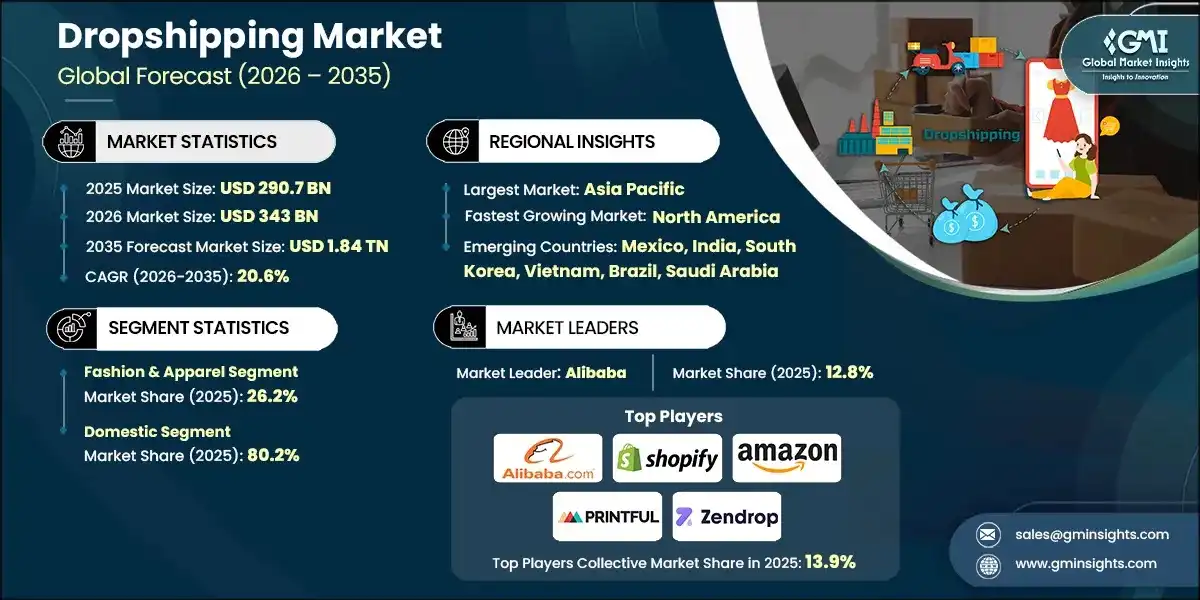
The global dropshipping market size was valued at USD 290.7 billion in 2025. The market is expected to grow from USD 343 billion in 2026 to USD 1.84 trillion in 2035 at a CAGR of 20.6%, according to latest report published by Global Market Insights Inc.
Dropshipping Market Key Takeaways
Market Size & Growth
- 2025 Market Size: USD 290.7 Billion
- 2026 Market Size: USD 343 Billion
- 2035 Forecast Market Size: USD 1.84 Trillion
- CAGR (2026–2035): 20.6%
Key Market Drivers
- Low Barrier to Entry for Entrepreneurs.
- Growth of Global E-commerce.
- Rise of Social Commerce & Mobile Shopping.
- Expansion of Cross-Border E-commerce.
Challenges
- Long Shipping Times from Overseas Suppliers.
- Supplier Reliability Issues.
Opportunity
- Niche & Micro-Niche Market Targeting.
- Domestic/Regional Supplier Networks.
- B2B Dropshipping Growth.
- Influencer-Driven Commerce Integration.
Key Players
- Market Leader: Alibaba led with over 12.8% market share in 2025.
- Leading Players: Top 5 players in this market include Alibaba, Shopify, Amazon, Printful, Zendrop, which collectively held a market share of 13.9% in 2025.
Get Market Insights & Growth Opportunities
Affordable social media ads are helping the market grow by providing low-cost promotion options for small and medium-sized businesses. These ads allow dropshippers to reach specific audiences with little spending, increasing their visibility and sales. Platforms like Facebook, Instagram, and TikTok offer tools to target specific groups based on demographics and interests, making ads more effective and improving conversion rates.
In addition, businesses can track and analyze ad performance in real time, helping them improve their strategies and get better results. Since social media ads are still cheaper than traditional media, dropshipping businesses can expand their operations more easily.
Over 27% of retailers use dropshipping to fulfill orders. Many online retailers choose this model because it lets them sell products on e-commerce platforms or their own stores without keeping inventory. Consequently, this trend is fueling the growth of the market by making it more accessible and profitable for a broader range of participants.
Market success depends on the profit or ROI made through the business model. Dropshipping is expected to increase an online store's profit by 10-15%. This is because there is no need to keep physical inventory. Dropshipping stores can offer a variety of products and change their catalogs without taking financial risks. Products are only shipped after a customer places an order.
To get key market trends
Dropshipping Market Trends
The traditional dropshipping business is being transformed by AI and ML technology. Entrepreneurs in the dropshipping business now have access to these technologies, allowing them to make more informed decisions about what products to sell. The use of AI & ML allows for more thorough and precise analysis and evaluation of sales trends and improved decision-making.
For example, AI quickly analyzes large amounts of data, such as social media trends, competitor sales, and search engine queries. By using this type of technology, sellers can quickly identify the most popular sellers on the market and forecast demand before they become oversaturated with other sellers. In addition to this, automation software is becoming increasingly more important for those who are utilizing a dropshipping model.
Meanwhile, With the use of automation software, individuals no longer have to spend countless hours performing repetitive manual tasks. Instead, the automation software will take over those repetitive tasks and provide a platform that allows for growth. Automation software creates an automated link between the online store of the seller and supplier's shipping and inventory management systems through the use of API technology.
Due to high competition, dropshippers are moving away from selling a wide range of products and are focusing on specific niches. Businesses that offer specialized products, like eco-friendly home goods or ergonomic tools, are more likely to succeed. This approach builds stronger customer loyalty because customers see these businesses as experts.
The growth of global e-commerce allows dropshippers to reach customers worldwide. They can sell products that are hard to find or expensive in certain areas, meeting specific needs across regions. For example, a supplier in Asia can easily ship trendy and unique products to customers in North America or Europe.
Dropshipping Market Analysis
Learn more about the key segments shaping this market
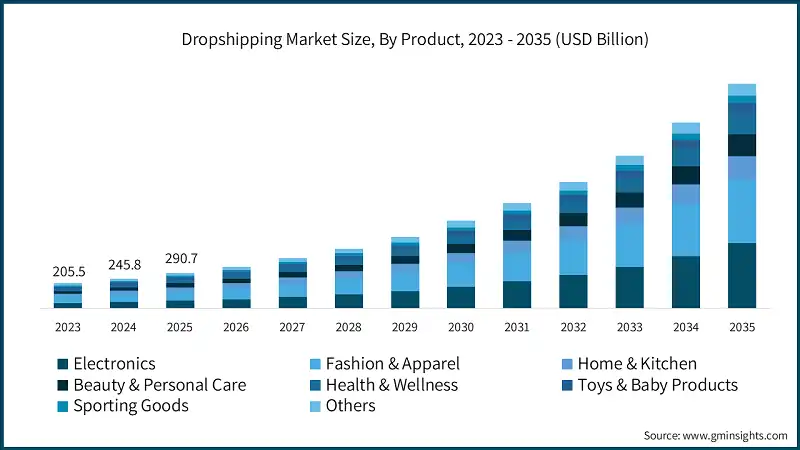
Based on product, the market is divided into electronics, fashion & apparel, home & kitchen, beauty & personal care, health & wellness, toys & baby products, sporting goods and others. The fashion & apparel segment dominated the market with 26.2% share.
- Electronics and fashion are the main categories in the market. Electronics benefit from global standards and frequent upgrades, while fashion thrives on variety and visual appeal. In 2023, around 1.2 billion smartphones were shipped, more than double the number in 2010.
- The large scale of fashion e-commerce and the growing trend to shop secondhand has opened up new opportunities for niche brands and unique style options. Other growing categories in e-commerce include Home & Kitchen, Beauty & Personal Care, Health & Wellness, Toys & Baby, and Sporting Goods, as well. Each of these areas has its own needs for shipping, regulations, and merchandising.
- International dropshipping of electronics can be highly effective due to the universally accepted characteristics and high digital interest (via search engines) associated with them. The fashion industry has found great success using social commerce, as the method used for displaying product attributes and styles through short video clips are ideal for social media engagement. Many beauty products are lightweight, expensive and purchased repeatedly, but they are subject to many regulations for the inclusion of materials and labeling of their contents.
Learn more about the key segments shaping this market
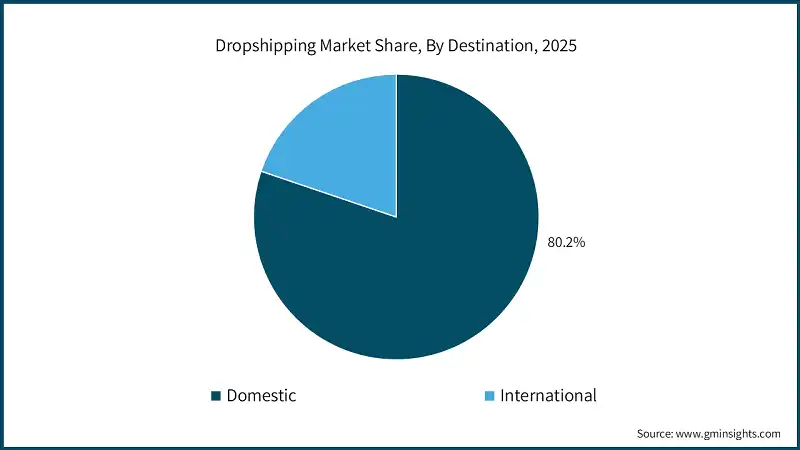
Based on destination, the dropshipping market is segmented into domestic and international. The domestic segment substantially leads the market by 80.2% market share in 2025.
- In 2025, domestic dropshipping made up most of the market because it offered faster delivery, easier returns, and simple payments within the same country. On the other hand, cross-border dropshipping grew due to the rise in global digital trade, which increased from USD 4.59 trillion in 2020 to USD 7.23 trillion in 2024, growing about 12% annually. By 2024, cross-border e-commerce made up nearly one-third of all online sales, showing strong demand for international products and price differences.
- The EU's IOSS rules and the removal of the €22 de minimis threshold changed how imports to Europe are handled, making the process stricter but clearer. In the U.S., the USD 800 de minimis limit stayed the same, but volumes more than doubled since 2020, leading to more regulatory focus and better data tracking.
- International dropshipping is growing faster than domestic dropshipping because of better logistics and access to more products. However, longer shipping times, complicated returns, and VAT/GST issues make domestic dropshipping a better choice for products that need fast delivery. As digital payments improve and translation tools get better, cross-border transactions will become easier.
- For companies, the main point is to offer their products thoughtfully, make quick-selling items available locally, and for special items with high margins, shipping across borders. Besides, the support programs for e-commerce in emerging markets are also a big help for small businesses, and a lot of them have already obtained millions in contracts through selective initiatives.
Looking for region specific data?
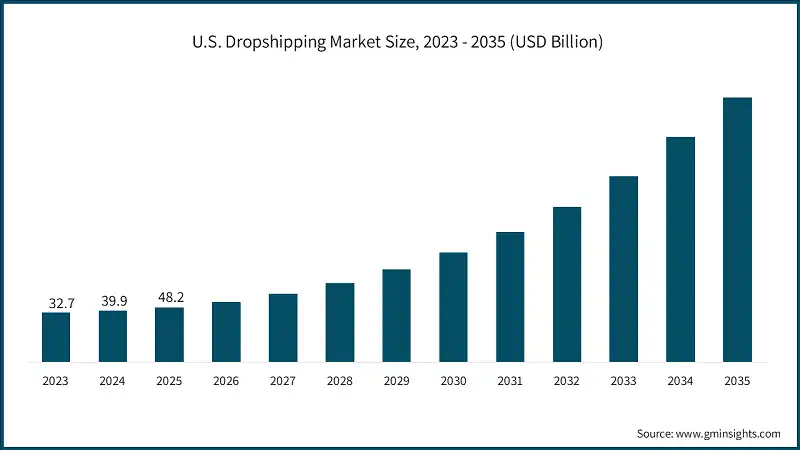
The US dropshipping market reached USD 48.2 billion in 2025, growing from USD 39.9 billion in 2024.
- The U.S. market benefits from its advanced digital systems and supportive environment for entrepreneurs. High e-commerce usage and widespread internet and smartphone access provide a large, always-available customer base.
- A secure digital payment system and the low cost of starting a dropshipping business align well with the entrepreneurial culture in the U.S. This makes it easy for small businesses to quickly start and use existing e-commerce platforms.
- Another important factor is the strong U.S. logistics network and changing consumer preferences. Dropshipping depends on various suppliers, and the efficient logistics system ensures fast deliveries to meet customer expectations. Dropshipping meets this demand by offering a variety of products, including niche items, without needing to keep inventory.
- The market's growth is supported by strong e-commerce sales data. In Q2 2025, U.S. retail e-commerce sales grew by 1.4% compared to the previous quarter and 5.3% compared to the same period last year. This growth is faster than total retail sales, which increased by 0.4% quarter-over-quarter and 3.9% year-over-year. With e-commerce making up 16.3% of total sales in Q2 2025, the ongoing shift to online shopping ensures a growing revenue stream and suggests dropshipping's importance as a key distribution method in the U.S.
The North America region is growing at the fastest CAGR of 22.6% between 2026 and 2035.
- The North American dropshipping market is expanding at a faster pace than the other regions as a result of improved logistics, the strong presence of marketplaces, and the high level of consumer spending. In the third quarter of 2025, about 62% of the sales, in terms of units, happened through third-party sellers in the largest US marketplace.
- In Canada, the market is powered by the strong platform infrastructure and trade connections with the US. Social commerce is getting more and more popular with younger consumers. E-commerce represented 6.1% of the total retail sales in Canada in December 2024, with online retail sales around USD 3.14 billion.
- Moreover, Canada’s e-commerce market is estimated to have reached almost US$89.4 billion in gross merchandise value (GMV).
The Europe dropshipping market accounted for USD 23.8 billion in 2025 and is anticipated to grow at the CAGR of 17.1% between 2026 and 2035.
- Europe's market faces strict consumer protection and VAT rules. These rules increase compliance requirements but also build consumer trust. The removal of the €22 de minimis threshold and the introduction of the IOSS have changed import costs and processes, requiring better tax and data management.
- Advanced e-commerce systems and the high level of digital skills are the driving factors behind the strong growth of dropshipping in Germany, the UK, France, and the Netherlands. The sellers in Europe are adopting dropshipping as a way to test new items without the risk of keeping the stock, which has led to its popularity among small retailers and startups.
- The robust e-commerce market of Germany combined with active marketplaces of the UK, France, and Poland are the facilitators of local and international trade. The customers are leaning towards eco-friendly products like longer-lasting goods, circular systems, and local fashion. The role of social media and marketplaces is considerable but winning over the customers still hinges on having unambiguous delivery and return policies.
Germany's dropshipping market is growing quickly in Europe, with a strong CAGR of 16.5% between 2026 and 2035.
- In Germany, about 83% of internet users between 16- and 74-years old buy goods online, which significantly opens up the market in Germany as result of Germany’s high purchasing power and wide use of e-commerce. Furthermore, the e-commerce market in Germany is predicted to expand by 7.13% per annum from 2025 to 2029, thereby amounting to USD 142 billion by 2029. Thus, Germany becomes a major player in Europe’s digital retail environment and an appealing market for dropshipping companies.
- One of the significant challenges of dropshipping that is depending on third-party shipping is resolved with the help of Germany's first-rate logistics network. Fast, reliable and economical deliveries that meet the expectations of consumers in Germany are guaranteed by the country's central position in the European Union and state-of-the-art courier, express and parcel (CEP) services.
- Moreover, enormous digital marketplaces together make up 57% of the total online sales in Germany. Trusted platforms of this kind can be leveraged by dropshippers to bring in customers and divert their attention to providing great products and services.
The Asia Pacific dropshipping market accounted for USD 200.9 billion in 2025, and it is anticipated to grow at a CAGR of 20.6% during the analysis timeframe.
- One of the main factors that make the Asia Pacific region the largest market for dropshipping is the strong manufacturing base, plus the variety of platforms and increasing spending of the middle class.
- In the region, China is a major player in this scenario as it is the biggest production hub and a wide market for consumers; at the same time, the main platforms are concentrating on mergers and acquisitions and investing in worldwide commerce infrastructure. The fast spread of digital access and social commerce in India is positively impacting the number of both sellers and buyers.
- Rapidly growing regional social media, mainly those that incorporate short videos, are the ones to look out for in the future. The rise in internet penetration is anticipated to be one of the factors driving the growth of cross-border trade in Asia along with the advancements in logistics and payment systems.
China is estimated to grow with a CAGR of 19.9% between 2026 and 2035, in the Asia Pacific dropshipping market.
- The Chinese market remains robust, what with its highly developed industry, logistics support from the government, and expanding global e-commerce customer base. Being the "world's factory", China offers dropshippers an extensive variety of products at low prices due to its massive production.
- This pricing advantage boosts the profits of overseas sellers and makes it easier for them to source products, besides facilitating quick entry into multiple niches. Thus, e-commerce startups around the globe are lured by the strong supply chain.
- The year 2024 saw a rise in online retail sales by 9.8% compared to previous year, with almost $996 billion being total sales. The dropshipping model, allowing new entrants to easily access the market, takes advantage of the low cost and variety of Chinese goods. Therefore, the Chinese supply chain becomes a crucial part of the e-commerce economy worldwide.
Latin America dropshipping market accounted for USD 10.8 billion in 2025 and is anticipated to show lucrative growth over the forecast period.
- The size of the dropshipping industry in Latin America is getting bigger along with the digital transformation. This transformation is very intentional and not an incidental effect of the scenario. Governments and private sectors are collaborating to build an e-commerce ecosystem with a good level of trust.
- The number of internet and smartphone users in the area has led to a scenario where mobile shopping is the primary mode of shopping. It is this connectivity that empowers dropshippers to target a wide customer base without the need for poor inventory management.
- Over the next few years, the e-commerce sector in Latin America will undergo a major transformation, with the largest markets in the area predicted to register a 25% growth in sales volume, thus providing an ongoing flow of income for internet retailers.
- Digital payment solutions such as Brazil's Pix are considerably facilitating the transaction process. In 2023, Pix is estimated to manage 29% of e-commerce retail sales in Brazil, thus overtaking credit and debit cards. For dropshipping traders, this will be the case that there will be quicker and more secure transactions, and also, they will be able to have more customers, less abandoned carts, and informal market activities coming to the fore.
Brazil is estimated to grow with a CAGR of 20.1% between 2026 and 2035, in the Latin America dropshipping market.
- The Brazilian market is expanding, driven by the country's digital advancements and financial innovations. Brazil is home to almost 150 million internet users, more than 55 million of them are online buyers, thus, it has a huge and tech-savvy market. Good mobile coverage and the increase in mobile shopping are the main reasons for this demand.
- The financial system of Brazil is also a significant factor. The PIX instant payment method, which the government launched, makes payments very fast and cheap, which is a necessity for expeditious cash flow in dropshipping. The 'parcelamento' option for payment in installments boosts the purchasing power of consumers.
- Dropshipping contributes to the growth of small businesses and individuals. It eliminates the necessity of pre-purchased stock and warehouse space, thus reducing the starting cost of a business. This, in turn, opens the market for more Brazilians to catch the wave of huge domestic demand the country has.
The Middle East and Africa accounted for USD 3.5 billion in 2024 and is anticipated to show lucrative growth over the forecast period.
- The MEA Dropshipping Market has been fueled by changes in digital and demography across the region. The young population that is inclined towards mobile shopping and the high use of smartphones have together formed a sizable online consumer base.
- The dropshipping model, on the other hand, with its low entry barriers, permits small traders and startups to reap the benefits of rising disposable incomes and the growing demand for a variety of international products.
- The MEA's average two-day delivery percentage rate is 38%, but it is heavily influenced by certain areas. The UAE is at the top with a two-day delivery rate of 65% and then comes South Africa with 41%. This clearly indicates that delivery efficiency is a phenomenon mainly found in the developed urban areas.
- In the underdeveloped areas, the dropshippers have to deal with issues such as poor road conditions, complex customs regulations, and the last mile delivery which is already made difficult by the lack of addressing system, making it even worse.
UAE to experience substantial growth in the Middle East and Africa dropshipping market in 2024.
- The market for dropshipping in the UAE has governmental backing in the form of explicit policies and rules. The new laws for e-commerce and the continuous attempts to develop the digital economy are creating a secure and open system for online businesses.
- The UAE's Free Zones provide international business investors with the assurance that they will not only get 100% ownership but also no tax burden, and this is encouraging global entrepreneurs to set up their businesses in the region, and this is also making it easier for the newcomers in the dropshipping industry to enter the market.
- The UAE's solid logistics and infrastructure fortify the market even more. Their geographic position, state-of-the-art ports, airports, and speedy domestic delivery services are an indispensable part of the dropshipping process. The systems in place allow for the rapid and cost-effective transportation of goods from foreign suppliers to local consumers.
- This speed not only keeps prices down but also caters to the increasing need for same-day and next-day delivery, thus eliminating one of the major difficulties faced by e-commerce.
Dropshipping Market Share
The top 7 companies in the market are Shopify, Alibaba, Printful, Amazon, CJ Dropshipping, AutoDS and Zendrop contributing 13.9% of the market in 2024.
- Shopify helps merchants create online stores easily with its e-commerce platform. It works with dropshipping apps like DSers and Collective to make product sourcing, inventory updates, order processing, and secure payments simple, without needing sellers to keep physical stock.
- Alibaba's main B2B marketplace is a large global sourcing platform. It connects dropshippers with wholesalers and manufacturers for bulk product purchases. It also offers direct dropshipping services through its specialized portals.
- Printful offers a Print-on-Demand (POD) dropshipping service. Users can create custom designs for products like clothing, accessories, and home goods using its Design Maker tool. Printful manages production, storage, packaging, and shipping, delivering the products directly to customers.
- Amazon's marketplace allows sellers to use dropshipping by listing products and sending orders to third-party suppliers for fulfillment. Sellers use the Amazon Seller Central program to reach Amazon's large customer base while following its strict seller policies.
- CJ Dropshipping is a complete dropshipping platform that provides product sourcing, global warehousing, and order fulfillment. It offers a wide range of products and extra services like quality checks, custom packaging, and print-on-demand options.
- AutoDS is a dropshipping automation tool that simplifies daily tasks. It includes features like importing products from over 25 suppliers, tracking prices and stock, product research, and automated order processing with tracking updates.
- Zendrop is a US-based fulfillment platform focused on fast shipping and reliable sourcing. It connects e-commerce store owners with trusted suppliers and offers features like one-click product imports, automated order fulfillment, and custom branding options such as thank-you cards and private labels.
Dropshipping Market Companies
Major players operating in the dropshipping industry are:
- Shopify
- Alibaba
- Amazon
- CJ Dropshipping
- SaleHoo
- Spocket
- Printful
- Zendrop
- AutoDS
- DSers
- Shopify is a top e-commerce platform that is easy to customize and scale for online stores. Its large App Store allows quick integration with most dropshipping and fulfillment apps (including those mentioned below), giving merchants full control over branding, marketing, and the customer experience.
- Alibaba's strength is its direct access to manufacturers, offering the lowest wholesale prices. It is ideal for experienced dropshippers who want private labeling, product customization, and better deals on bulk orders to increase profits.
- Printful is a leader in the Print-on-Demand (POD) dropshipping industry, focusing on quality and global fulfillment. It handles everything from design to printing, warehousing, and shipping through its own and partner facilities, ensuring high-quality branded products.
- Amazon's main advantage is its huge audience of buyers and the trust associated with its brand. Dropshippers use Amazon's marketplace to reach customers without spending much time or money on building brand awareness.
- CJ Dropshipping offers a complete logistics service, including warehousing, consolidation, and fulfillment. It provides personalized support and has fulfillment centers in the US and other countries, offering faster shipping options (like "CJ Packet") and competitive prices for a wide range of products.
- AutoDS is a leading dropshipping automation tool. It saves time by automating tasks like product research, importing products with one click, and monitoring prices and stock to reduce risks and errors in high-volume businesses.
- Zendrop focuses on fast fulfillment from US-based warehouses and pre-approved suppliers, ensuring quicker delivery to North American customers. This improves customer satisfaction and reduces refund requests compared to overseas fulfillment methods.
Dropshipping Market Report Attributes
| Key Takeaway | Details |
|---|---|
| Market Size & Growth | |
| Base Year | 2025 |
| Market Size in 2025 | USD 290.7 Billion |
| Market Size in 2026 | USD 343 Billion |
| Forecast Period 2026-2035 CAGR | 20.6% |
| Market Size in 2035 | USD 1.84 Trillion |
| Key Market Trends | |
| Drivers | Impact |
| Low Barrier to Entry for Entrepreneurs | Encourages rapid entrepreneurial participation, significantly accelerating dropshipping adoption and expanding competitive intensity across markets |
| Growth of Global E-commerce | A rising digital retail ecosystem consistently boosts dropshipping activity |
| Rise of Social Commerce & Mobile Shopping | Mobile-first buying behavior enhances conversion rates, enabling faster product discovery and driving higher dropshipping sales globally |
| Expansion of Cross-Border E-commerce | International fulfillment capabilities broaden customer reach and stimulating strong market expansion |
| Pitfalls & Challenges | Impact |
| Long Shipping Times from Overseas Suppliers | Delayed deliveries from overseas suppliers reduce customer satisfaction and negatively affecting overall business performance |
| Supplier Reliability Issues | Inventory inaccuracies and quality failures weaken brand credibility, causing operational disruptions and reduced customer trust |
| Opportunities: | Impact |
| Niche & Micro-Niche Market Targeting | Focused product categories reduce competition and stronger brand positioning within targeted audiences |
| Domestic/Regional Supplier Networks | Localized sourcing cuts delivery times and boosting long-term loyalty |
| B2B Dropshipping Growth | Enterprise-level buyers generate stable, recurring orders, strengthening market depth and long-term revenue predictability |
| Influencer-Driven Commerce Integration | Social endorsements accelerate product visibility and conversions for dropshipping brands |
| Market Leaders (2025) | |
| Market Leaders |
12.8% market share |
| Top Players |
Collective market share in 2025 is 13.9% |
| Competitive Edge |
|
| Regional Insights | |
| Largest Market | Asia Pacific |
| Fastest Growing Market | North America |
| Emerging Country | Mexico, India, South Korea, Vietnam, Brazil, Saudi Arabia |
| Future Outlook |
|
What are the growth opportunities in this market?
Dropshipping Industry News
- In November 2025, ShopFunnels, a Dubai-based ecommerce technology company, announced that its White-Label Dropshipping System is now used in over 30 countries. The system helps people set up online stores with ready-made infrastructure, workflows, and AI tools.
- In October 2025, Logicbroker bought Virtualstock, a UK-based online retail technology company, to strengthen its dropshipping services. Virtualstock works with big UK brands like Aldi, Argos, and John Lewis, making it easier for suppliers to join and manage products through its platform.
- In December 2025, DropSure, a dropshipping company, added new features to its platform to connect with Shopify, WooCommerce, TikTok, and other major e-commerce platforms. This update gives businesses one place to manage their operations.
- In July 2024, Fiverr acquired AutoDS, a service that helps dropshippers with tasks like finding products, managing inventory, and automating orders. AutoDS has a global reach, offering over 150 million products to thousands of subscribers.
- In January 2024, Logicbroker announced it had acquired Cortina, a growing company in marketplace and dropshipping solutions.
The dropshipping market research report includes in-depth coverage of the industry with estimates & forecasts in terms of revenue ($ Mn/Bn) and shipment (number of orders) from 2022 to 2035, for the following segments:
Market, By Product
- Electronics
- Fashion & apparel
- Precious metal & jewelry
- Clothes
- Footwear
- Others
- Home & kitchen
- Beauty & personal care
- Health & wellness
- Toys & baby products
- Sporting goods
- Others
- Food & beverages
- Automotive & car accessories
- Furniture & home furnishings
- Hobby & DIY
- Furniture & home furnishings
- Media
Market, By Destination
- Domestic
- International
Market, By Business Model
- B2C
- B2B
- SMEs
- Large enterprises
- C2C
Market, By Sales Channel
- Online marketplaces
- Branded e-commerce stores
- Social commerce platforms
The above information is provided for the following regions and countries:
- North America
- US
- Canada
- Europe
- Germany
- UK
- France
- Italy
- Spain
- Russia
- Nordics
- Benelux
- Asia Pacific
- China
- India
- Japan
- South Korea
- ANZ
- Singapore
- Malaysia
- Indonesia
- Vietnam
- Thailand
- Latin America
- Brazil
- Mexico
- Argentina
- Colombia
- MEA
- South Africa
- Saudi Arabia
- UAE
- Turkey
Frequently Asked Question(FAQ) :
What was the market size of the dropshipping market in 2025?
The market for dropshipping was valued at USD 290.7 billion in 2025, supported by rapid growth in global e-commerce and rising adoption across SMEs.
What is the estimated market size of the dropshipping market in 2026?
The market is projected to reach USD 343 billion in 2026, driven by rising social commerce, mobile shopping, and cross-border e-commerce expansion.
What is the projected value of the global dropshipping industry by 2035?
The market is expected to hit USD 1.84 trillion by 2035, growing at a strong 20.6% CAGR during 2026–2035.
Which product segment led the dropshipping industry in 2025?
The fashion & apparel segment dominated with 26.2% market share, driven by fast-moving trends and high social media engagement.
What was the share of domestic dropshipping in 2025?
Domestic fulfillment accounted for 80.2% of the market in 2025, supported by faster delivery, easier returns, and reliable payments.
Which region was the largest market for dropshipping in 2025?
Asia Pacific was the largest regional market in 2025, driven by strong manufacturing capacity, rising consumer spending, and growing digital ecosystems.
Which region is expected to grow the fastest through 2035?
North America is projected to grow at the fastest CAGR of 22.6% from 2026 to 2035 due to advanced logistics, strong marketplaces, and high online spending.
Who are the key players in the global dropshipping market?
Leading players include Alibaba, Shopify, Amazon, Printful, Zendrop, CJ Dropshipping, AutoDS, DSers, and Spocket, offering sourcing, automation, and fulfillment solutions.
What are the expected growth drivers for the dropshipping market in 2026?
In 2026, growth will be driven by affordable social media advertising, expansion of cross-border e-commerce, and rising adoption among first-time digital entrepreneurs.
Dropshipping Market Scope
Related Reports