Summary
Table of Content

Dispenser Pumps Market
Get a free sample of this report
Form submitted successfully!
Error submitting form. Please try again.
Thank you!
Your inquiry has been received. Our team will reach out to you with the required details via email. To ensure that you don't miss their response, kindly remember to check your spam folder as well!
Request Sectional Data
Thank you!
Your inquiry has been received. Our team will reach out to you with the required details via email. To ensure that you don't miss their response, kindly remember to check your spam folder as well!
Form submitted successfully!
Error submitting form. Please try again.
Dispenser Pumps Market Size
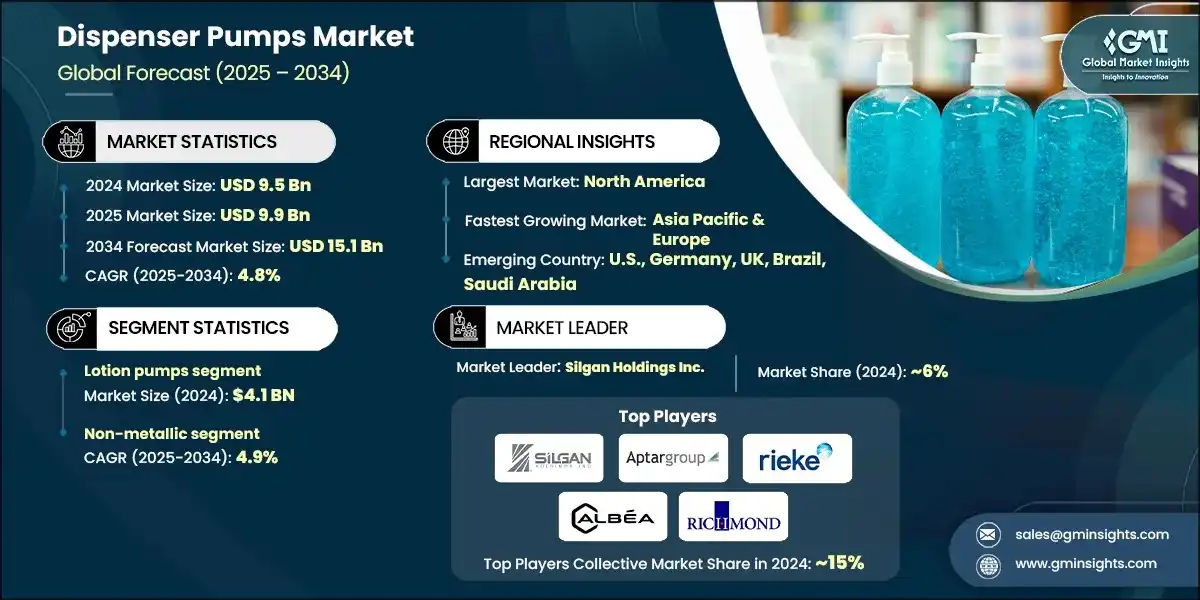
According to a recent study by Global Market Insights Inc., the dispenser pumps market was estimated at USD 9.5 billion in 2024. The market is expected to grow from USD 9.9 billion in 2025 to USD 15.1 billion in 2034, at a CAGR of 4.8%.
To get key market trends
The dispenser pumps market is witnessing significant growth due to growing consumer demand for hygiene, convenience, and sustainability. The World Health Organization (WHO) estimates that global health awareness has grown dramatically in recent years, especially since the COVID-19 pandemic, which made sanitary and mess-free solutions a necessity. Dispenser pumps with control and hygienic product dispensing have become a must for products like hand sanitizers, liquid soaps, lotions, and cleaning solutions. Their usage is especially high in healthcare, food service, and household cleaning industries where hygiene is paramount. The advantage of accurate dispensing, portability, and simplicity has further made them choose packaging solutions across various industries.
Furthermore, the personal care and cosmetics industry is a major driver for the dispenser pumps market. According to the Personal Care Products Council, the global market for cosmetics stood at about USD 380 billion in 2023 and is expected to have a compound annual growth rate (CAGR) of 5.3% over the forecasting period 2024-2029. This growth is fueling the demand for dispenser pumps in items like moisturizers, serums, shampoos, and liquid foundations.
Consumers are demanding increasingly advanced and functional packaging, leading brands to shift towards advanced solutions such as airless pumps and multi-dose dispensers. Not only these innovations maintain product integrity, but they also improve user experience through offering a controlled application. Further, the growth in e-commerce, which captured more than 20% of retail sales globally in 2023, as per the United Nations Conference on Trade and Development, has compelled brands to invest in aesthetically pleasing and protective packaging, increasing the demand for dispenser pumps that balance with function.
In addition, to reduce plastic waste, manufacturers have developed recyclable materials, refillable systems, and thin, lightweight packaging because of growing environmental consciousness. For instance, AptarGroup and Silgan Dispensing Systems have used post-consumer recycled (PCR) plastics to develop eco-friendly dispenser pumps. Sustainable packaging is no longer niche, but mainstream expectation, especially among younger, green-conscious consumers.
Alongside, premiumization and customization movements are prompting brands to provide customized packaging options, like color versions, embossed logos, and custom dispensing mechanisms, that benefit their image and consumer tastes. This combination of sustainability and brand differentiation imperatives is propelling the market towards more intelligent, environmentally friendly, and consumer-focused dispenser pump solutions, ensuring strong growth in future years.
Dispenser Pumps Market Report Attributes
| Key Takeaway | Details |
|---|---|
| Market Size & Growth | |
| Base Year | 2024 |
| Market Size in 2024 | USD 9.5 Billion |
| Market Size in 2025 | USD 9.9 Billion |
| Forecast Period 2025 - 2034 CAGR | 4.8% |
| Market Size in 2034 | USD 15.1 Billion |
| Key Market Trends | |
| Drivers | Impact |
| Rising demand for hygiene and convenience | Drives widespread adoption of dispenser pumps in personal care, healthcare, and home cleaning products for sanitary and easy use. |
| Increasing demand in cosmetics and personal care industry | Drives widespread adoption of dispenser pumps in personal care, healthcare, and home cleaning products for sanitary and easy use. |
| Sustainability and eco-friendly packaging | Encourages manufacturers to develop recyclable, refillable, and lightweight pump solutions to align with global environmental goals. |
| Premiumization and customization | Pushes brands offer tailored dispenser pump designs that enhance product aesthetics and brand identity. |
| Pitfalls & Challenges | Impact |
| Recycling complexity of multi-material pumps | Limits sustainability efforts due to difficulties in separating components for effective recycling. |
| Market fragmentation and intense competition | It makes it challenging for manufacturers to maintain margins and brand differentiation in a crowded landscape. |
| Opportunities: | Impact |
| Expansion into emerging markets | Enables companies to scale operations, diversify revenue streams, and establish early brand loyalty in high-growth regions. |
| Integration of smart dispensing technologies | Enhances product functionality, supports automation, and creates differentiation in a competitive market through value-added features. |
| Market Leaders (2024) | |
| Market Leaders |
Market share of ~6% |
| Top Players |
Collective market share in 2024 ~15% |
| Competitive Edge |
|
| Regional Insights | |
| Largest Market | North America |
| Fastest Growing Market | Asia Pacific & Europe |
| Emerging Country | U.S., Germany, UK, Brazil, Saudi Arabia |
| Future Outlook |
|
What are the growth opportunities in this market?
Dispenser Pumps Market Trends
Customization and sustainability are emerging as significant trends for the market for dispenser pumps in the future.
- Companies are moving more towards the use of recyclable materials, biodegradable plastics, and reusable pump systems to respond to expanding consumer and regulatory pressures for environmental sustainability. This is especially pronounced in Europe and North America, where sustainability is a primary purchasing factor. Brands are also investigating mono-material pumps and lighter weight to minimize carbon footprints and enhance recyclability. The adoption of smart dispensing technologies like airless pumps and metered dosing is also picking up pace, providing extended product preservation and user control.
- Premiumization and personalization of packaging is another notable trend, particularly in the cosmetic and personal care industries. As more consumers are looking for luxurious, visually appealing, and functional packs that meet their lifestyle and brand needs. Consequently, there has been a huge demand for dispenser pumps with customizable options like color variations, embossed branding, and ergonomic shapes. In addition, e-commerce has shaped the evolution of packaging, with companies prioritizing leak-proof, tamper-evident, travel-friendly dispenser pumps that protect product quality during transportation. The industry is also witnessing growing usage of pumps across niche areas such as baby care, pet care, and wellness products, expanding its scope of application further and fueling innovation in design and functionality.
Dispenser Pumps Market Analysis
Learn more about the key segments shaping this market
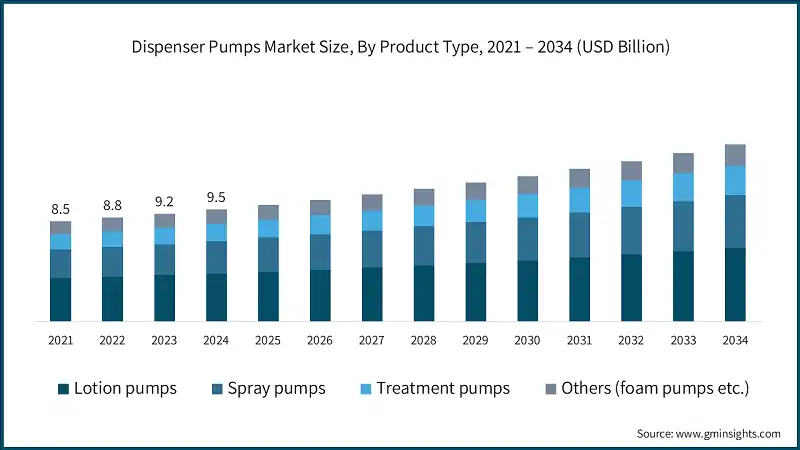
Based on product type, the market can be segmented into lotion pumps, spray pumps, treatment pumps and others (foam pumps etc.). The lotion pumps segment accounted for revenue of around USD 4.1 billion in 2024 and is estimated to grow at a CAGR of 4.4% from 2025 to 2034.
- Their expansion is due to their extensive use in personal care, skincare, and hygiene products. They are popular due to their capacity for controlled, hygienic, and mess-free dispensing, which improves user experience and product life. Lotion pumps are particularly popular in packaging moisturizers, hand creams, body lotions, and liquid soap and hence are a mainstay in both mass-market and premium product offerings.
- Manufacturers are using airless lotion pumps, recyclable packaging materials, and refillable packs to sustain changing environmental regulations and consumer tastes. Also, increasing e-commerce and travel-friendly packaging is compelling brands to use leak-proof, resistant, and attractive lotion pumps. These drivers combined strengthen the lotion pumps segment as a major growth driver in the overall dispenser pumps market.
Learn more about the key segments shaping this market
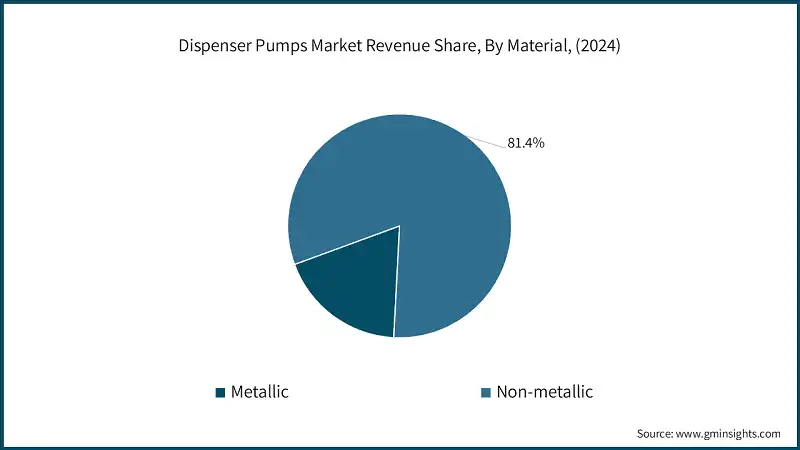
Based on material, the market is categorized as metallic and non-metallic. The non-metallic material held around 81.4% of the total market share in 2024 and is anticipated to grow at a CAGR of 4.9% through 2034.
- The growth is primarily because they are cost-effective, light in weight, and flexible in design, making them perfect for mass production and customization in personal care, food, and drug applications. Non-metallic dispenser pumps can also be easily molded into different shapes and sizes, enabling brands to develop aesthetically pleasing and convenient packaging that maximizes user experience. Manufacturers are making investments in sustainable materials and pump refill structures to support the world's sustainability initiatives and consumer values.
- Although metallic pumps are increasingly becoming popular for use in premium and industrial applications because they are sturdy, non-metallic pumps are going to remain on top of the market because they are versatile, inexpensive, and flexible across most industries.
Looking for region specific data?
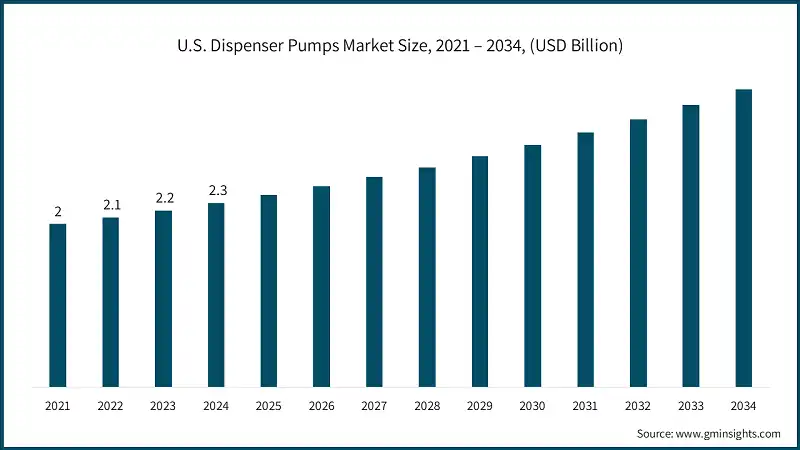
North America Dispenser Pumps Market The U.S. dominates an overall North America dispenser pumps industry and valued at USD 2.3 billion in 2024 and is expected to grow at a CAGR of 5% from 2025 to 2034. In Europe, Germany dispenser pumps is expected to experience significant and promising growth from 2025 to 2034. In Asia Pacific region China held 32.4% market share in 2024 and is expected to grow at a CAGR of 5.6% during the 2025 to 2034. In the Middle East and Africa Saudi Arabia held 29.4% market share in 2024 and is expected to grow during 2025 to 2034. Major players operating in the dispenser pumps industry include: Albéa Group leverages its global presence and deep expertise in beauty packaging to stay competitive. The company is a leader in sustainable innovation, offering eco-design services and packaging made from recycled or bio-based materials. Albéa also invests heavily in design and branding support, helping clients create visually compelling and functional packaging that resonates with consumers. Its agility in responding to market shifts and its collaborative approach with brands ensure continued relevance and growth. Richmond Containers CTP Ltd differentiates itself through flexibility, speed-to-market, and customer-centric service. The company offers a wide range of dispenser pump solutions with low minimum order quantities, making it ideal for emerging brands and boutique manufacturers. Richmond Containers also emphasizes sustainability and innovation, regularly updating its product lines to include recyclable and refillable options. Its strong distribution network and responsive customer support further enhance its competitiveness in the European market.Europe Dispenser Pumps Market
Asia Pacific Dispenser Pumps Market
Middle East and Africa Dispenser Pumps Market
Dispenser Pumps Market Share
Dispenser Pumps Market Companies
Dispenser Pumps Market News
The dispenser pumps market research report includes in-depth coverage of the industry, with estimates & forecasts in terms of revenue (USD Billion) and volume (Thousand Units) from 2021 to 2034, for the following segments:
Market, By Product type
- Lotion pumps
- Spray pumps
- Treatment pumps
- Others (foam pumps etc.)
Market, By Material
- Metallic
- Non-metallic
- Plastic
- Glass
- Others (ceramic, etc.)
Market, By Neck size
- Below 24 mm
- 24 mm - 28 mm
- Above 28 mm
Market, Pump output
- Upto0.5 ml
- 0.5 ml to 1.5 ml
- 1.5 ml to 2.5 ml
- Above 2.5 ml
Market, Locking Mechanism
- Lock up
- Lock down
- Clip lock
Market, Application
- Sanitizers
- Creams
- Lotions
- Shampoos
- Conditioners
- Others (body washes, shower gels etc.)
Market, End Use industry
- Cosmetics and personal care
- Pharmaceuticals
- Food & beverages
- Others (chemical, household cleaners, etc.)
Market, Distribution Channel
- Direct
- Indirect
The above information is provided for the following regions and countries:
- North America
- U.S.
- Canada
- Europe
- Germany
- UK
- France
- Italy
- Spain
- Asia Pacific
- China
- Japan
- India
- South Korea
- Australia
- Indonesia
- Malaysia
- Latin America
- Brazil
- Mexico
- Argentina
- MEA
- Saudi Arabia
- UAE
- South Africa
Frequently Asked Question(FAQ) :
What are the upcoming trends in the dispenser pumps market?
Key trends include expansion into emerging markets, IoT-enabled smart dispensing, recyclable and refillable pumps, premium customization, and growth in baby and pet care applications.
Who are the key players in the dispenser pumps market?
Key players include Silgan Holdings Inc., AptarGroup Inc., Rieke, Albéa Group, Richmond Containers CTP Ltd, DARIN, TAPLAST, Frapak Packaging, PKP Plastic Products, Unicom International, TYH Container Enterprise, Zhejiang Sun-Rain Industrial, Scopenext, Ningbo Song Mile Packaging, Sanjiaozhou Enterprise, and Guangdong Standard Fluid System Company.
What was the market share of the non-metallic material segment in 2024?
The non-metallic material held around 81.4% of the total market share in 2024, primarily due to cost-effectiveness, lightweight properties, and design flexibility.
What is the growth outlook for the U.S. dispenser pumps market from 2025 to 2034?
The U.S. dispenser pumps market is expected to grow at a CAGR of 5% from 2025 to 2034, supported by growing demand for liquid soaps, sanitizers, and smart dispensing technologies.
Which region leads the dispenser pumps market?
China held about 32.4% share of the Asia Pacific dispenser pump market in 2024, with a CAGR of 5.6% expected through 2034, supported by rising demand for premium skincare products requiring advanced dispensing systems like airless pumps.
How much revenue did the lotion pumps segment generate in 2024?
Lotion pumps accounted for revenue of around USD 4.1 billion in 2024 and is estimated to grow at a CAGR of 4.4% from 2025 to 2034, driven by their extensive use in personal care, skincare, and hygiene products.
What is the market size of the dispenser pumps in 2024?
The market size exceeded USD 9.5 billion in 2024, with a CAGR of 4.8% expected through 2034 driven by growing consumer demand for hygiene, convenience, and sustainability.
What is the current dispenser pumps market size in 2025?
The market size is projected to reach USD 9.9 billion in 2025.
What is the projected value of the dispenser pumps market by 2034?
The dispenser pumps market is expected to reach USD 15.1 billion by 2034, propelled by rising demand for hygiene and convenience, increasing demand in cosmetics and personal care industry, and sustainability and eco-friendly packaging trends.
Dispenser Pumps Market Scope
Related Reports