Summary
Table of Content

DC Motor Market
Get a free sample of this report
Form submitted successfully!
Error submitting form. Please try again.
Thank you!
Your inquiry has been received. Our team will reach out to you with the required details via email. To ensure that you don't miss their response, kindly remember to check your spam folder as well!
Request Sectional Data
Thank you!
Your inquiry has been received. Our team will reach out to you with the required details via email. To ensure that you don't miss their response, kindly remember to check your spam folder as well!
Form submitted successfully!
Error submitting form. Please try again.
DC Motor Market Size
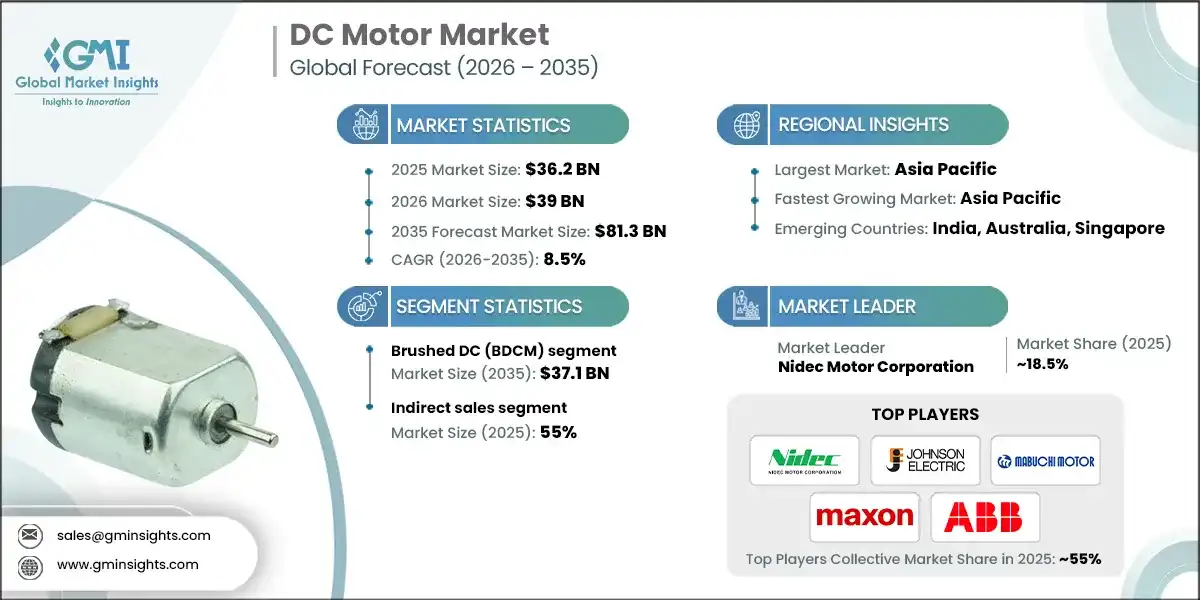
The global DC motor market was estimated at USD 36.2 billion in 2025. The market is expected to grow from USD 39 billion in 2026 to USD 81.3 billion in 2035, at a CAGR of 8.5% according to latest report published by Global Market Insights Inc.
To get key market trends
Increased interest in electric vehicle technology has been a major incentive for DC motors, particularly traction motors for electric vehicles (EVs). In the USA alone, the sales of electric cars increased from an estimated 0.2% of all automobile sales in 2011 to approximately 4.6% of total car sales as reported by the U.S. Bureau of Labor Statistics, and projections show that by 2030, EVs may account for 40-50% of total vehicle sales. The growth of the electric vehicle market represents not only a transformation from traditional automobiles, but also a transformation of the market itself through increased governmental regulations, public awareness of environmental issues, and technological advancements that have decreased the costs of manufacturing components of electric vehicles. Because of their ability to deliver high torque with good controllability at low speeds, brush and brushless DC motors are used extensively in the propulsion systems of EVs. The rapid adoption of electric vehicles has been enhanced by the development of charging infrastructure and battery technology. For instance, the U.S. Department of Energy estimates that there will be at least 33 million EVs on the road by 2030, requiring approximately 28 million charging stations. The growth of EVs will likewise increase the demand for DC motors for secondary systems such as pumps and fans, demonstrating that the growth of the electric vehicle industry and the demand for DC motors are mutually reinforcing trends within the framework of a longer-term structural change toward global decarbonization.
The future growth of industrial automation is especially influenced by the development of DC motors, specifically as the “Heartbeat” of an automation system, which is the power source that drives many different types of automated machines, including robotic arms, conveyor belts and precision tools. With their ability to provide precise speed control and ease of integration into digital controllers, DC motors are often used over other electric motor types in many industries where precision and flexibility are necessary for digital controller applications. For example, DC motors allow robots which are used for welding and painting in an automotive assembly line to work with very high precision levels, which results in lower defect rates and higher throughput. Motorized Systems (pump systems, conveyor systems, and other drive systems) account for approximately 50% of the total electricity consumed within the manufacturing industry. As more and more manufacturers continue to utilize Smart Technologies and IoT within their factories, the need for DC motors to create variable speed and variable torque will increase.
Motor design and adoption are globally impacted by energy efficiency mandates. The U.S. Department of Energy (DOE) has released updated and newly established Energy Conservation Standards for electric motors, which will take effect in June 2027 under the Energy Policy and Conservation Act. These energy conservation regulations will help reduce the energy consumed by industries as electric motors consume a significant portion of the electricity within the industrial sector. Therefore, manufacturers will need to innovate toward higher efficiency designs to align themselves with the new energy conservation standards and increase the usage of DC electric motors because DC motors inherently allow for improved controllability and lower losses than various AC motors.
The DC motor market is extremely sensitive to fluctuations in the price of copper, steel, and rare earth magnets used in winding the motors and manufacturing permanent magnets. Geopolitical tensions and supply chain disruptions have caused the global commodity markets to experience extreme volatility. For example, according to the IMF, commodity price swings increase inflation and impede investment cycles; thus, energy and metal prices have recently surged to near-record levels during various crises. Such fluctuations in commodity prices greatly affect manufacturers' costs to produce electric motors, which, in turn, create a squeeze on motor manufacturers' margins and may hinder the adoption of electric motors for applications that are highly sensitive to price changes.
DC Motor Market Report Attributes
| Key Takeaway | Details |
|---|---|
| Market Size & Growth | |
| Base Year | 2025 |
| Market Size in 2025 | USD 36.2 Billion |
| Market Size in 2026 | USD 39 Billion |
| Forecast Period 2026 - 2035 CAGR | 8.5% |
| Market Size in 2035 | USD 81.3 Billion |
| Key Market Trends | |
| Drivers | Impact |
| Surge in Electric Vehicle (EV) Adoption | Accelerating EV penetration worldwide is driving exponential demand for high-performance DC motors in traction systems and auxiliary components. |
| Industrial Automation and Robotics | The global shift toward smart factories and robotics is boosting DC motor adoption for precision-driven applications across manufacturing and logistics. |
| Energy Efficiency Regulations | Stringent international efficiency standards are compelling industries to replace legacy motors with advanced DC motor technologies, fostering sustainable growth globally. |
| Pitfalls & Challenges | Impact |
| Raw Material Price Volatility | Unpredictable fluctuations in copper and steel prices are inflating production costs, reducing profitability, and slowing DC motor adoption in cost-sensitive sectors. |
| Competition from Alternative Motor Technologies | The growing preference for AC and PMSM motors due to lower maintenance and higher efficiency is eroding DC motor market share in key industrial and automotive applications. |
| Opportunities: | Impact |
| Integration with Renewable Energy Systems | Companies that innovate in high-efficiency DC motors for renewable applications could see accelerated global adoption, especially in emerging markets investing heavily in green energy. |
| Expansion in Smart Consumer Appliances | Manufacturers that integrate advanced features like sensor compatibility and low-noise operation will gain a competitive edge. This opportunity also opens doors for partnerships with leading appliance brands, creating a steady demand pipeline and reducing dependency on industrial sectors. |
| Market Leaders (2025) | |
| Market Leaders |
Market share of ~18.5% |
| Top Players |
|
| Competitive Edge |
|
| Regional Insights | |
| Largest Market | Asia Pacific |
| Fastest growing market | Asia Pacific |
| Emerging countries | India, Australia, Singapore |
| Future outlook |
|
What are the growth opportunities in this market?
DC Motor Market Trends
The shift toward electric vehicles and electric systems for commercial and industrial applications, including automotive, industrial and marine applications, is a key driver of the motor market. Governments across the globe are implementing legislation that will limit CO2 emissions from motor vehicles, creating a favorable environment for electric vehicles to take over a substantial market share. The use of new electric drivetrains is taking place in many sectors, including aerospace, which is expected to support the electric vehicle revolution. The transition to automated and intelligent manufacturing will also provide a driver of the DC motor market in the future. The continued increase in the number of electric vehicle manufacturers will create a need for high efficiency and digitally integrated DC motors.
- Brushless Direct Current (BLDC) motors are quickly becoming popular worldwide because they are more energy efficient than their previous models (brushed), have lower maintenance, and last longer than brushed-style DC motors. There is also an increasing trend towards using BLDC motors in the automotive, HVAC, and robotics industries to help reduce friction losses and provide higher torque-to-weight ratios for better performance. Electric vehicles and other applications require high torque-to-weight ratios, and this trend is being enhanced even further by regulations encouraging the use of energy-efficient solutions and the increasing need to create automated systems that operate reliably. The use of BLDC technology will be the foundation for future motor designs.
- The combination of DC motor technology with IoT and smart control technologies is creating new ways to achieve greater operational efficiencies and predictive maintenance capabilities. The use of embedded sensors and connectivity enables the manufacturer to provide their consumers with real-time monitoring of motor performance, as well as monitoring of energy consumption and early detection of faults. This is most important in the industrial automation sector and smart home appliance industry, where data-driven insights are being used to reduce downtime and enhance energy efficiency. As Industry 4.0 becomes more prevalent, there will be an increasing number of DC motors that are integrated with sophisticated controllers and cloud-based analytics that will be a necessity to achieve the goals of digital transformation and operational resilience.
- The increasing prevalence of global disruptions to the supply chain combined with a growing focus on sustainability have prompted motor manufacturers to localize their sources of supply as well as to utilize sustainable materials for manufacturing. The use of alternative sources to rare earth magnets and recyclable components has allowed manufacturers to minimize their environmental impact and dependence upon unreliable, heavily fluctuating global supply chains.
DC Motor Market Analysis
Learn more about the key segments shaping this market
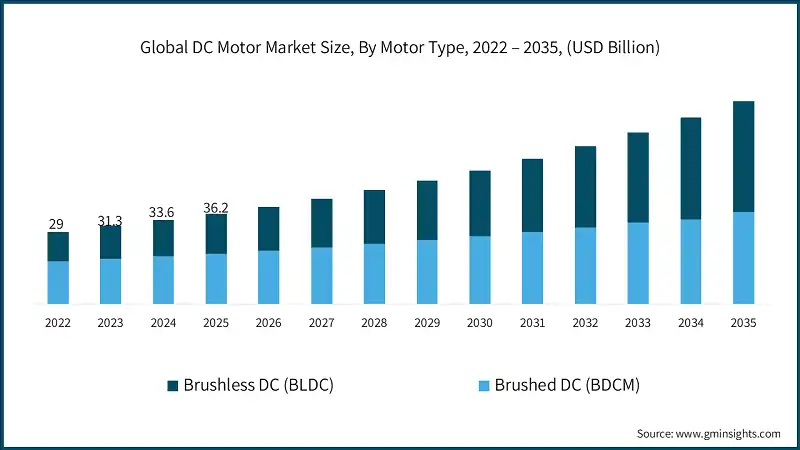
Based on the motor type, the market is segmented into brushless DC (BLDC) and brushed DC (BDCM). The brushed DC (BDCM) segment was valued at USD 20.3 billion in 2025 and is projected to reach USD 37.1 billion by 2035.
- The brushed DC motor (BDCM) market continues to be a dominant segment of the consumer electronics industry, owing largely to the low cost and ease of construction associated with these products compared with the alternatives available (e.g., brushless motors). The use of mechanical brushes for commutation provides manufacturers and users with an easy-to-manufacture, maintain product that requires minimal upfront capital investment on the part of consumers/businesses. Therefore, the low cost of BDCM is especially attractive for consumers and businesses operating within price-sensitive industries (e.g., household appliances, automotive auxiliary systems, small industrial machinery) where performance/price trade-offs are moderate and cost efficiency trumps performance needs when making product selections. With the ease of construction of BDCM come opportunities for easy integration into systems for which advanced control strategies are not required, making these types of products the most preferred choice in applications with such limited performance specifications.
- The BDCM has had a historical presence in established traditional applications (e.g., automotive starters, power windows) as well as more basic industrial machinery. End-users of legacy systems continue to rely on BDCM for proven reliability and compatibility with legacy infrastructure. Furthermore, the volume of production on BDCM drives economies of scale, keeping prices competitive and availability of product high. In markets where modernization is gradually implemented (e.g., select developing economies), BDCM will continue to be the benchmark product to be used, based on the users' familiarity with these products and the breadth of a service network associated with these products.
Learn more about the key segments shaping this market
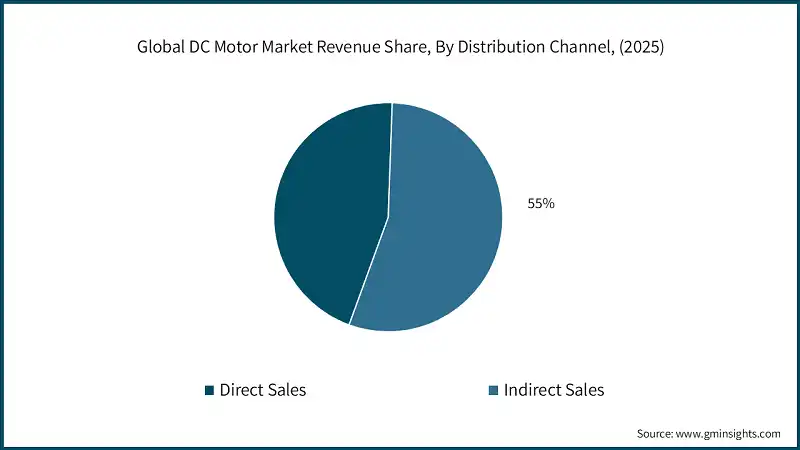
Based on distribution channel, the market is segmented into direct sales and indirect sales. The indirect sales segment crossed USD 19.9 billion and has a market share of around 55% in 2025.
- A major segment of the DC motor market occurs through indirect sales channels (such as distributors, dealers, and third-party vendors) because they give manufacturers a wider geographic reach with access to multiple types of customers. Because of their established networks in the three major industrial sectors (truck & automotive, consumer products, computer), distributors offer faster times to market for manufacturers without having to invest heavily in building out an infrastructure of direct sales. Indirect channels will continue to grow in emerging markets as distributors have established strong ties and regional knowledge regarding demands, which will lead to more effective product delivery and service support.
- Indirect sales reduce the cost of sales for manufacturers because they lessen the amount of time & money manufacturers must spend on maintaining large inside sales forces & logistics operations. Manufacturers are then able to focus their resources on R&D and production, while using distributors for marketing, warehousing, and after-sales support. This allows manufacturers to use this scalable model to sell to more than one region at the same time without incurring significant operational costs. As global supply chains encounter greater disruptions and higher costs, indirect channels have demonstrated their ability to provide flexibility and resilience, allowing manufacturers to keep a consistent presence in the marketplace and maintain contact with their customers.
Looking for region specific data?
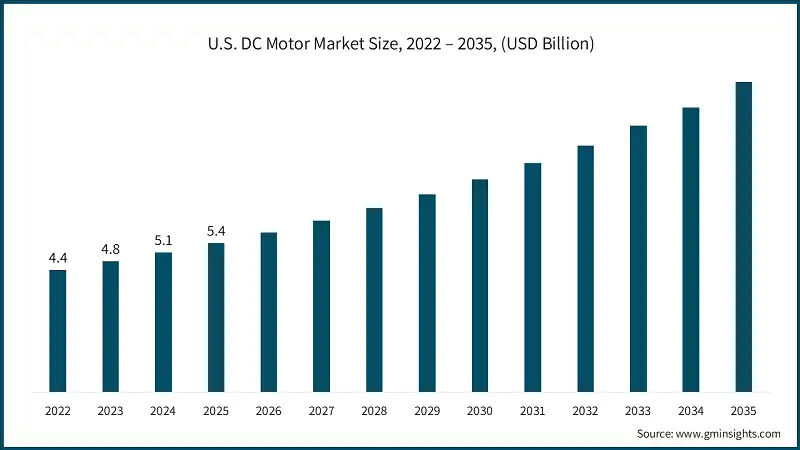
The U.S. DC motor market was valued at around USD 5.4 billion in 2025 and is anticipated to register a CAGR of 7.7% between 2026 and 2035.
- The market share of electric vehicles (EVs) in the USA has increased sharply between 2011 and 2021, from 0.2% to 4.6%, creating a structural inflection indicating rising demand for traction and auxiliary direct current (DC) motors within light trucks and passenger vehicles. Looking to the future, the infrastructure plan backed by the federal government expects to have 33 million EVs on US roads by 2030 and 28 million charging ports. This rapid electric vehicle proliferation, along with public-private investment being triggered, is likely to create continual sustained demand for DC motors used in drivetrains, pumps, fans and cooling subsystems for power electronics; making the USA the fastest growing end-user market worldwide for motor (DC) products related to mobility.
- Approximately 50% of all electricity consumed in the manufacturing industry is consumed by motor-driven systems (fans, pumps, conveyors, compressors), therefore, any increase in motor efficiency as the result of policy action also equates to an increase in demand for motors and retrofitting opportunities. The new and revised energy conservation standards for electric motors established by the U.S. Department of Energy will apply to motors manufactured on or after June 1, 2027. These standards require higher-efficiency electric motors to replace legacy motors in many applications where dramatically improved precision of speed/torque control and tighter integration with modern drives and controls are essential; thus, driving near-term orders for DC motors.
The Asia Pacific DC motor market was valued at around USD 16 billion in 2025 and is anticipated to register a CAGR of 9.7% between 2026 and 2035.
- Both India and China are leading the way in developing electric vehicles (EV) to reach worldwide goals regarding EV use; According to China's Ministry of Industry & Information Technology China produced approximately 7 million new energy vehicles (NEV), which is equal to 44.3% of all new car sales in China during the first half of 2025; they remain on track to produce more than 10 million annually. India reports that it has sold over 2 million Electric Vehicles (EV) for FY 2024-25, representing a 15.7% increase from FY 2023-2024 and has set a goal for the year 2030 to sell 30% of all new vehicle sales as cars that are solely for private use and 80% of all two/three wheelers as Electric Vehicles by the year 2030. These figures reflect a structural shift supported by aggressive policy frameworks, subsidies, and charging infrastructure investments across the region. This surge in EV adoption directly translates into heightened demand for DC motors, which are integral to traction systems, battery cooling, and auxiliary components in electric vehicles.
- Industry growth through industrialization and automation in Asia Pacific was a further impetus to growth as evidenced by substantial investment in programs such as “Made in China 2025” and “Manufacturing Innovation 3.0”. Such programs have allocated large amounts of money for the development of smart factories and therefore the demand for precision-controlled DC motors used in a variety of applications including robotics and automation. Companies also use a significant portion of that investment to meet the renewable energy targets set by the APEC which calls for renewable energy to grow to 2.6 terawatts by the year 2030, with China currently accounting for the majority (71%) of that renewable capacity. Therefore, the growth of renewable energy technologies such as solar tracking systems, wind turbine pitch controls and energy storage systems will require DC motors for improved energy efficiency and reliability. Therefore, with the ongoing convergence between clean energy and automation, the Asia Pacific region will continue to be the fastest growing market for DC motors in the world and will continue to be supported by government led sustainability and digital transformation initiatives.
Europe DC motor market was valued at around USD 7.5 billion in 2025 and is anticipated to register a CAGR of 9.3% between 2026 and 2035.
- The European Green Deal and Europe’s commitment to reducing CO2 emissions, as well as other climate-friendly initiatives, is causing an increase in the use of electric vehicles (EVs) throughout Europe. The European Environment Agency states that in 2024 alone, the EU saw the creation of 2.2 million EVs, of which 2.0 million were battery electric vehicles (BEVs), accounting for 13.6% of total new car registrations and 700,000 plug-in hybrid electric vehicles (PHEVs), making up 7.3% of total new car registrations. This growth in EV adoption is driven by legislation mandating 55% reduction in CO2 emissions from new cars sold in the EU by 2030 and the complete ban of internal combustion engines (ICE) by 2035. As EVs continue to be adopted at an increasing rate, demand for DC motors needed to support traction systems, provide battery cooling, and perform auxiliary tasks are increasing, creating a tremendous growth opportunity for manufacturers of electric motors in Europe.
- As Europe progresses towards Industry 4.0 and sustainability objectives, there is a Digital Transformation occurring within the European Industrial Sector, supported by the manufacturing industry providing 64% of the USD 36 billion Private Sector R&D expenditures. Significant Investments in Robotics and smart automated systems that utilize DC motors for precise control have been made as a result of continual growth within the Manufacturing Sector (EUROSTAT) over last several years. The revised European Union Directive Regarding Renewable Energy sets forth a binding goal of a minimum of 42.5% by 2030, with an ultimate goal of reaching 45%. The shift towards renewable energy will result in increased demand for DC motors for use in solar tracking systems, pitch control of wind turbines and energy storage systems. As a result of the Mandatory Ecodesign Efficiency Standards for Electric Motors (EU Regulation 2019/1781) that require IE3 and IE4 efficiency classes for Industrial Motors, Europe is establishing a comprehensive backdrop for continued Demand for DC Motors.
DC Motor Market Share
- The top 5 companies in the DC motor industry, such as Nidec Motor Corporation, Johnson Electric Holdings Limited., Mabuchi Motor, Maxon Motor, and ABB hold a market share of 55%.
- Nidec’s strategy focuses on investment in early-stage technologies and, through its leadership in technology, has made significant advancements in its manufacturing processes, including margin expansion through operational efficiencies. In addition, Nidec pursues a "No.1 global market share" strategy that enters into high-growth markets ahead of demand. Examples include Nidec's rapid scaling of electric vehicle traction motor production (EV traction motors) coupled with strategic mergers and acquisitions such as Makino Milling Machine Co., which will enhance its machining capabilities for electric vehicle components. Nidec's operating expense strategy includes consolidating smaller facilities, rationalizing its global manufacturing footprint, and deploying optimized supply chain solutions. Collectively, speed to market (i.e., rapid scaling of production), willingness to take calculated risks, and a diversification strategy into higher-value segments (e.g. electric vehicle systems, industrial automation) provide Nidec with the scale, innovation, and strength to compete effectively against its competitors through an extensive portfolio of M&A and operational efficiency measures.
- Johnson Electric capitalizes on a customer-driven, comprehensive approach to motion solutions, with an emphasis on not just providing motors but also complete systems that are customized to meet customer requirements in automotive, industrial and medical fields. Customer customization and partnership collaborations with OEMs are key differentiators that not only provide long-term contract commitments but also create embedded relationships in customers' key supply chains. Johnson Electric uses a number of methods to alleviate competitive pressures, including global manufacturing diversification, strategic alliances with third parties, and continual R&D investment in developing energy-efficient and intelligent motion technologies. In turn, success by focusing on flexible interconnectivity, haptic technologies, and precision components enables Johnson Electric to delineate itself from the marketplace as a source for solutions rather than merely as a supplier of commodity motors.
- The successful combination of specialized product and global standardization is the key to Mabuchi Motor’s growth and resilience. Mabuchi has grown to become the dominant provider of automotive products such as door locks and mirrors (with claims of 70% to 85% market share) due to their current production rate of over 1 billion units per year. The company's strategy of standardizing specifications between its customers, while offering some flexibility for customization when required, provides for economies of scale. Mabuchi recognizes and actively works toward sustainability, as well as long term growth based on the “e-MOTO” concept, and also operates in companies through acquisitions and diversification of their product lines, providing to continue their core competence with operational excellence, enabling them to remain the leader despite increasing competition from low-cost manufacturers.
DC Motor Market Companies
Major players operating in the DC motor industry are:
- ABB
- AMETEK
- Allied Motion, Inc.
- ARC Systems Inc
- Continental AG
- DENSO Corporation
- Dunkermotoren GmbH
- Johnson Electric Holdings Limited.
- Mabuchi Motor
- Maxon Motor
- Minebea Mitsumi
- Nidec Motor Corporation
- ORIENTAL MOTOR CORP
- Robert Bosch
- Zhejiang Songtian Automotive Motor System Co., Ltd
Maxon positions itself within the niche markets of precision-critical and high-performance electric drives in the areas of robotics and aerospace/medical technology, while emphasizing the importance of customization and providing cutting-edge products with premium quality through its proprietary technologies, including ironless rotor designs and advanced brushless DC motors. To maintain its competitive advantage, Maxon has expanded its manufacturing capabilities worldwide, including opening a new facility in the United States for producing localized products and developing rapid prototyping abilities. In addition, its strategic investments, such as Synapticon, have improved the motion control knowledge expertise within Maxon. By concentrating on these specialized market segments that require a high degree of reliability and precision, Maxon protects itself from competing solely on the basis of price and continues to be a leader in these specialized sectors where technical superiority is more important than the price.
ABB's vision is to be recognized as a global leader in energy efficiency through integrated solutions for complete electrification. This will be done by using motors to provide complete packages of electric drive solutions and digital service offerings. While motor usage currently represents 45% of the world’s electricity usage, ABB intends to create synergies between its electrical and mechanical engineering capabilities to provide highly efficient (IE5) synchronous reluctance motors and variable-speed drives to reduce energy consumption by up to 40%. Additionally, ABB is actively seeking bolt-on acquisitions to provide even greater coverage in its product lineup and increase its global reach. We believe that digitalization, lifecycle services, and circularity (99% recyclable motors) are fundamental drivers toward enabling our company to differentiate its product offerings and meet customer needs effectively. As these value-added solutions help to differentiate ABB from other suppliers, they ultimately protect the company’s position in the marketplace.
DC Motor Industry News
- In November 2024, WEG announced a $62 million investment to expand its Rugao, China facility with a new 30,000 m² factory for high-voltage electric motors. This will help the company meet growing Chinese market demand and provide improved speed, innovation, and customer service in the region.
- In October 2024, Bosch launched a new 2 kW integrated drive control unit for electric two-wheelers targeting India and Southeast Asian markets. This will help the company capture the smaller electric two-wheeler segment with features like regenerative braking that extends range up to 8%.
- In March 2024, Siemens signed an agreement to acquire ebm-papst's industrial drive technology business employing 650 people across Germany and Romania. This will help the company strengthen its factory automation position and leverage growth in intelligent battery-powered drive solutions for intralogistics applications.
- In 2024, Nidec established a new factory in Nimarna, India for e-Bike drive motors, having sold over 100,000 units by April 2024. This will help the company capitalize on projected e-Bike market growth from 3 million units in 2024 to 10 million by 2025.
The DC motor market research report includes in-depth coverage of the industry, with estimates & forecasts in terms of revenue (USD Billion) and volume (Million Units) from 2022 to 2035, for the following segments:
Market, By Motor Type
- Brushed DC (BDCM)
- Brushless DC (BLDC)
Market, By Power Rating
- Micro Motors (< 1W)
- Fractional HP Motors (1W - 750W)
- Integral HP Motors (750W - 75 kW)
- Large Motors (>75 kW)
Market, By End Use Industry
- Automotive
- Robotics
- Consumer Electronics and Appliance
- Industrial Automation and Manufacturing
- Medical Devices and Healthcare
- HVAC and Building Automation
- Aerospace and Defense
- Agriculture and Construction
- Marine and Shipbuilding
- Others
Market, By Distribution Channel
- Direct Sales
- Indirect Sales
The above information is provided for the following regions and countries:
- North America
- U.S.
- Canada
- Europe
- Germany
- U.K.
- France
- Italy
- Spain
- Asia Pacific
- China
- Japan
- India
- South Korea
- Australia
- Latin America
- Brazil
- Mexico
- Argentina
- MEA
- UAE
- Saudi Arabia
- South Africa
Frequently Asked Question(FAQ) :
Who are the key players in the DC motor market?
Key players include Nidec Motor Corporation, Johnson Electric Holdings Limited, Mabuchi Motor, Maxon Motor, ABB, AMETEK, Allied Motion Inc., Continental AG, DENSO Corporation, Dunkermotoren GmbH, Minebea Mitsumi, ORIENTAL MOTOR CORP, Robert Bosch, and Zhejiang Songtian Automotive Motor System Co., Ltd.
Which region leads the DC motor market?
The U.S. DC motor market was valued at around USD 5.4 billion in 2025 and is set to grow at a CAGR of 7.7% between 2026 and 2035.
What are the upcoming trends in the DC motor market?
Key trends include adoption of brushless DC (BLDC) motors, integration with IoT and smart control technologies, and increasing use of sustainable materials for manufacturing.
What is the growth outlook for the Asia Pacific DC motor market from 2026 to 2035?
Asia Pacific DC motor market is projected to grow at a 9.7% CAGR through 2035, supported by EV adoption in China and India, and renewable energy investments.
What was the valuation of indirect sales segment in 2025?
Indirect sales held 55% market share and generated USD 19.9 billion in 2025.
What is the market size of the DC motor in 2025?
The market size was USD 36.2 billion in 2025, with a CAGR of 8.5% expected through 2035 driven by rising adoption of electric vehicle traction motors and industrial automation.
How much revenue did the brushed DC motor segment generate in 2025?
Brushed DC motors generated USD 20.3 billion in 2025 and are projected to reach USD 37.1 billion by 2035.
What is the projected value of the DC motor market by 2035?
The DC motor market is expected to reach USD 81.3 billion by 2035, propelled by EV proliferation, energy efficiency regulations, and integration with IoT technologies.
What is the current DC motor market size in 2026?
The market size is projected to reach USD 39 billion in 2026.
DC Motor Market Scope
Related Reports