Summary
Table of Content

Dairy Protein Hydrolysates Market
Get a free sample of this report
Form submitted successfully!
Error submitting form. Please try again.
Thank you!
Your inquiry has been received. Our team will reach out to you with the required details via email. To ensure that you don't miss their response, kindly remember to check your spam folder as well!
Request Sectional Data
Thank you!
Your inquiry has been received. Our team will reach out to you with the required details via email. To ensure that you don't miss their response, kindly remember to check your spam folder as well!
Form submitted successfully!
Error submitting form. Please try again.
Dairy Protein Hydrolysates Market Size
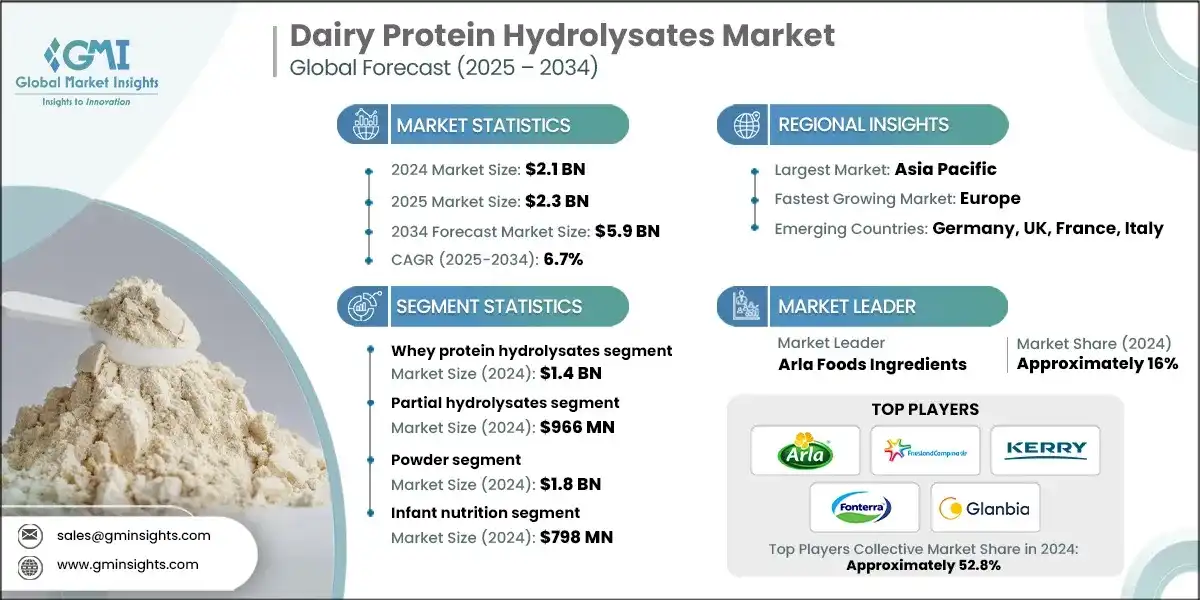
The global dairy protein hydrolysates market size was valued at USD 2.1 billion in 2024. The market is expected to grow from USD 2.3 billion in 2025 to USD 5.9 billion in 2034, at a CAGR of 6.7%, according to latest report published by Global Market Insights Inc.
Dairy Protein Hydrolysates Market Key Takeaways
Market Size & Growth
- 2024 Market Size: USD 2.1 Billion
- 2025 Market Size: USD 2.3 Billion
- 2034 Forecast Market Size: USD 5.9 Billion
- CAGR (2025–2034): 6.7%
Key Market Drivers
- Growing infant nutrition demand.
- Sports nutrition market expansion.
- Clinical nutrition applications growth.
Challenges
- High production costs.
- Taste and palatability issues.
Opportunity
- Biotechnology and cell culture expansion.
- Personalized nutrition trends.
Key Players
- Market Leader: Arla Foods Ingredients led with over 16% market share in 2024.
- Leading Players: Top 5 players in this market include Arla Foods Ingredients, FrieslandCampina Ingredients, Kerry Group, Fonterra/NZMP, Glanbia Nutritionals, which collectively held a market share of 52.8% in 2024.
Get Market Insights & Growth Opportunities
- Dairy protein hydrolysates represent a sophisticated category of bioactive ingredients derived from milk proteins through controlled enzymatic hydrolysis processes. These hydrolyzed proteins offer enhanced digestibility, improved bioavailability, and reduced allergenicity compared to intact proteins, making them essential ingredients across infant nutrition, sports nutrition, and clinical applications. The hydrolysis process breaks down complex protein structures into smaller peptides and amino acids, facilitating rapid absorption and utilization by the human body. With growing consumer awareness of functional foods and personalized nutrition, manufacturers are increasingly incorporating dairy protein hydrolysates to meet specific dietary requirements and health objectives.
- The infant nutrition sector drives the largest demand for dairy protein hydrolysates, accounting for approximately 38% of market consumption. Whey protein hydrolysates are particularly crucial for infant formula manufacturing due to their hypoallergenic properties and superior digestibility profiles. The hydrolysis process reduces protein molecular weight, minimizing allergenic potential while maintaining essential amino acid profiles required for infant growth and development. This application segment benefits from stringent regulatory standards that mandate high-quality protein sources, creating consistent demand for premium dairy protein hydrolysates with specific hydrolysis degrees and functional characteristics.
- Advanced enzymatic hydrolysis technologies are revolutionizing production processes, enabling manufacturers to achieve precise control over hydrolysis degrees and peptide profiles. Modern processing techniques utilize specific enzyme combinations and controlled reaction conditions to produce hydrolysates with targeted functional properties, including enhanced solubility, improved taste profiles, and optimized bioactivity. These technological advances support the development of specialized hydrolysates for clinical nutrition applications, sports performance products, and biotechnology applications, driving market expansion across diverse end-use sectors.
To get key market trends
Dairy Protein Hydrolysates Market Trends
- Advanced hydrolysis technology development is transforming the industry through implementation of precision enzymatic processes, membrane filtration systems, and controlled reaction environments. Modern production facilities are achieving targeted hydrolysis degrees while maintaining protein functionality and minimizing bitter peptide formation. The development of multi-enzyme systems and sequential hydrolysis processes enables manufacturers to produce hydrolysates with specific molecular weight distributions and enhanced bioactive properties, supporting specialized applications in clinical nutrition and biotechnology sectors.
- Strengthening regulatory frameworks for infant nutrition and clinical applications are establishing stringent quality standards and safety requirements for dairy protein hydrolysates. Regulatory agencies worldwide are implementing comprehensive guidelines for hydrolysate production, testing protocols, and labeling requirements, ensuring product safety and efficacy. These regulations are standardizing manufacturing processes, improving product quality consistency, and driving investment in advanced processing technologies and quality control systems.
- Evolving sports nutrition landscape is reshaping demand patterns as consumer preferences shift toward scientifically validated performance ingredients and rapid-absorption protein sources. The growing popularity of endurance sports, fitness activities, and active lifestyle choices is driving demand for specialized hydrolysates with optimized amino acid profiles and enhanced bioavailability. Sports nutrition manufacturers are increasingly incorporating dairy protein hydrolysates to differentiate products and meet specific performance objectives.
- Expanding applications in biotechnology and cell culture are opening new market segments for specialized dairy protein hydrolysates with defined peptide compositions. Biopharmaceutical manufacturing, cell-based meat production, and regenerative medicine applications require high-quality protein sources with consistent performance characteristics. The growing biotechnology sector necessitates reliable hydrolysate supplies with specific functional properties, creating sustained demand for premium dairy protein hydrolysates in industrial applications and research environments.
Dairy Protein Hydrolysates Market Analysis
Learn more about the key segments shaping this market
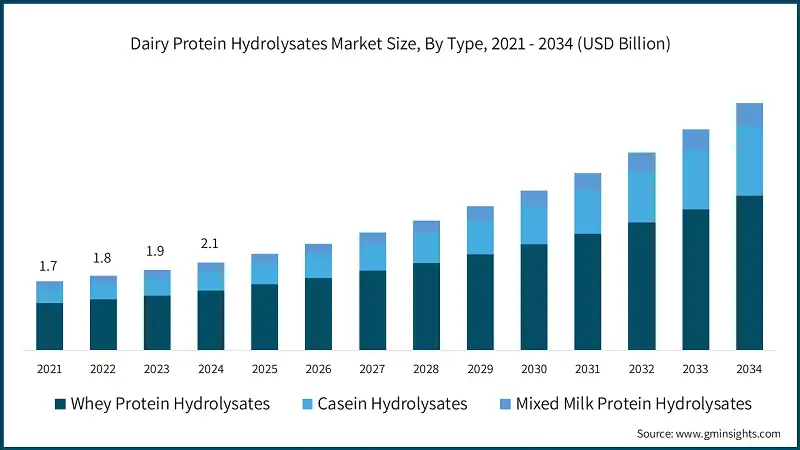
Based on type, dairy protein hydrolysates market is segmented into whey protein hydrolysates, casein hydrolysates and mixed milk protein hydrolysates. Whey protein hydrolysates generated USD 1.4 billion revenue in 2024 and is anticipated to expand at a CAGR of 6.5% during 2025 to 2034, holding a market share of 68% in 2024.
- Whey protein hydrolysates dominate the dairy protein hydrolysates market due to their superior nutritional profile and exceptional functional properties across diverse applications. The advantages of whey protein hydrolysates stem from their complete amino acid composition, rapid absorption characteristics, and excellent solubility achieved through controlled enzymatic hydrolysis of whey proteins. These properties make whey protein hydrolysates particularly suitable for infant nutrition, sports nutrition, and clinical applications where bioavailability and digestibility are critical requirements.
- Whey protein hydrolysates have established market leadership through their versatility in meeting specific nutritional and functional requirements across multiple application segments. By controlling hydrolysis parameters such as enzyme selection, reaction time, and temperature, manufacturers can tailor properties including degree of hydrolysis, peptide size distribution, and bioactive peptide content to match exact formulation specifications. This customization capability has enabled whey protein hydrolysates to capture approximately 68% of the total dairy protein hydrolysates market, significantly outperforming casein and mixed protein alternatives in demanding applications.
- Industrial applications comprise infant formula manufacturing, sports nutrition products, clinical nutrition supplements, and specialized biotechnology applications. The infant nutrition sector represents the largest consumption area, utilizing extensively hydrolyzed whey proteins for hypoallergenic formulas and specialized medical nutrition products. Sports nutrition applications include protein powders, recovery beverages, and performance supplements where whey hydrolysates ensure rapid amino acid delivery and enhanced muscle protein synthesis under intensive training conditions.
Learn more about the key segments shaping this market
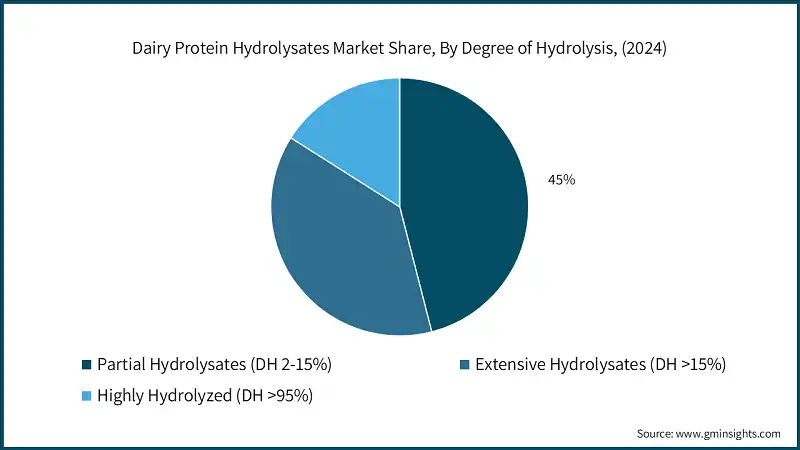
Based on degree of hydrolysis, dairy protein hydrolysates market is segmented into partial hydrolysates (DH 2-15%), extensive hydrolysates (DH >15%) and highly hydrolyzed (DH >95%). Partial hydrolysates generated USD 966 million revenue in 2024 and is anticipated to expand at a CAGR of 6.6% during 2025 to 2034, holding a market share of 45% in 2024.
- Partial hydrolysates dominate the dairy protein hydrolysates market due to their optimal balance between functional properties and palatability characteristics across diverse food and nutrition applications. The advantages of partial hydrolysates stem from their controlled peptide size distribution, maintained protein structure integrity, and reduced bitterness levels achieved through limited enzymatic hydrolysis processes. These properties make partial hydrolysates particularly suitable for sports nutrition products, functional foods, and general nutrition applications where taste acceptability and nutritional functionality are critical requirements.
- Partial hydrolysates have established market leadership through their versatility in meeting both nutritional and sensory requirements across multiple consumer segments. By maintaining hydrolysis degrees between 2-15%, manufacturers can preserve essential protein functionality while achieving improved digestibility and bioavailability compared to intact proteins. This controlled hydrolysis approach has enabled partial hydrolysates to capture approximately 46% of the total dairy protein hydrolysates market, significantly outperforming extensively hydrolyzed alternatives in taste-sensitive applications.
- Industrial applications comprise sports nutrition supplements, protein-enriched beverages, functional food ingredients, and general wellness products. The sports nutrition sector represents the largest consumption area, utilizing partial hydrolysates for protein powders, ready-to-drink beverages, and performance bars where rapid protein absorption is desired without compromising taste profiles. Food and beverage applications include protein fortification of dairy products, nutritional beverages, and functional snacks where partial hydrolysates provide enhanced nutritional value while maintaining acceptable organoleptic properties under various processing conditions.
Based on form, market is segmented into powder form, liquid concentrates and paste form. Powder form generated USD 1.8 billion revenue in 2024 and is anticipated to expand at a CAGR of 6.3% during 2025 to 2034, holding a market share of 85% in 2024.
- Powder form dominates the dairy protein hydrolysates market due to its superior storage stability, transportation efficiency, and versatile application capabilities across diverse end-use industries. The advantages of powder form stem from its extended shelf life, reduced shipping costs, and excellent reconstitution properties achieved through advanced spray drying and freeze drying technologies. These properties make powder form particularly suitable for infant nutrition, sports nutrition, and clinical applications where product stability, convenience, and precise dosing are critical requirements.
- Powder form has established market leadership through its exceptional versatility in meeting manufacturing and consumer requirements across multiple application segments. By utilizing optimized drying processes and protective packaging systems, manufacturers can maintain protein functionality while achieving moisture levels below 5%, ensuring microbiological stability and preventing protein degradation during storage. This processing capability has enabled powder form to capture approximately 85% of the total dairy protein hydrolysates market, significantly outperforming liquid and paste alternatives in shelf-stable applications.
Based on application, market is segmented into infant nutrition, sports nutrition, clinical nutrition, animal nutrition and biotechnology & cell culture. Infant nutrition generated USD 798 million revenue in 2024 and is anticipated to expand at a CAGR of 6.5% during 2025 to 2034, holding a market share of 38% in 2024.
- Infant nutrition dominates the dairy protein hydrolysates market due to the critical importance of hypoallergenic and easily digestible protein sources for infant formula manufacturing and specialized pediatric nutrition products. The advantages of dairy protein hydrolysates in infant nutrition stem from their reduced allergenicity, enhanced digestibility, and optimized amino acid profiles achieved through controlled enzymatic hydrolysis processes. These properties make dairy protein hydrolysates particularly suitable for hypoallergenic formulas, extensively hydrolyzed formulas, and specialized medical nutrition products where safety, tolerance, and nutritional adequacy are paramount requirements.
- Infant nutrition has established market leadership through stringent regulatory requirements and growing demand for premium infant formula products across global markets. By utilizing extensively hydrolyzed whey and casein proteins, manufacturers can develop formulas that minimize allergic reactions while providing complete nutrition for infants with cow's milk protein allergies or digestive sensitivities. This specialized application has enabled infant nutrition to capture approximately 38% of the total dairy protein hydrolysates market, significantly outperforming other application segments in terms of value and regulatory complexity.
Looking for region specific data?
The dairy protein hydrolysates market in North America will grow at a CAGR of approximately 6.5% between 2025 and 2034.
- Rising awareness at the corporate level about functional nutrition and personalized dietary solutions influences the regional drive for specialized protein ingredients in infant nutrition, sports nutrition, and clinical applications. At the same time, increasing concerns for food allergies and digestive health have been commencing optimistic trends for advanced protein hydrolysis technologies to gradually replace conventional protein sources and traditional processing methods.
- Unique hydrolysis systems and process innovations epitomize the technical evolution into enhanced efficiency of protein recovery processes together with bioavailability and nutritional benefits, making the industrial future of functional nutrition manufacturing, e.g., in the upcoming era of personalized nutrition, clinical nutrition therapy, and premium infant formula applications.
The dairy protein hydrolysates markets in Europe, especially in a few countries like Germany, are expected to grow with a rapid pace in the coming years, especially from 2025 to 2034, with CAGR of 6.9%.
- Stringent food safety regulations along with established knowledge of advanced protein processing methods have observed an incline in hydrolyzed protein preference; such incline further augurs well for the dairy protein hydrolysates market.
- R&D explorations of better hydrolysis technologies and process optimization in enzymatic and membrane filtration modes have surged forth with admittable efficiency and expanded hydrolyzed protein applications, especially in infant nutrition and clinical nutrition products.
- The European market propagated by the functional food program only certifies hydrolyzed proteins in specialized nutrition formulations and in the process widens market opportunities in a broad spectrum of sectors. Higher investment in R&D and in biotechnology infrastructure development is expanding the product applications of dairy protein hydrolysate materials.
The dairy protein hydrolysates market in China and India is expected to have lucrative growth between 2025 and 2034, with CAGR 6.6% in the Asia Pacific region.
- Demand is fueled with a burgeoning infant nutrition sector and spurt in sports nutrition manufacturing, looking for high-quality hydrolyzed protein materials produced through advanced enzymatic technology.
- On-going government policies toward healthier nutrition and functional food practices further pour in capital investment for the clean production methods with protein hydrolysis facilities.
- Due to the increasing health consciousness and premium nutrition markets, Asia Pacific continues utilizing such technologies, with counting on classes in the infant formula manufacturing and sports nutrition applications.
Between 2025 and 2034, the market for dairy protein hydrolysates in the Middle East is projected to grow significantly during this period with CAGR of 6.3%.
- The high rate of population growth, healthcare sector expansion, and infant nutrition demands for high-quality, specialized, and bioavailable protein ingredients using the hydrolyzed protein processing methods.
- It rides upon regional government programs, which will recommend nutritional development and functional food manufacturing, thus integrating hydrolyzed proteins with the infant nutrition, clinical nutrition, and sports nutrition markets.
Between 2025 and 2034, a promising expansion of the dairy protein hydrolysates sector is foreseen in the Latin America with CAGR of 6.3%.
- High nutritional awareness already enjoys their consideration for specialized and bioavailable protein ingredients as interest-worthy, encouraging the use of hydrolyzed protein technology.
- Awareness is multiplying for the benefits of functional nutrition through hydrolyzed protein technology, and it is now gaining considerable industrial understanding, much in infant formula manufacturing and sports nutrition infrastructure.
- The tremendous boost to hydrolyzed protein technology by laws aimed at encouraging functional food manufacturing and health-focused methods of ingredient sourcing, everything appears to be nothing but optimism in the development for that technology in Latin America.
Dairy Protein Hydrolysates Market Share
In 2024, the dairy protein hydrolysates industry was led by a diverse group of dairy processors, specialty ingredient manufacturers, and nutrition companies, where the top eight companies collectively accounted for approximately 52.8% of the market share in 2024, including Arla Foods Ingredients, FrieslandCampina Ingredients, Kerry Group, Fonterra/NZMP, Glanbia Nutritionals, Nestlé Health Science, Lactalis Ingredients, and Carbery Group. These companies hold strong market positions due to their advanced enzymatic hydrolysis technologies, large-scale protein processing facilities, precision peptide control systems, and strategic partnerships with infant formula manufacturers, enabling efficient protein hydrolysis, scaling, and specialized nutrition ingredient production optimization.
- Arla Foods Ingredients is a leading global dairy ingredients company headquartered in Denmark, specializing in whey protein hydrolysates with an annual processing capacity exceeding 1.2 million tonnes of milk across 13 countries. The company operates advanced enzymatic hydrolysis facilities producing high-quality infant nutrition ingredients, sports nutrition proteins, and specialized clinical nutrition products while expanding into organic hydrolysate operations in Europe, positioning itself as a pioneer in sustainable protein processing and functional nutrition practices.
- FrieslandCampina Ingredients operates one of the world's largest integrated dairy protein processing facilities in the Netherlands, with annual hydrolysate production capacity of approximately 85,000 tonnes per annum, handling both whey and casein protein sources. The company recently invested EUR 45 million in advanced membrane filtration technology and maintains global farm-to-formula operations, serving as a critical component of FrieslandCampina's integrated nutrition portfolio with established customer relationships across infant nutrition, sports nutrition, and clinical applications sectors.
- Kerry Group is a premier global ingredient solutions company based in Ireland, processing approximately 180,000 tonnes of dairy proteins annually through specialized enzymatic hydrolysis facilities. The company focuses on comprehensive protein modification operations, maintaining advanced bioactive peptide research capabilities and established innovation networks that enable efficient customized hydrolysate systems supporting the global infant formula and functional nutrition markets.
Dairy Protein Hydrolysates Market Companies
The major players operating in dairy protein hydrolysates industry include:
- Arla Foods Ingredients
- FrieslandCampina Ingredients
- Kerry Group
- Fonterra/NZMP
- Glanbia Nutritionals
- Nestlé Health Science
- Lactalis Ingredients
- Carbery Group
- Milk Specialties Global/Actus Nutrition
- Agropur Cooperative
- Hilmar Ingredients
- Ingredia
- AMCO Proteins
- Armor Proteines
- Tatua Co-operative
- Costantino & C. spa
- Saputo Ingredients
- DMK Group/wheyco
Dairy Protein Hydrolysates Market Report Attributes
| Key Takeaway | Details |
|---|---|
| Market Size & Growth | |
| Base Year | 2024 |
| Market Size in 2024 | USD 2.1 Billion |
| Market Size in 2025 | USD 2.3 Billion |
| Forecast Period 2025 - 2034 CAGR | 6.7% |
| Market Size in 2034 | USD 5.9 Billion |
| Key Market Trends | |
| Drivers | Impact |
| Growing infant nutrition demand | Increasing birth rates in developing regions and premium infant formula adoption drive consistent demand for hypoallergenic dairy protein hydrolysates with superior digestibility profiles |
| Sports nutrition market expansion | Rising health consciousness and athletic participation fuel demand for rapidly absorbed protein hydrolysates that support muscle recovery and performance enhancement |
| Clinical nutrition applications growth | Aging populations and increasing prevalence of digestive disorders create demand for easily digestible protein sources in medical nutrition therapy and elderly care products |
| Pitfalls & Challenges | Impact |
| High production costs | Complex enzymatic hydrolysis processes and specialized equipment requirements result in elevated manufacturing costs, limiting market penetration in price-sensitive segments |
| Taste and palatability issues | Bitter peptides generated during hydrolysis create flavor challenges, requiring additional processing steps and masking agents that increase product complexity and costs |
| Opportunities: | Impact |
| Biotechnology and cell culture expansion | Growing biopharmaceutical industry and cell-based meat production create new demand streams for specialized protein hydrolysates with defined peptide profiles |
| Personalized nutrition trends | Increasing consumer interest in tailored nutrition solutions opens opportunities for customized hydrolysate products targeting specific health conditions and dietary requirements |
| Market Leaders (2024) | |
| Market Leaders |
Market Share Approximately 16% |
| Top Players |
Collective market share in 2024 is Collective Market Share Approximately 52.8% |
| Competitive Edge |
|
| Regional Insights | |
| Largest Market | Asia Pacific |
| Fastest Growing Market | Europe |
| Emerging Country | Germany, UK, France, Italy |
| Future Outlook |
|
What are the growth opportunities in this market?
Dairy Protein Hydrolysates Industry News
- In November 2024, Arla Foods Ingredients launched Lacprodan DI-3092, a new whey protein hydrolysate for medical nutrition applications. The product delivers 10g protein per 100ml (vs. market standard 6-7g/100ml) with improved taste profile and minimal bitterness to enhance patient compliance
- In November 2024, FrieslandCampina Ingredients received EU approval for its protein hydrolysate ingredient for use in infant and follow-on formulas, enabling commercial access to the EU infant nutrition market
The dairy protein hydrolysates market research report includes in-depth coverage of the industry with estimates & forecast in terms of revenue (USD Million) & (Kilo Tons) from 2021 to 2034, for the following segments:
Market, By Type
- Whey protein hydrolysates
- Casein hydrolysates
- Mixed milk protein hydrolysates
Market, By Degree of Hydrolysis
- Partial hydrolysates (DH 2–15%)
- Extensive hydrolysates (DH >15%)
- Highly hydrolyzed products (DH >95%)
Market, By Form
- Powder form
- Paste form
- Liquid concentrates
Market, By Application
- Infant nutrition
- Extensively hydrolyzed formulas (eHF)
- Partially hydrolyzed formulas (pHF)
- Amino acid-based formulas (AAF)
- Others (follow-on, growing-up, and special medical purpose infant foods)
- Sports nutrition
- Pre-workout supplements
- Post-workout & recovery supplements
- Protein powders & RTD beverages
- Others (bars, solid form products, and elite athlete nutrition)
- Clinical nutrition
- Enteral nutrition (tube feeding)
- Parenteral nutrition (IV administration)
- Medical foods & disease-specific formulations
- Others (malnutrition, critical care, and wound recovery)
- Animal nutrition
- Dairy cattle feed
- Poultry feed
- Aquafeed (fish & shrimp nutrition)
- Others (swine, pet food, and specialty animal nutrition)
- Biotechnology & cell culture media
- Cell culture media supplements (serum replacements)
- Bioprocessing applications (protein & cell production)
- Pharmaceutical manufacturing (vaccines & biologics)
- Others (research, regenerative medicine, and analytical testing)
The above information is provided for the following regions and countries:
- North America
- U.S.
- Canada
- Europe
- UK
- Germany
- France
- Italy
- Spain
- Rest of Europe
- Asia Pacific
- China
- India
- Japan
- South Korea
- Australia
- Rest of Asia Pacific
- Latin America
- Brazil
- Mexico
- Argentina
- Rest of Latin America
- MEA
- UAE
- Saudi Arabia
- South Africa
- Rest of Middle East and Africa
Frequently Asked Question(FAQ) :
What is the market size of the dairy protein hydrolysates in 2024?
The market size was valued at USD 2.1 billion in 2024, with a CAGR of 6.7% expected through 2034. Increasing consumer awareness of functional foods and personalized nutrition is driving market growth.
What is the projected value of the dairy protein hydrolysates market by 2034?
The market is poised to reach USD 5.9 billion by 2034, driven by advancements in hydrolysis technologies and expanding applications in infant nutrition, sports nutrition, and biotechnology.
What is the expected size of the dairy protein hydrolysates industry in 2025?
The market size is projected to reach USD 2.3 billion in 2025.
How much revenue did whey protein hydrolysates generate in 2024?
Whey protein hydrolysates generated approximately USD 1.4 billion in revenue in 2024 and is anticipated to witness over 6.5% CAGR till 2034.
What was the valuation of partial hydrolysates in 2024?
Partial hydrolysates accounted for USD 966 million in revenue in 2024 and is expected to expand at a CAGR of 6.6% through 2034.
What is the growth outlook for the powdered form segment from 2025 to 2034?
The powdered form segment, which generated USD 1.8 billion in revenue in 2024, is set to observe around 6.3% CAGR up to 2034.
Which region leads the dairy protein hydrolysates sector?
North America leads the market, with a projected CAGR of approximately 6.5% between 2025 and 2034. Rising awareness of functional nutrition and personalized dietary solutions.
What are the upcoming trends in the dairy protein hydrolysates market?
Key trends include advanced hydrolysis tech, stricter nutrition regulations, rising demand for fast-absorbing proteins, and broader biotech applications.
Who are the key players in the dairy protein hydrolysates industry?
Key players include Arla Foods Ingredients, FrieslandCampina Ingredients, Kerry Group, Fonterra/NZMP, Glanbia Nutritionals, Nestlé Health Science, Lactalis Ingredients, Carbery Group, Agropur Cooperative, Hilmar Ingredients, and Ingredia.
Dairy Protein Hydrolysates Market Scope
Related Reports