Summary
Table of Content

Dairy and Soy Food Market
Get a free sample of this report
Form submitted successfully!
Error submitting form. Please try again.
Thank you!
Your inquiry has been received. Our team will reach out to you with the required details via email. To ensure that you don't miss their response, kindly remember to check your spam folder as well!
Request Sectional Data
Thank you!
Your inquiry has been received. Our team will reach out to you with the required details via email. To ensure that you don't miss their response, kindly remember to check your spam folder as well!
Form submitted successfully!
Error submitting form. Please try again.
Dairy & Soy Food Market Size
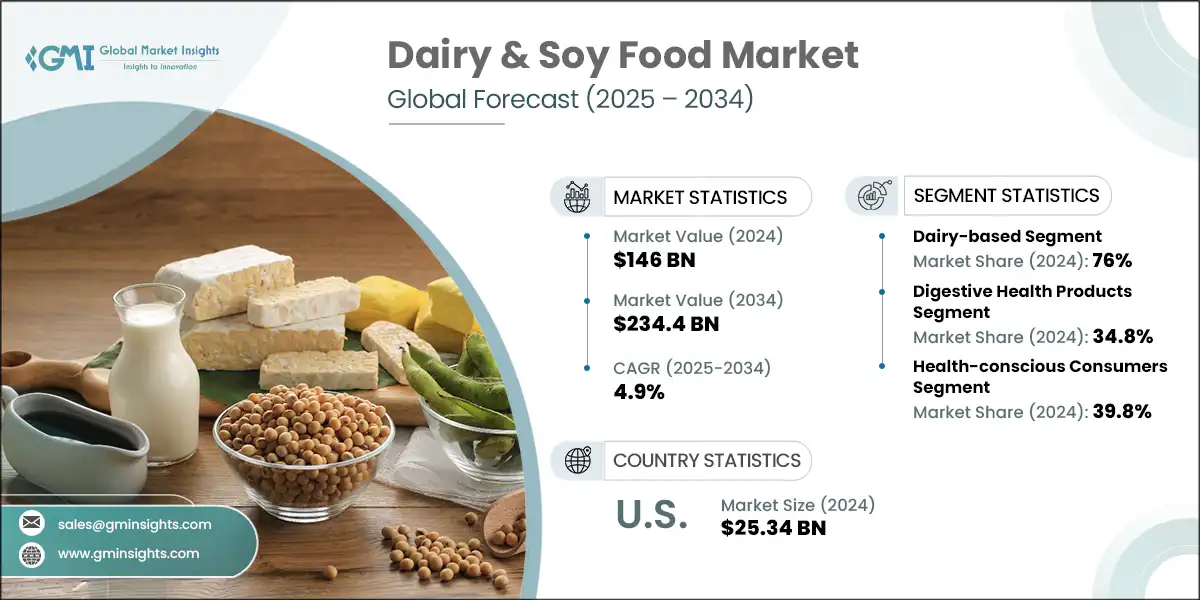
The global dairy & soy food market size was estimated at USD 146 billion in 2024. The market is expected to grow from USD 152.4 billion in 2025 to USD 234.4 billion in 2034, at a CAGR of 4.9%.
Dairy and Soy Food Market Key Takeaways
Market Size & Growth
- 2024 Market Size: USD 146 Billion
- 2034 Forecast Market Size: USD 234.4 Billion
- CAGR (2025–2034): 4.9%
Regional Dominance
- Largest Market: Asia Pacific
- Fastest Growing Region: North America
Key Market Drivers
- Increasing health and wellness consciousness.
- Rising prevalence of lactose intolerance.
- Plant-based diet adoption and veganism growth.
- Protein enrichment and nutritional enhancement demands.
Challenges
- Traditional dairy industry competition.
- Price premium for specialty health products.
Opportunity
- Emerging market health awareness growth.
- Functional food and nutraceutical integration.
- E-commerce and direct-to-consumer growth.
Key Players
- Market Leader: Danone S.A. led with over 14% market share in 2024.
- Leading Players: Top 5 players in this market include Danone S.A., Nestlé S.A., Lactalis Group, Arla Foods amba, General Mills, Inc., which collectively held a market share of 52% in 2024.
Get Market Insights & Growth Opportunities
- Dairy & soy foods constitute an extensive category of important consumer goods, which include milk and dairy products, yogurt, cheese, plant-based beverages, and soy-based alternatives.
- The key factor behind the continuous expansion of the market is the increase in health consciousness among modern consumers demanding clearly labeled, nutritious products with the least additives, and which deliver enhanced functional benefits. For instance, major brands like Danone are continuously reformulating and launching protein-enhanced and low-sugar dairy and soy lines.
- The fast-spreading lactose intolerance has created a strong demand for lactose-free dairy and soy-based products with many consumers switching to those plant-based alternatives that can provide the texture, taste, and nourishment.
- Plant-based diet adoption and vegan lifestyle is setting off product innovation in the market, with the market swiftly expanding its portfolios of various types of yogurts, plant-based beverages, and fortified products targeting vegans, flexitarians, and other environmentally conscious shoppers.
- As populations age, especially in developed countries, demand for functional dairy and soy products fortified with protein, vitamins, and probiotics is on the rise to support bone health, digestion, and general vitality.
- E-commerce and the rise of digital distribution channels have greatly enhanced product accessibility, allowing the producers to reach a wider audience while increasing product assortment.
- Asia Pacific keeps the leading position in the dairy & soy food market due to rapidly rising middle-class incomes, urbanization, and changes in dietary habits in countries such as China and India. Asia-Pacific has a significant vegetarian population, an increasing health awareness level and active government support through subsidies for plant-based food processing and regulatory initiatives promoting plant-based diets and processing infrastructure.
- North America is the fastest growing region in the dairy & soy food market, owing to greater consumer awareness, developed retail distribution, and strong consumer preference for organic and clean-label products.
To get key market trends
Dairy & Soy Food Market Trends
- The increasing consumption of soy milk by consumers, alongside tofu and other dairy alternatives from plants, is driving global growth due to the transition towards veganism and plant-based eating.
- Health-conscious consumers are turning toward more fortified high-protein and functional dairy and soy products made richer with vitamins, calcium, and probiotics
- This is coupled with the continuous introduction of new-to-the-world flavors and improved formulas into the consumer offering.
- The search for clean labels and more natural products initiates reformulation and marketing efforts. Dairy alternatives are making their products sustainably sourced and packed to lure the green consumers as they align with the world's environmental goals.
- Increasingly foodservice outlets, cafes, and institutional buyers tend to stock soy milk and plant-based dairy that incentivizes inclusivity in diets and cost savings.
- The upward surge in online shopping for groceries, accelerated by the pandemic, improves access and convenience for dairy & soy foods. Subscription and personalized bundles are now available on online platforms as proved at increased retail availability and choice for consumers.
Dairy & Soy Food Market Analysis
Learn more about the key segments shaping this market
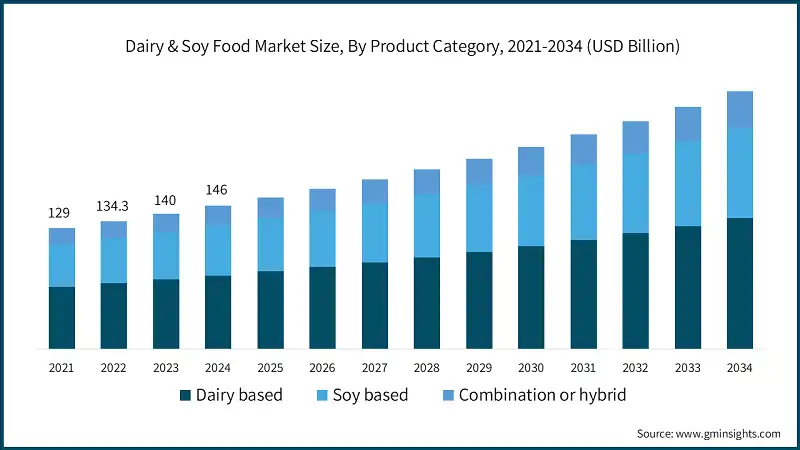
Based on product category, the dairy & soy food market is segmented into dairy-based health foods, soy-based food products, and combination or hybrid products. Dairy-based health foods dominated the market with an approximate share of 76% in 2024 and is expected to grow with the CAGR of 5.3% till 2034.
- Dairy based health foods occupy the leading position in the segment alluring health-conscious consumers seeking the perceived benefits of gut health, immunity, and bone strength. Innovations in the sector are directed squarely at reduced fat and low sugar products, as well as lactose-free ones, catering to the growing numbers of dietary restriction segments with wellness goals.
- Soy food products form one of the fastest-expanding categories, supported by greater acceptance of plant-based diets and concerns for lactose intolerance. The major brands expand this segment with organic, fortified, flavored soy beverages and probiotic soy yogurts for digestive health on a continuous basis.
- Combination/hybrid products benefits from flexibility in dietary trends and cater to customers seeking taste diversity, nutritional balance and environmental responsibility. This innovative field is comprised of blends of dairy with soy proteins, dairy with other plant-based ingredients thereby enhancing the overall nutrition profile.
Learn more about the key segments shaping this market
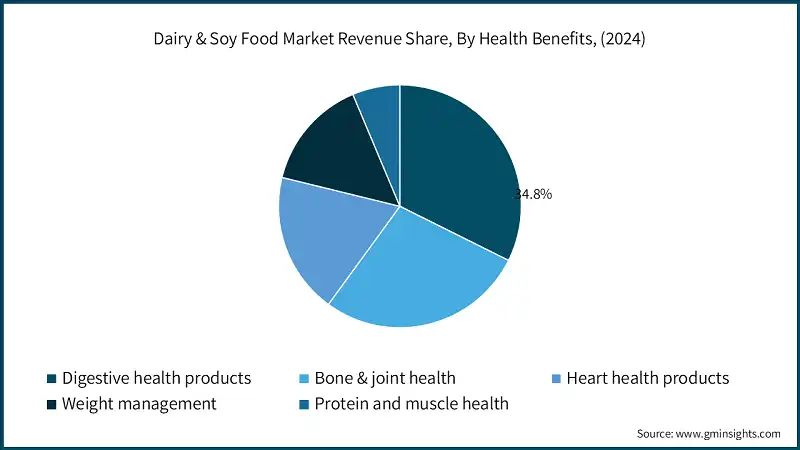
Based on health benefits, the dairy & soy food market is segmented into digestive health products, bone and joint health, heart health products, protein and muscle health and weight management. Digestive health products hold the largest market share of 34.8% in 2024 and are expected to grow at a CAGR of 5.5%, mainly due to rising consumer perception toward gut health, immune boosting, and rising incidence of digestive health disorders.
- Bone and joint health products are expected to thrive owing to the rise in aging populations & an increased awareness of the importance of calcium and vitamins for maintaining bone density. Senior consumers are looking for fortified dairy products and soy-based alternatives with these nutrients for help in mobility and joint health.
- Heart health products form a category that is trending upward due to the increased incidence of cardiovascular diseases and changing consumer preferences towards heart-friendly ingredients. Major products in this category include low-fat dairy items, omega-3-enriched soy beverages and plant sterol-fortified products.
- Protein and muscle health products are in a fast-growing niche, spurred on by increasing fitness consciousness and athletic lifestyles. High protein yogurt, soy protein shakes & muscle recovery dairy blends all address protein needs for muscle repair and maintenance among different age groups.
- Weight management products have gained prominence each year with increasing consumer attention to obesity issues and dieting trends alike. Low-calorie and high-protein dairy and soy foods that contain appetite-suppressing fibers or metabolism-boosting ingredients would be mainly appealing to health-conscious consumers on weight-training in a healthy way.
Based on consumer segments, the dairy & soy food market is categorized into health-conscious consumers, dietary restriction segments, age-based segments and lifestyle-based segments. Health-conscious consumers hold the largest market share of 39.8% in 2024 and are expected to grow at a CAGR of 5.5%, mainly because of their increasing preference for well-labeled, nutritious products containing less or no additives and with fortified benefits. Such consumers actively seek products concerning health, immunity, digestion, and other sustainable ingredients, making this group an important bulwark for the innovation and marketing strategies of products.
- The dietary restriction segment will be expanded as more people become lactose-intolerant, vegan, gluten-sensitive, or allergen-aware. With clear labeling, fortified dairy, and soy alternatives for nutrition and lifestyle needs become sought-after products by these categories. Most would shop in both modern retail and specialized online health food stores.
- Segments are also age based; for instance, product innovations could include calcium and vitamin D-fortified dairy for seniors and protein-enriched soy products for adults concerned with muscle health.
- The lifestyle-based categories include athletes, busy professionals, and environmentally conscious individuals who, via multiple retail formats and e-commerce channels, demand convenient, functional, and sustainable dairy and soy delights.
Looking for region specific data?
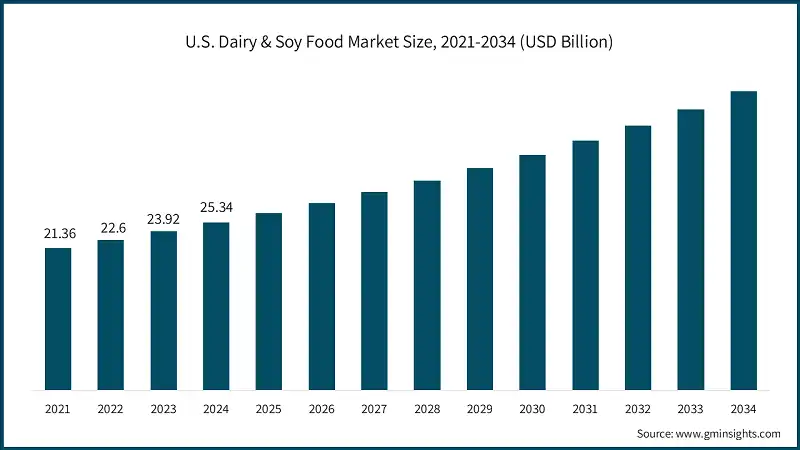
In the dairy & soy food market, U.S. accounts the major share in North America by accounting USD 25.34 billion in 2024 and is expected to grow at a CAGR of 6.4% by 2034.
- Consumer confidence built on a preference from comprehensive studies about brand safety for products, descriptive minimum nutritional labels, and convenience formats supported by a modern manufacturing and supply chain system has driven the US into market leadership. These shifts to organic, gluten-free, and plant-based staples serve as critical growth catalyst for U.S. led initiatives.
- Alongside the U.S., Canada has rapidly surged due to the increasing health awareness, demand of specialty food, and growing penetration of retail and e-commerce, making it one of the most important regional contributors to growth.
The dairy & soy food market in the Germany is expected to experience significant and promising growth from 2025 to 2034.
- Europe accounts for around 21.8% of the dairy & soy food market in 2024. The market benefits from stringent food regulations, increasing organic and clean label segments, and advanced retail ecosystems.
- Germany is the largest and most potent market and where increased demand from consumers for functional foods as well as allergen-free alternatives drive innovation. Multinational and local players are actively pushing fortified and convenient staple products owing to lifestyle changes.
- UK is the most prominent emerging country in Europe with a strongly growing consumer health consciousness, retail modernization, and the ever-expanding availability of organic dairy and soy products.
The dairy & soy food market in China is expected to experience significant and promising growth from 2025 to 2034.
- Rising urbanization and disposable incomes coupled with changes in consumer patterns push for packaged branded staples. The dairy & soy food market accounts for the largest share in the Asia-Pacific region and is steadily growing at a CAGR of 6.5%. Growing health consciousness together with government food safety initiatives strongly favor market expansion with the region projected to grow at a CAGR of about 3.9%.
- Apart from these, Japan and South Korea also play an important role in premium consumer market demand that focuses mainly on modernized technology for food products as well as organic staples.
The dairy & soy food market in Brazil is expected to experience significant and promising growth from 2025 to 2034, driven by middle-class expansion, adoption of urban lifestyles, and increased penetration of packaged foods pave the way for market success.
- The dairy and soy food market in the region continues to grow at a CAGR of 3.1%. These developments increase the investment in infrastructure around food manufacturing and distribution, to further open avenues for availability and consumer reach.
- Mexico is fast becoming relevant in Latin America emerging markets. This has been made possible through urbanization, diversification of retail formats, and increasing popularity for fortified and specialty dairy and soy products. Rising health consciousness and better food supply chain improvements make Colombia a growth market in the region.
The dairy & soy food market in South Africa is expected to experience significant and promising growth from 2025 to 2034.
- The dairy & soy food market is observing gradual but robust growth in Middle East and Africa, with a CAGR of 2.3%. South Africa dominates the MEA region, it has a robust food processing sector, has increased consumer income levels, as well as an ever-growing demand for quality branded staples.
- Among the emerging MEA markets, Saudi Arabia stands out because of its developing dairy farming and processing capacity, which has been spurred on by urbanization and the rising consumption of the middle class. Active government initiatives concerning safety and improvements in supply-chain throughout the whole country have created an enabling environment for growth of the market.
Dairy & Soy Food Market Share
The top 7 companies in the dairy & soy food industry include Danone S.A., Nestlé S.A., Lactalis Group, Arla Foods amba, General Mills, Inc., FrieslandCampina and Fonterra Co-operative Group. These are globally leading players' when segmented into their various regions, catering to 59% of the market share. They have a very solid portfolio of operations around the world which has been built up from the experience gained in the dairy & soy food market. Their broad product portfolios, supported with strong capacity and distribution networks, enable them to meet increasing demands across a few regions.
- Danone S.A. leads the dairy & soy food market by relying on plant-based innovation through brands such as Silk and So Delicious while trying to find an optimum balance of taste, convenience and nutrition.
- Nestlé is a key market player, furthering its extensive R&D and growing plant-based dairy alternatives. It expanded soymilk production coupled with sustainability pledges in sourcing. In early 2025, Nestlé announced to raise its spending on the manufacture of plant-based products to respond to the increasing demand of consumers worldwide for nutritious sources of sustenance that are also environmental-friendly.
- Lactalis leverages its international dairy portfolio of quality milk, cheese and yogurt products. Lactalis is venturing into markets of lactose-free and plant-based extensions. In 2024, Lactalis strengthened its international footprint with acquiring strategic regional brands of dairy such as DPA (Dairy Partners, America).
- Arla Food amba is one of the largest cooperatives progressing in the field of sustainable dairy farming practices, along with organic product lines. Increasing its lactose-free and plant-based alternative offerings in 2024, the company introduced blended dairy-soy beverages to meet the growing demands for allergen-friendly and nutritional staples in Europe and Asia.
- General Mills grows with innovative development in organic, gluten-free, and plant-based dairy alternatives. Recently, General Mills expanded its Yoplait yogurt line to include plant-based and fortified yogurts for health-conscious people.
- FrieslandCampina is one of the major players in a combination of tradition and innovation, as this is the energy that it channels into functional dairy and soy beverages.
- Fonterra is a global cooperative major in dairy, focusing on innovating ingredients and strategy for global penetration. In 2023, it introduced novel high-protein blends of dairy and soy products customized for the evolving markets.
Dairy & Soy Food Market Companies
Major players operating in the dairy & soy food industry include:
- Arla Foods amba
- Danone S.A.
- Dean Foods Company
- Fonterra Co-operative Group
- FrieslandCampina
- General Mills, Inc.
- Hain Celestial Group, Inc.
- Kellogg Company
- Lactalis Group
- Nestlé S.A.
- Silk (Danone)
- The Kraft Heinz Company
- Unilever PLC
- WhiteWave Foods (Danone)
- Yakult Honsha Co., Ltd.
Dairy and Soy Food Market Report Attributes
| Key Takeaway | Details |
|---|---|
| Market Size & Growth | |
| Base Year | 2024 |
| Market Size in 2024 | USD 146 Billion |
| Forecast Period 2025 - 2034 CAGR | 4.9% |
| Market Size in 2034 | USD 234.4 Billion |
| Key Market Trends | |
| Drivers | Impact |
| Increasing health and wellness consciousness | Boost demand for low-fat, fortified dairy and soy products. |
| Rising prevalence of lactose intolerance | Increase the market base for soy-based and lactose-free dairy alternatives. |
| Plant-based diet adoption and veganism growth | Drive innovation in soy and dairy food substitutes. |
| Protein enrichment and nutritional enhancement demands | Drive product development and premiumization. |
| Pitfalls & Challenges | Impact |
| Traditional dairy industry competition | Limits the rapid expansion of soy alternatives in some regions. |
| Price premium for specialty health products | Restrict mass adoption, especially in markets which are price sensitive. |
| Opportunities: | Impact |
| Emerging market health awareness growth | Opens the entry for new consumer segments for dairy and soy foods. |
| Functional food and nutraceutical integration | Enhances product appeal and differentiation. |
| E-commerce and direct-to-consumer growth | Improves product accessibility and consumer engagement. |
| Market Leaders (2024) | |
| Market Leaders |
14% Market share |
| Top Players |
Collective market share 52% in 2024 |
| Competitive Edge |
|
| Regional Insights | |
| Largest Market | Asia Pacific |
| Fastest growing market | North America |
| Emerging countries | U.S., Canada, Brazil, Argentina and South Africa |
| Future outlook |
|
What are the growth opportunities in this market?
Dairy & Soy Food Industry News
- In early 2025, Nestlé announced to raise its spending on the manufacture of plant-based products to respond to the increasing demand of consumers worldwide for nutritious sources.
- In 2024, Lactalis strengthened its international footprint with acquiring strategic regional brands of dairy such as DPA Brazil.
- In 2024, Yeo Hiap Seng introduced Immuno Soy Milk fortified with vitamin B6 and zinc, aligning with immunity trends.
- In 2022, Silk expanded its plant-based creamers lineup by including new silk enhanced almond creamers and silk sweet oat latte creamer.
This dairy & soy food market research report includes in-depth coverage of the industry, with estimates & forecasts in terms of revenue (USD Million) and volume (Kilo Tons) from 2025 to 2034, for the following segments:
Market, By Product category
- Dairy-based health foods
- Probiotic dairy products
- Protein-enriched dairy
- Functional dairy products
- Soy-based food products
- Traditional soy foods
- Soy milk and beverages
- Soy protein products
- Combination and hybrid products
- Dairy-soy blend products
- Multi-protein formulations
- Functional food combinations
- Specialty nutritional products
Market, By Health benefit
- Digestive health products
- Probiotic and prebiotic foods
- Digestive enzyme enhanced
- Gut health support products
- Bone and joint health
- Calcium-enriched products
- Vitamin D fortified foods
- Bone health support formulations
- Heart health products
- Cholesterol management foods
- Omega-3 enhanced products
- Heart-healthy formulations
- Protein and muscle health
- High-protein products
- Muscle recovery formulations
- Sports nutrition integration
- Weight management
- Low-calorie and reduced-fat
- Satiety-enhancing products
- Metabolic support formulations
Market, By Consumer segment
- Health-conscious consumers
- Dietary restriction segments
- Age-based segments
- Children and adolescent nutrition
- Adult health and wellness
- Senior nutrition and care
- Lifestyle-based segments
- Busy professional
- Organic and natural preference
- Premium and artisanal consumers
The above information is provided for the following regions and countries:
- North America
- U.S.
- Canada
- Europe
- Germany
- UK
- France
- Spain
- Italy
- Rest of Europe
- Asia Pacific
- China
- India
- Japan
- Australia
- South Korea
- Rest of Asia Pacific
- Latin America
- Brazil
- Mexico
- Argentina
- Rest of Latin America
- Middle East and Africa
- Saudi Arabia
- South Africa
- UAE
- Rest of Middle East and Africa
Frequently Asked Question(FAQ) :
What is the market size of the dairy & soy food in 2024?
The market size was estimated at USD 146 billion in 2024, with a CAGR of 4.9% expected through 2034. The growth is driven by increasing demand for plant-based alternatives, fortified products, and clean-label offerings.
What is the projected value of the dairy & soy food market by 2034?
The market is poised to reach USD 234.4 billion by 2034, supported by rising health consciousness, sustainable sourcing, and innovation in product formulations.
What was the market share of dairy-based health foods in 2024?
Dairy-based health foods dominated the market with an approximate share of 76% in 2024 and is set to expand at a CAGR of 5.3% through 2034.
What is the market share and growth outlook for digestive health products?
Digestive health products held the largest market share of 34.8% in 2024 and is likely to showcase around 5.5% CAGR till 2034.
What is the market share of health-conscious consumers in 2024?
Health-conscious consumers accounted for 39.8% of the market in 2024 and is anticipated to witness over 5.5% CAGR up to 2034.
Which region leads the dairy & soy food sector?
The U.S. market accounting for USD 25.34 billion in 2024. It is expected to grow at a CAGR of 6.4% through 2034.
What are the key trends in the dairy & soy food market?
Key trends are plant-based alternatives, functional and fortified products, clean-label demand, sustainable sourcing, and personalized online grocery subscriptions.
Who are the key players in the dairy & soy food industry?
Key players include Arla Foods amba, Danone S.A., Dean Foods Company, Fonterra Co-operative Group, FrieslandCampina, General Mills, Inc., Hain Celestial Group, Inc., Kellogg Company, Lactalis Group, and Nestlé S.A.
Dairy and Soy Food Market Scope
Related Reports