Summary
Table of Content

Curtain Wall Market
Get a free sample of this report
Form submitted successfully!
Error submitting form. Please try again.
Thank you!
Your inquiry has been received. Our team will reach out to you with the required details via email. To ensure that you don't miss their response, kindly remember to check your spam folder as well!
Request Sectional Data
Thank you!
Your inquiry has been received. Our team will reach out to you with the required details via email. To ensure that you don't miss their response, kindly remember to check your spam folder as well!
Form submitted successfully!
Error submitting form. Please try again.
Curtain Wall Market Size
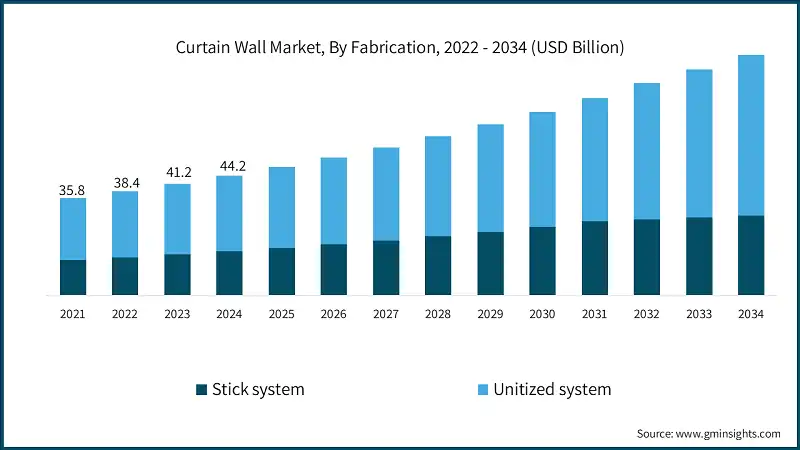
The global curtain wall market size was estimated at USD 44.2 billion in 2024, and the market is expected to grow from USD 47.4 billion to USD 88.9 billion in 2034, at a CAGR of 7.2%. The growth is driven by key factors such as rapid urbanization, architectural trends, energy efficiency, and sustainability.
Curtain Wall Market Key Takeaways
Market Size & Growth
- 2024 Market Size: USD 44.2 Billion
- 2034 Forecast Market Size: USD 88.9 Billion
- CAGR (2025–2034): 7.2%
Key Market Drivers
- Rapid urbanization.
- Architectural trends.
- Energy efficiency and sustainability.
Challenges
- High initial cost.
- Complexity and customization challenges.
Opportunity
- Smart building integration.
- Government incentives.
Get Market Insights & Growth Opportunities
The global curtain wall market reached USD 38 billion in 2019 and recorded high growth during the past few years. The major cause of growth was the rising construction of commercial, institutional, and high-rise dwelling buildings. Urbanization and emphasis on energy-efficient and visually appealing buildings have been leading to the demand for curtain walls. The market growth expanded owing to huge investments in commercial property and infrastructure, primarily in emerging markets such as Asia and the Middle East.
The curtain wall market growth is fueled by tighter building codes, green standards, and green design orientation. Curtain walls conserve building energy in the form of better thermal performance, daylight, and tighter envelopes. They are being used more frequently in buildings, rated according to green standards such as LEED, BREEAM, and IGBC, fueling market growth. As per the International Energy Agency (IEA), buildings consume almost 30% of the globe's energy, and thus energy-efficient products such as curtain walls are all the more significant.
The Asia-Pacific (APAC) region is driving the market and holds around 32% of the value of the world's curtain walls. Geographies such as China, India, and Indonesia are heavily investing in commercial towers, intelligent cities, and transportation infrastructure, fueling demand for unitized and stick-built curtain wall systems. North America, with a 27% share, is led by infrastructure upgrades, expansion of LEED-certified buildings, and continuous commercial property investments. Europe, with a 22% share, is led by energy retrofitting demand and sustainability codes in nations such as Germany, France, and the UK. The Middle East & Africa (MEA) and Latin America (LATAM) combined have approximately a 19% share, led by tourism-fueled infrastructure investments and urban projects. The World Bank foresees investment in developing economies' infrastructure growing heavily, further boosting curtain wall market growth.
Unitized systems control is leading as it install more rapidly, with increased quality control and appropriate use for big projects. Stick-built systems control 30% of the market and are utilized on mid-rise and custom façades. Semi-unitized and hybrid systems account for the other 7%. Global construction expenditures were USD 12.9 trillion in 2022, as estimated by Oxford Economics, and the United Nations projects that another 2.5 billion citizens will become urban dwellers by the year 2050. All these are likely to spur the market for curtain walls even further, along with energy savings of 20–25% and government incentives for green infrastructure.

To get key market trends
Curtain Wall Market Trends
- Unitized curtain wall systems are gaining increasing popularity because these systems ensure improved thermal insulation, water resistance, and airtightness, in addition to quicker installation compared to stick-built systems. The growing demand for high-rise construction activities, particularly in the Asia-Pacific (APAC) and the Middle East, is propelling the surge. Based on the United Nations, 55% of the world population resides in urban cities and is estimated to rise to 68% by the year 2050 and therefore drive demand for higher urban development. Demand for unitized systems is estimated to rise between 2024 and 2028 at a compound annual rate (CAGR) of more than 9%. This document also recommends growth in the adoption of green building certification and modular construction techniques, and as a result, unitized curtain walls are the center of attention for green city growth.
- The demand for curtain walls is predicted to increase with the adoption of intelligent glass and energy-efficient glazing technologies. According to the IEA, nearly 40% of global energy consumption comes from buildings. Governments and developers are seeking to increase energy efficiency through the adoption of sophisticated façade technologies. Low-E, electrochromic, and solar panel-integrated photovoltaic glass curtain walls are gaining traction, conserving as much as 20–25% energy in HVAC, lighting, and heating, ventilation, and air conditioning. As an example, the LEED standards by the U.S. Green Building Council and the European Union's EPBD are promoting such adoption. By 2023 to 2030, high-performance glazing solutions would be commonplace in developed economies. Smart glass also integrates with smart city projects for the creation of digital and sustainable infrastructure.
- Retrofitting and refurbishing existing commercial buildings is a new venture, especially in Europe and North America. The majority of the buildings on these continents were built during the period between the 1970s and the 1990s. As governments implement more stringent energy codes and sustainability regulations, building owners are retro commissioning curtain walls to maximize energy efficiency, minimize operating expenses, and increase the value of their buildings. As more than 60% of U.S. office buildings are more than 20 years old, the U.S. Energy Information Administration (EIA) indicates, façade replacement work is on the rise. From 2024, the market for refurbishment of curtain walls will increase steadily, boosted by government incentives and new building performance standards. This is in the context of an overall plan to cut down on carbon emissions and revitalize city centers. Light and high-performance materials are currently in vogue since they can be easily retrofitted into existing older buildings without drastic structural modifications.
Curtain Wall Market Analysis
Learn more about the key segments shaping this market
Based on fabrication, the market is divided into stick systems and unitized systems. In 2024, the unitized system segment dominated about 63% market share and is expected to grow at a CAGR of 8% from 2025 to 2034.
- Unitized systems are finest as they are fabricated off-site, allowing quicker on-site installation at a higher rate, lower labor cost, and enhanced quality control. These advantages matter in high-rise and mega commercial buildings. Stick systems with more on-site labor and assembly are better suited for small or specialty applications.
- New technologies impel unitized curtain wall design. Computerized production lines, CNC millwork, and robot glazing enabled unitized panels to be more precise and manufacturable in quantity. Smart glass, photovoltaic panels, and new insulation materials are being incorporated into unitized systems as energy-efficient and sustainable building becomes the norm. The U.S. Department of Energy reports that buildings consume close to 40% of the entire energy, and technologies like unitized systems have the potential to reduce it by a massive percentage. Unitized systems are also aided in Building Information Modeling (BIM) and modular construction, and therefore, they are very much in demand in modern and fast-track building projects.
- Though unitized systems are 15–20% more material and manufacturing-intensive, they save time and labor on installation and are therefore cost-effective for large-scale projects. They are therefore particularly attractive in rapidly growing economies such as APAC and the Middle East, where speed and efficiency take top priority. Stick systems remain reasonable, however, in low-cost markets where in-site customization is a greater concern than faster installation. As stated by the International Energy Agency (IEA), urbanization in places such as Asia is estimated to grow at a rate of 2.3% each year, increasing demand for affordable building solutions such as unitized systems. Unitized systems tend to be more efficient, flexible, and beneficial throughout their lifespan, thus the preferred choice within the curtain wall industry.
Based on construction type, the curtain wall market is segmented into refurbishment and new construction. In 2024, the new construction segment held approximately 71% revenue share and is expected to grow at a CAGR of 7.4% from 2025 to 2034.
- Urbanization, office building construction, and mega-scale developments are propelling new building growth in China, India, the UAE, and Southeast Asia. Mega-scale developments involve high-rise skyscrapers, business districts, airports, and smart cities, where curtain wall systems are the standard as far as function and appearance are concerned.
- The population of the world in 2050 will be set at 68% of city dwellers from 56% in 2020, the United Nations forecasts. Increased urbanization is associated with the demand for new buildings. Between 2025-2034, the new build sector would most probably witness a CAGR of 7.4%, marginally more than the refurbishment sector, which would probably register a CAGR of 6.1%. Refurbishment is also gaining ground in established economies like Western Europe and North America, with the need for energy-efficient retrofits and aging infrastructure. New building still dominates in size, investment, and use of high-tech facade systems even in these markets. Building Information Modeling (BIM), prefabricated curtain wall units, and energy-efficient planning are more prevalent in new buildings, where new buildings are planned from the beginning to have these features. These technologies save project time, achieve higher building performance, and offer more flexible designs.
- The new building also offers greater cost savings. Curtain walls are also included in the design process, which makes customization and structure changes costly. Unit systems, while more expensive per square meter than stick systems, are faster to install and more energy efficient and thus less expensive in the long term. Refurbishment is more costly in terms of custom fitting, limited access, and time-consuming fitting, especially when refurbishing existing buildings to include new systems. Though refurbishment is needed for increased energy efficiency and legislative conformity within the current building stock, preponderant new builds dominate the market due to their scale, high intensity of technological use, and compatibility with global urbanization and economic development trends.
Learn more about the key segments shaping this market
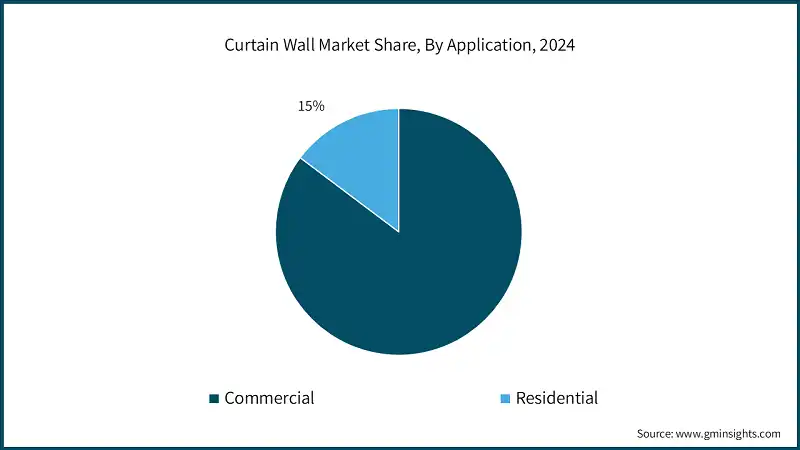
Based on applications, the curtain wall market is segmented into residential and commercial. In 2024, the commercial segment generated a revenue of USD 37.8 billion and is expected to grow at a CAGR of 7.3% till 2034.
- The commercial segment takes the lead due to curtain walls' extensive application in high-rise office complexes, hotels, shopping centers, hospitals, and transportation terminals. These buildings are supplemented with curtain walls as they are energy-efficient, provide more daylight, and accommodate current designs. The United States Department of Energy shows that energy-efficient buildings with systems such as curtain walls can save 20–25% of energy usage. This aligns with international green building regulations such as LEED, BREEAM, and IGBC. Urbanization in Asia-Pacific and the Middle East, fueled by government funding in smart cities and infrastructure, is also fueling demand.
The residential segment, while lower, is anticipated to rise at a higher rate, with a 2025-2034 CAGR of 6.7%, against 7.3% for the commercial segment. Residential expansion is spurred by the increasing demand for high-end high-rise condominiums in urban metropolises such as New York, London, Dubai, and Singapore. Occupiers in such cities are demanding features such as floor-to-ceiling glass, sound insulation, and up-to-date looks, and they are offered by curtain walls. Adoption of the latest technology, including unitized systems and smart glazing, is also fueling the trend. But curtain walls are less typical in budget and mid-range homes for the added expense and diminished special ordering. Luxury housing projects use more sophisticated building materials, such as curtain walls, more frequently, states the National Association of Home Builders (NAHB). - Additionally, though the residential market has good potential for growth, the commercial market is the largest segment of the curtain wall business. This is because of enormous building projects and the requirement to fulfill conditions for sustainability. Both markets profit from new technology and urban growth, but the commercial market will remain at the helm because of its scale, budgetary discretion, and consistency with international infrastructure objectives. Government initiatives like the U.S. Infrastructure Investment and Jobs Act and other similar programs in the Asia-Pacific region are also likely to favor the development of the commercial segment.
Looking for region specific data?
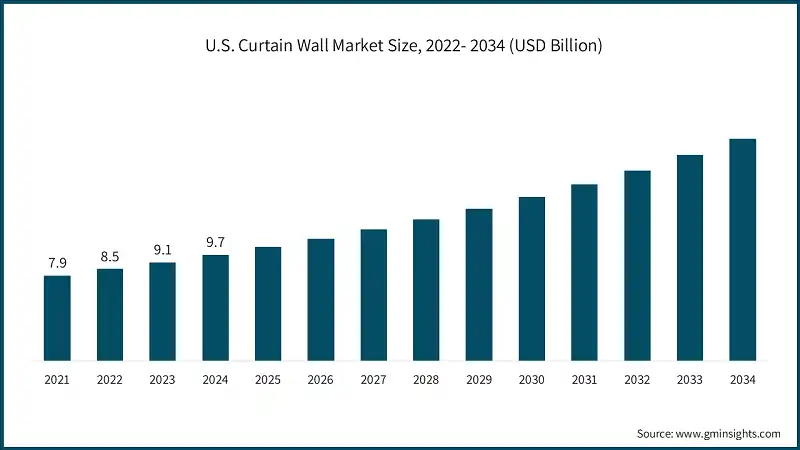
In 2024, the United States dominated the North American curtain wall market by 77.3% revenue share and generated USD 9.7 billion in revenue.
- The U.S market growth is fueled by strong commercial real estate space, high-rise redevelopment in cities, and widespread usage of LEED-certified buildings. New York, Chicago, and San Francisco are some of the key contributors with projects such as office redevelopment, airport redevelopment, and mixed-use high-rises. According to the U.S. Green Building Council, over 100,000 LEED-certified projects have been completed in the country, highlighting the demand for green buildings. Toronto and Vancouver are being envisioned as growth hubs in Canada due to increased real estate investment and increased green building needs.
The European curtain wall market in the Rest of the EU is expected to experience significant and promising growth from 2025 to 2034.
- Europe's curtain wall industry is well-developed but expected to grow gradually, especially in regions outside of core markets like Germany, France, and the UK. Between 2025-2034, the EU will build energy efficiency laws, climate goals, and city renewal policies that will drive growth. Poland, Spain, Italy, and the Netherlands are leading players in construction and high-rise building development. EU buildings are expected to consume 40% of the energy, which has directed policies like the EU Green Deal and next generation EU investments in green and low-carbon buildings.
The APAC curtain wall market in the rest of APAC is expected to experience significant and promising growth from 2025 to 2034.
- The APAC region is the largest and fastest-growing curtain wall industry worldwide, followed by Japan, China, India, and Southeast Asia. China is the largest market with speedier urbanization and business expansion. Otherwise, nations such as Indonesia, Vietnam, Thailand, and the Philippines are likely to post double-digit growth in 2025-2034. Asia is positioned at 54% of the global urban population by the United Nations, which is spurring commercial real estate, hotel, and airport demand. Governments of the region are requiring existing green building standards, also driving the adoption of curtain wall systems further forward. The market will increase with a CAGR higher than 8.4% due to low cost of production, regulation, and energy-saving skyscraper demand.
The MEA curtain wall market in the rest of MEA is expected to experience significant and promising growth from 2025 to 2034.
- The MEA curtain wall industry is changing but has tremendous growth potential, mainly in non-GCC nations like Egypt, Morocco, Kenya, and South Africa. These nations are investing in transportation infrastructure, urban mega-projects, and tourist infrastructure. Government-sponsored housing and infrastructure projects, international investment, and climate-resilient projects will drive growth from 2025 to 2034. African infrastructure spending is set to hit USD 170 billion annually in 2025, reports the African Development Bank. The growth, however, in the GCC region was spearheaded by Saudi Arabia's NEOM and UAE's Expo City Dubai, driving demand for technology-based, energy-efficient curtain walls. The area is likely to grow at a CAGR of 7.9% with rising investment in public, commercial, and hospitality infrastructure schemes.
Curtain Wall Market Share Analysis
AGC Inc., Central Glass Co. Ltd., Guardian Industries Corp., Nippon Sheet Glass Co., Ltd, and Saint-Gobain group collectively held a substantial 10-15% market share in curtain wall. The market is highly fragmented.
- Market leaders in curtain walling implement different kinds of strategic interventions to dominate the competition front and build their global brand. The most prominent emphasis is on product innovation along with technology adoption, and companies are working intensively on R&D to create futuristic products such as lightweight composites and high-performance glazing, and smart technologies such as photovoltaic panels and dynamic fades. This allows them to respond to increasing demand for energy-efficient, sustainable, and digitally enabled curtain wall systems.
- Furthermore, most of the companies pursue geographical expansion through opening regional manufacturing facilities and partnerships in high-growth economies such as Southeast Europe, the Middle East, and the Asia-Pacific region so that they can implement large-scale projects globally. Strategic partnerships with architects, engineering consultancy firms, and local façade companies also help such companies gain access to high-end projects as well as new geographies. To ensure quality and timely completion of projects, market leaders like to keep design, fabrication, testing, and installation in-house under vertical integration.
Curtain Wall Market Companies
Major players operating in the curtain wall industry are:
- AGC Inc.
- Central Glass Co.LTD
- Guardian Industries Corp.
- Nippon Sheet Glass Co., Ltd
- Saint-Gobain group
- Elicc Group
- EFCO Corporation
- EFP International B.V
- Reynaers Group
- Schott AG
- Vitro S.A.B. de C.V.
- Xinyi Glass Holdings Limited
- Yuanda China Holdings Limited
- Hainan Development Holdings Nanhai Co., Ltd.
- Technal
- PortaFab Corporation
- Kazmi Enterprises
- G. James Group
- LIXIL Group Corporation
- Kawneer Company Inc
AGC Inc., Central Glass Co. LTD, Guardian Industries Corp., Nippon Sheet Glass Co., Ltd, Saint-Gobain Group, Schott AG, Xinyi Glass Holdings Limited, Yuanda China Holdings Limited, Kawneer Company Inc., and a couple of others—are some of the largest companies engaged in the curtain wall business and are mostly engaged in providing raw materials and complete façade systems used in curtain wall construction.
They encompass glassmakers and processors (e.g., AGC Inc., Guardian Industries, Saint-Gobain, Nippon Sheet Glass, Xinyi Glass) and produce various architectural glass products like tempered glass, laminated glass, insulated glass, low-emissivity, and smart glass solutions that are critical to curtain wall performance.
Others, such as Yuanda China Holdings Limited, Kawneer Company Inc., Reynaers Group, EFCO Corporation, Technal, and EFP International B.V., provide specialty in curtain wall system design, fabrication, and installation—providing aluminum framing, unitized and stick-built systems, and custom façade solutions.
Schott AG and Vitro SAB de C.V. are some of the competitors providing specialty glass products like high-performance coatings and solar control glass that enable energy efficiency in curtain walls. New building still dominates in size, investment, and use of high-tech facade systems even in these markets. Building Information Modeling (BIM), prefabricated curtain wall units, and energy-efficient planning are more prevalent in new buildings, where new buildings are planned from the beginning to have these features. These technologies save project time, achieve higher building performance, and offer more flexible designs.
The new building also offers greater cost savings. Curtain walls are also included in the design process, which makes customization and structure changes costly. Unit systems, while more expensive per square meter than stick systems, are faster to install and more energy efficient and thus less expensive in the long term.
Curtain Wall Market Report Attributes
| Key Takeaway | Details |
|---|---|
| Market Size & Growth | |
| Base Year | 2024 |
| Market Size in 2024 | USD 44.2 Billion |
| Forecast Period 2025 – 2034 CAGR | 7.2% |
| Market Size in 2034 | USD 88.9 Billion |
| Key Market Trends | |
| Drivers | Impact |
| Rapid urbanization | Increasing population in cities drives demand for modern infrastructure and construction solutions. |
| Architectural trends | Evolving building designs and aesthetics fuel demand for innovative construction materials and technologies. |
| Energy efficiency and sustainability | Growing environmental concerns push the adoption of green building solutions and eco-friendly systems. |
| Pitfalls & Challenges | Impact |
| High initial cost | Significant upfront investment can deter adoption despite long-term benefits. |
| Complexity and customization challenges | Tailoring term solutions to unique project needs can lead to design, integration, and execution difficulties. |
| Opportunities: | Impact |
| Smart building integration | Rising demand for IoT-enabled and automated infrastructure opens new growth avenues. |
| Government incentives | Supportive policies and green building incentives encourage the adoption of energy-efficient technologies. |
| Market Leaders (2024) | |
| Market Leader |
|
| Top Players |
Collective market share in 2024 is 14% |
| Competitive Edge |
|
| Regional Insights | |
| Largest Market | Asia Pacific |
| Fastest Growing Market | Asia Pacific |
| Emerging Countries | China, India, South Korea |
| Future outlook |
|
What are the growth opportunities in this market?
Curtain Wall Industry News
- In January 2025, Kawneer introduced a new addition to its curtain wall framing product family with the 1600UT SS Curtain Wall System. Specifically created to address the building and construction market's thermal curtain wall requirements, the 1600UT SS will enter the marketplace with a complete system U-factor of 0.29, utilizing standard 1" glass/COG 0.24. For applications with extra thermal loads, the system can attain a total system U-factor of 0.24 for 1' glass/COG 0.20
- In November 2024, AluK India is revolutionizing high-rise buildings with the introduction of its W75U Unitized Curtain Walling System, an elegant, innovative solution that not just makes building tall but seen. Designed to draw attention and constructed to last, it is the perfect solution for every skyscraper. The system has an array of strong advantages for high-rise buildings. Offsite production enables quicker and safer installation, reducing construction time and disruption. Its design also allows for precision assembly with reduced on-site labor costs. The flexibility of the system accommodates different architectural forms, ranging from continuous glazing to floor-to-floor type, types of glass, window and door units, with differing design possibilities.
- In December 2023, Akira Uozu) noted the acquisition of Thailand curtain wall firm YHS International Ltd. ("YHSI") and related manufacturing firm Siam Metal Co., Ltd. ("SM"). YKK AP will, through the acquisition, obtain its fourth global curtain wall manufacturing base and advance with its development to become a stable global supply system and expand its curtain wall business in the Asia region. With factory facilities occupying a total area of 26,089 square meters and an annual production capacity of nearly 180,000 square meters of curtain wall, YHSI and SM have monopolized the Thai curtain wall market. YHSI and SM produce, design, and supply their curtain wall systems and offer installation and servicing as well. Aside from contract business in Thailand, they have been supplying their curtain wall systems for various mega-sized projects in Japan. Their good past history of technological capabilities and experiences complement well with YKK AP's corporate philosophy - to insist on quality in everything, and to lead to this acquisition as growth partners.
- In 2023, Dallas-headquartered Oldcastle Building Envelope, a worldwide distributor of metal, architectural glass, and hardware, unveiled Reliance-TC LT as an addition to its Reliance line of curtain wall solutions. The product, according to the company, is a high-performance curtain wall that's "lightweight, cost-competitive, and well-suited for IECC Zones 4-8." Not only does the double-pane curtain wall offer a U-factor rating of 0.29, offering superior thermal protection against climate extremes in the United States and Canada, but it also bests industry standards in this class, according to OBE.
The curtain wall market research report includes in-depth coverage of the industry with estimates & forecasts in terms of revenue ($ Mn/Bn) and shipment (Units) from 2021 to 2034, for the following segments:
Market, By Fabrication
- Stick System
- Unitized System
Market, By Construction Type
- Refurbishment
- New Construction
Market, By Application
- Commercial
- Residential
Market, By Distribution Channel
- Online
- Company website
- E-commerce
- Offline
- Supermarket/hypermarket
- Specialty stores
- others
The above information is provided for the following regions:
- North America
- U.S.
- Canada
- Europe
- UK
- Germany
- France
- Italy
- Spain
- Russia
- Asia Pacific
- China
- India
- Japan
- Australia
- South Korea
- Latin America
- Brazil
- Mexico
- MEA
- UAE
- South Africa
- Saudi Arabia
Frequently Asked Question(FAQ) :
What is the market size of the curtain wall market in 2024?
The market size was USD 44.2 billion in 2024, with a CAGR of 7.2% expected through 2034, driven by rapid urbanization, architectural trends, and sustainability demands.
What is the projected value of the curtain wall market by 2034?
The global market for curtain wall is projected to reach USD 88.9 billion by 2034, fueled by green building standards, energy efficiency needs, and smart city developments.
How much revenue did the unitized system segment generate in 2024?
The unitized system segment generated approximately USD 25.6 billion in 2024, dominating the market with a 63% share due to faster installation and better quality control.
What was the valuation of the new construction segment in 2024?
The new construction segment accounted for 71% of the market, generating around USD 33.4 billion in 2024, led by urbanization and mega infrastructure projects.
What is the growth outlook for the commercial application segment from 2025 to 2034?
The commercial segment is generated USD 37.8 billion in 2024 and is projected to grow at a CAGR of 7.3%, supported by rising demand for high-rise offices, malls, and hospitals.
Which region leads the curtain wall market?
Asia-Pacific leads the market with 32% share, contributing approximately USD 15 billion in 2024, propelled by urbanization in China, India, and Southeast Asia.
What are the upcoming trends in the curtain wall market?
Key trends include the adoption of smart glass, energy-efficient glazing, IoT-integrated systems, and retrofitting of existing buildings for improved energy performance.
Who are the key players in the curtain wall market?
Key players include AGC Inc., Central Glass Co. LTD, Guardian Industries Corp., Nippon Sheet Glass Co. Ltd, Saint-Gobain Group, Yuanda China Holdings, Kawneer Company Inc., Reynaers Group, Schott AG, and Xinyi Glass Holdings Limited
Curtain Wall Market Scope
Related Reports