Summary
Table of Content

Cultivated Seafood Production Systems Market
Get a free sample of this report
Form submitted successfully!
Error submitting form. Please try again.
Thank you!
Your inquiry has been received. Our team will reach out to you with the required details via email. To ensure that you don't miss their response, kindly remember to check your spam folder as well!
Request Sectional Data
Thank you!
Your inquiry has been received. Our team will reach out to you with the required details via email. To ensure that you don't miss their response, kindly remember to check your spam folder as well!
Form submitted successfully!
Error submitting form. Please try again.
Cultivated Seafood Production Systems Market Size
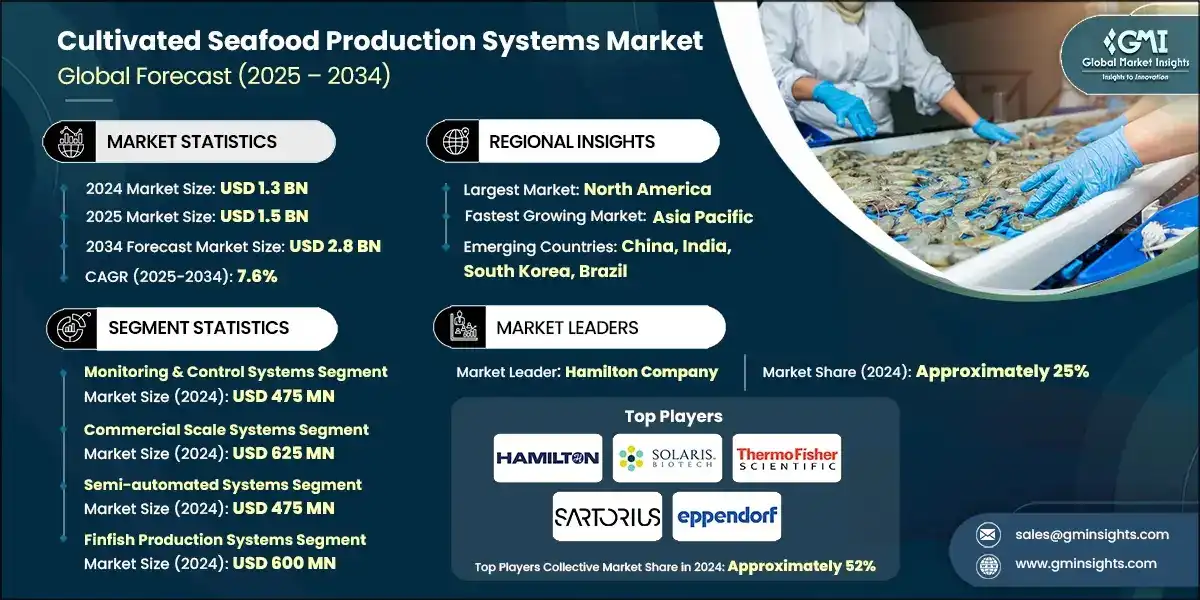
The global cultivated seafood production systems market size was valued at USD 1.3 billion in 2024. The market is projected to grow from USD 1.5 billion in 2025 to USD 2.8 billion by 2034, a trajectory that implies a 7.6% CAGR from 2025 to 2034 according to latest report published by Global Market Insights Inc.
Cultivated Seafood Production Systems Market Key Takeaways
Market Size & Growth
- 2024 Market Size: USD 1.3 Billion
- 2025 Market Size: USD 1.5 Billion
- 2034 Forecast Market Size: USD 2.8 Billion
- CAGR (2025–2034): 7.6%
Key Market Drivers
- Increasing demand for sustainable protein production and cellular agriculture.
- Advances in automation and IoT integration enabling improved efficiency and scalability.
- Growing regulatory approval for cultivated seafood and investment in food technology.
- Rising investment in sustainable aquaculture technologies and precision farming.
Challenges
- High capital costs and complex installation processes.
- Regulatory uncertainty surrounding cellular agriculture.
- Competition from traditional aquaculture methods.
Opportunity
- Expansion into pharmaceutical and nutraceutical applications.
- Development of modular systems for specific applications.
- Integration into emerging technologies like vertical farming and bioprocessing.
- Strategic partnerships for co-development of application-specific solutions.
Key Players
- Market Leader: Hamilton Company led with over 25% market share in 2024.
- Leading Players: Top 5 players in this market include Hamilton Company, Solaris Biotech, Thermo Fisher Scientific, Sartorius, Eppendorf, which collectively held a market share of 52% in 2024.
Get Market Insights & Growth Opportunities
- Bioreactor systems and commercial-scale installations show the short-term demand trend, while commercial smart monitoring systems and automated applications provide the journey for the much wider market applications. The combination of improvement performance attributes for recirculating aquaculture systems (RAS) with very solid funding support for cellular agriculture research and a steady commercialization path for cultivated seafood technologies explains this momentum. The FDA/USDA regulatory tailwinds along with maturing quality frameworks for adoption in food production, biotechnology, and sustainable protein development further enhance progress in such commercial systems.
- Cultivated seafood production systems are now sprouting in the aquaculture-high-performance equipment market that rapidly morphs into commercial-scale installations and advanced cellular agriculture. Bioreactor systems and cell culture technologies manifest good scalability and process control balance, networking them towards next-gen protein production and sustainable aquaculture operations. The forefront automation abilities of new production systems with their easy fitment for IoT application make these very systems great for next-gen food technology and precision agriculture systems.
- The remarkable advancements in bioreactor design and automation now make them more efficient, more scalable, and greatly extended in terms of application with wider acceptance of advanced production systems for specialty aquaculture operations. Success in cellular agriculture technologies and methods for controlled cultivation yields better and more consistent performances, whereas some robust-for-commerce systems have improved performance in large-scale food production. This basically opens up the entire opportunity field to advanced commercialization and includes cultivated seafood away from research installations and into applications for the market: modernizing traditional aquaculture and integrated bioprocessing.
- The emerging trend towards sustainable protein solutions and advanced food production is gradually translating into a substantial demand increase among cultivated seafood production systems for commercial aquaculture and precision aquaculture applications. Advanced bioreactor systems, in other words, automated RAS and cellular cultivation platforms, have become typical production technologies in commercial facilities, whereas novel monitoring systems and integrated automation showcase the variety of applications that are possible. Very obvious trends have emerged related to next-gen food production facilities and sustainable protein systems that will require benefits of high-performance cultivation and processing technologies.
To get key market trends
Cultivated Seafood Production Systems Market Trends
Four strengthening trend lines—advanced bioreactor integration, commercial-scale automation, cellular agriculture commercialization, sustainable manufacturing, and digital transformation—are changing the market direction of cultivated seafood production systems through redirecting innovations on R&D investments, specification updates, and procurement decisions.
- Given that the commercial-scale bioreactor systems are being incorporated into aquaculture and cellular agriculture with records of continuous crossing in efficiency as confirmed facilities, ongoing innovation is being pushed. Commercial facilities for cellular agriculture as portrayed in the latest happenings in the industry assert the need for scalability in bioreactor engineering ever more so.
- On a short to medium term, industrial cultivation and commercial seafood production will be designed around scaling up continuous production systems whereby efficiencies of up to 60 to 70% yield improvements at the facility level leading capacity expansions among the major producers are vigorously fuelling the demand for advanced bioreactor systems and compatible automation technologies towards developing applications for sustainable and economic protein production.
- In the long run, a steady scale-up of commercialization is being undertaken for cultivated seafood production systems and specialized bioreactor variants instituted for improved scalability and production efficiency. The innovations allow commercial-scale processing techniques in cellular cultivation, conventional aquaculture, and hybrids of both, and improve facility performance. Patent activity is advancing in parallel, indicating a considerable R&D push behind.
- There is, however, increasing demand in the high-performance commercial applications where sustainable and efficient features are considered ahead of cost, even if the cost of such applications remains about 3-5 times the value of the conventional systems. Accordingly, development in market production will lean towards specialized productions systems relevant under recognized regulatory and quality frameworks.
- Production system-making processes are undergoing change along the lines of environmental stewardship and corporate sustainability targets. As manufacturers seek to minimize environmental impacts, they are working on energy-efficient designs, closed-loop water systems, and renewable energy integration. The application of green technology principles to commercial-scale production will, in the medium term, bring substantial benefits. These immediate improvements enhance vendor competitiveness by achieving energy efficiency gains of 30-40% and lessening carbon footprints, while future green technology certification such as ISO standards and sustainability assessments will develop into procurement differentiators.
- Manufacturing the production system is digitally transforming, enhancing productivity and consistency. Manufacturers streamline monitoring of manufacturing processes through the Internet of Things (IoT), Artificial Intelligence (AI)-guided predictive maintenance, and real-time material quality analytics to optimize control and yield. The digital workflows can offer productivity improvements between 25 to 35 percent, especially within commercial-scale production environments. Thus, favoring suppliers able to offer reproducibility, traceability, and fast track commissioning backed by substantial evidence-based documentation and remote monitoring capabilities will go to the market which is leaning towards improved digital maturity.
Cultivated Seafood Production Systems Market Analysis
Learn more about the key segments shaping this market
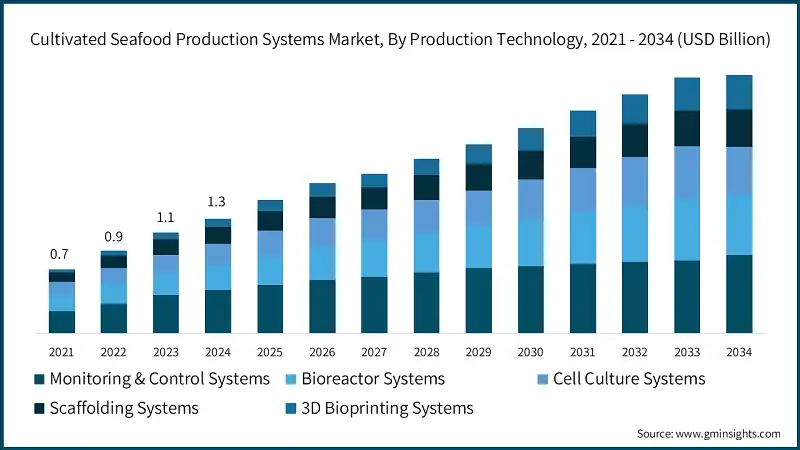
The cultivated seafood production systems market from monitoring & control systems segment was valued at USD 475 million in 2024, and it is anticipated to expand at 8.2% CAGR during 2025 to 2034, holding a market share of 38% in 2024
- Standalone cellular agriculture technology innovations, broad versatility in cultivation applications, and titled automation standards accepted at efficiencies of ≥95% and 99%+ provide a strong foothold for Bioreactor Systems within the cultivated seafood production systems segment.
- Its cultivation structure is scalable, along with optimizing the growth characteristics of cell types, which is the most accepted technology for commercial cellular agriculture and thereby creates an ever-steady demand within the research, pilot, and commercial production ambience. Aeration of the large-scale protein production process receives an additional advantage with the integration of advanced bioreactor systems with examples of perfusion and fed-batch cultivation workhorse systems.
- Monitoring & Control Systems, which oversee the processes in aquaculture facilities to enhance operational efficiency and guarantee regulatory compliance, are ranked first with 38 % market share. Greater than or equal to 99.5 % precision and real-time analytics are offered by suppliers, who have popularized their use in commercial-scale RAS and cellular agriculture applications.
- Advanced 3D Bioprinting Systems is the segment that is expected to be the fastest-growing segment in the market with 12.9% CAGR due to this being the game changer in developing structured seafood products with complex tissue architecture that is best suited for premium applications. Their premium is placed because of the challenging technology development and the exceptional product differentiation that these systems provide in structured seafood, whole-cut alternatives, and specialty product formulations against traditional production methods.
- The cultivation seafood production systems are increasingly going forward to differentiate between volume-using traditional RAS equipment on one side, and value-adding cellular agriculture technologies on the other, thus the way in which the competition among suppliers evolve through automation level, process efficiency, and specialized technical integration.
Learn more about the key segments shaping this market
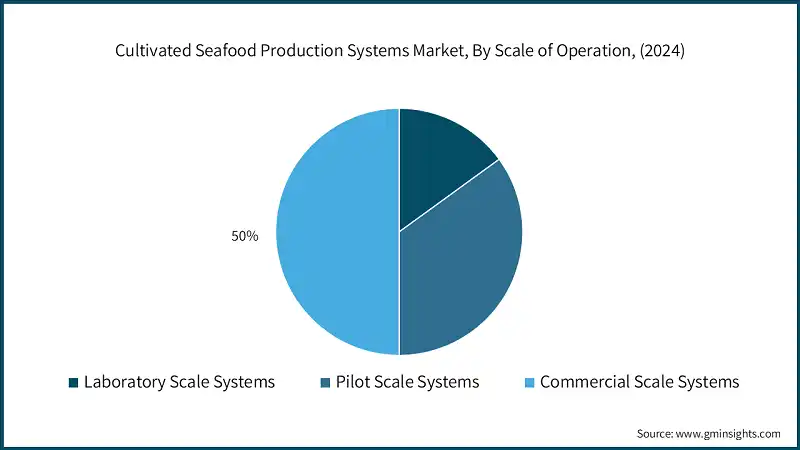
The cultivated seafood production systems market from commercial scale systems segment was valued at USD 625 million in 2024, and it is anticipated to expand at 9.6% CAGR during 2025 to 2034, holding a market share of 50% in 2024
- The largest deployment segment for cultivated seafood production systems is commercial scale installations with strong investment backing from venture capital and strategic corporate partnerships. The FDA/USDA regulatory approvals, private equity portfolios, and government funding streams for sustainable protein, cellular agriculture, and advanced aquaculture sustain high-capacity system consumption and technology scaling across biotechnology, food production, and sustainable protein fields.
- Cellular agriculture and advanced RAS stand out as fast-commercializing applications: bioreactor systems and automated production platforms remain integral parts of high-efficiency commercial facilities, while hybrid production categories keep traditional aquaculture relevant alongside cellular cultivation through advantages like proven scalability, established supply chains, and regulatory clarity.
- Pilot scale systems, with an estimated USD 437.5 million and 35% market share in 2024, are bolstering their growth trajectory in a constantly evolving food technology market for advanced process validation and commercial readiness. Production systems like modular RAS and pilot bioreactors have excellent properties for scalability testing while remaining cost-effective, ideal for technology validation, process optimization, and regulatory approval applications. This segment benefits from the increasing adoption of phased scaling approaches in cellular agriculture, traditional aquaculture modernization, and integrated bioprocessing, as all these require demand for high-performance pilot-scale validation systems.
- Laboratory Scale Systems involve specialized research applications, technology development, and proof-of-concept studies wherein smaller system configurations can deliver critical innovation gains; extensive academic research and pilot deployments are supported by government programs and research institution databases. Contract research and custom system development create flexible channels for application-specific configurations, specialized monitoring, and documentation-heavy installations that research institutions and biotechnology companies increasingly need; favored by modular designs, automated controls, and scalable architectures, research integration and preclinical development pathways get enhanced.
The cultivated seafood production systems market from semi-automated systems segment was valued at USD 475 million in 2024 and is anticipated to expand at 7.1% CAGR during 2025 to 2034, holding a market share of 38% in 2024
- The largest deployment segment for cultivated seafood production systems is for commercial-scale installations that enjoy investment from venture capitalists and strategic corporate partnerships. The FDA/USDA regulatory approvals combined with private equity portfolios and government funding streams for sustainable protein, cellular agriculture, and advanced aquaculture keep high-capacity systems consuming and technology scaling across biotechnology, food production, and sustainable protein places.
- Among cellular agriculture and advanced RAS, these technologies are fast being commercialized: bioreactor systems and automated production platforms are both key components of extremely-high-efficiency commercial setups, while hybrid production classes keep traditional aquaculture in the game alongside cellular cultivation with advantages such as proven scalability, established supply chains, and regulatory clarity.
- Pilot-scale systems, with an estimated USD 437.5 million and 35% market share in 2024, are increasingly becoming front-runners in the food technology market to establish advanced process validation and commercial readiness. With respect to operational systems such as modular RAS and pilot bioreactors, their excellent scalability testing ability and cost-effectiveness make them ideal for technology validation, process optimization, and regulatory approvals. Further, in this context, there is increasing use of phased scaling approaches in cellular agriculture, the modernization of traditional aquaculture, and integrated bioprocessing; all of these require high-performance pilot-scale validation systems.
- Laboratory scale systems comprise all specialized research applications, technology development, and proof-of-concept studies wherein smaller system configurations can bring critical innovation gains; extensive academic research and pilot deployments are supported by government programs and databases of research institutions. Contract research and custom system development create flexible channels for application-specific configurations, specialized monitoring, and documentation-heavy installations currently favored by research institutions and biotechnology companies; enriched by modular designs, automated controls, and scalable architectures, research integration and preclinical development pathways are solutions that need fast-tracking.
The cultivated seafood production systems market from finfish production systems segment was valued at USD 600 million in 2024, and it is anticipated to expand at 7.1% CAGR during 2025 to 2034, holding a market share of 48% in 2024
- Finfish Production Systems account for the largest share of product applications and thus dominate the market for major end users such as commercial salmon farms, trout operations, and emerging cellular finfish companies. These finfish systems enjoy the benefit of being designed by traditional aquaculture norms with proven technologies, scalable production capacities, and regulatory compliance protocols. The segment is characterized by the end users' need for cultivated seafood production systems for these high-value, proven technologies in which finfish-specific manufacturer-to-customer relationships offer better species optimization, rapid system commissioning, and customized production development specifically for salmon, trout, bass, and other finfish species.
- Shellfish production systems are forecasted to be valued at USD 350 million with a share of 28% in 2024, growing at a CAGR of 7%. Shellfish systems cater to specialized handling and water quality management for operations with oysters, mussels, and clams. These systems thus provide coastal producers with the essential operational advantages while offering species-specific cultivation technologies, integrated harvesting solutions, and optimized growing environments to their clientele. The segment is currently on a roll, because the number of shellfish farms and aquaculture enterprises adopting advanced production systems for various bivalve cultivation and processing applications has increased.
- Structured product manufacturing aims at complete cellular agriculture solutions for creating whole-cut seafood products with complex tissue architecture with 10% market share, the highest growth of 11.7% CAGR in 2024. This rapidly growing segment serves the emerging cultivated seafood industry requiring sophisticated bioreactor systems, 3D bioprinting technology, and specialized scaffolding solutions for producing structured fish fillets, steaks, and premium seafood alternatives.
Looking for region specific data?
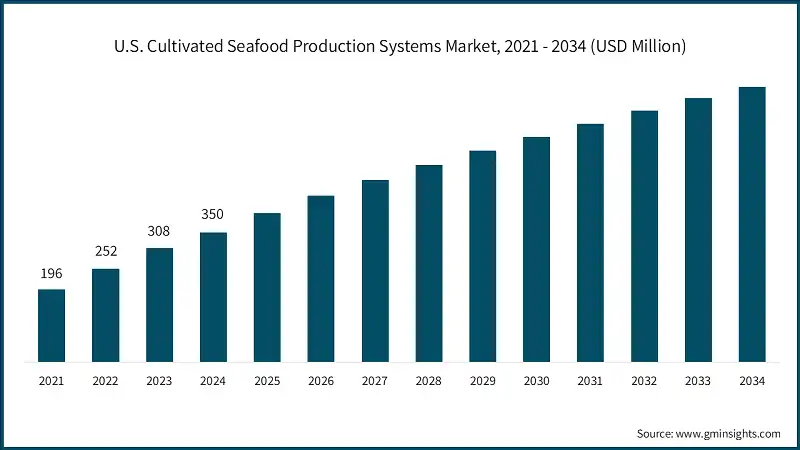
The North America cultivated seafood production systems market was valued at USD 437.5 million in 2024, and it is anticipated to expand at 8.7% CAGR during 2025 to 2034, holding a market share of 35% in 2024.
- The market for cultivated seafood production systems, both in terms of share and technological advancement, is led by North America. Behind this leadership, one finds advanced biotechnology infrastructure and a sound regulatory framework. The region is seen to have high adoption of several production technologies and levels of automation for cellular agricultural activities, commercial aquaculture, and research applications, with innovations taking place largely in the U.S. and building strong foundations for traditional aquaculture in Canada.
- The FDA/USDA efforts towards regulatory clarity fast track cellular agriculture and next generation production systems as venture capital and strategic partnerships innovate commercialization of these advanced technologies. Supply chains provide scalable manufacturing for integrated production systems, automated controls, and modular designs, advancing both commercial cultivation and R&D momentum.
- In North America, the U.S. represents the largest market for cultivated seafood production systems and is projected to continue providing leadership in technological aspects for the region. The U.S. boasts the fastest pace of innovation adoption owing to established biotechnology infrastructure, food technology industry, and clarifier investments towards cellular agriculture applications. Substantial venture capital funding, along with regulatory support directed at advanced food production systems and new companies developing production technologies, positions the United States as a heavyweight consumer while a technological leader in the market.
The Asia Pacific cultivated seafood production systems market dominated the global market with a market share of 25% from 2025 - 2034
- Furthermore, the Asia Pacific market for cultivated seafood production systems has been characterized by the high manufacturing capabilities in the region, sustained investment by governments, and developing aquaculture infrastructures in the countries participating in the region. An example is China's food security programs, advanced manufacturing policies, and other national initiatives promoting the establishment of production systems and cellular agriculture that would eventually increase the demand for high-efficiency RAS and bioreactor systems. Regulatory frameworks formalizing cellular agriculture and technology validation will be greatly beneficial for commercial scaling in both Singapore and Japan.
- Government support in South Korea and India is increasing further advancements in technology adoption for modern aquaculture systems and precision manufacturing. The Asia Pacific market is also related to the traditional aquaculture modernization initiatives with sustainable protein, while those in China are equipped with manufacturing capabilities and academic consortia for innovating production systems and safety studies for cell-based agriculture.
The Europe cultivated seafood production systems market accounted for USD 375 million in 2024 and is anticipated to show steady growth over the forecast period
- The European market revolves around requirements for safety standards, regulations, and innovations in technology. Supplier requirements and procurement standards have been informed and developed via the Green Deal and other sustainability frameworks as well as ISO standards. Farm to Fork as well as sustainable protein initiatives continue to sustain downstream demand for advanced production systems.
- The EU funded research programs fully explore the promising cellular agricultural technologies, sustainable aquaculture systems, and advanced bioprocessing technologies sponsored by Horizon Europe and national programs. Major players include those who have built a reputation in AKVA Group (advanced RAS systems), ScaleAQ (integrated solutions), and a significant portion of biotechnology companies (cellular agriculture platforms). Research projects running on cellular agriculture, sustainable aquaculture, and food technologies linked to production system innovations are still being funded by national research funding agencies such as Germany or the Netherlands.
The Latin America cultivated seafood production systems market accounted for 7% in 2024 and is anticipated to show moderate growth over the forecast period
- Research and commercial activities across Latin America, with particular intensity in Brazil, Argentina, and Mexico, have been complemented by expanding aquaculture modernization programs and newly funded sustainable protein initiatives. The market opportunity for the region is underpinned by increasing collaboration with North American and European technology providers, growing interest in sustainable food production technologies, and developing biotechnology capabilities. It has a strong aquaculture industry in Brazil and an ever-expanding research base, which serves as a strong foundation for the broader adoption of advanced production systems.
- Brazil is ahead of all Latin American countries when it comes to the cultivated seafood production systems market, with constant growth in the analysis period. The well-developed aquaculture operations in Brazil, along with their expanding biotechnology programs, make Brazil the leading country in that region. The commercial sector strongly benefits from support from the government and international partnerships, as well as an increasing focus on sustainable protein applications, which results in a strong ongoing demand for advanced production systems in commercial aquaculture and aspiring cellular agriculture.
Middle East & Africa cultivated seafood production systems market is anticipated to grow at a CAGR of 8.1% during 2025 to 2034
- The Middle East and Africa are the main and significant places for the great likelihoods of growth dominated by the establishment of food security mechanisms, along with investments in developing sustainable technologies, and the interest in sophisticated aquaculture applications. Investment in science and technology infrastructure creates parameters that open opportunities for cultivated seafood production system applications in many stages of commercial development and research activities in Saudi Arabia, the UAE, and South Africa.
- Saudi Arabia continues to hold a dominant position in the Middle East & Africa cultivated seafood production systems market due to its major growth potential. Saudi Arabia has become a regional leader due to heavy investments in food security and sustainable technology research under the Vision 2030 initiative. With the establishment of advanced research facilities such as KAUST and the increase in biotechnology programs, Saudi Arabia is emerging as a critical market as regard to commercialization of modern aquaculture and new cellular agriculture applications, all aimed at the production of cultivated seafood.
Cultivated Seafood Production Systems Market Share
In 2024, the cultivated seafood production systems industry was led by a diverse group of biotechnology, equipment, and cell-culture technology providers, where the top seven companies collectively accounted for approximately 54% of the market share in 2024, including Solaris Biotech (Donaldson), Hamilton Company, Thermo Fisher Scientific, Sartorius, Eppendorf, Steakholder Foods, and CytoNest. These companies hold strong market positions due to their advanced bioprocessing solutions, large-scale bioreactor technologies, precision instrumentation, and strategic partnerships with cultivated seafood producers, enabling efficient cell cultivation, scaling, and production system optimization.
- Solaris Biotech: Solaris Biotech, a Donaldson company, specializes in the design and manufacture of advanced bioreactors, fermenters, and related process equipment for biopharmaceutical, food, and biotechnology industries. Its product range supports R&D to production-scale operations, emphasizing automation, scalability, and process control for cell culture, microbial fermentation, and precision fermentation applications.
- Hamilton Company: Hamilton Company is a global leader in precision measurement technologies, automation solutions, and laboratory instruments. The company offers high-performance liquid handling systems, sensors, and bioreactor control technologies widely used in biotechnology, pharmaceuticals, and diagnostics. Hamilton’s expertise lies in enhancing process efficiency and reproducibility across analytical and life science workflows.
- Sartorius: Sartorius is a global biotechnology supplier offering innovative laboratory and bioprocess solutions for the biopharmaceutical industry. The company’s products include filtration systems, cell culture technologies, and bioreactors that support upstream and downstream bioprocessing. Sartorius focuses on digitalization, process optimization, and sustainability to accelerate the development and production of biologics and cell-based products.
- Eppendorf: Eppendorf is a leading life sciences company that develops and produces instruments, consumables, and services for handling liquids, samples, and cells. Its product range includes centrifuges, pipettes, bioreactors, and cell culture equipment. Eppendorf supports research, clinical, and industrial laboratories globally by improving reproducibility, efficiency, and precision in biotechnological and biomedical processes.
Cultivated Seafood Production Systems Market Companies
The major players operating in cultivated seafood production systems industry include:
- Solaris Biotech (Donaldson)
- Hamilton Company
- Thermo Fisher Scientific
- Sartorius
- Eppendorf
- Steakholder Foods
- CytoNest
- Culture Biosciences
- Prolific Machines
- Molecular Devices
- Ark Biotech
- E-Tech Group
- Cytiva (Danaher)
- Merck KGaA/EMD
- Applikon Biotechnology
- Matrix Meats
- EdiMembre
- Hitachi Zosen
Cultivated Seafood Production Systems Market Report Attributes
| Key Takeaway | Details |
|---|---|
| Market Size & Growth | |
| Base Year | 2024 |
| Market Size in 2024 | USD 1.3 Billion |
| Market Size in 2025 | USD 1.5 Billion |
| Forecast Period 2025 - 2034 CAGR | 7.6% |
| Market Size in 2034 | USD 2.8 Billion |
| Key Market Trends | |
| Drivers | Impact |
| Increasing demand for sustainable protein production and cellular agriculture | Drives adoption of bioreactor systems and cell culture technologies for next-generation food production |
| Advances in automation and IoT integration enabling improved efficiency and scalability | Enables broader applications from research facilities to commercial-scale production systems |
| Growing regulatory approval for cultivated seafood and investment in food technology | Accelerates development of novel production systems for emerging protein applications |
| Rising investment in sustainable aquaculture technologies and precision farming | Encourages commercialization of advanced production solutions for traditional and cellular cultivation |
| Pitfalls & Challenges | Impact |
| High capital costs and complex installation processes | Limits adoption in cost-sensitive applications, requiring continued process optimization and financing solutions |
| Regulatory uncertainty surrounding cellular agriculture | Extends development timelines and increases market entry barriers for new production technologies |
| Competition from traditional aquaculture methods | Impacts market penetration in conventional applications, driving need for clear ROI demonstration |
| Opportunities: | Impact |
| Expansion into pharmaceutical and nutraceutical applications | Enables market growth into high-value biotechnology and therapeutic protein production |
| Development of modular systems for specific applications | Creates new market segments and increases value proposition for equipment manufacturers |
| Integration into emerging technologies like vertical farming and bioprocessing | Opens new application areas in next-generation food production and biotechnology |
| Strategic partnerships for co-development of application-specific solutions | Accelerates market penetration through integrated design and manufacturing approaches |
| Market Leaders (2024) | |
| Market Leaders |
Market Share Approximately 25% |
| Top Players |
Collective market share in 2024 is Collective Market Share Approximately 52% |
| Competitive Edge |
|
| Regional Insights | |
| Largest Market | North America |
| Fastest Growing Market | Asia Pacific |
| Emerging Country | China, India, South Korea, Brazil |
| Future Outlook |
|
What are the growth opportunities in this market?
Cultivated Seafood Production Systems Industry News
- In April 2024, BLUU Seafood, a leading European cultivated fish producer, opened Europe’s first pilot plant in Hamburg-Altona. The new 2,000 m² facility transitions the company from lab to pilot scale, featuring fermenters up to 65 L (expandable to 2,000 L) for large-scale cultivation of Atlantic salmon and rainbow trout cells.
- In April 2024, Atlantic Fish Co, in collaboration with the North Carolina Food Innovation Lab, unveiled the world’s first cultivated black sea bass prototype in Kannapolis, North Carolina. The company developed proprietary suspension-based fish cell lines to reduce seafood’s carbon footprint and environmental impact. Next, it aims to cut production costs through customized growth media and expand tasting events with restaurant partners.
The cultivated seafood production systems market research report includes in-depth coverage of the industry with estimates & forecast in terms of revenue (USD Million) & (Units) from 2021 to 2034, for the following segments:
Market, By Production Technology
- Monitoring & control systems
- Bioreactor systems
- Cell culture systems
- Scaffolding systems
- 3d bioprinting systems
Market, By Scale of Operation
- Laboratory scale systems
- Pilot scale systems
- Commercial scale systems
Market, By Automation Level
- Manual operation systems
- Semi-automated systems
- Fully automated systems
- Integrated turnkey solutions
Market, By Product Application
- Finfish production systems
- Shellfish production systems
- Structured product manufacturing
- Unstructured product processing
- Hybrid product manufacturing
- Specialty & premium products
The above information is provided for the following regions and countries:
- North America
- U.S.
- Canada
- Europe
- UK
- Germany
- France
- Italy
- Spain
- Rest of Europe
- Asia Pacific
- China
- India
- Japan
- South Korea
- Australia
- Rest of Asia Pacific
- Latin America
- Brazil
- Mexico
- Argentina
- Rest of Latin America
- MEA
- UAE
- Saudi Arabia
- South Africa
- Rest of Middle East and Africa
Frequently Asked Question(FAQ) :
What is the market size of the cultivated seafood production systems in 2024?
The market size was valued at USD 1.3 billion in 2024, with a CAGR of 7.6% expected from 2025 to 2034. The growth is driven by advancements in bioreactor systems, automation technologies, and increasing commercialization of cellular agriculture.
What is the projected value of the cultivated seafood production systems market by 2034?
The market is poised to reach USD 2.8 billion by 2034, fueled by innovations in sustainable manufacturing, digital transformation, and regulatory support for cultivated seafood technologies.
What is the expected size of the cultivated seafood production systems industry in 2025?
The market size is projected to reach USD 1.5 billion in 2025.
How much revenue did the monitoring & control systems segment generate in 2024?
The monitoring & control systems segment generated approximately USD 475 million in 2024 and is anticipated to expand at a CAGR of 8.2% from 2025 to 2034.
What was the valuation of the commercial-scale systems segment in 2024?
The commercial-scale systems segment was valued at USD 625 million in 2024 and is set to observe around 9.6% CAGR during the forecast period.
What is the growth outlook for the semi-automated systems segment?
The semi-automated systems segment is expected to showcase over 7.1% CAGR till 2034.
Which region leads the cultivated seafood production systems sector?
North America leads the market, with a valuation of USD 437.5 million in 2024 and an anticipated CAGR of 8.7% through 2034.
What are the upcoming trends in the cultivated seafood production systems market?
Trends include advanced bioreactors, automation, sustainable manufacturing, IoT- and AI-driven digitalization, and green technologies with renewable energy integration.
Who are the key players in the cultivated seafood production systems industry?
Key players include Solaris Biotech (Donaldson), Hamilton Company, Thermo Fisher Scientific, Sartorius, Eppendorf, Steakholder Foods, CytoNest, Culture Biosciences, Prolific Machines, Molecular Devices, Ark Biotech, and E-Tech Group.
Cultivated Seafood Production Systems Market Scope
Related Reports