Summary
Table of Content

Cosmetic Preservatives Market
Get a free sample of this report
Form submitted successfully!
Error submitting form. Please try again.
Thank you!
Your inquiry has been received. Our team will reach out to you with the required details via email. To ensure that you don't miss their response, kindly remember to check your spam folder as well!
Request Sectional Data
Thank you!
Your inquiry has been received. Our team will reach out to you with the required details via email. To ensure that you don't miss their response, kindly remember to check your spam folder as well!
Form submitted successfully!
Error submitting form. Please try again.
Cosmetic Preservatives Market Size
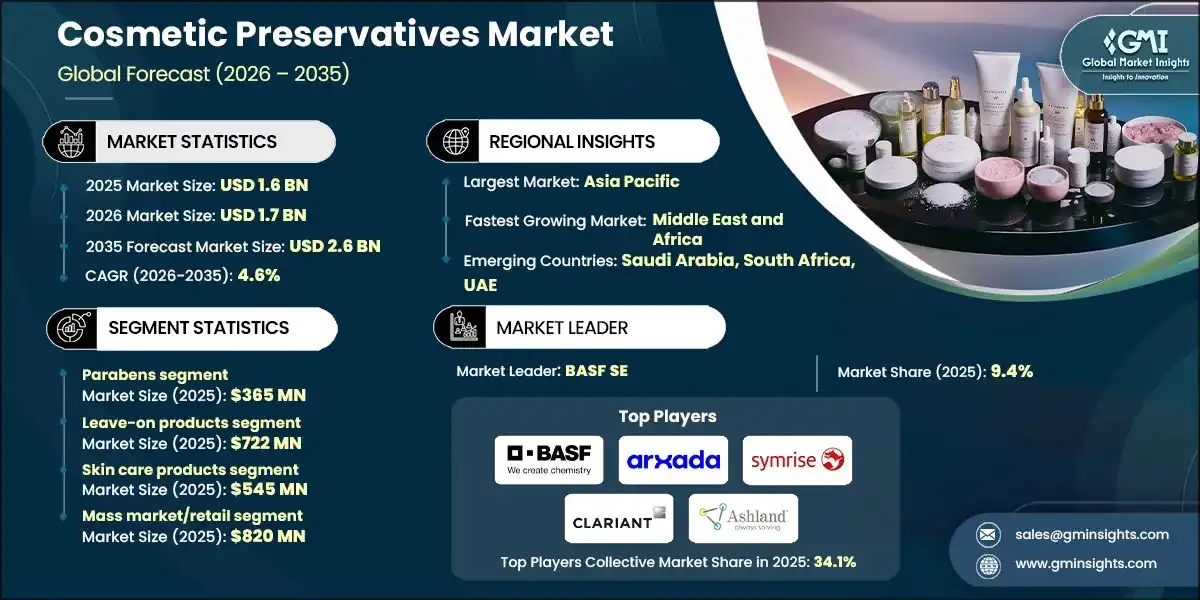
The global cosmetic preservatives market was valued at USD 1.6 billion in 2025. The market is expected to grow from USD 1.7 billion in 2026 to USD 2.6 billion in 2035, at a CAGR of 4.6% according to the latest report published by Global Market Insights Inc.
To get key market trends
- Preservatives in cosmetics refer to the chemicals that are included in cosmetic and personal care products to prevent microbial growth of bacteria, yeast, and mold. The specified organisms can contaminate products during manufacturing or application, leading to spoilage or skin infections. Preservatives are in fact there for prolonged storage of cosmetics and to ensure that the products remain safe, stable, and effective during the intended period of use.
- Preservative agents handle major activities regarding product quality and safety for those cosmetic products that contain water such as creams, lotions, shampoos, make-up, etc. These products can easily become contaminated without preservatives, resulting in some changes in colour, odour, texture, and performance. Preservatives used in cosmetics are known to be parabens, phenoxyethanol, formaldehyde releasers, and organic acids, all these are used in controlled quantities as regulated by the health authorities.
- Technological advancements have made possible the adoption of safe, natural, and multifunctional alternatives in cosmetic preservation. Advancement in formulation science has allowed the introduction of natural extracts, antimicrobial peptides, and preservative boosters, complemented by advanced packaging systems (e.g., airless pumps for contamination reduction). This transition is in tune with the growing demands of consumers who want "clean label" cosmetics while keeping product safety and stability intact.
Cosmetic Preservatives Market Report Attributes
| Key Takeaway | Details |
|---|---|
| Market Size & Growth | |
| Base Year | 2025 |
| Market Size in 2025 | USD 1.6 Billion |
| Market Size in 2026 | USD 1.7 Billion |
| Forecast Period 2026-2035 CAGR | 4.6% |
| Market Size in 2035 | USD 2.6 Billion |
| Key Market Trends | |
| Drivers | Impact |
| Rising demand for personal care products | The growing use of skincare, haircare, and cosmetic products worldwide has increased the need for preservatives to maintain product safety and shelf life. |
| Rising popularity of water-based formulations | Rising popularity of water-based formulations |
| Expansion of the global cosmetic industry | Expansion of the global cosmetic industry |
| Pitfalls & Challenges | Impact |
| Risk of skin irritation and allergies | Some preservatives may cause sensitivity reactions, limiting their use in products designed for delicate or sensitive skin. |
| Limited efficacy of natural preservatives | Natural alternatives may offer weaker antimicrobial protection, making it difficult to ensure long-term product stability. Impact |
| Opportunities: | Impact |
| Growing demand for natural and clean-label cosmetics | Consumer preference for natural products creates opportunities for the development of plant-based and eco-friendly preservatives. |
| Technological advancements in preservation systems | Innovations such as preservative boosters and multifunctional ingredients improve product safety while reducing chemical load. |
| Adoption of advanced packaging technologies | Airless and antimicrobial packaging reduces contamination risk, allowing lower preservative concentrations. |
| Market Leaders (2025) | |
| Market Leaders |
9.4 % |
| Top Players |
|
| Competitive Edge |
|
| Regional Insights | |
| Largest Market | Asia Pacific |
| Fastest growing market | Middle East and Africa |
| Emerging country | Middle East and Africa |
| Future outlook |
|
What are the growth opportunities in this market?
Cosmetic Preservatives Market Trends
- The cosmetics preservatives market is gaining traction due to the demand for clean-label and natural products. Consumers are now more conscious about safety of ingredients and are preferably opting for cosmetics that are free from synthetic preservatives. This scenario has motivated manufacturers to look for alternative preservation systems that go along with the positioning of natural and organic products.
- Another significant trend in the market is the increasing use of multifunctional ingredients that provide preservation and other properties, like moisturizing or antioxidant benefits. Such ingredients help to reduce the chemical load in formulations while maintaining safety.
- The demand for multifunctional ingredients that provide not only preservative effects, but also additional benefits such as moisture delivery or antioxidant activity are resulting in market growth. Such ingredients allow to minimize the chemical burden in formulations while ensuring product safety, and they further complement the newly emerging minimalist formulations that are being adopted by consumers.
- The market performs exceptionally well in the developing economies due to the increase in disposable income, urbanization, and better beauty awareness. As there is an increase in cosmetic consumption in these countries hence the demand for effective and compliant preservative systems is also rising sharply. All these provide a opportunity for both global and local preservative manufacturers.
Cosmetic Preservatives Market Analysis
Learn more about the key segments shaping this market
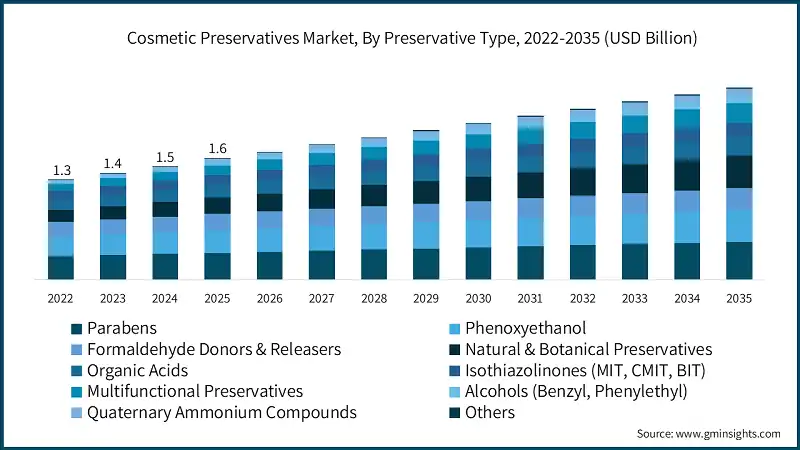
The cosmetic preservative market by preservative type is segmented parabens, phenoxyethanol, formaldehyde donors & releasers, natural & botanical preservatives, organic acids, isothiazolinones (MIT, CMIT, BIT), multifunctional preservatives, alcohols (benzyl, phenylethyl) quaternary ammonium compounds and others. Parabens hold the largest market value of USD 365 million in 2025.
- Parabens and Phenoxyethanol are used widely as preservatives due to their broad-spectrum antimicrobial protection properties, whereas preservatives like Formaldehyde donors and releasers take care of bacterial and fungal growth. Natural and botanical preservatives, along with organic acids, are in demand by consumers due to milder and eco-friendly alternatives. Isothiazolinones (MIT, CMIT, BIT), alcohols like benzyl and phenylethyl, quaternary ammonium compounds are more specialized preservatives for products that possess specific formulation requirements for preservation.
- The growing trends toward clean labels and skin-friendly products have stimulated growth in natural, botanical, and multifunctional preservatives. Formulators have begun to actively explore the use of organic acids in optimized combinations of preservatives to ensure that products are safe for consumers while also adhering to regulatory requirements.
The cosmetic preservatives market by product form is segmented into leave-on products, rinse-off products, water-based products and oil-based products. Leave-on products hold the largest market value of USD 722 million in 2025.
- Leave-On Products rise with the growth of consumer demand due to convenient and effective long-lasting skin products hence making them popular among consumers. Water-Based Products under this segment are more attractive because they are light, non-greasy, and fit well into a modern skincare lifestyle and preference for sensitive skin.
- Rinse-Off Products are growing at steady rate, as they are essential for cleansing. Oil-Based Products are known for specific deep hydration, but their heavier weight makes them less in demand compared to the growing trends of water-based and leave-on products.
The cosmetic preservatives market by application is segmented into skin care products, hair care products, color cosmetics, bath & shower products, fragrances & perfumes, oral care products, sun care products and others. Skin care products hold the largest market value of USD 545 million in 2025.
- Skin Care Products are gaining momentum due to rising concerning awareness about skin care routines, well-being, and innovations in products in the market. Demand for hair care are rising because consumers are looking for corrective measures against hair fall, shine, luster, and scalp health. All these trends link color cosmetics to increased social media influencing, evolving preferences in beauty, and changing varieties of products.
- Bath & Shower Products generally take up a steady growth trend as they become influentials in everyday kitchens, particularly in mild and natural formulations. Moreover, Fragrances & Perfumes are increasingly combined with the growing importance of personal grooming, with Oral Care Products growing through health-awareness preventive measures, while Sun Care Products are growing due to increasingly visible concerns about ultraviolet protection, and Others are growing gradually as niche and specialized products gain acceptance.
Learn more about the key segments shaping this market
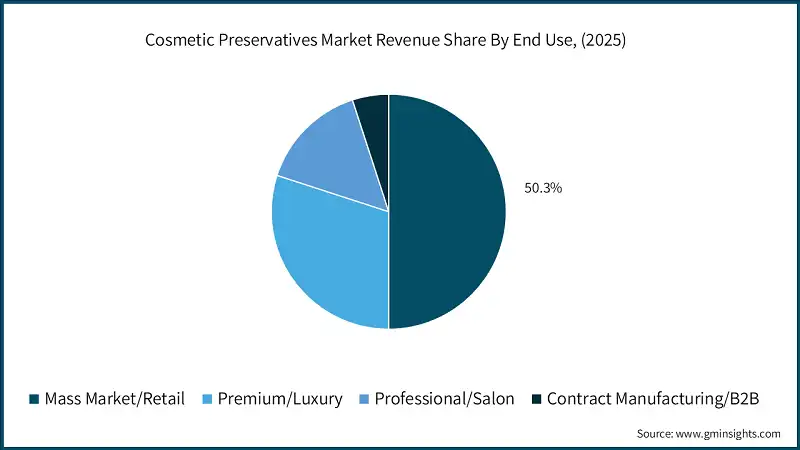
The cosmetic preservatives market by end user is segmented into mass market/retail, premium/luxury, professional/salon and contract manufacturing/B2B. Mass market/retail hold the largest market value of USD 820 million in 2025.
- Mass Market/Retail is a booming sector that encompasses a wide consumer base affording value-price products with easy reach through e-commerce and offline channels. Meanwhile, Premium/Luxury products are rising since consumers demand high-quality ingredients, brand value, and a custom-made experience in beauty.
- Professional/Salon is increasing in the growth of demand for recommended products and sophisticated treatments. Contract Manufacturing/B2B is also growing, whereby brands outsource their productions hence to reduce some costs and gain time for product launches, and they can concentrate on branding and innovation.
Looking for region specific data?
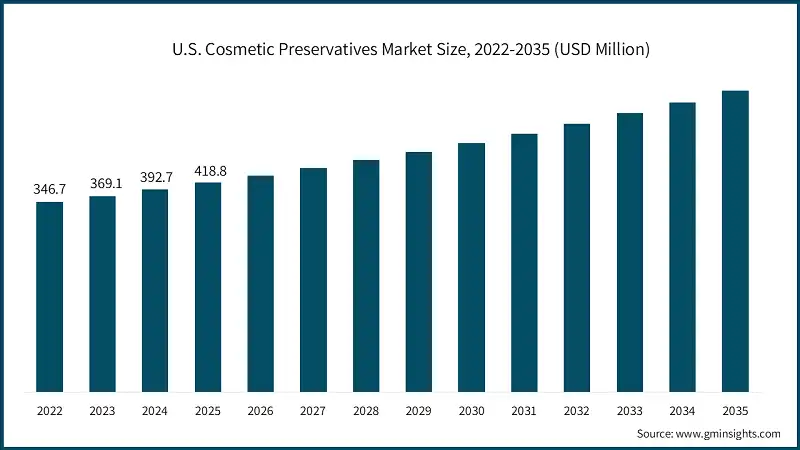
The market in the North America is expected to experience significant and promising growth from USD 489 million in 2025 to USD 761 million in 2035. The U.S. cosmetic preservative market accounted for USD 418.8 million in 2025.
- The North American cosmetic preservatives market is seeing steady growth owing to increasing awareness regarding personal care and grooming and wellness products. It consumes all high quality, safe, and performance-oriented cosmetic oils for skin and hair care. Demand also enjoys a strong base by retail infrastructure, digital sales channels, and continuous product innovation.
- Market in United States is growing because of their huge audience and high expenditure on beauty and personal care products. Similarly, Canada adds to the demand with an increasing interest in natural and clean-label cosmetic products. The presence of reputable cosmetic brands and advanced product formulations ensures continuous development of the market within the entire region.
The market in the Europe is expected to experience significant and promising growth from USD 474 million in 2025 to USD 742 million in 2035.
- European cosmetic preservative market is controlled by an immense stress on quality standards, sustainability, and ingredient transparency. The consumers prefer preservative solution that are eco-friendly and naturally sourced thus beneficial for skin care, hair care, and wellness. The regulatory frameworks also play a role in influencing the formulation of products and the stability in the market.
- Countries like Germany, France and the United Kingdom play a major role in strengthening the cosmetic industries. In terms of premium skincare products, the Germans favour organic and dermatologically tested solutions. Market growth in Uk is catered by increasing demand of premium and independent beauty brands utilizing innovative preservative systems.
The cosmetic preservatives market in Asia Pacific is expected to experience increasing growth from USD 494 million in 2025 to USD 771 million in 2035 with a CAGR of 4.4%.
- Asia-Pacific has vast potential for market expansion due to increased population growth and disposable income and heightened awareness of beauty. Cosmetic products play an essential role in particular daily activities, especially skin-nourishing applications and hair-care products. There is higher demand for multifunctional and natural preservatives that are safe for sensitive skin and compatible with diverse cosmetic formulations which supports further growth throughout the region.
- At the country level, India is a strong demand generator because of the traditional use of herbal, paraben-free, and natural preservatives in skin and hair care products. China leads growth through high-scale cosmetic production and adoption of effectively novel-preservative technology.
Middle East & Africa market is expected to experience significant and promising growth from USD 95 million in 2025 to USD 175 million in 2035.
- Development in the Middle East & Africa market is because of dynamic urbanization along with increased disposable income and a growing focus on premium and personal care products. During dry climatic conditions, cosmetic products are in demand as they are predominantly used for skin conditioning and hair care, hence demand for cosmetic preservative also increase. The market demand is also backed by traditional usage of oils.
- In the UAE, market is growing because of demand for luxury high-end cosmetics that require advanced preservative systems. South Africa contributes with increasing enhancements in cosmetic production as well as acceptance of natural and safe preservative solutions.
Latin America is expected to experience significant and increasing growth from USD 78 million in 2025 to USD 151 million in 2035.
- The cosmetics preservatives market in Latin America flourished substantially with the growing beauty culture and increased adoption of international cosmetic brands. There is an increase in the demand for mild preservatives that are safe and can be used under different climatic conditions.
- Brazil is the leading country within the market owing to greater demand for skincare and hair care products, promoting the use of multifunctional preservatives. Mexico boosts sales because of expanding retail channels while product-usage awareness enhances shelf life and safety perception.
Cosmetic Preservatives Market Share
- Cosmetic preservatives markets are moderately consolidated with players like BASF SE, Arxada, Symrise AG, Clariant, Ashland holding 34.1% market share and BASF SE being the market leader holding the market share of 9.4 % in 2025.
- Companies in the cosmetic preservative market have improved and developed their sensory formulations against market competition. Manufacturers are investing enormous amounts to increase research and development for the purpose of producing preservatives that are effective, safe, and mild for use on the skin, thus meeting emerging regulatory standards.
- The safety guidelines and legal frameworks for cosmetic preservatives market vary throughout the world. Companies are maintaining their positions by consistently modifying their product offerings as per the regulations like the EU's Cosmetics Regulation or the FDA guidelines in the United States of America. Companies advanced by keeping ahead of regulatory shifts maintain brand reputation and be opened to international market opportunities for business expansion.
- Strategic partnerships and collaborations with cosmetic manufacturers, ingredient suppliers, and research institutions for developing preservatives targeted to specific formulations help companies to maintain their position. These partnerships tend to accelerate the process of innovation and share costs involved while giving access to niche markets. By building significant networks within the supply chain, companies can secure long-term contracts, in turn, ensuring stability and continued relevance in a competitive market.
- Companies are adopting modern advancements in production and testing technologies to achieve high efficiency and reliability. With the modern analytical tools plus established quality control systems, they can produce consistent product performance and shelf life. Investments into automation and sustainable processes follow the increasing consumer and industrial expectations, and high costs of doing business, as well as environmental degradation. By combining technology excellence with market awareness, these companies can maintain and continue to thrive against competition in the cosmetic preservatives industry.
Cosmetic Preservatives Market Companies
Major players operating in the cosmetic preservative market are:
- Akema S.r.l
- Arkema S.A.
- Ashland
- BASF SE
- Brenntag SE
- Clariant International Ltd
- Dadia Chemical Industries
- Evonik Industries AG
- Galaxy Surfactants Ltd
- Inolex Chemical Company
- Kumar Organic Products Ltd
- Lanxess Corporation
- Lonza Group AG
- Micro Science Tech
- Minasolve
- Naturex (Givaudan)
- Salicylates and Chemicals Pvt Ltd
- Sharon Personal Care
- Spec-Chem Industry Inc.
- Stepan Company
- Symrise AG
- Thor Group (Part of Arxada)
- Troy Corporation
BASF SE is one of the world's largest chemical companies, with a highly diversified portfolio across chemicals, materials, industrial solutions, surface technologies, nutrition & care, and agricultural solutions, with a sound global manufacturing base, deep R&D capabilities, and a focus on sustainable, and innovation-centric chemical solutions.
Arxada known globally in the field of specialty chemicals, providing some of the best preservative solutions, active ingredients, and performance chemicals for various industries such as cosmetics, personal care, and household products.
Symrise AG deals in fragrance, flavor, cosmetic ingredients, and special solutions markets combining natural raw materials, biotechnology, and innovation for food, beverage, personal care, and pharmaceutical applications.
Clariant is a Swiss-based specialty chemical company involved in the environmentally friendly and sustainable solution provision in various industries, including cosmetics, personal care, and household products. For cosmetic preservatives, Clariant makes and markets functional ingredients together with preservatives that maintain product stability and shelf life with the consideration of diminishing health concerns.
Ashland is a global specialty chemical company that serves personal care, cosmetics, and general-industry products with high performance in ingredients. With a wide range of innovative materials providing preservatives, stabilizers, and formulation aids, the company continues to strive for improved performance and safety for products.
Cosmetic Preservatives Industry News
- In March 2025, Clariant launched Nipaguard SCE Vita, a blend of fully natural preservation for personal care products. The formulation combines 100% renewable Sorbitan Caprylate with naturally derived benzoic acid to provide broad-spectrum antimicrobial protection with no controversial preservatives.
- In March 2024, Symrise partnered with India's Virchow Group to create a joint venture called Vizag Care Ingredients for the manufacturing of personal care ingredients in Visakhapatnam, India. This site is to be Symrise's first-ever chemical production site outside of Europe and North America, with operations expected to commence by June. The venture aims to supply high-quality cosmetic ingredients, particularly multifunctional actives, botanicals, and UV filters, to the Asia-Pacific.
The cosmetic preservative market research report includes an in-depth coverage of the industry with estimates and forecast in terms of revenue in USD Million and volume in terms of kilo tons from 2022–2035 for the following segments:
Market, By Preservative Type
- Parabens
- Methylparaben
- Ethylparaben
- Propylparaben
- Butylparaben
- Paraben blends
- Phenoxyethanol & alcohols
- Phenoxyethanol
- Benzyl alcohol
- Chlorobutanol
- Denatured alcohol
- Formaldehyde-releasing agents
- DMDM hydantoin
- Imidazolidinyl urea
- Diazolidinyl urea
- Quaternium-15
- Bronopol
- Organic acids
- Benzoic acid & sodium benzoate
- Sorbic acid & potassium sorbate
- Salicylic acid
- Dehydroacetic acid
- Citric acid & silver citrate
- Isothiazolinones
- Methylisothiazolinone (MIT)
- Methylchloroisothiazolinone (MCI/MIT blends)
- Benzisothiazolinone (BIT)
- Quaternary ammonium compounds
- Benzalkonium chloride
- Cetrimonium chloride
- Polyaminopropyl biguanide (PAPB)
- Chlorhexidine & salts
- Natural & botanical preservatives
- Essential oils & plant extracts
- Fermented ingredients
- Organic acids from natural sources
- Ecocert/COSMOS approved preservatives
- Multifunctional preservatives
- Caprylyl glycol
- Pentylene glycol
- Ethylhexylglycerin
- Glyceryl caprylate
- 1,2-diols & polyols
- Others
- Zinc pyrithione
- Triclosan (restricted markets)
- Silver compounds
- Iodopropynyl butylcarbamate
Market, By Product Form
- Leave-on products
- Rinse-off products
- Water-based products
- Emulsions (O/W & W/O)
- Gels & aqueous solutions
- Anhydrous products
- Oil-based formulations
- Powders & solid forms
Market, By Application
- Skin care
- Face cream & lotions
- Moisturizers
- Anti-aging products
- Sunscreens & sun care
- Facial cleansers
- Serums & concentrates
- Body lotions & butters
- Hair care
- Shampoos
- Conditioners
- Hair styling products (gels, mousses, sprays)
- Hair dyes & colorants
- Hair masks & treatments
- Scalp care products
- Color cosmetics (makeup)
- Foundations & BB/CC creams
- Lipsticks & lip glosses
- Eye makeup (mascara, eye shadow, eyeliner)
- Nail care (nail polish, removers)
- Blush & bronzers
- Toiletries
- Deodorants & antiperspirants
- Body washes & shower gels
- Bath products (bath salts, bubble bath)
- Intimate hygiene products
- Hand sanitizers
- Fragrances & perfumes
- Perfumes
- Colognes
- Body mists
- Baby care products
- Baby lotions & creams
- Baby shampoos & body wash
- Baby wipes
- Diaper rash creams
- Others
- Wet wipes (cosmetic use)
- Oral care (non-medicinal mouthwash)
- Men's grooming products
- Tanning products
Market, By End Use
- Mass Market/Retail
- Premium/Luxury
- Professional/Salon
- Contract Manufacturing/B2B
The above information is provided for the following regions and countries:
- North America
- U.S.
- Canada
- Europe
- Germany
- UK
- France
- Spain
- Italy
- Rest of Europe
- Asia Pacific
- China
- India
- Japan
- Australia
- South Korea
- Rest of Asia Pacific
- Latin America
- Brazil
- Mexico
- Argentina
- Rest of Latin America
- Middle East and Africa
- Saudi Arabia
- South Africa
- UAE
- Rest of Middle East & Africa
Frequently Asked Question(FAQ) :
Which product form held the largest share in the cosmetic preservatives market in 2025?
Leave-on products held the largest share in 2025, generating USD 722 million in revenue. Strong demand for creams, lotions, and serums that require long-lasting preservation is driving segment leadership.
Which preservative type dominated the cosmetic preservatives industry in 2025?
Parabens dominated the market in 2025, accounting for USD 365 million in revenue. Their broad-spectrum antimicrobial effectiveness and cost efficiency continue to support widespread use across cosmetic formulations.
What is the market size of the cosmetic preservatives industry in 2026?
The market size for cosmetic preservatives reached USD 1.7 billion in 2026, reflecting steady expansion driven by new cosmetic product launches and increasing use of water-based formulations.
What is the projected value of the cosmetic preservatives market by 2035?
The market size for cosmetic preservatives is expected to reach USD 2.6 billion by 2035, growing at a CAGR of 4.6%. Growth is fueled by clean-label demand, advancements in preservation systems, and rising global cosmetic consumption.
What is the cosmetic preservatives market size in 2025?
The market size for cosmetic preservatives is valued at USD 1.6 billion in 2025. Rising demand for personal care and cosmetic products, along with the need to ensure product safety and shelf life, is supporting market growth.
What was the largest application segment in the cosmetic preservatives industry in 2025?
Skin care products led the market with a valuation of USD 545 million in 2025. Rising consumer focus on skincare routines, anti-aging solutions, and product safety is accelerating preservative demand in this segment.
What is the growth outlook for the North America cosmetic preservatives market?
North America market is expected to grow from USD 489 million in 2025 to USD 761 million by 2035, driven by rising demand for personal care products, increasing preference for high-quality formulations, and ongoing innovation in preservative systems.
What are the key trends in the cosmetic preservatives industry?
What are the key trends in the cosmetic preservatives industry?
Who are the key players in the cosmetic preservatives market?
Key players include BASF SE, Arxada, Symrise AG, Clariant, Ashland, Evonik Industries AG, Lanxess Corporation, Inolex Chemical Company, and Galaxy Surfactants Ltd. These companies focus on formulation innovation, regulatory compliance, and sustainable preservative solutions.
Cosmetic Preservatives Market Scope
Related Reports