Summary
Table of Content

Cosmetic Oil Market
Get a free sample of this report
Form submitted successfully!
Error submitting form. Please try again.
Thank you!
Your inquiry has been received. Our team will reach out to you with the required details via email. To ensure that you don't miss their response, kindly remember to check your spam folder as well!
Request Sectional Data
Thank you!
Your inquiry has been received. Our team will reach out to you with the required details via email. To ensure that you don't miss their response, kindly remember to check your spam folder as well!
Form submitted successfully!
Error submitting form. Please try again.
Cosmetic Oil Market Size
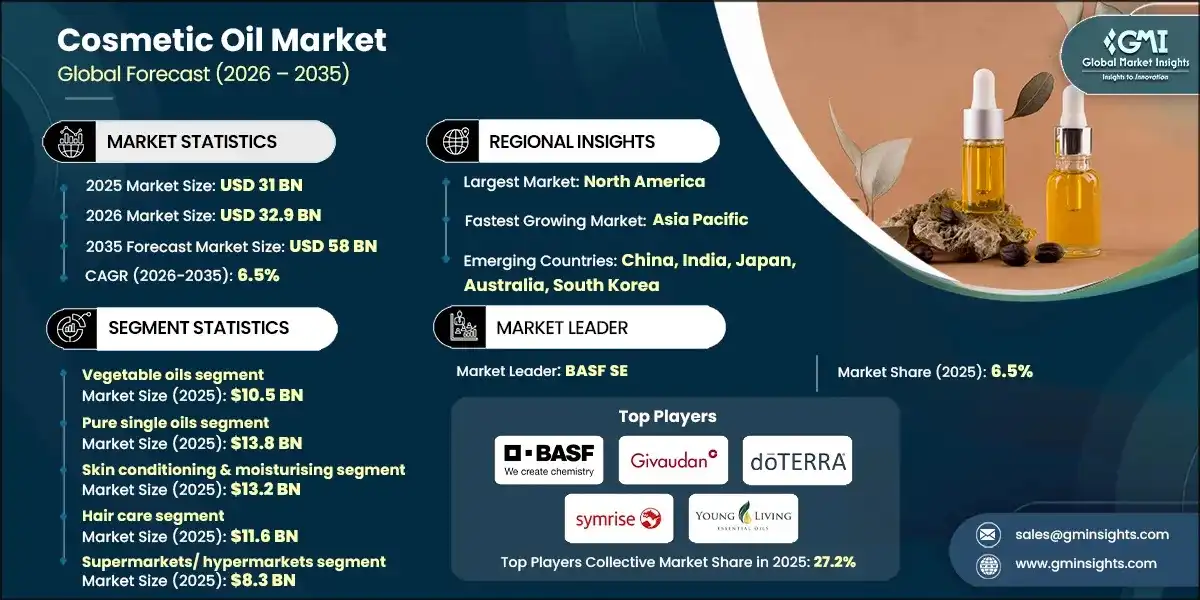
The global cosmetic oil market was valued at USD 31 billion in 2025. The market is expected to grow from USD 32.9 billion in 2026 to USD 58 billion in 2035, at a CAGR of 6.5% according to the latest report published by Global Market Insights Inc.
Cosmetic Oil Market Key Takeaways
Market Size & Growth
- 2025 Market Size: USD 31 Billion
- 2026 Market Size: USD 32.9 Billion
- 2035 Forecast Market Size: USD 58 Billion
- CAGR (2026–2035): 6.5%
Regional Dominance
- Largest Market: North America
- Fastest Growing Region: Asia Pacific
Key Market Drivers
- Rising demand for natural and organic products.
- Consumers are increasingly looking for skincare and haircare products made from plant-based and chemical-free ingredients..
- Expansion of the beauty and personal care industry.
Challenges
- Allergic reactions or skin sensitivity.
- High cost of premium oils.
Opportunity
- Sustainable and eco-friendly packaging.
- Development of multifunctional oils.
- Integration with advanced skincare technologies.
Key Players
- Leading Players: Top 5 players in this market include BASF SE, Givaudan SA, doTERRA International LLC, Symrise AG, Young Living Essential Oils, which collectively held a market share of 27.2% in 2025.
Get Market Insights & Growth Opportunities
- Cosmetic oils are natural or synthetic oils specifically formulated for skin and hair care masking purposes. Their purpose is to nourish, hydrate, and protect skin or hair from providing essential fatty acids, vitamins, antioxidants, and other actives.
- Such oils can be made from plant, seed, nut, or mineral oils, and, typically, as carriers for active ingredients of beauty. The difference of cosmetic oils as compared to other normal mechanized oils is that these oils are specially processed and purified so that the essential parts would work in a safe and effective topical application.
- Cosmetic oils maintain skin and hair health and helps to lock moisture, improve elasticity, and strengthen the natural barrier of the skin. Among the most common oils, argan oil, jojoba oil, and coconut oil are very popular because they fit for all skin types and satisfy the dry and frizzy problems of hair as well as inflammatory issues for most people. These oils do not just nourish but also increase skin and hair appearances in terms of making them softer, shinier, and more resilient.
- Cosmetic oils are natural antioxidants and vitamins that helps skin to provide protection against environmental stress like pollution and UV damage. They find application either on their own or in blends with other skincare ingredients to prepare serums, creams, or hair masks. The flexibility of cosmetic oils has enabled them to create products, from anti-aging treatments to makeup removers. Their natural origin and the gentle formulation mean they can be used daily by anyone, irrespective of age.
- Recent advances in cosmetic science have altered the processes involved in extraction, purification, and incorporation of oils into the beauty formulations. Cold-pressing, supercritical CO2 extraction, and nano emulsion techniques have thus enhanced the absorption, and stability of the cosmetic oils. These innovations make it possible for the manufacturers to offer highly concentrated active ingredients while retaining the oils' natural properties. Hence, modern cosmetic oils today are scientifically developed for higher efficacy and targeted to resolve specific skin or hair-based problems.
To get key market trends
Cosmetic Oil Market Trends
- Cosmetic oils have seen a rapidly growing acceptance in the recent years, owing to increasing consumer inclination toward natural and organic beauty products. People are becoming conscious about the formulations used on their skin and hair and thus tend to avoid any harsh chemicals or synthetic additives. Oils that are extracted from plants, seeds, and nuts are more popular due to their abilities to nourish or protect.
- The nature of cosmetic oil trend is also determined by the demand for multifunctional products. Consumers are now looking for oils that not only provide good moisturizing factors but also include anti-aging, antioxidant, or UV protection benefits. This demand paved the way for blended oils and serums that helps to treat multiple skin and hair concerns at the same time.
- The technological advances in cosmetic oils for extraction and formulation of oil results in shaping the market. Cold-pressing, supercritical CO? extraction, and nano emulsion techniques enhance oil stability, potency, and absorption, thus allowing brands to deliver efficient product. This innovation increased the demand of cosmetic oils from simple moisturizers to high-performance skincare and haircare products.
- The rising importance of sustainability and ethical practices results in growing demand for cosmetics oil market. Customers are increasingly inclined to preferring the brands that source ingredients responsibly and use eco-friendly packaging. This has compelled the manufacturers to develop ingredients and source them transparently, reduce their carbon footprints, and advocate recyclable or biodegradable materials, thereby adding value to the brand reputation while at the same time responding to global environmental concerns.
Cosmetic Oil Market Analysis
Learn more about the key segments shaping this market
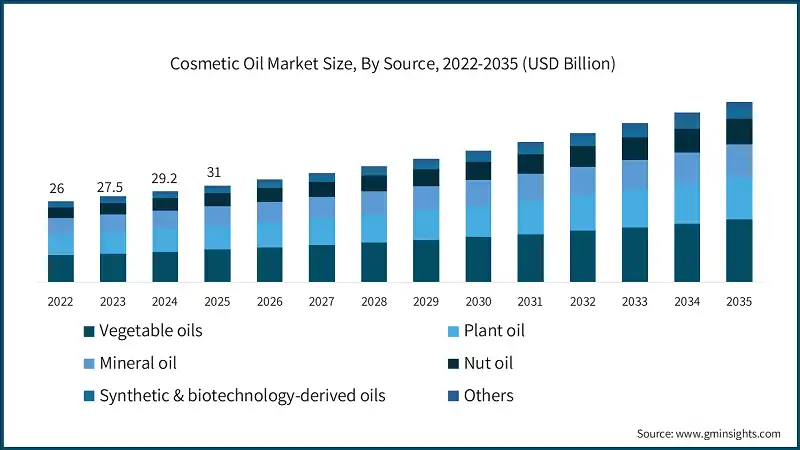
The cosmetic oil market by source is segmented mineral oil, nut oil, plant oil, vegetable oils and synthetic & biotechnology-derived oils. Vegetable oils hold the largest market value of USD 10.5 billion in 2025.
- Cosmetic oils come from several sources such as mineral oils, nut oils, plant oils, vegetable oils, and synthetic or biotechnology-derived oils. Mineral oils have traditionally been well accepted because they are cheap and have good moisturizing properties. In fact, natural oils such as nut and plant oils are beginning to take preference as they are regarded as having more nourishing effects and compatibility with the skin. This fact is also beneficial to a consumer who is searching for environment-friendly and sustainable products.
- Like natural oils, synthetic and biotechnology-derived oils are gaining importance in the cosmetic industry. These oils are made using the latest scientific methods, contributing towards superior stability, purity, and benefits when compared to some natural oils. The concept of using both natural and synthetic oils results in the production of products which turn out to be both effective and consistent in quality. Such diversity in sources of oils thus marks as a market trend and encourages innovations in the cosmetic formulations.
The cosmetic oil market by formulation is segmented into pure single oils, blended/carrier oils, infused oils and encapsulated/nano-emulsified oils. Pure single oils hold the largest market value of USD 13.8 billion in 2025.
- Pure, single oils are oils extracted solely from one oil source and appreciated for their natural properties and simplicity. Blended or carrier oils are the ones that combine two or more oils to achieve better value, texture, or reduction of potency of the strong aroma oils. Infused oils include other therapeutic or aromatic properties by steeping herbs or other botanicals in a base oil.
- Novel formulations like encapsulated or nano-emulsified oils are gaining importance due to their improved performance. Encapsulation and nano-emulsification break down oil droplets into very tiny particles, which then get absorbed deeper into the skin and stably penetrate it. These technologies help cosmetic oils to deliver active ingredients more effectively with longer lasting results. As consumers are looking for better-performing skincare products, such innovations fuel growth and extend prospects for applications in cosmetic oil.
The cosmetic oil market by function is segmented into Skin conditioning & moisturising¸ Hair conditioning, Anti-aging & antioxidant, UV protection, Cleansing & makeup removal and Others. Skin conditioning & moisturising holds the largest market value of USD 13.2 billion in 2025.
- Skin conditioning and moisturizing oils are in demand as they are used daily basis by all age groups. Hair conditioning oils are also showing slow but steady growth as they are used for nourishment, damage repair, and scalp care. The skin conditioning oils and hair conditioning oils are basic personal care products and are mass-market cosmetic segments, thus are showing steady growth.
- The anti-aging and antioxidant oils are growing faster because of awakening awareness among consumers toward skin aging and environmental damage. The UV protection oils are on demand for sun protection and preventive skincare gain traction with consumers. Cleansing and makeup-removal oils are becoming popular as these promise gentle yet effective cleansing without drying the skin. Other functional oils are experiencing moderate growth led primarily by innovations in products and catering to niche consumer demands.
The cosmetic oil market by application is segmented into hair care, skin care, fragrance & aromatherapy, bath & shower products, make-up and others. Hair care holds the largest market value of USD 11.6 billion in 2025.
- The skin and hair care segments for cosmetic oils drives the market in terms of application due to steady use and a wider customer base. Among the two segments, skin care is more in demand, as oils are predominantly used for moisturizing, nourishing, and protecting, whereas hair care has shown steady growth with demand arising from conditioning, repair, and scalp health. These segments are persistently showing steady growth as they fulfill daily needs of personal care.
- Growth is also being witnessed in newer applications like fragrance and aromatherapy, bath and shower products, and make-up. Another factor giving rise to the growth of fragrance and aromatherapy oils is the tremendous interest in wellness and stress management. Bath and shower products are growing as consumers are preferring those formulations that add moisturizing and sensory enhancement. There's increasing use of cosmetic oils in make-up to enhance texture and skin compatibility. The growth of other applications is moderate, mainly on the account of innovation and niche applications.
The cosmetic oil market by distribution channel is segmented into supermarkets/ hypermarkets, specialty stores, professional salon, online/e-commerce, pharmacy stores and others. Supermarkets/ hypermarkets holds the largest market value of USD 8.3 billion in 2025.
- The growth of supermarkets and hypermarkets is catered by the increase in the sale of cosmetic oils because of their wide reach, convenience, and ability to sell multiple brands at one place. Specialty stores are growing as shoppers are looking for expert recommendations and a more niche assortment of beauty and personal care products. Pharmacy stores are also expanding in their cosmetic oil offerings, buoyed by consumer trust on safety, quality, and doctor-recommended products.
- Professional salons are growing as cosmetic oils are being embraced more for Hair and skin treatments and high-end care services. Online and e-commerce setups are thriving due to their accessibility, home delivery, and use of digital platforms for product discovery. Other channels of distribution are gradually growing, owing to local demand, niche products, and customized retail approaches.
Learn more about the key segments shaping this market
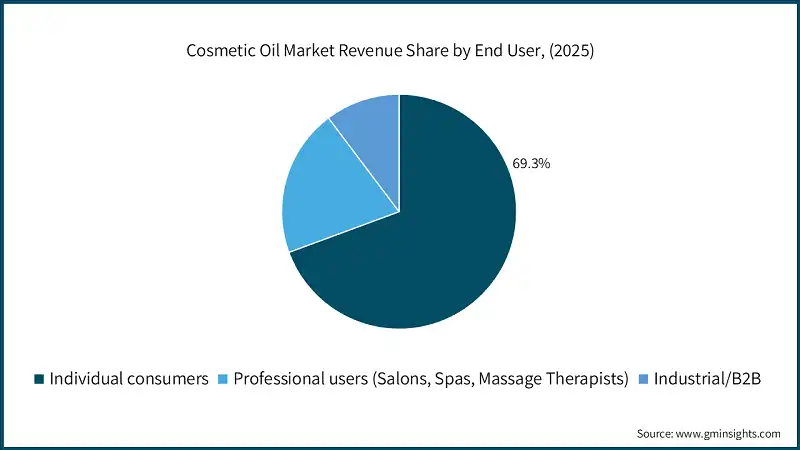
The cosmetic oil market by end user is segmented into individual consumers, professional users (salons, spas, massage therapists) and industrial/B2B. Individual consumers hold the largest market value of USD 21.5 billion in 2025.
- The growing consumption of cosmetic oils is among the factors driving market development among individual users for personal skin and hair care today. Continued awareness about personal grooming, hygiene, and self-care practices ensures permanent demand from this segment in the market. Consumers favor their simplicity and multipurpose application. This continues supporting a constant expansion of the market.
- Service providers such as salons, spas, and massage therapists are increasing the use of cosmetic oils, thus driving growth in the market. Their demand is further emphasized by the expanding scope of professional beauty and relaxation services. Industrial and B2B segment is performing quite well, as cosmetic oils are used widely as an ingredient in the manufacturing of personal care and cosmetic products. In addition to this, manufacturers also rely on a consistent bulk supply of these products for their formulation purposes. These end users jointly contribute to the overall market development.
Looking for region specific data?
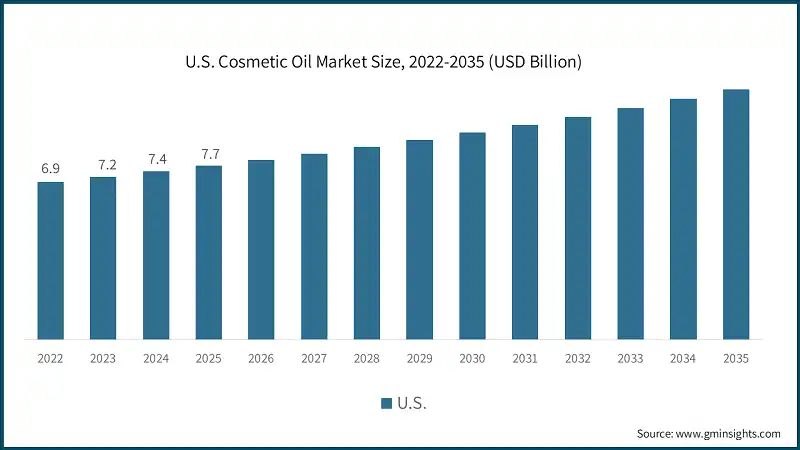
The market in the North America is expected to experience significant and promising growth from USD 9.3 billion in 2025 to USD 15 billion in 2035. The U.S. cosmetic oil market accounted for USD 7.7 billion in 2025.
- The North American cosmetic oil market is seeing steady growth owing to increasing awareness regarding personal care and grooming and wellness products. It consumes all high quality, safe, and performance-oriented cosmetic oils for skin and hair care. Demand also enjoys a strong base by retail infrastructure, digital sales channels, and continuous product innovation.
- The market in United States is growing because of their huge audience and high expenditure on beauty and personal care products. Similarly, Canada adds to the demand with an increasing interest in natural and clean-label cosmetic oils. The presence of reputable cosmetic brands and advanced product formulations ensures continuous development of the market within the entire region.
The market in the Europe is expected to experience significant and promising growth from USD 7.1 billion in 2025 to USD 12.1 billion in 2035.
- European cosmetic oil market is controlled by an immense stress on quality standards, sustainability, and ingredient transparency. The consumers prefer using plant-based and naturally sourced oils for skin care, hair care, and wellness products. The regulatory frameworks also play a role in influencing the formulation of products and the stability in the market.
- Countries like Germany, France and the United Kingdom play a major role in strengthening the cosmetic industries. In terms of premium skincare oils, the French are highly regarded, while the Germans favour organic and dermatologically tested. Demand from the Southern European countries is buoyed by such traditional use of vegetable and plant oils.
The cosmetic oil market in Asia Pacific is expected to experience increasing growth from USD 10.2 billion in 2025 to USD 23.2 billion in 2035 with a CAGR of 8.5%.
- Asia-Pacific has vast potential for market expansion due to increased population growth and disposable income and heightened awareness of beauty. Cosmetic oils play an essential role in particular daily activities, especially skin-nourishing applications and hair-care products. There is open acceptance of oil-based products which supports further growth throughout the region.
- At the country level, India is a strong demand generator because of the traditional use of hair oils and skin oils among its population. China is contributing by the rapid growth of its skincare consumption and expansion of e-commerce platforms. Advancements in formulation and innovations related to applications of cosmetic oils help support the market.
Middle East & Africa market is expected to experience significant and promising growth from USD 1.8 billion in 2025 to USD 2.9 billion in 2035.
- Despite the gradual increase that the region has experienced, there is promise for growth as interest increases in grooming, wellness, and premium beauty products among Middle East & Africa consumers. During dry climatic conditions, cosmetic oils are predominantly used for skin conditioning and hair care. The market demand is also backed by traditional usage of oils.
- Gulf countries like the UAE and Saudi Arabia result in growing the market for both personal and luxury beauty products. South Africa is one of the countries in Africa that has exhibited growth in demand owing to urbanization and widening retail networks. Consumption of traditional and natural oils caters to the market growth.
Latin America is expected to experience significant and increasing growth from USD 2.4 billion in 2025 to USD 4.6 billion in 2035.
- Latin American cosmetic oil markets are increasing with rising attention towards appreciating personal appearance and grooming. Natural and plant-based oils are the general formulations used considering the favourable climatic conditions and availability of raw materials. Urbanization is also leading to an increasing probability of use of such cosmetic products.
- As the largest beauty and personal care market in the region, with strong demand for hair care oils, Brazil leads the regional market. The use of cosmetic oils is growing in Mexico and Argentina through greater access to retail and increasing consumer awareness. Consumer awareness is driving the regional production of botanical oils, which are available in abundance.
Cosmetic Oil Market Share
- The cosmetic oil industry is moderately consolidated with players like BASF SE, Givaudan SA, doTERRA International LLC, Symrise AG, Young Living Essential Oils holding 27.2% market share and BASF SE being the market leader holding the market share of 6.5 % in 2025.
- Innovating and improving product designs consistently keeps the cosmetics oil industry at bay. Most of these companies heavily invest in research and development, especially new formulations, advanced extraction techniques, and multiple functions, to help launch oils that would best suit shifting needs of consumers. Through innovations, brands can distinguish themselves in a crowded market and keep the customer's attention.
- Strong branding and marketing strategies are another crucial factor. By advertising to target audiences, collaborating with influencers, and conducting digital campaigns, companies generate brand recognition and loyalty. Product benefits, natural ingredients, and sustainable practices must be communicated effectively such that retained customers are also kept coming to new ones.
- Companies strengthen their market presence through strategic partnerships and collaborations. For example, collaborating with salons, spas, wellness centers, and e-commerce platforms can expand and multiply a company's credibility in various distribution channels. Partnerships with raw-material suppliers then ensure consistent quality and availability of essential oils meant for production.
- Ethical sourcing and sustainability drive the demand for eco-conscious consumers. With responsibly sourced ingredients and eco-friendly packaging and a transparent supply chain such as those used by brands, such brands prove to be part of the current global trend in clean and sustainable beauty.
- These companies are diversified and expand globally to sustain their position. The wider the range of skin care, hair care, and specialty applications that the company offers, the more different market segments of consumers it can cater to. When entering newer geographical markets, companies capture emerging new demand and grow steadily despite overwhelming competitive pressure.
Cosmetic Oil Market Companies
Major players operating in the cosmetic oil industry are:
- ATDM Co., Ltd.
- BASF SE
- Cargill, Incorporated
- Clariant AG
- doTERRA International LLC
- ExxonMobil Corporation
- Gandhar Oil Refinery India Limited (India)
- Givaudan SA
- Henry Lamotte Oils
- Maverik Oils
- Olvea Vegetable Oils
- Petro-Canada Lubricants
- Renkert Oil
- Sonneborn LLC
- Sophim
- Symrise AG
- Vigon International, Inc.
- Young Living Essential Oils
BASF SE is one of the world's largest chemical companies, with a highly diversified portfolio across chemicals, materials, industrial solutions, surface technologies, nutrition & care, and agricultural solutions, with a sound global manufacturing base, deep R&D capabilities, and a focus on sustainable, and innovation-centric chemical solutions.
Givaudan SA deals in flavors and fragrances for the food, beverage, consumer goods, and fine fragrance markets, with a strong emphasis on natural ingredients, sensory innovations, and collaborative partnerships with customers around the world.
doTERRA International LLC is a wellness company that is best known for its very high-quality-grade essential oils, using direct-selling as a business model placed upon the pillars of their product purity, ethical sourcing, and a robust global distribution network focusing on wellness.
Symrise AG deals in fragrance, flavor, cosmetic ingredients, and special solutions markets combining natural raw materials, biotechnology, and innovation for food, beverage, personal care, and pharmaceutical applications.
Young Living Essential Oils is an international wellness company focusing on plant-based essential oils and holistic health products, integrating controlled sourcing, in-house distillation, and a member-driven direct sales model to promote the concept of natural living and preventive wellness.
Cosmetic Oil Market Report Attributes
| Key Takeaway | Details |
|---|---|
| Market Size & Growth | |
| Base Year | 2025 |
| Market Size in 2025 | USD 31 Billion |
| Market Size in 2026 | USD 32.9 Billion |
| Forecast Period 2026-2035 CAGR | 6.5% |
| Market Size in 2035 | USD 58 Billion |
| Key Market Trends | |
| Drivers | Impact |
| Rising demand for natural and organic products | Consumers are increasingly looking for skincare and haircare products made from plant-based and chemical-free ingredients. |
| Consumers are increasingly looking for skincare and haircare products made from plant-based and chemical-free ingredients. | People are more conscious about maintaining skin hydration, anti-aging, and hair nourishment, driving cosmetic oil consumption. |
| Expansion of the beauty and personal care industry | The growing global beauty market, especially in Asia and the Middle East, fuels cosmetic oil adoption. |
| Pitfalls & Challenges | Impact |
| Allergic reactions or skin sensitivity | Some oils may cause irritation or breakouts for certain skin types. |
| High cost of premium oils | Oils like argan or rosehip can be expensive, limiting accessibility for some consumers. |
| Opportunities: | Impact |
| Sustainable and eco-friendly packaging | Environmentally friendly initiatives can appeal to eco-conscious buyers. |
| Development of multifunctional oils | Oils that combine hydration, anti-aging, and UV protection can attract health-conscious consumers. |
| Integration with advanced skincare technologies | Combining oils with nanotechnology, serums, or smart formulations can enhance absorption and effectiveness, opening new premium segments. |
| Market Leaders (2025) | |
| Market Leaders |
6.5 % |
| Top Players |
|
| Competitive Edge |
|
| Regional Insights | |
| Largest Market | North America |
| Fastest growing market | Asia Pacific |
| Emerging country | China, India, Japan, Australia, South Korea |
| Future outlook |
|
What are the growth opportunities in this market?
Cosmetic Oil Industry News
- In September 2025, Cleaning Food Group (CFG), a UK-based food-tech business, got regulatory approval for CLEAN Oil 25 in the perspective of its use as a cosmetic ingredient in the UK, Europe, and the US. The fermentation-based oil is then derived in collaboration with THG LABS and Croda that becomes a sustainable option for skin, hair, or personal care products.
- In December 2023, Unilever announced an agreement to acquire premium biotech haircare brand K18 and enhance its portfolio in the rapidly growing premium segment. Established in 2020, K18 applies biotechnology to tackle hair damage with its signature K18Peptide, providing quick and effective results.
- In August 2023, L'Oreal completed its acquisition of luxury beauty brand Aesop after initially announcing the terms in. The acquisition is intended for expanding L'Oreal Luxe's global presence and growth potential, particularly in China.
The cosmetic oil market research report includes an in-depth coverage of the industry with estimates and forecast in terms of revenue in USD Billion and volume in terms of kilo tons from 2022–2035 for the following segments:
Market, By Source
- Mineral oil
- Nut oil
- Macadamia oil
- Walnut oil
- Hazelnut oil
- Pecan oil
- Kalahari melon oil
- Brazil nut oil
- Mongongo oil
- Others
- Plant oil
- Almond oil
- Argan oil
- Coconut oil
- Olive oil
- Avocado oil
- St. John's wort oil
- Jojoba oil
- Micro-algae oil
- Others
- Vegetable oils
- Palm oil
- Soy oil
- Hemp oil
- Sesame oil
- Rice bran oil
- Sunflower oil
- Safflower oil
- Borage oil
- Rapeseed oil
- Others
- Synthetic & biotechnology-derived oils
- Squalane (synthetic)
- Silicone-based oils
- Bioengineered oils
Market, By Formulation
- Pure single oils
- Blended/carrier oils
- Infused oils
- Encapsulated/nano-emulsified oils
Market, By Function
- Skin conditioning & moisturizing
- Hair conditioning
- Anti-aging & antioxidant
- Free radical protection
- Wrinkle reduction
- UV protection
- Cleansing & makeup removal
- Others
Market, By Application
- Hair care
- Hair oil
- Shampoos
- Conditioners
- Hair serums
- Hair masks
- Others
- Skin care
- Creams & lotions
- Oils and Formulations
- Others
- Fragrance & aromatherapy
- Bath & shower products
- Make-up
- Others
Market, By Distribution Channel
- Supermarkets/ Hypermarkets
- Specialty stores
- Professional salon
- Online/e-commerce
- Pharmacy stores
- Others
Market, By End Use
- Individual consumers
- Professional users (Salons, Spas, Massage Therapists)
- Industrial/B2B
The above information is provided for the following regions and countries:
- North America
- U.S.
- Canada
- Europe
- Germany
- UK
- France
- Spain
- Italy
- Rest of Europe
- Asia Pacific
- China
- India
- Japan
- Australia
- South Korea
- Rest of Asia Pacific
- Latin America
- Brazil
- Mexico
- Argentina
- Rest of Latin America
- Middle East and Africa
- Saudi Arabia
- South Africa
- UAE
- Rest of Middle East & Africa
Frequently Asked Question(FAQ) :
What was the market size of the cosmetic oil market in 2025?
The global market was valued at USD 31 billion in 2025, with a CAGR of 6.5% expected through 2035, driven by increasing consumer preference for natural and organic beauty products.
What is the projected value of the global cosmetic oil market by 2035?
The market is expected to reach USD 58 billion by 2035, fueled by the demand for multifunctional oils offering benefits such as anti-aging, antioxidant, and UV protection.
What was the market size of vegetable oils in the cosmetic oil market in 2025?
Vegetable oils held the largest market value of USD 10.5 billion in 2025.
What was the market size of pure single oils in the cosmetic oil market in 2025?
Pure single oils dominated the market with a value of USD 13.8 billion in 2025.
What was the valuation of the skin conditioning & moisturizing segment in 2025?
The skin conditioning & moisturizing segment held the largest market value of USD 13.2 billion in 2025.
Which application segment led the cosmetic oil market in 2025?
The hair care segment led the market with a value of USD 11.6 billion in 2025.
Which region is expected to experience significant growth in the market?
North America is projected to grow significantly, from USD 9.3 billion in 2025 to USD 15 billion by 2035. The U.S. market accounted for USD 7.7 billion in 2025.
Who are the key players in the cosmetic oil market?
Key players include ATDM Co., Ltd., BASF SE, Cargill, Incorporated, Clariant AG, doTERRA International LLC, ExxonMobil Corporation, Gandhar Oil Refinery India Limited (India), Givaudan SA, and Henry Lamotte Oils.
Cosmetic Oil Market Scope
Related Reports