Summary
Table of Content

Cooler Bags Market
Get a free sample of this report
Form submitted successfully!
Error submitting form. Please try again.
Thank you!
Your inquiry has been received. Our team will reach out to you with the required details via email. To ensure that you don't miss their response, kindly remember to check your spam folder as well!
Request Sectional Data
Thank you!
Your inquiry has been received. Our team will reach out to you with the required details via email. To ensure that you don't miss their response, kindly remember to check your spam folder as well!
Form submitted successfully!
Error submitting form. Please try again.
Cooler Bags Market Size
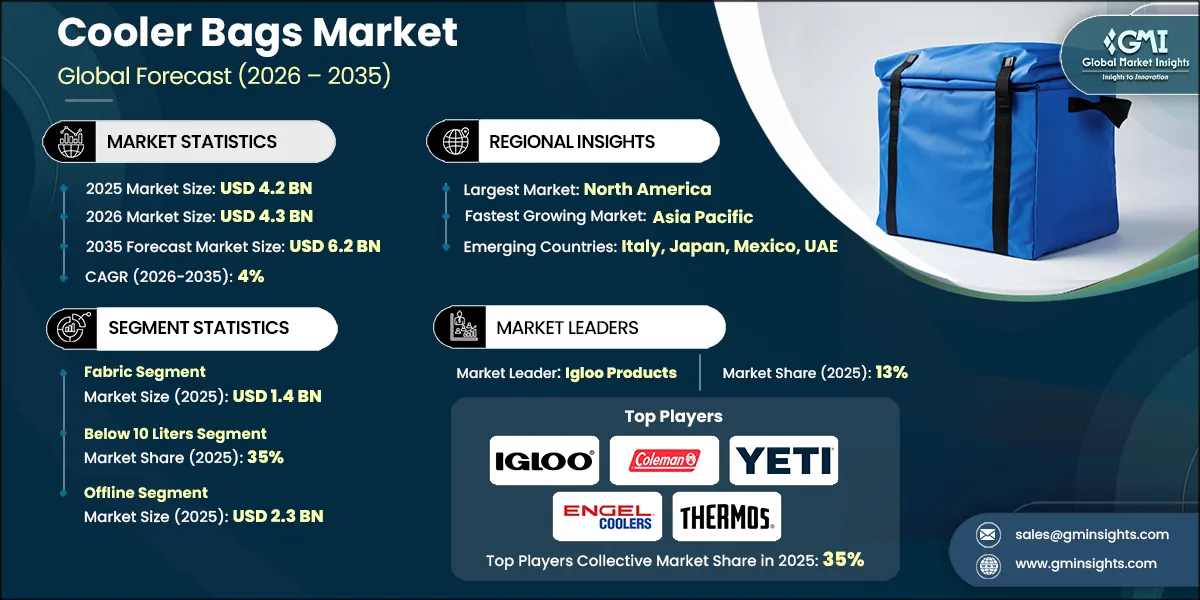
The cooler bags market was estimated at USD 4.2 billion in 2025. The market is expected to grow from USD 4.3 billion in 2026 to USD 6.2 billion in 2035, at a CAGR of 4% according to latest report published by Global Market Insights Inc.
Cooler Bags Market Key Takeaways
Market Size & Growth
- 2025 Market Size: USD 4.2 Billion
- 2026 Market Size: USD 4.3 Billion
- 2035 Forecast Market Size: USD 6.2 Billion
- CAGR (2026–2035): 4%
Regional Dominance
- Largest Market: North America
- Fastest Growing Region: Asia Pacific
Key Market Drivers
- Shift toward outdoor activities.
- Demand for comfort in outdoor settings.
- Rise in domestic travel.
Challenges
- High market fragmentation & price competition.
- Strong seasonality & demand volatility.
Opportunity
- Multi-use & hybrid furniture.
- Modular & space-efficient designs.
Key Players
- Market Leader: Igloo Products led with over 13% market share in 2025.
- Leading Players: Top 5 players in this market include Igloo Products, Coleman Company, YETI Holdings, Engel Coolers, Thermos, which collectively held a market share of 35% in 2025.
Get Market Insights & Growth Opportunities
As more people participate in outdoor activities and leisure activities than ever before, this new way of life is becoming an established trend. Consumers are putting greater emphasis on short-term and low-commitment experiences like a picnic, a trip to the beach, a day hike, a sporting event, and/or a weekend road trip. With these types of experiences, the demand for a way to store food and beverages in a portable manner is growing. Cooler bags provide an alternative means to store prepared and unprepared food and beverages in a convenient and flexible manner by allowing the user to transport fresh food and cold drinks without needing permanent facilities. This trend is especially common among young people who live in urban areas and want to participate in spontaneous and social activities. Where an experience is the main motivation for participating in an event.
Cooler bags are evolving into lifestyle brands that are associated with leisure, health and fitness, and an outdoor lifestyle, beyond just being functional. The design, color and styling of cooler bags demonstrate how the product is intended for those who actively participate in a healthy outdoor lifestyle versus being a utility item. As more people regularly socialize informally outside, as opposed to inside at structured social gatherings, cooler bags serve as products that promote an experience that is shared among friends and family. This connection to recreational activities helps to maintain a steady level of demand, decreases the dependence on seasonal purchasing due to the frequency of short-term trips and increases the likelihood of customers repurchasing or upgrading to a better-designed product.
Concerns about sustainability are changing how people view the items they carry and store daily. As awareness grows about the daily waste associated with disposable, single-use packaging in food and drink retailers, shoppers are increasingly aware of how they impact their environment through these forms of waste production daily. Therefore, using reusable cooler bags presents a more practical way to reduce disposable packaging while concurrently satisfying consumer convenience needs. This product naturally aligns issues related to responsible consumption, as it will replace many single-use products used within one person's lifetime without requiring the consumer to change their behavior in any way.
In combination with this, sustainability has become an acceptable expectation versus a differentiator in the marketplace. As such, consumers are increasingly looking for recycled materials, strong construction and extended longevity from cooler bags in all price ranges; even mid-priced items are expected to have recycled fabrics, durability, and a long life. Reusability enhances the perceived value of long-lasting and versatile products; therefore, they will be viewed as worthwhile investments and not optional purchases. This will open many opportunities for brands to develop trust and loyalty among consumers but will also create additional pressures for brands to meet these expectations to achieve both environmental credentials as well as durability, functionality and price competitiveness.
To get key market trends
Cooler Bags Market Trends
Cooler bags are transitioning from just an occasional, niche product category into something that is much more lifestyle-oriented, commercially relevant and functional. There is a trend toward growing consumer demand around food consumption habits, mobility, sustainability and enjoyment of leisure time outdoors and through continued use in both food delivery and institutional applications. The intensifying competition in this market requires that differentiating products be based on design, performance, sustainability credentials and multi-functionality rather than just basic insulation alone.
- In addition to having been used for outdoor leisure activities, cooler bags are now being incorporated into the everyday lives of consumers including taking office lunches, meal preparation, grocery shopping and taking beverages with them. Consumers living in urban areas have expressed a preference for compact and lightweight solutions that will enable them to bring the items they want to their destination while still adhering to their on-the-go/lifestyle commutes. As such, this will create a reduction in seasonality within the cooler bag market; therefore, the total addressable market will increase, resulting in more consumers using cooler bags on a regular and repeat basis.
- In the cooler bags industry, sustainability is changing the way consumers perceive products. Consumers are looking for re-usable alternatives and want to move away from using disposable packaging when purchasing food and beverages. Therefore, there is an increased demand for cooler bags made from recycled and environmentally friendly materials, constructed durably, and with long product lives. Sustainability has now become a basic requirement and no longer just offers a point of differentiation; it drives product development and brand positioning.
- Cooler bags are becoming not just functional products but also accessories that can define a person’s lifestyle and the way the product is used. More consumers are looking for aesthetic appeal, color choices, ergonomically designed formats, and hybrid style designs when choosing cooler bags to purchase. This design-centric approach allows brands to charge a premium price, segment consumers more effectively, and develop a deeper emotional connection with consumers beyond just functional performance.
- In addition to being popular with consumers, cooler bags are being used more for food delivery, catering, grocery logistics and other large institutions, where temperature control is necessary. Cooler bags provide businesses with an affordable way to keep their products fresh and safe while they are being shipped to their customers by providing businesses with an alternative to using a one-time-use cooler during transportation.
Cooler Bags Market Analysis
Learn more about the key segments shaping this market
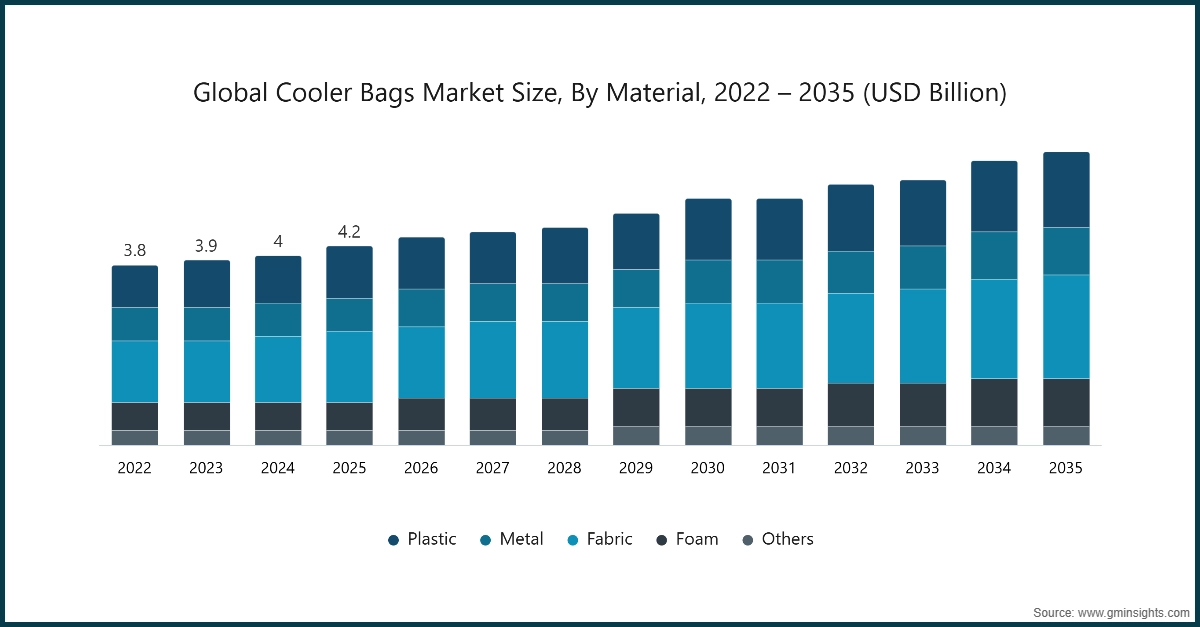
Based on material, the market is divided into plastic, metal, fabric, foam and others. In 2025, fabric held the major market share, generating a revenue of USD 1.4 billion.
- Fabric is the first method that most people think of for cooler bags because it has many uses, cost effectiveness and can be used with many products. Types of fabrics, including polyester, nylon, canvas and recycled materials, allow manufacturers to create a variety of lightweight, flexible, portable cooler bags that are appropriate for everyday use, outdoor recreation, or commercial use. Cooler bags made from fabric can be easily carried, stored, and transported as soft-sided containers, so they’re very popular as lunch bags, tote cooler bags, backpack cooler bags, and compact personal bags.
- Another major advantage of fabric cooler bags is that they provide flexibility in design and the ability to be scalable across various price categories. Fabric also provides many opportunities for different visual designs, such as color, texture, patter, and graphics, so manufacturers can cater to the mass market and to premium consumers alike. While small entry level cooler bags are great for everyday use, higher end outdoor soft-sided coolers take the same basic cooler bag designs and enhance them with different linings, insulation thickness, waterproofing, and reinforcement. This versatility provides brands with an opportunity to meet the diverse needs of consumers without having to make significant changes to their manufacturing methods.
- Fabric materials are ideal for reuse, durability and changing environmental expectations. Further increase of recycled polyester and durable woven fabrics support both longer product life cycles and less single-use packaging. Whilst internal insulation is critical to function, fabric exterior materials provide a balance of durability/comfort/environment and reinforce continued dominance of cooler bags in the market. As everyday/lifestyle usage continues to expand, cooler bags made from fabric are anticipated to continue being the primary material choice across capacity sizes and geographical locations.
Learn more about the key segments shaping this market
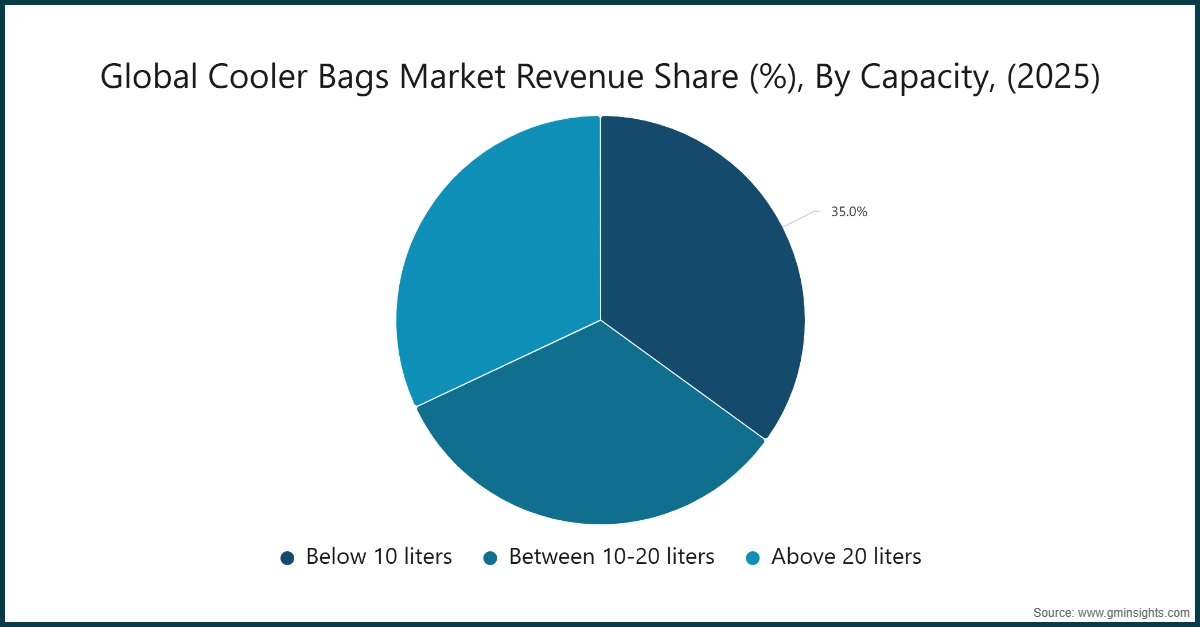
Based on capacity, the market is segmented in below 10 liters, between 10-20 liters and above 20 liters. The below 10 liters segment held around 35% of the global cooler bags market share in 2025.
- The below 10-liter size range is a very popular option within the cooler bag market due to having a good fit with typical mobility and convenience needs. Often used as a means of carrying personal meals, drinks, snacks or small groceries, compact cooler bags are utilized during office commutes, at school, going to the gym, on quick errands or while participating in solo outdoor activities. The lightweight design of compact cooler bags also makes them increasingly appealing to urban consumers whose needs for convenience outweigh the need for larger capacity coolers.
- Versatility and accessibility at a range of pricing are additional factors supporting the popularity of this segment. Because coolers of this size are typically manufactured with fewer materials, they are both less expensive to produce and more affordable for mass-market consumers, providing the opportunity for high-volume sales. At the same time, premium options exist that offer enhanced insulation capabilities, trendy designs or durable construction, allowing companies to cater to both value-conscious consumers and lifestyle-focused consumers. Consequently, the below 10-liter category serves as an entry point for new consumers as well as providing upgrade options for return purchasers.
- The 10-liter size category provides brands with the strategic advantage of less seasonal variability in the demand for cooler bags. Larger capacity bags tend to be purchased almost exclusively for use when traveling or going out in groups, while small capacity bags are widely used daily throughout the year. As a result of their frequency of use, small size capacity bags have a much higher level of recurring demand than larger size capacity bags. Therefore, this segment is very appealing to retailers; they can rely on a steady demand for these products, rapid inventory turnover, and opportunity to differentiate through design.
Based on distribution channel, the cooler bags market is segmented into online and offline.The offline segment generating a revenue of USD 2.3 billion in 2025.
- Offline distribution channels remain significant player in the cooler bag market due to their tactile and functional nature. Physical inspection is the preferred method by consumers when purchasing cooler bags to ensure that they meet standards such as product insulation thickness, construction material quality, zipper strength, weight and portability. Consumers will have the opportunity to compare sizes, designs and prices for cooler bags in brick-and-mortar stores will increase the likelihood of a consumer becoming confident in making a first-time purchase of a cooler bag.
- The benefit of offline distribution channels for brands is enhanced through providing an opportunity for impulse purchases and displaying seasonally marketed products providing consumers with incentive opportunities to purchase cooler bags during the summer months, holiday travel periods and outdoor activity seasons. In addition, offline retail channels provide strong visibility, brand awareness and access to mass consumer segments, not actively searching for cooler bags online, yet responding to a need recognition when in-store. Although e-commerce is increasing, offline distribution channels remain a significant contributor to cooler bag purchase volumes, product discovery and connecting with price-sensitive and non-digital consumers.
Looking for region specific data?
North America Cooler Bags Market
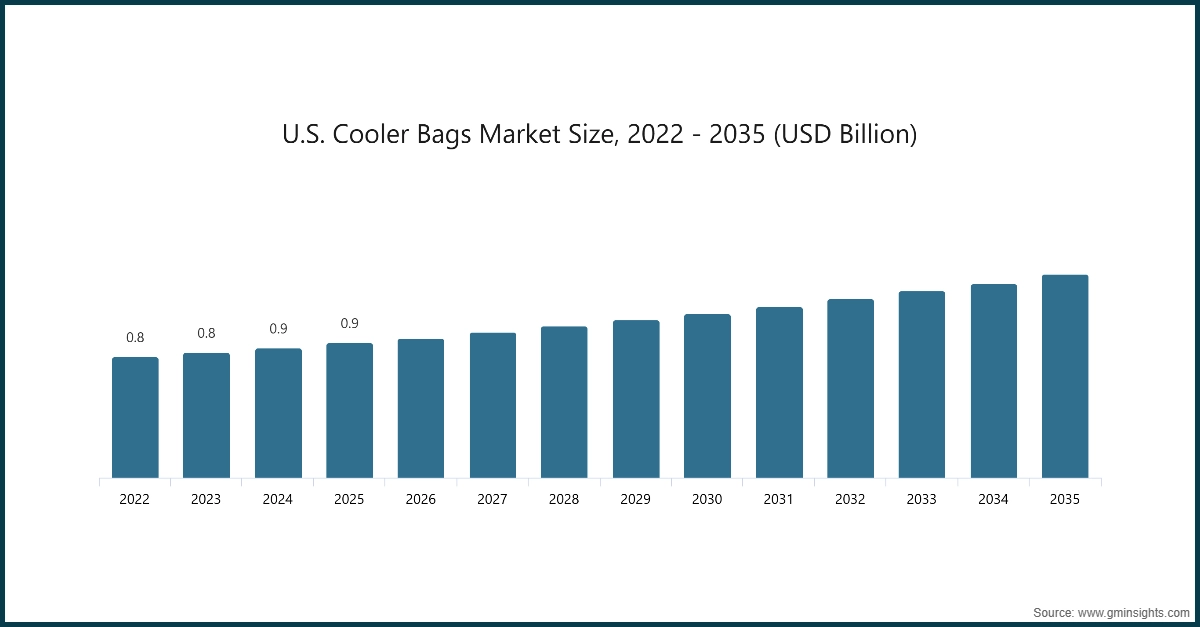
In 2025, the U.S dominated the North America cooler bags industry, accounting for around 64.5% share and generating around USD 900 million revenue in the same year.
- The U.S. is recognized as a longstanding and established market for cooler bags, due to many factors including a strong lifestyle of outdoor recreation, high levels of engagement in leisure activities, and a high level of acceptance of on-the-go consumption of food products. Cooler bags are frequently used for all types of occasions and venues such as picnicking, camping, sporting events, travelling via road, and going to the beach and by many consumers on an everyday basis to carry their lunch to the office or their groceries from the grocery store. In the U.S. marketplace, the average consumer prefers products that are durable, perform well and have good looking designs and they are willing to pay more for cooler bags with superior insulation, reputable brands and good functionality.
- North America, as a region, exhibits a diverse and consistently robust demand for cooler bags due to the numerous similarities between the U.S. and Canada with respect to lifestyle patterns specifically, preferences for the outdoors, travel, and leisure activities with friends and family. Therefore, cooler bags are viewed by consumers as practical utility products, rather than as infrequent transactions, and therefore the user base varies across all customer segments consumer, commercial, and institutional. With regards to cooler bag purchasing patterns, both the small and medium-sized cooler bags intended for both short-term travel and day-to-day use are most frequently purchased.
- From a market dynamics standpoint, North America has an equal amount of mass-market volume and premium-growth products. The value placed by consumers on quality, reusability and convenience benefits retailers with a strong emphasis on in-store sales supplemented by the growth in online shopping. Seasonal peaks in sales for cooler bags occur; however, everyday customers and food-related sales assist in providing steadily stable sales throughout the year. Thus, North America remains an important strategic region for cooler bags due to its size and buying power as well as willingness to accept new product innovation.
Europe Cooler Bags Market
Europe market held 26.9% share in 2025 and is expected to grow at 4.1% CAGR during the forecast period.
The cooler bag industry in Europe is very mature and is growing quickly because many European consumers are environmentally conscious, spend time doing outdoor leisure activities, and have a lot of different places to eat their food. Consumers throughout Europe tend to use cooler bags for picnics or short trips as well as for grocery shopping, especially when they live in urban or semi-urban areas. Compact and medium-capacity cooler bags are the most popular; their ease of use allows people in urban or semi-urban areas to easily take cooler bags with them on public transportation and while walking.
- Sustainability is one of the most important factors influencing purchasing decisions in Europe. European consumers place significant value on reusable, durable and non-toxic materials, which is why European brands focus on producing eco-friendly/ sustainable materials for their products. Others aim for longer product lifespans and minimalist design. While consumers may be price sensitive in some markets, do tend to be willing to pay more for better quality and high-performing environmentally responsible products, thus supporting both the mid-range and premium-priced cooler bags in the marketplace.
Asia Pacific Cooler Bags Market
The Asia Pacific held the market share of 23.3% in 2025 and is anticipated to grow with a CAGR of around 4.3% from 2026 to 2035.
- The demand for cooler bags throughout the Asia or Pacific area is varied in nature and quickly changing to meet the requirements of a growing number of urban environments, increased disposable income and shifting trends in how people consume food. As cooler bags become increasingly integrated into everyday life, the very small size of the cooler bags, their affordable price point, and their ease of portability will all drive their continued increase in use within densely populated cities.
- In addition, as the Asia-Pacific region continues to develop, businesses are expanding their commercial applications for cooler bags through food delivery services, casual catering opportunities, and small business environments. Many countries in the Asia-Pacific region will have climate-related issues affecting their daily activities affecting how often people need products that provide temperature control which will, in turn, create new demand for temperature-controlled carrying solutions. Even though there is an increasing level of sustainability consciousness among consumers, price and performance are still key determinants of how consumers will make their purchase decisions; therefore, the cooler bags that are inexpensive, long-lasting, and able to serve many different purposes are very appealing to consumers in the Asia-Pacific region.
Middle East & Africa Cooler Bags Market
Middle East & Africa market is growing at a CAGR of 4% during the forecast period.
- In the Middle East & Africa, the market for cooler bags is affected by two major factors: functionality and climate. High temperatures in many areas means there will be a rise in the need for portable cooling systems to maintain food/beverage temperature while travelling, working or partaking in outdoor activities. Cooler bags are frequently used by families on outings; at social gatherings; on long car trips and for events where there is no refrigeration available.
- Middle East & Africa demonstrates an uneven level of demand throughout various countries but does ultimately show that there is an increasing level of usage in urban and higher income regions. Insulation performance, practicality and durability are most important to end-users, particularly among mid-priced cooler bags, as opposed to aesthetics. There is a growing view among consumers that cooler bags are an appropriate accessory for the home and commercial sector, indicating that there could be significant long-term growth even though the current state of the market is fragmented.
Cooler Bags Market Share
Igloo Products is leading with 13% market share. Igloo Products, Coleman Company, YETI Holdings, Engel Coolers, Thermos, collectively hold around 35%, indicating moderately fragmented market concentration. These prominent players are proactively involved in strategic endeavors, such as mergers & acquisitions, facility expansions & collaborations, to expand their product portfolios, extend their reach to a broad customer base, and strengthen their market position.
Coleman is one of the most successful companies in this segment offering multiple types of soft-sided cooler bags, which include lunch coolers, tote bags, backpacks and family-sized formats. Positioned primarily in mid-price, Coleman can combine functional insulation with affordability to create their cooler bags for usage in camping, travel, picnics and everyday leisure activities, which have resulted in high utilization rates for Coleman. Coleman also has a large presence through offline and online distribution channels resulting in very high sales volume and consistent replacement demand for cooler bags.
Igloo Products is the dominant force within the cooler bag category with a broad product offering and extensive penetration into daily usage. Igloo meets the diverse consumer needs of insulated lunch bags coolers, tote coolers, back packs and lifestyle designs that deliver practicality combined with style. Igloo’s ability to ensure accessibility across their broad pricing range and a diverse offering of designs enables them to fulfill considerable volume build across urban, family and casual outdoor segments. As a result, Igloo provides cooler bags that are most generally positioned as versatile, high turnover products as opposed to being classified as premium performance products providing Igloo with industry leading market share position.
Cooler Bags Market Companies
Major players operating in the cooler bags industry are:
AO Coolers
- Arctic Zone
- Carhartt
- Coleman Company
- Dometic Group
- Engel Coolers
- Grizzly Coolers
- Hydro Flask
- Igloo Products
- Klein Tools
- Stanley
- Pelican Products
- RTIC Outdoors
- Thermos
- YETI Holdings
Stanley has established itself as a lifestyle-oriented premium brand in the cooler bag category by extending its expertise in insulation from drinkware to include soft coolers and insulated carry. The cooler bags manufactured by Stanley are engineered to provide long-lasting durability, maintain thermal performance and be usable daily. They provide an attractive option for consumers who want a rugged cooler bag that is also simply designed and functional.
Arctic Zone is a dominant mid-market and family-friendly brand in the cooler bags segment, with an emphasis on insulated lunch coolers, insulated grocery bags, and casual soft-sided coolers for outdoor use. The brand markets itself around convenience, innovation, and value, making their products perfect for use at school, at work, at the beach, or during non-overnight excursions. Arctic zone provides customers with affordable price points and functional designs that connect everyday consumers with value-based products offering reliable insulation performance; therefore, affordable family customers are consistently looking for and buying value-based insulated carry products from Arctic Zone.
Cooler Bags Market Report Attributes
| Key Takeaway | Details |
|---|---|
| Market Size & Growth | |
| Base Year | 2025 |
| Market Size in 2025 | USD 4.2 Billion |
| Market Size in 2026 | USD 4.3 Billion |
| Forecast Period 2026-2035 CAGR | 4% |
| Market Size in 2035 | USD 6.2 Billion |
| Key Market Trends | |
| Drivers | Impact |
| Shift toward outdoor activities | The demand for portable, long-lasting cooler bags that can be used for travel, picnics, sporting events and short outdoor trips will grow. |
| Demand for comfort in outdoor settings | Increased sales of reusable cooler bags will lead to a shift in how often consumers replace their existing coolers and more brand loyalty. |
| Rise in domestic travel | Improved insulation, ergonomics and multiple-use formats will differentiate cooler bags from one another and make cooler bags look like a better value to customers. |
| Pitfalls & Challenges | Impact |
| High market fragmentation & price competition | Higher production costs associated with eco-friendly materials will put pressure on cooler bag companies and increase their cost and pricing strategies. |
| Strong seasonality & demand volatility | Due to the ease of replicating innovations, it will increase competition among cooler bag companies and subsequently drive down prices for cooler bags at a faster pace than previously expected. |
| Opportunities: | Impact |
| Multi-use & hybrid furniture | This will create greater margins for cooler bag companies because consumers are willing to pay more for higher quality insulation, superior durability and for the brand's credibility. |
| Modular & space-efficient designs | There is an increase in B2B purchasing of cooler bags for promotional usage, for corporate gifts and through branded cooler bag contracts. |
| Market Leaders (2025) | |
| Market Leader |
13% market share |
| Top Players |
The collective market share in 2025 is 35% |
| Competitive Edge |
|
| Regional Insights | |
| Largest market | North America |
| Fastest growing market | Asia Pacific |
| Emerging countries | Italy, Japan, Mexico, UAE |
| Future Outlook |
|
What are the growth opportunities in this market?
Cooler Bags Industry News
- In July 2025 Igloo Products initiated a customization program allowing consumers to personalize select cooler bags and compact coolers using full‑colour graphic printing, photo uploads, text customization, and laser‑etch design options, enhancing consumer engagement and gifting appeal.
- In July 2025 AO Coolers introduced updates to its soft‑cooler portfolio with the nomad roll‑top backpack cooler, incorporating a water‑resistant exterior, leak‑resistant internal liner, roll‑top closure system, and improved ergonomic shoulder straps aimed at marine and fishing applications.
- In June 2025, Dometic Group introduced the Recon modular cooling system, comprising stackable soft coolers in 12 L, 17 L, and 21 L sizes, engineered with space‑optimized outer dimensions, reinforced abrasion‑resistant fabrics, multi‑directional access lids, and compatibility with vehicle‑based storage systems.
- In May 2025 Arctic Zone expanded its zipper less soft‑cooler lineup with a 30‑can HardBody model featuring flip‑open lid access, removable internal shelf for food separation, radiant heat‑barrier insulation, and an anti‑slip shoulder strap system for everyday and family use.
- In April 2025, Coleman Company launched the Pro series, adding 16‑can and 24‑can soft cooler bags with reinforced bases, improved insulation thickness, separate dry‑storage compartments, heavy‑duty zippers, and lightweight construction positioned below premium price tiers.
The cooler bags market research report includes in-depth coverage of the industry with estimates & forecasts in terms of revenue (USD Billion) & volume (Million Units) from 2022 to 2035, for the following segments:
Market, by Material Type
- Plastic
- Metal
- Fabric
- Foam
- Others (gel, etc.)
Market, by Capacity
- Below 10 liters
- Between 10-20 liters
- Above 20 liters
Market, by Price
- Low
- Medium
- High
Market, by Application
- Individual
- Retail
- Travel
- Others
Market, by Distribution Channel
- Online
- E-commerce
- Company websites
- Offline
- Supermarkets/hypermarkets
- Specialty stores
- Others (Departmental stores. Etc.)
The above information is provided for the following regions and countries:
- North America
- U.S.
- Canada
- Europe
- Germany
- UK
- France
- Italy
- Spain
- Asia Pacific
- China
- India
- Japan
- Australia
- South Korea
- Latin America
- Brazil
- Mexico
- Argentina
- Middle East and Africa
- South Africa
- Saudi Arabia
- UAE
Frequently Asked Question(FAQ) :
What is the market size of the cooler bags in 2025?
The market size was USD 4.2 billion in 2025, with a CAGR of 4% expected through 2035 driven by shift toward outdoor activities, demand for comfort in outdoor settings, and rise in domestic travel.
What is the projected value of the cooler bags market by 2035?
The cooler bags market is expected to reach USD 6.2 billion by 2035, propelled by multi-use hybrid designs, modular space-efficient formats, and growing commercial applications in food delivery and catering.
What is the current cooler bags market size in 2026?
The market size is projected to reach USD 4.3 billion in 2026.
What was the valuation of fabric material segment in 2025?
Fabric material segment held the major market share generating USD 1.4 billion in 2025, driven by versatility, cost effectiveness, lightweight flexibility, and design scalability across price categories.
What was the market share of below 10 liters capacity segment in 2025?
Below 10 liters segment held 35% market share in 2025, driven by good fit with mobility and convenience needs for office commutes, school, gym, and solo outdoor activities.
What was the valuation of offline distribution channel segment in 2025?
Offline segment held the largest market share generating USD 2.3 billion in 2025, driven by consumer preference for tactile inspection and impulse purchase opportunities in physical stores.
Which region leads the cooler bags market?
North America is the largest market with the U.S. accounting for 64.5% regional share generating USD 900 million in 2025, driven by strong outdoor recreation lifestyle and high engagement in leisure activities.
What are the upcoming trends in the cooler bags market?
Key trends include transition from occasional niche products to lifestyle-oriented functional items for everyday use including office lunches and grocery shopping, growing sustainability focus with demand for recycled materials and durable construction.
Who are the key players in the cooler bags market?
Key players include Igloo Products, Coleman Company, YETI Holdings, Engel Coolers, Thermos, AO Coolers, Arctic Zone, Carhartt, Dometic Group, Grizzly Coolers, Hydro Flask, Klein Tools, Stanley, Pelican Products, and RTIC Outdoors.
Cooler Bags Market Scope
Related Reports