Summary
Table of Content

Consumer Audio Market
Get a free sample of this report
Form submitted successfully!
Error submitting form. Please try again.
Thank you!
Your inquiry has been received. Our team will reach out to you with the required details via email. To ensure that you don't miss their response, kindly remember to check your spam folder as well!
Request Sectional Data
Thank you!
Your inquiry has been received. Our team will reach out to you with the required details via email. To ensure that you don't miss their response, kindly remember to check your spam folder as well!
Form submitted successfully!
Error submitting form. Please try again.
Consumer Audio Market Size
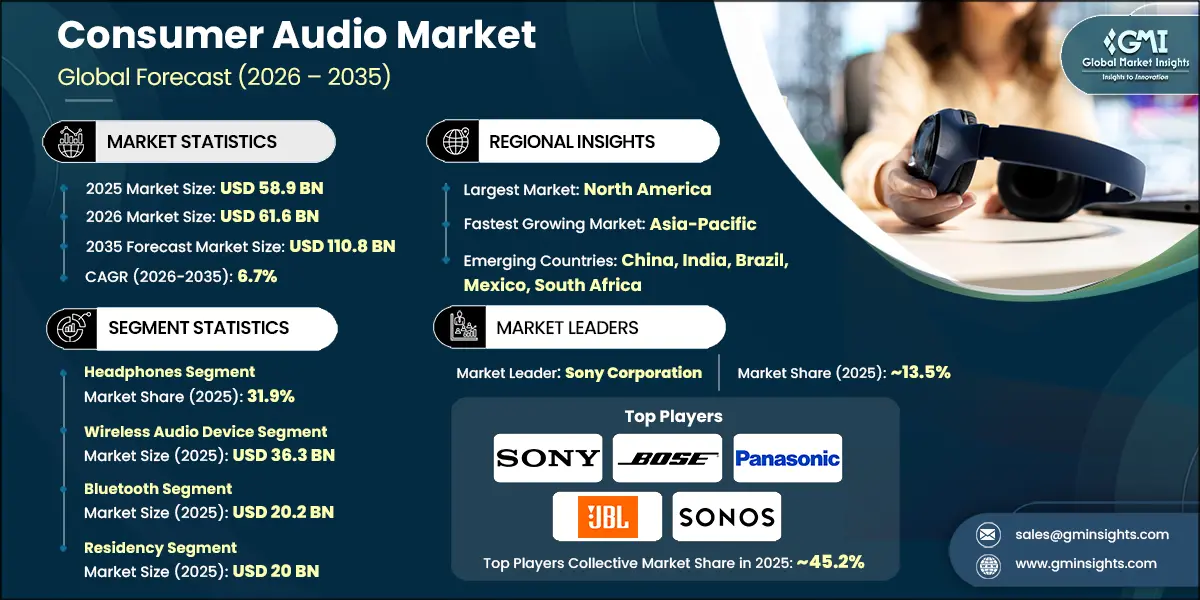
The global consumer audio market was valued at USD 58.9 billion in 2025. The market is expected to grow from USD 61.6 billion in 2026 to USD 110.8 billion in 2035, at a CAGR of 6.7% during the forecast period, according to the latest report published by Global Market Insights Inc.
Consumer Audio Market Key Takeaways
Market Size & Growth
- 2025 Market Size: USD 58.9 Billion
- 2026 Market Size: USD 61.6 Billion
- 2035 Forecast Market Size: USD 110.8 Billion
- CAGR (2026–2035): 6.7%
Regional Dominance
- Largest Market: North America
- Fastest Growing Region: Asia-Pacific
Key Market Drivers
- Surge in wireless and TWS (True Wireless Stereo) adoption.
- Integration of voice assistants (Alexa, Google Assistant, Siri).
- Shift toward high-resolution audio & immersive experiences (Dolby Atmos, Spatial Audio, Hi-Res Audio).
- Rising fitness & wellness integration.
Challenges
- Price sensitivity in emerging markets.
- Intense competition & commoditization.
Opportunity
- Next-gen connectivity (Bluetooth LE Audio, Auracast).
- Adoption of AI-driven personalization.
Key Players
- Market Leader: Sony Corporation led with over 13.5% market share in 2025.
- Leading Players: Top 5 players in this market include Sony Corporation, Bose Corporation, Panasonic Corporation, JBL, Sonos, which collectively held a market share of 45.2% in 2025.
Get Market Insights & Growth Opportunities
- The global consumer audio market is witnessing steady growth, driven by increasing demand for smart speakers, wireless, and portable audio solutions that deliver enhanced sound quality. Innovations in audio technology, including spatial audio and advanced noise cancellation, are further encouraging adoption. Additionally, the expansion of e-commerce platforms has made it easier for consumers to access a wider range of products at competitive prices. Rising consumer focus on high-quality audio experiences at home and on the go is expected to sustain market growth.
- Music streaming and online gaming are key factors contributing to market expansion. Platforms such as Spotify, Apple Music, and YouTube Music have transformed listening habits, encouraging consumers to invest in higher-quality audio devices. For instance, in April 2024, WiSA Technologies, Inc. announced a WiSA E licensing agreement with a leading consumer electronics company, enabling the integration of its immersive audio software into end-user devices.
- The growth of the gaming sector, including esports, has increased demand for gaming headsets that offer low-latency, high-fidelity, and immersive sound experiences. Consumers increasingly expect superior audio performance, prompting companies to introduce innovative products. In August 2025, JBL launched three new gaming headsets in its Quantum line—the Quantum 950, Quantum 650, and Quantum 250—featuring ergonomic designs, enhanced audio accuracy, and premium sound quality across different price points.
- From 2022 to 2023, the consumer audio market grew from $52.6 billion to $54.5 billion, reflecting rising consumer preference for wireless and portable devices. Smart speakers have gained significant traction, audio technology has advanced, and online retail channels have expanded accessibility. Increased consumer interest in home entertainment, gaming, and personal music consumption has also contributed to market growth. For example, in November 2025, Sennheiser launched the HDB 630 wireless headphones in India, targeting audiophiles and technology enthusiasts with high-fidelity audio, advanced noise cancellation, and extended battery life.
- Technological advancements continue to expand the consumer audio market. Developments in wireless connectivity, such as Bluetooth 5.3 and Wi-Fi 6, enable higher-quality audio streaming and seamless device integration. Artificial intelligence is enhancing features in headphones, earbuds, and smart speakers, including noise cancellation, voice control, and spatial audio. In September 2025, Skullcandy introduced the Smokin’ Buds, Rail TWS earbuds, and Crusher ANC 2 headphones in India, incorporating advanced noise-canceling capabilities.
- Rising adoption of mobile technology and remote work has boosted demand for portable audio solutions. In parallel, the increasing popularity of smart TVs and video streaming services is driving growth in home audio systems and soundbars. For instance, in December 2024, LG launched LG Radio+ on its smart TVs, offering access to radio stations, podcasts, and music streaming directly on the device, enhancing the home audio experience without requiring additional equipment.
To get key market trends
Consumer Audio Market Trends
- The consumer audio industry is undergoing a clear transition from wired to wireless products, driven by rising demand for convenience, mobility, and seamless usability. The removal of headphone jacks from smartphones and significant advancements in Bluetooth technology have accelerated the adoption of wireless earbuds and headphones. True Wireless Stereo (TWS) devices, in particular, are gaining strong traction due to their compact form factor and advanced functionalities such as touch controls, voice assistant compatibility, and active noise cancellation. This shift reflects a broader industry movement toward integrated, cable-free audio experiences.
- Sustainability has become an increasingly influential trend shaping product development and brand strategies in the consumer audio sector. Manufacturers are adopting environmentally responsible practices, including the use of recycled materials, reduced packaging, energy-efficient components, and designs that support extended product lifecycles. Younger consumer segments, in particular, are displaying stronger preferences for brands with credible sustainability commitments. As a result, companies are positioning eco-friendly innovations and transparent supply chain practices as strategic differentiators rather than merely regulatory requirements.
- Smart technology is also redefining consumer expectations, with growing emphasis on voice-enabled capabilities and AI-driven personalization. Smart speakers, earbuds, and other connected audio devices now offer features such as real-time translation, adaptive audio tuning, and seamless integration with smart home ecosystems. This trend is fueled by rising demand for multifunctional devices that enhance not only entertainment but also productivity and everyday convenience. As voice assistants and AI algorithms continue to advance, audio products are evolving into intelligent, interactive companions, thereby strengthening user engagement and long-term brand loyalty.
Consumer Audio Market Analysis
Learn more about the key segments shaping this market
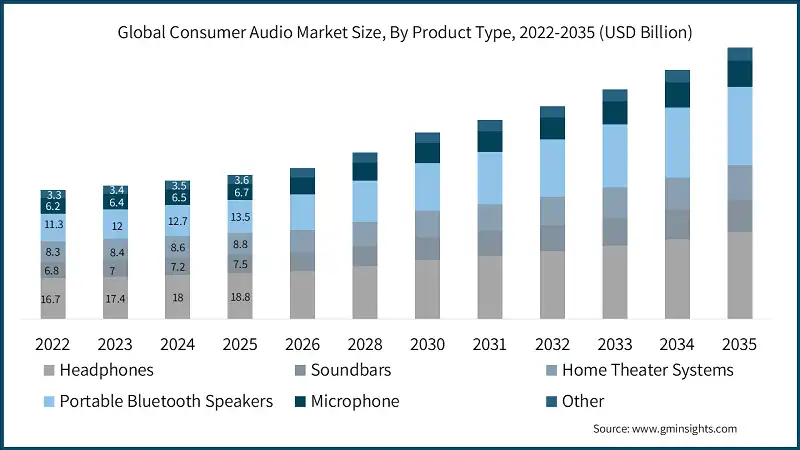
The market was valued at USD 52.6 billion and USD 54.5 billion in 2022 and 2023, respectively. The market size reached USD 61.6 billion in 2026, growing from USD 58.9 billion in 2025.
Based on product type, the market is divided into headphones, soundbars, home theatre systems, portable Bluetooth speaker, microphone, and others. The headphones segment accounted for 31.9% of the market in 2025.
- The headphones segment was valued at USD 18.8 billion in 2025, remaining the largest product segment in the consumer audio market. Rising demand for wireless, noise-canceling, and high-fidelity headphones is driving growth. Technological advancements in Bluetooth connectivity, AI-enabled sound personalization, and energy-efficient designs allow immersive listening experiences. Consumer preference for high-quality audio, portable solutions, and integration with smart devices further contributes to market expansion, making headphones a key segment in modern audio consumption.
- Manufacturers should focus on developing durable, high-quality, and energy-efficient headphones with wireless and smart connectivity features. Enhancing noise cancellation, AI-driven sound personalization, and seamless device integration will attract consumers, expand adoption, and strengthen brand presence in the competitive market.
- The portable Bluetooth speaker segment in the consumer audio market is anticipated to grow at a CAGR of 9.1% during the forecast period. Increasing consumer demand for portable, high-quality, and smart speakers drives this growth. Features such as wireless connectivity, long battery life, waterproof designs, and AI-powered audio enhancements support immersive experiences for music, gaming, and outdoor use, boosting global adoption.
- Manufacturers should focus on creating high-performance, energy-efficient Bluetooth speakers with wireless and AI-enabled features. Enhancing portability, sound quality, and user-friendly connectivity will cater to evolving consumer preferences, support market expansion, and increase adoption across homes, offices, and outdoor environments globally.
Based on technology, the consumer audio market is divided into wired audio devices, and wireless audio device. The wireless audio device segment dominated the market in 2025 with a revenue of USD 36.3 billion.
- The wireless audio devices segment holds the largest market share, driven by convenience, long battery life, and reliable performance across various settings. Consumers increasingly prefer wireless headphones, earbuds, and speakers for home, office, and outdoor use. Integration with smart devices, streaming services, and AI-powered features further supports adoption.
- Manufacturers should focus on producing durable, energy-efficient, and high-quality wireless audio devices. Enhancing connectivity, sound fidelity, battery performance, and ease of use will cater to evolving consumer preferences, boost adoption, and expand market penetration globally.
- The wired audio devices segment is the fastest-growing, expected to expand at a CAGR of 7.7% and reach USD 74.8 billion by 2035. High reliability, consistent performance, and superior sound quality drive demand for wired headphones, home audio systems, and professional audio equipment across homes, studios, and entertainment venues.
- Manufacturers should focus on producing high-fidelity, durable, and energy-efficient wired audio products. Developing scalable, user-friendly solutions with enhanced audio performance will support adoption in both consumer and professional segments, driving growth and market expansion globally.
On the basis of connectivity, the market is divided into Bluetooth, Wi-Fi, NFC, and others. Bluetooth segment dominated the market in 2025 with a revenue of USD 20.2 billion.
- The Bluetooth segment dominates the consumer audio market due to its portability, ease of use, and suitability for on-the-go listening across homes, offices, and outdoor settings. Wireless headphones, earbuds, and speakers provide reliable, high-quality audio without the limitations of wired connections. Advancements in long-lasting, energy-efficient batteries and low-power Bluetooth technologies further enhance user experience. Rising adoption among casual listeners, audiophiles, and gamers, combined with growing smart device integration, is driving significant growth for Bluetooth-enabled audio products globally.
- Manufacturers should focus on developing Bluetooth audio devices with long-lasting, energy-efficient batteries and low-power technologies. Enhancing portability, ease of connectivity, and high-quality sound will support adoption among diverse consumer segments, boosting market growth and expanding global reach.
- The Wi-Fi audio segment is the fastest-growing, anticipated to expand at a CAGR of 8.1% and reach USD 37.1 billion by 2035. Growth is driven by increasing demand for smart, connected, and energy-efficient audio solutions in homes, offices, and entertainment spaces. Wi-Fi-enabled speakers and sound systems allow seamless streaming, multi-room connectivity, and integration with smart home ecosystems, enhancing user convenience and engagement.
- Manufacturers should focus on developing efficient, durable, and cost-effective Wi-Fi-enabled audio products. Enhancing streaming quality, multi-device connectivity, and energy-efficient designs will support adoption across households and commercial spaces, driving growth in the market globally.
Learn more about the key segments shaping this market
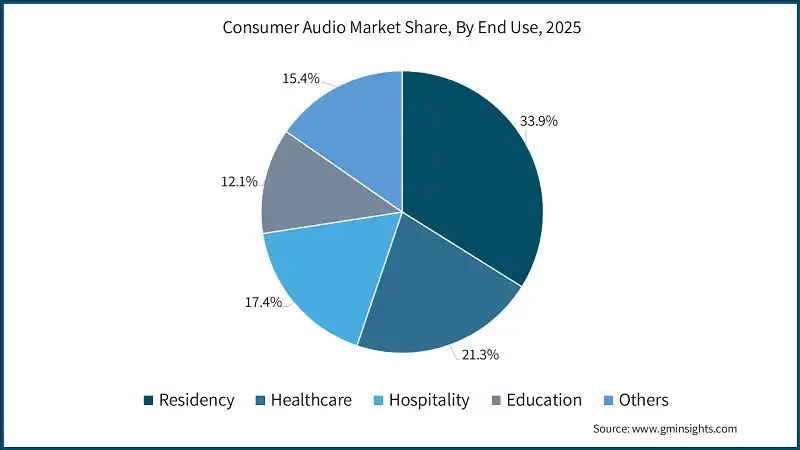
Based on the end use, the consumer audio market is segmented into residency, healthcare, hospitality, education, and others. The residency segment dominated the market in 2025 with a revenue of USD 20 billion.
- The residency segment dominates the market due to its ability to adopt shared and scalable audio solutions. Families and co-living spaces prefer multi-room speakers, smart home audio systems, and wireless headphones that offer high-quality sound and convenience. Bundled solutions and integrated platforms enhance user experience, while streaming services and smart home compatibility further strengthen adoption in residential settings.
- Manufacturers should focus on creating affordable, easy-to-use audio devices for households. Offering multi-device connectivity, centralized control platforms, and user-friendly interfaces will encourage adoption. Developing durable, high-quality, and scalable solutions will further expand market penetration across diverse household setups.
- The education segment is expected to grow at a CAGR of 7% during the forecast period, driven by increasing consumer awareness of personal audio experiences, demand for high-quality portable sound, and the need for convenience on-the-go. Affordable wireless headphones, earbuds, and portable speakers with high-fidelity sound are becoming more accessible. Integration with smartphones, streaming platforms, and smart assistants further supports adoption globally.
- Manufacturers should focus on developing low-cost, portable, and easy-to-use audio devices for individual consumers. Offering wireless, IoT-enabled solutions with simple interfaces, strong after-sales support, and app integration will boost adoption and enhance overall personal audio experiences worldwide.
Looking for region specific data?
The North America market held 28.3% market share in 2025. In consumer audio market, the North America held a significant share in 2025. North America has been expanding steadily due to rapid adoption of wireless headphones, smart speakers, and connected audio systems, along with strong investment in smart home technologies and high disposable incomes. Consumers increasingly rely on premium audio devices for music, gaming, and home entertainment. Rising awareness of immersive sound, AI-enabled personalization, and multi-room connectivity further drives adoption.
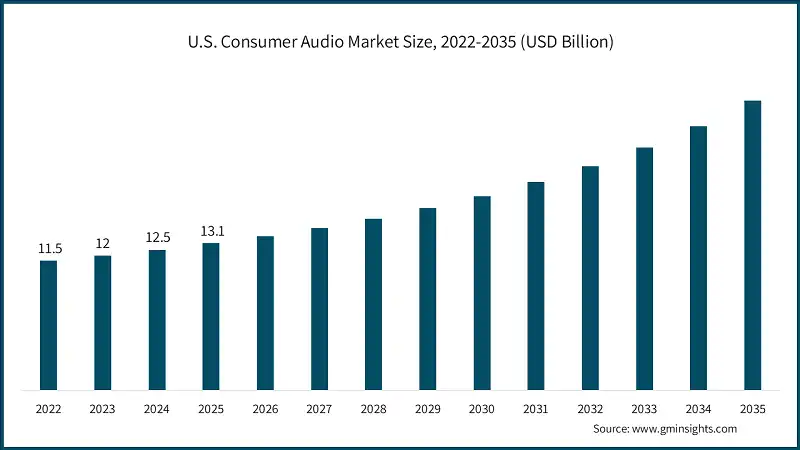
- In U.S. the consumer audio industry was valued at USD 12 billion and USD 12.5 billion in 2023 and 2024, respectively. The market size reached USD 13.8 billion in 2026, growing from USD 13.1 billion in 2025. The U.S. continues to lead the market, supported by advanced technology infrastructure, high disposable incomes, and widespread adoption of wireless, AI-enabled, and smart home audio devices. Large electronics companies, tech innovators, and streaming platforms drive continuous development of high-quality headphones, smart speakers, and home audio systems. Government support for digital infrastructure, growing awareness of immersive audio experiences, and strong broadband connectivity further accelerate adoption across households, offices, and entertainment venues, maintaining the U.S.’s leadership in the market.
- Manufacturers should focus on developing advanced, AI-enabled, and IoT-integrated audio devices tailored for U.S. consumers. Prioritizing superior sound quality, durability, and seamless integration with smart home and streaming platforms will boost adoption. Offering scalable, user-friendly solutions aligned with connected home ecosystems and lifestyle trends will strengthen market presence and meet rising consumer demand.
In Europe, the consumer audio market accounted for USD 11.6 billion in 2025 and is anticipated to show lucrative growth over the forecast period. Europe holds a significant share of the market due to strong adoption of wireless headphones, smart speakers, and home audio systems. Consumers increasingly prefer high-quality, connected audio solutions for music, gaming, and home entertainment. Government initiatives supporting digital infrastructure, investments in smart home technologies, and rising awareness of immersive audio experiences further strengthen the region’s position. The presence of leading electronics companies, research institutions, and tech innovators continues to drive demand for advanced, connected consumer audio devices across Europe.
Germany dominates the consumer audio market, showcasing strong growth potential.
- Germany dominates the European market, showcasing strong growth potential. The country’s advanced technology infrastructure, high consumer awareness, and widespread adoption of smart home devices drive demand for wireless headphones, smart speakers, and home audio systems. German consumers increasingly seek high-quality, connected audio solutions with immersive sound, AI-driven personalization, and multi-room streaming capabilities. Government support for digital innovation, energy-efficient devices, and smart home technologies further accelerates adoption across households, offices, and entertainment venues.
- Manufacturers should focus on producing high-performance, durable, and smart-enabled audio devices tailored for Germany’s tech-savvy consumer base. Prioritizing superior sound quality, AI and IoT integration, seamless connectivity with smart home ecosystems, and energy-efficient designs—while collaborating with local electronics and streaming service providers—will help strengthen Germany’s leadership in the European market.
The Asia-Pacific consumer audio market is anticipated to grow at the highest CAGR of 7.9% during the analysis timeframe.
- The Asia-Pacific region is experiencing rapid growth in the market due to expanding adoption of smart devices, connected homes, and digital entertainment. Demand is rising for wireless headphones, smart speakers, home audio systems, and portable audio devices. Growing smartphone penetration, rising disposable incomes, and government initiatives promoting digital infrastructure in India, China, Japan, and Southeast Asia are accelerating market growth. The presence of both global and local audio brands, along with increasing interest in AI-enabled and high-fidelity audio solutions, makes Asia-Pacific one of the fastest-growing regions for consumer audio products.
- Manufacturers in Asia-Pacific should focus on developing affordable, durable, and energy-efficient audio devices for homes, offices, and personal use. Prioritizing wireless connectivity, AI-enabled sound personalization, and user-friendly mobile apps will help meet rising consumer demand. Leveraging government initiatives supporting digital technology and expanding smart home adoption will support strong market growth across the region.
China’s consumer audio market is estimated to grow at a significant CAGR of 8.9% from 2026 to 2035.
- China dominates the Asia-Pacific market due to large-scale investments in electronics manufacturing, strong technological capabilities, and rapid adoption of smart home and personal audio devices. The country is widely adopting wireless headphones, smart speakers, high-fidelity home audio systems, and AI-enabled portable audio devices. Government initiatives supporting digital infrastructure, smart homes, and connected entertainment are boosting demand. Collaboration between audio manufacturers, AI companies, and streaming platforms, along with the growth of domestic consumer electronics startups, supports rapid innovation in next-generation audio technologies.
- Manufacturers should focus on producing cost-effective, durable, and high-performance audio devices tailored for China’s diverse consumer base. Emphasis on wireless connectivity, AI-driven personalization, smart home integration, and mobile-friendly platforms will meet rising demand. Leveraging government-backed digital initiatives and collaborating with local tech companies will help scale production and expand adoption across the country.
In 2025, the Latin America consumer audio market is expected to reach USD 5.2 billion, driven by growing adoption of wireless headphones, smart speakers, home audio systems, and portable audio devices across major urban and semi-urban areas. Increasing disposable incomes, rising interest in digital entertainment, and expanding retail and e-commerce channels are further fueling market growth across the region.
The Middle East & Africa consumer audio market was valued at USD 7 billion in 2035. MEA is witnessing steady growth, driven by urbanization, smartphone penetration, and rising interest in smart home technologies. UAE and South Africa are leading markets, with consumers seeking premium and connected audio solutions.
In Saudi Arabia the market is set to experience substantial growth in 2025.
- Saudi Arabia is showing strong growth potential in the consumer audio market due to rising investments in smart homes, connected entertainment systems, and digital infrastructure. Demand for high-quality wireless headphones, smart speakers, home audio systems, and AI-enabled portable devices is increasing rapidly. Government initiatives supporting technology adoption, modern retail, and digital connectivity further strengthen market growth. Collaboration with global electronics brands and rapid expansion of smart home projects position Saudi Arabia as a leading market in the region.
- Manufacturers should focus on delivering high-performance, durable, and energy-efficient audio devices tailored for Saudi Arabia’s households, offices, and entertainment venues. Emphasizing wireless connectivity, AI-driven sound personalization, and smart home integration—while leveraging government-backed digital initiatives and partnerships—is expected to help drive adoption and support the country’s growing consumer audio ecosystem.
Consumer Audio Market Share
- The digital camera market is highly competitive, with companies focusing on innovation, strategic partnerships, and advancements in mirrorless, DSLR, compact, and AI-enabled imaging technologies. Leading players such as Canon Inc., Sony Corporation, Nikon Corporation, Fujifilm, and Panasonic hold a significant market share of 45.2%. These companies specialize in developing high-resolution, energy-efficient, and durable cameras for professional photographers, content creators, and hobbyists. Advances in AI-assisted photography, wireless connectivity, computational imaging, and high-speed autofocus are enhancing image quality, usability, and convenience. Collaboration with mobile app developers, cloud storage providers, and content platforms helps expand adoption across households, studios, and professional setups.
- Emerging players are offering affordable, scalable, and easy-to-use camera solutions suitable for amateur photographers, vloggers, travelers, and compact camera users. New developments in AI-powered imaging, wireless transfer, lightweight mirrorless systems, and portable cameras are improving durability, performance, and real-time processing. Working closely with mobile apps, editing platforms, and online content ecosystems enables seamless integration and enhanced user experience. These advancements increase accessibility, convenience, and adoption of digital cameras across diverse applications such as photography, videography, vlogging, travel, and content creation globally.
Consumer Audio Market Companies
List of prominent players operating in the consumer audio industry include:
- Alpine Electronics
- Audio-Technica
- Bang & Olufsen
- Bose Corporation
- Bowers & Wilkins
- Dynaudio
- Focal-JMLab
- Harman International Industries
- JBL
- Panasonic Corporation
- Pioneer Corporation
- Qualcomm
- Sennheiser Electronic GmbH
- Sony Corporation
- Sonos
- Sony Corporation
Sony Corporation is a leading player in the consumer audio market, holding an estimated 13.5% share. The company is recognized for its advanced headphones, wireless speakers, and smart audio devices, widely used across homes, offices, and entertainment venues. Sony focuses on delivering high-fidelity, AI-enabled, and energy-efficient audio solutions that provide immersive sound experiences and seamless connectivity. Strong global distribution, continuous technological innovation, and integration with streaming platforms and smart home ecosystems further strengthen Sony’s position and drive widespread adoption of its consumer audio products.
Bose Corporation is a prominent player in the consumer audio market, known for its expertise in sound processing technologies, AI-driven personalization, and smart audio devices. The company provides high-performance headphones, smart speakers, and home audio systems with advanced connectivity, predictive sound adjustments, and energy-efficient designs. By collaborating with audio technology partners, streaming platforms, and smart home solution providers, Bose strengthens intelligent audio ecosystems, enhancing user experience, sound quality, and broader adoption of its smart audio products globally.
Panasonic Corporation holds a significant 8.8% share of the consumer audio market, driven by its leadership in advanced audio innovation and manufacturing. The company specializes in wireless speakers, headphones, and connected home audio systems, delivering high-quality, durable, and energy-efficient products. Its large-scale production capabilities, robust supply chain, and continuous investment in next-generation audio technologies strengthen its global presence. By partnering with electronics retailers, streaming services, and smart home providers, Panasonic supports growing demand for immersive audio, connected entertainment, and portable smart audio devices worldwide.
Consumer Audio Market Report Attributes
| Key Takeaway | Details |
|---|---|
| Market Size & Growth | |
| Base Year | 2025 |
| Market Size in 2025 | USD 58.9 Billion |
| Market Size in 2026 | USD 61.6 Billion |
| Forecast Period 2026 - 2035 CAGR | 6.7% |
| Market Size in 2035 | USD 110.8 Billion |
| Key Market Trends | |
| Drivers | Impact |
| Surge in wireless and TWS (True Wireless Stereo) adoption | Rising adoption of wireless and smart audio devices drives around 35% of demand in the consumer audio market. Consumers are increasingly purchasing wireless headphones, earbuds, and smart speakers for music, podcasts, and home entertainment. Advanced audio features such as noise cancellation, high-fidelity sound, and voice assistant integration enhance user experience, boosting overall market growth. |
| Integration of voice assistants (Alexa, Google Assistant, Siri) | Integration with connected devices and smart home ecosystems accounts for approximately 30% of market expansion. Smart TVs, IoT-enabled speakers, and multi-room audio systems rely on seamless connectivity and real-time audio streaming. Energy-efficient designs and automated features are preferred by consumers for convenience, personalization, and enhanced listening experiences. |
| Shift toward high-resolution audio & immersive experiences (Dolby Atmos, Spatial Audio, Hi-Res Audio) | Applications in entertainment, gaming, and media consumption contribute about 25% of growth. Consumer audio devices are widely used for immersive gaming, home theaters, streaming services, and online content consumption. High-quality audio improves user engagement, content enjoyment, and overall satisfaction across digital entertainment platforms. |
| Rising fitness & wellness integration | Innovation and industry initiatives represent the remaining 10% of growth. Investments in R&D, AI-driven audio enhancements, spatial sound technologies, and collaborations with streaming platforms drive the development of next-generation audio products, expanding market opportunities globally. |
| Pitfalls & Challenges | Impact |
| Price sensitivity in emerging markets | In emerging markets, consumers often prioritize cost over advanced features, making premium and high-end audio products less accessible. This price-conscious behavior limits the adoption of innovative audio devices, reducing overall market demand. Manufacturers face challenges in balancing affordability with quality, which can slow growth in these regions. |
| Intense competition & commoditization | The consumer audio market faces intense competition, with many players offering similar products. This commoditization drives down prices and profit margins, making it harder for brands to differentiate themselves. As products become more standardized, consumer loyalty decreases, limiting demand growth for premium devices and creating a challenging environment for sustained market expansion. |
| Opportunities: | Impact |
| Next-gen connectivity (Bluetooth LE Audio, Auracast) | The adoption of next-generation connectivity technologies, such as Bluetooth LE Audio and Auracast, presents significant opportunities for the market. These innovations enable higher-quality audio streaming, multi-device connectivity, and improved energy efficiency, enhancing user experience and driving demand for advanced wireless headphones, earbuds, and smart speakers globally. |
| Adoption of AI-driven personalization | AI-driven personalization offers a key growth opportunity in the market. Intelligent algorithms can adapt sound profiles, recommend content, and optimize listening experiences based on user preferences. This enhances engagement, satisfaction, and brand loyalty, encouraging consumers to invest in AI-enabled audio devices and boosting overall market adoption. |
| Market Leaders (2025) | |
| Market Leaders |
~13.5% market share. |
| Top Players |
|
| Competitive Edge |
|
| Regional Insights | |
| Largest Market | North America |
| Fastest growing market | Asia-Pacific |
| Emerging countries | China, India, Brazil, Mexico, South Africa |
| Future outlook |
|
What are the growth opportunities in this market?
Consumer Audio Industry News
- In July 2022, Qualcomm has expanded its collaboration with Bose to support the development of next-generation wireless audio devices across portable, home, and automotive segments. Leveraging the Qualcomm S5 Audio SoC, Bose products will benefit enhanced connectivity, low power consumption, and advanced processing capabilities, enabling seamless sound quality and integrated voice experiences.
- In July 2024, Bose introduced the next generation of its QuietComfort line with the launch of the QuietComfort Ultra Headphones, QuietComfort Ultra Earbuds, and the QuietComfort Headphones. The new models retain the series’ signature features of advanced noise cancellation, high-quality sound, and comfort, while the QC Ultra Headphones and Earbuds debut a refreshed premium design and Bose Immersive Audio for an enhanced listening experience.
- In January 2025, JBL launched Tour One M3 headphones feature a touchscreen Smart Tx transmitter that allows them to wirelessly connect to older, non-Bluetooth devices, enabling low-latency audio streaming even from traditional sources like in-flight entertainment systems or legacy media players.
- In September 2025, Bowers & Wilkins launched Px8 S2 wireless headphones. This product offers high-res 24-bit/96kHz audio, improved noise cancellation, optional wired connectivity, and a premium build with replaceable ear cushions/headband for longevity.
- In November 2024, Bose acquired McIntosh Group. The aims of this acquisition to provide premium audio in automotive sector.
- In October 2025, Sennheiser launched HDB 630 wireless headphones its first model in a high-definition audio reference series. These headphones deliver high-resolution, 24-bit/96 kHz sound, adaptive noise cancellation, customized EQ, 60-hour battery life (with ANC), and versatile connectivity (USB-C, aptX/aptX HD/aptX Adaptive, analog).
The consumer audio market research report includes an in-depth coverage of the industry with estimates and forecast in terms of revenue (USD billion) from 2022 – 2035 for the following segments:
Market, By Product Type
- Headphones
- Soundbars
- Home theater systems
- Portable Bluetooth speakers
- Microphone
- Other
Market, By Technology
- Wired audio devices
- Wireless audio devices
Market, By Connectivity
- Bluetooth
- Wi-Fi
- NFC
- Other
Market, By End Use
- Residency
- Healthcare
- Hospitality
- Education
- Others
The above information is provided for the following regions and countries:
- North America
- U.S.
- Canada
- Europe
- Germany
- UK
- France
- Italy
- Spain
- Netherlands
- ROE
- Asia Pacific
- China
- India
- Japan
- South Korea
- Australia
- RoAPAC
- Latin America
- Brazil
- Mexico
- Argentina
- RoLATAM
- Middle East and Africa
- Saudi Arabia
- South Africa
- UAE
- RoMEA
Frequently Asked Question(FAQ) :
What is the consumer audio market size in 2025?
The market size for consumer audio was valued at USD 58.9 billion in 2025, driven by rising adoption of wireless headphones, TWS earbuds, smart speakers, and portable audio solutions.
What is the market size of the consumer audio industry in 2026?
The market size for consumer audio reached USD 61.6 billion in 2026, supported by continued growth in Bluetooth-enabled devices, smart home ecosystems, and demand for high-fidelity audio experiences.
What is the projected value of the consumer audio market by 2035?
The market size for consumer audio is expected to reach USD 110.8 billion by 2035, growing at a CAGR of 6.7% from 2026 to 2035. This expansion is fueled by smart connectivity, AI-driven audio enhancements, and increasing use of wireless entertainment devices.
How much revenue did the wireless audio devices segment generate in 2025?
The wireless audio devices segment generated USD 36.3 billion in 2025, making it the largest technology category. Strong demand for wireless headphones, earbuds, and smart speakers is driving segment leadership.
What was the valuation of the headphones segment in 2025?
The headphones segment was valued at USD 18.8 billion in 2025, driven by rising demand for noise-canceling, high-fidelity, Bluetooth-compatible, and AI-enabled audio solutions.
What is the growth outlook for the portable Bluetooth speakers segment from 2026 to 2035?
The portable Bluetooth speakers segment is projected to grow at a CAGR of 9.1% through 2035.
Which region leads the consumer audio market?
North America led the global market with a 28.3% share in 2025, supported by early adoption of wireless headphones, smart speakers, and connected home audio systems. The U.S. continues to dominate regional demand due to high disposable incomes and strong smart home penetration.
What are the upcoming trends in the consumer audio industry?
Key trends include the rise of AI-driven personalization, sustainability in product design, next-gen wireless standards (Bluetooth LE Audio, Auracast), spatial audio adoption, multi-room smart audio ecosystems, and integration of audio devices with gaming, AR/VR, and smart TVs.
Who are the key players in the consumer audio market?
Major players include Sony Corporation, Bose Corporation, Panasonic Corporation, JBL, Sonos, Sennheiser, Bang & Olufsen, Audio-Technica, Bowers & Wilkins, Alpine Electronics, and others. These companies focus on smart connectivity, innovative audio technologies, and AI-enabled product enhancements.
Consumer Audio Market Scope
Related Reports