Summary
Table of Content

Connected Vehicle Technology Market
Get a free sample of this report
Form submitted successfully!
Error submitting form. Please try again.
Thank you!
Your inquiry has been received. Our team will reach out to you with the required details via email. To ensure that you don't miss their response, kindly remember to check your spam folder as well!
Request Sectional Data
Thank you!
Your inquiry has been received. Our team will reach out to you with the required details via email. To ensure that you don't miss their response, kindly remember to check your spam folder as well!
Form submitted successfully!
Error submitting form. Please try again.
Connected Vehicle Technology Market Size
The growing prevalence of advanced driver assistance systems (ADAS) has increased the levels of connectivity found in modern vehicles. From collision avoidance systems, improved lane detection systems to increased driver awareness systems; numerous automotive technology companies have introduced an array of ADAS-enabled solutions into their connected safety offerings for both the global OEM market as well as the aftermarket. For instance, in January 2025, Bosch announced they had enhanced some of the ADAS features found within its connected safety solutions for both OEMs and aftermarket customers with the aim of improving V2V prediction safety capabilities and providing additional functionality to OEMs through expanded connectivity opportunities.
Connected Vehicle Technology Market Key Takeaways
Market Size & Growth
- 2025 Market Size: USD 45.3 Billion
- 2026 Market Size: USD 48.9 Billion
- 2035 Forecast Market Size: USD 129.2 Billion
- CAGR (2026–2035): 11.4%
Regional Dominance
- Largest Market: Asia Pacific
- Fastest Growing Region: Asia Pacific
Key Market Drivers
- Increasing adoption of ADAS and vehicle safety technologies.
- Expansion of 5G and cellular connectivity infrastructure.
- Growing adoption of electric and software-defined vehicles.
- Rising demand for fleet management and mobility services.
Challenges
- Cybersecurity and data privacy concerns.
- High implementation and system integration costs.
Opportunity
- Expansion of smart city and intelligent transportation infrastructure.
- Growth of Mobility-as-a-Service (MaaS) platforms.
- Vehicle data monetization and cloud-based services.
- Connected solutions for commercial fleets and logistics.
Key Players
- Market Leader: Continental led with over 17% market share in 2025.
- Leading Players: Top 5 players in this market include Aptiv, Bosch, Continental, Denso, Harman, which collectively held a market share of 56% in 2025.
Get Market Insights & Growth Opportunities
To deliver this connectivity, the advancing rollout of 5G network capabilities is becoming paramount for creating an ecosystem for connected vehicles. Through providing the required service (i.e., connectivity via high speed and low latency), 5G will enable vehicle-to-everything (V2X) real-time communication (i.e., connectivity between vehicles and their surroundings), enable remote vehicle management through cloud-based services and provide next-generation infotainment solutions for both passenger and commercial applications. As a result, once all of the global 5G networks are launched, connected vehicles will see broad based utilization of connected technologies. For instance, in March 2025, Ericsson announced it was partnering with various OEMs and telecommunications companies to create C-V2X (cellular -V2X) vehicle communication networks utilizing 5G.
Digital platforms and centralized managed software architectures are being increasingly deployed within electric vehicles, thus making connectivity a critical element for managing battery systems, enabling TRU (Telematics Remote Update) communications, and enabling the remote diagnosis of vehicle data.
Commercial fleets are increasingly adopting connected technologies to improve operational efficiency, route optimization, and asset monitoring. Telematics systems enable fleet operators to track vehicle performance, fuel efficiency, and driver behavior in real time, reducing costs and improving logistics management across transportation networks. For instance, in June 2025, Geotab introduced expanded connected fleet analytics solutions enabling logistics operators to optimize routes and predictive vehicle maintenance.
The global connected vehicle technology market was valued at USD 45.3 billion in 2025. The market is expected to grow from USD 48.9 billion in 2026 to USD 129.2 billion in 2035 at a CAGR of 11.4%, according to latest report published by Global Market Insights Inc.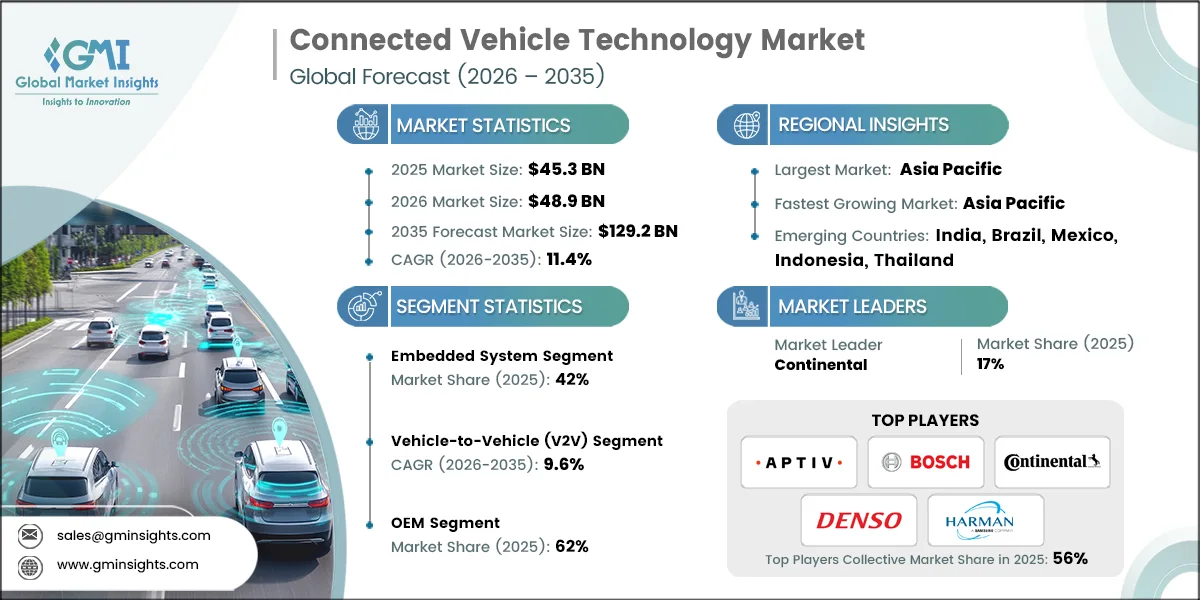
To get key market trends
Connected Vehicle Technology Market Trends
Due to the growing demand for software-defined architectures in vehicles, many car manufacturers are moving away from hardware-dependent designs toward a new system of controlling vehicle functions through centralized, software-defined platforms. This allows for constant improvements to features by being able to update them remotely via a software upgrade and improve the management of a vehicle's overall life cycle. For instance, Qualcomm announced in May 2025 that it has expanded its Snapdragon Digital Chassis platform with additional features to support a software-defined vehicle architecture along with the related connected mobility services.
The use of Cellular V2X technology is growing as a major new communication standard that will enable vehicles to communicate with other vehicles, roadway infrastructure, pedestrians, and cloud-based systems. Achieving such connectivity will enhance safety on the roadways, reduce traffic congestion and enable further advances in developing autonomous vehicles. Government agencies and automakers are investing significantly in developing C-V2X operating ecosystems.
Automakers are increasingly implementing Over-the-Air (OTA) updates, allowing manufacturers to deliver software upgrades, security fixes and new features to their models without requiring owners to bring their vehicles into a dealer for a service visit. OTA updates will help increase the overall value of a vehicle over its life cycle and provide manufacturers the capability to improve the performance of their vehicle models and the overall customer experience on an ongoing basis with digital upgrades.
For instance, in July 2025, Harman announced about its expanded capabilities of OTA software solution, allowing automakers to use one platform to perform many large-scale remote updates on all vehicles in a connected fleet.
Artificial Intelligence (AI) and edge-based computing are being incorporated into connected vehicles to process the vast amounts of data from various types of vehicle sensors and connectivity locally. This enables faster decision-making for driver assistance, predictive maintenance, and autonomous driving applications while reducing latency and dependence on cloud processing. In September 2025, Mobileye announced it has successfully deployed an AI-based perception and connected data processing capabilities for advanced driver assistance and autonomous vehicle platforms.
Connected Vehicle Technology Market Analysis
Learn more about the key segments shaping this market
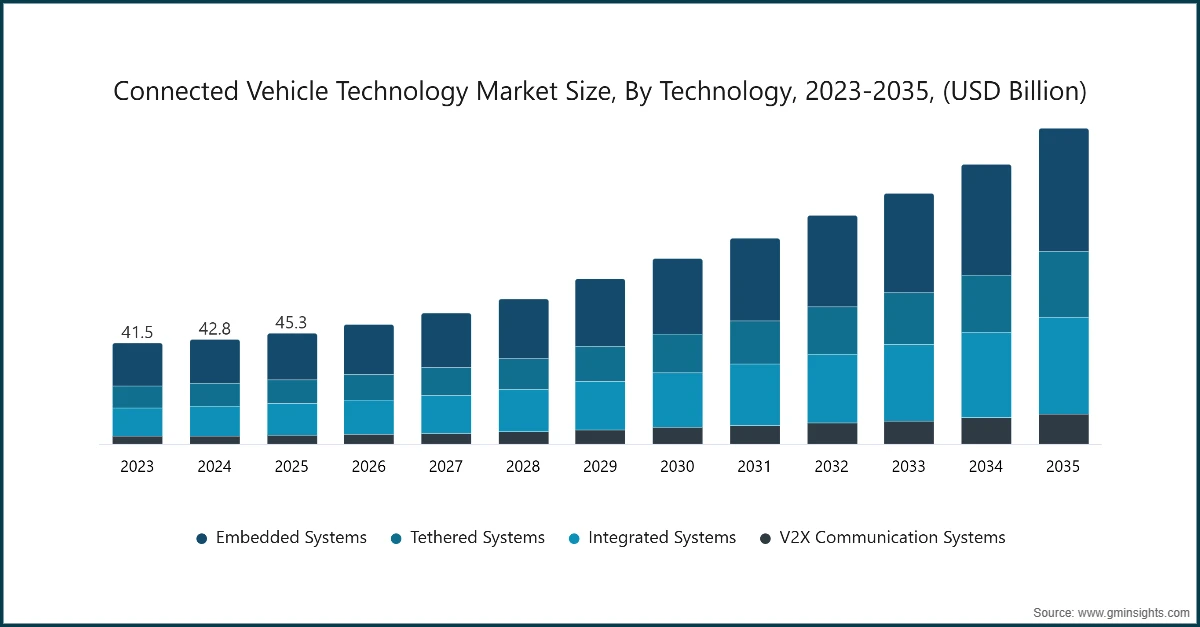
Based on technology, the market is divided into embedded systems, tethered systems, integrated systems and V2X communication system. Embedded system accounting for over 42% market share in 2025 and are expected to grow at a CAGR of 10.5% through 2026 to 2035.
- Embedded connectivity systems are gaining traction as automakers increasingly integrate telematics control units, sensors, and onboard computing directly into vehicles. This trend supports advanced driver assistance, remote diagnostics, and over-the-air updates while enabling automakers to deliver seamless connected services throughout the vehicle lifecycle.
- Tethered connectivity systems remain relevant in cost-sensitive vehicle segments by enabling internet access through smartphones via Bluetooth or Wi-Fi. Automakers are leveraging tethered solutions to provide infotainment and navigation services without expensive embedded hardware, supporting connectivity adoption in entry-level vehicles and emerging markets.
- Integrated connectivity systems are emerging as automakers deploy fully integrated platforms combining hardware, software, and cloud connectivity. These systems support infotainment, telematics, vehicle diagnostics, and remote updates within a unified architecture, enabling seamless user experiences and expanding digital services across connected vehicle ecosystems.
- V2X communication systems are gaining momentum as governments and automakers invest in intelligent transportation infrastructure. These systems enable vehicles to communicate with other vehicles, road infrastructure, pedestrians, and networks, improving road safety, traffic management, and supporting the development of autonomous and cooperative driving technologies.
Learn more about the key segments shaping this market
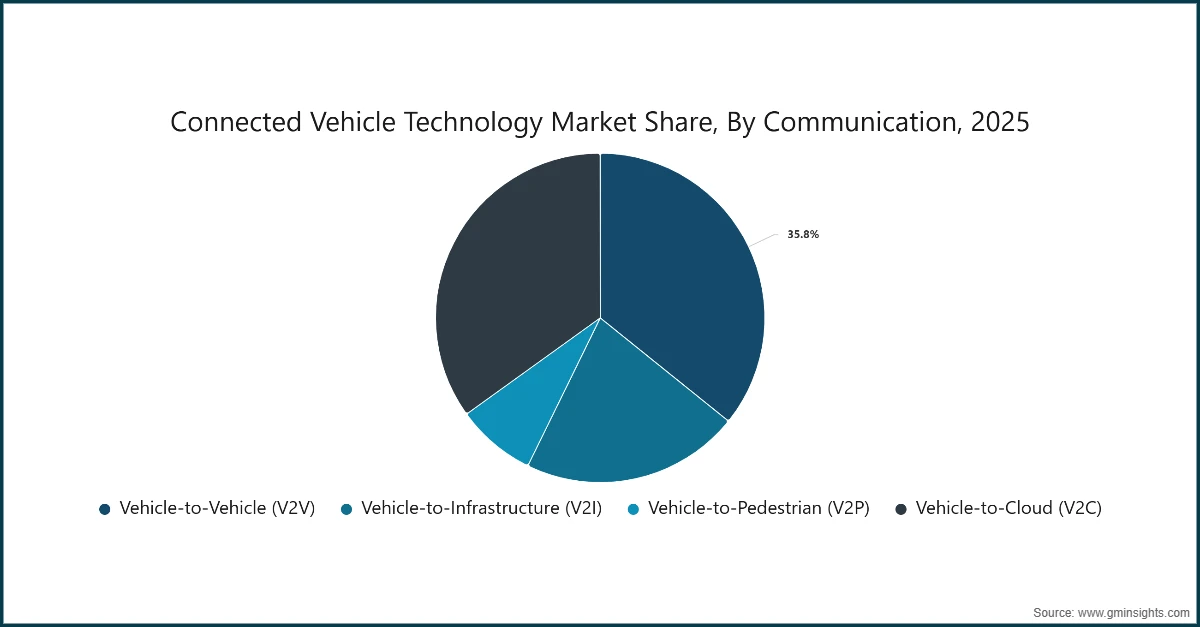
Based on communication, the connected vehicle technology market is segmented into Vehicle-to-Vehicle (V2V), Vehicle-to-Infrastructure (V2I), Vehicle-to-Pedestrian (V2P) and Vehicle-to-Cloud (V2C). Vehicle-to-Vehicle (V2V) segment dominates the market with 35.8% share in 2025, and the segment is expected to grow at a CAGR of 9.6% from 2026 to 2035.
- The development of Vehicle-to-Vehicle communication allows proximity to nearby vehicles for exchanging information about speed, location, and direction. This capability promotes better road safety as it provides drivers and automated systems critical, timely information regarding potential collisions, cooperative braking, and awareness of surrounding traffic. This helps drivers to adequately respond to potential hazards.
- Vehicle-to-Infrastructure communication establishes a link between a vehicle and roadside infrastructure. Examples of connectivity sources include traffic lights, road sensors, and toll systems. It includes the ability to utilize real-time driver information management (with respect to various traffic-related aspects). This can optimize light timing, create alerts about hazardous conditions, reduce traffic congestion, and improve traffic control operations in Smart Transportation ecosystems.
- Vehicle-to-Pedestrian communication promotes safety while traveling by improving pedestrian safety by allowing vehicles to both detect and communicate directly with pedestrians/cyclists through wearable devices/smartphones. This system provides both drivers and pedestrians/cyclists with a warning system to help identify their location and can greatly reduce the likelihood of accidents occurring in urban areas, thereby increasing safety for vulnerable road users.
- Vehicle-to-Cloud communication allows for a vehicle to be connected (and may be connected) to cloud computing to store data, analyze their use and provide vehicle services that may be delivered remotely. This type of communication allows for over-the-air updates, capable of providing diagnostic information, supporting navigation services, providing real-time monitoring of a vehicle's performance, and allowing vehicle manufacturers to consistently provide their customers with software updates and data-driven mobility solutions.
Based on end use, the connected vehicle technology market is segmented into OEM and aftermarket. OEM segment dominates the market with 62% share in 2025, and the segment is expected to grow at a CAGR of 10.9% from 2026 to 2035.
- OEM are expanding V2X communication capabilities in their new vehicles to enable real-time communication between vehicles and roadway structures. This supports safe driving practices, increases the efficiency of movement through traffic, and facilitates the advancement of cooperative and autonomous driving technologies.
- Automakers are incorporating embedded connectivity platforms into their vehicle manufacturing processes at an escalating rate. This trend is making advanced driver assistance systems, remote diagnostics, and over-the-air upgrades available to consumers.
- These advancements will contribute greatly to the development of software-defined vehicles, as well as provide OEM with the tools necessary to continue providing their customers with digital services throughout ownership.
- In aftermarket they provide plug-and-play telematics devices and smartphone modules that will allow older vehicles to gain connected capabilities. This trend is supporting the growth of connected vehicle adoption by existing fleets and cost-conscious vehicle owners.
- Consumers continue to upgrade their older vehicles by installing aftermarket connected infotainment systems with smart navigation, app integration, and cloud connectivity capabilities.
Based on vehicle, the connected vehicle technology market is segmented into passenger cars and commercial vehicles. Passenger cars segment is expected to dominate the market with a share of 62% in 2025.
- Passenger cars are increasingly designed with centralized computing systems enabling over-the-air updates, cloud connectivity, and continuous feature upgrades throughout the vehicle lifecycle.
- Automakers are equipping passenger vehicles with advanced connectivity platforms to support navigation, entertainment, remote diagnostics, and driver assistance, enhancing user experience and vehicle safety.
- Logistics and transportation companies are deploying connected technologies to monitor vehicle location, fuel consumption, and driver behavior for improved operational efficiency.
- Connected systems in commercial vehicles help fleet operators identify maintenance issues early, reducing downtime and optimizing fleet performance.
Looking for region specific data?
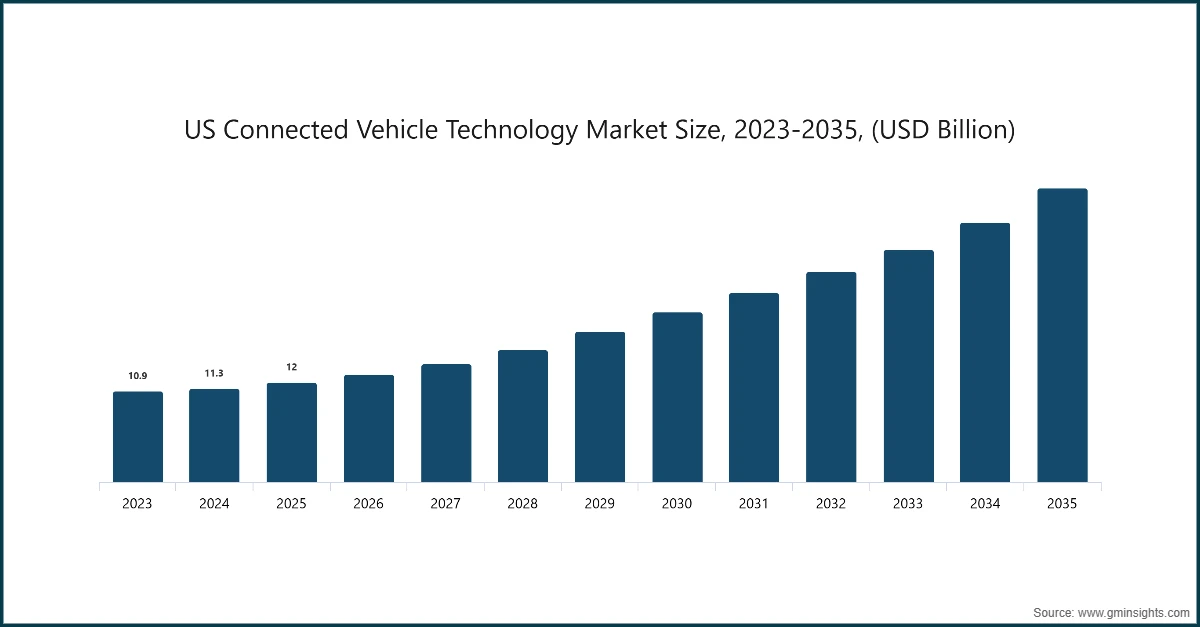
U.S. connected vehicle technology market reached USD 12 billion in 2025.
- In US, with an increasing number of automakers in the US implementing software-focused vehicle architecture, features for these vehicles can continuously be updated based on the latest software innovations through hardware access, with the introduction of both vehicle diagnostic systems as well as advanced driver assistance and the expansion of the overall connectivity ecosystem.
- Pilot programs for both self-driving and semi-autonomous vehicles heavily rely on both vehicle-to-everything (V2X) communications and artificial intelligence (AI) enabled connected systems to promote effective traffic management and safe operation.
- Many manufacturers are integrating components such as charging, telematics, and fleet management into one connected solution so the electric vehicle ecosystem can increase both energy efficiency and the mobility-services available to urban and regional areas.
North America dominated the connected vehicle technology market with a market size of USD 14.6 billion in 2025.
- In North America, the 5G network becomes available throughout the country, the associated increase in communications technology will enable quicker adoption of connected vehicle communication (C-V2X), allowing real-time communication between vehicles and infrastructure, ultimately leading to safer driving environments and increased support for the deployment of passenger and commercial autonomous vehicle technology.
- As commercial fleet operators begin integrating telematics solutions that can optimize routes for increased efficiency, provide predictive maintenance assistance, and identify methods to reduce fuel usage, fleets will drive the adoption and development of connected-vehicle technology via the logistics and transportation markets.
- With an increasing number of automakers implementing OTA software capabilities into their connected passenger-vehicle ecosystem, manufacturers can provide remote updates for software upgrades, infotainment capabilities, and security fixes while reducing the dependency on dealerships for service repairs, thereby enhancing the customer experience.
Europe connected vehicle technology market accounted for a share of 19.3% and generated revenue of USD 8.7 billion in 2025.
- European countries are adopting Cellular Vehicle-to-Everything protocols for intelligent transportation systems, supporting safer roads, smart city integration, and cross-border vehicle connectivity.
- European cities are implementing connected infrastructure, including traffic sensors and IoT-enabled street systems, allowing vehicles to interact with urban infrastructure for smoother traffic flow.
- High EV adoption rates are driving integration of telematics, remote diagnostics, and OTA services across passenger and commercial vehicles, supporting sustainability and digital mobility trends.
Germany dominates the connected vehicle technology market in Europe, showcasing strong growth potential, with a CAGR of 12.2% from 2026 to 2035.
- Germany is testing and implementing V2X systems on autobahns to improve traffic safety and autonomous driving readiness.
- Logistics and commercial vehicle operators adopt telematics and predictive maintenance systems to reduce operational costs and enhance efficiency.
- German OEMs are increasingly building vehicles around centralized computing systems, enabling OTA updates, advanced ADAS, and connected services.
The Asia Pacific connected vehicle technology market is anticipated to grow at the highest CAGR of 12.4% from 2026 to 2035 and generated revenue of USD 17.5 billion in 2025.
- In APAC, there are commercial logistics providers, who are implementing connected vehicle systems to enhance their operations using telematics, route planning, fuel efficiency, and remote diagnostics.
- Cities around APAC are also beginning to implement smart transportation systems to enhance the safety of vehicles and reduce congestion through communication between vehicles and traffic control infrastructure.
- The increasing adoption of electric vehicles and telematics solutions are increasingly being integrated into vehicles to provide cloud-based vehicle management capabilities, and OTA software services to improve operational performance and monitoring of these vehicles.
China connected vehicle technology market is estimated to grow with a CAGR of 13.4% from 2026 to 2035.
- In China, the rapid rise in the adoption of connected vehicles from manufacturers based in China has led to the integration of embedded technology solutions V2X and over-the-air (OTA) connectivity into many of its products and services, thereby providing support for smart city infrastructures and autonomous mobility programs.
- Furthermore, electric vehicle fleets are increasingly connected to mobility-as-a-service platforms, optimizing urban transit, fleet operations, and ride-sharing services.
- There has been considerable investment by both the central and local governments in the development of C-V2X enabled roads and roadside units to promote V2X communication between vehicles and infrastructure.
Latin America connected vehicle technology market shows lucrative growth over the forecast period.
- Commercial transport companies adopt telematics solutions for logistics efficiency, monitoring driver behavior, and vehicle maintenance.
- Older passenger and commercial vehicles are upgraded with tethered and integrated connectivity solutions, supporting navigation, safety, and remote monitoring.
- Limited-scale smart infrastructure in urban areas is enabling V2I testing and connected mobility initiatives.
Mexico connected vehicle technology market is estimated to grow with a CAGR of 8.4% from 2026 to 2035 and reach USD 1.9 billion in 2035.
- Commercial fleet operators in Mexico are increasingly deploying telematics systems for route optimization, fuel efficiency, and driver behavior monitoring. This trend enhances operational efficiency, reduces costs, and drives connected vehicle adoption among logistics and transportation companies.
- Mexico’s growing electric vehicle market is driving integration of embedded telematics, OTA updates, and connected infrastructure. EV manufacturers are leveraging connectivity to improve battery management, vehicle diagnostics, and smart charging services in urban areas.
- Mexican cities are testing smart traffic infrastructure and Vehicle-to-Infrastructure (V2I) connectivity to improve traffic flow, safety, and urban mobility. Pilot programs enable vehicles to communicate with traffic signals, sensors, and road infrastructure for better traffic management.
Middle East and Africa connected vehicle technology market accounted for USD 2.1 billion in 2025 and is anticipated to show lucrative growth over the forecast period.
- In MEA, fleet telematics connectivity is being adopted within transport & logistics to improve the performance, efficiency and overall operational ability of companies that utilize a wide range of vehicles over large areas of their operational networks using telematics platforms for route optimization and/or efficiency reasons.
- Pilot projects using intelligent infrastructure are supporting smart city solutions. Through integration of Vehicle-to-Infrastructure (V2I) connectivity, the ability of vehicles to interface with local traffic systems and road sensors will be tested.
- Connected electric vehicle fleets in urban centers are using embedded systems for management of charging systems, telematics systems and deployment of over the air software updates.
UAE market is expected to experience substantial growth in the Middle East and Africa connected vehicle technology market, with a CAGR of 4.9% from 2026 to 2035.
- In UAE, connected vehicle technology integration with traffic management systems and intelligent infrastructure is supporting safe and efficient mobility solutions within smart cities.
- Commercial & government fleets utilize telematics and predictive maintenance systems to monitor performance and ensure that their fleets operate at optimum levels and with maximum efficiency based upon real-time data gathered through advanced technological solutions.
- UAE is currently establishing an autonomous vehicle pilot program utilizing both Vehicle-to-Vehicle (V2X) and Artificial Intelligence (AI) to provide new innovative transportation options for Urban Centers.
Connected Vehicle Technology Market Share
- The top 7 companies in the connected vehicle technology industry are Continental, Bosch, Aptiv, Denso, Harman, NXP and Qualcomm contributing 67% of the market in 2025.
- Continental has developed an interconnected hardware and software system. The company delivers connected solutions for passenger and commercial vehicles that enable increased safety, enhanced fleet management capabilities, and vehicle autonomy while also allowing automakers to have scalable connectivity options for their global operations.
- Bosch has a full range of integrated connected vehicle solutions, including electronic control units (ECUs), advanced driver assistance systems (ADAS), V2X communication modules, and software development tools. The company's technologies provide support for autonomous driving, vehicle diagnostics, entertainment systems, and cloud-based services, making Bosch one of the largest suppliers of end-to-end integrated connected mobility products globally.
- Aptiv is a leader in developing vehicle architecture and smart connectivity solutions such as electric powertrains, telematics, and software-defined vehicles. The company enables seamless data interchange between vehicles, drivers, and the environment, providing OEMs with a range of benefits from improved safety features to enhanced mobility services using connected vehicles for both passenger and commercial vehicle ecosystems.
- Denso provides telematics control unit, integrated automotive electronics, and automotive sensors to establish connected vehicle ecosystems. Denso's telematics solutions support fleet management, safety, ADAS integration, and vehicle diagnostics. Denso provides OEMs with a comprehensive set of connectivity infrastructure solutions with leading-edge performance and reliability of advanced vehicle systems.
- Harman (Samsung) delivers adjustable infotainment systems, over-the-air (OTA) software platforms, security solutions, and cloud-based services for connected vehicles. By combining hardware and software platforms, Harman enhances passenger experience and improves vehicle safety through ongoing delivery of new vehicle features to consumers around the globe.
- NXP provides V2X communication chipsets, automotive-grade processors (S32 platform), and embedded connectivity solutions. Its technologies enable real-time vehicle communication, safety applications, and advanced driver assistance, supporting connected mobility and autonomous vehicle deployments worldwide.
- Qualcomm develops the Snapdragon Digital Chassis, C-V2X modules, and telematics chipsets for connected vehicles. Its platforms enable software-defined vehicle architecture, OTA updates, AI-driven mobility services, and cellular V2X communication for enhanced safety, infotainment, and autonomous driving applications.
Connected Vehicle Technology Market Companies
Major players operating in the connected vehicle technology industry are:
- Aptiv
- Bosch
- Continental
- Denso
- Ericsson
- Harman
- Microsoft
- Mobileye
- NXP
- Qualcomm
- The competitive advantages include leadership positions in the automotive semiconductor sub-segments, diversified semiconductor portfolios of processors, connectivity and security devices, strong working relationships with Tier 1 suppliers and automotive manufacturers, V2X communication semiconductor manufacturing capability developed through early market leadership and significant R&D investments to ensure a semiconductor technology leadership position.
- Additionally, connected vehicle technology participant strategic initiatives include developing partnerships with telecommunications service providers to create cellular modems that provide connectivity for connected vehicles, working with cybersecurity solution providers to create a pipeline of threat intelligence to protect against cybersecurity risks, and developing next generation V2X technologies with greater potential to support higher levels of automation.
Connected Vehicle Technology Market Report Attributes
| Key Takeaway | Details |
|---|---|
| Market Size & Growth | |
| Base Year | 2025 |
| Market Size in 2025 | USD 45.3 Billion |
| Market Size in 2026 | USD 48.9 Billion |
| Forecast Period 2026-2035 CAGR | 11.4% |
| Market Size in 2035 | USD 129.2 Billion |
| Key Market Trends | |
| Drivers | Impact |
| Increasing adoption of ADAS and vehicle safety technologies | Drives demand real-time connectivity, sensors, and vehicle communication systems. |
| Expansion of 5G and cellular connectivity infrastructure | Enables faster data exchange for V2X communication and advanced connected vehicle applications. |
| Growing adoption of electric and software-defined vehicles | Increased integration of connected platforms, OTA updates, and cloud-based vehicle services. |
| Rising demand for fleet management and mobility services | Boosts adoption of telematics, remote monitoring, and predictive maintenance solutions. |
| Pitfalls & Challenges | Impact |
| Cybersecurity and data privacy concerns | Creates risks of data breaches and slows large-scale deployment of connected vehicle systems. |
| High implementation and system integration costs | Limits adoption among cost-sensitive OEMs and emerging markets. |
| Opportunities: | Impact |
| Expansion of smart city and intelligent transportation infrastructure | Accelerates deployment of V2X communication and connected mobility ecosystems. |
| Growth of Mobility-as-a-Service (MaaS) platforms | Increase demand for real-time vehicle connectivity and data-sharing capabilities. |
| Vehicle data monetization and cloud-based services | Enables OEMs to generate recurring revenue through subscription-based connected services. |
| Connected solutions for commercial fleets and logistics | Improves operational efficiency through tracking, route optimization, and predictive analytics. |
| Market Leaders (2025) | |
| Market Leader |
17% market share |
| Top Players |
Collective market share in 2025 is 56% |
| Competitive Edge |
|
| Regional Insights | |
| Largest Market | Asia Pacific |
| Fastest growing market | Asia Pacific |
| Emerging countries | India, Brazil, Mexico, Indonesia, Thailand |
| Future outlook |
|
What are the growth opportunities in this market?
Connected Vehicle Technology Industry News
- In March 2026, Continental launched its 5G-enabled TCU 3.0 with integrated multi-access edge computing, offering 10× performance improvement and 30% lower power consumption. Initial deployment targets European and Asian OEMs for 2027 models, with annual production projected at 5 million units by 2028.
- In February 2026, Qualcomm expanded its partnership with General Motors to deploy Snapdragon Automotive 5G platforms, including hardware, cloud services, OTA infrastructure, and app platforms. The agreement covers 2027 models and is projected to impact over 10 million vehicles annually by 2030.
- In January 2026, The EU announced accelerated C-V2X infrastructure deployment with 10,000 new roadside units across member states by end of 2027. The €2.5 billion program focuses on high-accident areas and urban traffic management, boosting OEM investments in connected vehicle technologies.
- In December 2025, Denso established a Software & Connected Services business unit with ¥300 billion (~USD 2 billion) investment through 2030. The initiative includes centers in Japan, US, and China, employing 3,000 engineers for cloud platforms, OTA updates, and connected vehicle applications.
The connected vehicle technology market research report includes in-depth coverage of the industry with estimates & forecasts in terms of revenue ($ Mn/Bn) and shipments (Million Units) from 2022 to 2035, for the following segments:
Market, By Technology
- Embedded systems
- Tethered systems
- Integrated systems
- V2X communication systems
Market, By Communication
- Vehicle-to-Vehicle (V2V)
- Vehicle-to-Infrastructure (V2I)
- Vehicle-to-Pedestrian (V2P)
- Vehicle-to-Cloud (V2C)
Market, By Vehicle
- Passenger car
- Hatchback
- Sedan
- SUV
- Commercial vehicle
- LCV
- MCV
- HCV
Market, By Application
- Safety & Security
- Infotainment
- Navigation & Telematics
- Fleet Management
- Driver Assistance Systems (ADAS)
- Vehicle Diagnostics & Maintenance
Market, By End use
- OEM
- Aftermarket
The above information is provided for the following regions and countries:
- North America
- US
- Canada
- Europe
- Germany
- UK
- France
- Italy
- Spain
- Russia
- Nordics
- Poland
- Romania
- Asia Pacific
- China
- India
- Japan
- South Korea
- ANZ
- Vietnam
- Indonesia
- Thailand
- Latin America
- Brazil
- Mexico
- Argentina
- MEA
- South Africa
- Saudi Arabia
- UAE
Frequently Asked Question(FAQ) :
What is the market size of the connected vehicle technology in 2025?
The market size was USD 45.3 billion in 2025, with a CAGR of 11.4% expected through 2035, driven by increasing ADAS adoption, and growing demand for software-defined vehicles.
What is the projected value of the connected vehicle technology industry by 2035?
The connected vehicle technology market is expected to reach USD 129.2 billion by 2035, propelled by V2X communication expansion, AI integration, and rising EV connectivity adoption.
What is the connected vehicle technology industry size in 2026?
The market size is projected to reach USD 48.9 billion in 2026.
How much revenue did the embedded systems segment generate in 2025?
Embedded systems segment held 42% share in 2025, growing at a CAGR of 10.5% through 2035, supported by direct integration of telematics and onboard computing in vehicles.
What was the market share of the Vehicle-to-Vehicle (V2V) communication segment in 2025?
The V2V segment held 35.8% share in 2025, enabling real-time exchange of speed, and direction data to improve road safety and collision avoidance.
What is the growth outlook for the OEM segment from 2026 to 2035?
The OEM segment is expected to grow at a 10.9% CAGR through 2035, due to automakers embedding V2X, telematics, and OTA capabilities into new vehicles.
Which region leads the connected vehicle technology market?
Asia Pacific connected vehicle technology market generating USD 17.5 billion in 2025 and projected to grow at a CAGR of 12.4% from 2026 to 2035, driven by smart city investments and EV adoption.
What are the upcoming trends in the connected vehicle technology market?
Key trends include the shift to software-defined vehicle architectures, widespread OTA software update deployment, and integration of AI and edge computing for real-time driver assistance.
Who are the key players in the connected vehicle technology market?
Key players include Continental, Bosch, Aptiv, Denso, Harman, NXP, and Qualcomm.
Connected Vehicle Technology Market Scope
Related Reports