Summary
Table of Content

Conductive Inks for Printed Electronics Market
Get a free sample of this report
Form submitted successfully!
Error submitting form. Please try again.
Thank you!
Your inquiry has been received. Our team will reach out to you with the required details via email. To ensure that you don't miss their response, kindly remember to check your spam folder as well!
Request Sectional Data
Thank you!
Your inquiry has been received. Our team will reach out to you with the required details via email. To ensure that you don't miss their response, kindly remember to check your spam folder as well!
Form submitted successfully!
Error submitting form. Please try again.
Conductive Inks for Printed Electronics Market Size
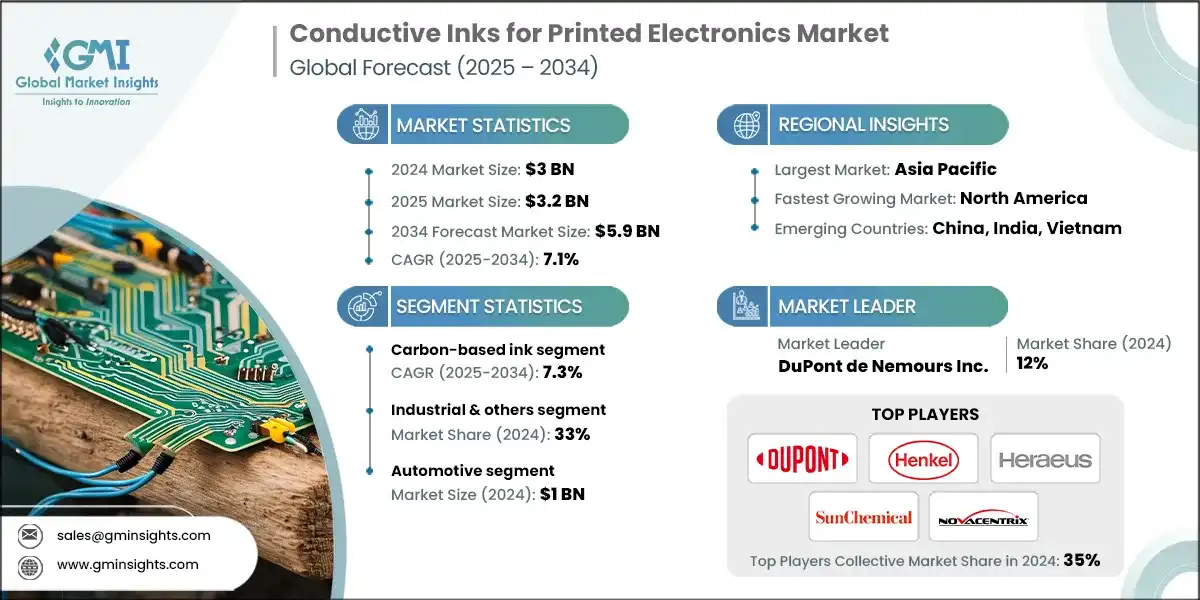
The global conductive inks for printed electronics market was estimated at USD 3 billion in 2024 The market is expected to grow from USD 3.2 billion in 2025 to USD 5.9 billion in 2034, at a CAGR of 7.1% according to latest report published by Global Market Insights Inc.
To get key market trends
- The conductive inks for printed electronics market is characterized by strong trends of adoption in flexible and wearable electronics across industries. But at the same time, miniaturization and sustainability were at the table of design, making manufacturers and consumers favor more eco-friendly low VOC with maximum substrate (paper, polymers, textiles) compatibility conductive inks. New production processes are suited to be low waste using additives and scaling up.
- Various developments in this segment have led to several companies creating advanced formulations using silver nanoparticles, copper flakes, graphene, and carbon nanotubes. This has targeted high-end applications like RFID tags, printed sensors, flexible circuits, and photovoltaic cells. Photonic sintering and UV curable inks are fast production processes with low-temperature processing for sensitive flexible materials and are growing in popularity.
- Electric vehicles need printed heaters and sensors; IoT devices for smart homes and industry; and disposable biosensors for applications in health care. Sustainability-focused brands have created bio-based and recyclable ink systems in line with regulations for the environment and consumers.
- Asia-Pacific has achieved good volumes of production because it has a huge electronics infrastructure built on cheap labor while North America turns out to be a leader in the applications of high performance by medical grades. However, Europe is just beginning to innovate for the automotive market and sustainable development as there are strong regulatory policies such as REACH and RoHS.
Conductive Inks for Printed Electronics Market Report Attributes
| Key Takeaway | Details |
|---|---|
| Market Size & Growth | |
| Base Year | 2024 |
| Market Size in 2024 | USD 3 Billion |
| Market Size in 2025 | USD 3.2 Billion |
| Forecast Period 2025 - 2034 CAGR | 7.1% |
| Market Size in 2034 | USD 5.9 Billion |
| Key Market Trends | |
| Drivers | Impact |
| 5G & mmWave technology adoption acceleration | The demand for electronic elements which are compact, flexible, and capable of operating at high frequency increases. Essential for the printing of antennas, sensors, and interconnects supporting these advanced communication systems. |
| Flexible electronics & wearable device proliferation | Electronics can be printed directly on flexible substrates using conductive inks. |
| Automotive electrification & smart vehicle integration | Platforms for sensors, touch controls, lighting, and battery management systems are seeing increased in use of printed electronics. |
| Pitfalls & Challenges | Impact |
| Silver price volatility & raw material cost pressures | Prices fluctuations and difficulties with supply chain affects production costs and profit margins so adversely. |
| Technical limitations in conductivity & durability | Matching performance with that of traditional metal conductors, particularly with mechanical stress, at high temperatures, or after prolonged use, has proven quite challenging. |
| Opportunities: | Impact |
| Copper ink development & cost reduction potential | Copper offers comparable conductivity and is significantly cheaper, making it useful for large-scale applications. |
| Sustainable & recycled material innovation | Driven by both regulatory pressures and consumer demand for greener electronics. |
| Market Leaders (2024) | |
| Market Leaders |
12% Market Share |
| Top Players |
Collective Market Share of 35% in 2024 |
| Competitive Edge |
|
| Regional Insights | |
| Largest Market | Asia Pacific |
| Fastest growing market | North America |
| Emerging countries | China, India, Vietnam |
| Future outlook |
|
What are the growth opportunities in this market?
Conductive Inks for Printed Electronics Market Trends
- The conductive inks market is going through transformations, the industry environment and technological capabilities. Advancement in telecoms, in particular the 5G and IoT infrastructure, has elevated demand for high-performance conductive inks for printed antennas, sensors, and RF components. Innovations in flexible electronics have allowed for even forays into wearables, intelligent packaging, and foldable devices, thus stirring demand for stretchable, transparent, and low-temperature curing ink formulations. These are further accentuated by electrification in the automotive industry with new requirements for printed heaters, sensors, and in-mold electronics, which are giving impetus for manufacturers to customize conductive inks for lightweight multifunctional applications in vehicle parts. Hence, these three forces continue to strengthen the market pull toward flexible, sustainable, and application-specific solutions.
Conductive Inks for Printed Electronics Market Analysis
Learn more about the key segments shaping this market
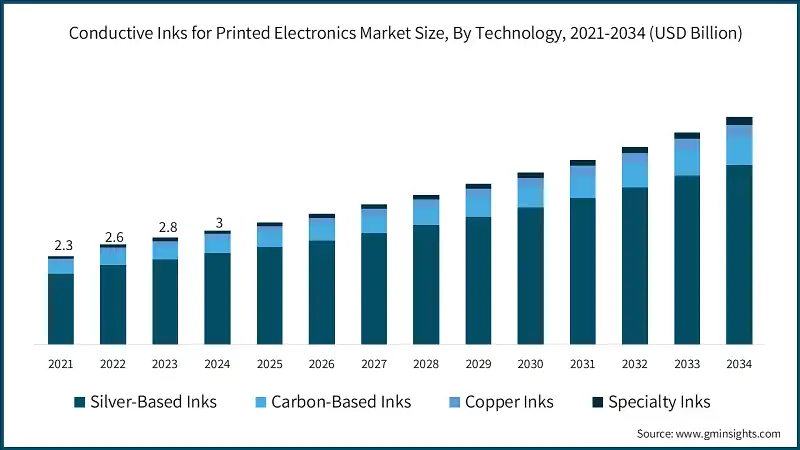
Based on technology, the market is segmented into silver-based inks, carbon-based inks, copper inks, specialty inks. Individual portion packaging dominated the market with an approximate share of 79.8% in 2024 and is expected to grow with the CAGR of 7% by 2034.
- The silver-based formulation has dominated so far, although other contenders are now also acquiring strategic importance in terms of their increasing importance. In 2024, therefore, silver ink is expected to represent 80% of the entire market. This factor primarily results from the very high electrical conductive properties possessed by the inks concerning application requirements in high-performance applications. For most of the applications, silver inks achieve conductivities close to 80% of metallic silver performance, thus becoming useful in areas such as photovoltaics metallization, RFID antennas production, and precision electronic circuit printing.
- Carbon-based inks have a 12% market share with CAGR at 7.3%. Carbon, therefore, offers promising, cost-effective, and environmentally sustainable alternatives. On the other hand, the electrical performance of graphene and carbon nanotube formulations renders them effective for low-performance applications with their superior mechanical flexibility and chemical stability.
- Copper inks represent a small 5% share of the market but are on the rise with the best CAGR of 7.7%, mainly due to the ongoing technological advances in preventing oxidation and optimizing processes. Copper is almost as conductive as silver, but at a fraction of the price making it a viable candidate for cost-sensitive applications such as RFID tags and smart packaging.
- Specialty inks command a market share of around 3% with a CAGR of about 8.9% and comprise gold inks for high-reliability applications, conductive polymers for flexibility requirements, and hybrid compositions consisting of several conductive materials.
Learn more about the key segments shaping this market
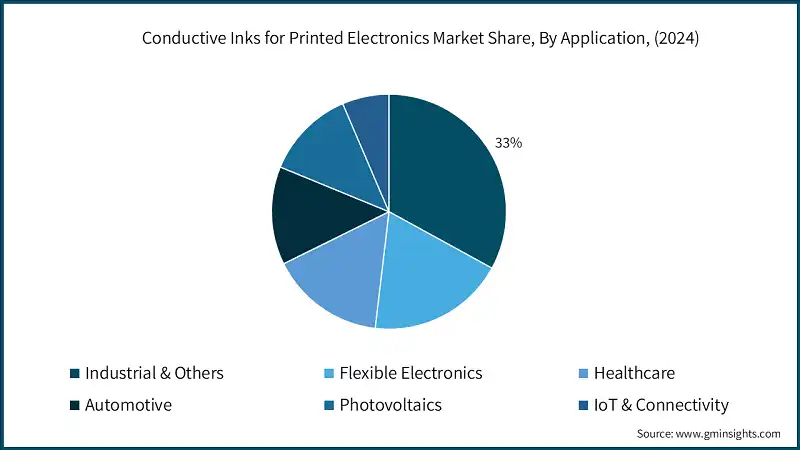
Based on applications, the market is segmented into industrial & others, flexible electronics, healthcare, automotive, photovoltaics, IoT & connectivity. Industrial & others hold the largest market share of 33% in 2024 and are expected to grow at a CAGR of 7.2%.
- The industrial and other applications segment commands a significant share of approximately 33% in the conductive inks for printed electronics market, indicating its much broader application in sectors like energy, manufacturing, and infrastructure. A key boost in the growth of this segment comes from the global advances in solar energy technologies, particularly in the field of thin-film solar cells. Conductive inks are vital in metallization for photovoltaic cells, whereby they form front-side grid lines, print back-side contacts, and interconnection systems. All these are essential for the efficacy and scalability of solar modules, thereby rendering conductive inks crucial to the transition of renewable energy and sustainable industrial solutions.
- Flexible electronics applications are ongoing robust growth driven by expanding use in wearable devices and e-textile interfaces. Market segments covered include applications such as displays, wearable health monitors, smart textiles, and conformable sensor-based systems. The application requirements tend to lean towards the requirement of mechanical flexibility, retention of adhesion during deformation, and compatibility with polymer substrate materials normally found in flexible electronics manufacturing.
- Automotive applications, which have vast potential for growth because of the increasing adoption of electric vehicles and the deployment of advanced driver assistance systems. Printed electronics would act as large-area heating elements for window defogging and battery thermal management; printed sensor arrays would be used for occupancy detection and structural monitoring; flexible circuit interconnects would be needed in space-constrained automotive environments.
- Healthcare includes medical devices integration, biosensor fabrication, and wearable health monitoring systems. Biocompatibility requirements dictate specific ink formulations, often foiling the use of carbon-based conductive fillers or special silver compositions with surface treatments.
Based on end use, the conductive inks for printed electronics market is segmented into automotive, healthcare & medical device, telecommunications, and packaging industry. Automotive hold the largest market size of USD 1 billion in 2024 and is expected to grow at a CAGR of 7.2%.
- The automotive industry possesses a major chunk of 35% in end-use consumption, representing a holistic incorporation of printed electronics in all vehicle systems. Proliferation of electric vehicles has exceptional demand in components for battery management systems, thermal management parts, and sensor integration that warrants the use of special application-formulated conductive inks.
- Related to healthcare devices and applications, the market occupies 30.2% share with a 2% CAGR, being driven by the proliferation of wearable health monitoring devices and trends toward miniaturization in medical devices. Biocompatible ink formulations justify their applications in direct skin contact, while some tailored compositions support implantable devices and diagnostic equipment. This segment stands to benefit from the demographic trend of an increasing aged population and increased digitization of healthcare services, creating an unending requirement for the printed electronic components in medical applications
Looking for region specific data?
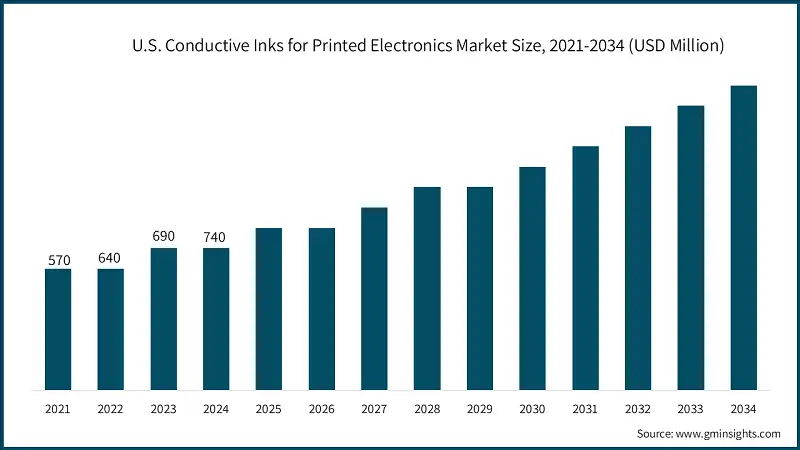
North America Conductive Inks for Printed Electronics Market The North America market is emerging in the global conductive inks for printed electronics industry with a market share of 30.2% in 2024. U.S. dominates the North America conductive inks for printed electronics market, showcasing strong growth potential. Europe conductive inks for printed electronics is anticipated to show lucrative growth over the forecast period. Germany dominates the European conductive inks for printed electronics market, showcasing strong growth potential. The Asia Pacific conductive inks for printed electronics dominates the market’s highest CAGR of 7.4% during the analysis timeframe. China conductive inks for printed electronics is estimated to grow with a significant CAGR, in the Asia Pacific. Latin America conductive inks for printed electronics accounted for 2.9% in 2024 and is anticipated to show lucrative growth over the forecast period. Brazil leads the Latin American conductive inks for printed electronics market, exhibiting remarkable growth during the analysis period. Middle East & Africa conductive inks for printed electronics anticipated showing steady growth over the forecast period. Saudi Arabia conductive inks for printed electronics market to experience substantial growth in the Middle East and Africa market in 2024. The top 5 companies in conductive inks for printed electronics industry include DuPont Electronics & Industrial, Henkel AG & Co. KGaA, Heraeus Holding GmbH, Sun Chemical Corporation, NovaCentrix. These are prominent companies operating in their respective regions covering 35% of the market share. These companies hold strong positions due to their extensive experience in conductive inks for printed electronics market. Their diverse product portfolios, backed by robust production capabilities and distribution networks, enable them to meet the rising demand across various regions. Major players operating in the market include:Europe Conductive Inks for Printed Electronics Market
Asia Pacific Conductive Inks for Printed Electronics Market
Latin American Conductive Inks for Printed Electronics Market
Middle East and Africa Conductive Inks for Printed Electronics Market
Conductive Inks for Printed Electronics Market Share
Conductive Inks for Printed Electronics Market Companies
Conductive Inks for Printed Electronics Industry News
This conductive inks for printed electronics market research report includes in-depth coverage of the industry, with estimates & forecasts in terms of revenue (USD Million) and volume (Tons) from 2025 to 2034, for the following segments:
Market, By Technology
- Silver-based inks
- Carbon-based inks
- Copper inks
- Specialty inks
Market By Application
- Industrial & others
- Flexible electronics
- Healthcare
- Automotive
- Photovoltaics
- IoT & connectivity
Market, By End Use
- Automotive
- Healthcare & medical device
- Telecommunications
- Packaging industry
The above information is provided for the following regions and countries:
- North America
- U.S.
- Canada
- Europe
- Germany
- UK
- France
- Spain
- Italy
- Rest of Europe
- Asia Pacific
- China
- India
- Japan
- Australia
- South Korea
- Rest of Asia Pacific
- Latin America
- Brazil
- Mexico
- Argentina
- Rest of Latin America
- Middle East and Africa
- Saudi Arabia
- South Africa
- UAE
- Rest of Middle East and Africa
Frequently Asked Question(FAQ) :
What is the market size of the conductive inks for printed electronics industry in 2024?
The market size was USD 3 billion in 2024, with a CAGR of 7.1% expected through 2034 driven by automotive electrification and smart vehicle integration.
What is the current conductive inks for printed electronics market size in 2025?
The market size is projected to reach USD 3.2 billion in 2025.
Who are the key players in the conductive inks for printed electronics market?
Key players include DuPont Electronics & Industrial, Henkel AG & Co. KGaA, Heraeus Holding GmbH, Sun Chemical Corporation, NovaCentrix, Agfa-Gevaert Group, Voltera Inc., XTPL S.A., Advanced Nano Products, Copprint Technologies, Electroninks Incorporated, SPGPrints B.V., and C3 Nano Inc.
What is the projected value of the conductive inks for printed electronics market by 2034?
The market is expected to reach USD 5.9 billion by 2034, fueled by demand from flexible electronics, IoT applications, and renewable energy systems.
What is the growth outlook for copper inks from 2025 to 2034?
Copper inks are projected to grow at a CAGR of 7.7% till 2034. Cost advantages and advances in oxidation prevention make copper suitable for large-scale applications like RFID and smart packaging.
Which region leads the conductive inks for printed electronics market?
North America accounted for 30.2% of the market share in 2024. Growth is supported by 5G infrastructure, EV adoption, and aerospace applications.
What are the upcoming trends in the conductive inks for printed electronics industry?
Key trends include expansion of flexible and wearable electronics, adoption of eco-friendly and recyclable ink systems, and development of low-temperature curing inks for sensitive substrates.
What was the valuation of the silver-based inks technology segment in 2024?
Silver-based inks dominated with 80% market share in 2024. Their superior conductivity makes them vital for photovoltaics, RFID antennas, and high-performance circuit printing.
How much revenue did the automotive end use segment generate in 2024?
The automotive sector generated USD 1 billion in 2024, accounting for 35% of the market. Growth is driven by rising EV adoption and integration of advanced printed electronics in vehicles.
Conductive Inks for Printed Electronics Market Scope
Related Reports