Summary
Table of Content

Condom Market
Get a free sample of this report
Form submitted successfully!
Error submitting form. Please try again.
Thank you!
Your inquiry has been received. Our team will reach out to you with the required details via email. To ensure that you don't miss their response, kindly remember to check your spam folder as well!
Request Sectional Data
Thank you!
Your inquiry has been received. Our team will reach out to you with the required details via email. To ensure that you don't miss their response, kindly remember to check your spam folder as well!
Form submitted successfully!
Error submitting form. Please try again.
Condom Market Size
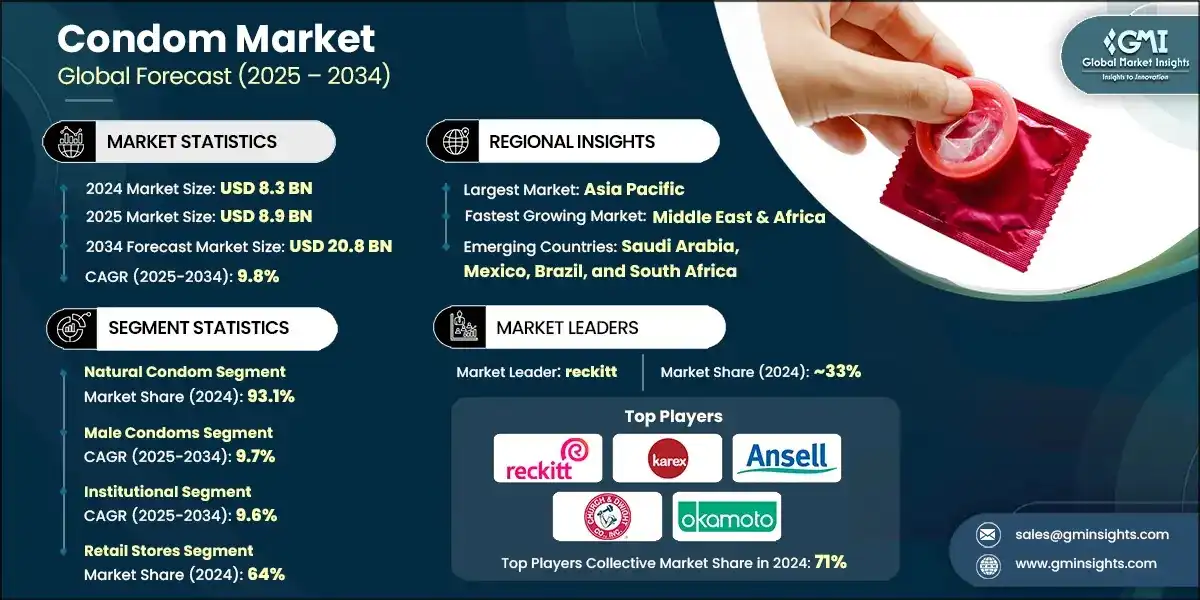
The global condom market was valued at USD 8.3 billion in 2024. The market is expected to grow from USD 8.9 billion in 2025 to USD 20.8 billion in 2034, at a CAGR of 9.8% during the forecast period, according to the latest report published by Global Market Insights Inc. The high market growth is attributed to growing awareness regarding sexually transmitted diseases (STIs), enhanced availability and affordability of products, and rapid demand for safe contraceptives, among others.
To get key market trends
Condoms are essential products in sexual health, playing a critical role in contraception, STI prevention, and promoting safe intimacy. Leading manufacturers such as Reckitt, Karex, Ansell, CHURCH & DWIGHT CO., INC., and Okamoto offer a diverse portfolio ranging from ultra-thin and textured condoms to vegan-certified and biodegradable options. These products leverage advanced technologies, including precision latex molding, electronic quality testing, and even smart features like graphene-based materials for enhanced strength and sensitivity.
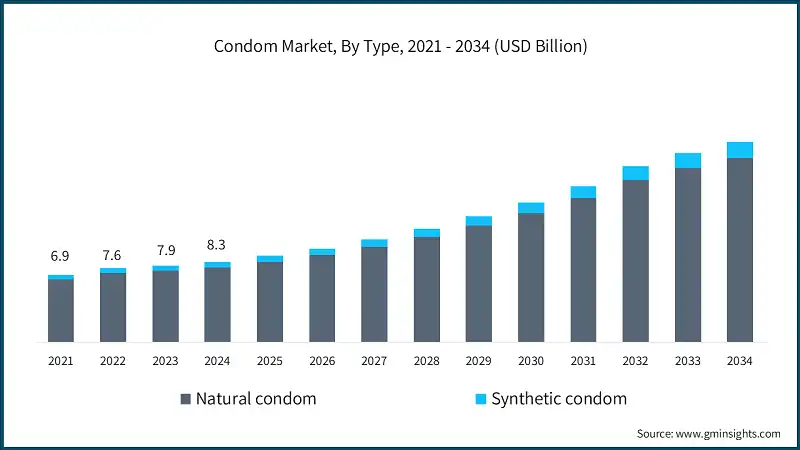
The market has increased from USD 6.9 billion in 2021 and reached USD 7.9 billion in 2023, with a historic growth rate of 7%. This expansion has been driven by the rising awareness of sexual health, growing acceptance of contraceptive methods, and the availability of innovative products catering to diverse consumer preferences.
Growing global awareness of sexual health has become a significant growth driver for the condom market. This shift has led to increased adoption of condoms as a reliable and accessible contraceptive method. Additionally, the World Health Organization (WHO) reported that 374 million new cases of curable STIs (such as syphilis, gonorrhea, chlamydia, and trichomoniasis) occur annually, underscoring the urgent need for preventive measures like condom use. This growing consciousness is not only improving public health outcomes but also driving innovation and demand in the global condom industry.
A condom is a protective barrier used during sexual activity to help prevent pregnancy and reduce the risk of contracting sexually transmitted infections (STIs). Condoms are typically made from materials such as latex, polyurethane, or lambskin and are available in both male and female versions, each designed to cover the genitals and prevent the exchange of bodily fluids.
Condom Market Report Attributes
| Key Takeaway | Details |
|---|---|
| Market Size & Growth | |
| Base Year | 2024 |
| Market Size in 2024 | USD 8.3 Billion |
| Market Size in 2025 | USD 8.9 Billion |
| Forecast Period 2025 - 2034 CAGR | 9.8% |
| Market Size in 2034 | USD 20.8 Billion |
| Key Market Trends | |
| Drivers | Impact |
| Rising awareness about sexually transmitted infections (STIs) | Increased public education and health campaigns have led to greater condom adoption for STI prevention. |
| Growing government initiatives promoting safe sexual activities | National programs and subsidies have expanded access to condoms, especially in underserved regions. |
| Increased product availability and affordability | Wider retail distribution and competitive pricing have made condoms more accessible to diverse consumer segments. |
| Accelerated demand for safe contraceptives | Changing lifestyles and health-conscious choices are driving consistent growth in condom usage globally. |
| Pitfalls & Challenges | Impact |
| Social stigma in developing regions | Cultural taboos and lack of open dialogue continue to hinder condom usage in many communities. |
| Side effects from the materials used in condoms | Allergic reactions and discomfort from latex or additives can discourage repeat use among sensitive users. |
| Opportunities: | Impact |
| Rise of e-commerce and digital distribution | Online platforms enable discreet purchases and broader reach, especially among younger and urban consumers. |
| Market Leaders (2024) | |
| Market Leaders |
~33% market share |
| Top Players |
Collective market share in 2024 is 71% |
| Competitive Edge |
|
| Regional Insights | |
| Largest Market | Asia Pacific |
| Fastest Growing Market | Middle East & Africa |
| Emerging Country | Saudi Arabia, Mexico, Brazil, and South Africa |
| Future Outlook |
|
What are the growth opportunities in this market?
Condom Market Trends
Government initiatives aimed at promoting safe sexual practices have become a major factor in the growth of the global condom market.
- Public health authorities and international organizations are increasingly prioritizing sexual health education to curb the spread of STIs and reduce unintended pregnancies. Programs such as free condom distribution, awareness campaigns in schools and colleges, and mass media outreach have significantly improved accessibility and acceptance of condoms.
- For instance, the National AIDS Control Programme (NACP) in India and similar initiatives worldwide have normalized condom use as an essential preventive measure, driving consistent demand.
- Moreover, regulatory support and funding have further amplified these efforts. Governments in developing regions are partnering with NGOs and private players to ensure affordable pricing and widespread availability of condoms, even in rural and underserved areas.
- Additionally, global health bodies like the World Health Organization (WHO) and UNAIDS advocate condom use as a frontline defense against HIV and other STIs, reinforcing its importance in public health strategies.
- These initiatives not only increase awareness but also reduce stigma, making condoms more socially acceptable and encouraging adoption among younger demographics.
Condom Market Analysis
Learn more about the key segments shaping this market
The global condom market was valued at USD 6.9 billion in 2021. The market size reached USD 7.9 billion in 2023, from USD 7.6 billion in 2022.
Based on type, the condom market is segmented into natural condom and synthetic condom. The natural condom segment accounted for 93.1% of the market in 2024 due to increasing consumer preference for eco-friendly and skin-safe products, growing awareness about latex allergies, and rising demand for sustainable alternatives that align with health and environmental concerns. The segment is expected to exceed USD 19.1 billion by 2034, growing at a CAGR of 9.7% during the forecast period.
On the other hand, the synthetic condom segment accounted for a 6.9% market share in 2024, driven by its cost-effectiveness, durability, and widespread availability through retail and online channels. Materials such as polyurethane and polyisoprene provide enhanced strength and flexibility, making them an attractive choice for consumers seeking reliable protection without compromising comfort.
- The natural condom segment is also benefiting from strong marketing narratives around health and sustainability. Brands are positioning these products as premium, eco-conscious alternatives that cater to consumers seeking chemical-free and biodegradable options. This trend aligns with the broader movement toward sustainable living and ethical consumption, which resonates strongly with the new generation. As regulatory bodies and health organizations emphasize safer materials and hypoallergenic solutions, natural condoms are expected to gain further traction, reinforcing their role as a key growth driver in the overall market.
Based on category, the condom market is segmented into male condoms and female condoms. The male condoms segment dominated the market in 2024 and is growing with a CAGR of 9.7% during the forecast period.
- The growth of this segment is driven by its widespread availability, affordability, and strong consumer preference for a reliable and easy-to-use contraceptive method. Male condoms remain the most popular form of barrier protection globally, supported by extensive government distribution programs, retail penetration, and increasing awareness about STI prevention. Their convenience and cost-effectiveness make them the first choice for both casual and long-term users.
- The female condoms segment is expected to grow with a CAGR of1 1.4% during the analysis period. This growth is primarily driven by increasing awareness of women’s sexual health, empowerment initiatives, and the need for female-controlled contraceptive options. Female condoms offer dual protection against unintended pregnancies and STIs, making them an essential tool in public health strategies. Governments and NGOs are actively promoting these products through educational campaigns and free distribution programs, particularly in regions with high HIV prevalence.
Based on sector, the condom market is segmented into institutional and non-institutional. The institutional segment dominated the market in 2024 and is growing with a CAGR of 9.6% during the forecast period.
- The growth of this segment is primarily due to large-scale procurement by government health programs, NGOs, and international organizations focused on STI prevention and family planning. These institutions play a critical role in distributing condoms through public health campaigns, hospitals, and community outreach programs, ensuring widespread accessibility, especially in low-income and rural regions.
- The non-institutional segment is expected to grow with a 10.1% CAGR during the analysis period. This growth is primarily driven by increasing consumer preference for retail and online purchases, rising penetration of e-commerce platforms, and growing demand for discreet buying options. This segment includes pharmacies, supermarkets, convenience stores, and digital marketplaces, which offer consumers greater accessibility and privacy compared to institutional channels.
Learn more about the key segments shaping this market
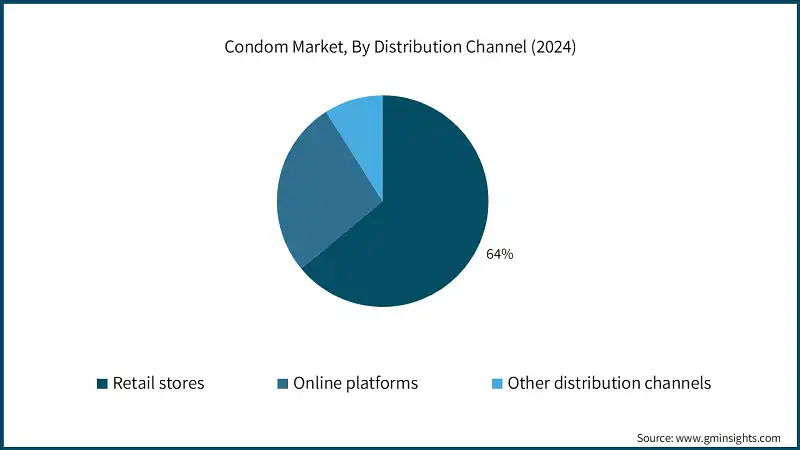
Based on distribution channel, the condom market is segmented into retail stores, online platforms, and other distribution channels. The retail stores segment held a market share of 64% in 2024 and is expected to reach USD 12.7 billion within the forecast period.
- This significant market share is primarily driven by strong consumer preference for physical purchase points and the convenience of immediate product availability. Pharmacies, supermarkets, and convenience stores remain key distribution channels, particularly in regions where online penetration is still developing. Retail outlets also benefit from impulse buying behavior and promotional campaigns that attract walk-in customers.
- The online platforms segment accounted for a 27% share in 2024 and is expected to grow at a CAGR of 11.1%. This growth is primarily driven by the increasing preference for discreet purchasing, the convenience of home delivery, and the rising penetration of e-commerce and digital health platforms. Online channels allow consumers to access a wide range of products, including premium and niche variants, without the social stigma often associated with in-store purchases.
- The other distribution channels segment is expected to grow with a 9.2% CAGR during the analysis period, supported by the presence of alternative sales points such as vending machines and community-based programs. These channels cater to consumers seeking convenience and privacy, particularly in high-traffic areas like educational institutions, workplaces, and public spaces.
Looking for region specific data?
North America Condom Market
The North America condom market is anticipated to grow at a CAGR of 7.8% during the analysis timeframe.
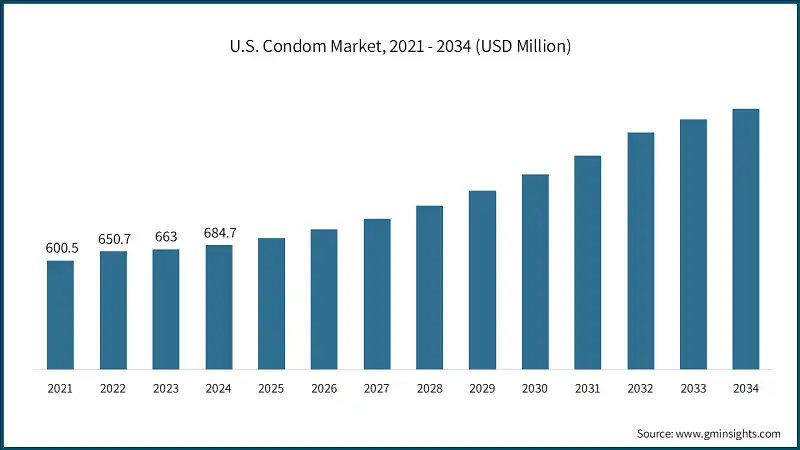
- The U.S. condom market was valued at USD 600.5 million and USD 650.7 million in 2021 and 2022, respectively. The market size reached USD 684.7 million in 2024, growing from USD 663 million in 2023, and is anticipated to grow at a CAGR of 7.9% between 2025 and 2034.
- Growth in the region is driven by high awareness of sexual health, strong sex education programs, and proactive government initiatives promoting safe sex practices. The U.S. dominates the regional market, supported by a robust healthcare infrastructure and widespread availability of contraceptives. Increasing adoption of female condoms and innovations in non-latex materials are also contributing to market expansion.
- Premium product offerings such as ultra-thin, textured, and flavored condoms are seeing strong demand among younger demographics in the region. However, competition from alternative contraceptive methods like intrauterine devices (IUDs) remains a challenge for sustained growth.
Europe Condom Market
Europe condom market accounted for USD 2 billion in 2024 and is anticipated to show lucrative growth over the forecast period.
- Rising STI cases, as reported by the European Centre for Disease Prevention and Control, have heightened public awareness and boosted condom adoption. Governments and NGOs are actively promoting sex education and family planning programs, while the younger consumers are driving demand for diverse product offerings.
- The region is witnessing strong growth in non-latex condoms, catering to consumers with latex allergies. Online platforms and modern retail formats are expanding accessibility, while premium features such as ribbed textures and flavored variants enhance consumer appeal.
Asia Pacific Condom Market
Asia Pacific dominated the global condom market with the highest market share of 41% in 2024.
- Asia Pacific holds the largest share of the global condom market, due to rapid urbanization, population growth, and government-led family planning initiatives. Countries such as India and China are pivotal growth drivers, supported by extensive public health campaigns and increasing consumer awareness of STI prevention. The region is witnessing strong demand for affordable products alongside rising interest in premium and eco-friendly variants.
- Moreover, e-commerce penetration is transforming purchasing behavior, enabling discreet transactions and overcoming cultural taboos prevalent in rural areas. However, persistent stigma and affordability constraints in low-income segments remain key challenges, creating opportunities for targeted outreach and low-cost product strategies.
Latin America Condom Market
The Latin America condom market is experiencing notable growth over the analysis timeframe.
- Latin America’s condom market is expanding steadily, driven by heightened awareness of HIV prevention and government-sponsored sexual health programs.
- Brazil and Mexico lead regional growth, supported by educational initiatives and rising acceptance of contraceptive use among younger demographics. Premium offerings such as flavored and ultra-thin condoms are gaining popularity, particularly in urban centers.
Middle East & Africa Condom Market
The Middle East & Africa (MEA) condom market is experiencing robust growth over the analysis timeframe.
- Growth of MEA is fueled by international health initiatives and government-led family planning programs. Countries like South Africa remain a key market due to elevated HIV prevalence and strong public health interventions, while other Middle Eastern countries are witnessing rising demand for premium and sustainable products. Strategic collaborations with NGOs and global health organizations are improving condom availability in underserved areas.
Condom Market Share
Leading industry players such as reckitt, Karex, Ansell, CHURCH & DWIGHT CO., INC., and Okamoto collectively hold a market share of around 71% in the oligopoly condom market. These companies maintain leadership through extensive product portfolios, strong brand recognition, and robust distribution networks spanning retail and e-commerce channels. Their strategic focus on product innovation, such as ultra-thin designs, non-latex alternatives, and premium variants, combined with aggressive marketing campaigns, enables them to capture diverse consumer segments and sustain growth in competitive markets.
Other notable contributors include CUPID LIMITED, Ceylor, FUJI LATEX CO., LTD., GLYDE HEALTH, and HLL Lifecare, which are actively expanding in niche areas such as female condoms, sustainable materials, and digitally integrated subscription models. These players leverage advancements in manufacturing technology, eco-friendly packaging, and discreet online distribution to differentiate their offerings. Their emphasis on affordability, customization, and partnerships with public health programs positions them to capitalize on emerging opportunities in developing regions and among health-conscious consumers.
Condom Market Companies
A few of the prominent players operating in the condom industry include:
- Ansell
- Ceylor
- CHURCH & DWIGHT CO., INC.
- CUPID LIMITED
- FUJI LATEX CO., LTD.
- GLYDE HEALTH
- HLL Lifecare
- JIMMYJANE
- Karex
- LELO
- LifeStyles
- Mankind
- MAYER
- Okamoto
- Pasante
- reckitt
- rfsu
- SAGAMI
- veru
- VITALIS
Reckitt Benckiser dominates the global condom market through strong brand equity, extensive product diversification, and aggressive marketing strategies. Durex is synonymous with premium quality and innovation, offering ultra-thin, textured, and flavored variants that cater to evolving consumer preferences. The company leverages global distribution networks and digital engagement campaigns to maintain leadership, while its focus on sexual wellness education reinforces brand trust.
Ansell differentiates itself through advanced material science and product safety, positioning its condoms as high-performance solutions for both protection and comfort. The company emphasizes non-latex alternatives and sustainable manufacturing practices, appealing to allergy-sensitive and eco-conscious consumers. Ansell’s strong presence in institutional channels and partnerships with healthcare organizations further strengthens its market position.
Condom Industry News:
- In September 2024, Durex, a brand of Reckitt, announced the launch of its Close Fit Invisible Condoms. This close-fit thin condom may allow couples to experience enhanced closeness without compromising on protection. Such an innovative product launch will enable the company to further consolidate its industry position in the market.
- In April 2023, Veru Inc. entered into a distribution agreement with Afaxys Group Services, LLC (AGS) to expand access to the FC2 Female Condom. Through AGS’s Group Purchasing Organization (GPO), the partnership aims to serve over 31 million individuals relying on public health and community centers, enhancing contraceptive availability for both women and men.
The condom market research report includes an in-depth coverage of the industry with estimates and forecasts in terms of revenue in USD Million from 2021 - 2034 for the following segments:
Market, By Type
- Natural condom
- Latex
- Lambskin
- Synthetic condom
- Polyurethane
- Polyisoprene
- Nitrile
Market, By Category
- Male condoms
- Female condoms
Market, By Sector
- Institutional
- Non-institutional
Market, By Distribution Channel
- Retail stores
- Supermarkets and hypermarkets
- Drug stores
- Specialty stores
- Online platforms
- Other distribution channels
The above information is provided for the following regions and countries:
- North America
- U.S.
- Canada
- Europe
- Germany
- UK
- France
- Italy
- Spain
- Netherlands
- Asia Pacific
- China
- Japan
- India
- Australia
- South Korea
- Latin America
- Brazil
- Mexico
- Argentina
- Middle East and Africa
- South Africa
- Saudi Arabia
- UAE
Frequently Asked Question(FAQ) :
Who are the key players in the condom market?
Key players include Ansell, Ceylor, CHURCH & DWIGHT CO., INC., CUPID LIMITED, FUJI LATEX CO., LTD., GLYDE HEALTH, HLL Lifecare, JIMMYJANE, Karex, LELO, LifeStyles, Mankind, MAYER, Okamoto, Pasante, Reckitt, RFSU, SAGAMI, Veru, and VITALIS.
Which region leads the condom market?
The North America condom market is anticipated to grow at a CAGR of 7.8% during 2025 to 2034.
What are the emerging trends in the condom market?
Key trends include the integration of smart packaging, AI-driven consumer insights, and the use of sustainable materials to enhance user experience and brand engagement.
What is the growth outlook for male condoms during the forecast period?
The male condom segment is expected to grow at a CAGR of 9.7% from 2025 to 2034, supported by widespread availability and affordability.
Which distribution channel dominated the condom market in 2024?
Retail stores held a 64% market share in 2024, led by consumer preference for physical purchase points and immediate product availability.
What was the market share of natural condoms in 2024?
Natural condoms accounted for 93.1% of the market in 2024, supported by consumer preference for eco-friendly and skin-safe products.
What is the market size of the condom in 2024?
The market size was USD 8.3 billion in 2024, with a CAGR of 9.8% expected through 2034 driven by increasing awareness of sexual health and demand for safe contraceptives.
What is the projected value of the condom market by 2034?
The condom market is expected to reach USD 20.8 billion by 2034, driven by rising STI awareness, better product accessibility, and increasing demand for safe contraceptives.
What is the expected market size of the condom market in 2025?
The market size is projected to reach USD 8.9 billion in 2025.
Condom Market Scope
Related Reports