Summary
Table of Content

Condensed Canned Soups Market
Get a free sample of this report
Form submitted successfully!
Error submitting form. Please try again.
Thank you!
Your inquiry has been received. Our team will reach out to you with the required details via email. To ensure that you don't miss their response, kindly remember to check your spam folder as well!
Request Sectional Data
Thank you!
Your inquiry has been received. Our team will reach out to you with the required details via email. To ensure that you don't miss their response, kindly remember to check your spam folder as well!
Form submitted successfully!
Error submitting form. Please try again.
Condensed Canned Soups Market Size
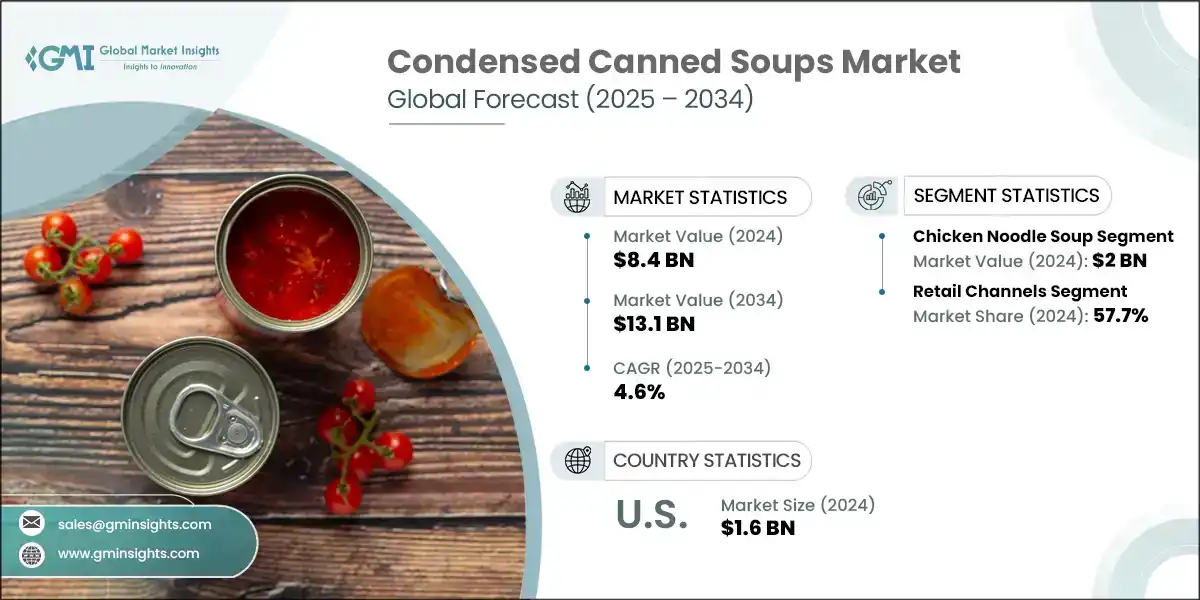
The global condensed canned soups market size was valued at USD 8.4 billion in 2024. The market is expected to grow from USD 8.7 billion in 2025 to USD 13.1 billion in 2034, at a CAGR of 4.6%.
Condensed Canned Soups Market Key Takeaways
Market Size & Growth
- 2024 Market Size: USD 8.4 Billion
- 2034 Forecast Market Size: USD 13.1 Billion
- CAGR (2025–2034): 4.6%
Regional Dominance
- Largest Market: Asia Pacific
- Fastest Growing Region: Latin America
Key Market Drivers
- Rising demand for convenient and shelf-stable foods.
- Health-conscious consumer trends.
- Expansion of e-commerce and direct-to-consumer channels.
Challenges
- Environmental concerns over packaging waste.
- Limited innovation in flavour and format.
Opportunity
- Development of sustainable and eco-friendly packaging.
- Expansion into emerging markets.
Key Players
- Market Leader: Campbell Soup Company led with over 25% market share in 2024.
- Leading Players: Top 5 players in this market include Campbell Soup Company, General Mills Inc. (Progresso), The Kraft Heinz Company, Nestlé S.A., Unilever (Knorr), which collectively held a market share of 67% in 2024.
Get Market Insights & Growth Opportunities
- The condensed canned soups are well-known in the packaged food industry designed primarily to offer consumers a convenient, cheap meal with a long shelf life. Over the years, consumer tastes have changed, thereby bringing in a change in this otherwise simple, straightforward value offering. Health-minded consumers are now requesting low-sodium, organic, and clean-label offerings with natural ingredients, thereby encouraging innovations in product formulation.
- Condensed soups are excellent options for daily convenience because they can easily pass for emergency food supplies. Food manufacturers often use several processing techniques to flavor the use of sodium while enriching the soups with plant proteins and nutrients. This will allow these companies to develop products that otherwise would not be suitable in traditional soup formats. Hence, they have been transforming condensed soups into integral meal bases utilized for nutritious and flexible meal preparation.
- In North America, the market for condensed canned soups experiences increased consumer demand for shelf-stable meals that are easy to prepare. The most current investments being made in food processing and sustainable packaging are aligned with what people expect in clean label certifications and eco-friendliness.
- Rapid urbanization and changing dietary habits of the middle-class consumers are boosting the Asia-Pacific region to be the fastest growing market for canned condensed soups. The demand is increasing because of convenience and ready-to-eat foods in China, India, and Japan as the lifestyles here are changing, making these consumers in search of quick nutritious meal solutions.
To get key market trends
Condensed Canned Soups Market Trends
- This trend in general, these changes reflect consumer demand for transparency, wellness, and more easily recognizable ingredients in processed foods. Nutrition guidelines instituted by the government in North America and Europe promote changes like this, pushing manufacturers toward improved health standards without compromising taste or convenience.
- It includes increasingly adopting clean-label recipes with low sodium, organic, gluten-free, and plant-based ingredients. All these metamorphoses will serve to broaden the scope of consumer requirements regarding transparency, wellness, and even in simple and recognizable ingredients in processed foods. These in-between also set trends off with government-backed and nutrition guidelines.
- To fulfil the needs of a more diverse and specific consumer base, producers create new value-added and functional soup options. These include high-protein soups, bone-broth-based recipes, immune-boosting mixes, and meal replacement options. There is a growing trend in experimentation with global and regional flavour profiles that appeal to multicultural populations and adventurous eaters.
- Sustainability is expected to continue playing a major role in the market, and there will be more thrusts for eco-friendly solutions, such as recyclable metal cans, BPA-free linings, and probably plant-based or biodegradable packaging formats. Major installers are investing in responsible sourcing and cutting back the production efficiencies that lead to food wastage. That not only speaks to pro-green consumers but also gains momentum through changes in regulations with respect to packaging waste and emissions in the food manufacturing sector.
Condensed Canned Soups Market Analysis
Learn more about the key segments shaping this market
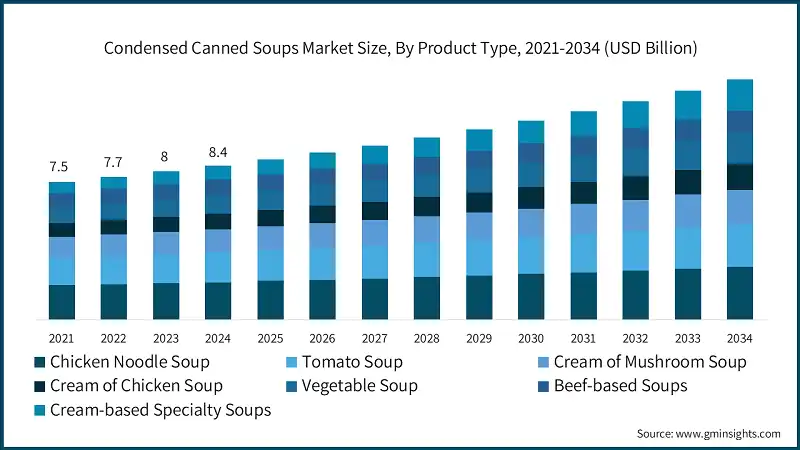
The condensed canned soups market by product type is segmented into chicken noodle soup, tomato soup, cream of mushroom soup, cream of chicken soup, vegetable soup, beef-based soups, cream-based specialty soups. Chicken noodle soup generated USD 2 billion in 2024.
- Condensed canned soup market comprises a variety of widely accepted products: chicken noodle- and tomato-flavored soups lead the rest in familiarity and broad appeal. Cream of chicken and cream of mushroom soups, too, put up a strong front as tested meals and versatile cooking ingredients.
- Health trends are increasingly making gains in vegetable and beef soups; also popularly consumed in this fast-growing category are consumer plant-based options, high-protein, hearty meals. To widen their reach, companies are reformulating products using lower sodium, organic ingredients, and allergen-friendly alternatives.
- Cream-based specialty soups are also fastest growing variety and expected to grow at a CAGR of 8.3%. Such rising demand is fulfilled in terms of home premium and restaurant-like flavours.
- Brands continue to innovate with clean-label ingredients, sustainable packaging, and premium flavour offerings, the category is becoming more versatile and appealing to a broader audience.
Learn more about the key segments shaping this market
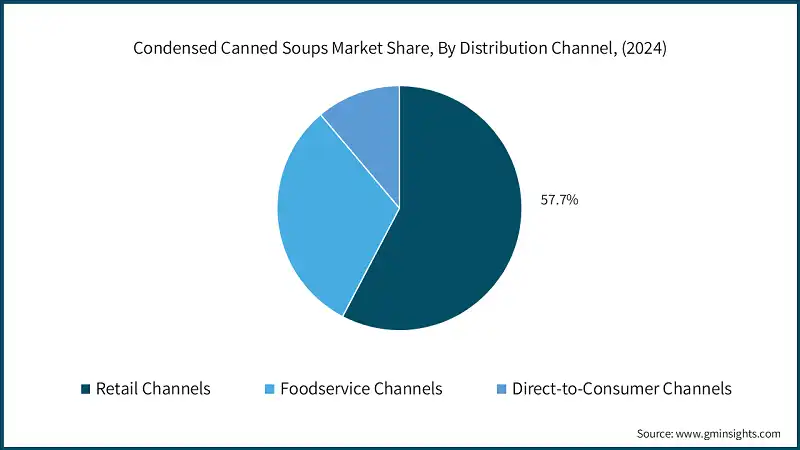
Based on distribution channel, the condensed canned soups market is segmented into retail channels, foodservice channels, direct-to-consumer channels. Retail channels made up 57.7% of the market in 2024.
- Retail channels have kept on being the major source for the sale of canned soups, i.e., by supermarkets, hypermarkets, and grocery stores. Naturally, these stores are still the major outlets for typical consumers to find a wide array of brands, flavours, and price points. It is the shelf visibility, promotion on a seasonal basis, and private label choices that greatly influence the purchase decisions.
- The condensed canned soups market from fastest growing segment of the channel is the foodservice channels-that is, cafeterias, hospitals, schools, and restaurants. The convenience and economy of condensed soups make them ideal for bulk preparation, institutional menus, and high-volume operations. Some foodservice operators also use such soups as bases for custom recipes, thereby enhancing menu flexibility and greater control over food cost.
- Direct-to-consumer channels works through e-commerce portals, brand websites, and subscription meal services. Consumers increasingly want doorstep delivery, personal bundles, and online promotions. Such channels enable the brand to develop stronger relationships with customers, acquire valuable purchasing data, and even present niche or premium options not available in most retail settings.
- While traditional retail would remain the principal channel enduring to volume and accessibility, foodservice is recovering and the institutional demand is shifting- reshape the entire notion of convenience and engagement for direct-to-consumer models.
Based on packaging format, the condensed canned soups market is segmented into traditional metal cans, alternative packaging formats. Traditional metal cans lead the market in 2024.
- Traditional metal cans still dominate the packaging format segment despite all modern alternatives. Besides being durable and highly cost-effective, traditional metal cans are the benchmark for mass distribution because they have been tried and found capable of integrating into high-volume filling lines.
- Manufacturers and environmentally aware consumers particularly appreciate cans due to their highly developed barrier properties and recyclability. Moreover, in the end uses of retail and food service applications, they gain significance because of their easy stacking and storage.
- Alternative packaging forms like microwaveable bowls, tetra packs, pouches, and BPA-free containers start coming up on the market, while consumers tend, little by little, to prefer convenience and weigh lighter and eco-friendlier materials. These formats are safely favored by young consumers or health-oriented buyers wishing to have single servings and portion control.
- Packaging innovation includes aesthetics and function as well; therefore, the brands are also exploring smart packaging technology, resealable closures, and minimalistic designs that will enhance their products on the shelves and improve consumers' experience. Continued evolution of the packaging world into something more sustainable and consumer friendly involves manufacturers experimenting with plant-based or compostable materials.
Looking for region specific data?
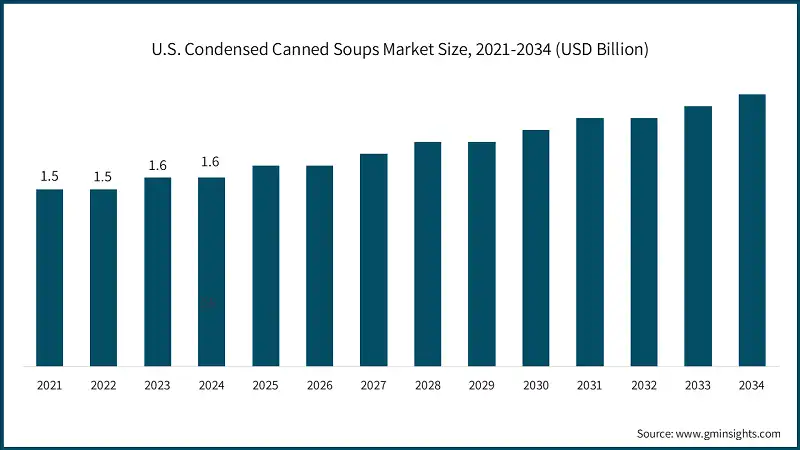
U.S. condensed canned soups market accounted for USD 1.6 billion in 2024.
- North America market for canned condensed soups is majorly dominated by the U.S., on account of its ready-to-eat meals, and over so long, soup has developed itself into a common home fare. There is still existence for health-conscious formulations like low-sodium, organic, and plant-based versions as they ride the wave of ever-changing consumer lifestyles and diet trends; this is what makes the US a leader in this market.
- US developed a retail infrastructure to invest in product development and advances in food technology for responding to demands in shorter periods. From expanding retailing through the invention of mechanization of packaging to enhancement of sustainability, US remains strong manufacturer for the condensed canned soups market.
- Canada, while a small nation, nevertheless contributes immensely toward the fast-growing market of the category of condensed canned soups. Constant Growth is anticipated as result of government-promoted nutrition campaigns, an increasingly developed palette for shelf-stable and long-shelf products, as well as heightened consumer interest in plant-forward and clean-label eating.
The condensed canned soups market in the Germany is expected to experience significant and promising growth from 2025 to 2034.
- Condensed canned soup is in a strong phase of growth in the European market and is becoming a significant value proposition due to changing consumer behaviour pattern with increased health consciousness demand and convenience associated with recipes of ready-to-eat shelf-stable foods. Germany and the UK, leading the change, see consumers increasingly demanding clean-label products low in sodium and based on plant ingredients. In Germany sustainability considerations and food transparency are putting pressure on manufacturers to source ingredients responsibly and pursue recyclable packaging in line with the overall food policy objectives of the European Union.
- With this increasing demand for convenience, retailers are now expanding their private-label soup brands, while premium and gourmet creamed specialty soups are quickly gaining popularity among the younger, health-conscious demographic. Digital grocery platforms have been instrumental in fostering within the UK greater access to different varietals of soup, increasing visibility and sales of the category.
The condensed canned soups market in China is expected to experience significant and promising growth from 2025 to 2034.
- The Asia-Pacific (APAC) region is seeing strong momentum for the condensed canned soups market owing to urbanization, changing food habits, and the rising demand for convenient meal solutions. China is leading the region's growth with the rapid expansion of modern retail, e-commerce, and a growing middle class that increasingly opts for ready-to-eat items. Food innovation has become a focus area for the government, while domestic key players and international entrants have been urged to ramp up operations in the country to scale investments in shelf-stable and nutritionally balanced products.
- India is turning out to be a lucrative market, with increasing incomes, a young population, and time-strapped urban households fueling the demand for quick and inexpensive meal options. Local and international brands are catering to this need with localized flavors, vegetarian diets, and smaller, affordable packaging formats that suit Indian case studies. The growing retail chains and food delivery apps are making canned soups easily accessible for metro and tier-2 cities alike.
UAE condensed canned soups market is expected to experience significant and promising growth from 2025 to 2034.
- The UAE is becoming a fast-growing key market within the region, where demand is greatly affected by a culturally diverse population and high consumer awareness surrounding international food trends.
- Saudi Arabia is also considerably investing in processed and packaged foods under the Vision 2030 initiative to diversify the economy and improve food security. Favorable government policies promote local food production coupled with rapidly rising appeal for solutions offering quick and affordable meals for working families, generating traction for canned soups. Long shelf life, nutritional value, and ease of preparation characterize items high on consumers' priority list in both urban and remote areas.
- With the rapid transformation of consumer expectation and food distribution infrastructure, the Middle East is developing into a rapidly attractive terrain of growth for condensed canned soups.
Brazil condensed canned soups market is expected to experience significant and promising growth from 2025 to 2034.
- Latin America has seen steady but slow growth for condensed canned soups, accelerated by changing consumer habits, rapid urbanization, and rising affordability of ready meals. Brazil is extremely distinguished as a leader in this region: increased consumption is primarily driven by a wealthy urban population who, coupled with an expanding middle class and a high degree of modern retail penetration, are becoming an affluent consumer market.
- The growth of Latin America in canned condensed soups is conditioned by economic recovery, improvement of institutional infrastructures within these countries, and access to food. As Brazil continues to take the lead in driving market growth, Argentina, Chile, and Colombia follow suit with a considerable distance behind. With a more concentrated force on investment, innovation, and retail access, the region stands a long-term promise for market growth.
Condensed Canned Soups Market Share
- Market for condensed canned soups is consolidated, with the Campbell Soup Company, General Mills Inc. (Progresso), The Kraft Heinz Company, Nestlé S.A., and Unilever (Knorr) together holding approximately 67% of the market share.
- The leading players in the marketed condensed canned soup maintain their competitive advantage mainly through continuous investments in innovation, consumer research, and in building brand equity over the years. Campbell Soup Company, General Mills (Progresso), and Kraft Heinz keep leading the game by diversifying portfolios towards healthier, premium, and plant-based offers while remaining receptive to regional flavors and dietary trends.
- Meanwhile, aggressive international expeditions undertaken by sure soup brands into markets experiencing increased demand for convenient shelf-stable meals are quite merited. Local flavor development, sustainable packaging, and digital engagement are not all about increasing market share; such companies are building the global soups industry, setting various standards in quality, accessibility, and innovation.
Condensed Canned Soups Market Companies
Major players operating in the condensed canned soups industry are:
- Campbell Soup Company
- General Mills Inc. (Progresso)
- The Kraft Heinz Company
- Nestlé S.A.
- Unilever (Knorr)
- ConAgra Brands Inc.
- Baxters Food Group
- BCI Foods Inc.
- Vanee Foods Company
- Amy’s Kitchen Inc.
Campbell Soup Company was founded in 1869, is a focused brand powerhouse with two divisions: Meals & Beverages and Snacks. The company focuses on healthier formulations, including low-sodium, organic, and plant-based options, to meet evolving consumer preferences. With a strong emphasis on quality, consistency, and convenience.
General Mills Inc. (Progresso) joined General Mills in 1969 and has continued to deliver home style soups and Italian ingredients to families across the nation. It plays a key role in the condensed canned soups market by offering premium, ready-to-serve soups that emphasize high-quality ingredients and bold flavours.
The Kraft Heinz Company has grown to become a major player in the market for condensed canned soups by providing top quality ready-to-eat soups that are all about high-grade ingredient use and bold flavors.
Nestlé S.A. has around 277,000 employees, more than 2,000 brands and a presence in 185 countries. Nestlé strives to bring local recipes as well as health in the front line by launching products that are low fat, have no added MSG, and contain vegetables.
In a joint collaborative effort, these companies illustrate the development and improvement of new innovative canned, condensed soups in nutrition, taste, and convenience. By new innovation in formulation and presentation, they have identified available problems from shelf stability, health trends, and scalability.
Condensed Canned Soups Market Report Attributes
| Key Takeaway | Details |
|---|---|
| Market Size & Growth | |
| Base Year | 2024 |
| Market Size in 2024 | USD 8.4 Billion |
| Forecast Period 2025 - 2034 CAGR | 4.6% |
| Market Size in 2034 | USD 13.1 Billion |
| Key Market Trends | |
| Drivers | Impact |
| Rising demand for convenient and shelf-stable foods | Condensed canned soups offer a practical solution for quick meal preparation without compromising shelf life. |
| Health-conscious consumer trends | The growing focus on wellness has led manufacturers to reformulate soups with cleaner labels, reduced sodium, and added nutritional value (e.g., protein-rich, organic, and gluten-free options). |
| Expansion of e-commerce and direct-to-consumer channels | The growth of online grocery shopping and subscription-based food delivery services has made it easier for consumers to access condensed soups without visiting physical stores. |
| Pitfalls & Challenges | Impact |
| Environmental concerns over packaging waste | Traditional metal cans and non-recyclable packaging contribute to environmental waste, drawing criticism from eco-conscious consumers and advocacy groups. |
| Limited innovation in flavour and format | A lack of variety in flavour and formats can make condensed soups appear outdated or monotonous, especially to consumers seeking more global, gourmet, or dietary-specific options. |
| Opportunities: | Impact |
| Development of sustainable and eco-friendly packaging | Investing in recyclable, BPA-free, or biodegradable packaging, brands can appeal to environmentally conscious consumers and meet growing regulatory pressures. |
| Expansion into emerging markets | Increased demand for convenient, affordable foods in regions like Asia-Pacific, Latin America, and Africa present strong growth opportunities. |
| Market Leaders (2024) | |
| Market Leaders |
25% |
| Top Players |
Collective market share in 2024 is 67% |
| Competitive Edge |
|
| Regional Insights | |
| Largest Market | Asia Pacific |
| Fastest growing market | Latin America |
| Emerging countries | India, Brazil, Mexico, Indonesia, Vietnam |
| Future outlook |
|
What are the growth opportunities in this market?
Condensed Canned Soups Industry News
- October 2024 – Campbell Soup Co. acquired Sovos Brands, Inc.to boost it’s meals and beverages business sells.
- July 2023 - Campbell adds gluten free soups to condensed cooking line which will be available in cream of mushroom and cream of chicken.
- December 2022 – Kitskitchen commenced R&D for a line of premium dried and canned soups.
- November 2021 – Campbell released a new look for Campbell’s Condensed Soup as new logo, packaging, and visual identity.
The condensed canned soups market research report includes an in-depth coverage of the industry with estimates and forecast in terms of revenue in USD billion and volume in terms of Units from 2021-2034 for the following segments:
Market, By Product Type
- Condensed Soup Varieties
- Chicken Noodle Soup
- Tomato Soup
- Cream of Mushroom Soup
- Cream of Chicken Soup
- Vegetable Soup
- Beef-based Soups
- Cream-based Specialty Soups
Market, By Distribution Channel
- Retail Channels
- Supermarkets and Hypermarkets
- Convenience Stores
- Discount Retailers
- Specialty Food Stores
- Online Retail and E-commerce
- Foodservice Channels
- Restaurants and Quick Service
- Institutional Foodservice
- Healthcare and Educational Facilities
- Direct-to-Consumer Channels
Market, By Packaging Format
- Traditional Metal Cans
- Standard Size Cans (10.5-11 oz)
- Family Size Cans (18-23 oz)
- Institutional Size Cans
- Alternative Packaging Formats
- Flexible Pouches and Stand-up Pouches
- Aseptic Cartons and Tetra Packs
- Microwaveable Containers
- Single-serve Cups and Bowls
The above information is provided for the following regions and countries:
- North America
- U.S.
- Canada
- Europe
- Germany
- UK
- France
- Spain
- Italy
- Rest of Europe
- Asia Pacific
- China
- India
- Japan
- Australia
- South Korea
- Rest of Asia Pacific
- Latin America
- Brazil
- Mexico
- Argentina
- Rest of Latin America
- Middle East and Africa
- Saudi Arabia
- South Africa
- UAE
- Rest of Middle East & Africa
Frequently Asked Question(FAQ) :
What was the market size of the condensed canned soups in 2024?
The market size was valued at USD 8.4 billion in 2024, with a CAGR of 4.6% projected through 2034. The demand for convenient, long-shelf-life meals and health-conscious innovations is driving market growth.
What is the projected value of the condensed canned soups market by 2034?
The market is expected to reach USD 13.1 billion by 2034, driven by clean-label offerings, organic ingredients, and sustainability-focused packaging solutions.
How much revenue did chicken noodle soup generate in 2024?
Chicken noodle soup generated USD 2 billion in 2024, maintaining its position as one of the most popular products in the market.
What is the growth outlook for cream-based specialty soups?
Cream-based specialty soups segment is poised to expand at a CAGR of 8.3% during the forecast period.
What was the market share of retail channels in 2024?
Retail channels accounted for 57.7% of the market in 2024, with supermarkets, hypermarkets, and grocery stores being the primary sales outlets.
Which region leads the condensed canned soups sector?
North America leads the market, with the U.S. accounting for USD 1.6 billion in 2024, driven by ready-to-eat meals and health-conscious demand.
What are the upcoming trends in the condensed canned soups market?
Key trends include clean-label, plant-based, gluten-free options, functional soups, global flavors, and sustainable packaging.
Who are the key players in the condensed canned soups industry?
Key players include Campbell Soup Company, General Mills Inc. (Progresso), The Kraft Heinz Company, Nestlé S.A., Unilever (Knorr), ConAgra Brands Inc., Baxters Food Group, BCI Foods Inc., Vanee Foods Company, and Amy’s Kitchen Inc.
Condensed Canned Soups Market Scope
Related Reports