Summary
Table of Content

Commercial Vehicle & Fleet Digital Twin Market
Get a free sample of this report
Form submitted successfully!
Error submitting form. Please try again.
Thank you!
Your inquiry has been received. Our team will reach out to you with the required details via email. To ensure that you don't miss their response, kindly remember to check your spam folder as well!
Request Sectional Data
Thank you!
Your inquiry has been received. Our team will reach out to you with the required details via email. To ensure that you don't miss their response, kindly remember to check your spam folder as well!
Form submitted successfully!
Error submitting form. Please try again.
Commercial Vehicle & Fleet Digital Twin Market Size
The commercial vehicle & fleet digital twin market enables real-time virtual replicas of vehicles and fleet ecosystems, leveraging telematics, IoT sensors, AI analytics, and cloud tools. It supports OEMs, fleet operators, and logistics providers in predictive maintenance, lifecycle management, and operational optimization.
Commercial Vehicle & Fleet Digital Twin Market Key Takeaways
Market Size & Growth
- 2025 Market Size: USD 1.7 Billion
- 2026 Market Size: USD 2.2 Billion
- 2035 Forecast Market Size: USD 11.8 Billion
- CAGR (2026–2035): 20.2%
Regional Dominance
- Largest Market: North America
- Fastest Growing Region: Asia Pacific
Key Market Drivers
- Increasing adoption of IoT & connected vehicle technology.
- Rising demand for predictive maintenance solutions.
- Regulatory push for fleet safety & emissions reduction.
- Growing focus on fleet operational efficiency.
- Accelerating electric vehicle fleet adoption.
Challenges
- High initial implementation costs.
- Data privacy & security concerns.
Opportunity
- Expansion in emerging markets.
- Integration with autonomous vehicle development.
- Scenario planning for fleet electrification.
- Development of industry-specific solutions.
Key Players
- Market Leader: Siemens led with over 14% market share in 2025.
- Leading Players: Top 5 players in this market include ANSYS, Dassault Systems, Microsoft, PTC, Siemens, which collectively held a market share of 46% in 2025.
Get Market Insights & Growth Opportunities
Digital twin solutions have evolved from basic telematics dashboards to comprehensive, AI-powered fleet orchestration systems capable of simulating thousands of operational scenarios. These platforms enable fleet managers to model fuel efficiency strategies, electrification transitions, battery degradation patterns, and total cost of ownership (TCO) comparisons between ICE and EV commercial vehicles.
Advanced systems also support scenario-based optimization for route planning, cargo load balancing, emissions tracking, and compliance reporting. The integration of digital twins with autonomous driving stacks and advanced driver assistance systems further enhances safety validation and performance benchmarking across diverse operating environments.
The rapid adoption of commercial vehicle digital twins is driven by regulatory, economic, and technological factors. For instance, in early 2025, the European Commission strengthened fleet CO₂ monitoring and reporting requirements under its mobility decarbonization framework, pushing fleet operators to deploy real-time emissions tracking and simulation tools.
The National highway traffic safety administration has expanded safety performance and data transparency requirements for commercial fleets using advanced safety systems. This shift is driving investments in cloud-based digitalization infrastructure to enable real-time modeling of vehicle health, regulatory compliance, and operational risks.
North America dominates the market due to early adoption of connected fleet management systems, strong telematics penetration, and rapid deployment of autonomous and semi-autonomous trucking pilots by logistics companies and OEMs.
Europe's adoption of carbon tracking and predictive maintenance digital twins is driven by stringent emission regulations and cross-border fleet optimization needs. Asia Pacific leads in growth due to expanding e-commerce logistics, rapid commercial vehicle electrification, and large-scale smart mobility initiatives. Chinese and Japanese manufacturers increasingly use digital twin platforms to enhance export competitiveness and optimize fleet performance globally.
The global commercial vehicle & fleet digital twin market was estimated at USD 1.7 billion in 2025. The market is expected to grow from USD 2.2 billion in 2026 to USD 11.8 billion in 2035, at a CAGR of 20.2% according to latest report published by Global Market Insights Inc.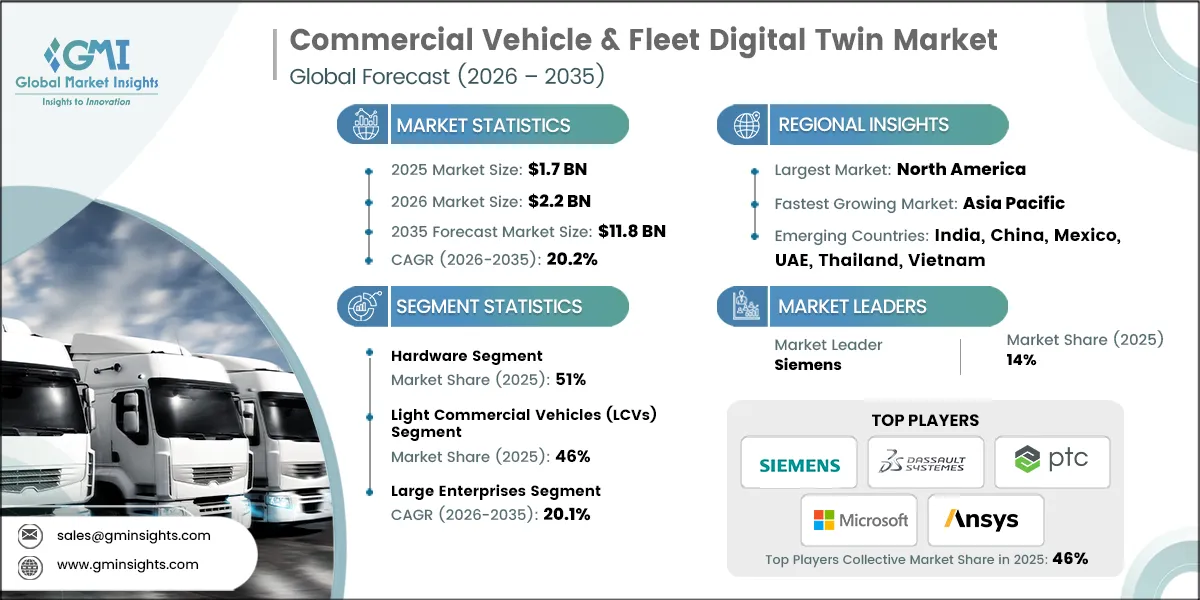
To get key market trends
Commercial Vehicle & Fleet Digital Twin Market Trends
The market is transforming due to stricter emissions regulations, fleet electrification, AI-driven analytics, and connected mobility. Fleet operators are adopting digital twin ecosystems that replicate real-time data, enabling a shift from reactive management to predictive and prescriptive optimization.
Subscription-based Digital Twin-as-a-Service (DTaaS) platforms are replacing traditional capital-intensive fleet management systems, reducing entry barriers for mid-sized logistics providers. These cloud-native platforms eliminate the need for costly IT infrastructure, offering flexible monthly subscriptions ranging from USD 10,000 to USD 150,000 based on fleet size, data complexity, and analytics needs.
Cloud-native architectures integrate telematics, IoT sensor data, GPS tracking, fuel usage, and battery diagnostics into unified fleet models. These platforms enable pay-per-use analytics and dynamic compute allocation, allowing operators to simulate scenarios instantly, reducing risks and improving decision-making for distributed fleets.
AI and machine learning are transforming predictive maintenance and performance optimization in fleet digital twins. Unlike traditional systems with fixed service intervals, digital twins analyze extensive data to predict component wear and failures. For electric commercial vehicles, battery digital twins optimize charging, monitor degradation, and support zero-emission transitions.
Hardware integration and edge computing are enhancing real-time fleet visibility. Advanced vehicle control units and IoT gateways synchronize with cloud-based twins in milliseconds, enabling near real-time validation of safety systems, load stability, and powertrain performance. This allows operators to virtually test updates and strategies before deploying them across live fleets.
Digital twin technology is transforming from a fleet monitoring tool to a lifecycle intelligence platform. By synchronizing data between physical vehicles and their digital counterparts, fleet operators can analyze inefficiencies, validate updates, and optimize ownership costs. This positions digital twins as a key enabler for autonomous, electric, and data-driven fleet ecosystems over the next decade.
Commercial Vehicle & Fleet Digital Twin Market Analysis
Learn more about the key segments shaping this market
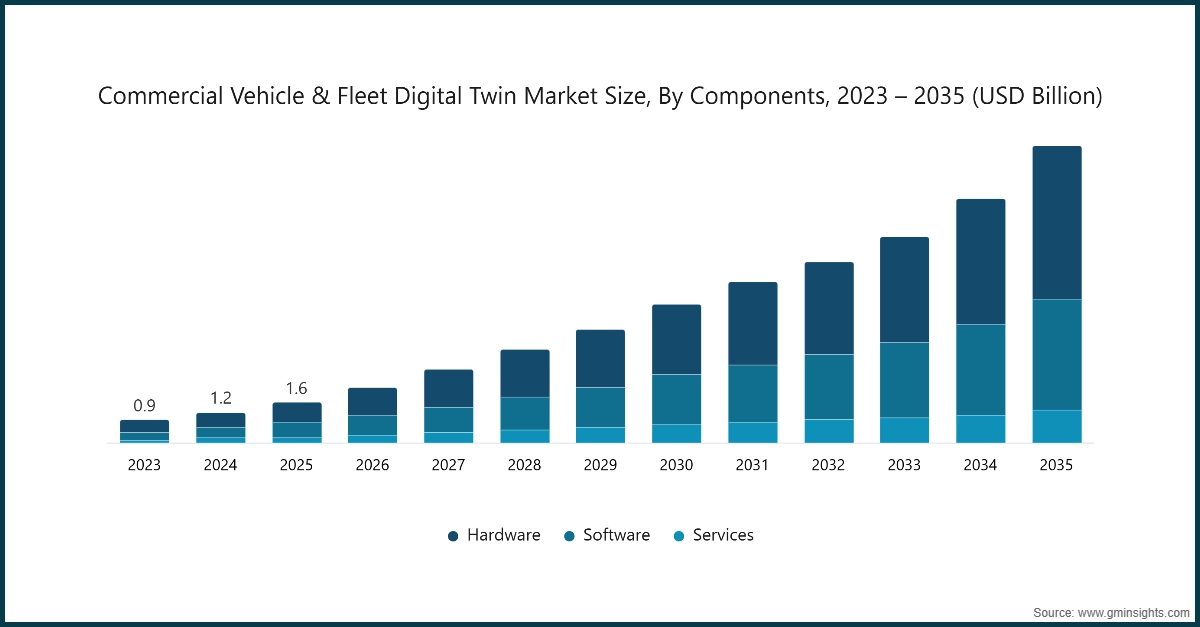
Based on components, commercial vehicle & fleet digital twin market is segmented into hardware, software and services each playing distinct but complementary roles in creating comprehensive digital twin ecosystems. The hardware segment dominates the market with 51% share in 2025, and the segment is expected to grow at a CAGR of 20.5% from 2026 to 2035.
- Commercial vehicle digital twin solutions utilize hardware components such as IoT sensors, telematics control units, edge computing devices, connectivity modules, cameras, LiDAR, radar sensors, and gateway devices for data aggregation and secure transmission.
- A commercial vehicle with digital twin monitoring typically features 15-25 sensor types, generating data at frequencies from once per minute to 10-50 Hz.
- Advancements in the hardware segment include multi-function sensor modules for cost-efficient installations, 5G-enabled telematics for real-time data applications, and edge AI accelerators for predictive maintenance and driver assistance.
- The hardware segment's growth is driven by declining sensor costs, increased factory-installed telematics, retrofitting fleets with aftermarket sensors for digital twins, and edge computing for real-time analytics.
- The software component includes digital twin platforms for virtual vehicle representation, simulation engines for modeling behavior, and analytics tools for actionable insights. It also comprises visualization tools, integration middleware, and AI/ML frameworks for predictive capabilities like failure prediction and performance optimization.
- The software segment experienced 20.9% growth in 2024, the highest growth rate among all component categories, reflecting the shift toward software-defined fleet management and the increasing sophistication of analytics capabilities demanded by customers.
- The software segment has advanced with cloud-native digital twin platforms offering scalability, generative AI for automated insights, and low-code/no-code tools for customizable analytics. Open API frameworks further enable third-party integrations and ecosystem growth.
- The services include implementing and integrating digital twin solutions with IT systems, consulting for digital transformation and ROI optimization, training for effective utilization, managed services by third-party providers, and ongoing technical support.
- In 2024, the services segment grew by 17.2%, driven by the complexity of digital twin implementations, a shortage of in-house expertise, and the preference for managed service models offering predictable operational costs.
Learn more about the key segments shaping this market
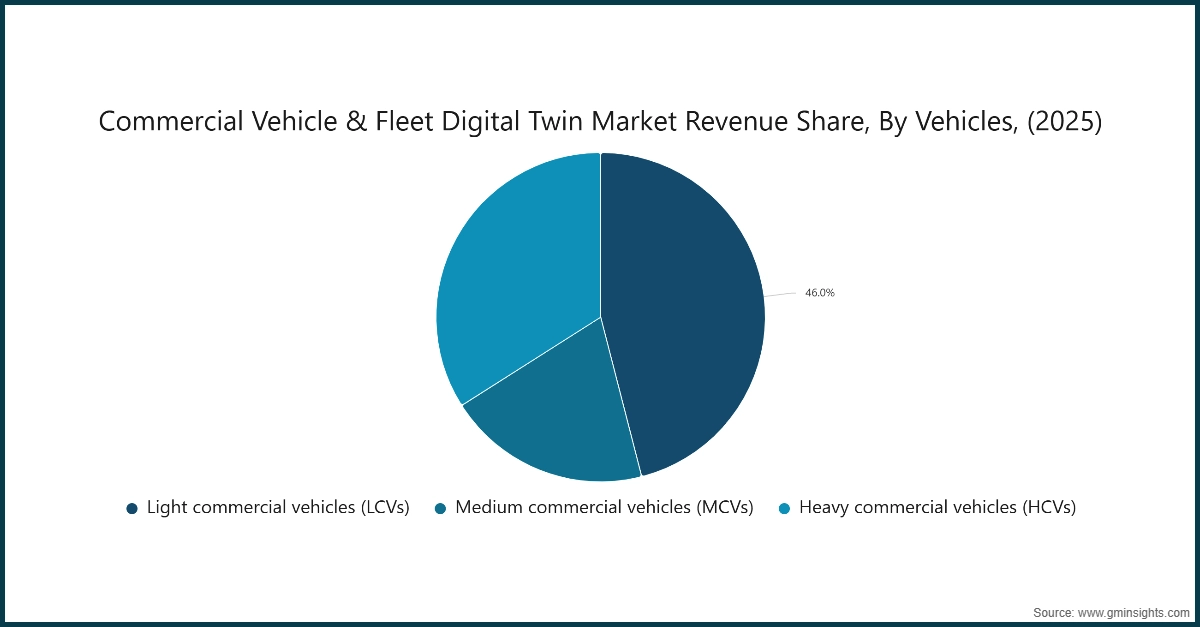
Based on vehicles, commercial vehicle & fleet digital twin market is divided into light commercial vehicles (LCVs), medium commercial vehicles (MCVs) and heavy commercial vehicles (HCVs). The light commercial vehicles (LCVs) segment dominates with 46% market share in 2025 and is growing at the rate of 20.2% CAGR.
- Light commercial vehicles, typically defined as vehicles with gross vehicle weight ratings between 3.5 and 7.5 metric tons and including delivery vans, pickup trucks, and small box trucks, dominated the market in 2025.
- The LCV segment is experiencing particularly strong adoption in urban delivery applications, where digital twins enable sophisticated multi-stop route optimization, delivery time window compliance monitoring, driver performance benchmarking, and vehicle allocation optimization based on package volume and delivery density.
- The electrification trend in LCV segments is particularly pronounced, with electric models representing approximately 8% of new LCV sales in Europe and 3.5% in North America during 2024 according to International energy agency.
- Managing electric LCVs involves addressing range limitations through route planning, optimizing charging schedules for cost and efficiency, and monitoring battery health and thermal performance to ensure operational reliability.
- Medium commercial vehicles, typically defined as vehicles with gross vehicle weights between 7.5 and 16 metric tons and including single-axle delivery trucks, box trucks, and stake bed trucks, represented 20% of market value in 2025.
- This segment serves diverse applications including regional distribution, furniture and appliance delivery, beverage distribution, construction material delivery, and municipal services such as street maintenance and tree trimming.
- Digital twin technology in MCV operations enables predictive maintenance for high-wear components, load optimization to maximize utilization within weight limits, driver performance monitoring to reduce fuel consumption and wear, and delivery compliance tracking for time-sensitive industries like retail and restaurant supply.
- Heavy commercial vehicles, defined as trucks with gross vehicle weights exceeding 16 metric tons and including line-haul tractors, heavy-duty straight trucks, and specialized haulers, accounted for 34% of market value in 2025.
Based on fleet size, the commercial vehicle & fleet digital twin market is segmented into large enterprises and small & medium enterprises (SMEs). The large enterprises segment dominates with 66% market share in 2025 with 20.1% CAGR during 2026 to 2035.
- In 2025, large enterprise fleets accounted for 66% of the market, valued at USD 1.1 billion. This was driven by their substantial technology budgets, advanced IT systems, and complex multi-regional operations.
- Large enterprises are implementing digital twin solutions across their fleets, integrating with ERP, TMS, WMS, and HR systems. They utilize cloud and edge computing for hybrid analytics while establishing centers of excellence with data science teams to extract actionable insights.
- Large fleet operators invest an average of USD 2,500-4,000 per vehicle in digital twin capabilities over five-year periods, significantly higher than SME spending levels of USD 800-1,500 per vehicle.
- Large enterprises are adopting centralized operations to manage geographically dispersed activities, requiring standardized processes and centralized visibility. They also rely on advanced analytics for network optimization and must address regulatory compliance and growing demands for sustainability reporting and carbon footprint reduction.
- Small and medium enterprise fleet operators represented 34% of market value in 2025 at USD 574.5 million, reflecting the massive number of SME fleet operators globally.
- SME fleets primarily operate within regional or local areas, focusing on specific industry verticals or services. They often lack dedicated IT staff or analytics capabilities and prioritize immediate operational needs over strategic technology initiatives.
- SMEs are adopting digital twins due to competitive pressure from larger rivals, affordable and easy-to-implement solutions, subscription-based pricing models reducing financial barriers, and user-friendly, mobile-first interfaces requiring no specialized training.
Based on deployment mode, the commercial vehicle & fleet digital twin market is divided between on-premises, cloud-based and hybrid. On premises dominate with 44% market share in 2025, and with a CAGR of 19.7% during forecast period.
- On-premises digital twin infrastructure continues to hold a significant share due to data sovereignty, intellectual property protection, and real-time fleet performance optimization requirements, even as cloud adoption accelerates.
- Commercial vehicle OEMs and fleet operators managing proprietary vehicle dynamics models, telematics data, and EV battery algorithms prefer on-premises deployments to minimize external data exposure and ensure deterministic system behavior.
- Cloud-based fleet digital twin platforms, especially those processing sensitive operational or personally identifiable driver data, face compliance challenges from GDPR in Europe, CCPA in the US, and China’s Data Security Law.
- Benchmarking by independent labs shows that on-premises HIL and fleet simulation systems achieve 30–50% lower computational latency compared with cloud-only deployments, critical for real-time predictive maintenance and autonomous fleet scenario validation.
- Cloud platforms provide capital expenditure relief, elastic compute scalability, and faster scenario iteration, supporting a projected 20.9% CAGR outperformance over the forecast period.
- Providers such as AWS, Microsoft Azure, and Google Cloud offer digital twin-as-a-service solutions, with pricing ranging from USD 5–20 per compute hour, depending on processor power, memory, and analytics complexity.
- Hybrid deployments combine on-premises infrastructure for hardware-in-the-loop testing, telematics integration, and algorithm development with cloud resources for scenario simulation, AI analytics, and multi-site collaboration.
- This hybrid model can deliver a 25–35% reduction in total cost of ownership compared with fully on-premises systems while preserving performance for safety-critical fleet operations.
- Hybrid adoption is primarily among established OEMs and large fleet operators with significant existing infrastructure, strict data governance, and high operational reliability requirements.
- Effective hybrid deployment requires dynamic workload orchestration, directing tasks to either on-premises or cloud environments based on compute intensity, data sensitivity, latency requirements, and cost efficiency.
Looking for region specific data?
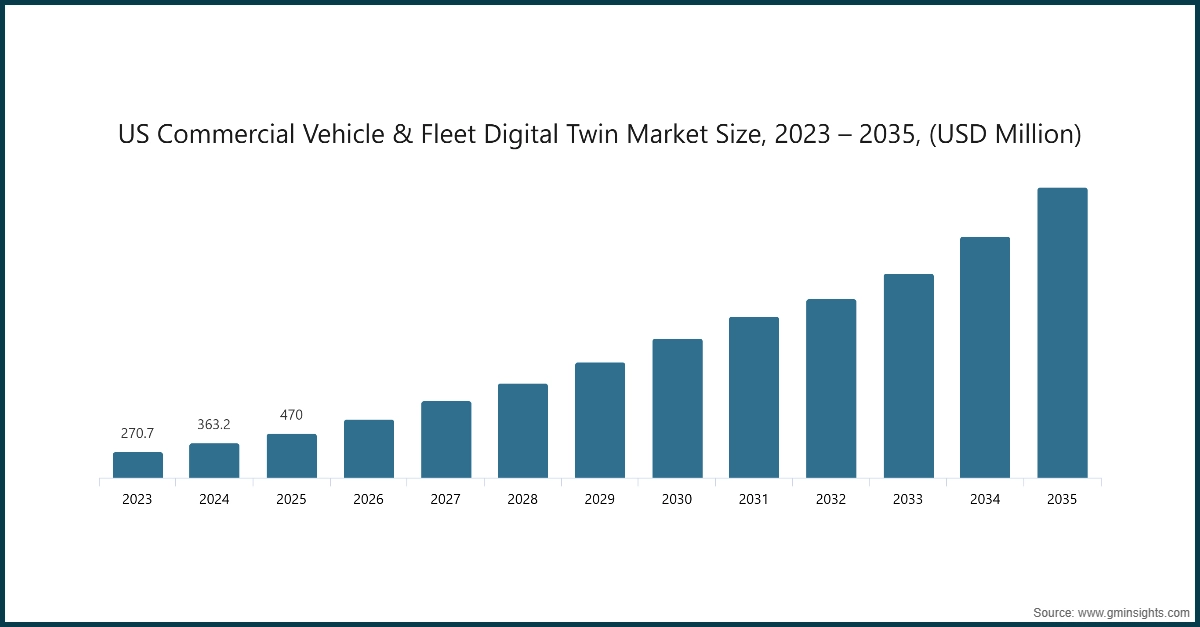
US dominated North America commercial vehicle & fleet digital twin market, generating revenue of USD 470 million in 2025 with CAGR of 19.5% during the forecasted timeframe from 2026 to 2035.
- The US leads the market globally, driven by strict emissions regulations, fleet electrification mandates, and AI-powered fleet analytics adoption.
- Highway and long-haul logistics trends in the US are driving fleet operators and OEMs to adopt digital twin platforms. These systems enable real-time monitoring, predictive maintenance, and performance optimization for commercial vehicle fleets.
- For instance, in March 2025, over 50 logistics companies in California adopted cloud-native digital twin solutions. These solutions optimize more than 20,000 vehicle routes, improving battery usage and load efficiency in real time.
- Texas and Arizona are emerging as key hubs for digital twin innovations, driven by expanding telematics infrastructure, permissive pilot programs, and global OEMs' engineering centers. Companies are leveraging simulation environments to test fleet electrification, autonomous features, and predictive maintenance before deployment.
- In the US, the adoption of Digital Twin-as-a-Service (DTaaS) platforms has lowered capital barriers for mid-sized fleets. These subscription-based platforms integrate telematics, IoT sensor data, GPS, and diagnostics, enabling scenario simulations and pay-per-use analytics for operational efficiency.
- In February 2025, Waabi partnered with Volvo Trucks to integrate its virtual driver and fleet digital twin system into autonomous heavy trucks, enabling predictive maintenance, route optimization, and performance monitoring.
- Similarly, in May 2025, Intangles launched its AI-driven fleet digital twin platform to enhance predictive maintenance and operational efficiency for mid-sized logistics fleets in North America.
North America dominated the commercial vehicle & fleet digital twin market accounting for USD 581.3 million in 2025 and is anticipated to show growth of 19.7% CAGR over the forecast period.
- The region leads due to its focus on fleet electrification programs, strict vehicle emissions and safety regulations, advanced digital twin technology providers, and significant government funding for smart mobility initiatives.
- In 2025, North America is expected to generate 839.8 million in regional revenue, with the United States contributing 81% and Canada 19%. This growth is driven by the early adoption of DTaaS platforms and AI-enabled predictive fleet management.
- Canada's commercial vehicle & fleet digital twin market is expected to grow at a 20.4% CAGR, surpassing the US. This growth is driven by autonomous public transit initiatives, research tax incentives, and increased adoption of simulation-based fleet optimization tools.
- In 2024 and 2025, the Canadian government's Strategic Innovation Fund allocated CAD 150 million (USD 110 million) to autonomous mobility and fleet digital twin projects, focusing on scenario simulation, predictive maintenance modeling, and EV integration.
- In March 2025, Ontario expanded its autonomous vehicle pilot program to include Level 4 trucks and commercial vehicles on 1,500 kilometers of designated highways. This expansion is expected to drive demand for digital twin-based scenario validation and predictive maintenance simulations.
- Canada's automotive and fleet sector heavily utilizes digital twin simulation, with key suppliers like Magna International and Linamar Corporation developing ADAS, battery management, and fleet optimization components for North American and global OEMs.
The commercial vehicle & fleet digital twin market in China is expected to experience significant and promising growth with a CAGR of 22.4% from 2026 to 2035.
- China's government is expediting the market under its national ICV strategy, aiming to enhance autonomous, electric, and data-driven fleet ecosystems.
- The goal is to achieve 50% penetration of Level 2+ commercial vehicles by 2025 and advance Level 3 fleet deployments by 2030, boosting demand for predictive maintenance, route optimization, and scenario simulation via digital twin platforms.
- For instance, in January 2025, the ministry of industry and information technology (MIIT) introduced updated ICV standards. These standards mandate simulation-based validation for assisted driving and fleet operation features.
- In China's competitive domestic market, manufacturers such as BYD, NIO, XPeng, and Li Auto are utilizing advanced driver-assistance systems (ADAS) and digital twin technologies to improve vehicle performance, safety, and energy efficiency.
- Local providers such as Tencent Cloud, Baidu Apollo, and 51Sim are expanding their market share by integrating digital twin platforms with domestic telematics systems. International vendors complement this growth with expertise in sensor modeling, scenario coverage, and cloud simulations.
- China's data security law and personal information protection law mandate that digital twin simulation platforms handling driving and fleet data localize infrastructure domestically, ensuring compliance with export restrictions and secure data management.
- For instance, in April 2025, the Cyberspace Administration of China (CAC) introduced regulations for connected vehicle data management, emphasizing the necessity of compliant cloud-native digital twin platforms.
Asia Pacific commercial vehicle & fleet digital twin market is anticipated to grow at a CAGR of 23.1% during the analysis timeframe.
- The Asia-Pacific market is growing rapidly, driven by increasing EV production, strong domestic automotive industries, and government-backed smart mobility initiatives.
- Driven by large-scale infrastructure investments, smart-city initiatives, and V2X pilot corridors, OEMs and Tier-1 suppliers are adopting cloud-native digital twin platforms and hardware-in-the-loop ADAS simulation systems. These technologies enable fleet optimization, predictive maintenance, and scenario validation.
- China, the region's largest automotive production hub, is driving demand for digital twin and simulation platforms to enhance electric and intelligent vehicle functions, ADAS, and fleet electrification programs.
- Japan's automotive market is highly developed, with companies like Toyota, Honda, and Nissan utilizing advanced digital twin and simulation technologies.
- For instance, in March 2025, the Ministry of Land, Infrastructure, Transport and Tourism (MLIT) introduced Level 4 testing guidelines requiring simulation-based validation for fleet and ADAS functions.
- South Korea is rapidly adopting ADAS and digital twin technologies, driven by Hyundai Motor Group's investments in electrification and autonomous vehicles. For instance, in February 2025, the government designated 330 kilometers of highways as autonomous vehicle priority zones to expedite simulation-validated system approvals.
- India's commercial vehicle simulation market is growing, driven by companies like Tata Motors and Mahindra & Mahindra integrating ADAS and digital twin technologies. The PLI scheme for the automotive sector supports this growth by incentivizing advanced technology adoption, including simulation capabilities.
Germany dominates the Europe commercial vehicle & fleet digital twin market, showcasing strong growth potential, with a CAGR of 18.7% from 2026 to 2035.
- Germany leads the European market, driven by significant investments from OEMs like BMW, Mercedes-Benz, Audi, and Volkswagen in digital twin platforms, predictive fleet analytics, and virtual validation for autonomous and electric commercial vehicles.
- German federal transport authorities and EU homologation frameworks are urging OEMs and fleet operators to strengthen digital twin and simulation programs. This initiative focuses on meeting safety standards, emissions regulations, and faster software release cycles.
- The growing adoption of advanced vehicle technologies by German fleet operators and commercial vehicle consumers is driving demand for digital twin solutions. OEMs and Tier-1 suppliers use these solutions to validate complex ADAS and electrification features across various operational scenarios, including highways, urban areas, and mixed-use logistics routes.
- Germany's EV infrastructure expansion and electrification strategies are increasing the demand for cloud-based fleet digital twin platforms. These platforms provide real-time monitoring, predictive analytics, and virtual scenario testing for autonomous, hybrid, and electric commercial vehicles.
Europe commercial vehicle & fleet digital twin industry accounted for USD 505 million in 2025 and is anticipated to show growth of 18.3% CAGR over the forecast period.
- The European market is driven by stringent safety and emissions regulations, advanced domestic engineering expertise, and the growing adoption of connected vehicle and electrified fleet infrastructure.
- The mandatory implementation of UNECE R155 and R156 regulations in July 2024 is accelerating the use of digital twin and simulation platforms for cybersecurity, software-update testing, and predictive maintenance validation before vehicle and fleet approval.
- European standardization bodies and research consortia are advancing V2X, cooperative driving, and fleet electrification frameworks. This requires OEMs and fleet operators to simulate vehicle-to-vehicle and vehicle-to-infrastructure interactions in synthetic scenarios before commercial deployment.
- Germany, the UK, France, Italy, Spain, and Nordic countries display varying adoption levels of fleet digital twin and ADAS simulation platforms, driven by differences in automotive industry maturity, regulatory priorities, and electrification initiatives.
- The UK market features a strong network of simulation software providers, such as rFpro and Ansible Motion, alongside motorsport engineering expertise advancing fleet digital twin and ADAS applications.
- Nordic countries, including Sweden, Norway, and Finland, exhibit high simulation adoption due to government autonomous vehicle programs, stringent winter testing needs, and early fleet electrification efforts.
- Spain and Italy have lower penetration due to smaller automotive sectors and limited autonomous vehicle activity. However, EU cohesion funding is driving advancements in digital twin capabilities and ADAS simulation adoption for commercial fleets.
Brazil leads the Latin American commercial vehicle & fleet digital twin market, exhibiting remarkable growth of 21.6% during the forecast period of 2026 to 2035.
- Brazil dominates the Latin American market, driven by strong automotive production, expanding EV programs, road safety initiatives, and investments in connected and autonomous vehicle R&D.
- The 2024–2027 mandate for emergency braking systems in trucks and buses is driving Brazil's adoption of digital twin and simulation platforms, as OEMs and fleet operators require virtual validation to meet evolving safety standards.
- For instance, in February 2025, the Brazilian National Traffic Council (CONTRAN) implemented updated vehicle safety regulations. These included ADAS testing protocols based on European standards, driving demand for fleet digital twin and scenario simulation platforms.
- Brazil's market growth is fueled by regulatory compliance, electrification, and agricultural fleet modernization, establishing digital twins as essential for safer and more efficient commercial fleets in Latin America.
UAE to experience substantial growth in the Middle East and Africa commercial vehicle & fleet digital twin market in 2025.
- The UAE dominates Middle Eastern demand for commercial vehicle & fleet digital twin platforms, driven by high income levels, advanced infrastructure, and strong government support for autonomous and connected fleets.
- The strong demand for premium and luxury commercial vehicles in Gulf markets drives OEMs and Tier-1 suppliers to invest in cloud-based digital twin platforms and virtual validation programs for ADAS and autonomous fleet operations.
- The UAE logistics sector is adopting digital twin technology for fleet management, with operators like DHL, FedEx, and Aramex integrating collision avoidance, lane-keeping, and predictive maintenance systems into virtual fleet models.
- For instance, in March 2025, the Abu Dhabi Department of Transport introduced updated connected vehicle infrastructure standards, requiring digital twin technology and simulation-based validation for fleet and ADAS systems before deployment.
- International OEMs and technology providers are utilizing the UAE’s extreme climate and operational conditions to validate fleet digital twin simulations and ADAS performance. The absence of domestic automotive manufacturing further enables the establishment of testing and R&D hubs in the region.
- The UAE's market growth is driven by government initiatives, premium fleet adoption, logistics modernization, and climate-specific testing. These advancements establish digital twin platforms as critical for safe and efficient commercial fleet operations in the Middle East.
Commercial Vehicle & Fleet Digital Twin Market Share
The top 7 companies in the commercial vehicle & fleet digital twin industry are Siemens, Microsoft, PTC, Dassault Systems, ANSYS, Hexagon and IBM contributed around 55% of the market in 2025.
- Siemens strengthens its leadership in the market through its Simcenter portfolio, which integrates model-based systems engineering, multi-physics simulation, and closed-loop fleet validation. In January 2025, Siemens expanded its AI-driven digital twin capabilities by acquiring a startup specializing in ADAS and fleet scenario generation.
- Microsoft utilizes Azure Digital Twins to offer cloud-native fleet digital twin solutions, integrating telematics, IoT sensors, GPS, fuel/battery data, and AI-driven analytics. In February 2025, it partnered with a North American logistics operator to implement real-time fleet simulation and predictive maintenance modeling for mid-sized and large fleets.
- PTC utilizes its ThingWorx platform to deliver digital twin solutions for commercial vehicles, focusing on IoT connectivity, vehicle health monitoring, and predictive maintenance. In March 2025, it expanded to include ADAS scenario simulations and real-time fleet optimization for European logistics providers.
- Dassault Systems delivers 3DEXPERIENCE-based virtual twin solutions for fleet lifecycle management, combining multi-physics simulation, route optimization, and battery health monitoring. In April 2025, Dassault introduced a fleet operations module enabling predictive maintenance, EV battery simulation, and operational scenario testing for commercial and logistics fleets.
- ANSYS specializes in high-fidelity physics and sensor simulations, aiding in the validation of ADAS, LiDAR, and camera systems for commercial vehicles. Its VRXPERIENCE platform allows fleet operators to simulate complex scenarios, including vehicle dynamics, EV powertrain performance, and autonomous driving under extreme conditions.
- Hexagon focuses on fleet digital twin solutions for logistics and heavy-duty vehicles. In May 2025, it partnered with Brazilian agricultural and commercial fleet operators to deploy digital twin simulations, enhancing vehicle safety and operational efficiency.
- IBM utilizes Watson IoT and Maximo Asset Performance Management to enhance AI-driven fleet optimization by analyzing telematics data, simulating scenarios, and predicting component wear. In February 2025, IBM partnered with a European EV fleet provider to deploy cloud-native digital twin models, improving battery management, route optimization, and fleet efficiency.
Commercial Vehicle & Fleet Digital Twin Market Companies
Major players operating in commercial vehicle & fleet digital twin industry are:
- ANSYS
- Dassault Systems
- Descartes Systems
- General Electric (GE Digital)
- Hexagon
- IBM
- Microsoft
- NVIDIA
- PTC
- Siemens
- ANSYS, Dassault Systems, Descartes Systems, General Electric (GE Digital), Hexagon, IBM, Microsoft, NVIDIA, PTC, and Siemens lead the commercial vehicle & fleet digital twin market. These companies provide comprehensive digital twin platforms and simulation tools, enabling OEMs, fleet operators, and Tier-1 suppliers to develop, validate, and optimize commercial vehicles and fleet operations efficiently.
- These vendors enhance digital twin solutions by offering AI-driven scenario analysis, predictive maintenance modeling, high-fidelity vehicle and sensor simulations, SiL and HiL integration, cloud-native deployment, and lifecycle optimization. Their platforms allow fleet operators to simulate EV battery performance, route optimization, load management, and autonomous driving functions in virtual environments before live deployment.
- The market is expanding rapidly due to the increasing adoption of electric, autonomous, and connected commercial vehicles, stricter safety and emissions regulations, and the growing need for cost-effective fleet management and testing solutions.
Commercial Vehicle & Fleet Digital Twin Market Report Attributes
| Key Takeaway | Details |
|---|---|
| Market Size & Growth | |
| Base Year | 2025 |
| Market Size in 2025 | USD 1.7 Billion |
| Market Size in 2026 | USD 2.2 Billion |
| Forecast Period 2026-2035 CAGR | 20.2% |
| Market Size in 2035 | USD 11.8 Billion |
| Key Market Trends | |
| Drivers | Impact |
| Increasing adoption of IoT & connected vehicle technology | Enables real-time data integration into digital twin platforms, improving vehicle performance monitoring, diagnostics, and remote fleet management capabilities. |
| Rising demand for predictive maintenance solutions | Drives deployment of digital twins to forecast component failures, reduce downtime, and optimize maintenance schedules across large fleets. |
| Regulatory push for fleet safety & emissions reduction | Encourages use of digital twins for continuous compliance monitoring, emissions tracking, and safety performance validation. |
| Growing focus on fleet operational efficiency | Promotes simulation-based route optimization, fuel management, and asset utilization to lower operating costs and improve productivity. |
| Accelerating electric vehicle fleet adoption | Increases need for battery health modeling, charging infrastructure simulation, and TCO analysis through advanced digital twin systems. |
| Pitfalls & Challenges | Impact |
| High initial implementation costs | Significant upfront investment in IoT infrastructure, cloud platforms, sensors, and integration services can limit adoption among small and mid-sized fleet operators. |
| Data privacy & security concerns | Risks related to cyberattacks, data breaches, and unauthorized access to fleet operational data may slow deployment and require additional cybersecurity investments. |
| Opportunities: | Impact |
| Expansion in emerging markets | Growing logistics, infrastructure development, and digitalization initiatives in emerging economies create new demand for fleet digital twin deployment. |
| Integration with autonomous vehicle development | Supports real-time performance monitoring and validation of autonomous commercial vehicles, unlocking advanced fleet optimization capabilities. |
| Scenario planning for fleet electrification | Enables simulation of EV transition strategies, charging infrastructure planning, and total cost of ownership modeling for large fleets. |
| Development of industry-specific solutions | Tailored digital twin platforms for sectors such as mining, construction, cold chain, and public transport expand market penetration and specialized revenue streams. |
| Market Leaders (2025) | |
| Market Leader |
14% Market Share |
| Top Players |
Collective Market Share is 46% |
| Competitive Edge |
|
| Regional Insights | |
| Largest Market | North America |
| Fastest growing market | Asia Pacific |
| Emerging countries | India, China, Mexico, UAE, Thailand, Vietnam |
| Future outlook |
|
What are the growth opportunities in this market?
Commercial Vehicle & Fleet Digital Twin Industry News
- In March 2025, Microsoft Azure introduced an automotive industry accelerator package with reference architectures, pre-built digital twin models for commercial vehicles, and integration templates for leading fleet management systems.
- In February 2025, PTC released a major platform update featuring enhanced edge computing capabilities, automated AI model deployment, and improved cloud analytics integration. The release targets commercial vehicle applications with pre-built analytics for predictive maintenance of common failure modes.
- In January 2025, Siemens AG and NVIDIA Corporation announced an expanded partnership to integrate advanced simulation capabilities with digital twin platforms, enabling photorealistic virtual environments for commercial vehicle development.
The commercial vehicle & fleet digital twin market research report includes in-depth coverage of the industry with estimates & forecasts in terms of revenue (USD Bn) and shipments (Units) from 2022 to 2035, for the following segments:
Market, By Components
- Hardware
- IoT sensors & telematics devices
- Onboard computing units
- GPS and connectivity modules
- Software
- Digital twin platform & simulation software
- Fleet management and analytics software
- Predictive maintenance & operational optimization software
- Services
- Professional services
- Managed services
Market, By Vehicles
- Light commercial vehicles (LCVs)
- Medium commercial vehicles (MCVs)
- Heavy commercial vehicles (HCVs)
Market, By Fleet Size
- Large enterprises
- Small & medium enterprises (SMEs)
Market, By Deployment Mode
- On premises
- Cloud-based
- Hybrid
Market, By End Use
- OEMs
- Fleet operators & logistics companies
- Tier 1 & Tier 2 suppliers
- Automotive software & technology providers
- Aftermarket & service centers
- Others
The above information is provided for the following regions and countries:
- North America
- US
- Canada
- Europe
- Germany
- UK
- France
- Italy
- Spain
- Russia
- Netherlands
- Sweden
- Denmark
- Poland
- Asia Pacific
- China
- India
- Japan
- Australia
- South Korea
- Singapore
- Thailand
- Indonesia
- Vietnam
- Latin America
- Brazil
- Mexico
- Argentina
- Colombia
- MEA
- South Africa
- Saudi Arabia
- UAE
- Israel
Frequently Asked Question(FAQ) :
Who are the key players in the commercial vehicle & fleet digital twin industry?
Leading companies include Siemens, Microsoft, PTC, Dassault Systems, ANSYS, Hexagon, and IBM, collectively contributing a significant share of the global market through advanced simulation, IoT integration, and AI-driven fleet optimization platforms.
What are the key trends in the commercial vehicle & fleet digital twin industry?
Key trends include adoption of Digital Twin-as-a-Service (DTaaS) platforms, integration of AI and machine learning for predictive maintenance, battery health modeling for electric fleets, and hybrid cloud deployments for scalable simulation and analytics.
How much revenue did the US commercial vehicle & fleet digital twin market generate in 2025?
The U.S. market generated USD 470 million in 2025 and is projected to grow at a CAGR of 19.5% through 2035. Growth is fueled by AI-powered fleet analytics adoption, electrification mandates, and expansion of autonomous trucking pilots.
Which region leads the commercial vehicle & fleet digital twin industry?
North America generated USD 581.3 million in 2025 and is expected to grow at a CAGR of 19.7% over the forecast period. Growth is driven by early adoption of Digital Twin-as-a-Service (DTaaS), strict safety and emissions regulations, and rapid fleet electrification programs.
What was the valuation of the on-premises deployment segment in 2025?
The commercial vehicle & fleet digital twin market from on-premises deployment held 44% share in 2025 and is projected to grow at a CAGR of 19.7% during the forecast period. Adoption remains strong due to data sovereignty requirements, intellectual property protection, and low-latency performance for real-time fleet simulations.
What was the growth performance of the software segment in commercial vehicle & fleet digital twin industry?
The software segment recorded the highest growth of 20.9% in 2024, reflecting the rapid transition toward software-defined fleet management, AI-driven analytics, and scalable cloud-native digital twin platforms.
How much revenue did large enterprises account for in 2025?
The Large enterprises accounted for 66% of the commercial vehicle & fleet digital twin market in 2025, generating USD 1.1 billion in revenue. Growth is supported by strong IT budgets, multi-regional fleet operations, and integration of digital twins with ERP, TMS, and analytics systems.
How much revenue did the hardware segment generate in commercial vehicle & fleet digital twin market in 2025?
The hardware segment dominated the market with a 51% share in 2025 and is projected to grow at a CAGR of 20.5% through 2035, supported by expanding deployment of IoT sensors, telematics control units, and edge computing devices in commercial fleets.
What is the projected value of the commercial vehicle & fleet digital twin market by 2035?
The commercial vehicle & fleet digital twin industry is expected to reach USD 11.8 billion by 2035, growing at a CAGR of 20.2% from 2026 to 2035 due to increasing electrification, autonomous fleet deployment, and demand for predictive maintenance solutions.
What is the market size of the commercial vehicle & fleet digital twin market in 2025?
The market size fo commercial vehicle & fleet digital twin was valued at USD 1.7 billion in 2025, driven by rising adoption of connected fleet technologies and AI-powered simulation platforms.
What is the market size of the commercial vehicle & fleet digital twin market in 2026?
The market is projected to reach USD 2.2 billion in 2026, reflecting accelerated investments in IoT-enabled fleet infrastructure and cloud-based digital twin platforms.
Commercial Vehicle & Fleet Digital Twin Market Scope
Related Reports