Summary
Table of Content

Commercial Vehicle ADAS Market
Get a free sample of this report
Form submitted successfully!
Error submitting form. Please try again.
Thank you!
Your inquiry has been received. Our team will reach out to you with the required details via email. To ensure that you don't miss their response, kindly remember to check your spam folder as well!
Request Sectional Data
Thank you!
Your inquiry has been received. Our team will reach out to you with the required details via email. To ensure that you don't miss their response, kindly remember to check your spam folder as well!
Form submitted successfully!
Error submitting form. Please try again.
Commercial Vehicle ADAS Market Size
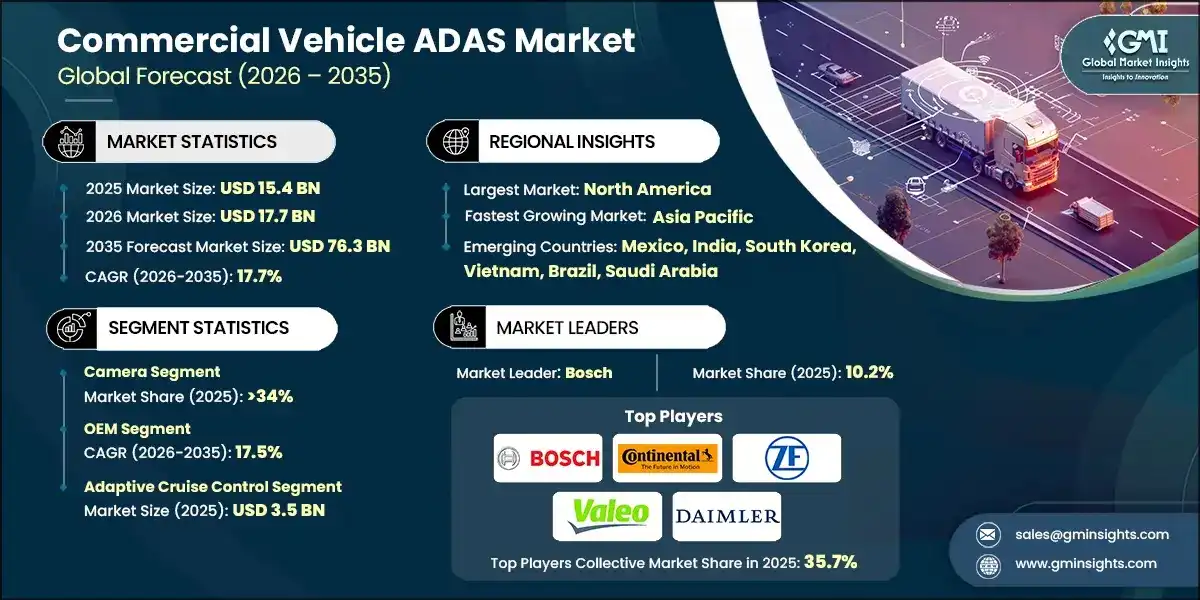
The global commercial vehicle ADAS market was valued at USD 15.4 billion in 2025. The market is expected to grow from USD 17.7 billion in 2026 to USD 76.3 billion in 2035 at a CAGR of 17.7%, according to latest report published by Global Market Insights Inc.
Commercial Vehicle ADAS Market Key Takeaways
Market Size & Growth
- 2025 Market Size: USD 15.4 Billion
- 2026 Market Size: USD 17.7 Billion
- 2035 Forecast Market Size: USD 76.3 Billion
- CAGR (2026–2035): 17.7%
Regional Dominance
- Largest Market: North America
- Fastest Growing Region: Asia Pacific
Key Market Drivers
- Stringent Government Safety Regulations for Commercial Vehicles.
- Rising Road Accidents Involving Heavy and Commercial Vehicles.
- Growing Adoption of Fleet Safety and Telematics Solutions.
- Rapid Growth of E-commerce and Last-Mile Delivery Fleets.
Challenges
- Reliability Issues in Harsh Weather and Road Conditions.
- Complexity in Retrofitting ADAS in Existing Vehicles.
Opportunity
- Increasing Demand for ADAS in Electric and Connected Commercial Vehicles.
- Growth Potential in Emerging Markets and Developing Economies.
- Integration of ADAS with Vehicle-to-Everything (V2X) Communication Systems.
- Expansion of ADAS Retrofitting Solutions for Aging Fleets.
Key Players
- Market Leader: Bosch led with over 10.2% market share in 2025.
- Leading Players: Top 5 players in this market include Bosch, Continental, ZF, Valeo, Daimler, which collectively held a market share of 35.7% in 2025.
Get Market Insights & Growth Opportunities
The growing push for and adoption of road safety measures is one of the major reasons leading to the growing demand for integration of advanced driver assistance systems (ADAS) in commercial vehicles segment.
ADAS helps drivers to identify pedestrians, avoid collisions, and get lane assistance and monitoring in situations like sleep or uncertain health issues. Its growing popularity among truck and bus drivers has gained too much since its inception.
In this year to date, over 3,850 patents have been filed on Advanced Driver Assistance Systems (ADAS). It is up about 10% compared to 2024. Such increasing numbers every year reflect how key players are seeing potential opportunities with ADAS in the coming years.
In recent years, the U.S. has reported between 143,000 and 166,000 truck accidents annually, according to FMCSA. Trucks were involved in about 6% of these accidents. Due to the rise in road accidents, fleet operators and governments are adopting Advanced Driver-Assistance Systems (ADAS) to help reduce such incidents.
Similarly, the EU reported that in 2024, 19,940 people lost their lives in road crashes across the EU. This represents a 2% decrease compared to 2023. The main reason behind this decrease is the region’s view on the improvement in vehicle safety.
In regions such as North America, Europe, and parts of Asia, fleet operators are required to have systems that can monitor driver fatigue and distraction, such as a driver monitoring system (DMS). DMS systems help drivers to be alert in case they feel sleepy or distracted, thus avoiding chances of any accidents or mishaps due to this human error. Such factors are thus contributing to the demand for ADAS in commercial vehicles.
To get key market trends
Commercial Vehicle ADAS Market Trends
AI and ML are being integrated into ADAS as it helps improve various functions of commercial vehicles. This integration of AI and ML is expected to help process real time data which will be helpful for making timely decisions and thus improve the working status of vehicles. This will thus improve the safety of vehicles and reduce the risk of accidents resulting from human errors.
For instance, in October 2025, Gauzy launched its new Smart-Vision Camera Monitor System (CMS) for buses and coaches. This advanced driver assistance system (ADAS), with AI-powered safety features, is displayed at Gauzy’s Booth 711 in Hall 7 and on four buses at Yutong’s Booth 305 in Hall 3.
Moreover, Vehicle-to-Everything (V2X) is growing into a significant vehicle technology trend as it enables communication between commercial vehicles and other vehicles, infrastructure, and cloud networks. V2X helps with enhanced situational awareness, thus helping vehicles to understand traffic, hazards, and other conditions, thus improving safety and operational efficiency for fleet management.
Qualcomm Technologies in September 2025 partnered with the BMW to launch a new automated driving (AD) system in the BMW iX3. This system is the result of three years of collaboration. The BMW iX3 also includes Qualcomm's V2X 200 chipset, which improves vehicle-to-everything (V2X) communication for better safety. V2X communication helps vehicles detect risks beyond what ADAS sensors can see. It reduces collisions by allowing vehicles to directly communicate with their surroundings, such as road infrastructure, pedestrians, and other vehicles.
Overall, growing concerns about driver safety are increasing the demand for driver monitoring and fatigue detection systems in Advanced Driver-Assistance Systems (ADAS). These systems have shown clear benefits, leading to higher demand for components such as cameras, infrared sensors, and biometric devices.
Commercial Vehicle ADAS Market Analysis
Learn more about the key segments shaping this market
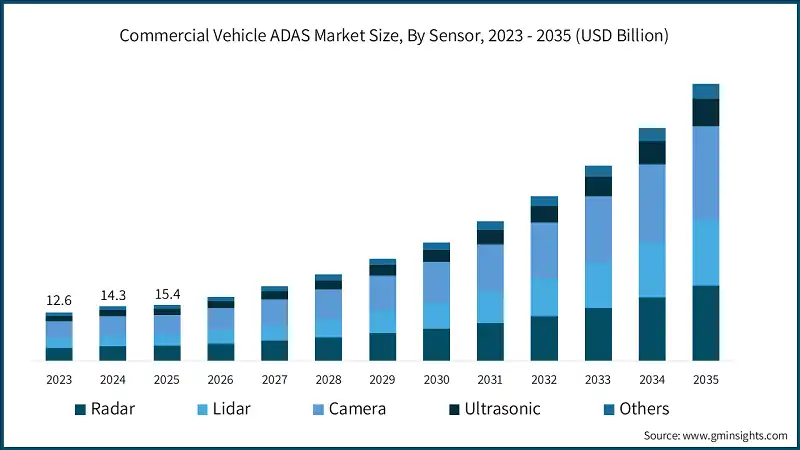
Based on sensor, the market is segmented into radar, LiDAR, ultrasonic, camera, and others. In 2025, the camera segment held a market share of over 34% and was valued at around USD 5.3 billion.
- Image sensors support various vision-based ADAS functions that include lane departure warnings, traffic sign recognition, borderline pedestrian detection, and forward collision warning systems. These functions are achieved through the real time video capturing and processing services for safer navigation which contributes to the demand for image sensors in ADAS systems.
- In September 2024, Euler Motors launched an electric LCV called Storm EV in India. The launched vehicle is priced at USD 10,324 and it marks a significant advancement in the LCV segment as it is the first electric LCV in the country which is equipped with ADAS. Storm EV is equipped with features such as night vision system, front and rear camera collision alerts, and traffic light alerts. These features improve visibility and safety, especially during nighttime operation.
- Heavy commercial vehicles are increasingly adopting advanced driver-assistance systems for increasing their safety features. This is being done through the adoption of driving image sensors that provide 360-degree surround view cameras with high dynamic range imaging and night vision enablement which make these devices effective during low light or poor weather conditions.
- Image sensors are less expensive and more readily available, thus making it easy to integrate into commercial vehicles. This also makes them a preferred option for commercial vehicle manufacturers aiming to competitively price their ADAS-enabled vehicles.
Learn more about the key segments shaping this market
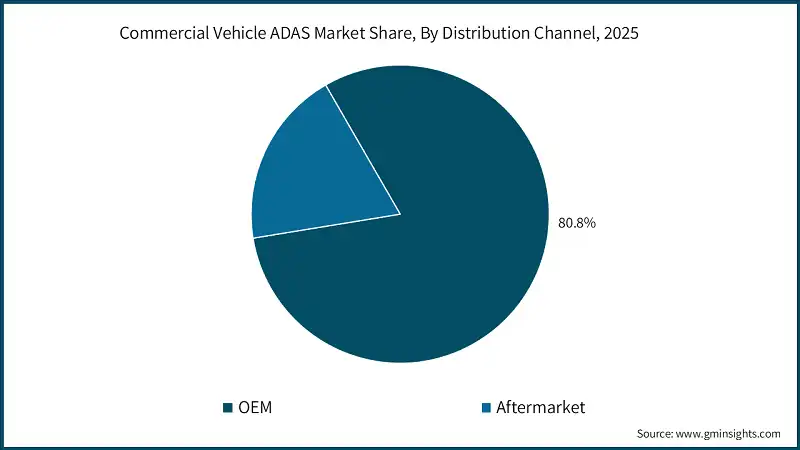
Based on distribution channel, the commercial vehicle ADAS market is divided into OEM and aftermarket. The OEM segment is expected to grow at a CAGR of 17.5% between 2026 and 2035.
- OEMs design, develop, and manufacture vehicles from scratch and integrate systems such as ADAS at the manufacturing stage itself. This ensures that vehicles can be made available with advanced safety features such as standard or optional equipment. This is primarily the reason as to why the OEM segment dominates the distribution channel for ADAS.
- Ashok Leyland introduced The Saathi as its new entry-level light commercial vehicle in January 2025 at the Bharat Mobility Global Expo 2025. The Saathi is equipped with a 1.5-liter, 3-cylinder turbocharged diesel engine with intercooler that boasts an impressive 45 HP of power along with 110 Nm of torque. It is also equipped with rear parking sensors for improved safety during reverse actions.
- Fleet operators and other commercial vehicle buyers usually prefer fully integrated solutions, which include in-built ADAS systems. This one-stop-shop capability fuels the demand of ADAS technologies with other vehicle features, strengthening OEMs position as a distributor channel for ADAS.
- OEMs provide extended support and maintenance of ADAS along with regular services through its partnership with fleet operators. This ongoing relationship enables enhanced satisfaction for the OEMs and positions them as the preferred distribution channel because they provide more comprehensive solutions, unlike aftermarket providers.
Based on system, the commercial vehicle ADAS market is divided into adaptive cruise control, blind spot detection, lane departure warning system, automatic emergency braking, forward collision warning, night vision system, driver monitoring, tire pressure monitoring system, head-up display, park assist system, and others. The adaptive cruise control segment held a major market share in this segment in 2025.
- In 2025, the adaptive cruise control segment is valued at USD 3.5 billion, which continues to be a dominant segment in the commercial vehicle ADAS market. The advanced driver assistance system for adaptive cruise control (ACC) offers comfort and convenience to all drivers, particularly during long-distance journeys. It enables automatic speed adjustments in accordance with the speed of the vehicles in front.
- With reduced driver workload, it is highly beneficial for the heavy commercial vehicle segment which is mainly used for long hours of monotonic driving.
- ACC operates and is integrated with other advanced driver-assistance systems such as lane management, collision mitigation, and autonomous emergency braking. Such combinations improve the vehicle functioning.
- These multi-feature ADAS systems working together enable ACC to enhance and promote the safety and operational effectiveness of commercial vehicles.
Looking for region specific data?
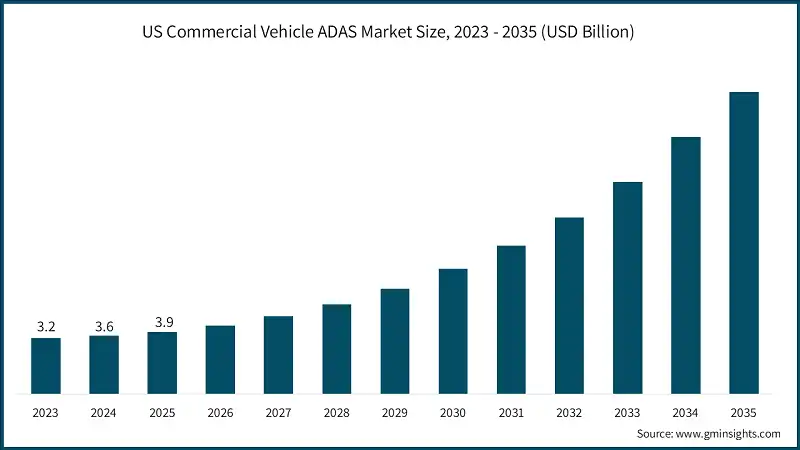
The US commercial vehicle ADAS market reached USD 3.9 billion in 2025, growing from USD 3.6 billion in 2024.
- The U.S. commercial fleet needs Advanced Driver Assistance Systems (ADAS) to address the safety risks and high costs caused by crashes involving large trucks and buses. The National Highway Traffic Safety Administration (NHTSA) states that human behavior is the main cause of most serious roadway crashes.
- Technologies like Automatic Emergency Braking (AEB) and Lane Departure Warning (LDW) help reduce or prevent collisions. This is especially important for heavy commercial motor vehicles (CMVs), which have a higher risk of causing fatalities and major property damage. NHTSA estimates that AEB alone could prevent thousands of crashes, injuries, and hundreds of deaths, showing the importance of adopting ADAS quickly.
- The Federal Motor Carrier Safety Administration (FMCSA), part of the Department of Transportation, is working to encourage the use of ADAS technologies. Its "Tech-Celerate Now" program, in partnership with the Intelligent Transportation Systems (ITS) Joint Program Office, aims to increase ADAS adoption in the trucking industry.
The North America region is estimated to reach USD 25.3 billion by 2035 and expected to grow at a CAGR of 16.9% between 2026 and 2035.
- The U.S. holds a significant share in terms of sale of commercial vehicles, and according to an OICA study, the USA’s sales figure for commercial vehicles in 2024 stood at 13.4 million.
- The country also has one of the largest and most advanced fleets of commercial vehicles, which includes a large fleet of long-haul trucks and delivery vehicles. In the U.S., fleet owners focus on safety, operational efficiency, and cost minimization. This increases the demand for ADAS solutions that increase safety, reduce fuel consumptions, and accidents.
- The country is home of various automotive leaders such as Continental. These companies have created advanced ADAS and autonomous driving systems, which makes the country a major market for advanced safety system technologies for commercial vehicles.
- Canada seems to grow at the faster growth rate between 2026 and 2035. This is due to stricter safety rules, more freight movement in the country, and a stronger focus on road safety. Government programs supporting advanced safety technologies and following North American safety standards are helping this growth.
The Europe commercial vehicle ADAS market accounted for USD 4.2 billion in 2025 and is anticipated to grow at the CAGR of 18% between 2026 and 2035.
- Advanced Driver Assistance Systems (ADAS) are essential for Europe's commercial fleet in order to achieve safer roads, minimize accident-related costs and risks from fatigue and distraction, particularly in long-distance and city logistics.
- The European Union is promoting the adoption of ADAS through the General Safety Regulation (GSR2) contained in Regulation (EU) 2019/2144. This legislation stipulates that all vehicle classes (M, N, and O) in the EU will be fitted with advanced safety features. It will be in force for all newly registered vehicles starting from July 2024.
- For commercial vehicles like buses, coaches, and trucks, the regulation focuses on technologies that improve blind spot detection, warn about possible collisions with pedestrians or cyclists, and monitor tire pressure, along with other safety features.
- The main objective of the European Union is mandate to roll out specific ADAS for reducing serious injuries and fatalities on roads to all new vehicles, including those in commercial fleets.
- They reflect the European Commission's determination to secure the best safety technologies for the protection of vulnerable road users in the case of commercial vehicles through such rules as pedestrians and cyclists by making them safely equipped.
Germany's commercial vehicle ADAS market is growing quickly in Europe, with a strong CAGR of 16.5% between 2026 and 2035.
- As of December 2024, Germany's total truck fleet reached 3.8 million registered trucks, marking a 2.4% increase year-over-year. However, in 2024, Germany experienced a 6.9% decline in truck registrations. These year-on-year stats are fluctuating in the country due to many reasons, such as changes in the regulations and customer preferences.
- Adoption of ADAS within the county will put Germany at a new height. As Germany is one of the major countries in terms of technology development and adoption in autonomous and electric vehicles, it is shifting towards autonomous and electrically powered commercial vehicles.
- Germany also invests heavily on research and development of automotive technologies. This includes ADAS, AI, and ML. Many German enterprises and research center are also investing in the development of sensor technologies and the integration of ADAS into commercial vehicles which contributes to the country’s large market share in market.
The Asia Pacific commercial vehicle ADAS market is estimated to reach USD 21.6 billion by 2035, by growing at a CAGR of 19.1% during the analysis timeframe.
- The need for ADAS in countries like India is a must. The number of road accident fatalities in India rose 2.3% to over 1.77 lakh in 2024 due to reasons such as over speeding, drunken driving, driving on the wrong sides, and phone usage while driving. It was observed that highways had recorded the highest number of severe accidents.
- To reduce these numbers and improve the road safety, the Indian government in January 2025 announced their plan of mandating the adoption of ADAS systems in new heavy trucks and buses. Through this the government aims to control the increasing road accidents involving heavy vehicles and thus improve road safety.
- Modern retail stores grow in countries like China, Japan, Australia, and India. Supermarket, hypermarket, and convenience store chains, which operate on a large scale, are adding self-checkout to their stores in order to serve more customers and to be able to catch up with the changing needs of the customers.
China is estimated to grow with a CAGR of 20.1% in the projected period between 2026 and 2035, in the Asia Pacific commercial vehicle ADAS market.
- China holds a significant share in commercial vehicle market due to its rising fleet number of trucks, buses, and delivery vehicles. In 2024, China was ranked second by OICA due to its high sales of commercial vehicles which was added up to 4 million in that year.
- The implementation of ADAS solutions has changed from luxury to necessity for commercial vehicles for both OEMs and fleet managers as demand for advanced safety features and driver assistance technologies increases.
- The Chinese government is heavily investing in developing and implementing policies and subsidies aimed at enhancing road safety and accident reduction in the country. The growing expansion of ADAS in commercial vehicles is backed by the strong focus on ADAS features such as lane-keeping assist, automatic emergency braking, and collision avoidance on new vehicles.
- There is strong domestic production capacity in China for ADAS sensors and components. Companies such as SAIC Motors are leading the industry with the integration of ADAS into commercial vehicles. These companies are supporting the local production of products such as sensors, cameras, and radar systems. Large scale production of these systems helps reduce costs and encourage the deployment of ADAS technologies in China.
Latin America commercial vehicle ADAS market is estimated to reach USD 1.1 billion in 2025 and is anticipated to show lucrative growth over the forecast period.
- In Latin America, cities like Buenos Aires and Bogotá have seen a rise in registered vehicles, leading to more traffic congestion. In São Paulo, the Transport Engineering Company (CET) reports that congestion increases accident risks by 40%.
- The commercial sector, which uses LCVs for last-mile deliveries and HCVs for long-haul transport, is adopting ADAS to reduce risks, lower insurance costs, and improve safety for drivers and cargo. According to Argentina's National Road Safety Agency (ANSV), vehicles with ADAS in Buenos Aires had a 28% lower accident rate compared to those without.
- To address safety concerns, some Latin American governments have introduced or are planning regulations, with Brazil leading the way. Brazil’s CONTRAN Resolution 910/2022 requires all new vehicles to include Electronic Stability Control (ESC) and Automatic Emergency Braking (AEB) by 2024.
Brazil is estimated to grow with a CAGR of 15.6% between 2026 and 2035, in the Latin America commercial vehicle ADAS market.
- The extensive area of Brazil and its heavily dependence on the road freight transportation necessitate the incorporation of Advanced Driver Assistance Systems (ADAS) in its commercial fleet.
- Alongside the country’s congested urban areas, the hightech solutions like Forward Collision Warning (FCW), Automatic Emergency Braking (AEB), and Lane Departure Warning (LDW) can certainly take part in accidents involving commercial vehicles, which, unfortunately, are still very frequent due to the long roads.
- The Brazilian government, through the National Traffic Council (CONTRAN), has introduced rules to promote key safety technologies that are part of ADAS. One important rule is CONTRAN Resolution 910/2022 (and its updates), which requires all new vehicles sold in Brazil to have essential safety systems.
The Middle East and Africa accounted for USD 785.7 million in 2025 and is anticipated to show lucrative growth over the forecast period.
- The national goals in the MEA region emphasize the necessity of Advanced Driver Assistance Systems (ADAS) for the enhancement of both road safety and logistics. The UAE and Saudi Arabia, which are the countries presently engaged in diversifying their economies, rely on transportation and commercial vehicles as the main pathways for logistics and construction.
- For example, the Roads and Transport Authority in Dubai has imposed regulations to bring about the use of technology to improve the safety of heavy vehicles. Apart from this, initiatives like Saudi Arabia’s Vision 2030 and Dubai's emphasis on autonomous transport reflect the region's aspiration for smart mobility. These initiatives allow the deployment of Level 1 and Level 2 ADAS, which are the initial stages for self-driving cars, in bus fleets and other commercial vehicles.
UAE to experience substantial growth in the Middle East and Africa commercial vehicle ADAS market in 2025.
- Federal and local authorities, such as the Roads and Transport Authority (RTA) in Dubai and the Integrated Transport Centre (ITC) in Abu Dhabi, are promoting a safe, smart, and sustainable transportation system. While the UAE government focuses on Electric and Autonomous Vehicles, this plan also highlights the need for ADAS features as a key step.
- For example, the Dubai Autonomous Transportation Strategy aims to make 25% of all trips autonomous by 2030. To achieve this, ADAS technologies must first be developed, reliable, and standardized for public and commercial vehicles.
- There is no specific national rule requiring Level 1 or Level 2 ADAS features (like AEB or LDW) for all commercial fleets. However, the government is clearly moving toward regulating advanced vehicle technologies. For instance, Dubai Law No. (9) of 2023, which regulates Autonomous Vehicles, states that no Autonomous Vehicle can operate without an RTA license. The law also requires vehicles to pass technical inspections, meet safety standards, and have systems that can interact with roads and traffic signs as per RTA rules.
Commercial Vehicle ADAS Market Share
- The top 7 companies in the commercial vehicle ADAS industry are Bosch, Continental, ZF, Valeo, Daimler, Ford and Volvo, contributing 42.5% of the market in 2025.
- Bosch uses radar sensors, cameras, and AI to provide advanced ADAS for commercial vehicles. Features like blind spot detection, lane keeping assist, emergency braking, and road sign recognition improve safety, efficiency, and driver comfort in trucks.
- Continental offers ADAS solutions for trucks with a focus on sensors and software. Key features include adaptive cruise control, collision avoidance, and pedestrian detection. These systems improve road safety and meet global regulations.
- ZF offers ADAS for trucks that uses cameras, radars, and actuators. Features like blind spot warnings, emergency braking, and stability control help protect road users and assist drivers.
- Valeo provides ADAS for commercial vehicles with cameras, sensors, and domain controllers. Features like 360° surround view, driver monitoring, and automated parking make driving safer and improve environmental awareness.
- Daimler includes ADAS like Active Brake Assist and Sideguard Assist in Mercedes trucks. These features detect pedestrians, cyclists, and hazards, enabling automatic braking to improve fleet safety and meet regulations.
- Ford's ADAS for commercial vans includes adaptive cruise control, lane-keeping, and emergency braking. Pre-Collision Assist warns drivers about obstacles, helping to reduce accidents and make long trips easier.
- Volvo Trucks' ADAS includes collision warning, lane departure alerts, and driver alertness systems. Using radar and cameras, the system enables automatic braking and stability, supporting Volvo's goal of zero accidents for heavy vehicles.
Commercial Vehicle ADAS Market Companies
Major players operating in the commercial vehicle ADAS industry are:
- Bosch
- Continental
- ZF Friedrichshafen
- Valeo
- Daimler
- Ford
- Volvo
- Denso
- Mobileye
- Magna
- Bosch uses its ADAS ecosystem, which includes radar, cameras, and vehicle supercomputers, to provide cost-effective and scalable solutions for different commercial vehicle segments.
- Continental stands out with its "Road to Cloud" ADAS system, which combines advanced sensors and High-Performance Computers (HPCs). This makes system integration easier and supports modern vehicle designs.
- ZF focuses on smart cameras and chassis control systems, offering ADAS solutions tested for tough real-world conditions. Its proprietary technology, like OnGuard MAX, gives it an edge.
- Valeo has a sensor portfolio including its mass-produced LiDAR (SCALA 3). With heavy investments in AI and system controllers, Valeo leads in ADAS innovation.
- Daimler Truck uses its expertise as a leading OEM to include advanced safety features in its brands like Freightliner and Mercedes-Benz. It leads the heavy commercial vehicle market in North America and Europe.
- Ford Pro, Ford's commercial business unit, offers a complete ADAS solution by combining vehicle technology with fleet management software and services.
- Volvo focuses on safety and combines advanced ADAS with its expertise in electric trucks. This helps prevent accidents, improves driver comfort, and supports its goal of zero-emission transport.
Commercial Vehicle ADAS Market Report Attributes
| Key Takeaway | Details |
|---|---|
| Market Size & Growth | |
| Base Year | 2025 |
| Market Size in 2025 | USD 15.4 Billion |
| Market Size in 2026 | USD 17.7 Billion |
| Forecast Period 2026-2035 CAGR | 17.7% |
| Market Size in 2035 | USD 76.3 Billion |
| Key Market Trends | |
| Drivers | Impact |
| Stringent Government Safety Regulations for Commercial Vehicles | Push manufacturers and fleet owners to adopt ADAS, accelerating market growth and standard feature integration. |
| Rising Road Accidents Involving Heavy and Commercial Vehicles | Raise demand for ADAS technologies to improve driver awareness, reduce collisions, and enhance overall road safety. |
| Growing Adoption of Fleet Safety and Telematics Solutions | Combine ADAS with telematics to monitor drivers and optimize operational efficiency. |
| Rapid Growth of E-commerce and Last-Mile Delivery Fleets | Increase demand for ADAS to ensure safety, reduce downtime, and manage frequent urban driving conditions. |
| Pitfalls & Challenges | Impact |
| Reliability Issues in Harsh Weather and Road Conditions | ADAS performance may decline in rain, fog, or poor roads, limiting trust and slowing adoption among commercial vehicle operators. |
| Complexity in Retrofitting ADAS in Existing Vehicles | Retrofitting ADAS into older fleets is technically complex and costly, restricting adoption among price-sensitive fleet owners. |
| Opportunities: | Impact |
| Increasing Demand for ADAS in Electric and Connected Commercial Vehicles | Rising electric and connected vehicle adoption creates strong opportunities for integrated, software-driven ADAS solutions. |
| Growth Potential in Emerging Markets and Developing Economies | Improving infrastructure and safety awareness in emerging regions create new demand for affordable commercial vehicle ADAS systems. |
| Integration of ADAS with Vehicle-to-Everything (V2X) Communication Systems | V2X integration enhances ADAS capabilities by enabling real-time communication and traffic management. |
| Expansion of ADAS Retrofitting Solutions for Aging Fleets | Aftermarket ADAS retrofit solutions offer growth opportunities by upgrading safety features in large, existing commercial vehicle fleets. |
| Market Leaders (2025) | |
| Market Leaders |
10.2% market share |
| Top Players |
|
| Competitive Edge |
|
| Regional Insights | |
| Largest Market | North America |
| Fastest growing market | Asia Pacific |
| Emerging countries | Mexico, India, South Korea, Vietnam, Brazil, Saudi Arabia |
| Future outlook |
|
What are the growth opportunities in this market?
Commercial Vehicle ADAS Industry News
- In November 2025, Gauzy partnered with Renault Trucks and a French government program to improve advanced driver-assistance systems (ADAS) for commercial vehicles. Gauzy’s AI-powered Smart-Vision CMS is now part of Renault Trucks’ DOLPHIN concept, meeting new European rules.
- In November 2025, Isuzu Motors Limited will start testing autonomous trucks for business use on public roads. These new heavy-duty autonomous trucks will transport parts between the Iwafune and Chubu Parts Centers.
- In March 2025, TRATON Group partnered with Applied Intuition to use advanced vehicle software for all TRATON brands. This builds on their five-year collaboration on tools for ADAS and automated driving (AD).
- In August 2024, Isuzu Motors Limited and Applied Intuition signed a partnership to develop Level 4 autonomous commercial trucks together.
- In February 2024, ZF added ADAS sensors for commercial vehicles to its aftermarket products under the WABCO brand. These include a front camera for the OnLaneALERT lane departure warning system and a radar sensor for the OnGuardACTIVE automatic emergency braking system.
The commercial vehicle ADAS market research report includes in-depth coverage of the industry with estimates & forecasts in terms of revenue ($ Mn/Bn) and volume (Units) from 2022 to 2035, for the following segments:
Market, By System
- Adaptive cruise control
- Blind spot detection
- Lane departure warning system
- Automatic emergency braking (AEM)
- Forward collision warning
- Night vision system
- Driver monitoring
- Tire pressure monitoring system
- Head-up display
- Park assist system
- Others
Market, By Sensor
- Radar
- Lidar
- Ultrasonic
- Camera
- Others
Market, By Vehicle Category
- LCV
- MCV
- HCV
Market, By Level
- Level-1
- Level-2
- Level-3
- Level-4
Market, By Propulsion
- ICE
- EV
- Hybrid
Market, By Distribution Channel
- OEM
- Aftermarket
The above information is provided for the following regions and countries:
- North America
- US
- Canada
- Europe
- Germany
- UK
- France
- Italy
- Spain
- Russia
- Nordics
- Benelux
- Asia Pacific
- China
- India
- Japan
- South Korea
- ANZ
- Singapore
- Malaysia
- Indonesia
- Vietnam
- Thailand
- Latin America
- Brazil
- Mexico
- Argentina
- Colombia
- MEA
- South Africa
- Saudi Arabia
- UAE
Frequently Asked Question(FAQ) :
What is the commercial vehicle ADAS market size in 2025?
The commercial vehicle ADAS industry is valued at USD 15.4 billion in 2025. Growing adoption of fleet safety solutions, stringent government safety regulations, and rising road accidents involving commercial vehicles are supporting market growth.
What is the market size of the commercial vehicle ADAS industry in 2026?
The market size for commercial vehicle ADAS reached USD 17.7 billion in 2026, reflecting strong expansion driven by increased integration of advanced safety systems in trucks, buses, and delivery vehicles.
What is the projected value of the commercial vehicle ADAS market by 2035?
The commercial vehicle ADAS market is expected to reach USD 76.3 billion by 2035, growing at a CAGR of 17.7%. This expansion is fueled by mandatory safety regulations, fleet electrification, and increasing deployment of connected and autonomous driving technologies.
How much revenue did the camera sensor segment generate in 2025?
The camera segment accounted for over 34% of the market in 2025, making it the leading sensor category. Strong demand for lane departure warning, collision avoidance, traffic sign recognition, and driver monitoring systems is supporting segment growth.
What was the valuation of the adaptive cruise control segment in 2025?
The adaptive cruise control segment was valued at USD 3.5 billion in 2025, making it one of the dominant system categories. Its adoption is driven by long-haul trucking needs, reduced driver fatigue, and improved fuel efficiency.
What is the growth outlook for the OEM distribution channel from 2026 to 2035?
The OEM segment is projected to grow at a CAGR of 17.5% through 2035. Factory-installed ADAS, seamless system integration, and growing preference for built-in safety solutions are driving sustained demand.
What is the size of the U.S. commercial vehicle ADAS market in 2025?
The U.S. market reached USD 3.9 billion in 2025, supported by rising adoption of advanced safety systems and stricter vehicle safety regulations.
What are the upcoming trends in the commercial vehicle ADAS industry?
Key trends include integration of AI and machine learning, growing adoption of driver monitoring systems, expansion of V2X-enabled ADAS, increased demand for ADAS in electric commercial vehicles, and rapid growth of aftermarket ADAS retrofitting solutions.
Who are the key players in the commercial vehicle ADAS market?
Key players include Bosch, Continental, ZF Friedrichshafen, Valeo, Daimler, Ford, and Volvo. These companies are expanding ADAS capabilities through advanced sensors, AI-driven software platforms, and integrated safety solutions for commercial fleets.
Commercial Vehicle ADAS Market Scope
Related Reports