Summary
Table of Content

Commercial Display Market
Get a free sample of this report
Form submitted successfully!
Error submitting form. Please try again.
Thank you!
Your inquiry has been received. Our team will reach out to you with the required details via email. To ensure that you don't miss their response, kindly remember to check your spam folder as well!
Request Sectional Data
Thank you!
Your inquiry has been received. Our team will reach out to you with the required details via email. To ensure that you don't miss their response, kindly remember to check your spam folder as well!
Form submitted successfully!
Error submitting form. Please try again.
Commercial Display Market Size
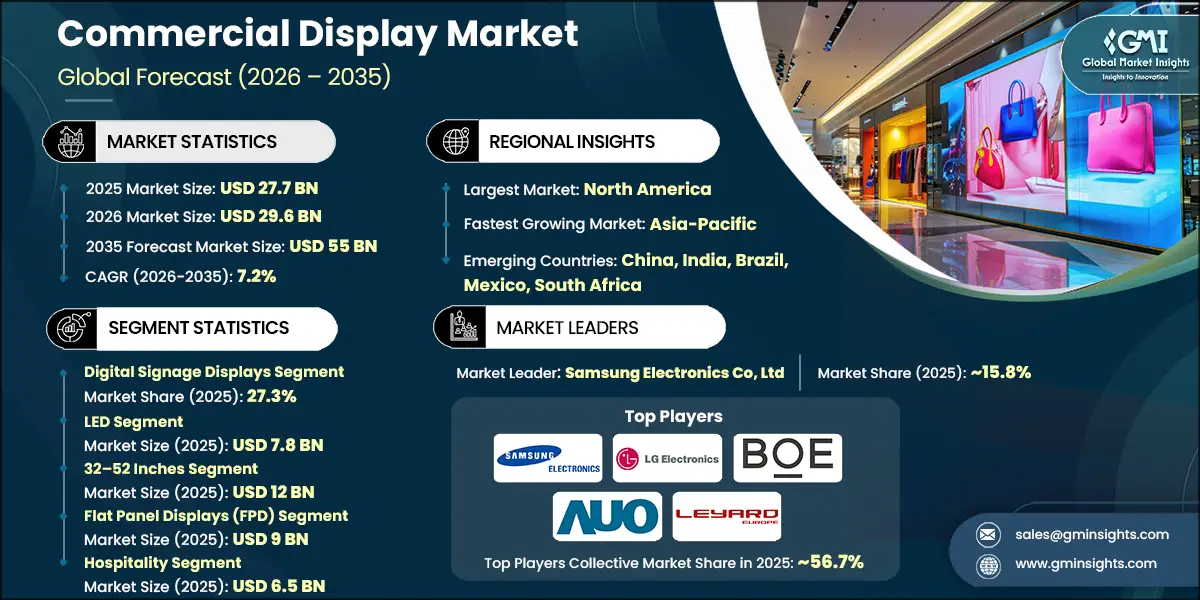
The global commercial display market was valued at USD 27.7 billion in 2025. The market is expected to grow from USD 29.6 billion in 2026 to USD 55 billion in 2035, at a CAGR of 7.2% during the forecast period, according to the latest report published by Global Market Insights Inc.
To get key market trends
- The commercial displays market is expanding as demand increases for digital signage, interactive touchscreens, and high-resolution display solutions across retail, corporate, hospitality, and transportation environments. Adoption of LED and LCD technologies continues to rise, supported by growing interest in video walls and energy-efficient smart displays. These advancements contribute to sustained market growth.
- The education and healthcare sectors are becoming major adopters of interactive display technologies as digital transformation initiatives accelerate. The U.S. Department of Education’s latest National Educational Technology Plan highlights interactive and collaborative tools including digital displays and touch-enabled surfaces as essential for improving teaching and learning environments. This emphasis is supporting higher adoption of commercial display solutions. For example, in January 2025, PPDS, the global distributor of Philips Professional Display Solutions, partnered with Philips Monitors to develop new education-focused display offerings.
- Similarly, guidance from the World Health Organization identifies digital communication tools such as patient information screens, wayfinding kiosks, and public health messaging systems as critical components of effective healthcare delivery and patient engagement. These policy frameworks are broadening the commercial display market beyond traditional verticals such as retail and transportation, strengthening its long-term growth trajectory. In November 2025, Aceso Interactive partnered with Samsung Electronics to deliver advanced patient engagement and digital signage solutions to healthcare facilities across North America.
- From 2022 to 2023, the market expanded from USD 22.9 billion to USD 24.4 billion. Government investment in smart city development and advanced transportation infrastructure remains a key growth accelerator. In the United States, the Department of Transportation’s Intelligent Transportation Systems program supports the deployment of adaptive passenger information boards, interactive wayfinding displays, and emergency communication systems each contributing to improved efficiency and user experience across urban mobility networks and driving demand for commercial displays.
- In the retail sector, next-generation display technologies are reshaping customer engagement by bridging online and in-store experiences. Digital signage networks now support context-aware promotions, interactive product catalogs, and dynamic assistance interfaces, enabling retailers to modernize customer interaction and operational efficiency. This convergence of digital and physical retail environments is directly contributing to the expansion of the commercial displays market. For instance, in September 2025, Samsung partnered with Toyota to supply 23,000 smart displays and software solutions to upgrade dealerships worldwide.
Commercial Display Market Report Attributes
| Key Takeaway | Details |
|---|---|
| Market Size & Growth | |
| Base Year | 2025 |
| Market Size in 2025 | USD 27.7 Billion |
| Market Size in 2026 | USD 29.6 Billion |
| Forecast Period 2026 - 2035 CAGR | 7.2% |
| Market Size in 2035 | USD 55 Billion |
| Key Market Trends | |
| Drivers | Impact |
| Escalating demand for digital signage across retail, hospitality, and transportation | Digital signage adoption drives about 35% of demand in the commercial display market. Businesses are increasingly using high-resolution screens, interactive touch displays, and dynamic content for advertising, branding, and customer engagement across retail, hospitality, transportation, and corporate sectors. Investments in advanced display technologies enhance visual experiences and audience interaction. |
| Adoption of high-resolution displays (4K/8K) and advanced technologies (OLED, microLED) | Integration with smart technologies and IoT accounts for around 30% of market growth. As businesses deploy connected systems, demand rises for displays that support real-time updates, analytics, and interactivity in smart stores, airports, transportation hubs, and corporate environments. Energy-efficient and compact solutions are increasingly preferred. |
| Integration of AI and cloud-based content management | Commercial applications in education, healthcare, and corporate environments contribute roughly 25% of growth. Interactive panels, video walls, and collaboration displays improve learning, patient engagement, and office productivity. High-quality visuals and touch-enabled functionality help businesses communicate effectively and boost operational efficiency. |
| Growth in smart city infrastructure and public service automation | Innovation and government/industry programs represent the remaining 10% of growth. Funding for research, development of advanced LED, OLED, and microLED displays, and smart city initiatives are driving adoption of next-generation commercial display solutions, expanding market potential worldwide. |
| Pitfalls & Challenges | Impact |
| Supply chain disruptions and high production costs | Ongoing supply chain challenges and rising production costs are limiting the availability of commercial display products. Delays in component sourcing, higher raw material expenses, and logistics issues are increasing prices and affecting timely delivery, thereby slowing adoption and restraining market growth. |
| Shortage of skilled professionals for installation and maintenance | The commercial display market faces a shortage of trained professionals for installation, configuration, and maintenance. This skills gap leads to longer deployment times, improper setup, and reduced operational efficiency, creating challenges for businesses and hindering the widespread adoption of advanced commercial display solutions globally. |
| Opportunities: | Impact |
| Expansion in smart cities and transportation hubs | The growth of smart cities and modern transportation hubs presents opportunities for commercial displays. High-resolution screens, interactive kiosks, and digital signage enhance navigation, information dissemination, and public engagement, driving adoption across airports, train stations, bus terminals, and urban infrastructure projects globally. |
| Integration with building management and POS systems | Commercial displays integrated with building management systems and point-of-sale (POS) platforms offer enhanced operational efficiency and customer experience. Real-time data, dynamic content, and interactive features enable energy management, promotions, and analytics, creating opportunities for widespread deployment in retail, hospitality, corporate offices, and public spaces. |
| Market Leaders (2025) | |
| Market Leaders |
~15.8% market share. |
| Top Players |
Collective market share in 2025 is ~56.7% |
| Competitive Edge |
|
| Regional Insights | |
| Largest Market | North America |
| Fastest growing market | Asia-Pacific |
| Emerging countries | China, India, Brazil, Mexico, South Africa |
| Future outlook |
|
What are the growth opportunities in this market?
Commercial Display Market Trends
- A prominent trend influencing the commercial display industry is the growing emphasis on energy-efficient technologies, including LED backlighting, OLED panels, and low-power e-paper displays. Rising global sustainability commitments and increasingly stringent environmental regulations are encouraging manufacturers to develop solutions that reduce power consumption and extend product lifespan. This shift is further reinforced by institutional frameworks such as the United Nations Sustainable Development Goals (SDGs), which promote the adoption of greener technologies across public and private infrastructure.
- The market is also experiencing a continued transition toward cloud-based content management systems, which enable real-time updates, centralized monitoring, and integration with advanced analytics platforms. This approach allows multinational retailers, corporate campuses, and government agencies to efficiently manage content across dispersed display networks. Cloud-centric architectures also enhance cybersecurity compliance and data consistency, aligning with international digital governance standards, including policy directions from the OECD on digital economy frameworks.
- Commercial displays are increasingly connected to AI-enabled ecosystems that support personalized, context-aware content delivery. Retail environments are adopting AI-driven, computer-vision systems to analyze shopper behavior, while transportation hubs are utilizing AI for predictive scheduling and dynamic crowd-management messaging. Endorsements from global organizations, such as the World Economic Forum, highlight AI as a cross-industry enabler, reinforcing expectations for sustained, data-driven growth in commercial display deployments.
- In addition, the commercial display sector is becoming more integrated with the advertising industry through the expansion of programmatic buying within digital-out-of-home (DOOH) environments. Displays located in airports, shopping centers, and high-traffic urban areas are increasingly incorporated into automated advertising networks that support real-time bidding and targeted messaging. Industry bodies, including the Interactive Advertising Bureau (IAB), are developing standards for programmatic DOOH transactions, signaling the rapid maturation and broader acceptance of this advertising channel.
Commercial Display Market Analysis
Learn more about the key segments shaping this market
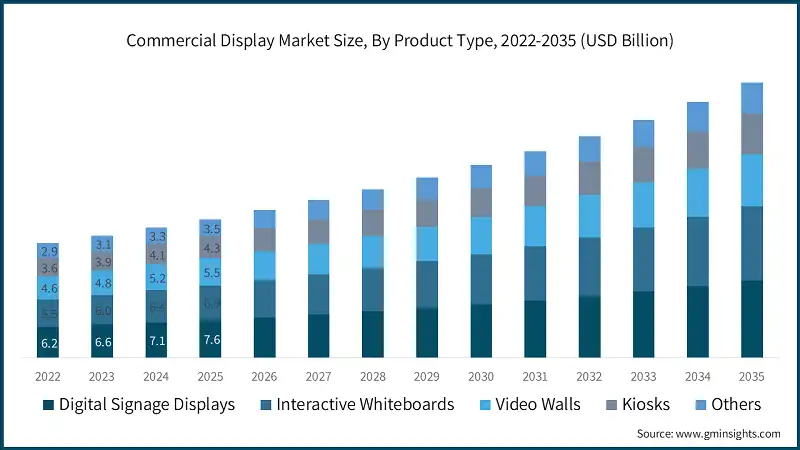
The market was valued at USD 22.9 billion and USD 24.4 billion in 2022 and 2023, respectively. The market size reached USD 29.6 billion in 2026, growing from USD 27.7 billion in 2025.
Based on product type, the market is divided into digital signage displays, interactive whiteboards, video walls, kiosks and others. The digital signage displays segment accounted for 27.3% of the market in 2025.
- The digital signage displays market was valued at USD 7.6 billion in 2025. Digital signage displays remain the largest product segment, driven by widespread adoption across retail, transportation, and corporate environments. Increasing demand for dynamic content delivery, advertising, and way-finding solutions continues to fuel growth. Government-supported smart city programs, particularly in North America and Asia, have accelerated public infrastructure investments that utilize large-format digital signage.
- Manufacturers should focus on developing high-resolution, energy-efficient displays with interactive and touch-enabled features. Integration with cloud-based content management, IoT, and AI-driven analytics can enhance user engagement and operational efficiency. Expanding into smart cities, airports, train stations, and corporate campuses while offering customizable solutions will help capture growing demand and strengthen market position.
- The interactive whiteboards are anticipated to grow with a CAGR of 8% during the forecast period. Interactive whiteboards are witnessing the fastest growth, largely propelled by the digital transformation of education and corporate training environments. The increasing penetration of e-learning platforms and government-backed digitization programs in schools across Europe, the U.S., and Asia are accelerating adoption. Additionally, hybrid work models are driving corporate investment in collaborative display solutions.
- Manufacturers should focus on developing advanced interactive whiteboards with high-resolution touch displays, seamless connectivity, and collaborative software integration. Enhancing compatibility with e-learning platforms, video conferencing tools, and hybrid work solutions will drive adoption in education and corporate sectors, while offering durable, user-friendly, and cost-effective products to capture the growing market demand.
Based on technology, the commercial display market is divided into LED, LCD, OLED and others. The LED segment dominated the market in 2025 with a revenue of USD 7.8 billion.
- The LED was the largest market share, driven by energy efficiency, long lifespan, and suitability for both indoor and outdoor applications. Retail, transportation, and advertising industries prefer LED for its cost-effectiveness and scalability in video walls and signage systems. Urbanization and government spending on digital public infrastructure also sustain LED demand.
- Manufacturers should focus on producing high-efficiency, long-lasting LED displays with superior brightness and color accuracy for indoor and outdoor applications. Developing scalable video walls, customizable signage solutions, and energy-efficient panels will cater to retail, transportation, and public infrastructure projects, helping businesses meet growing demand and expand their market presence.
- The OLED was the fastest growing segment and is anticipated to grow with a CAGR of 8.2% each year and hitting $16.5 billion by 2035, driven by its superior contrast, thinner form factor, and flexibility. Demand is rising in high-end retail, hospitality, and corporate settings, where design aesthetics and immersive experiences are valued. The technology is also benefitting from R&D investments in transparent and foldable display formats.
- Manufacturers should focus on developing high-quality OLED displays with superior contrast, flexibility, and sleek form factors. Investing in innovative designs like transparent, foldable, and curved panels for high-end retail, hospitality, and corporate environments will enhance user experience, cater to premium demand, and capitalize on the rapidly growing OLED market.
On the basis of display size, the commercial display market is divided into below 32 inches, 32–52 inches and above 52 inches. The 32–52 inches segment dominated the market in 2025 with a revenue of USD 12 billion.
- Mid-sized displays in the 32–52-inch range dominate the market share, due to serving retail stores, classrooms, hospitals, and corporate boardrooms. Their affordability, balance of visibility, and ease of installation drive demand across both developed and emerging economies. Standardization in content formats for these displays also supports continued adoption.
- Manufacturers should focus on producing mid-sized displays (32–52 inches) that offer clear visibility, affordability, and easy installation. Ensuring compatibility with standardized content formats and optimizing performance for retail, education, healthcare, and corporate environments will help capture demand in both developed and emerging markets while supporting widespread adoption.
- The above 52 inches market was the fastest growing segment and is anticipated to grow with a CAGR of 7.7% each year and hitting $21.5 billion by 2035, driven by demand for immersive experiences in entertainment venues, transportation hubs, and corporate lobbies. Increasing popularity of video walls and DOOH (digital out-of-home) advertising campaigns further fuels this growth. Government-led urban modernization programs are reinforcing demand in public infrastructure.
Based on panel type is divided into flat panel displays, curved panel displays, flexible/transparent displays and others. The flat panel displays (FPD) segment dominated the market in 2025 with a revenue of USD 9 billion.
- The flat panel displays were the largest and fastest growing during the forecast period. Flat panel displays dominate the market due to their versatility, cost efficiency, and broad adoption across industries. Their widespread use in retail signage, education systems, and corporate communication ensures steady demand. The maturity of LCD and LED flat panel technologies keeps them highly competitive.
- Manufacturers should focus on developing versatile, cost-efficient flat panel displays with high performance and reliability. Enhancing LCD and LED technologies, ensuring compatibility across retail, education, and corporate applications, and offering scalable, easy-to-install solutions will help meet growing demand and maintain competitiveness in the rapidly expanding commercial display market.
- The flexible/transparent displays is anticipated to witness significant growth at a CAGR of 8.3% over the analysis period, reaching USD 18.2 billion by 2035. Flexible and transparent displays are rapidly gaining momentum, fueled by demand in luxury retail, automotive, and high-end hospitality sectors. Their unique form factors support innovative installations such as curved walls, see-through store windows, and futuristic interiors, appealing to design-focused industries.
Learn more about the key segments shaping this market
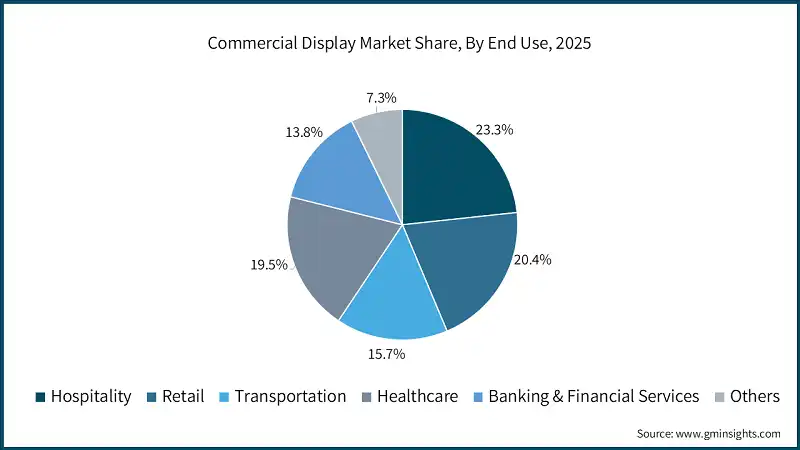
Based on the end use, the commercial display market is segmented into hospital, retail, transportation, healthcare, banking & financial services, and others. The hospitality segment dominated the market in 2025 with a revenue of USD 6.5 billion.
- The hospitality segment dominates the market due to its widespread use in hotels, resorts, restaurants, and event venues. Commercial displays are deployed for digital signage, way-finding, interactive guest services, and promotional content, enhancing customer experience and operational efficiency. High-resolution screens, interactive touch panels, and video walls allow hospitality businesses to engage guests effectively, deliver personalized services, and showcase branding. The growing emphasis on digital transformation, smart hotel solutions, and immersive experiences continues to drive strong demand in this segment globally.
- Manufacturers should focus on developing high-resolution, interactive displays and video walls tailored for hotels, resorts, restaurants, and event venues. Solutions that enhance guest engagement, support digital signage, way-finding, and personalized services, while integrating with smart hotel systems, will help capture demand and strengthen market presence in the hospitality segment.
- The healthcare segment in the commercial display market is anticipated to grow at a CAGR of 8.9% during the forecast period, driven by the increasing adoption of digital solutions in hospitals, clinics, and diagnostic centers. Commercial displays are used for patient monitoring, digital signage, telemedicine, surgical guidance, and healthcare training, improving operational efficiency and patient care. High-resolution screens, interactive panels, and video walls enable real-time data visualization, collaboration, and communication among medical professionals. Growing investments in smart hospital infrastructure, government healthcare digitization programs, and the rising demand for immersive and interactive medical technologies continue to fuel market growth in this segment.
- Manufacturers should focus on developing high-resolution, interactive displays and video walls tailored for healthcare applications. Solutions that support patient monitoring, telemedicine, surgical guidance, and staff collaboration, while integrating with smart hospital infrastructure and digital healthcare systems, will enhance operational efficiency, improve patient care, and capture the growing demand in this segment.
Looking for region specific data?
The North America commercial display industry held 27.3% market share in 2025.
- The market in North America has been expanding steadily. North America is one of the most mature commercial display markets, driven by large-scale deployment in retail, quick-service restaurants, transportation, and DOOH advertising networks. Regulatory support, such as the Federal Communications Commission (FCC)’s accessibility rules on closed captioning, compels public-facing institutions to invest in compliant display technologies. Additionally, airports, stadiums, and higher-education campuses are embracing interactive digital signage to enhance customer experience and safety communications. Growth is also reinforced by corporate ESG initiatives that promote energy-efficient and sustainable hardware.
- Manufacturers should focus on producing energy-efficient, sustainable, and FCC-compliant commercial displays for the North America. Solutions with high-resolution, interactive, and accessible features for retail, transportation, DOOH advertising, airports, stadiums, and educational campuses will meet regulatory requirements, enhance user experience, and capitalize on growing demand in this mature market.
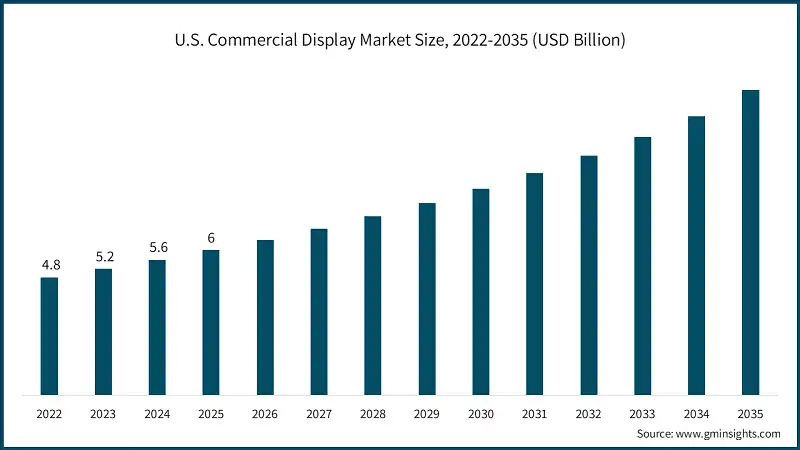
The U.S. commercial display market was valued at USD 5.2 billion and USD 5.6 billion in 2023 and 2024, respectively. The market size reached USD 6.4 billion in 2026, growing from USD 6 billion in 2025.
- The U.S. continues to dominate the market, supported by strong investments in digital signage, smart retail technologies, and advanced display manufacturing capabilities. Growth is being driven by increasing adoption of interactive displays, LED video walls, and smart advertising solutions across retail, transportation, hospitality, and corporate environments. The expansion of IoT integration, cloud-based content management, and energy-efficient display technologies is further boosting market development in the country.
- Manufacturers should focus on developing high-brightness, durable, and energy-efficient commercial display solutions tailored for outdoor advertising, retail engagement, and enterprise collaboration applications in the U.S. Emphasis should be placed on innovations such as 4K/8K displays, transparent screens, touchscreen interfaces, and cloud-connected digital signage platforms. Aligning with smart city initiatives, growing retail digitalization, and rising demand for immersive visual experiences will help companies tap into strong market opportunities.
In Europe the commercial display market accounted for USD 5.7 billion in 2025 and is anticipated to show lucrative growth over the forecast period.
- Europe holds a significant share of the market, driven by strong adoption of digital signage, interactive displays, and advanced visualization solutions across retail, transportation, corporate, hospitality, and healthcare sectors. Investments in smart city projects, public information systems, and digital transformation are boosting demand. The presence of major automotive and industrial players, government support for energy-efficient display technologies, and the rise in LED, OLED, and smart display deployments further strengthen Europe’s position as a key hub for commercial display innovation.
- Manufacturers should develop modern, energy-efficient commercial displays for retail, transportation hubs, workplaces, and healthcare facilities across Europe. Focusing on high-resolution panels, interactive touch solutions, and smart cloud-connected display systems will help them benefit from government sustainability goals, strong digital infrastructure, and the rising need for immersive, real-time visual communication technologies.
Germany dominates the Europe market, showcasing strong growth potential.
- Within Europe, Germany holds a substantial share of the commercial display market due to its strong automotive, industrial, and retail sectors, along with rapid adoption of digital transformation technologies. The country has been quick to implement smart factories, digital signage networks, and advanced display systems in transportation, corporate environments, and public infrastructure. Government initiatives supporting energy-efficient technologies, along with collaboration between technology providers and industrial manufacturers, are fueling market growth. The need for high-quality LED displays, interactive panels, and smart information systems positions Germany as one of the leading markets for commercial display innovation in Europe.
- Manufacturers should focus on developing reliable, energy-efficient commercial display solutions tailored for Germany’s automotive showrooms, factories, retail stores, and transportation hubs. Prioritizing high-resolution screens, interactive and touch-enabled systems, and cloud-connected display platforms—and collaborating with automotive and industrial players while leveraging government support—will help companies expand and strengthen Germany’s leadership in advanced commercial display adoption.
The Asia-Pacific market is anticipated to grow at the highest CAGR of 8.1% during the analysis timeframe.
- The Asia-Pacific region is experiencing rapid growth in the commercial display market, driven by a rise in demand for digital signage, interactive kiosks, video walls, smart retail systems, and large-format displays. Businesses in retail, transportation, hospitality, education, and corporate sectors are adopting high-resolution and energy-efficient displays to improve customer engagement and operational efficiency. Governments are supporting smart city projects, which require digital screens for public communication and information systems. The expansion of e-commerce, shopping malls, airports, and entertainment venues is further boosting the use of advanced commercial displays. In addition, strong manufacturing capabilities, growing investments in display technologies, and the presence of global and regional players make Asia-Pacific one of the fastest-growing regions for commercial display solutions.
- Manufacturers in Asia-Pacific should focus on developing high-quality, energy-efficient commercial displays that support ultra-HD content, touch interactivity, digital signage, and outdoor visibility. They should prioritize technologies such as LED, OLED, and LCD with improved brightness, durability, and connectivity. Leveraging government initiatives, smart city development, and expanding retail and transportation networks can help manufacturers introduce innovative solutions and meet the rising demand across the region.
China commercial display market is estimated to grow with a significant CAGR 9.2% from 2026 to 2035.
- China dominates the Asia-Pacific market, supported by strong manufacturing capabilities, large-scale investments in display technologies, and rapid digital transformation across major industries. The country is expanding the use of digital signage, interactive kiosks, LED video walls, and smart retail displays in malls, transportation hubs, corporate offices, and public spaces. Government initiatives for smart cities, intelligent transportation, and digital infrastructure boost demand for high-resolution and energy-efficient commercial displays. Collaboration between display manufacturers and technology companies, along with a growing ecosystem of startups, accelerates innovation in LED, OLED, and LCD technologies. These factors help China maintain its leadership position and rapidly deploy advanced commercial display solutions across domestic and regional markets.
- Manufacturers should focus on developing high-brightness, energy-efficient, and durable commercial displays tailored for retail, transportation, hospitality, and corporate environments in China. Prioritizing technologies such as LED video walls, 4K/8K large-format displays, and interactive touchscreens will help meet the country's growing demand. By leveraging government support for digital infrastructure, participating in smart city projects, and forming partnerships with tech firms, manufacturers can drive innovation, scale production, and expand the adoption of commercial display solutions across a wide range of applications.
In 2025, the Latin America commercial display market is expected to reach $2.6 billion due to expanding digital signage adoption, rising retail modernization, smart city projects, and increased investment in display solutions across multiple industries.
The Middle East market should reach $3.6 billion by 2035. This rise is because AI is being used more in smart cities, factory automation, cars, and improving IT.
UAE commercial display industry to experience substantial growth in the Middle East and Africa market in 2025.
- The UAE is showing strong growth potential in the Middle East and Africa market, supported by major investments in smart city projects, digital transformation, and advanced communication infrastructure. Demand is rising across retail, hospitality, transportation, corporate environments, and government sectors. Widespread adoption of digital signage, interactive kiosks, LED video walls, and display solutions for public services strengthens the market. Strategic collaborations, expansion of tourism, and the push for high-tech customer engagement further position the UAE as a leading market for commercial display technologies.
- Manufacturers should focus on delivering high-brightness, energy-efficient, and durable commercial displays tailored for the UAE’s retail, hospitality, transportation, and public sector applications. Leveraging smart city initiatives, government-led digital transformation programs, and partnerships with technology providers will help increase adoption. Emphasis on advanced solutions such as interactive displays, LED signage, and AI-enabled display systems will support growth in the fast-evolving market.
Commercial Display Market Share
- The commercial display industry is highly competitive, with companies focusing on innovation, strategic partnerships, and investments in advanced display technologies. Leading players such as Samsung Electronics Co., Ltd., LG Electronics Inc., BOE Technology Group Co., Ltd., AU Optronics Corp., and Leyard Optoelectronic Co., Ltd. a significant share 56.7% of the market. They focus on producing high-brightness, energy-efficient, and durable displays used in digital signage, retail, transportation, hospitality, corporate environments, and public services. Advances in LED, OLED, interactive touchscreens, and 4K/8K display technologies are improving clarity, performance, and long-term reliability. Collaboration with solution providers, smart city projects, and retail technology firms is helping these companies expand their presence and integrate their displays across multiple applications.
- In addition, emerging players are offering cost-effective, compact, and energy-saving display solutions suitable for small businesses, smart kiosks, education centers, and industrial environments. New advancements in mini-LED, micro-LED, interactive panels, and display security features are enhancing durability, user engagement, and operational safety. Working closely with software developers, system integrators, and digital signage startups enables faster adoption of advanced display capabilities. These developments improve real-time content delivery, reduce maintenance costs, and support broader use of commercial displays across retail, healthcare, transportation, corporate offices, and entertainment sectors worldwide.
Commercial Display Market Companies
List of prominent players operating in the commercial display industry include:
- AU Optronics Corp.
- Barco NV
- BenQ Corporation
- BOE Technology Group Co., Ltd.
- Christie Digital Systems USA, Inc.
- Daktronics, Inc.
- Delta Electronics, Inc.
- E Ink Holdings Inc.
- Elo Touch Solutions, Inc.
- Hisense Visual Technology Co., Ltd.
- Innolux Corporation
- Leyard Optoelectronic Co., Ltd.
- LG Electronics Inc.
- Mitsubishi Electric Corporation
- NEC Corporation
- Panasonic Corporation
- Planar Systems, Inc.
- Qisda Corporation
- Samsung Electronics Co., Ltd.
- Sharp Corporation
- Shenzhen Absen Optoelectronic Co., Ltd.
- Sony Corporation
- ViewSonic Corporation
- SamsungElectronicsCo.,Ltd.
Samsung Electronics Co., Ltd. is a leading player in the commercial display market, holding an estimated 15.8% share. The company is known for its advanced LED, LCD, OLED, and interactive display solutions used across retail, hospitality, transportation, corporate, and education sectors. Samsung focuses on high-brightness displays, energy-efficient technologies, and durable designs that support 24/7 operation. Its portfolio includes digital signage, video walls, smart displays, and kiosk solutions tailored for various commercial environments. Strong global distribution, continuous innovation, and integration with smart platforms and cloud-based content management systems further strengthen Samsung’s position and drive widespread adoption of its commercial display products. - LG Electronics Inc.
LG Electronics Inc. is a leading player in the commercial display market, known for its strong capabilities in processing technologies, embedded systems, and AI-driven visual solutions. The company provides high-performance processors, graphics platforms, and edge computing modules that power digital signage, smart retail displays, interactive kiosks, and video walls. Intel focuses on improving display intelligence through real-time analytics, content optimization, and enhanced visual processing. Its solutions support energy efficiency, security, and reliable long-hour operation. By collaborating with display manufacturers, retailers, and system integrators, Intel strengthens intelligent display ecosystems, enabling smoother content delivery, better audience engagement, and wider adoption of smart commercial display technologies across global markets.
BOE Technology Group Co., Ltd. holds a significant 11.4% share of the commercial display market, driven by its leadership in advanced display manufacturing and innovation. The company specializes in LCD, OLED, Mini-LED, and interactive display solutions used in retail, transportation, education, healthcare, and corporate environments. BOE focuses on producing high-resolution, energy-efficient, and durable commercial panels with wide viewing angles and strong color accuracy. Its large-scale manufacturing capacity, strong supply chain, and continuous investment in next-generation display technologies strengthen its global presence. By partnering with device makers and solution providers, BOE supports the growing demand for smart signage, digital boards, and immersive commercial display applications worldwide.
Commercial Display Industry News
- In January 2025, At Integrated Systems Europe (ISE) 2025, LG Electronics unveiled an upgraded version of its LG Business Cloud platform, designed to streamline the management of commercial displays and hotel TVs. The enhanced platform now includes LG DOOH Ads, a digital signage advertising solution, and LG Pro:Centric Stay, tailored for short-term rental businesses. These additions reflect LG’s commitment to evolving B2B needs by offering centralized, cloud-based control and monetization tools for display networks across hospitality, retail, and enterprise environments.
- In January 2025, TCL Electronics, launched its latest flagship commercial display solutions at Integrated Systems Europe (ISE) 2025. The company unveiled a diverse lineup including digital signage, content management systems (CMS), interactive flat panel displays (IFPDs), and flat panel displays (FPDs). These innovations are designed to power smart retail, smart offices, and smart education, leveraging TCL’s vertically integrated supply chain to deliver high-performance, scalable solutions for global B2B clients.
The commercial display market research report includes in-depth coverage of the industry with estimates and forecast in terms of revenue in USD Billion from 2022 to 2035 for the following segments:
Market, By Product Type
- Digital signage displays
- Interactive whiteboards
- Video walls
- Kiosks
- Others
Market, By Technology
- LED
- LCD
- OLED
- Others
Market, By Display Size
- Below 32 inches
- 32–52 inches
- Above 52 inches
Market, By Panel Type
- Flat panel displays (FPD)
- Curved panel displays
- Flexible/transparent displays
Market, By End Use
- Hospitality
- Retail
- Transportation
- Healthcare
- Banking & financial services
- Others
The above information is provided for the following regions and countries:
- North America
- U.S.
- Canada
- Europe
- Germany
- UK
- France
- Italy
- Spain
- Netherlands
- Asia Pacific
- China
- India
- Japan
- South Korea
- Australia
- Latin America
- Brazil
- Mexico
- Argentina
- Middle East and Africa
- UAE
- Saudi Arabia
- South Africa
Frequently Asked Question(FAQ) :
Who are the key players in the commercial display market?
Major players include Samsung Electronics, LG Electronics, BOE Technology, AU Optronics, and Leyard Optoelectronic. These companies are expanding capabilities in LED, OLED, interactive panels, and cloud-connected digital signage platforms.
What are the upcoming trends in the commercial display industry?
Key trends include rapid adoption of energy-efficient LED/OLED panels, AI-enabled content personalization, cloud-based display management, programmatic DOOH advertising, and growing use of transparent and flexible displays for futuristic installations.
What is the projected value of the commercial display market by 2035?
The market size for commercial display is expected to reach USD 55 billion by 2035, growing at a CAGR of 7.2%. This expansion is fueled by 4K/8K adoption, IoT-enabled display networks, AI-driven content management, and increasing deployment in smart buildings and transportation hubs.
What is the market size of the commercial display industry in 2026?
The market size for commercial displays reached USD 29.6 billion in 2026, supported by smart city development, public service automation, and growing installation of LED and LCD video walls.
Which region leads the commercial display market?
North America led the market with 27.3% share in 2025, driven by strong retail digitization, DOOH advertising networks, transportation upgrades, and regulatory support for accessible and high-brightness display technologies.
What is the growth outlook for the interactive whiteboards segment from 2025 to 2035?
The interactive whiteboards segment is projected to grow at a CAGR of 8% through 2035, supported by digital transformation in classrooms, hybrid work adoption, and rising use of collaborative touch-enabled solutions in corporate environments.
What was the valuation of the LED technology segment in 2025?
The LED segment generated USD 7.8 billion in 2025, making it the dominant technology category. Its leadership is attributed to energy efficiency, long lifespan, high brightness, and suitability for indoor and outdoor applications.
How much revenue did the digital signage displays segment generate in 2025?
The digital signage displays segment was valued at USD 7.6 billion in 2025, accounting for the largest product share due to widespread use in retail, transportation, hospitality, and public communication systems.
What is the commercial display market size in 2025?
The global market size for commercial display was valued at USD 27.7 billion in 2025, driven by rising adoption of digital signage, interactive touchscreens, and high-resolution displays across retail, corporate, and transportation environments.
Commercial Display Market Scope
Related Reports