Summary
Table of Content

Cognitive Agent Market
Get a free sample of this report
Form submitted successfully!
Error submitting form. Please try again.
Thank you!
Your inquiry has been received. Our team will reach out to you with the required details via email. To ensure that you don't miss their response, kindly remember to check your spam folder as well!
Request Sectional Data
Thank you!
Your inquiry has been received. Our team will reach out to you with the required details via email. To ensure that you don't miss their response, kindly remember to check your spam folder as well!
Form submitted successfully!
Error submitting form. Please try again.
Cognitive Agent Market Size
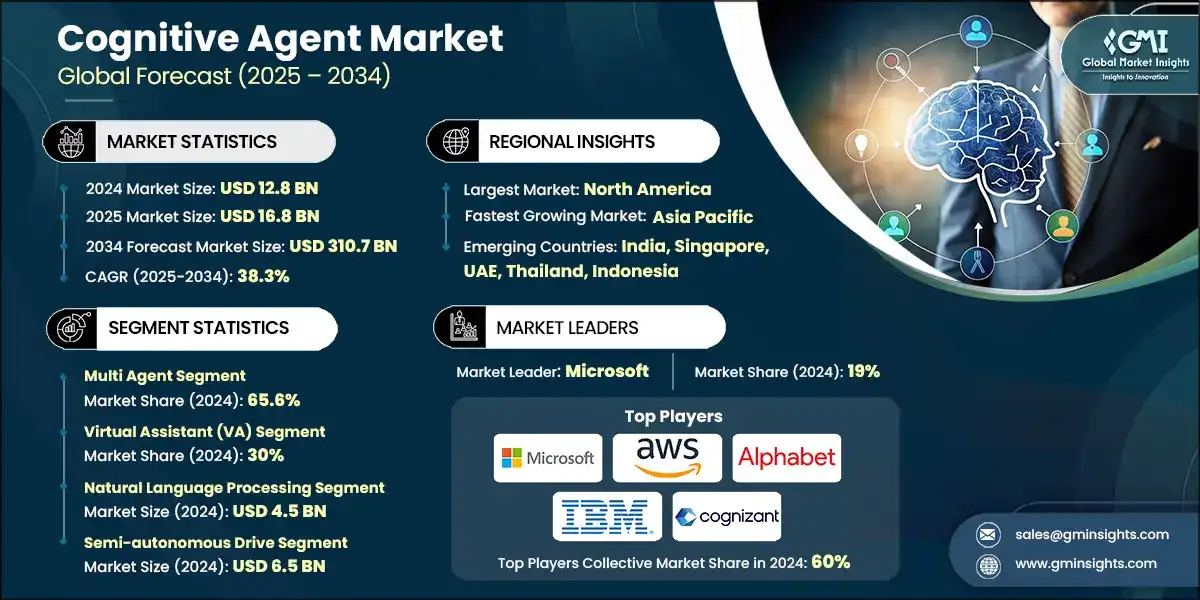
The global cognitive agent market size was valued at USD 12.8 billion in 2024. The market is expected to grow from USD 16.8 billion in 2025 to USD 310.7 billion in 2034, at a CAGR of 38.3%, according to latest report published by Global Market Insights Inc.
Cognitive Agent Market Key Takeaways
Market Size & Growth
- 2024 Market Size: USD 12.8 Billion
- 2025 Market Size: USD 16.8 Billion
- 2034 Forecast Market Size: USD 310.7 Billion
- CAGR (2025–2034): 38.3%
Regional Dominance
- Largest Market: North America
- Fastest Growing Region: Asia Pacific
Key Market Drivers
- Increasing enterprise adoption of AI-powered virtual assistants.
- Rising investments in generative AI, machine learning, and NLP technologies.
- Growing demand for automation across industries.
- Expansion of cloud infrastructure and AI-as-a-Service offerings.
Challenges
- Data privacy, cybersecurity, and regulatory concerns.
- High integration complexity with legacy IT systems.
Opportunity
- Collaboration between AI tech providers and industry-specific players.
- Development of multi-agent systems and fully autonomous cognitive agents.
Key Players
- Market Leader: Microsoft led with over 19% market share in 2024.
- Leading Players: Top 5 players in this market include Microsoft, Amazon Web Services, Alphabet, IBM, Cognizant, which collectively held a market share of 60% in 2024.
Get Market Insights & Growth Opportunities
The cognitive agent market is growing significantly as organizations begin to implement AI tools to create better decision-making, automate customer interactions, and improve visibility of operational efficiency. Cognitive agents move beyond traditional virtual assistants to rely on state-of-the-art technology to understand context, learn from experience, and act either autonomously or semi-autonomously.
These agents are operating in specific industries, including BFSI, healthcare, retail, manufacturing, government, and education, to support customer service, fraud detection, supply chain optimization, and workforce assistance. This trend and others are prompting $375 billion in worldwide A.I. infrastructure investments from organizations in 2025. The pace of investment in generative A.I., conversational A.I., and digital workers is fueling adoption and creating a major role for cognitive agents in the digital transformation strategies of enterprises.
The emergence of COVID-19 served as a substantial catalyst for the adoption of cognitive agents and AI technologies worldwide. Industry and government faced the unique challenge of managing operations under a highly disrupted competition, including the need to facilitate remote work and interact with customers. Between 2019 and 2020 total global capital investment in AI increased by 40 percent, which represents a meaningful increase compared to around 12 percent growth between 2018 and 2019.
The increase in investment, even while paraphrasing, captures the growing reliance of organizations on solutions driven by artificial intelligence including cognitive agents, that could ensure continuity, facilitate processes, and provide services to their customers, during the operational constraints imposed by lockdowns and social distancing.
North America is a leader in the adoption and deployment of cognitive agents owing to a good technology base, high enterprise AI adoption, and substantial investments in research and development. The region is expected to account for more than 50 percent of global AI spending by 2028, with overall spending of about $336 billion, indicating its strong position in the market. Companies in the U.S. and Canada are adopting cognitive agents in customer engagement, process automation, decision support, and personalization services. Industries such as BFSI, healthcare, retail, and government are utilizing cognitive agents.
The Asia-Pacific (APAC) region is emerging as the fastest-growing market for cognitive agents, driven by rapid digital transformation, increasing AI adoption, and supportive government initiatives across countries like China, India, Japan, and Southeast Asia. Various substantial and emerging initiatives, such as Google.org's $10 million investment in the APAC AI for Society program, are a significant accelerator of cognitive technology adoption in agriculture, healthcare, energy, among other sectors. These programs seek advanced cutting-edge AI solutions to improve outcomes in response to urgent challenges in society, showcasing the progressive impact cognitive agents will have beyond consumer outer boundaries.
To get key market trends
Cognitive Agent Market Trends
The increasing availability of open-source tools for cognitive agents is creating very rapid growth and innovation across many industries. Corporations are beginning to see that open platforms will reduce the barriers to adoption, allowing developers, enterprises and researchers to co-develop scalable solutions without being locked into proprietary platforms.
For example, in May 2025, Cognizant released the Neuro AI Multi-Agent Accelerator as an open-source community tool to enable easy prototyping and deployment of agent networks for various use cases. With the release of this tool for free, Cognizant is accelerating AI adoption and lays a foundation for adaptive operations, real-time decision-making, and integrated deployments.
Cognitive agents are being used for automating repetitive and laborious processes in a growing number of areas in various industries to decrease reliance on human labor and increase efficiency dramatically. This is especially evident in functions that utilize back-office activities, information technology services, and security monitoring, where the use of agents based on large language models allows processing large amounts of data in real time while better flagging anomalies.
Companies such as Cognosys and Adept are bringing agentic systems into use in processes such as invoice reconciliation and security operations center (SOC) alert triage to reduce manual work by 60% or more. By automating such resource-intensive activities, organizations are lowering their costs of service delivery and freeing skilled employees to do higher value, strategic work. This development demonstrates the bottom-line return on investment cognitive agents provide, making them competitive investment by companies seeking productivity and cost efficiencies.
The cognitive agent market has seen increasing growth in AI-enabled deployment in the customer experience space to improve customer interactions, increase satisfaction, and mitigate service delivery operational bottlenecks. Corporations across industries, including banking, insurance, and telecommunications, are adopting conversational agents to deliver full-time service availability, minimize resolution times to service inquiries, and respond to a variety of inquiries without the customer being routed to a human representative.
For instance, the Ping An Insurance company in China utilizes AI agents in its customer service function, and the company is now confirming that over 60% of all inquiries are being handled through an AI-agent. With increased reliance on these conversational agents, companies can increase response times and improve customer satisfaction through consistency and overall service experience.
Cognitive Agent Market Analysis
Learn more about the key segments shaping this market
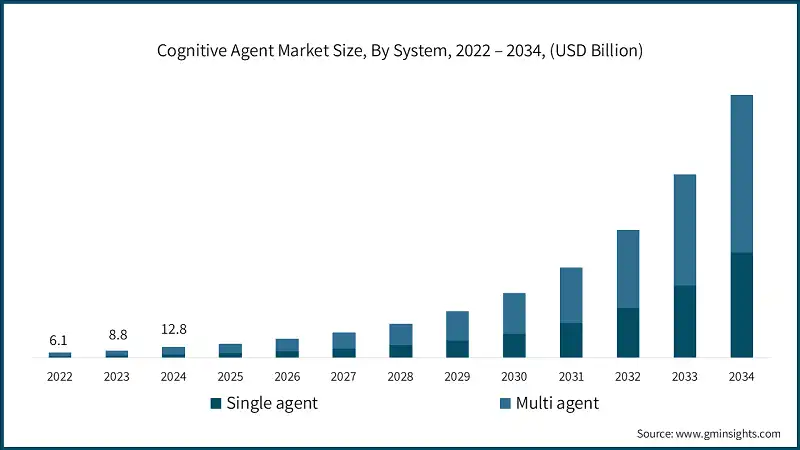
Based on system, the cognitive agent market is divided into single agent and multi agent. The multi agent segment dominated the market accounting by around 65.6% in 2024 and is expected to grow at a CAGR of 37.1% from 2025 to 2034.
- The multifaceted agent segment takes a lead over the cognitive agent market due to its ability to collaborate with several AI systems to solve a task interactively and interdependently. In these approaches, agents operate together, share information, and notate aspects of decision-making to optimize performance. The scalability implies they have become the preferred choice for organizations needing to manage dynamic and a large scale of agents interactively and dependently with many stakeholders in ATP scenarios.
- For example, in July 2024, Salesforce introduced Einstein Service Agent, a product that integrates autonomous AI agents into service interactions. Landing on top of traditional rules-based processes, the Einstein Service Agent is an agent system that can interpret various unpredictable and complex support issues without requiring pre-defined scripts. In turn, this provides the capacity to adapt while serving customers in real-time.
- While single agent systems are smaller than multi-agent systems, their importance is crucial for the targeted or specialized applications. Agents work particularly well for well-defined problems, like booking management, personal assistants, or automated report generation applications, where autonomy is needed as opposed to agents working collaboratively. Their simplicity, ease of implementation, and lower-cost deployment options for organizations with a narrower use case or smaller AI infrastructure make them a viable option.
Learn more about the key segments shaping this market
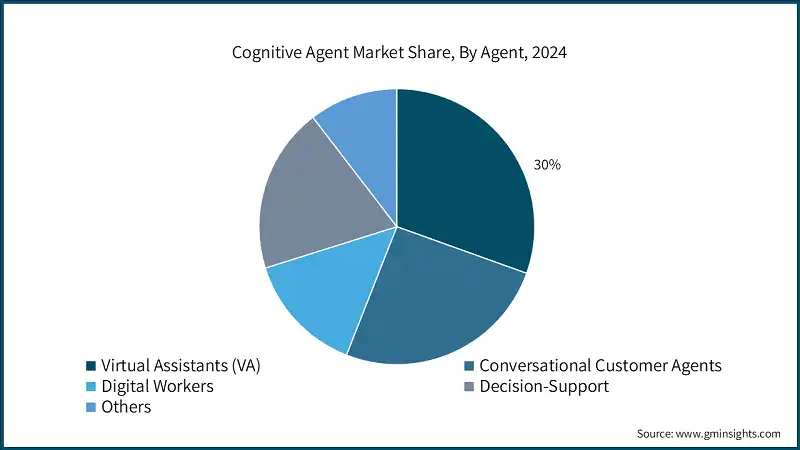
Based on agent, the cognitive agent market is categorized into virtual assistant (VA), conversational customer agents, digital workers, decision-support, and others. Virtual assistant (VA) segment dominates the market with 30% share in 2024, and the segment is expected to grow at a CAGR of 35.5% between 2025 and 2034.
- The virtual assistant segment possesses the largest portion of the cognitive agent marketplace, as businesses and consumer platforms begin to adopt these agents to optimize customer interactions and improve user experiences. In addition, virtual assistants are highly scalable to millions of users and blend into digital ecosystems, making them unique for external user and internal application purposes.
- For example, Rakuten Mobile and Rakuten Group in August 2025 publicized the full-scale launch of Rakuten AI, a next-generation AI agent designed for improved experiences across the Rakuten Ecosystem. By embedding cognitive capabilities into shopping, payments, telecoms, and digital services, Rakuten AI is designed to enhance everyday activities with more intuitive, efficient, and personalized interactions. This highlights the fact that cognitive agents and considerations around virtual assistants are growing prevalent to digital transformation and customer engagement for brand loyalty and operational efficiencies.
- The digital workers and decision-support systems segment is also starting to take traction as enterprises leverage AI agents that enhance workforce productivity to make better decisions in a data-driven way. These systems can automate blind-tight knowledge tasks, create actionable recommendations, and assist managers in complex scenarios bridging the gap between human expertise and artificial intelligence efficiency.
Based on technology, the cognitive agent market is divided into machine learning (ML), natural language processing, computer vision, robotics process automation (RPA), cognitive computing, and others. The natural language processing segment dominates the market and was valued at USD 4.5 billion in 2024.
- The natural language processing (NLP) sector is the largest in the cognitive agent space due to the growing demand for human-like interaction, automated content comprehension, and intelligent decision making. NLP enables agents to understand, analyze, and respond to textual and vocal input in support of applications including chatbots, browser assistants, sentiment analysis, and knowledge management in different industries.
- For example, IBM has enhanced its Conversation, NLP, and other APIs from Watson to support the new iOS 10 speech framework. This allows applications to support conversational interactions and provide deeper insights for users. This is just an example of how NLP technologies are evolving in different ways to improve real-time communication, customize user experiences, and help applications to process the complexities of spoken and written language inputs.
- Computer vision, robotic process automation (RPA), and cognitive computing represent salient sectors of the cognitive agent space and solutions for enterprises with different operational needs. Computer vision allows machines to explain visual data related to quality inspection, surveillance, and navigation as autonomous vehicles, for instance. RPA automates repetitive, rule-based tasks that support completion of tasks across workflows, while saving time and manual effort in general, and costs for findings in total after implementation.
Based on autonomy levels, the cognitive agent market is divided into semi-autonomous, fully autonomous, and assistive (human-in-the-loop). The semi-autonomous drive segment dominates the market and was valued at USD 6.5 billion in 2024.
- The semi-autonomous segment is the largest in the cognitive agent market, driven by its balanced approach between automation and human oversight. Semi-autonomous agents execute tasks autonomously, while allowing a final decision point for the user. These agents are seen as favorable for applications with accuracy, accountability and flexibility in mind. As a result, enterprises have adopted semi-autonomous agents for many applications to exponentially reduce manual workload, accelerate workflows and reduce errors without giving total control to AI.
- For instance, Jules, which is designed as a semi-autonomous agent providing automated functionality during software development. While some of the tasks associated with coding are automated through Jules, the human user can still confirm the output of the coding before it is deployed into production. With this capability, semi-autonomous agents, like Jules, are showing why this segment of the overall cognitive agent market is the largest, by streamlining and speeding up the speed of routine development work.
- Fully autonomous agents focus on the ability of agents to operate independently with little human intervention. Fully autonomous agents are useful for high-volume tasks or need for time-sensitive execution, as all agents can operate at the speed of their own internal capabilities. The other segment is assistive (human-in-the-loop), where human oversight is included as part of the solution and where AI can provide input into the decision; thus, allowing a human to take actions, and keeping the quality of the decisions in-check for processes that may have ethical concerns or complexities involved.
Looking for region specific data?
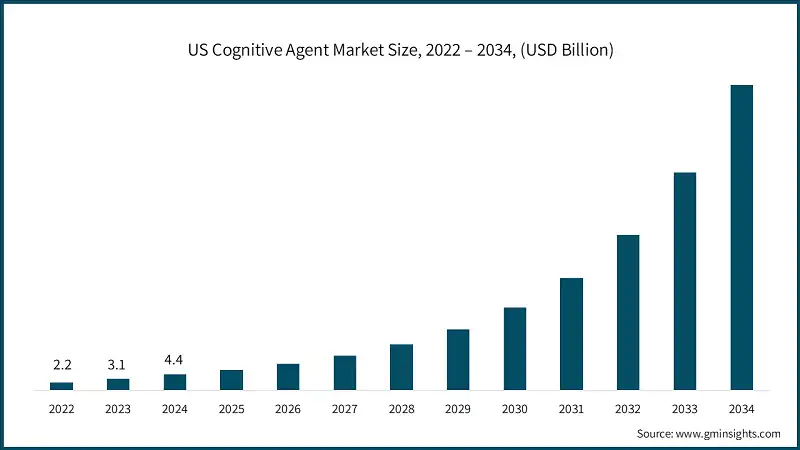
The US dominated the North America cognitive agent market with revenue of USD 4.4 billion in 2024.
- US is the world's largest cognitive agent market, driven by a sophisticated technology infrastructure, significant enterprise adoption, and government support. For instance, the U.S. National AI Initiative is critical for developing U.S.-led AI technologies, and research, demonstration, and deployment are part of it. This initiative and the strategic focus on AI have encouraged existing tech companies and new start-ups to invest in cognitive agents across many industries, including enterprise software, customer service, and healthcare.
- As an example of innovation in this space, Microsoft launched new developments to Microsoft 365 Copilot, with cognitive agents, in September 2024. These Copilot agents allow users to create AI assistants that automate workflows and conduct tasks across third-party applications and Microsoft's proprietary software. These Copilot agents aimed to enhance productivity and collaboration.
- Similarly, Canada is substantial in the cognitive agent’s market as a strong presence in AI research, regulatory environment, and growing enterprise adoption. The country has budgeted heavily for AI research and innovation in recent years, making it a location for developing cognitive agents for local and international businesses and markets.
UK Cognitive Agent market will grow tremendously with CAGR of 35.1% between 2025 and 2034.
- UK serves as the largest market for cognitive agents in Europe, with significant adoption in legal, financial, and enterprise service industries. Organizations within the UK are increasingly adopting AI agents to automate generic workflows, increase operational efficiency, and improve decision-making. The matured technology ecosystem that the UK has, equipped with regulatory frameworks supporting the deployment of AI, has made the UK a premier innovation technology center.
- In July 2024, for example, UK-based company BRYTER introduced its AI Agents product portfolio with significant updates to its no-code experience. BRYTER's AI Agents utilize a specialized trained AI to assist law firms and legal departments with repetitive tasks such as contract reviews with the Review Agent and drafting email responses for commercial teams with the Email Agent, which is embedded in MS Outlook or Gmail.
- Germany and France represent significant European markets for cognitive agents, due to their strong industrial bases and increased investment in AI. Businesses in Germany and France are using cognitive agents to improve operational efficiency, enhance customer service, and automate knowledge work processes, thereby moving toward digital transformation. Adoption in both markets is evident in finance, manufacturing, and professional services, providing both markets with a significant presence.
The Cognitive Agent market in China will experience strong growth during 2025-2034.
- Asia-Pacific accounts for more than 20% of the cognitive agent industry and has the highest growth potential with a CAGR of 42.2%. Investments, along with substantial government promotion of smart technologies, have brought enterprises in banking, insurance, e-commerce, and telecom to deploy AI agents in the enhancement of customer interaction, the automation of labor, and the standardization of services, all while maintaining efficiency. The extent of AI diffusion, combined with a large user base, establishes China as the world's leading market, with firms such as Ping An Insurance leading the way in automating customer service incurring a situation where over 60% of inquiries are handled by AI agents in an efficient manner.
- South Korea and Japan are important markets in the Asia Pacific region, owing to their strong technology base and purposefulness in AI innovation. South Korea forecasts spending in 480 billion won ($349.1 million) during the year of 2025, to stimulate the development of AI-based products and services, to reflect the country's initiative to spur development of next generation intelligent systems. Japan, with an advanced industrial base and enterprises adopting cognitive agents, is actively deploying AI agents to elevate operational efficiency, enhance customer service and aid decision support. Both countries are significant players in enabling growth in the market in APAC.
The cognitive agent market in Brazil will experience significant growth between 2025 & 2034.
- Latin America holds an 5% share of the cognitive agent market in 2024 with a CAGR of 41 %. In Latin America, Brazil represents the largest market for cognitive agents due to strong governmental support and enterprise adoption. The federal government has announced investments worth $4.2 billion in AI projects in the coming years. This announcement signals a strategic federal effort to increase digital transformation of industries such as finance, healthcare, and telecommunications. The investment from the public sector, along with increasing adoption in the private sector, positions Brazil as a hub for AI and cognitive agent technologies in the region.
- Argentina is being established as an emerging market for cognitive agents in Latin America significantly due to increased foreign investment and local AI initiatives. Salesforce in February 2025 announced a $500 million dollars investment in Argentina over the next five years to expand its AI-enabled customer relationship management or CRM and overall digital infrastructure. Salesforce's strategic investment should highlight its potential for Argentina as a growing hub for AI based solutions, and particularly as it relates to enterprise applications and customer engagement platforms.
The Cognitive Agent market in UAE is expected to experience robust growth between 2025 & 2034.
- The United Arab Emirates represents the largest cognitive agent market in the Middle East and Africa due to strong government support, high adoption within the enterprise, and a commitment to using cognitive agents in conjunction with artificial intelligence. A recent report revealed that 81% of businesses in the UAE operate with a defined and agreed purpose for the role of AI, with 60% of respondents having dedicated AI experts governing AI activities. Such forward-looking approaches have created an enabling environment that has paved the way for cognitive agents to be used in sectors such as finance, telecommunications, and logistics, and firmly position the UAE as the leading country for AI use in business transformation in the region.
- The Kingdom of Saudi Arabia is a rising country in the MEA cognitive agent market, supported by national strategies that tie AI adoption to national output goals. The Saudi Data and AI Authority (SDAIA) has guided government agencies and enterprise operators across 66 AI milestones that align with Vision 2030, encouraging the use of analysis and cognitive systems to address social issues with emerging data sources. That said, the structured approach creates a more diverse and a fast-paced adoption of AI-based decision-making and automation across sectors increasing operational efficiency, ultimately establishing Saudi Arabia as a leading spot for AI innovation in the region.
Cognitive Agent Market Share
The top 7 companies in the market are Microsoft, Amazon Web Services, Alphabet, IBM, Cognizant, Accenture, and Salesforce. These companies hold around 68% of the market share in 2024
- Accenture is a worldwide professional services firm that specializes in strategy, consulting, digital, technology, and operations. In the realm of cognitive agents, Accenture is focused on the design and implementation of AI-powered solutions that increase enterprise productivity, automate complex processes, and facilitate intelligent decision making. Accenture's deep industry knowledge and AI innovation labs allow it to offer customized cognitive agent services across multiple sectors, including banking, healthcare, and telecom.
- Amazon Web Services (AWS) is a premier cloud services provider that provides scalable infrastructure, AI, and machine learning capabilities. AWS powers cognitive agent development, including Alexa for Business, Amazon Connect, and other AI-driven tools used by enterprises to grow conversational agents, virtual assistants, and automated workflows.
- Salesforce is a global provider of customer relationship management (CRM) software and enterprise cloud solutions. Salesforce's Einstein AI platform brings cognitive agents into customer service, sales, and marketing functions to automate handling of customer inquiries, predictive analytics, and workflow automation.
- Cognizant is an information technology and consulting firm that provides digital, technology, and AI solutions to enterprises around the world. Across the cognitive agent marketplace, Cognizant centers on multi-agent systems, process automation, and AI-enabled operational intelligence.
- Alphabet, the parent company of Google, is a leader in AI research, cloud services, and digital transformation. The company can support an enterprise with a range of tools and services, including Google Cloud AI, Dialogflow, and DeepMind, that will enable businesses to design improved cognitive agents, virtual assistants, and decision support systems. Existing AI tools focus on areas like natural language understanding, machine learning, and analytics, providing value to businesses as well as users in general.
- IBM is one of the world's foremost technology companies providing broad expertise in artificial intelligence (AI), cloud-based offerings, and enterprise software. Its Watson AI platform supplies cognitive agents to support conversational intelligence, data analytics to identify opportunities, and decision support agents. IBM aims to integrate these AI agents into business operations to offer automation, predictive analytics, and higher quality experience within the customer journey for industries like healthcare, banking and finance, and retail.
- Microsoft is a significant service in cognitive agents, including Azure AI, Copilot, and Microsoft Cognitive Services. These works and services enable an enterprise to develop its own automated workflow, multi-agent systems, or virtual assistants. Using the combination of the Azure cloud scale, natural language processing, and machine learning tools, Microsoft is focused on delivering intelligent AI solutions to a range of industries.
Cognitive Agent Market Companies
Major players operating in the cognitive agent industry include:
- Accenture
- Amazon Web Services
- Cognizant
- IBM
- Microsoft
- NVIDIA
- Open AI
- Oracle
- Salesforce
- The cognitive agent market is a very competitive place with large tech corporations like Accenture, Cognizant, and IBM. These companies have deep industry expertise and consulting capabilities to create scalable solutions implementing agents across industries, including healthcare, finance, and logistics.
- Cloud providers like Amazon Web Services, Microsoft, and Alphabet have a stronghold on the infrastructure and platforms to build agents since they have flexible and scalable tools for virtual assistants, multi-agent systems, and decision support applications. There are also players in the market leveraging advances in natural language processing, machine learning, and real-time analytics for an intelligent, adaptable enterprise.
- Complementary players in the market are companies such as Cognigy, Blue Yonder, Nuance Communications, and SAS Institute, which develop niche applications novelties in conversational AI, predictive analytic capabilities, and industry-region optimization capabilities are some alternate examples in the market.
- Companies in this market rely on more complexity than the prior larger companies from building their own expertise, prebuilt AIs, and a supportive ecosystem of arrangements with the customer. The push to develop AI competitiveness and improve operational efficiency, the continuous development of AI provides another layer of intensity by market.
- These evolutions via strategic partnerships and collaborations, further development of open-source offerings, and competition among market players to simply heighten the agent capabilities beyond non-agent-based solutions to build toward hyper-personalized, AI-driven experiences for the consumer. The paradigm of such an independent ecosystem of the term agent creates additional technology adoption in addition to evolution of cognitive agents.
Cognitive Agent Market Report Attributes
| Key Takeaway | Details |
|---|---|
| Market Size & Growth | |
| Base Year | 2024 |
| Market Size in 2024 | USD 12.8 Billion |
| Market Size in 2025 | USD 16.8 Billion |
| Forecast Period 2025 - 2034 CAGR | 38.3% |
| Market Size in 2034 | USD 310.7 Billion |
| Key Market Trends | |
| Drivers | Impact |
| Increasing enterprise adoption of AI-powered virtual assistants | Cognitive agents enhance operational efficiency, reduce human workload, improve accuracy, and make businesses more agile and cost-efficient. |
| Rising investments in generative AI, machine learning, and NLP technologies | Accelerates innovation in cognitive agents, enabling more advanced reasoning, personalized interactions, and predictive capabilities across industries. |
| Growing demand for automation across industries | Helps organizations streamline complex workflows, reduce errors, enhance compliance, and free human employees for higher-value tasks. |
| Expansion of cloud infrastructure and AI-as-a-Service offerings | Enables scalable, cost-effective deployment of cognitive agents, even for small and medium-sized enterprises, fostering broader market penetration. |
| Pitfalls & Challenges | Impact |
| Data privacy, cybersecurity, and regulatory concerns | Organizations may hesitate to adopt cognitive agents due to risks around sensitive data handling, compliance requirements, and potential breaches. |
| High integration complexity with legacy IT systems | Deploying cognitive agents often requires significant adaptation of existing software and workflows, increasing implementation costs and timelines. |
| Opportunities: | Impact |
| Collaboration between AI tech providers and industry-specific players | Partnerships can accelerate deployment of cognitive agents tailored to specific industries, driving adoption and market growth. |
| Development of multi-agent systems and fully autonomous cognitive agents | Enables advanced enterprise automation, autonomous decision-making, and sophisticated interactions, opening new use cases in logistics, healthcare, BFSI, and government sectors. |
| Market Leaders (2024) | |
| Market Leaders |
19% market share |
| Top Players |
Collective market share in 2024 is 60% |
| Competitive Edge |
|
| Regional Insights | |
| Largest Market | North America |
| Fastest Growing Market | Asia Pacific |
| Emerging Countries | India, Singapore, UAE, Thailand, Indonesia |
| Future outlook |
|
What are the growth opportunities in this market?
Cognitive Agent Industry News
- In June 2025, IBM launched out a full AI agent governance and security solution taken together watsonx.governance with Guardium AI Security. This solution provides lifecycle monitoring of cognitive agents, automated red-teaming, and pre-loaded global compliance frameworks to help organizations safely and responsibly scale the deployment of AI.
- In May 2025, Microsoft shared its enterprise-wide vision of generative AI agents with enhanced GitHub Copilot; NLWeb; Grok models on Azure; Agent Factory; Phi-4-mini; and Entra Agent ID. These tools are meant to support autonomous, secure, and interoperable operations of AI agents across platforms, laying the groundwork for AI agents to become further established foundational infrastructure in enterprises. Microsoft's approach is structural, emphasizing context-aware actions, interoperability, scalability, and deployment across businesses, which places AI agents at the very center of enterprise strategies for digital transformation.
- In January 2025 Accenture unveiled its reactions to AI intent development with AI Refinery for Industry, an ecosystem of 12 AI agent solutions for industries that would allow organizations to quickly build and deploy networks of agents focused on industry-specific challenges. Built atop NVIDIA AI Enterprise software enhancements, these agents improve workforce readiness, optimize workflows, and may be tuned with the organization’s data to accelerate decision making and business value. This aligns well with the increasing trend of cognitive agent solutions focused on industry.
- In January 2025, NVIDIA introduced AI Blueprints, which numbers of enterprises can use to develop multi-level agentic AI applications. This allows developers to build AI "knowledge robots" that can scrape data and provide interpretations of data in various formatting systems, automate procedures, and support more sophisticated levels of decision-making. It is a step toward allowing enterprises to rapidly leverage the potential of agentic AI technology to improve operational performance and drive innovation by providing them with the tools to design a variety of AI agents.
The cognitive agent market research report includes in-depth coverage of the industry with estimates & forecasts in terms of revenue and volume ($Bn) from 2021 to 2034, for the following segments:
Market, By Agent
- Virtual Assistants (VA)
- Conversational Customer Agents
- Digital Workers
- Decision-Support
- Others
Market, By System
- Single agent
- Multi agent
Market, By Autonomy Level
- Semi-autonomous
- Fully autonomous
- Assistive (Human-in-the-loop)
Market, By Technology
- Machine Learning (ML)
- Natural Language Processing
- Computer Vision
- Robotics Process Automation (RPA)
- Cognitive Computing
- Others
Market, By End use
- Banking, Financial Services & Insurance (BFSI)
- Healthcare & Life Sciences
- Retail & e-commerce
- Media & Entertainment
- Manufacturing
- Government & Public Sector
- Education
- Transportation & Logistics
- Energy & Utilities
- Others
The above information is provided for the following regions and countries:
- North America
- US
- Canada
- Europe
- UK
- Germany
- France
- Italy
- Spain
- Belgium
- Netherlands
- Sweden
- Asia Pacific
- China
- India
- Japan
- Australia
- Singapore
- South Korea
- Vietnam
- Indonesia
- Latin America
- Brazil
- Mexico
- Argentina
- MEA
- South Africa
- Saudi Arabia
- UAE
Frequently Asked Question(FAQ) :
What was the market size of the cognitive agent in 2024?
The market size was USD 12.8 billion in 2024, with a CAGR of 38.3% expected through 2034. The growth is driven by the adoption of AI tools for decision-making, customer interaction automation, and operational efficiency improvements.
What is the projected value of the cognitive agent market by 2034?
The market is poised to reach USD 310.7 billion by 2034, fueled by advancements in AI technologies, open-source platforms, and increased enterprise adoption.
What is the expected size of the cognitive agent market in 2025?
The market size is projected to reach USD 16.8 billion in 2025.
How much revenue did the multi-agent segment generate in 2024?
The multi-agent segment accounted for approximately 65.6% of the market in 2024 and is expected to witness over 37.1% CAGR till 2034.
What was the valuation of the virtual assistant segment in 2024?
The virtual assistant segment held a 30% market share in 2024 and is set to expand at a CAGR of 35.5% up to 2034.
What is the growth outlook for the semi-autonomous drive segment?
The semi-autonomous drive segment, valued at USD 6.5 billion in 2024, is the largest in the market. It is driven by its ability to balance automation with human oversight, enabling autonomous task execution with user decision points.
Which region leads the cognitive agent industry?
The United States leads the North American market, generating USD 4.4 billion in revenue in 2024. This dominance is attributed to advanced technology infrastructure, enterprise adoption, and government initiatives like the U.S. National AI Initiative.
What are the upcoming trends in the cognitive agent market?
Key trends include open-source adoption, AI-enhanced customer experience, task automation, real-time decision-making, and LLM integration for anomaly detection and data processing.
Who are the key players in the cognitive agent industry?
Major players include Accenture, Google, Amazon Web Services, Cognizant, IBM, Microsoft, NVIDIA, OpenAI, Oracle, and Salesforce.
Cognitive Agent Market Scope
Related Reports