Summary
Table of Content

Cloud Microservices Market
Get a free sample of this report
Form submitted successfully!
Error submitting form. Please try again.
Thank you!
Your inquiry has been received. Our team will reach out to you with the required details via email. To ensure that you don't miss their response, kindly remember to check your spam folder as well!
Request Sectional Data
Thank you!
Your inquiry has been received. Our team will reach out to you with the required details via email. To ensure that you don't miss their response, kindly remember to check your spam folder as well!
Form submitted successfully!
Error submitting form. Please try again.
Cloud Microservices Market Size
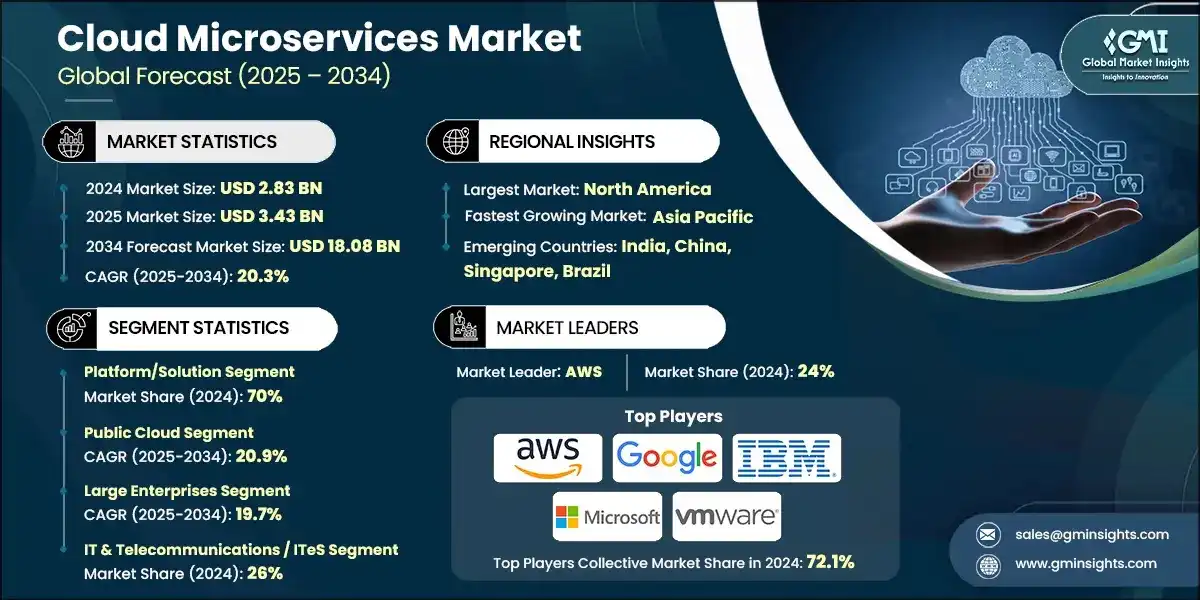
The global cloud microservices market size was estimated at USD 2.83 billion in 2024. The market is expected to grow from USD 3.43 billion in 2025 to USD 18.08 billion in 2034, at a CAGR of 20.3% according to latest report published by Global Market Insights Inc.
Cloud Microservices Market Key Takeaways
Market Size & Growth
- 2024 Market Size: USD 2.83 Billion
- 2025 Market Size: USD 3.43 Billion
- 2034 Forecast Market Size: USD 18.08 Billion
- CAGR (2025–2034): 20.3%
Regional Dominance
- Largest Market: North America
- Fastest Growing Region: Asia Pacific
Key Market Drivers
- Growing adoption of microservices for cloud-native applications.
- Rise of containerization and Kubernetes orchestration.
- Demand for continuous integration and continuous delivery (CI/CD).
- Need for resilient and fault-tolerant architectures.
Challenges
- Complexity in managing distributed services.
- Security vulnerabilities in microservices architectures.
Opportunity
- Expansion of microservices in edge computing.
- Integration with AI/ML for intelligent service orchestration.
Key Players
- Market Leader: AWS led with over 24% market share in 2024.
- Leading Players: Top 5 players in this market include AWS, Google, IBM, Microsoft, VMware, which collectively held a market share of 72.1% in 2024.
Get Market Insights & Growth Opportunities
The cloud microservices market is mostly driven by enterprises moving applications from monolithic applications to modular, cloud native architectures. About 62.3% of organizations reported use of microservices and container technologies in order to support more flexible coding and scale up application development and deploying software faster across distributed environments.
Enterprises support microservices as they provide developers with more autonomy to scale a particular service and deploy cloud-native applications much faster without increasing change in cycle time. Approximately 87% of organizations say microservices achieve infrastructure independence, and about 86% of organizations state they improve scalability and faster time to market via modular cloud-based application development.
Within both public and private sectors, the need for demand for cloud-native deployments continues to grow especially from within hybrid and multi-cloud ecosystem. Reports indicate that nearly 81% of federal and enterprise organizations in the pipeline recognize an imminent need to modernize the IT infrastructure to facilitate the cloud-native applications and microservices.
However, operational complexity is still a challenge within distributing microservices architectures. Approximately 36% of these organizations indicated integration issues across the infrastructure, while 35% indicated applying security policies across multi-services and environments so that they comply with regulatory frameworks which affect performance governance.
On the horizon, the convergence of AI and IT Operations (AIOps) is showing up as a significant driver for the intelligent management of microservices. Organizations continued implementing AIOps more frequently for predicate scaling and anomaly detection and forecasting.
To get key market trends
Cloud Microservices Market Trends
The global trend towards digital transformation is spurring significant adoption of microservices as organizations modernize their IT infrastructure. According to the US Department of Commerce, over 68% of organizations are accelerating their move to cloud-native to improve agility, operational resilience, and time to service (TTS) in deployment cycles.
Containerization technologies are rapidly emerging as the center of microservices implementations across all industries. In data from the National Institute of Standards and Technology (NIST), nearly 70% of new cloud applications in 2024 were deployed using containerized architecture, which helps improve interoperability and response to secure, scalable services in hybrid or multi-cloud.
Modernization initiatives from the public sector have greatly shaped the market. The US Federal Cloud Computing Strategy shows that over 80% of agencies have shifted critical applications to microservices-based systems to reduce infrastructure complexity, bolster system redundancy, and create cross-agency digital interoperability.
Microservices frameworks are becoming more integrated with security and compliance. The European Union Agency for Cybersecurity (ENISA) reports that, among tens of thousands of European enterprises, 42% are moving toward zero-trust frameworks within microservices as a way to reduce vulnerabilities of distributed workloads and API-based communication within cloud infrastructures.
AI-driven automation is transforming the operation of microservices to be more efficient and reliable. OECD digital economy statistics indicate that 61% of enterprises are using AIOps and intelligent orchestration tools for microservices management to provide predictive scaling, automated remediation, and greater observability in complex cloud environments.
Cloud Microservices Market Analysis
Learn more about the key segments shaping this market
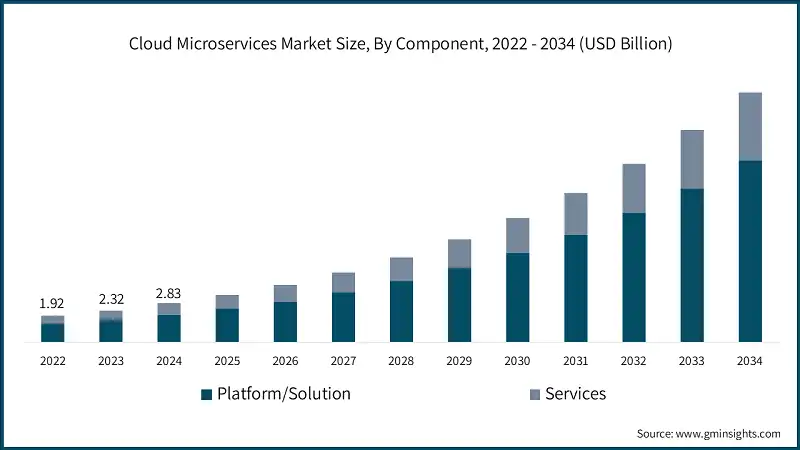
Based on component, the cloud microservices market is divided into platform/solution and services. Platform/solution segment dominated the market in 2024, accounting for 70% share of total revenue.
- The platform/solution segment is the largest revenue share of the cloud microservices market, as enterprises are increasingly looking for development frameworks that are scalable, secure, and interoperable. NIST indicates that approximately 72% of enterprises are using container orchestration platforms (Kubernetes) to orchestrate distributed microservices and operations.
- Comprehensive platform solutions are increasingly integrated with automation, observability, and API management capabilities. European Commission, Digital Economy Observatory reports that around 65% of cloud-native enterprises have deployed unified API management platforms to improve communication through microservices and optimize latency in complex hybrid cloud environments.
- Leading cloud providers, i.e. AWS, Microsoft Azure, Google Cloud, etc., are diversifying their platform portfolio toward supporting intelligent microservices management. The US Department of Commerce suggests that roughly 58% of enterprises are increasingly using cloud-native development frameworks offered by hyperscale’s to help with scalability and redundancy across multi-cloud environments.
- The services segment is being adopted in a very strong manner, as these enterprises are starting to seek professional help for design, deployment, and the overall governance of microservices architectures. OECD digital transformation data suggests that about 54% of enterprises claim to use external consulting, or managed services partnerships, to speed modernization plans and adhere to enterprise-grade standards.
Learn more about the key segments shaping this market
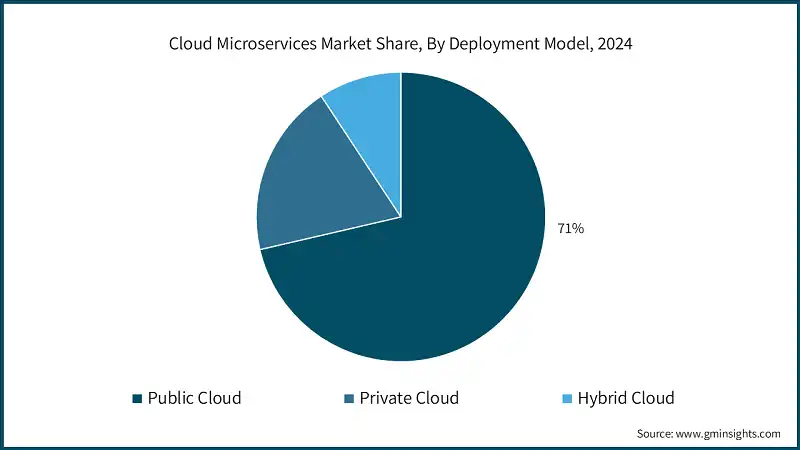
Based on deployment model, the market is segmented into public cloud, private cloud, hybrid cloud. The public cloud segment dominated the market in 2024 and is expected to grow at a CAGR of 20.9% from 2025 to 2034.
- The cloud microservices market is primarily driven by public cloud, given its broad uptake of managed and elastic infrastructure services. Of the data from US Federal Cloud Computing, around 76% of enterprises run public cloud environments to deploy microservices applications, as they find this option to be cost-efficient and fast scaling.
- Public cloud market share is also strengthened by ecosystem maturity and innovation. The European Cloud Observatory indicates that 68% of companies using microservices infrastructures favor public cloud services due to integrated DevOps tools and automated orchestration technology, alongside inherent support for container-based development frameworks.
- Private cloud continues to be popular among regulated industries, where security and governance of data are paramount. Data from the US National Institute of Standards and Technology (NIST) indicates that 47% of financial and healthcare companies deploy private cloud based microservices environments to comply with regulatory aligned cybersecurity and privacy data protection frameworks also unique to their respective sectors.
- Private cloud deployments also allow enterprises to retain strict control over system architecture and network access. OECD studies of digital infrastructure reveal that 52% of organizations utilizing private microservices clouds cited a desire for improved enforcement of policies and identity management as two of the chief reasons for wanting to retain their own infrastructure and operate within safer environments; therefore, organizations preferred to keep it located within their territories, and controlled private rather than public, shared environments.
Based on organization size, the market is segmented into large enterprises and small & medium enterprises (SMEs). The large enterprises segment dominated the market in 2024 and is expected to grow at a CAGR of 19.7% from 2025 to 2034.
- Larger enterprises presently drive the cloud microservices market due to their more capable digital infrastructures and desire for modernization. According to the US Department of Commerce, almost 71% of Fortune 500 companies have systems in place that integrate microservices as a way to improve operational agility, scale, and continuous integration capabilities. These enterprises can exploit microservices to facilitate expanded digital ecosystems and complex applications.
- Furthermore, data from the European Commission’s Digital Economy Report revealed that over 64% of companies with 1000 or more employees have leveraged microservices as a means to improve both delivery pipelines for software and to speed up their transitions to cloud native. Large enterprise respondents also show greater technological investment in automation and container orchestration tools. OECD enterprise technology adoption cognitive data further brings light to the reality that approximately 67% of global enterprises have developed Kubernetes-based microservices management platforms that really help to minimize deployment time processes and improve service resilience in hybrid/multi-cloud situations.
- Microservices adoption also has been gaining traction with small enterprises, or small and medium enterprises (SMEs), for improving competitive advantage and operational flexibility. NIST research found that approximately 53% of SMEs have even adopted microservices-based design and architectures as an approach of modernizing traditional legacy applications, which included speed of the updates for features and scaling of digital service delivery with little to no up-fit technology costs.
Based on end use, the cloud microservices market is segmented into IT & telecommunications / ITeS, retail & e-commerce, healthcare, BFSI, manufacturing, media & entertainment, government & public sector, transportation & logistics, and others. The IT & telecommunications / ITeS segment dominated the market, accounting for share of 26% in 2024.
- The IT & telecommunications / ITeS sector has a considerable presence in the cloud microservices space, due to the intense demand for modular, agile architectures in support of services providing connectivity, platforms and managed services.
- In this segment, roughly 73% of IT organizations indicate they are using cloud-native microservices architectures and 61% are utilizing microservices to advance functions such as 5G network services. These numbers represent just how microservices have revolutionized the delivery of real-time, scalable services and infrastructure across the telecom ecosystem.
- Retail & e-commerce is not far behind in terms of rapid development, but the industry is still yet to catch up considering the millions of transactions that take place in daily retail environments. However, the IT & telecom sector’s operational models, technology stack, ecosystem integrations, and migration to contemporary development methods enables it to have an operational advantage over other sector adoption and continuous delivery capacity with regards to microservices.
- IT/ITeS organizations are experiencing the benefits of the flexibility of microservices, in ways that other verticals that now consider microservices adoption are starting slowly ramping their own flexibility. For instance, microservices can provide support for CI/CD pipelines, multi-cloud deployments, and developer-controlled service release as part of the CI/CD pipeline (as opposed to ineffective release cycles) all at much shorter time-to-market considerations.
- Other end use verticals such as healthcare, BFSI, manufacturing, media, logistics, and government are steadily expanding their microservices deployments, but the IT & telecom sector remains the most mature adopter. Its leadership underscores the critical role of connectivity services, infrastructure upgrades, and enterprise software delivery in driving microservices uptake.
 Looking for region specific data?
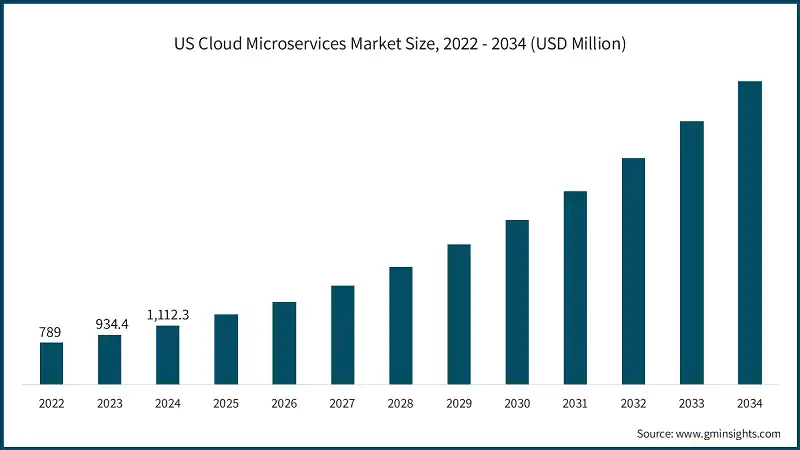
US dominates the North America cloud microservices market, generating USD 1.11 billion revenue in 2024.
- The state of the American business environment shows a high level of cloud adoption, with more than 60% of respondent firms from the Information sector reporting they use cloud services, making it more conducive for microservices use and adoption throughout various industries.
- Among businesses in the US, smaller firms also face fewer barriers than previously considered; between 50% and about 52% of firms in the Manufacturing sector reported not facing barriers to the adoption of cloud-based technology. This opens up opportunities for microservices adoption beyond the largest firms.
- In terms of business modernization by the Federal government, there is a clear indication of commitment towards cloud transformation. For example, government agencies have pursued a Cloud Smart strategy for the Federal government, focusing on security, procurement, and workforce modernization. These programs support the improvement of microservices architecture for public sector operations.
- For financial services in the United States, firms are quickly adopting cloud infrastructure. 72% of all financial chief information officers indicated that their firms expect to increase public cloud investment spending, which indicates firm commitment and ability to adopting and utilizing distributed microservices architectures along with modular applications deployment in regulated industries.
- The variation between industries is still pronounced in cloud adoption; the Information sector is reporting greater than 60% cloud computing capabilities, while agriculture and some small manufacturing segments lag substantially. Closing the gap will be essential to facilitating microservices adoption in all sectors in the US
The cloud microservices market in Germany is expected to experience robust growth of CAGR 19.8% from 2025 to 2034, driven by widespread cloud adoption, government digital initiatives, and strong enterprise demand for scalable microservices architectures.
- Germany's business sector exhibits an increasing reliance on cloud solutions, with around 46.5% of companies adopting cloud computing, and another 11.1% considering adoption. Sectors such as services (49%) and manufacturing (48.7%) exhibit strong interest from enterprises.
- While there is improvement, the digital adoption gap still exists at large enterprises compared to SMEs. In 2023, around 68.4% of large German enterprises utilized cloud services, compared to just 37.5% of SMEs, demonstrating a nearly 31 percentage point difference.
- Security and strategic alignment are important drivers: for the 61% of German companies that are using or talking about the cloud, the digitization of internal processing is one of the goals, and for 57%, the cloud-based infrastructure goal is to improve IT security.
- Automation and multi-cloud is becoming common: for organizations with over 50 employees, 82% are pursuing a multi-cloud approach, while only 29% of organizations have publicly automated cloud provisioning—indicating opportunities for operational maturity.
- Germany's cloud journey is still beset with regulatory challenges and infrastructure issues. Cloud adoption is on the rise, but manufacturing as an industry still lags behind, with important challenges remaining, such as the continued shortage of digital skills and the lack of investment in infrastructure means cloud adoption cannot be more robust or deeper.
The cloud microservices market in China is expected to experience strong growth from 2025 to 2034, fueled by government-backed digital transformation programs, rapid enterprise cloud adoption, and investments from leading domestic and global cloud service providers.
- The market for cloud microservices in China is advancing quickly as the country pursues its digital economy initiatives. More organizations are adopting a modular, cloud-native architecture to enable more business agility, scalability, and innovative capability to support modernization initiatives by the private and public sectors.
- Government policies such as "New Infrastructure" and digital transformation and guidelines are stimulating cloud adoption. These policies are focused on the integration of AI, 5G, and IoT, as well as the utilization of microservices, that allow organizations to create flexible and resilient IT infrastructure in support of large-scale, real-time applications.
- Leading technology providers in China, such as Alibaba Cloud, Tencent Cloud, and Huawei Cloud, are expanding microservices solutions to include containerization, orchestration, and API management solutions. This is supporting an ecosystem that allows enterprise organizations to deploy and manage distributed enterprise applications effectively across multiple cloud settings.
- Sector-specific cloud microservices adoption is particularly strong in finance, telecommunications, e-commerce, and government services. Organizations in these sectors are exploiting cloud-native microservices to improve operational efficiency, rapidly deploy new services, and remain compliant with local regulations and cybersecurity requirements.
The cloud microservices market in the UAE is anticipated to register consistent growth from 2025 to 2034, supported by national cloud strategies, smart city initiatives, and increasing adoption of microservices by both public and private sector organizations.
- The UAE is quickly moving toward cloud microservices in the context of the larger digital transformation agenda. Initiatives at the government level, including Smart Dubai and the UAE Cloud First Strategy, are driving enterprises to adopt cloud-native architectures to find IT solutions that are more scalable, agile and, innovative.
- Enterprises across sectors including banking, healthcare, telecommunications, and logistics are increasingly using microservices to achieve greater operational efficiency, improve the rapid delivery of digital services to customers, and create better customer experiences. Microservices are by nature a more modular architecture that allows organizations to respond quickly to varying demands in the market.
- The biggest public cloud providers, including Microsoft Azure, AWS, and Oracle Cloud, are expanding their operations at local data centers in the UAE to support the adoption of microservices. This will facilitate low-latency, secure, and compliant cloud solutions for enterprises and government agencies.
- With the strong regulatory support for the adoption of private sector cloud microservice architectures, there is also a focus to improve data security and support technology-led digital innovation. Many organizations are using microservices to meet regulatory compliance requirements with the added benefit of being able to layer advanced features such as container orchestration, API management, and automated service monitoring through the use of microservices.
- The elements of cloud microservices may be strong, but there are still challenges to consider as well such as limited local cloud-native skills and a need to standardize microservices deployment for the associated cloud-natives. However, the focus on government support for adoption, enterprise development/training programs, and building ecosystem partnerships/enablers will only help hasten the speed to which cloud microservices are adopted, and operational efficiencies will be improved across global sectors.
The Brazil cloud microservices market is anticipated to grow at a robust pace of 21.9% from 2025 to 2034, driven by digital transformation in banking, retail, and telecommunications, as well as government initiatives promoting cloud adoption and infrastructure modernization.
- Brazil is experiencing steady growth in the use of cloud microservices as organizations embrace digital transformation to improve operational agility and service delivery. More and more, enterprises are using cloud native architectures in order to modernize legacy applications and build scalable, modular IT environments.
- Financial services, retail, and telecommunications are leading cloud microservices adoption in Brazil. This is due to the demand for real-time services, enhanced customer experience, and shorter decision-to-deploy cycles. Organizations are utilizing containerized applications and orchestration frameworks to manage their distributed services.
- Government deployments and initiatives like the Brazilian Digital Transformation Strategy, push adoption of cloud services to the public and private sectors. They encourage innovation, modernization, interoperability, and secure cloud infrastructure. Policies by government agencies such as the General Data Protection Law and the National Cybersecurity Strategy are creating favorable conditions to deploy microservices while pursuing broader digital innovation.
- Local providers are now supporting many enterprises with their cloud architecture and deployment. This is especially true in the space where AWS, Microsoft Azure, and Google Cloud continue to expand their infrastructure and services offerings that can be used to deploy and manage microservices efficiently while fulfilling data sovereignty and cybersecurity requirements.
Cloud Microservices Market Share
- The top 7 companies in the cloud microservices industry are AWS, Microsoft, Google, IBM / Red Hat, VMware, Oracle, Alibaba, contributing around 77% of the market in 2024.
- Amazon Web Services (AWS) has a robust suite of microservices, containers, and orchestration services that enable enterprise-grade, scalable, secure, and flexible cloud-native applications for businesses world-wide across many industries.
- Microsoft also provides cloud services that integrate microservices, Kubernetes, and Service Fabric as part of its Azure cloud service offering, enabling marketplace capabilities for enterprise-grade security, multi-cloud deployment, and integrated access to productivity and artificial intelligence tools needed for organizations to rapidly advance in their digital transformation and business capabilities.
- Google Cloud delivers microservice capabilities through its bundling of Anthos, Cloud Run, and Kubernetes Engine. Google Cloud facilitates the build-out of scalable cloud-native applications, allowing enterprises to manage their cloud-native applications or workloads with an emphasis on analytic capabilities, artificial intelligence, and multi-cloud orchestration.
- IBM offer microservices deployment on the OpenShift platform and hybrid cloud solutions that enable secure, flexible, and scalable container-based applications focused on enterprise digital transformation and development with regulatory compliance across many verticals.
- VMware provides Tanzu, a microservices and container-based application orchestration support model. VMware provides a suite of capabilities on the platform for integrated access to enterprise-grade security of deployment in hybrid cloud and cloud-native environments to streamline deployment and enterprise microservices and management of applications.
- Oracle Cloud provides microservices architecture, container, API management, and orchestration capabilities focused on applications with solutions to support enterprise-grade cloud-native development and management of corporately controlled environments in an automated and secure fashion.
- Alibaba Cloud provides microservices capabilities through its Container Service for Kubernetes and Serverless offerings. Alibaba Cloud provides scalable, flexible, and cost-efficient cloud-native offerings, especially in larger regional markets outside of the United States.
Cloud Microservices Market Companies
Major players operating in the cloud microservices industry are:
- Alibaba
- AWS (Amazon)
- Dell Technologies
- IBM
- Microsoft
- Oracle
- Salesforce
- SAP
- VMware
- The cloud microservices market is rapidly advancing as more companies turn to cloud-native architecture to innovate faster, scale resources, and increase operational efficiency. Companies across industries such as IT, telecommunications, banking and financial services, retail, and healthcare are employing microservices to modularize applications, accelerate software deployment, and onboard continuous integration/continuous delivery practices. The decoupling of monolithic systems into distributed microservices enables faster times to market for new products, more real-time processing, and more efficient consumption of network resources, all while accelerating the demand for new digital offerings, and customer-centric services.
- The key trends driving the cloud microservices market include utilization of AI and automation to enable intelligent service orchestration, increased usage of containerization and Kubernetes, and multi-cloud or hybrid cloud approaches to optimize workloads. Enterprises are focusing on cloud microservices to improve operational resiliency, enable scalability of applications, and manage complex cloud environments. Although there are challenges to face in this new paradigm including security, interoperability, and talent gaps, government initiatives, digitalization policies, and investment in cloud infrastructure continue to advance adoption of cloud microservices which have become an essential element of enterprise IT strategy around the world.
Cloud Microservices Market Report Attributes
| Key Takeaway | Details |
|---|---|
| Market Size & Growth | |
| Base Year | 2024 |
| Market Size in 2024 | USD 2.83 Billion |
| Market Size in 2025 | USD 3.43 Billion |
| Forecast Period 2025 – 2034 CAGR | 20.3% |
| Market Size in 2034 | USD 18.08 Billion |
| Key Market Trends | |
| Drivers | Impact |
| Growing adoption of microservices for cloud-native applications | Enhances scalability and modularity, accelerating enterprise cloud transformation |
| Rise of containerization and Kubernetes orchestration | Simplifies deployment and management across hybrid and multi-cloud environments |
| Demand for continuous integration and continuous delivery (CI/CD) | Improves software delivery speed and operational efficiency |
| Need for resilient and fault-tolerant architectures | Encourages adoption of distributed microservices patterns for reliability |
| Pitfalls & Challenges | Impact |
| Complexity in managing distributed services | Increases operational overhead and monitoring requirements |
| Security vulnerabilities in microservices architectures | Requires robust authentication, authorization, and encryption mechanisms |
| Opportunities: | Impact |
| Expansion of microservices in edge computing | Enables low-latency processing closer to end-users |
| Integration with AI/ML for intelligent service orchestration | Supports adaptive and automated service scaling |
| Market Leaders (2024) | |
| Market Leaders |
24% market share |
| Top Players |
Collective market share in 2024 is 72.1% |
| Competitive Edge |
|
| Regional Insights | |
| Largest Market | North America |
| Fastest growing market | Asia Pacific |
| Emerging countries | India, China, Singapore, Brazil |
| Future outlook |
|
What are the growth opportunities in this market?
Cloud Microservices Industry News
- In January 2025, Microsoft announced strategic partnerships with leading Indian technology companies to accelerate cloud-native microservices adoption across the region, including comprehensive training programs and technical support initiatives designed to enhance local expertise in microservices architecture implementation and management.
- In December 2024, Oracle expanded its banking cloud microservices platform with enhanced regulatory compliance capabilities, introducing new features specifically designed for financial services organizations requiring strict data governance and audit trail requirements in distributed microservices environments.
- In November 2024, Nutanix launched its Enterprise AI public cloud expansion, integrating advanced artificial intelligence capabilities with microservices orchestration platforms to enable intelligent workload management, predictive scaling, and automated optimization across hybrid cloud environments.
- In October 2024, Salesforce introduced its next-generation cloud-native microservices platform, featuring enhanced integration capabilities with third-party systems and improved developer experience tools designed to accelerate microservices application development and deployment cycles.
- In September 2024, Google Cloud announced a strategic partnership with Apollo Hospitals to develop healthcare-specific microservices solutions, focusing on patient data management, telemedicine platforms, and clinical workflow optimization using cloud-native architectures.
- In August 2024, Amazon Web Services unveiled significant enhancements to its container services portfolio, including improved Amazon EKS capabilities, enhanced AWS Lambda integration, and new monitoring tools designed to simplify microservices operations and troubleshooting processes.
- In July 2024, IBM completed the integration of Red Hat OpenShift capabilities with Watson AI services, creating comprehensive AI-powered microservices development and management platforms designed for enterprise customers implementing intelligent automation initiatives.
The cloud microservices market research report includes in-depth coverage of the industry with estimates & forecasts in terms of revenue ($ Mn/Bn) from 2021 to 2034, for the following segments:
Market, By Component
- Platform/Solution
- Container Orchestration Platforms
- API Management Platforms
- DevOps & CI/CD Integration Tools
- Others
- Services
- Deployment & Integration Services
- Consulting & Advisory Services
- Maintenance & Support Services
- Training & Certification Services
Market, By Deployment Model
- Public Cloud
- Private Cloud
- Hybrid Cloud
Market, By Organization Size
- Large Enterprises
- Small & Medium Enterprises (SMEs)
Market, By End Use
- IT & Telecommunications / ITeS
- Retail & e-Commerce
- Healthcare
- BFSI (Banking, Financial Services & Insurance)
- Manufacturing
- Media & Entertainment
- Government & Public Sector
- Transportation & Logistics
- Others
The above information is provided for the following regions and countries:
- North America
- US
- Canada
- Europe
- Germany
- UK
- France
- Italy
- Spain
- Russia
- Nordics
- Asia Pacific
- China
- India
- Japan
- Australia
- South Korea
- Southeast Asia
- Latin America
- Brazil
- Mexico
- Argentina
- MEA
- South Africa
- Saudi Arabia
- UAE
Frequently Asked Question(FAQ) :
What is the market size of the cloud microservices in 2024?
The market size was USD 2.83 billion in 2024, with a CAGR of 20.3% expected through 2034. The shift from monolithic applications to modular, cloud-native architectures is driving market growth.
What is the projected value of the cloud microservices market by 2034?
The market is poised to reach USD 18.08 billion by 2034, fueled by the adoption of containerization technologies, AI-driven automation, and public cloud services.
What is the expected size of the cloud microservices industry in 2025?
The market size is projected to reach USD 3.43 billion in 2025.
How much revenue did the platform/solution segment generate in 2024?
The platform/solution segment generated approximately 70% of the total market revenue in 2024, led by the demand for scalable, secure, and interoperable development frameworks.
What was the valuation of the public cloud segment in 2024?
The public cloud segment is expected to witness over 20.9% CAGR till 2034, driven by the adoption of managed and elastic infrastructure services.
What is the growth outlook for the large enterprises segment from 2025 to 2034?
The large enterprises segment is anticipated to expand at a CAGR of 19.7% up to 2034, supported by their advanced digital infrastructures and modernization initiatives.
Which region leads the cloud microservices sector?
The United States leads the North American market, generating USD 1.11 billion in revenue in 2024.
What are the upcoming trends in the cloud microservices market?
Trends include the adoption of containerization technologies, zero-trust security frameworks, AI-driven automation, and modernization initiatives in the public sector.
Who are the key players in the cloud microservices industry?
Key players include Alibaba, AWS (Amazon), Dell Technologies, Google, IBM, Microsoft, Oracle, Salesforce, SAP, and VMware.
Cloud Microservices Market Scope
Related Reports