Summary
Table of Content

Cloud Compliance Market
Get a free sample of this report
Form submitted successfully!
Error submitting form. Please try again.
Thank you!
Your inquiry has been received. Our team will reach out to you with the required details via email. To ensure that you don't miss their response, kindly remember to check your spam folder as well!
Request Sectional Data
Thank you!
Your inquiry has been received. Our team will reach out to you with the required details via email. To ensure that you don't miss their response, kindly remember to check your spam folder as well!
Form submitted successfully!
Error submitting form. Please try again.
Cloud Compliance Market Size
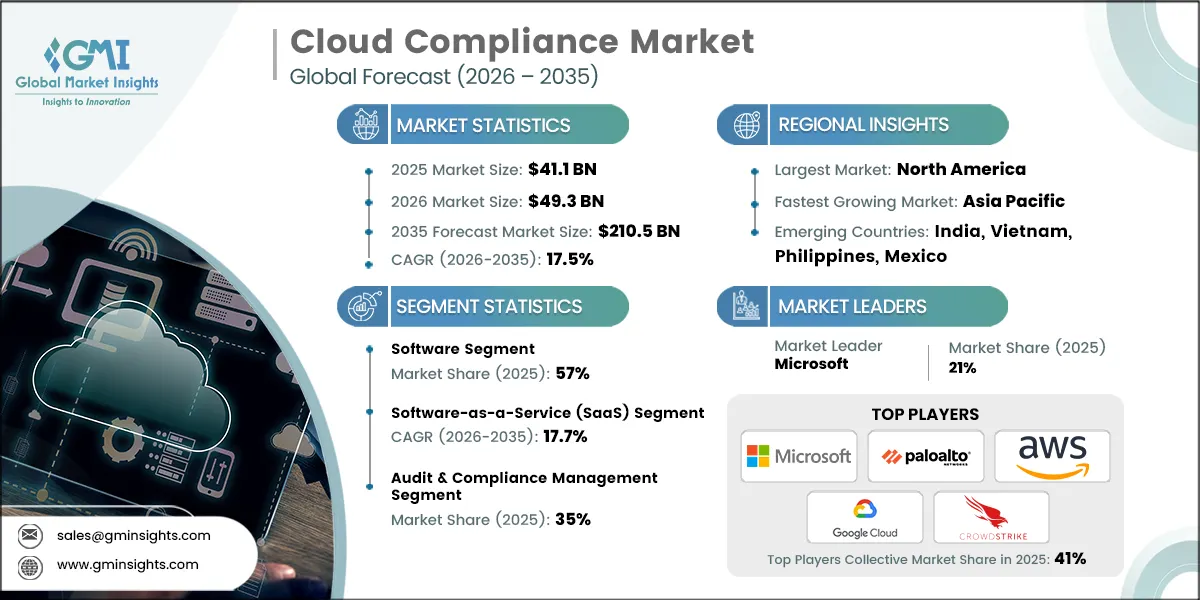
The global cloud compliance market was valued at USD 41.1 billion in 2025. The market is expected to grow from USD 49.3 billion in 2026 to USD 210.5 billion in 2035 at a CAGR of 17.5%, according to latest report published by Global Market Insights Inc.
Cloud Compliance Market Key Takeaways
Market Size & Growth
- 2025 Market Size: USD 41.1 Billion
- 2026 Market Size: USD 49.3 Billion
- 2035 Forecast Market Size: USD 210.5 Billion
- CAGR (2026–2035): 17.5%
Regional Dominance
- Largest Market: North America
- Fastest Growing Region: Asia Pacific
Key Market Drivers
- Accelerated cloud migration.
- Multi-cloud and hybrid complexity.
- Rising data privacy and security obligations.
- Shift to continuous compliance automation.
Challenges
- High implementation and integration costs.
- Shortage of skilled cloud compliance professionals.
Opportunity
- Compliance automation for SMBs.
- Managed cloud compliance services.
- Integration with DevSecOps and CI/CD pipelines.
- Public sector and government cloud adoption.
Key Players
- Market Leader: Microsoft led with over 21% market share in 2025.
- Leading Players: Top 5 players in this market include Amazon Web Services (AWS), CrowdStrike, Google Cloud, Microsoft, Palo Alto Networks, which collectively held a market share of 41% in 2025.
Get Market Insights & Growth Opportunities
Rapid enterprise migration to public and hybrid clouds is expanding compliance exposure across workloads, identities, and data layers. Organizations require continuous monitoring to meet internal and external controls on scale. In March 2025, large global 2000 companies continue to expand their usage of AWS and Azure, creating an increased demand among these companies for tools that help them maintain compliance.
The use of multiple cloud service providers, i.e. AWS, Google Cloud, and Azure, along with private cloud infrastructure is leading to fragmented policy enforcement and lack of visibility into compliance across companies, resulting in increased demand for centralized compliance orchestration platforms. The business sectors of Banking, Financial Services, Insurance (BFSI), and telecommunications begin implementing Cloud Security Posture Management (CSPM) and Cloud-native Application Protection Platforms (CNAPP) on a unified platform, with increased demand for unified compliance management over hybrid infrastructures among enterprises.
The enforcement of sector-specific security mandates and new data protection legislation is expanding the compliance risks faced by enterprises. Therefore, these companies are investing in automated reporting and evidence collection in order to reduce compliance exposure.
The increase in real-time compliance monitoring has replaced periodic audits as an effective method for mitigating the risk of breaches and reducing the fatigue associated with auditing. This has contributed to the increasing popularity of Software as a Service (SaaS) based compliance platform. Large enterprises have moved from relying on annual audits to continuous compliance dashboards integrated into their cloud-native security stacks.
To get key market trends
Cloud Compliance Market Trends
Organizations are combining CSPM, CIEM, and workload security into CNAPP solutions to cut down on the number of tools they use and increase transparency throughout a capital-intensive cloud environment. Businesses have changed their CSPM architecture from a stand-alone model to a CNAPP model to create an integrated approach to the management of both compliance and runtime risk.
Many businesses have begun incorporating compliance requirements into their Infrastructure-as-Code as well as CI/CD processes, thus allowing for the early identification of non-compliance errors prior to going into production. DevOps engineers have been incorporating policy-as-code governance into their Terraform pipeline processes in order to prevent deploying non-compliant configurations on the cloud platform.
Using Artificial Intelligence (AI) allows organizations to correlate misconfigured resources, users, and data security exposures so that only the most serious compliance-related gaps are remediated by the respective teams. Cloud Security Platforms are also applying AI to provide organizations with a compliance score to reduce both false positives and alert fatigue.
Organizations are aligning their cloud security and compliance organizations to improve accountability and reduce operational siloed functions through the application of unified governance frameworks. To support this initiative, some of the larger organizations have reorganized their Cloud Governance teams to create a single operating group that integrates Security, Compliance and Risk management.
Cloud Compliance Market Analysis
Learn more about the key segments shaping this market
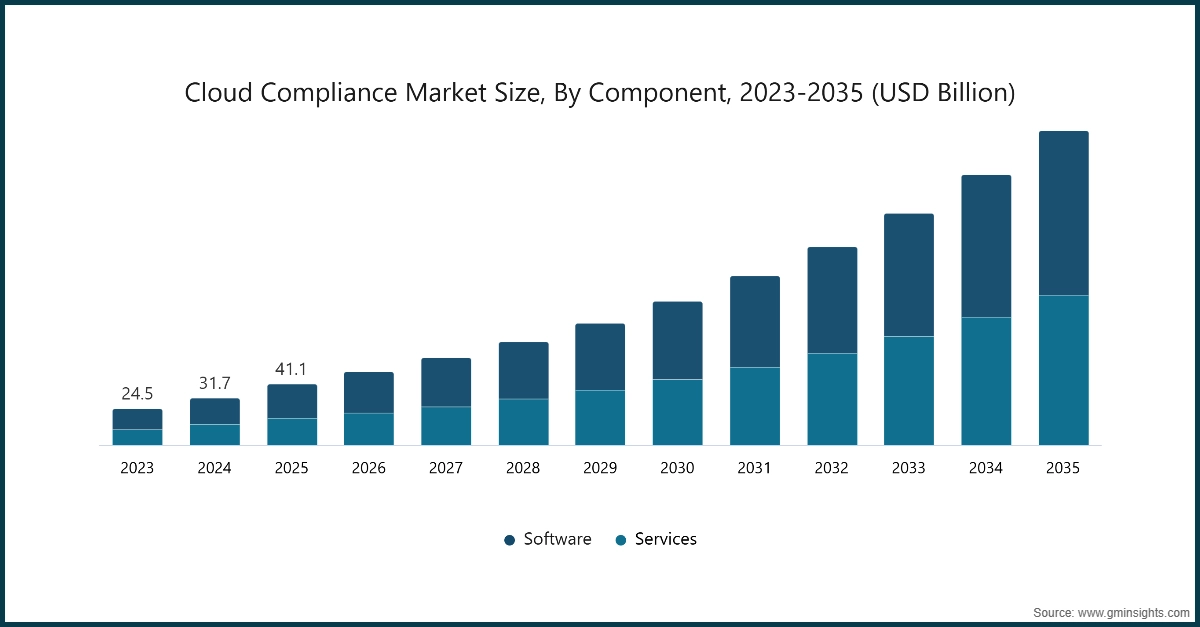
Based on component, the cloud compliance market is divided into software and services. Software dominated the market, accounting for 57% in 2025 and is expected to grow at a CAGR of 16.6% through 2026 to 2035.
- Cloud compliance solutions are changing from independent CSPM products into unified clouds that include identity, workload, data, and configuration compliance. This change will create tool consolidation by improving overall visibility across multiple clouds and increasing the stickiness of platforms in the larger enterprises that manage complex multi-cloud environments.
- Compliance checks are being integrated directly into CI/CD and Infrastructure-as-Code workflows by software vendors to help detect violations early (e.g., using the “shift-left” method). These types of changes will result in lower remediation costs, faster cloud deployments, and will increase compliance ownership on the part of both the development team as well as platform engineering teams.
- The deficits of talent, combined with a shortage of skilled workers, is leading enterprises to outsource their cloud compliance operations to managed service/third-party providers. These types of services offer continuous monitoring, audit readiness, evidence management, and remediation support; all of which creates predictable repeatable revenue streams for these types of service providers.
- As organizations migrate to the cloud for some or all of their workloads, they need to leverage consulting services for compliance gap analysis, control mapping and audit readiness. Over time, advisory solutions have expanded beyond the initial migration stages, to include ongoing compliance optimization service because risk profiles continue to evolve and operational complexity increases.
Learn more about the key segments shaping this market
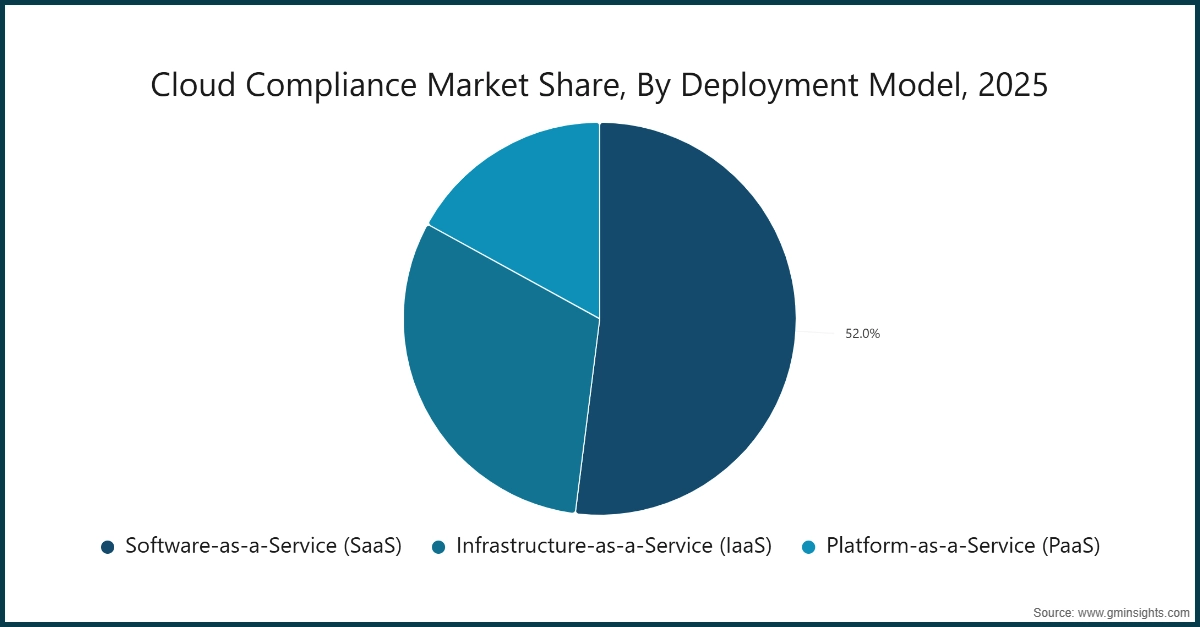
Based on deployment model, the cloud compliance market is segmented into Software-as-a-Service (SaaS), Infrastructure-as-a-Service (IaaS) and Platform-as-a-Service (PaaS). Software-as-a-Service (SaaS) segment dominates the market with 52% share in 2025, and the segment is expected to grow at a CAGR of 17.7% from 2026 to 2035.
- SaaS compliance involves regularly monitoring data access, user activity and application settings in third-party platforms. To protect data, provide identity management and be prepared for audits, businesses use SaaS compliance solutions to gain visibility into rapidly deployed enterprise platforms.
- IaaS compliance focuses on securing virtual systems (VMs), networks, storage and identities in the cloud. Solutions emphasize configuration management, protecting workload and continuously applying policies to prevent misconfiguration, aid audits, and lower compliance risk in many dynamic environments.
- PaaS compliance focuses on the security of managed databases, application runtimes, APIs and development services. Compliance solutions provide policy enforcement, data residency requirements and privacy for the secure deployment of applications by allowing developers to develop more rapidly while compliant with both corporate and regulatory obligations.
Based on application, the cloud compliance market is segmented into audit & compliance management, threat detection & remediation, activity monitoring & analytics, visibility & risk assessment and others. The audit & compliance management segment dominates the market with 35% share in 2025, and the segment is expected to grow at a CAGR of 15.9% from 2026 to 2035.
- The audit & compliance management solution continuously evaluate cloud configurations, controls and policies against both internal and external. Automated collection of evidence, reporting of findings and ensuring audit readiness across multiple clouds allows for reduced effort with a consistent level of governance and more rapid response to any identified compliance issues.
- Threat detection & remediation solutions use automated methods to detect misconfigurations, vulnerabilities, and malicious activity across all cloud workloads, identities, and data. It correlates risk in real time, enabling either automated or guided remediation of risk by minimizing risk exposure and limiting the impact of breaches while maintaining compliance in the constantly changing environment of cloud.
- Activity monitoring & analytics user, workload, and API activity across clouds allow for visibility into user behavior as well as detection of user behavior that is outside the norm. Advanced analytical capabilities assist with the detection of policy violations, insider threats, and suspicious activity – aiding both in the proactive enforcement of compliance and in the making of well-informed security decisions.
Based on enterprise size, the cloud compliance market is segmented into large enterprises and small & medium enterprises (SMEs). The large enterprises segment is expected to dominate the market with a share of 57% in 2025.
- Multi-cloud and hybrid environments have led to large organizations abandoning disparate point solutions for CNAPP-based technology that helps manage compliance, increase visibility and decrease operations costs.
- Enterprises are moving away from traditional, periodic audits and toward continuous compliance. Many enterprises have adopted real-time compliance dashboards to support their always-on regulatory reporting requirements.
- SMEs (small and medium sized) are looking to use low-cost, subscription-based solutions to comply with pre-defined policies and to reduce the overall cost and complexity of compliance. Cloud framework companies have made it possible for SMEs to get the security controls they need right out of the box.
- Most SMEs have no in-house compliance expertise, which is why they are outsourcing their compliance monitoring and remediation to managed service providers (MSPs). Regionally, MSPs have expanded their offerings to meet the needs of SMEs who are looking for a cloud-compliance solution that enables them to meet their audit requirements.
Looking for region specific data?
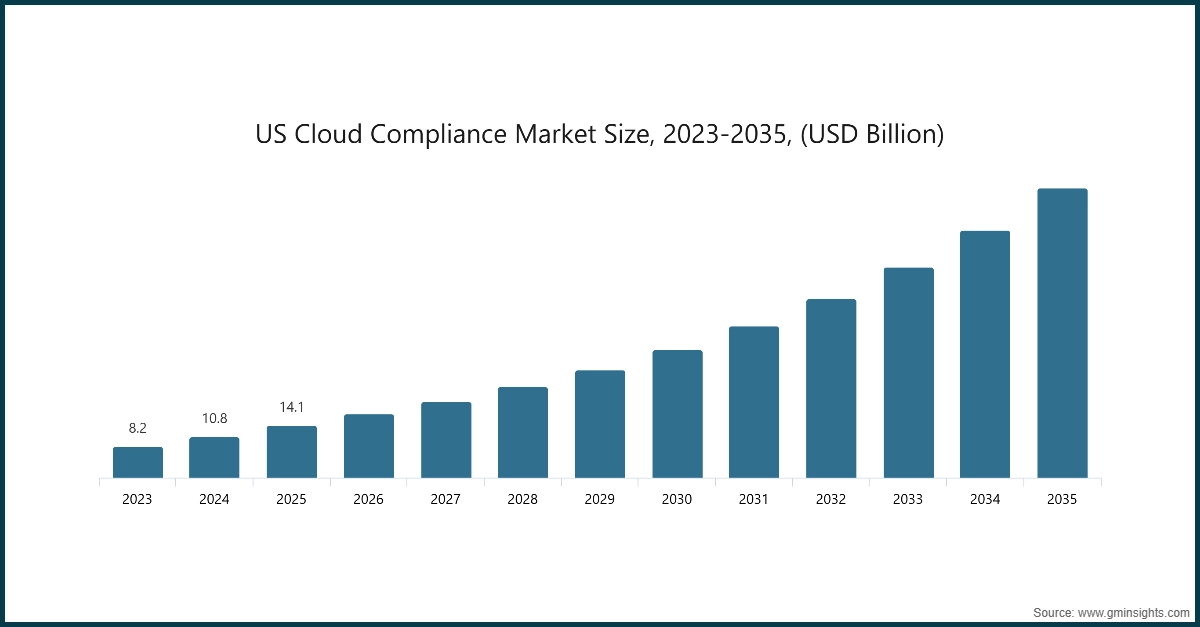
US cloud compliance market reached USD 14.1 billion in 2025, growing from USD 10.8 billion in 2024.
- In US, enterprises are coming together to combine several different compliance and security tools into single CNAPP platforms to manage regulatory compliance (i.e., HIPAA, FedRAMP, and SOX) in an efficient and streamlined way.
- The outcome of this consolidation is reduced tool sprawl, improved audit readiness and enhanced capability for continuous monitoring of workloads that are running in hybrid cloud environments.
- The use of AI-based risk prioritization continues to grow, allowing organizations to identify compliance gaps that will have a major impact on their business and automate the workflow required for remediation (one that is performed by multiple teams).
- The use of AI will lead to greater operational efficiency and fewer instances of false positives, thus enhancing collaboration between IT teams and security teams around areas of risk that are actionable.
- In March 2025, several Fortune 500 companies (in the US) migrated from using individual CSPM or workload security tools into a CNAPP platform to improve their continuous compliance visibility across all their AWS and Azure workloads.
North America dominated the cloud compliance market with a market size of USD 17 billion in 2025.
- In North America, companies continue to deploy hybrid cloud infrastructures, the requirement for multi-cloud compliance orchestration is growing at a rapid rate. One way that organizations are meeting this need is through their use of centralized monitoring dashboards that provide policy enforcement, audit readiness and unified reporting for all of their workloads on AWS, Azure and Google Cloud.
- Many SMEs are beginning to leverage SaaS-based compliance platforms that provide automated reporting in a cost-effective manner and that provide support for audits without the requirement to have in-house expertise.
- For instance, Regional Canadian telcos have implemented managed compliance services in response to evolving privacy regulations to automate their monitoring function across multiple cloud-based environments.
Europe cloud compliance market accounted for a share of 25.6% and generated revenue of USD 10.5 billion in 2025.
- The rise of multi-cloud visibility platforms has enabled businesses to satisfy cross-border compliance obligations by ensuring consistency between enterprise policies implemented across all EU countries.
- Organizations are increasingly turning to AI and ML technologies to detect anomalous behavior from users and/or errors in their application configurations to provide early warning of any compliance issues and reduce the time spent on audits through proactive enforcement of compliance.
- Additionally, European Union (EU) banks have incorporated AI into compliance dashboards to automatically flag high-risk configuration issues across multiple cloud service providers in advance of internal audits.
Germany dominates the cloud compliance market, showcasing strong growth potential, with a CAGR of 19.6% from 2026 to 2035.
- Due to the positive impact of GDPR on compliance monitoring tools, the financial services, banking, insurance, healthcare, and manufacturing sectors are adopting continuous compliance monitoring tools that provide wide-ranging support for ensuring the confidentiality of personal data, protecting access to personal data, and ensuring audit readiness.
- Organizations are using compliance controls into their DevSecOps pipelines to enforce policy as code when using infrastructure as code and deploying applications, thereby reducing the risk of noncompliance due to failure to follow appropriate regulatory processes.
- In April 2025, BMW adopted an automated policy-as-code approach within its continuous integration and continuous deployment (CI/CD) pipeline to prevent deployment of non-compliant cloud services, enabling BMW to comply with the requirements of the General Data Protection Regulation (GDPR) and ISO27001.
- Major German technology hubs including Munich, Berlin, and Frankfurt host substantial cloud infrastructure and generate significant compliance spending.
The Asia Pacific cloud compliance market is anticipated to grow at the highest CAGR of 19.7% from 2026 to 2035 and generated revenue of USD 8.3 billion in 2025.
- The fast growth of cloud computing in the Asia-Pacific region is leading to more need for managed compliance services in industries like healthcare, government and banking/financial services, to help reduce the complexity of running their business and be ready for an audit at any time.
- Organizations are moving towards continuously compliant models as opposed to being compliant periodically after the completion of an audit. This shift will include using automated monitoring, risk scoring and AI-based remediation processes to achieve compliance on their hybrid cloud.
- Some of the largest banks in Asia-Pacific have developed continuous compliance dashboards that allow them to monitor multi-cloud workloads and have reduced their manual audit efforts while facilitating their regulatory reporting obligations.
- Japan, South Korea, Australia, Singapore, and Southeast Asian nations contribute substantial market value. Japan's Act on the Protection of Personal Information (APPI), Australia's Privacy Act, Singapore's Personal Data Protection Act, and emerging data protection laws across Southeast Asia create regulatory drivers for cloud compliance adoption.
China cloud compliance market is estimated to grow with a CAGR of 20.2% from 2026 to 2035.
- Compliance solutions will continue to exist as they are, focusing on the local physical location of the data and the compliance/regulatory requirements that govern how a company handles that data (e.g. PIPL and the Cyber Security Law), but now providing very controlled access to that data and data governance for multi-country operations.
- Chinese data protection regulations including the Personal Information Protection Law (PIPL), Data Security Law, and Cybersecurity Law establish comprehensive requirements around data localization, cross-border data transfer restrictions, and government access to data.
- The integration of compliance capabilities into cloud-native security solutions will give real-time monitoring of workloads, access policy and configuration changes to minimize potential compliance breaches.
- In March 2025, Alibaba Cloud companies will implement new unified cloud compliance platforms that will provide for automated reporting and risk dashboards across an organization's regional data centres to ensure compliance with PIPL.
Latin America cloud compliance market shows lucrative growth over the forecast period.
- Platforms for multi-cloud compliance orchestration are becoming more common to assist companies with managing and complying with regional data residency requirements, privacy regimes, and security requirements in the various markets of LATAM.
- Small and medium enterprises (SMEs) are increasingly turning to managed cloud compliance services as their IT and compliance capabilities are generally limited.
- Financial services SMEs in both Mexico and Colombia are finding that outsourcing their compliance monitoring functions to regional managed service providers enables them to meet the regulatory standards required for cross-border transactions.
Brazil cloud compliance market is estimated to grow with a CAGR of 15.4% from 2026 to 2035 and reach USD 4.7 billion in 2035.
- Many enterprises are now focusing on cloud-native compliance solutions to be compliant with LGPD (Lei Geral de Proteção de Dados), and these businesses are including automated controls in their personal data management processes.
- By taking advantage of SaaS-based compliance platforms, smaller enterprises can create volunteer-level, automated monitoring, and reporting processes with little to no internal expertise.
- Magazine Luiza S.A, major retail chain in Brazil will be using SaaS-based tools to automate their LGPD reporting and perform real-time access monitoring for their ERP and CRM cloud-based solutions.
Middle East and Africa cloud compliance market accounted for USD 2.3 billion in 2025 and is anticipated to show lucrative growth over the forecast period.
- In MEA, organizations are deploying compliance solutions to address growing data privacy regulations, cybersecurity frameworks and multi-cloud adoption. Companies within the BFSI, telecommunications and government sectors are particularly focused.
- AI is being used more often for compliance/risk analytics to uncover misconfigurations, monitor user behavior and establish priorities for remediation across a multitude of cloud environments.
- Some of the largest banks within MEA have implemented AI-driven compliance dashboards to have real-time visibility over their multi-cloud environments, and reduce the time spent on audit preparation and enhance their regulatory compliance performance.
UAE market is expected to experience substantial growth in the Middle East and Africa cloud compliance market, with a CAGR of 12.4% from 2026 to 2035.
- Enterprises are implementing cloud compliance solutions aligned with government regulations, such as the UAE PDPL with particular focus on areas such as data protection, identity management and audit preparedness.
- By integrating CNAPP platforms, organizations are gaining centralized visibility over their environments with real-time risk scoring and automated evidence collection for both government and enterprise organizations.
- In March 2025, all federal agencies in the UAE will have implemented a unified CNAPP platform to ensure ongoing compliance with both the PDPL and ISO27001 regulations across hybrid cloud workloads.
Cloud Compliance Market Share
- The top 7 companies in the market are Microsoft, Amazon Web Services (AWS), Palo Alto Networks, Google Cloud, CrowdStrike Holdings, Wiz and Fortinet contributing 45% of the market in 2025.
- Microsoft’s solutions offer a full suite of tools and services that help enterprises achieve compliance. The Microsoft Azure platform has been certified to be compliant with GDPR, ISO 27001, and FedRAMP. The Microsoft 365 platform includes native compliance tools such as identity governance, continuous monitoring, and audit-ready reporting.
- AWS is the world leader in public cloud services and offers a variety of tools and services that can assist enterprises with implementing and maintaining compliant cloud solutions. AWS provides access to resources such as AWS Artifact, AWS Config, and AWS Security Hub that enable enterprises to demonstrate compliance to multiple regulatory standards (e.g., HIPAA, SOC, and FedRAMP). By using these tools, enterprises can ensure that they are maintaining ongoing compliance while monitoring and measuring the security of their environments.
- Palo Alto Networks offers a full suite of tools and services that enable organizations to be compliant with regulatory requirements through their Prisma Cloud CNAPP (Cloud Native Application Protection Platform) solution. Prisma Cloud provides full CSPM, CIEM, and workload protection capabilities that allow enterprises to manage multi-cloud environments securely. Prisma Cloud service enables businesses to implement real-time visibility into their multi-cloud environments, enforce policies, and be audit-ready to maintain compliance with industry regulations.
- Google Cloud provides scalable, secure infrastructure solutions that include embedded compliance capabilities. Google Cloud supports compliance with the GDPR, HIPAA and ISO regulations, and offers tool sets for managing data and identities, as well as enabling the automation of audits. Google Cloud is focused on delivering analytics driven compliance and providing continuous monitoring of cloud environments to enable enterprises to achieve compliance across their multi-cloud deployments.
- CrowdStrike's is specializing in cloud-native security and compliance through an AI-driven platform. Its Falcon platform provides threat detection, workload protection and identity monitoring, enabling organizations to maintain ongoing compliance and secure multi-cloud environments. With a focus on automation and rapid remediation, CrowdStrike helps organizations reduce their exposure and ensure audit readiness for enterprises worldwide.
- Wiz offers cloud security and compliance through visibility, risk identification, and posture management, identifying and resolving vulnerabilities, misconfigurations, and policy violations across hybrid and multi-cloud environments. Wiz supports enterprises in their compliance efforts with frameworks such as SOC, ISO 27001, and GDPR by providing continuous monitoring and remediation guidance, along with compliance reporting.
- Fortinet is the provider of Cloud Native compliance and security through FortiCnapp, Cloud NGFW, WAAP, and Governance services. Fortinet's solutions support continuous posture management, threat detection, and automated compliance reporting across hybrid and multi-cloud infrastructures. Fortinet's global presence along with its widespread enterprise adoption make it the ideal partner to help organizations effectively align compliance and security with their regulatory requirements.
Cloud Compliance Market Companies
Major players operating in the cloud compliance industry are:
- Amazon Web Services (AWS)
- Check Point Software
- CrowdStrike
- Fortinet
- Google Cloud
- Microsoft
- Palo Alto Networks
- Qualys
- Trend Micro
- Wiz
- The marketplace for cloud compliance vendors is rapidly changing thanks to various factors such as technology partnerships, strategic acquisitions and organic innovation. Most vendors are pursuing a competitive advantage by offering distinct capabilities (for example, offering solutions that focus on container security, policy-as-code and developer tooling), superior end user experience, a breadth of platforms and a focus on vertical industries.
- In addition, major platform vendors are expected to consolidate the market by acquiring specialized capabilities from smaller providers, as customers generally favour an integrated platform approach as opposed to buying several disparate point solutions. Conferences like Cloud Expo Europe or AWS Summits continue to create opportunities for vendor innovation through the introduction of new cloud technologies such as serverless computing, near edges and multi-cloud architecture, which will provide vendors with sustained growth and expansion opportunities.
- Established enterprise software vendors are offering cloud compliance features as part of their overall security and IT management capabilities. These vendors typically provide their existing relationships with enterprise customers to generate cross-selling opportunities; however, they face challenges competing against cloud-native solutions. Many of the emerging vendor solutions focus on integrating security into the DevOps process (DevSecOps) and provide tools for validating compliance in CI/CD pipelines. This will help developers comply with applicable regulations as the code is developed, rather than having to wait until after the code is completed before it is validated for compliance.
Cloud Compliance Market Report Attributes
| Key Takeaway | Details |
|---|---|
| Market Size & Growth | |
| Base Year | 2025 |
| Market Size in 2025 | USD 41.1 Billion |
| Market Size in 2026 | USD 49.3 Billion |
| Forecast Period 2026-2035 CAGR | 17.5% |
| Market Size in 2035 | USD 210.5 Billion |
| Key Market Trends | |
| Drivers | Impact |
| Accelerated cloud migration | Expands the addressable market as more workloads require compliance monitoring and governance. |
| Multi-cloud and hybrid complexity | Increase demand for centralized compliance platforms to manage policies across environments. |
| Rising data privacy and security obligations | Forces enterprises to invest in automated compliance solutions to avoid penalties and risk exposure. |
| Shift to continuous compliance automation | Drives higher recurring revenue through SaaS-based, always-on compliance platforms. |
| Pitfalls & Challenges | Impact |
| High implementation and integration costs | Slows adoption among cost-sensitive SMBs and mid-sized enterprises. |
| Shortage of skilled cloud compliance professionals | Limits effective deployment and optimization of compliance platforms. |
| Opportunities: | Impact |
| Compliance automation for SMBs | Enables vendors to tap a large, underpenetrated customer base with simplified solutions. |
| Managed cloud compliance services | Creates recurring revenue streams by outsourcing compliance operations for enterprises. |
| Integration with DevSecOps and CI/CD pipelines | Expands usage beyond security teams into development workflows. |
| Public sector and government cloud adoption | Supports long-term, stable demand driven by standardized compliance programs. |
| Market Leaders (2025) | |
| Market Leader |
21% market share |
| Top Players |
Collective market share in 2025 is 41% |
| Competitive Edge |
|
| Regional Insights | |
| Largest Market | North America |
| Fastest growing market | Asia Pacific |
| Emerging countries | India, Vietnam, Philippines, Mexico |
| Future outlook |
|
What are the growth opportunities in this market?
Cloud Compliance Industry News
- In January 2026, Microsoft Purview Data Security significantly improved their security posture, specifically around the handling of sensitive data, with the introduction of AI driven data classification technology. This technology automatically identifies sensitive data stored in multi-cloud environments and provides risk-based recommendations on how the organization should deploy protective controls for the sensitive data.
- In December 2025, AWS released AWS Compliance Automation Framework which allows organizations to deploy pre-configured compliance controls using an Infrastructure as Code model. This framework will comply with PCI, HIPAA and GDPR and will be able to be deployed within AWS Control Tower.
- In November 2025, Palo Alto Networks completed the acquisition of Cider Security as a policy-as-code solution for security, with an approximate transaction value of $300 million. The acquisition expands Prisma Cloud functionality regarding integration with DevSecOps and CI/CD pipeline security.
- In October 2025, Google Cloud announced that Assured Workloads Plus has reached General Availability. This allow organizations that operate in highly regulated industries to rely on enhanced compliance controls that support data residency, personnel restrictions, encryption key management and auditing of activity across the Google Cloud Platform.
The cloud compliance market research report includes in-depth coverage of the industry with estimates & forecasts in terms of revenue ($ Mn/Bn) from 2022 to 2035, for the following segments:
Market, By Component
- Software
- Services
Market, By Deployment model
- Software-as-a-Service (SaaS)
- Infrastructure-as-a-Service (IaaS)
- Platform-as-a-Service (PaaS)
Market, By Application
- Audit & compliance management
- Threat detection & remediation
- Activity monitoring & analytics
- Visibility & risk assessment
- Others
Market, By Enterprise size
- Large enterprises
- Small & medium enterprises (SMEs)
Market, By End use
- BFSI
- IT & Telecommunications
- Healthcare
- Government & Public Sector
- Retail & Consumer Goods
- Manufacturing
- Energy & Utilities
- Others
The above information is provided for the following regions and countries:
- North America
- US
- Canada
- Europe
- Germany
- UK
- France
- Italy
- Spain
- Russia
- Nordics
- Poland
- Romania
- Asia Pacific
- China
- India
- Japan
- South Korea
- ANZ
- Vietnam
- Indonesia
- Philippines
- Latin America
- Brazil
- Mexico
- Argentina
- MEA
- South Africa
- Saudi Arabia
- UAE
Frequently Asked Question(FAQ) :
What was the market size of the cloud compliance market in 2025?
The market size was USD 41.1 billion in 2025, with a CAGR of 17.5% projected through 2035, driven by the integration of CSPM, CIEM, and workload security into CNAPP solutions, as well as advancements in AI-driven compliance tools.
What is the projected value of the cloud compliance market by 2035?
The market is expected to reach USD 210.5 billion by 2035, fueled by the adoption of policy-as-code governance, AI-based compliance scoring, and the increasing demand for unified cloud security solutions.
What is the projected size of the cloud compliance market in 2026?
The market is expected to grow to USD 49.3 billion in 2026.
What was the market share of the software segment in 2025?
The software segment dominated the market, accounting for 57% of the market share in 2025, and is projected to grow at a CAGR of 16.6% from 2026 to 2035.
What was the market share of the Software-as-a-Service (SaaS) segment in 2025?
The Software-as-a-Service (SaaS) segment held the largest share, accounting for 52% of the market in 2025, and is expected to grow at a CAGR of 17.7% through 2035.
Which application segment dominated the market in 2025?
The audit & compliance management segment led the market with a 35% share in 2025, reflecting the growing need for robust compliance management solutions in cloud environments. The segment is projected to grow at a CAGR of 15.9% from 2026 to 2035.
Which region leads the cloud compliance market?
The United States was the largest market in 2025, with an estimated value of USD 14.1 billion. The region is expected to grow significantly, driven by strong cloud adoption rates and advancements in compliance technologies.
What are the upcoming trends in the cloud compliance market?
Key trends include the shift from standalone CSPM models to integrated CNAPP solutions, embedding compliance into Infrastructure-as-Code and CI/CD processes, the use of AI for compliance scoring and alert reduction, and the adoption of policy-as-code governance in DevOps pipelines.
Cloud Compliance Market Scope
Related Reports