Summary
Table of Content

Class 7 Trucks Market
Get a free sample of this report
Form submitted successfully!
Error submitting form. Please try again.
Thank you!
Your inquiry has been received. Our team will reach out to you with the required details via email. To ensure that you don't miss their response, kindly remember to check your spam folder as well!
Request Sectional Data
Thank you!
Your inquiry has been received. Our team will reach out to you with the required details via email. To ensure that you don't miss their response, kindly remember to check your spam folder as well!
Form submitted successfully!
Error submitting form. Please try again.
Class 7 Trucks Market Size
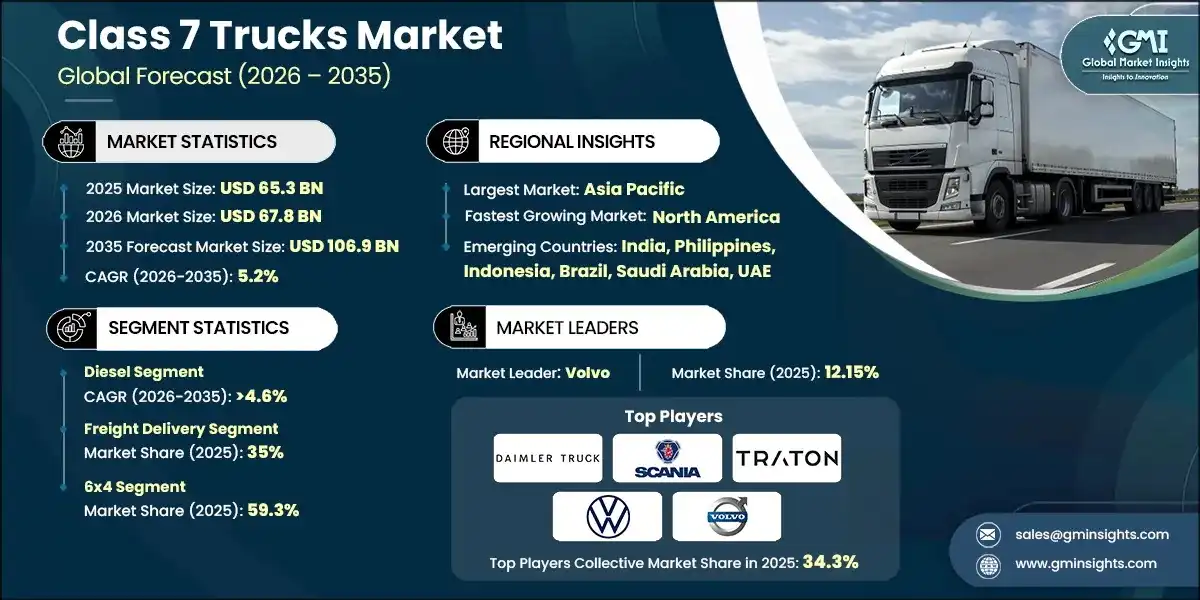
The global class 7 trucks market was estimated at USD 65.3 billion in 2025. The market is expected to grow from USD 67.8 billion in 2026 to USD 106.9 billion in 2035, at a CAGR of 5.2%, according to latest report published by Global Market Insights Inc.
Class 7 Trucks Market Key Takeaways
Market Size & Growth
- 2025 Market Size: USD 65.3 Billion
- 2026 Market Size: USD 67.8 Billion
- 2035 Forecast Market Size: USD 106.9 Billion
- CAGR (2026–2035): 5.2%
Regional Dominance
- Largest Market: Asia Pacific
- Fastest Growing Region: North America
Key Market Drivers
- Increasing demand for electric & hybrid class 7 trucks across the globe.
- Growing freight transportation activities across North America.
- Implementation of stringent emission regulations in Europe.
- Rising investments in infrastructure development activities in Asia Pacific.
Challenges
- High initial and maintenance costs.
- Shortage of truck drivers.
Opportunity
- Electrification of municipal and urban logistics fleets.
- Expansion of infrastructure and construction projects in emerging economies.
- Growth of flexible ownership and Truck-as-a-Service (TaaS) models.
- Integration of advanced telematics and fleet analytics solutions.
Key Players
- Market Leader: Volvo led with over 12.15% market share in 2025.
- Leading Players: Top 5 players in this market include Daimler Trucks, SCANIA, Traton, Volkswagen, Volvo, which collectively held a market share of 34.3% in 2025.
Get Market Insights & Growth Opportunities
The global overhaul of freight logistics, the building of infrastructure, and the industrial processes is transforming class 7 trucks that once were the conventional medium-duty workhorses, to be strategically optimized fleet assets. Class 7 trucks have a GVWR of 26,00133,000 lbs, and are being used in urban freight, regional deliveries, construction support, municipal services, and utility services. The global fleet operators are incorporating telematics platforms, advanced driver-assistance systems (ADAS) and alternative fuel powertrains, which have raised the expectations of organizing the fleet optimization, lifecycle management, and data-driven deployment strategy.
Class 7 truck demand is being heavily affected by government rules, public- private unions and emission requirements all over the world. Stricter emission limits (EPA, Euro VI), zero-emission freight areas, and clean fleets are being implemented in places like North America and Europe, which are hastening the fleet replacement frequency. In the meantime, the third world is moving to phased emission standards which are promoting modernization of the medium-duty fleet. Such regulatory frameworks are not just determining purchase decisions but also affecting powertrain choice, fleet renewal schedules, as well as infrastructure investment.
The development of telematics and related fleet ecosystems, in a short time, is changing the efficiency of operations in Class 7 fleets worldwide. The logistics and construction operators are moving towards real-time route optimization, predictive maintenance analytics, fuel-efficiency monitoring, and driver behavior scoring systems. The growth of digitization platforms of fleet and leasing schemes and usage-based insurance schemes are reducing the entry hurdle, especially among small and mid-sized businesses (SMEs) in construction, e-commerce shipping and regional haulage.
Class 7 value chain is being redefined by the flexible ownership structures and service-based deployment structures. The TaaS model, subscription-based leasing, and pay-per-use fleet models are also becoming popular in North America, Europe, and some parts of the Asia-Pacific. Such models save initial capitals, streamline maintenance strategizing, and allow quick scaling of the fleet, particularly where demand is cyclical, e.g. infrastructure projects, seasonal logistics, and municipal services.
The acceleration of digital transformation during the post-pandemic recovery phase and the shift in mid-mile and regional freight dynamics at the global level resulted from it. The rise in e-commerce, contactless delivery measures, and decentralized warehousing during COVID-19 boosted the demand of class 7 trucks that are optimized to lower the length of haul and deliver more often. Infrastructure stimulus policies and modernization of logistics were introduced by governments, and long-term demand of medium-duty trucks that can provide robust supply chain appeared.
China has the largest volume of Class 7-equivalent trucks in the world because, the country is extensively invested in infrastructure, has vertically integrated manufacturing ecosystems, and has a high demand in the country. The nation enjoys decades of supply chain innovation in commercial automobiles, fleet of large-scale municipal and construction vehicles, and continued investments in smart cities, logistics centers, and transportation networks. The constant encouragement to electrify and develop intelligent transport system as well as industrial development maintains the need to use high-performance vocation and regional haul trucks.
North America and Europe are high-value markets with premium vehicle specification, high levels of fleet technologies and high levels of regulatory control. The safety systems, emission compliance, connectivity and optimization of total cost of ownership are important to fleet operators. These are the areas that have been leading the implementation of electric and alternative-fuel class 7 trucks that are backed by building charging infrastructure, innovation by the OEMs, and incentives to electrify their fleet.
The Asia-Pacific region represents the strongest long-term growth potential due to the high rate of urban growth, investments in infrastructure, and the rising usage of medium-duty trucks to support the city logistics and constructions. China and the world volumes Large-scale rollout of medium-duty trucks through urban freight and municipal fleets, India, Japan and South Korea are increasingly using modern, fuel-efficient, and electric Class 7-equivalent trucks in regional freight haulage, e-commerce distribution and government fleets.
To get key market trends
Class 7 Trucks Market Trends
The adoption of electric and hybrid class 7 trucks is growing because the fleet operators are trying to have lower emissions, lower fuel expenses, and meet the stringent regulations. The electrification of medium-duty trucks is becoming feasible in urban and regional operations due to the improvements in battery range, charging infrastructure, and vehicle performance.
For instance, in April 2025, Accelera by Cummins and Isuzu Motors stated that it had developed a battery-electric powertrain, to be installed in the F-Series of the North American medium-duty trucks (Class 6 and Class 7) of Isuzu, to be produced in 2027 to enable zero-emission fleet use.
Class 7 trucks are being fitted with advanced driver-assistance systems to enhance road safety and minimize accident risks. Automatic emergency braking, lane departure warning, automatic blind-spot detection, driver-monitoring features are some of the features that can ensure that the fleet complies with safety regulations and reduce insurance and liability expenses.
Modular Class 7 truck platform OEMs are also creating modular truck platforms that can carry a variety of body styles, such as box, dump, refrigerated, and utility. This versatility enables fleet operators to use the same chassis in a myriad of applications, enhancing the utilization rate and reducing the total cost of ownership.
Lifecycle costs are becoming more influential in fleet purchases decisions as opposed to initial prices of the vehicle. The operators are focused on fuel efficiency, maintenance schedule, durability, resale value and warranty cover whereby manufacturers are motivated to come up with class 7 trucks that provide predictable operation cost and cost savings in the long run.
Class 7 Trucks Market Analysis
Learn more about the key segments shaping this market
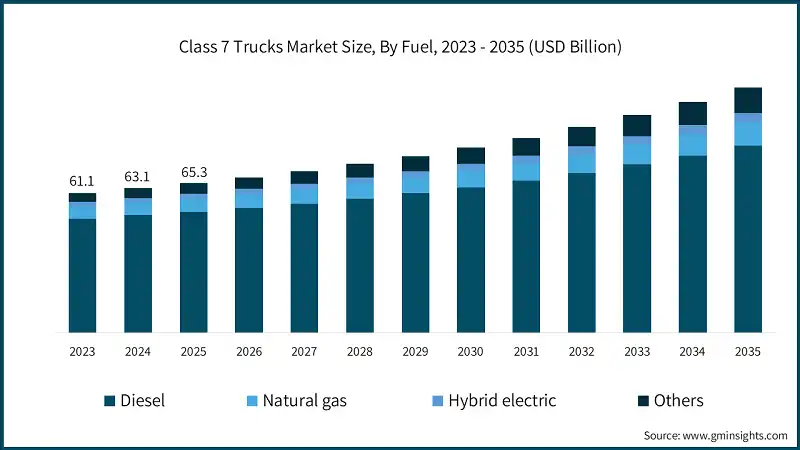
Based on fuel, the market is divided into diesel, natural gas, hybrid electric, and others. The diesel segment dominated the market accounting for around 80.81% share in 2025 and is expected to grow at a CAGR of more than 4.6% through 2035.
- The class 7 trucks industry is dominated by the diesel segment, as diesel engines offer greater torque and better fuel efficiency than the gasoline engines do, thus becoming the ideal choice for medium-duty trucks, which are required to travel long distances with heavy freight. Class 7 trucks that run on diesel are reliable and durable as well as cost effective and these factors are vital in logistics, construction, municipal and operations in the region of distribution. The existing refueling network and the high access to diesel fuel also promote the further popularity of the use of diesel-powered medium-duty trucks in both developed and developing markets.
- Moreover, the decades of technological development have been in favor of diesel engines, such as better emission control system and fuel efficiency, which can enable manufacturers to achieve high emission standards without impairing operational efficiency. Class 7 diesel trucks are also preferred by fleet operators because of their lower total cost of ownership throughout the vehicle lifecycle, ease of maintenance, and the performance in harsh environments. All these factors bolster the dominance of diesel in the Class 7 truck industry the world over.
- For example, in November 2025, Eicher Trucks and Buses released its all new Eicher Pro X diesel family in India with a purpose of last-mile and regional logistics, which shows that it still invests in efficient and reliable diesel truck-placing.
- The others segment will experience a CAGR of more than 9% through 2035, as more trucks in class 7 adopt alternative fuels, such as electric, hybrid, and CNG-powered vehicles. Increasing environmental standards, government subsidies of clean powertrain technologies, and fleet modernization measures are hastening the transition to powertrains with low and no emissions. Moreover, the increasing trend in the demand of sustainable urban logistics, construction, and municipal service is motivating OEMs to design multi-purpose medium-duty trucks that can be fueled by alternative energy sources.
Learn more about the key segments shaping this market
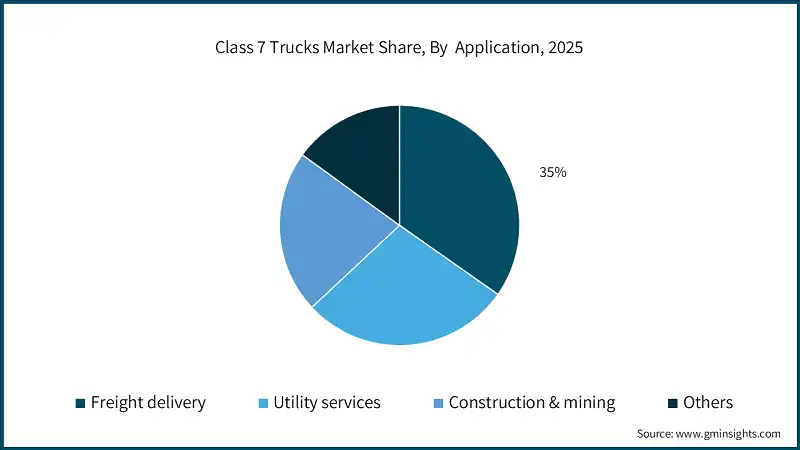
Based on application, the market is segmented into freight delivery, utility services, construction & mining, and others. The freight delivery segment accounted for around 35% share in 2025 and is expected to grow at a CAGR of over 5.3% from 2026-2035.
- The class 7 trucks market is dominated by the freight delivery segment since there is a growing need to provide efficient regional and last-mile delivery in logistics, e-commerce, and retail segments. Class 7 trucks provide the best compromise of load, agility, and efficiency thus it is best suited to transportation of goods in medium distances. The advent of e-commerce and on-demand delivery services have greatly boosted the amount of freights, and the need to acquire medium-duty trucks that can make frequent journey, punctual deliveries, and route bending.
- Moreover, the process of urbanization, industrial growth, and the development of infrastructures are also promoting the modernization of fleets and the rise in the use of class 7 trucks as freight vehicles. Fleet operators are focused on operational features that boost production efficiency, telematics level and low costs of maintenance that lower overall cost of ownership. This demand, versatility and efficiency make-up has solidified the dominance of the freight delivery segment in the class 7 truck market around the world.
- For example, in April 2023, Daimler Truck introduced a new brand of electric medium-duty trucks, the Rizon brand, in the U.S., targeting commercial delivery and regional haul, and increased the number of EV medium-duty models in local and freight applications. Manufacturing will commence in 2023 or later and will assist fleets to shift to cleaner vehicles of delivery.
- The utility services segment will experience a faster growth of more than 6% till 2035, owing to rising demand for class 7 trucks in municipal services, power distribution, waste management and in public infrastructure projects. The governments and private operators are upgrading utility fleets so as to enhance operational efficiency, decrease downtime, and to comply with environmental regulations. Also, there is an increase in the rate of fleet renewal in utility use through the adoption of alternative-fuel trucks, telematics-based fleet management, and advanced safety features.
Based on axle, the market is segmented into 4x6, 6x4, and 6x2. In 2025, 6x4 segment dominated with around 59.3% share, due to its superior load-carrying capacity, stability, and suitability for medium- to long-haul transportation.
- The 6x4 segment is the largest market segment in the class 7 trucks market because it has greater load carrying capacity, stability, and flexibility to accommodate a broad scale of medium-duty use. The axle design enables trucks to carry heavier loads successfully and still have improved traction and control, which makes it ideal in construction, logistics, regional freight, and municipal activities. The 6x4 truck is more popular among the fleet operators at their capacity to travel across hindrances, highways, and city roads without interfering with their output and ensuring the timely deliveries and reliability of their operations.
- In addition, the 6x4 design offers higher durability and operational efficiency than the 4x6 and 6x2 trucks, lowering the maintenance frequency and expenses. Its high usage is backed by OEM products, standardization of fleet usage and its presence in various satisfying environments. Reliability, versatility and affordability make the 6x4 segment overpower the class 7 trucks market in the world.
- For instance, in October 2025, Tata Motors introduced a new family of Euro 6 commercial trucks in the GCC market with an event in Dubai, and expanding its medium and heavy-duty portfolio to cater to the rising transport and logistic needs a strategy that incorporates powerful axle and drivetrain designs in challenging regional haulage.
- The 6x2 segment is expected to grow with a CAGR of more than 6.6% till 2035, due to its fuel efficiency, reduced operational costs, and suitability for urban and regional distribution applications. This axle configuration provides adequate load capacity while lowering tire wear, fuel consumption, and maintenance expenses compared with 6x4 trucks, making it attractive for fleet operators focused on cost optimization. Additionally, growing adoption of telematics, lightweight truck designs, and alternative-fuel solutions in medium-duty vehicles further supports 6x2 growth.
Based on horsepower, the market is divided into Below 300HP, 300HP-400HP, 400HP-500HP, and 500HP & above. The 400HP-500HP segment dominated the class 7 Trucks market.
- The 400HP-500HP segment dominates the market due to its optimal balance of power, efficiency, and versatility for medium-duty applications. Trucks in this horsepower range provide sufficient torque and acceleration to handle heavy payloads, regional freight, construction materials, and municipal services without compromising fuel efficiency. This power bracket is particularly suited for long-haul and mid-mile operations, ensuring consistent performance over highways, urban routes, and rough terrains. Fleet operators favor trucks in this segment for their ability to manage diverse operational requirements while maintaining reliability and minimizing downtime.
- Additionally, the 400HP-500HP range aligns with the specifications of most OEMs producing Class 7 trucks, making it widely available and supported globally. Advanced engine technologies, compliance with emission regulations, and integration with telematics systems further enhance operational efficiency. The combination of performance, regulatory compliance, and flexibility ensures that the 400HP-500HP segment remains the most dominant choice in the class 7 trucks market.
- For instance, in April 2025, Mack Trucks announced the Mack Pioneer Class 8 heavy duty truck line, offering engines with power profiles from 415 hp to 515 hp for improved performance and fuel efficiency in regional and on highway applications illustrating OEM focus on high power commercial trucks that also influence medium duty platform development in adjacent segments.
Looking for region specific data?
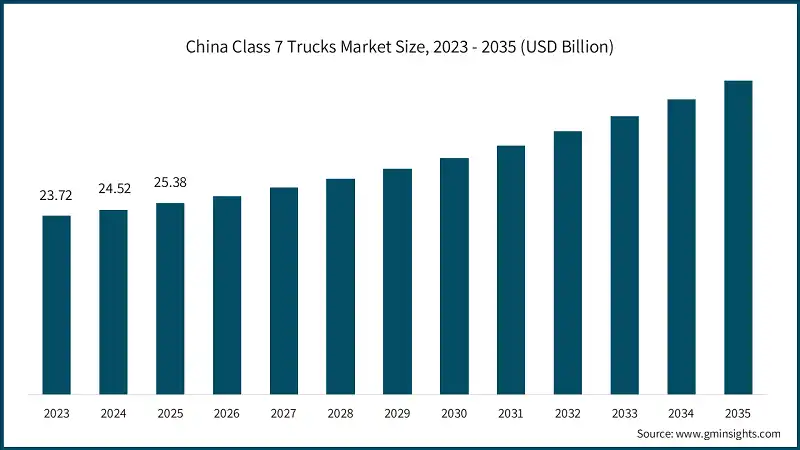
China dominated the class 7 trucks market in Asia Pacific with around 65.5% share and generated USD 25.38 billion in revenue in 2025.
- China market is experiencing robust growth due to sustained investments in infrastructure development, rapid expansion of urban logistics networks, and strong government support for commercial vehicle modernization. Large-scale road construction, industrial park development, smart city projects, and public utility upgrades are driving demand for medium-duty trucks used in construction support, municipal services, and regional freight movement.
- In addition, the rapid growth of e-commerce and same-day delivery services has increased the need for class 7 trucks that can efficiently handle mid-mile distribution between warehouses, sorting hubs, and urban delivery centers.
- Furthermore, China’s strong domestic manufacturing ecosystem and policy-driven push toward cleaner transportation are accelerating adoption. Local OEMs benefit from vertically integrated supply chains, high production volumes, and cost efficiencies, enabling competitive pricing and rapid model upgrades.
- Government incentives for new energy vehicles, stricter emission regulations, and pilot programs for electric and alternative-fuel medium-duty trucks are encouraging fleet replacement. These factors collectively support the large-scale deployment of technologically advanced, fuel-efficient, and electric class 7 trucks across China.
- For instance, in November 2024, Mack Trucks announced it had surpassed 200,000 connected commercial vehicles, indicating strong uptake of telematics and digital fleet management platforms across medium and heavy trucks to boost uptime and operational efficiency.
- India is projected to grow at a significant CAGR in the class 7 trucks market due to rapid infrastructure development, rising road freight movement, and expanding urban logistics demand. Large-scale investments in highways, industrial corridors, smart cities, and construction projects are increasing the need for medium-duty trucks. Additionally, stricter emission norms, fleet modernization initiatives, growth of e-commerce, and increasing adoption of technologically advanced and electric class 7 trucks are accelerating market expansion across logistics, construction, and municipal applications.
The Germany market is expected to experience significant and promising growth from 2026 to 2035.
- Europe accounts for over 21% of the class 7 trucks market share in 2025 and is expected to grow at a CAGR of around 4.7% through 2035, due to stringent emission regulations, accelerated fleet replacement cycles, and strong adoption of low- and zero-emission medium-duty trucks. The expansion of low-emission zones, government incentives, advanced charging infrastructure, and widespread use of class 7 trucks in urban logistics, municipal services, and regional distribution continue to support steady market growth across the region.
- Germany is a strong class 7 trucks market leader due to its advanced industrial base, highly developed logistics infrastructure, and central position within Europe’s freight transportation network. The country serves as a major transit hub for regional and cross-border trade, driving sustained demand for medium-duty trucks used in urban distribution, construction support, municipal services, and industrial supply chains. High freight density, strong e-commerce penetration, and well-organized logistics corridors further reinforce the need for efficient and reliable Class 7 vehicles.
- In addition, Germany’s leadership is supported by the presence of major commercial vehicle manufacturers, strong engineering capabilities, and early adoption of advanced truck technologies. OEMs and fleet operators actively deploy Euro VI-compliant, connected, and electric class 7 trucks to meet strict emission standards and urban mobility regulations. Government incentives, pilot programs for electric trucks, and investment in charging infrastructure further strengthen Germany’s position as a leading class 7 trucks market.
- For instance, in June 2025, DHL Group, Daimler Truck, and fleet provider hylane signed a partnership to deploy 30 Mercedes-Benz eActros 600 electric trucks in Germany under a Transport-as-a-Service model, with deliveries scheduled by mid-2026 marking one of the largest EV truck contracts in the country this year.
- The UK is emerging as a strong growth market for class 7 trucks due to increasing demand from urban logistics, e-commerce expansion, and stringent emission regulations. Rapidly growing last-mile and mid-mile freight movement, coupled with government incentives for low- and zero-emission commercial vehicles, is driving fleet modernization. Additionally, investments in smart city logistics, cleaner transportation policies, and adoption of electrified and connected class 7 trucks by delivery operators and municipal services are further boosting market growth. The combination of rising freight volumes, regulatory pressure, and technological adoption is positioning the UK as a key growth region for medium-duty trucks in Europe.
The US marker is expected to experience significant and promising growth from 2026-2035.
- North America accounts for over 13% of the class 7 trucks market in 2025 and is expected to grow at a CAGR of around 6% between 2026 and 2035 owing to rising demand from e-commerce-driven freight, expanding regional distribution networks, and increasing fleet replacement cycles. The adoption of advanced telematics connected fleet management systems, and fuel-efficient or electric class 7 trucks is accelerating across the U.S. and Canada. In addition, government incentives for clean trucks, strict emission standards, and ongoing investments in logistics infrastructure and last-mile delivery networks are supporting sustained growth.
- The US is the market leader in the class 7 trucks segment due to its extensive logistics and transportation infrastructure, high freight volumes, and advanced commercial vehicle ecosystem. The country’s mature e-commerce sector, extensive regional distribution networks, and strong industrial base drive demand for medium-duty trucks capable of efficiently handling mid-mile and last-mile operations. class 7 trucks are widely deployed for urban delivery, municipal services, construction support, and utility operations, benefiting from high operational reliability, versatility, and adherence to regulatory standards.
- Additionally, the US benefits from active innovation in truck technologies, including advanced telematics, driver-assistance systems, and electrified powertrains. Government incentives for zero- and low-emission trucks, stricter emission regulations, and increasing fleet modernization programs further support adoption. OEMs such as Daimler, Navistar, PACCAR, and Volvo continuously invest in manufacturing, local assembly, and electric truck development, reinforcing the US’s leadership in the class 7 trucks market.
- For instance, in 2024, Isuzu partnered with Gatik AI to jointly develop autonomous driving solutions for Class 37 trucks in North America, including designing new chassis and advancing middle mile autonomous logistics capabilities illustrating deep investment in connected and future ready medium duty fleets.
- Canada is becoming one of the fastest-growing markets in the class 7 trucks sector due to rising demand from regional distribution, urban logistics expansion, and infrastructure development projects. Increasing e-commerce volumes, government incentives for low- and zero-emission commercial vehicles, and stricter emission standards are driving fleet modernization. Additionally, the adoption of electric and hybrid medium-duty trucks, coupled with investments in connected fleet management technologies, is enhancing operational efficiency and sustainability.
The class 7 trucks market in Brazil is expected to experience significant and promising growth from 2026 to 2035.
- Latin America holds around 4% of the market share in 2025 and is growing steadily at a CAGR of around 3.4% between 2026 and 2035 due to expanding road freight activities, rising infrastructure development, and growing demand from construction and urban logistics sectors. Increasing industrialization, urbanization, and e-commerce penetration are driving the need for medium-duty trucks capable of handling regional distribution and municipal services.
- Brazil dominates the class 7 trucks market in Latin America due to its large and growing logistics and transportation sector, extensive road network, and high freight volumes. The country’s expanding industrial base, urbanization, and e-commerce growth have increased demand for medium-duty trucks capable of handling regional distribution, last-mile deliveries, and construction support. Class 7 trucks are widely used in municipal services, utility operations, and industrial logistics, benefiting from their balance of payload capacity, maneuverability, and operational efficiency.
- Additionally, Brazil’s domestic commercial vehicle manufacturing ecosystem and supportive government policies reinforce market leadership. Local OEMs such as Volkswagen Caminhoes, Mercedes-Benz Brazil, and Scania produce a wide range of Class 7 trucks, while initiatives like fleet modernization programs, fuel efficiency incentives, and gradual adoption of emission standards encourage fleet renewal. Investment in telematics, connected fleet management, and alternative-fuel vehicles further strengthens Brazil’s position as the leading Class 7 truck market in Latin America.
- The class 7 trucks market in Mexico is experiencing high growth due to rising demand from regional freight, construction projects, and expanding urban logistics networks. Growing industrialization, e-commerce penetration, and infrastructure development are increasing the need for medium-duty trucks capable of handling last-mile and mid-mile distribution. Government initiatives supporting fleet modernization, stricter emission regulations, and incentives for adopting cleaner and more efficient vehicles are accelerating the replacement of older fleets.
The class 7 trucks market in UAE is expected to experience significant and promising growth from 2026-2035.
- MEA holds around 2% of the market share in 2025 and is growing steadily at a CAGR of around 2.7% between 2026 and 2035 due to rising demand from construction, mining, and urban logistics sectors. Expanding industrialization, infrastructure projects, and increased freight movement are driving the need for medium-duty trucks capable of handling regional distribution and municipal services.
- The UAE dominates the MEA class 7 trucks market due to its advanced infrastructure, strategic position as a logistics hub, and strong industrial and construction activities. High demand for regional freight transport, urban delivery, and municipal services drives the need for medium-duty trucks that are efficient, reliable, and capable of handling diverse applications.
- Additionally, government initiatives supporting fleet modernization, adoption of low- and zero-emission vehicles, and investments in smart city and logistics projects further strengthen market leadership. The presence of global OEMs, well-developed commercial vehicle supply chains, and early adoption of telematics and connected fleet technologies enable efficient operations, making the UAE the leading class 7 trucks market in the MEA region.
- Saudi Arabia is expected to grow at the fastest CAGR in the MEA market due to rapid infrastructure development, expanding industrial and construction activities, and increasing urban freight demand. Large-scale projects under Saudi Vision 2030, including road networks, logistics hubs, and smart city initiatives, are driving demand for medium-duty trucks capable of handling regional distribution, municipal services, and construction logistics.
Class 7 Trucks Market Share
- The top 7 companies in the class 7 trucks industry are PACCAR, SCANIA, Traton, Volkswagen, Volvo, Daimler Trucks, and Isuzu Motors contributed around 36.7% of the market in 2025.
- PACCAR focuses on electrification and sustainability in its class 7 trucks through battery-electric Kenworth and Peterbilt models. The company invests in advanced telematics, integrated fleet solutions, and strategic partnerships with charging infrastructure providers like ChargePoint. PACCAR emphasizes total cost-of-ownership reduction, digital fleet management, and customer support programs to strengthen loyalty while expanding zero-emission and fuel-efficient offerings globally.
- SCANIA pursues a strategy centered on sustainable transport and operational efficiency. The company develops electric, hybrid, and alternative-fuel class 7 trucks while integrating connected fleet management, predictive maintenance, and telematics solutions. Strategic partnerships with logistics operators and renewable energy providers support urban and regional distribution adoption. SCANIA focuses on reducing emissions, improving up time, and offering customized solutions for heavy-duty fleet operators worldwide.
- Traton leverages synergies across MAN, Scania, and Navistar to optimize production, standardize components, and enhance global supply chains. The company prioritizes electrification, autonomous driving research, and connected vehicle solutions for Class 7 trucks. Strategic investments focus on battery-electric vehicles, digital fleet services, and joint ventures to expand regional penetration, reduce emissions, and deliver scalable, efficient transportation solutions.
- Volkswagen emphasizes electrification and digitalization in its Class 7 portfolio through VW e-Delivery and hybrid platforms. The company invests in battery technology, connected vehicle telematics, and sustainable logistics solutions. Strategic collaborations with fleet operators and urban mobility providers enable deployment of zero-emission vehicles in regional distribution networks, while VW focuses on total cost-of-ownership efficiency and regulatory compliance across global markets.
- Volvo’s strategy for class 7 trucks revolves around electrification, autonomy, and digital fleet integration. Volvo invests in battery-electric and hybrid trucks, connected telematics, and predictive maintenance solutions. Strategic partnerships with technology companies and logistics operators support autonomous and semi-autonomous deployments. Sustainability, low operational costs, and enhanced driver safety remain key priorities, reinforcing Volvo’s leadership in efficient, zero-emission medium-duty truck solutions.
- Daimler Trucks focuses on zero-emission vehicles, digital fleet services, and connected truck platforms for Class 7 trucks. The company develops battery-electric and fuel-cell trucks, integrated telematics, and predictive maintenance tools. Strategic partnerships with fleet operators, charging network providers, and technology companies enable scalable EV adoption. Daimler emphasizes regulatory compliance, operational efficiency, and sustainability, targeting urban and regional freight markets globally.
- Isuzu’s strategy centers on reliability, efficiency, and alternative-fuel adoption for Class 7 trucks. The company invests in battery-electric and hybrid variants while enhancing fuel-efficient diesel engines. Integration of telematics, GPS tracking, and connected fleet solutions supports optimized operations. Strategic collaborations with logistics providers, technology partners, and OEMs enable regional market expansion, cost-effective solutions, and compliance with environmental regulations.
Class 7 Trucks Market Companies
Major players operating in the class 7 trucks industry are:
- PACCAR
- SCANIA
- Traton
- Volkswagen
- Volvo
- Daimler Trucks
- Isuzu Motors
- Kenworth
- Peterbilt
- Ford
- Manufacturers and fleet operators in the class 7 trucks market are increasingly leveraging digital design, connected telematics, and cloud-based fleet management platforms to improve operational efficiency, safety, and vehicle uptime. Integration of IoT sensors, GPS tracking, AI-powered predictive maintenance, and real-time diagnostics enable monitoring of medium-duty truck performance, driver behavior, and route optimization. These technologies help detect mechanical anomalies, schedule proactive maintenance, optimize fuel consumption, and reduce downtime, while also providing actionable data for fleet planning, cost management, and regulatory compliance.
- Strategic partnerships and technology collaborations are driving innovation in the class 7 trucks ecosystem. Alliances between OEMs, telematics solution providers, software developers, and fleet service companies accelerate deployment of connected vehicle platforms, predictive analytics, and autonomous-capable systems. These partnerships facilitate standardized data exchange, interoperability, and integration with smart logistics and urban mobility platforms. As a result, fleets benefit from enhanced vehicle utilization, reduced operational costs, improved safety, and better compliance with emission regulations, accelerating the global transition toward a fully connected, data-driven, and highly efficient Class 7 truck ecosystem.
Class 7 Trucks Market Report Attributes
| Key Takeaway | Details |
|---|---|
| Market Size & Growth | |
| Base Year | 2025 |
| Market Size in 2025 | USD 65.3 Billion |
| Market Size in 2026 | USD 67.8 Billion |
| Forecast Period 2026-2035 CAGR | 5.2% |
| Market Size in 2035 | USD 106.9 Billion |
| Key Market Trends | |
| Drivers | Impact |
| Increasing demand for electric & hybrid class 7 trucks across the globe | Fleet operators are adopting electric and hybrid class 7 trucks to reduce fuel costs, comply with emission mandates, and improve urban operability. Advancements in battery density, charging infrastructure, and powertrain efficiency are accelerating electrification across municipal, logistics, and utility fleets. |
| Growing freight transportation activities across North America | Rising e-commerce volumes, regional distribution growth, and infrastructure maintenance are increasing demand for class 7 trucks in North America. These vehicles offer an optimal balance of payload capacity, maneuverability, and operating efficiency for mid-mile logistics, construction support, and municipal applications. |
| Implementation of stringent emission regulations in Europe | Strict Euro VI standards, low-emission zones, and city-level zero-emission mandates are driving accelerated replacement of older medium-duty trucks in Europe. Class 7 fleets are shifting toward cleaner diesel, hybrid, and electric models to maintain regulatory compliance and urban access. |
| Rising investments in infrastructure development activities in Asia Pacific | Large-scale investments in roads, industrial corridors, urban housing, and smart city projects across Asia-Pacific are boosting demand for Class 7 trucks. These vehicles support construction logistics, material transport, and utility operations while offering cost efficiency and adaptability in diverse operating conditions. |
| Pitfalls & Challenges | Impact |
| High initial and maintenance costs | Class 7 trucks require significant upfront investment due to advanced powertrains, emission-control systems, and safety technologies. Higher maintenance costs, specialized spare parts, and skilled labour requirements increase total cost of ownership, limiting adoption among small fleet operators and cost-sensitive markets. |
| Shortage of truck drivers | The global shortage of qualified truck drivers is constraining Class 7 truck utilization across logistics and construction sectors. Aging workforce demographics, demanding work conditions, regulatory compliance requirements, and limited new driver recruitment are impacting fleet expansion and operational efficiency worldwide. |
| Opportunities: | Impact |
| Electrification of municipal and urban logistics fleets | Municipal authorities and urban logistics operators are increasingly replacing diesel class 7 trucks with electric models to meet emission targets. Government incentives, depot-based charging, and predictable duty cycles create strong opportunities for OEMs and fleet solution providers. |
| Expansion of infrastructure and construction projects in emerging economies | Large-scale investments in roads, industrial corridors, smart cities, and public utilities across Asia-Pacific, Latin America, and the Middle East are driving demand for class 7 trucks used in construction support, material transport, and utility maintenance. |
| Growth of flexible ownership and Truck-as-a-Service (TaaS) models | Rising interest in leasing, subscription-based ownership, and pay-per-use models is creating opportunities to expand Class 7 truck adoption among SMEs. These models reduce upfront capital requirements and improve fleet scalability across logistics and service sectors. |
| Integration of advanced telematics and fleet analytics solutions | The increasing need for cost optimization, compliance monitoring, and predictive maintenance is driving demand for connected Class 7 trucks. OEMs and technology providers can capture value by bundling telematics, AI-based analytics, and fleet management platforms with vehicle sales. |
| Market Leaders (2025) | |
| Market Leaders |
12.15% market share |
| Top Players |
|
| Competitive Edge |
|
| Regional Insights | |
| Largest Market | Asia Pacific |
| Fastest growing market | North America |
| Emerging countries | India, Philippines, Indonesia, Brazil, Saudi Arabia, UAE |
| Future outlook |
|
What are the growth opportunities in this market?
Class 7 Trucks Market News
- In October 2025, Daimler Truck North America announced an expansion of Freightliner eM2 electric truck production at its Portland, Oregon facility to meet growing demand for zero-emission Class 7 vehicles. With over 480 customer orders and production slots through 2027, eM2 offers a 230-mile range and fast-charging capability. Major customers include PepsiCo, Penske, and Sysco.
- In September 2025, PACCAR unveiled next-generation Kenworth K270E and K370E battery-electric trucks featuring a 300-mile range, 30% improvement over previous models. The company partnered with ChargePoint Holdings to provide integrated fleet charging solutions, streamlining EV adoption through turnkey depot infrastructure and energy management platforms for fleet operators.
- In August 2025, The U.S. EPA finalized Phase 3 greenhouse gas emission standards for heavy-duty vehicles, requiring a 60% reduction in CO2 emissions for vocational vehicles, including Class 7 trucks, by 2032. The rules accelerate zero-emission vehicle adoption, though manufacturers expressed concerns over infrastructure readiness and customer adoption rates.
- In July 2025, Volvo Trucks expanded its partnership with Aurora Innovation to develop Level 4 autonomous driving technology for regional haul applications. Pilot programs target a 2027 commercial launch, integrating advanced sensor suites, redundant systems, and comprehensive testing, positioning Volvo as a leader in autonomous commercial vehicle technology.
- In June 2025, Ford Motor Company introduced a Super Duty chassis-cab hybrid combining diesel and electric power for improved fuel efficiency. The hybrid delivers 15% better fuel economy in city cycles, targeting utility, construction, and municipal fleets. Production is scheduled for early 2026 in North America.
- In May 2025, Navistar International transitioned production to Traton Group’s powertrain architecture, integrating MAN and Scania technologies. The San Antonio, Texas facility expansion supports International eMV Series battery-electric trucks, creating 450 jobs and boosting zero-emission vehicle production.
The class 7 trucks market research report includes in-depth coverage of the industry with estimates & forecasts in terms of revenue ($Bn), and shipment (Units) from 2022 to 2035, for the following segments:
Market, By Fuel
- Diesel
- Natural gas
- Hybrid electric
- Others
Market, By Application
- Freight delivery
- Utility services
- Construction & mining
- Others
Market, By Axle
- 4x2
- 6x4
- 6x2
Market, By Horsepower
- Below 300HP
- 300HP - 400HP
- 400HP - 500HP
- 500HP & Above
Market, By Ownership
- Fleet operator
- Independent operator
Market, By Transmission
- Manual transmission
- Automatic transmission
The above information is provided for the following regions and countries:
- North America
- US
- Canada
- Europe
- Germany
- UK
- France
- Italy
- Spain
- Russia
- Nordics
- Asia Pacific
- China
- India
- Japan
- Australia
- South Korea
- Philippines
- Indonesia
- Latin America
- Brazil
- Mexico
- Argentina
- MEA
- South Africa
- Saudi Arabia
- UAE
Frequently Asked Question(FAQ) :
What is the market size of the class 7 trucks in 2025?
The market size was USD 65.3 billion in 2025, with a CAGR of 5.2% expected through 2035 driven by evolving freight logistics, infrastructure development, and industrial modernization across global markets.
What is the projected value of the class 7 trucks market by 2035?
The class 7 trucks market is expected to reach USD 106.9 billion by 2035, propelled by electrification adoption, stricter emission regulations, e-commerce growth, and expansion of infrastructure projects worldwide.
What is the current class 7 trucks market size in 2026?
The market size is projected to reach USD 67.8 billion in 2026.
What was the market share of diesel fuel segment in 2025?
Diesel segment dominated the market accounting for around 80.81% share in 2025 and is expected to grow at a CAGR of more than 4.6% through 2035, due to superior torque, fuel efficiency, and reliability.
What was the market share of freight delivery application segment in 2025?
Freight delivery segment accounted for around 35% share in 2025 and is expected to grow at a CAGR of over 5.3% from 2026-2035, driven by e-commerce expansion and last-mile delivery demand.
What is the growth outlook for utility services segment from 2026 to 2035?
Utility services segment is expected to experience faster growth of more than 6% till 2035, owing to rising demand in municipal services, power distribution, waste management, and public infrastructure projects.
Which region leads the class 7 trucks market?
China dominated the Asia Pacific class 7 trucks market with a 65.5% share, generating USD 25.38 billion revenue in 2025, driven by strong infrastructure investment, expanding urban logistics networks, and government support for commercial vehicle modernization.
What are the upcoming trends in the class 7 trucks market?
Key trends include adoption of electric and hybrid powertrains, integration of advanced driver-assistance systems (ADAS), deployment of telematics and fleet analytics, growth of Truck-as-a-Service (TaaS) models, development of modular truck platforms, and focus on lifecycle cost optimization over initial purchase price.
Class 7 Trucks Market Scope
Related Reports