Summary
Table of Content

China Bio-based Construction Materials Market
Get a free sample of this report
Form submitted successfully!
Error submitting form. Please try again.
Thank you!
Your inquiry has been received. Our team will reach out to you with the required details via email. To ensure that you don't miss their response, kindly remember to check your spam folder as well!
Request Sectional Data
Thank you!
Your inquiry has been received. Our team will reach out to you with the required details via email. To ensure that you don't miss their response, kindly remember to check your spam folder as well!
Form submitted successfully!
Error submitting form. Please try again.
China Bio-based Construction Materials Market Size
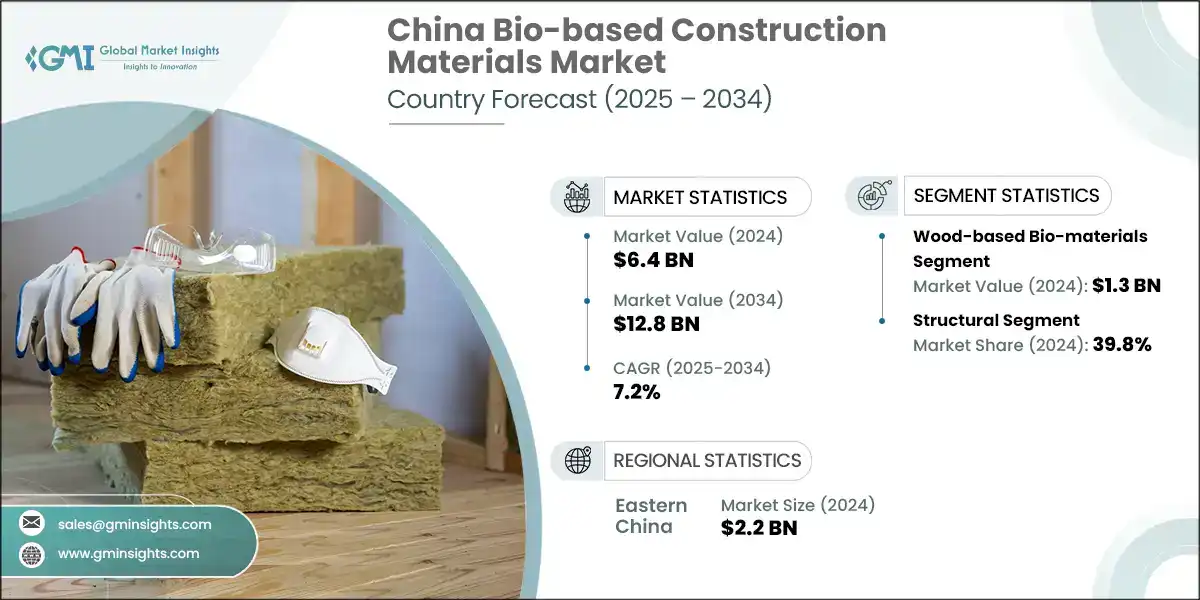
The China bio-based construction materials market was valued at USD 6.4 billion in 2024 and is projected to grow from USD 6.8 billion in 2025 to USD 12.8 billion by 2034, registering a CAGR of 7.2%, according to Global Market Insights Inc.
China Bio-based Construction Materials Market Key Takeaways
Market Size & Growth
- 2024 Market Size: USD 6.4 Billion
- 2034 Forecast Market Size: USD 12.8 Billion
- CAGR (2025–2034): 7.2%
Regional Dominance
- Largest Market: Eastern China
- Fastest Growing Country: Southern China
Key Market Drivers
- Increasing government policies supporting sustainability.
- Rising demand for eco-friendly construction materials.
- Urbanization and infrastructure development.
Challenges
- High production costs.
- Lack of standardized quality regulations.
Opportunity
- Technological innovation in bio-based materials.
- Expansion into rural and affordable housing markets.
Key Players
- Market Leader: Holcim led with over 10.8% market share in 2024.
- Leading Players: Top 5 players in this market include Holcim, Dasso Group, Suzano, Covestro, China Resources Cement Holdings Limited, which collectively held a market share of 36.4% in 2024.
Get Market Insights & Growth Opportunities
- Bio-based construction materials are those products that are considered environmentally sustainable building products obtained from renewable biological resources such as plant fibers, bio-polymers, and other organic materials to curb carbon footprints and promote green construction practices. The Chinese government has been on an active front to promote sustainability via policies aimed at curbing greenhouse gas emissions and promoting eco-friendly development.
- China is the largest emitter of CO2 emissions in the world. In 2018, CO2 emissions in China totaled 9.5 Gt CO2-29% of the world total. The National Development and Reform Commission (NDRC) reports that China has pledged to peak its carbon emissions by 2030 and achieve carbon neutrality by the year 2060, which can directly support its bio-based construction materials.
- There has been an open commitment to green building on the part of the Ministry of Housing and Urban-Rural Development, advocating for upgrading performance standards internationally and assuring sustainable material choices in the urban planning and infrastructure development of projects. So, this push along with an increasing awareness on the part of developers and consumers regarding environmental impacts has started to shift demand for green construction products.
- Eastern China, especially around major economic hubs of Shanghai and Jiangsu, currently leads the market owing to established manufacturing infrastructure and advancement of policies. Meanwhile, Southern China is growing the fastest due to the acceleration of urbanization, infrastructure, and governmental intervention for promoting green building practices. Together and interconnected, these three major forces-great government policy, urbanization, and environmental awareness-will expand the bio-based construction materials market in China, which is considered a great frontier for sustainable construction.
To get key market trends
China Bio-based Construction Materials Market Trends
- Technological advancements in material development: Rapid innovations take place in bio-based construction materials as next-gen bio-composites and bio-polymers are being developed that provide the better mechanical properties, insulation, and fire resistance. Nanotechnology and bio-engineering offer pathways for cataloging smarter, lighter, and newer sustainable materials. For example, bio-based foam insulations with enhanced thermal properties are being introduced into green buildings with assistance from research schemes provided at the government level, such as China’s 14th Five-Year Plan. Innovations like these create more designer possibilities without compromising naturalness, fostering acceptance across the construction sector.
- Stringent regulatory frameworks to favor sustainability: Governments have been imposing stringent regulations to facilitate the use of sustainable building material much more everywhere in the world, especially in China. A roadmap involving the targets for reducing carbon emissions and increasing the share of green buildings is encouraging builders in China to use bio-based materials. Evolving regulatory frameworks favoring eco-friendly products can also be reflected from the environment where standards such as the Green Building Evaluation Standard GBES have been established. The codes promote manufacturers and steer consumer choices, engendering an otherwise sluggish market dealing with sustainable construction solutions backed by far-reaching mandates.
- Digitalization and industry 4.0 in manufacturing: Interfacing of Industry 4.0 technologies such as automation, IoT, and artificial intelligence are fundamentally altering the manufacturing imagination of bio-based construction materials in China. These technologies not only help save time and costs in production but also enhance process efficiency, quality control, and customizability by addressing issues of waste. Smart manufacturing is a focus of the Chinese government, and under policies in the Made in China 2025 initiative, there is a push for innovation in the bio-products industry. This digital transformation aims at shortening product development cycles and giving it a wide market reach.
- Increasing investments in sustainable infrastructure projects: Investments from both the state and the private sector are increasingly directed toward sustainable infrastructures demanding the innovative bio-based materials. Major infrastructure development projects undertaken by the government under the Belt and Road Initiative imply green construction and encourage bio-based solutions.
China Bio-based Construction Materials Market Analysis
Learn more about the key segments shaping this market
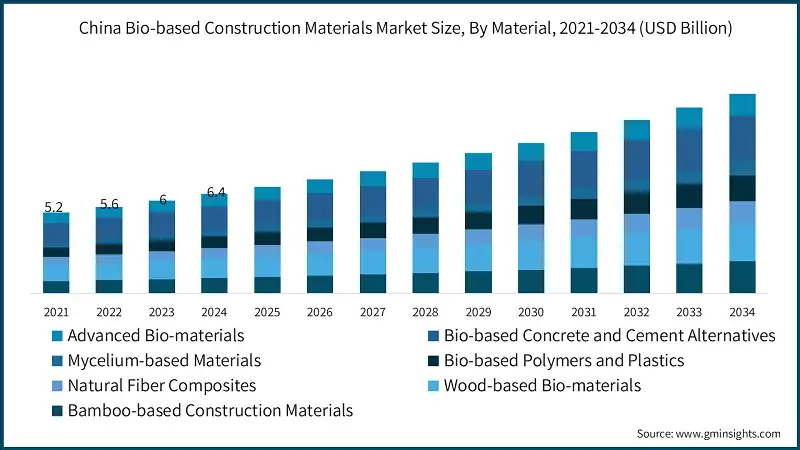
The market by material is segmented into bamboo-based construction materials, wood-based bio-materials, natural fiber composites, bio-based polymers and plastics, mycelium-based materials, bio-based concrete and cement alternatives and advanced bio-materials. Wood-based bio-materials generated USD 1.3 billion in 2024.
- Wood-based bio-materials ruled the China biobased construction materials market for their long tradition, structural strength, and easy incorporation into already established construction practices. Currently, China becomes the most significant importer of industrial logs; the second-most supreme importer of forest products in the world; and has continued to sustain a tremendous growth rate in its imports. Most of the imported products comprise industrial logs, sawnwood, and plywood. Increased imports are also related to wood-based fibreboard and particleboard. Furthermore, significant imports consist of pulp and paper products on average every year, often exceeding roundwood equivalent timber products.
- Natural fiber composites and bio-based polymers are slowly gaining popularity in the market, but still hold a smaller share compared to wood-based materials. The advantage of such composites is in lightweight, high-performing features making them suitable candidates for usage as interior panels, insulation, and decorative elements. Mycelium-based and bamboo-based materials are growing into niche markets as eco-savvy consumers seek to enhance their purchases through innovative research and development to reach mainstream preference.
- Bio-based concrete and cement alternatives are few and far away but very promising in that they should meet structural specifications at scale; however, they are still in development phases. Advanced bio-materials such as mycelia and bio-polymers are primarily being used either for pilot projects or for specialty applications.
Learn more about the key segments shaping this market
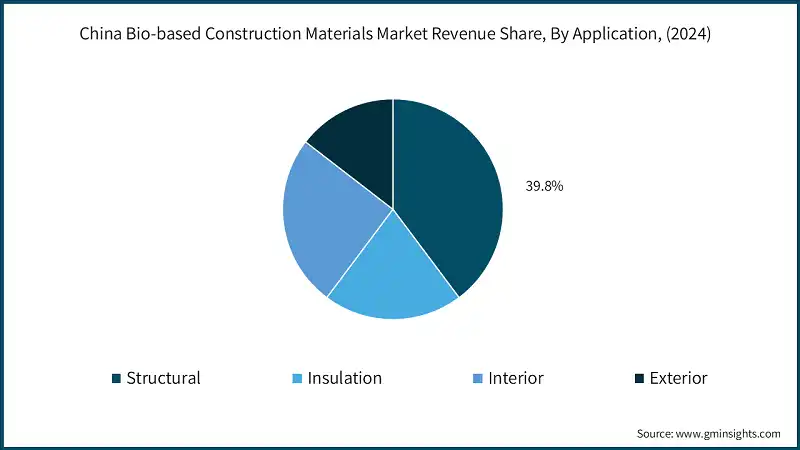
Based on application, the China bio-based construction materials market is segmented into structural, insulation, interior and exterior. Structural made up 39.8% of the market in 2024.
- Structural applications are the primary types of applications for bio-based construction materials in China since they form the basis of buildings that require strength and durability. Demand for load-bearing, innovative solutions like engineered wood, bio-based concrete, and composites comes from the country's emphasis on green infrastructure in its urban expansion. All of these safety-tested solutions offer reduced carbon footprints, thus making them the ideal solutions for residential, commercial, and public infrastructure projects. Bio-based materials are gaining prominence on par with concrete and steel in the structural fabric of buildings, fueling investment and innovation with industry standards and construction codes favoring the green option.
- Insulation applications have been estimated to increase very fast, but they still are not considered as leading application areas like structural. As China attaches great importance to energy efficiency, housing-related aspects even in green building certification, the demand for nature-based or bio-based insulation applications such as natural fiber-based insulations and bio-foams is expected to grow. Lightweight, thermal performance as well as environment friendliness profiles make them very attractive for new and retrofitting constructions.
- Increasing consumer trends towards sustainable and natural aesthetics have inspired new interior applications-including decorative panels, flooring, and furniture. The interiors contribute a big part of this overall demand, but the significant driving forces of growth are renovation and the interior fit-outs rather than new-builds.
Based on end use sector, the China bio-based construction materials market is segmented into residential construction, commercial construction, industrial construction and infrastructure projects. Residential construction leads the market in 2024.
- In China, the residential sector is the most relevant end-use sector for bio-based construction materials, considering urbanization, increasing middle-class income, and government efforts toward sustainable living environments. Urbanization in China has reached an all-time high of 66% in 2023. With this change in urban lifestyle away from "regular" construction, consumers are starting to become more aware of the value of eco-friendly and healthy spaces, thus boosting the demand for natural fiber composites, bio-based insulation, and engineered wood products.
- Commercial construction, which encompasses office buildings, hotels, and retail spaces, has gained considerable importance due to China's economic growth and urban development. The market demands affordable modern construction materials that meet safety, durability, and comfort standards, and that give consonance to the contemporary construction standards regarding environmental sustainability. In this light, the increased use of bio-based materials for interior finishes, thermal insulation, and structural components is directed toward achieving high green building certification such as LEED.
- Industrial construction and infrastructure constitute growing markets, although they are less significant designs due to specific technical and economic conditions. However, in specialized applications such as factory interiors, temporary works, and infrastructure retrofits, bio-based materials are slow to take hold, being pushed today largely through environmental regulations and the need for sustainable industrial development.
Looking for region specific data?
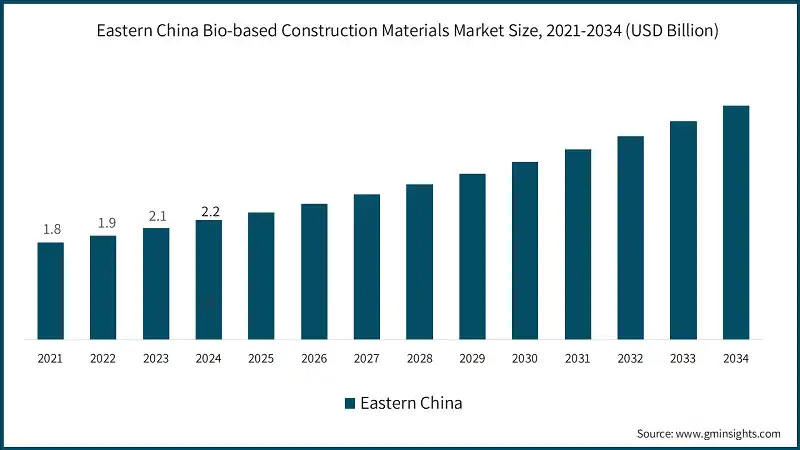
Eastern China bio-based construction materials market was accounted for USD 2.2 billion in 2024.
- Eastern China dominates due to densely packed urbanization and high construction activities. Demand is driven by the extremely large urban infrastructure projects in the region and the increasing acceptance of bio-based materials in commercial and residential buildings. The region is also supported by an established supply chain and advanced manufacturing facilities that allow the fast uptake of new bio-based construction products. The large population and position as an economic hub have stimulated higher activity of retrofit and new-build projects, especially in major cities like Shanghai and Hangzhou.
- Northern China would be experiencing steady growth sustained by government-sponsored infrastructure developments and urban expansions; thus, the region is lagging a bit behind Eastern China in bio-based materials acceptance. The cold weather warrants interest toward insulation materials, but traditional construction methods still command a sizeable market share.
- Southern China is recording growth that complements its extremely fast urbanization in cities like Guangzhou and Shenzhen that are beginning to see momentum with green construction. However, due to economic disparity among the regions, Southern China is still ranking behind Eastern China in terms of market size.
- Western and Central China, as emerging markets, have newfound awareness and investment appetite for sustainable construction. The two have growth impetus from infrastructural development and incentives from the government but hold comparatively lower market shares due to sparse urbanization and slow acceptance of bio-based materials.
China Bio-based Construction Materials Market Share
- The market for China bio-based construction materials is quite scattered, with players like Holcim, Dasso Group, Suzano, Covestro and China Resources Cement Holdings Limited counting about 36.4% of the total market shares.
- These companies hold strong positions globally due to their extensive experience in biofertilizers market. Their diverse product portfolios, backed by robust production capabilities and distribution networks, enable them to meet the rising demand for biofertilizers across various regions.
China Bio-based Construction Materials Market Companies
Major players operating in the China bio-based construction materials industry are:
- China National Building Material Company Limited
- China Resources Cement Holdings Limited
- Covestro
- Dasso Group
- Holcim
- Huaxin Cement Co., Ltd.
- Mitsui Chemicals
- Suzano
- Tangshan Jidong Cement Co., Ltd.
Holcim: Holcim has made its mark on the global stage as one of the leading innovators in developing durable and sustainable construction solutions through the supply of environment-friendly cement, concrete, and aggregates. In China, Holcim emphasizes research on bio-based and low-carbon alternatives to cement, using advanced manufacturing processes and green technologies to meet the growing need for concrete-solution deficiency in relation to sustainable construction practices and reducing adverse environmental impacts.
Dasso Group: The Dasso Group manufactures engineered wood and bamboo building materials that encourage eco-friendly building practices in China. Their products are focused on using natural renewable materials that are strong and durable, thus addressing the increasing demand for sustainable applications in areas such as interiors and structures within the GS sector of the region.
Suzano: Suzano is primarily known for cellulose and paper-based bio-products and is increasingly spreading into bio-based construction materials such as natural fiber composites. Focusing on innovative biodegradable materials, the company presents its offers for thermic insulation and finishing of interiors, thus making it aligned with China's whole drive toward environmentally friendly and renewable building solutions.
Covestro: A pioneer in high-performance polyurethanes and bio-based polymers, Covestro is pouring a lot of investment into the development of sustainable materials. Covestro has put great emphasis in the bio-based construction market in China on the utilization of bio-polyols and on the development of building insulation materials environment-friendly in terms of thermal efficiency and compatibility with the construction processes of green buildings.
China Resources Cement Holdings Limited: Bio-based additives and supplementary materials have been incorporated increasingly at China Resources Cement, a cement-and-concrete-producing heavyweight. They develop low-carbon and green cement-products in support of the low employment of their resources to achieve their goals in terms of leaving less footprint with respect to the state environmental goals set by China and the demand for construction infrastructure that is sustainable.
China Bio-based Construction Materials Market Report Attributes
| Key Takeaway | Details |
|---|---|
| Market Size & Growth | |
| Base Year | 2024 |
| Market Size in 2024 | USD 6.4 Billion |
| Forecast Period 2025 – 2034 CAGR | 7.2% |
| Market Size in 2034 | USD 12.8 Billion |
| Key Market Trends | |
| Drivers | Impact |
| Increasing government policies supporting sustainability | Accelerate adoption of eco-friendly construction materials |
| Rising demand for eco-friendly construction materials | Driving market growth and innovation |
| Urbanization and infrastructure development | Expand market size and application scope |
| Pitfalls & Challenges | Impact |
| High production costs | Limit competitiveness and scalability |
| Lack of standardized quality regulations | Hinder consumer trust and market expansion |
| Opportunities: | Impact |
| Technological innovation in bio-based materials | Enhance product performance and reduce costs |
| Expansion into rural and affordable housing markets | Unlock new growth segments |
| Market Leaders (2024) | |
| Market Leaders |
10.8% Market Share |
| Top Players |
Collective market share in 2024 is 36.4% |
| Competitive Edge |
|
| Regional Insights | |
| Largest Market | Eastern China |
| Fastest Growing Market | Southern China |
| Future outlook |
|
What are the growth opportunities in this market?
China Bio-based Construction Materials Industry News
- November 2024, Covestro has stepped up the manufacture of partially bio-based coating materials within the Asia Pacific, to achieve the sustainability goals for the region and reduce the carbon footprint. Especially in Foshan, China.
- October 2024, Suzano opened up new avenues for bio-based materials applications in China, including an agreement with Ningbo Actmix to facilitate the introduction of Ecolig, a bio-based rubber additive that promises to play a role in the transition to a low-carbon economy and foster sustainable industrial practices.
- November 2024, Mitsui Chemicals worked with Prime Polymer and Hide Kasuga 1896 to attach its bio-based flooring tiles to Expo 2025 while assisting carbon neutrality and sustainability and provided 20,000 tiles for the National Day Pavilion in the event.
- September 2023, scientists have developed low-carbon building materials. The grains such as sand, coal cinder, and brick rubble were used to replace traditional construction materials for an environmentally friendly way of life, thereby reducing the high global emission of carbon dioxide.
The China bio-based construction materials market research report includes an in-depth coverage of the industry with estimates and forecast in terms of revenue in USD Billion and volume in terms of Kilo Tons from 2021–2034 for the following segments:
Market, By Material
- Bamboo-based construction materials
- Engineered bamboo products
- Bamboo fiber composites
- Recombinant bamboo building materials
- Bamboo plywood and panels
- Bamboo reinforcement materials
- Wood-based bio-materials
- Cross-laminated timber (CLT)
- Engineered wood products
- Wood fiber insulation materials
- Wood-plastic composites
- Glue-laminated timber
- Natural fiber composites
- Hemp-based construction materials
- Flax fiber composites
- Straw-based building materials
- Other plant fiber composites
- Bio-based polymers and plastics
- Polylactic acid (PLA) materials
- Bio-based polyurethanes
- PBAT and PBS materials
- Biodegradable construction plastics
- Bio-based adhesives and binders
- Mycelium-based materials
- Mycelium insulation products
- Mycelium-wood composites
- Structural mycelium materials
- Mycelium-derived packaging materials
- Bio-based concrete and cement alternatives
- Bio-concrete products
- Alternative cement materials
- Carbon-negative building materials
- Geopolymer concrete with plant fibers
- Advanced bio-materials
- Chitosan foam materials
- Seaweed-based materials
- Agricultural waste-derived materials
- Synthetic biology-derived materials
Market, By Application
- Structural applications
- Load-bearing elements and frameworks
- Foundation systems and ground works
- Roofing systems and structures
- Wall systems and panels
- Flooring and decking materials
- Insulation applications
- Thermal insulation systems
- Acoustic insulation materials
- Fire-resistant insulation products
- Multi-functional insulation solutions
- Interior applications
- Interior wall coverings and panels
- Ceiling systems and components
- Interior fittings and fixtures
- Furniture and built-in elements
- Exterior applications
- Facade systems and cladding
- External insulation systems
- Weatherproofing materials
- Landscaping and outdoor applications
Market, By End Use Sector
- Residential construction
- Single-family houses and villas
- Multi-family residential buildings
- Affordable housing projects
- Rural construction and new rural development
- Renovation and retrofitting projects
- Commercial construction
- Office buildings and business centers
- Retail and shopping centers
- Hotels and hospitality facilities
- Educational institutions
- Healthcare facilities
- Industrial construction
- Manufacturing facilities and factories
- Warehouses and logistics centers
- Agricultural buildings and facilities
- Specialized industrial structures
- Infrastructure projects
- Transportation infrastructure
- Utilities and energy infrastructure
- Public buildings and government facilities
- Environmental infrastructure and green projects
The above information is provided for the following regions and countries:
- Eastern China
- Northern China
- Southern China
- Western China
- Central China
Frequently Asked Question(FAQ) :
What was the market size of the China bio-based construction materials in 2024?
The market size was valued at USD 6.4 billion in 2024, with a CAGR of 7.2% expected through 2034.
What is the projected value of the China bio-based construction materials market by 2034?
The market is projected to reach USD 12.8 billion by 2034, fueled by innovations in sustainable materials and increasing adoption in green building projects.
What was the revenue generated by wood-based bio-materials in 2024?
Wood-based bio-materials generated USD 1.3 billion in revenue in 2024, making it a significant segment of the market.
What was the market share of structural applications in 2024?
Structural applications accounted for 39.8% of the market share in 2024, dominating the application segments.
What was the valuation of the Eastern China bio-based construction materials market in 2024?
The Eastern China market was valued at USD 2.2 billion in 2024, leading the regional markets.
What are the key trends in the China bio-based construction materials industry?
Key trends include the development of next-gen bio-composites and bio-polymers, advancements in nanotechnology and bio-engineering, and the introduction of bio-based foam insulations with enhanced thermal properties.
Who are the major players in the China bio-based construction materials market?
Major players include China National Building Material Company Limited, China Resources Cement Holdings Limited, Covestro, Dasso Group, Holcim, Huaxin Cement Co., Ltd., Mitsui Chemicals, and Suzano.