Summary
Table of Content

Chickpeas Market
Get a free sample of this report
Form submitted successfully!
Error submitting form. Please try again.
Thank you!
Your inquiry has been received. Our team will reach out to you with the required details via email. To ensure that you don't miss their response, kindly remember to check your spam folder as well!
Request Sectional Data
Thank you!
Your inquiry has been received. Our team will reach out to you with the required details via email. To ensure that you don't miss their response, kindly remember to check your spam folder as well!
Form submitted successfully!
Error submitting form. Please try again.
Chickpeas Market Size
- Chickpeas, also known as garbanzo beans, are an important ingredient of various cuisines worldwide and are recognized for their nutritional value, including being a rich source of protein, fiber, vitamins, and minerals.
- A 1 cup (164g) serving of cooked chickpeas provides 269 calories, 14.5g protein, 4g fat, 45g carbs, 12.5g fiber, and the important nutrients including manganese (74% DV), folate (71%), copper (64%), iron (26%), zinc (23%), phosphorus (22%), magnesium (19%), thiamine (16%), vitamin B6 (13%), selenium (11%), and potassium (10%).
- According to the Harvard health publishing, the recommended dietary allowance (RDA) for protein is modest 0.8 grams of protein per kilogram of body weight, or 0.36 grams per pound. The RDA is the amount of nutrient you need to meet your basic nutritional requirements. The increasing consumer preference for plant-based protein sources and the growing awareness of the health benefits associated with chickpeas consumption is driving market growth.
- The chickpeas market has been primarily driven by the increasing consumer preference for plant-based protein sources and the growing awareness of the health benefits associated with chickpeas consumption. The rising demand for gluten-free and non-GMO food products has further accelerated the market growth, as chickpeas are naturally gluten-free and non-genetically modified.
The global chickpeas market was valued at USD 17.1 billion in 2025. The market is expected to grow from USD 18.2 billion in 2026 to USD 32.2 billion in 2035, at a CAGR of 6.5% according to latest report published by Global Market Insights Inc.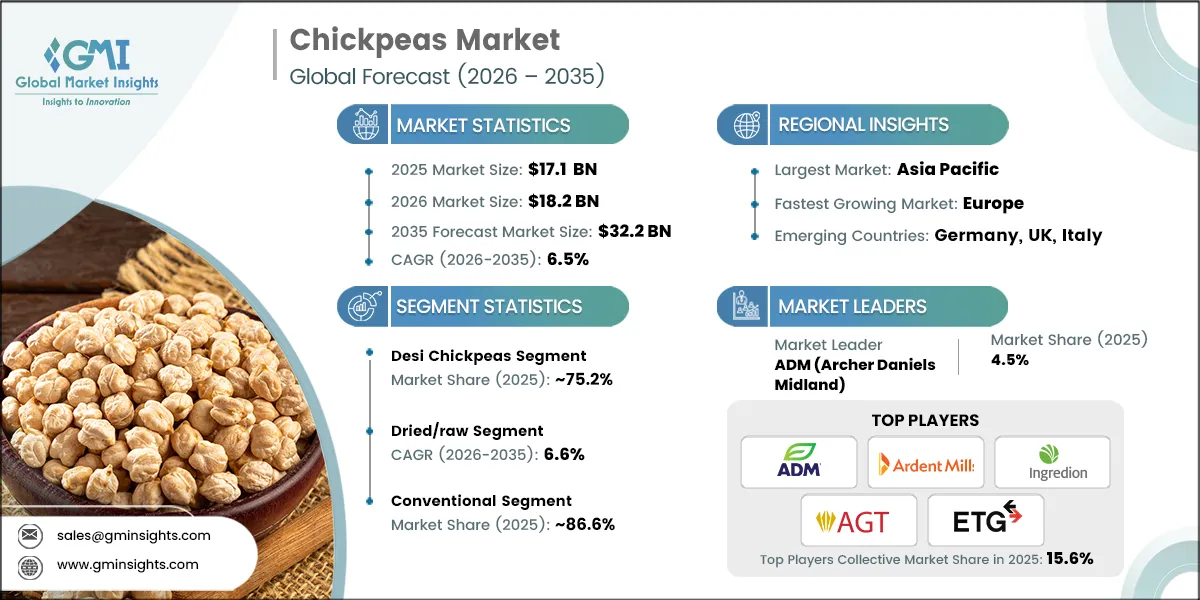
Chickpeas Market Key Takeaways
Market Size & Growth
- 2025 Market Size: USD 17.1 Billion
- 2026 Market Size: USD 18.2 Billion
- 2035 Forecast Market Size: USD 32.2 Billion
- CAGR (2026–2035): 6.5%
Regional Dominance
- Largest Market: Asia Pacific
- Fastest Growing Region: Europe
Key Market Drivers
- Rising global demand for plant-based proteins.
- Health benefits and nutritional value.
- Expanding food processing and snack industry.
Challenges
- Limited Crop Yield and Agricultural Challenges.
Opportunity
- Development of value-added products.
- Sustainable and organic farming practices.
Key Players
- Market Leader: ADM (Archer Daniels Midland) led with over 4.5% market share in 2025.
- Leading Players: Top 5 players in this market include ADM (Archer Daniels Midland), AGT Food & Ingredients Inc., Ingredion Incorporated, ETG Group, Ardent Mills, which collectively held a market share of 15.6% in 2025.
Get Market Insights & Growth Opportunities
To get key market trends
Chickpeas Market Trends
- Both vegetarian and flexitarian diets have become more popular, which has resulted in an increased demand for chickpeas and their related products. Over the years, plant-based diets have also become more popular, which has increased the demand for chickpeas. For vegans and vegetarians, chickpeas are a great source of plant-based protein which makes it easy to substitute for animal protein. Moreover, due to the implementation of a flexitarian diet, chickpeas are gaining popularity among the general population.
- Chickpeas are becoming more popular due to the increase in health consciousness among customers. Including chickpeas as part of a balanced diet will nourish the body with necessary nutrients and help maintain good heart health. They’re perfect for diabetics due to having low blood sugar levels, aid with weight loss, and help with better digestion due to being highly fibrous. The well-being of consumers is supported by the antioxidants and nutrients within chickpeas which will aid in their increasing popularity in snacks and foods meant for health-focused people.
- Chickpeas are not only limited to being a core ingredient of hummus, falafel, and stews, innovation and extension into new chickpea products is being observed throughout the market. Food manufacturers are now venturing into gluten-free products, plant based dairy products, ready-to-eat meals, and even innovative snacks such as chickpeas-based chips, crackers, protein bars, and even pasta. This is an alignment with the change in modern consumer needs towards more convenient and healthier dietary options.
- The increased emphasis on sustainability also helps bolster the position of chickpeas within the market. Being a nitrogen fixing crop, chickpeas can improve soil health and reduce the need for use of synthetic fertilizers. Their environmental friendliness makes them an optimistic choice for many. The nutritional value, along with versatility and sustainability reinforces the changing role that chickpeas play in global food markets. This is a clear shift among consumers in how they prioritize their personal health against the environment.
Chickpeas Market Analysis
Learn more about the key segments shaping this market
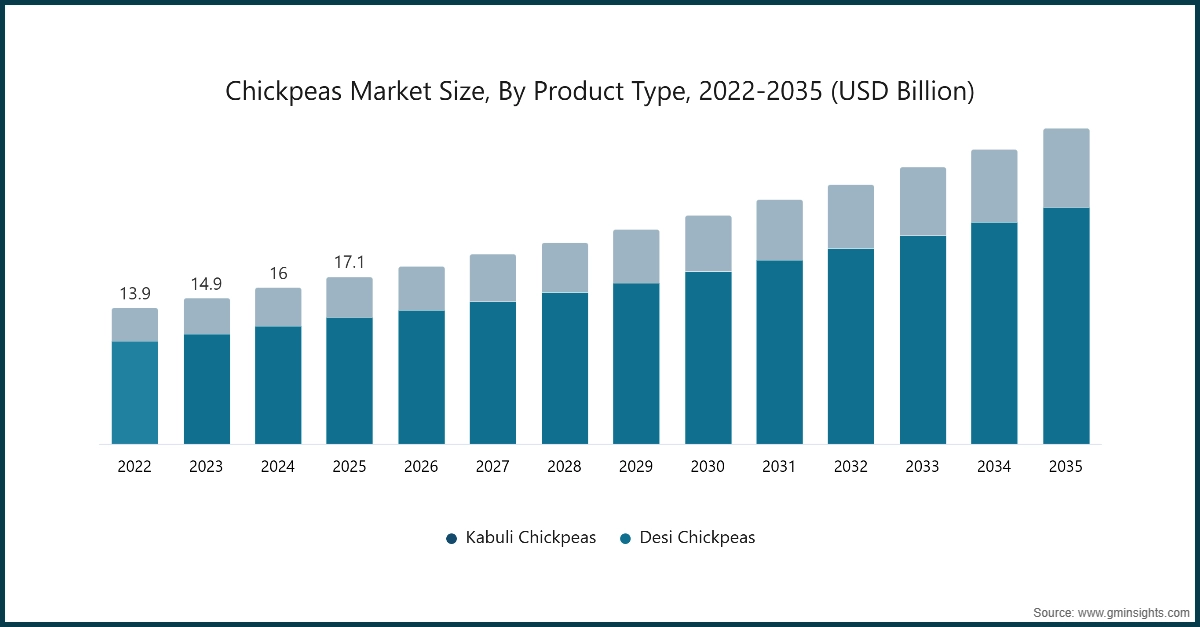
Based on product type, the market is segmented into kabuli chickpeas, desi chickpeas. Desi chickpeas dominated the market with an approximate market share of 75.2% in 2025 and is expected to grow with a CAGR of 6.5% by 2035.
- The global market for kabuli chickpeas is seeing rising demand because of their large size and mild taste and multiple cooking applications. Middle Eastern and Mediterranean and Western markets choose these chickpeas as their preferred ingredient for making hummus and salads and snack products. Kabuli chickpeas are increasingly popular among consumers who prefer healthy protein sources which lead to retail and food service growth and drives farmers and suppliers to increase their production and distribution networks.
- The Indian and South Asian food traditions use Desi chickpeas which have smaller dimensions and darker coloration and stronger taste characteristics. The demand for Desi chickpeas remains steady because these beans serve as a traditional ingredient for making chana masala and roasted chickpeas snacks. The market for Desi chickpeas grow because of the rising local consumption and growing export possibilities.
Learn more about the key segments shaping this market
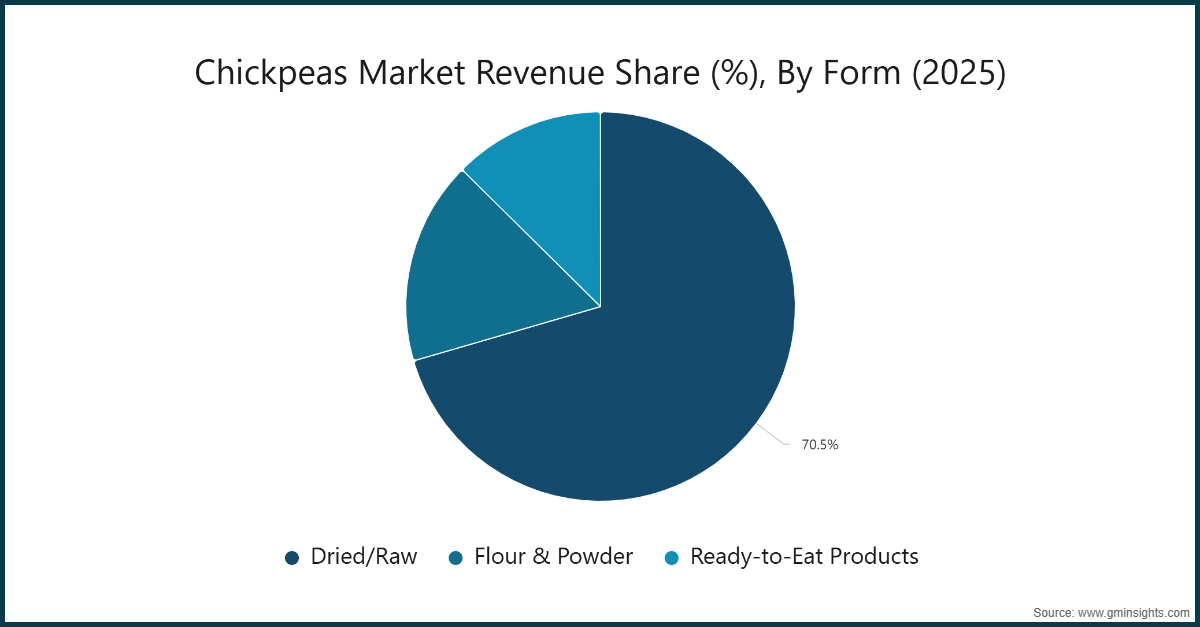
Based on form, the chickpeas market is segmented into dried/raw, flour & powder, ready-to-eat products. Dried/raw held the largest market share of 70.5% in 2025 and is expected to grow at a CAGR of 6.6% during 2026-2035.
- Companies that produce chickpeas for eating in their dried and raw forms see their business expand because consumers prefer to buy products which contain only natural ingredients that undergo minimal processing. People who want to cook at home increasingly choose dried chickpeas as their preferred ingredient because those customers particularly focus on health within their buying decisions. The rise of vegetarian and vegan diets creates benefits for this market segment because dried chickpeas serve as a flexible source of plant-based protein and fiber content. Farmers and suppliers have chosen to implement sustainable farming methods which lead to better environmental protection while they construct new storage and processing facilities to achieve both product excellence and constant product distribution.
- The market for chickpea-based products like flour, powder, and ready-to-eat items is also expanding rapidly. People are increasingly using chickpea flour, which is also known as besan, because it serves as a gluten-free ingredient that works well for baking and making snacks and traditional dishes. The ready-to-eat chickpea snacks and pre-cooked formulations have become more popular because they provide busy urban consumers with both health advantages and convenient eating options. The sales of chickpea products have grown because their packaging and flavoring methods and product formats have become better, establishing chickpea products as a major player in both functional and health food markets.
Based on nature, the chickpeas market is segmented into conventional and organic. Conventional segments dominated the market with an approximate market share of 86.6% in 2025 and is expected to grow with a CAGR of 6.6% by 2035.
- The chickpea market is experiencing a major transformation because consumers now understand how their choices impact both their health and the environment and the effectiveness of sustainable farming methods. Organic chickpeas, whether dried/raw or processed, are becoming more popular in premium markets because consumers prefer products that contain no chemicals and no genetically modified organisms. The organic segment is seeing rapid growth because both certification bodies and consumers who want clean-label foods have increased their demand for organic products which make organic chickpeas more appealing to international and domestic markets.
- Conventional chickpeas maintain their market dominance because they provide a cost-effective solution for consumers who prioritize budget-friendly products. These products are commonly used to make processed foods which include flour and ready-to-eat products because they offer cost savings and manufacturers have built reliable distribution networks. The organic market will experience more rapid expansion because consumers now choose healthier and sustainable products while stricter organic standards become mandatory. Both segments are essential for fulfilling different market requirements.
Based on application, the chickpeas market is segmented into food & beverages, animal feed, nutraceuticals, industrial/other. Food & beverages segments dominated the market with an approximate market share of 87% in 2025 and is expected to grow with a CAGR of 6.6% by 2035.
- Chickpeas have gained wider acceptance in the food and beverage industry because of their multiple cooking applications and health benefits and their ability to serve as a gluten-free ingredient. The food industry uses chickpeas as an ingredient in multiple products which include snacks and flour and protein bars and plant-based meat alternatives. The market demand for chickpea-based products has increased because consumers prefer plant-based diets and clean-label products which drive manufacturers to create new food items with improved flavor and packaging and convenient usage for health-focused buyers.
- Chickpeas have gained popularity as a sustainable protein source for livestock and poultry feed beyond their use in human food. The nutraceutical industry is also exploring chickpea extracts and powders for their antioxidant and health-boosting properties, which they use in dietary supplements. Chickpeas serve various purposes in industrial applications which include biodegradable packaging and adhesives and other non-food products because of the increasing demand for sustainable and plant-based raw materials. The growing range of applications across various industries creates new market possibilities for businesses.
Based on distribution channel, the chickpeas market is segmented into wholesale & direct sales, supermarkets & hypermarkets, specialty stores, online retail, convenience stores. Wholesale & direct sales segments dominated the market with an approximate market share of 44.4% in 2025.
- The chickpea market operates through wholesale and direct sales to provide bulk purchasing and long-term contracts which mainly serve food processors and traders and institutional buyers. The distribution system delivers cost benefits while maintaining consistent product availability for businesses that operate large-scale manufacturing and export operations. Wholesalers are expanding their distribution networks to meet growing chickpea demand, which strengthens supply chain efficiency for industrial and retail sectors.
- Supermarkets and hypermarkets function as essential retail channels to provide mass consumer access to their products. The company provides an extensive selection of chickpea products which include both raw pulses and packaged ready-to-cook items to satisfy consumer demand for health benefits. Specialty stores focus on organic, artisanal, and premium chickpea varieties, catering to niche markets. Online retail platforms are experiencing rapid growth, providing convenience and access to a broader customer base. Convenience stores have begun to increase their inventory of ready-to-eat chickpea snacks and small-packaged pulses to match the needs of consumers who prefer portable food options.
Based on end user, the chickpeas market is segmented into food processors & manufacturers, household/retail consumers, food service operators, institutional buyers. Food processors & manufacturers segments dominated the market with an approximate market share of 47.3% in 2025 and is expected to grow with a CAGR of 6.3% by 2035.
- Market growth for chickpeas is driven by rising consumer health and nutrition knowledge. Food processors and manufacturers are expanding their product lines to include chickpea-based snacks, flour, and ready-to-eat meals, fueling demand across various sectors. Plant-based diet adoption and gluten-free product demand both result in increased chickpea usage for creating new food products. The rise of healthy eating and vegetarian lifestyles has led more people to buy chickpeas for their home cooking needs. Online retail platforms make it easier for customers to buy chickpeas, which helps to support this trend.
- Food service operators and institutional buyers such as restaurants, cafes, and catering services add to market expansion through their use of chickpeas in their various menu offerings. The two sectors will keep increasing their demand because consumers want healthy ingredients that serve multiple purposes. The market trend shows consistent growth, which results from two main factors: health-conscious consumers and innovative product development which occurs in retail and food service and industrial sectors.
Looking for region specific data?
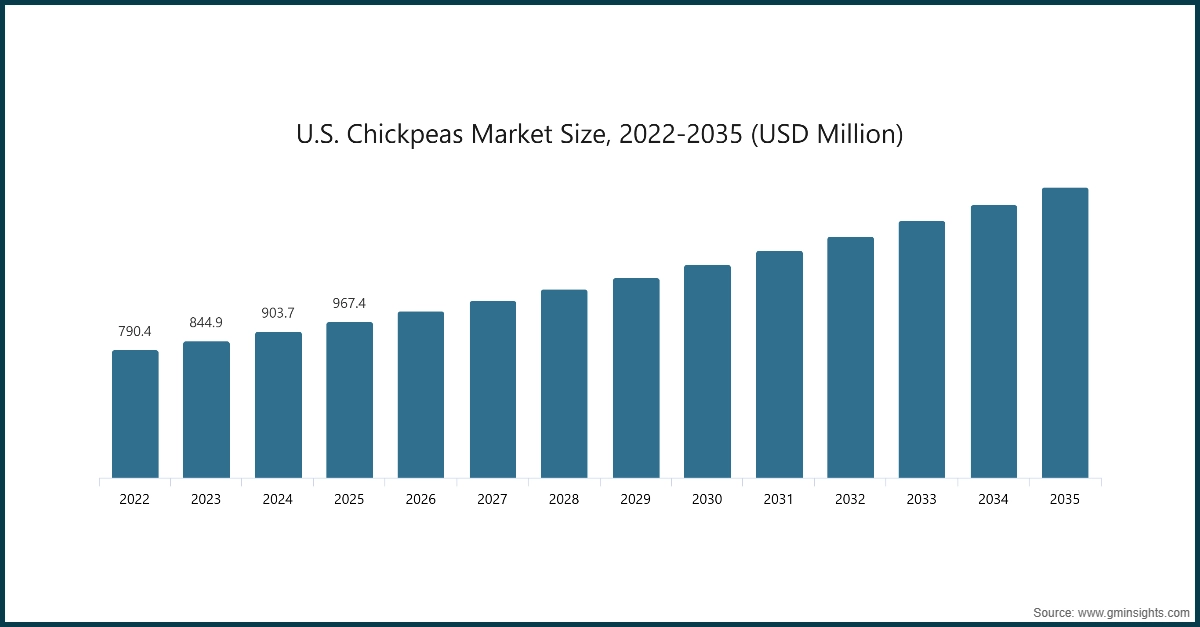
The North America chickpeas industry is growing rapidly on the global level with a market share of 7.1% in 2025.
- The North American market for chickpeas keeps expanding because more people learn about health benefits of their plant-based dietary choices. The U.S. and Canada serve as the main markets which show increasing needs for chickpea snacks and hummus and gluten-free items. The market expansion receives support from established food processing industries and the strong retail industry which exists in the region. The region experiences rising demand growth because more people choose vegan and vegetarian dietary practices. The distribution network expansion together with product innovations will maintain North American market growth.
Europe chickpeas market leads the industry with revenue of USD 859.9 million in 2025 and is anticipated to show lucrative growth over the forecast period.
- The European market shows strong growth because people want to improve their health and choose sustainable vegetarian diets. The UK, Germany and France lead European markets for chickpea products which include hummus and snacks and gluten-free foods. The region shows increasing demand for high-quality natural chickpeas because people prefer organic and clean-label products. Mediterranean cuisine has grown in popularity which creates market expansion opportunities. Market development receives support from strict food safety regulations and the rise of retail chains which offer organic and healthy products.
The Asia Pacific market is anticipated to grow at a CAGR of 6.6% during the analysis timeframe.
- The chickpeas market in Asia Pacific shows major growth potential because the region has a large population base which continues to grow through urbanization. The major markets for chickpeas include India, China and Australia because these countries use the ingredient in traditional dishes while its health benefits become more well-known. The rising disposable incomes and changing dietary preferences towards plant-based proteins are boosting demand. The retail sector and online food channels both expand their operations, which allows more people to access products. The region shows growth potential because its people support sustainable farming methods and organic product development.
Latin America chickpeas accounted for 3.7% market share in 2025 and is anticipated to show steady growth over the forecast period.
- The chickpeas market in Latin America is growing steadily because people change their eating habits and begin to understand the benefits of healthy food. The retail and foodservice markets in Brazil and Mexico and Argentina show increased demand for chickpeas. More people are now consuming traditional dishes that contain chickpeas which has led to market growth through vegetarianism. Local producers are also investing in improved cultivation techniques to meet rising demand.
Middle East & Africa chickpeas accounted for 8.5% market share in 2025 and is anticipated to show lucrative growth over the forecast period.
- Chickpeas have remained an essential food item throughout the MEA region since their introduction to Middle Eastern nations. The market shows consistent demand because people still follow their usual eating habits while they become more interested in healthy food options. The rising urban population together with more retail and supermarket stores enables people to find chickpeas. The market will expand because the region promotes sustainable agriculture together with organic farming practices. The popularity of chickpea-based dishes like hummus and falafel continues to promote demand, making MEA a promising region for market expansion.
Chickpeas Market Share
The top 5 companies in chickpeas industry include ADM (Archer Daniels Midland), AGT Food & Ingredients Inc., Ingredion Incorporated, ETG Group, Ardent Mills. These are prominent companies operating in their respective regions covering approximately 15.6% of the market share in 2025. These companies hold strong positions due to their extensive experience in chickpeas market. Their diverse product portfolios, backed by robust production capabilities and distribution networks, enable them to meet the rising demand across various regions.
- ADM holds the position of worldwide agricultural processing leader by using its complete supply chain and advanced processing facilities and high-performing distribution system to obtain a large portion of the chickpea industry. The company develops plant-based and gluten-free products through its innovative product development which includes production of chickpea flour and protein concentrates. ADM gains market advantage through its sustainable sourcing investments and international presence which enable the company to reach important markets in North America and Europe and Asia Pacific.
- AGT Foods company specializes in processing pulses and grains, with its expertise focused on chickpea processing. The company delivers top-grade products through its strong supply network which enables it to maintain constant product quality for all international markets. The online product catalog of AGT includes whole chickpeas, splits of chickpeas, and chickpea flour which the company sells to food producers and stores and dining establishments. The company achieves its competitive edge through its strategic locations in major chickpea-growing areas and its dedication to environmental-friendly sourcing.
- Ingredion serves as the top international provider of ingredient solutions through its delivery of plant-derived ingredients which include chickpea proteins and chickpea flour products. The company develops tailored solutions through its research and development programs which support food manufacturers in developing healthy and allergen-free functional ingredients. The distribution network of Ingredion operates throughout North America and Europe and Asia Pacific to deliver its products to multiple market segments.
- ETG company operates a major business in pulse processing which includes chickpeas while sourcing its products from primary farming regions. The company establishes its market advantage through its investments in processing technology and capacity expansion, which enable it to produce organic and specialty products. The company uses its regional business strength and quality focus to benefit from rising worldwide chickpea demand.
- Ardent Mills focuses on chickpea flour production, which serves the gluten-free and vegan markets and health-focused food sector, while it operates its flour and grain business. The company's extensive processing facilities and innovation focus enable it to develop tailored chickpea-based ingredients for various applications. The company achieves its competitive edge through its widespread North American distribution network and its active collaboration with food manufacturing companies.
Chickpeas Market Companies
Major players operating in the chickpeas industry include:
- ADM (Archer Daniels Midland)
- Agrocorp Processing Australia
- AGT Food & Ingredients Inc.
- Ardent Mills
- Avena Foods
- Bean Growers Australia
- Diefenbaker Spice & Pulse (DSP)
- ETG Group
- Grain Processing Corporation (GPC)
- Ingredion Incorporated
- MT Royal
- Nutriati Inc.
- Superior Pulses
- Vad Industries
Chickpeas Market Report Attributes
| Key Takeaway | Details |
|---|---|
| Market Size & Growth | |
| Base Year | 2025 |
| Market Size in 2025 | USD 17.1 Billion |
| Market Size in 2026 | USD 18.2 Billion |
| Forecast Period 2026-2035 CAGR | 6.5% |
| Market Size in 2035 | USD 32.2 Billion |
| Key Market Trends | |
| Drivers | Impact |
| Rising global demand for plant-based proteins | Increasing consumer preference for vegetarian and vegan diets is boosting chickpea consumption as a plant-based protein source. |
| Health benefits and nutritional value | Chickpeas are rich in fiber, protein, vitamins, and minerals, driving demand among health-conscious consumers. |
| Expanding food processing and snack industry | Growing popularity of chickpea-based products like flour, snacks, and ready-to-eat meals enhances market expansion. |
| Pitfalls & Challenges | Impact |
| Limited Crop Yield and Agricultural Challenges | Poor agronomic practices, pests, and climate change affect chickpea production, leading to supply constraints. |
| Opportunities: | Impact |
| Development of value-added products | Innovation in chickpea-based products such as gluten-free flours, protein powders, and snacks can open new markets. |
| Sustainable and organic farming practices | Promoting organic and sustainable cultivation can attract premium segments and meet growing environmental concerns. |
| Market Leaders (2025) | |
| Market Leader |
4.5% |
| Top Players |
Collective Market Share of 15.6% in 2025 |
| Competitive Edge |
|
| Regional Insights | |
| Largest Market | Asia Pacific |
| Fastest growing market | Europe |
| Emerging countries | Germany, UK, Italy |
| Future outlook |
|
| Companies covered: | 14 |
| Tables, Charts & Figures: | 205 |
| Countries covered: | 18 |
| No of Pages: | 190 |
What are the growth opportunities in this market?
Chickpeas Industry News
- In October 2025, AGT Food & Ingredients has invested USD 3.1 million in Chickapea, a Canadian brand specializing in organic chickpea pasta and products. This strategic investment aims to support Chickapea’s expansion across North America by boosting production capacity and enhancing distribution. The partnership aligns with AGT’s focus on high-quality pulses and sustainable sourcing. The investment will help Chickapea meet rising consumer demand for plant-based, gluten-free, and organic foods. Overall, this move strengthens AGT’s position in the healthy snack and pulse market while supporting Chickapea’s growth in North American markets.
- In April 2022, Tate & Lyle PLC, a notable ingredient supplier, acquired a significant portion of the assets belonging to Nutriati, based in Richmond, Va. Nutriati specializes in the development and production of chickpea-based ingredients, notably marketed under the Artesa brand.
This chickpeas market research report includes in-depth coverage of the industry, with estimates & forecasts in terms of revenue (USD Billion) and volume (Kilo Tons) from 2026 to 2035, for the following segments:
Market, By Product Type
- Kabuli chickpeas
- Desi chickpeas
Market, By Form
- Dried/raw
- Flour & powder
- Ready-to-eat products
Market, By Nature
- Conventional
- Organic
Market, By Application
- Food & beverages
- Home cooking/traditional meals
- Ready meals & prepared foods
- Bakery & confectionery
- Snacks & savories
- Plant-based protein products
- Others
- Animal feed
- Nutraceuticals
- Industrial
Market, By Distribution Channel
- Wholesale & direct sales
- Supermarkets & hypermarkets
- Specialty stores
- Online retail
- Convenience stores
Market, By End User
- Food processors & manufacturers
- Household/retail consumers
- Food service operators
- Institutional buyers
The above information is provided for the following regions and countries:
- North America
- U.S.
- Canada
- Europe
- Germany
- UK
- France
- Spain
- Italy
- Rest of Europe
- Asia Pacific
- China
- India
- Japan
- Australia
- South Korea
- Rest of Asia Pacific
- Latin America
- Brazil
- Mexico
- Argentina
- Rest of Latin America
- Middle East and Africa
- Saudi Arabia
- South Africa
- UAE
- Rest of Middle East and Africa
Frequently Asked Question(FAQ) :
What is the market size of the chickpeas in 2025?
The market size was USD 17.1 billion in 2025, with a CAGR of 6.5% expected through 2035, driven by rising consumer preference for plant-based proteins, growing health awareness, and expanding demand for gluten-free and non-GMO food products.
What is the projected value of the chickpeas market by 2035?
The chickpeas market is expected to reach USD 32.2 billion by 2035, propelled by innovation in value-added chickpea products, expanding applications in snacks and plant-based alternatives, and growing adoption of sustainable and organic farming practices.
What is the current chickpeas market size in 2026?
The market size is projected to reach USD 18.2 billion in 2026.
Which product type dominates the chickpeas market?
The desi chickpeas segment dominated the market with an approximate market share of 75.2% in 2025 and is expected to grow at a CAGR of 6.5% through 2035, supported by steady demand from Indian and South Asian food traditions and rising export opportunities.
Which form segment leads the chickpeas market?
The dried/raw segment held the largest market share of 70.5% in 2025 and is expected to grow at a CAGR of 6.6% during 2026–2035, driven by consumer preference for minimally processed natural ingredients and growing adoption of home cooking among health-conscious buyers.
Which application segment dominates the chickpeas market?
The food and beverages segment dominated the market with approximately 87% share in 2025 and is expected to grow at a CAGR of 6.6% through 2035, fueled by rising demand for chickpea-based snacks, flour, protein bars, and plant-based meat alternatives.
Which end user segment leads the chickpeas market
The food processors and manufacturers segment dominated with approximately 47.3% market share in 2025 and is expected to grow at a CAGR of 6.3% through 2035, driven by expanding product lines including chickpea-based snacks, flour, and ready-to-eat meals across retail and industrial sectors.
What are the key trends shaping the chickpeas market?
Key trends include innovation in chickpea-based snacks and plant-based dairy alternatives, and increasing emphasis on sustainable nitrogen-fixing crop cultivation to improve soil health and reduce synthetic fertilizer use.
Who are the key players in the chickpeas market?
Key players include ADM (Archer Daniels Midland), Agrocorp Processing Australia, AGT Food & Ingredients Inc., Ardent Mills, Avena Foods, Bean Growers Australia, Diefenbaker Spice & Pulse, ETG Group, Grain Processing Corporation, Ingredion Incorporated, MT Royal, Nutriati Inc., Superior Pulses, and Vad Industries.
Chickpeas Market Scope
Related Reports