Summary
Table of Content

Chemical Recycling Catalysts Market
Get a free sample of this report
Form submitted successfully!
Error submitting form. Please try again.
Thank you!
Your inquiry has been received. Our team will reach out to you with the required details via email. To ensure that you don't miss their response, kindly remember to check your spam folder as well!
Request Sectional Data
Thank you!
Your inquiry has been received. Our team will reach out to you with the required details via email. To ensure that you don't miss their response, kindly remember to check your spam folder as well!
Form submitted successfully!
Error submitting form. Please try again.
Chemical Recycling Catalysts Market Size
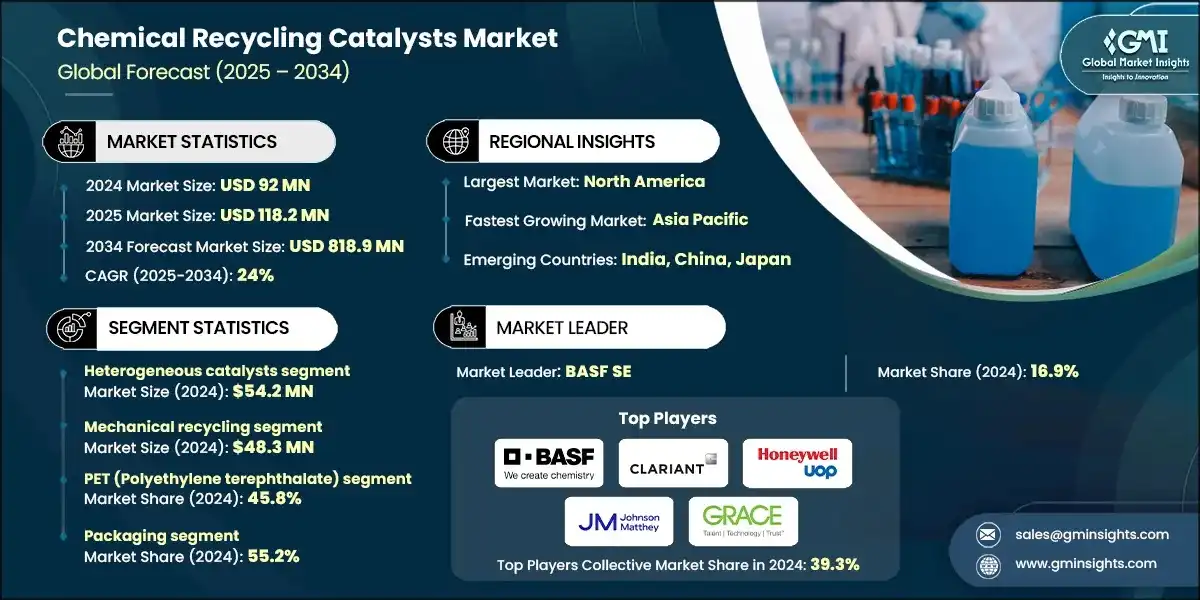
The global chemical recycling catalysts market was valued at USD 92 million in 2024. The market is expected to grow from USD 118.2 million in 2025 to USD 818.9 million in 2034, at a CAGR of 24%, according to the latest report published by Global Market Insights Inc.
Chemical Recycling Catalysts Market Key Takeaways
Market Size & Growth
- 2024 Market Size: USD 92 Million
- 2025 Market Size: USD 118.2 Million
- 2034 Forecast Market Size: USD 818.9 Million
- CAGR (2025–2034): 24%
Key Market Drivers
- Rapid innovation in catalyst and recycling technologies.
- Expansion of polymer use in high growth end use sectors.
- Growing regulatory pressure and sustainability mandates across industries.
Challenges
- High capital and operational costs.
- Feedstock variability and contamination issues.
Opportunity
- Development of multi-feedstock catalysts.
- Integration with renewable energy and green chemicals.
- Emerging markets with growing plastic consumption.
Key Players
- Leading Players: Top 5 players in this market include BASF SE, Clariant AG, Honeywell UOP, Johnson Matthey Plc, Grace Catalysts Technologies, which collectively held a market share of 39.3% in 2024.
Get Market Insights & Growth Opportunities
- Chemical recycling catalysts are specific compounds that facilitate chemical reaction transformations for breaking down waste polymers and plastics to original monomers or other useful compounds. Chemical recycling works differently than mechanical recycling, as it does not physically treat the waste plastics but uses catalysts to renew or change material at a molecular level so that it can be effective in high-quality feedstock recovery. These catalysts have been developed to augment reaction efficiency, selectivity, and sustainability, forming a very foundation for advanced recycling technologies.
- Development of chemical recycling catalysts market is catered by technological shift in waste management and circular economy strategies. Conventional recycling usually leads to downcycled products of lesser quality, whereas chemical recycling with the help of effective catalysts allows for nearly full restoration of material properties. This shift is due to increasing environmental awareness, stricter regulations, and the search for sustainable solutions for the plastics industry.
- Chemical recycling catalysts lower the amount of the energy required by chemical reactions that break the bonds in polymers. Depending on the composition of these catalysts, pyrolysis, hydrolysis or depolymerization occur. Metal catalysts provide active sites for bond-cleavage reactions and therefore, accelerate the reactions. Acid-base catalysis, in contrast, will promote hydrolytic cleavage or the esterification process. A new classification of catalysts is relative to the parameter of high yield, selectivity toward the desired product, and mild conditions to minimize energy consumption and environmental impact.
To get key market trends
Chemical Recycling Catalysts Market Trends
- The chemical recycling catalyst market is growing due to the increasing focus on sustainable and circular economy principles. Industries have come forward to invest in advanced catalysts using valuable chemicals, monomers, or fuels converting post-consumer plastics and mixed waste streams, thereby reducing the dependency in virgin fossil-based resources and operating under sustainable conditions.
- Technological developments in catalyst design are enhancing the catalysis efficiency, selectivity, and lifespan, and there are multi-feedstock catalysts becoming available that can process heterogeneous and contaminated plastic streams. These progressions put chemical recycling economically viable and largescale, resolving one of the major challenges in handling plastic waste.
- Rising demand for recycled chemicals and polymers is noted in industries such as packaging, that is driven by corporate sustainability goals and in compliance with emerging regulations. This trend further open collaboration between catalyst manufacturers, recycling industry stakeholders and end-use industries for comparability on quality and supply in recycled outputs.
- Supporting government policies which include waste management regulations, mandates to recycle and incentives for sustainable technology are likely to speed up the market growth with an augmentation of increasing private investments in commercially scaled plants. Competition-based businesses would be aligned with the establishment of high-performance chemical recycling catalysts.
Chemical Recycling Catalysts Market Analysis
Learn more about the key segments shaping this market
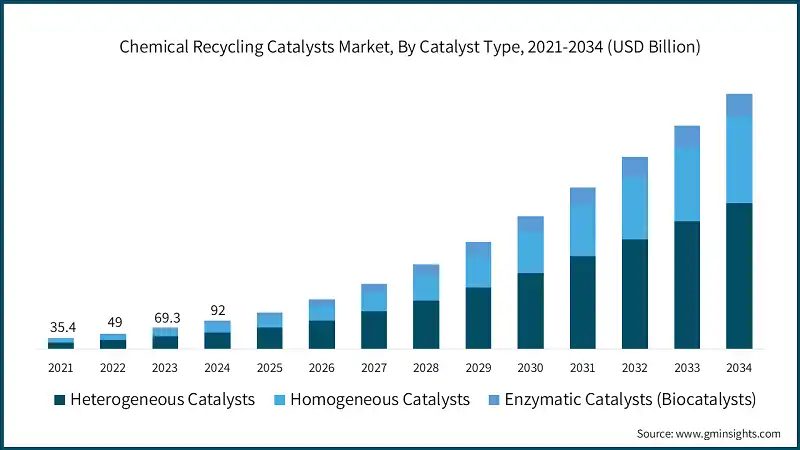
The chemical recycling catalysts market by catalyst type is segmented into heterogeneous catalysts, homogeneous catalysts and enzymatic catalysts (biocatalysts). Heterogeneous catalysts hold the largest market value of USD 54.2 million in 2024.
- Heterogeneous catalysts are most preferred catalytic techniques, primarily because of their stability, low-cost ease of separation, and high utility in industrial processes, such as refining, petrochemicals, and emissions control. Homogeneous catalysts are important catalysts regarding their use in highly selective reactions, such as those for fine chemicals and pharmaceuticals. However, their growth is usually restricted by the difficulties of separating them from the reaction product and the relatively high cost of homogeneous catalytic processes as compared to solid catalysis.
- Biocatalysts or enzymatic catalysts are popular because of their sustainability trends they perform in mild conditions and produce fewer by-products and thus align with green chemistry and circular economy principles. Advancements in biotechnology such as protein engineering and immobilizing enzymes make them much more efficient and robust towards industrial application. Owing to their expanding use in pharmaceuticals, bio-based chemicals, and environmental processes, enzymatic catalysts are envisaged to become that segment with the highest growth potential.
The chemical recycling catalysts market by process is segmented into pyrolysis catalysts, depolymerization catalysts, gasification catalysts and solvolysis catalysts. Mechanical recycling holds the largest market value of USD 48.3 million in 2024.
- The pyrolysis catalysts are, commonly used to break down plastics, biomass, and other feedstocks into oils, gases, and char. They are appreciated for their versatility and ability to enhance product yields and selectivity for large-scale industrial processes. Gasification catalysts are used for the conversion of biomass or waste into syngas, whereby this syngas may be treated further to give energy and chemical products. Both are of industrial importance, but their growth is fairly steady as these technologies are quite mature and widely applied.
- Depolymerisation and solvolysis catalysts are the fastest-growing segment of chemical recycling and sustainable materials management due to their ability to break down polymers into monomers under relatively mild conditions and hence obtaining products of high purity that may be reprocessed into new products. Improvements in catalyst design and processing have allowed an even more efficient and cost-effective application of these technologies, promoting even more applications in circular economy initiatives and high-value plastics in recycled plastics and specialty polymers.
Based on polymer type, the chemical recycling catalysts market is segmented into PET (Polyethylene terephthalate) catalysts, polyolefin (PE/PP) catalysts, polystyrene (PS) catalysts, mixed plastics catalysts, specialty polymer catalysts. PET (Polyethylene terephthalate) catalysts hold the highest market share of 45.8% in 2024.
- Catalysts for PET (polyethylene terephthalate) are growing significantly, as it is used for packaging and textiles, with much focus on recycling PET back to high-quality monomers. These chemical recycling processes-glycolysis or hydrolysis-require a catalyst to break PET efficiently under mild conditions to reuse it as new products. Also, polyolefin catalysts (for polyethylene and polypropylene) are important in the production and emerging chemical recycling processes. Innovations in these catalysts helps in breaking down polyolefin waste materials into reusable hydrocarbons to support sustainability and circular economy initiatives.
The demand for polystyrene catalysts is growing more slowly since the chemical recycling routes for PS are limited, thus demand is niche and specialized. Mixed plastics catalysts are growing in importance due to the difficulty of recycling waste streams with multiple polymer types. These catalysts facilitate the more effective recycling of heterogeneous plastic waste, which is an increasing need. Specialty polymer catalysts enjoy steady growth but on a smaller scale, as their application is more limited contrary to mainstream plastics.
Learn more about the key segments shaping this market
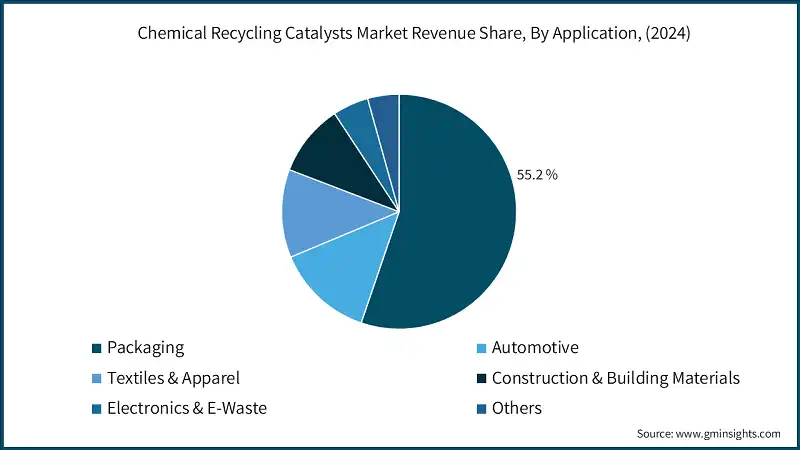
The chemical recycling catalysts market by application is segmented into packaging, automotive, textiles & apparel, construction & building materials, electronics & e-waste and others. Packaging holds the highest market share of 55.2 % in 2024.
- Packaging and Automotive increases the demand for catalysts, since plastics are very widely used in bottles, containers, and flexible packaging. There is a focus on promoting recycling and sustainable materials, that is why chemical recycling and depolymerization processes are fuelling the demand for high-performing catalysts. Automotive applications are equally important, with catalysts supporting fuel-efficient polymer production and recycling of plastics end of life.
- The textile and garment segment benefits from recycling of PET fibers and other synthetic fabrics, supporting circularity in the fashion industry. In the case of construction and building materials, polymers take the support of certain catalysts for production and even for recycling, accumulating a significant demand pull. Electronics and e-waste are showing growth as catalysts help in recovering high-value polymers and materials from discarded gadgets. In the case of "Others," it refers to materials with infrequent applications, as catalysts play growing roles while attuned to specific industrial or consumer needs.
Looking for region specific data?
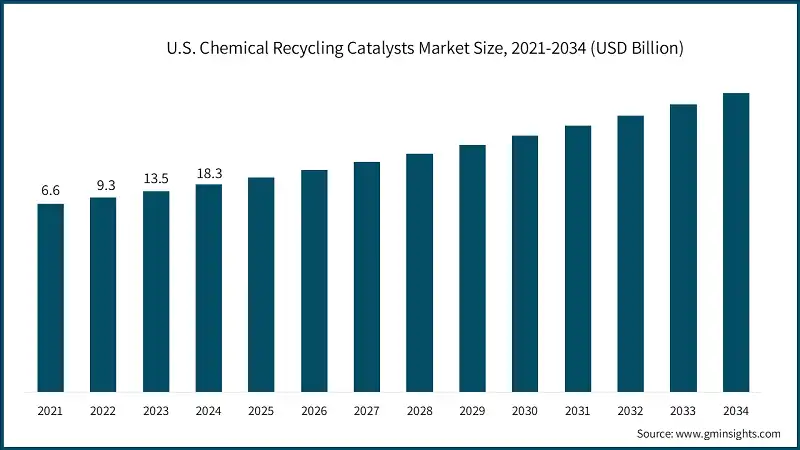
The U.S. chemical recycling catalysts market accounted for USD 18.3 million in 2024.
- In North America, chemical recycling catalysts have been adopted in industrial and research settings to improve recycling efficiency. The U.S. and Canada are interested in supporting pilot and commercial-scale materials-from-plastics projects that use catalysts. Partnerships between industry and research bodies will lead to further enhancements of catalyst technologies. Regulatory frameworks will stimulate recycling and waste reduction, thereby indirectly supporting catalyst adoption.
The market in the Germany is expected to experience significant growth from 2025 to 2034.
- In Europe, chemical recycling catalysts are part of the strategies to manage plastic waste in industrial operations. Germany, Netherlands, and France are involved in R&D activities to raise the level of catalyst performance and recycling process efficiency. The region supported sustainable practices through regulatory frameworks and policies. Industrial clusters are looking at integrating catalytic recycling into existing chemical and manufacturing processes.
The chemical recycling catalysts market in China is expected to experience notable growth from 2025 to 2034.
- The countries in the Asia-Pacific region (China, Japan, and South Korea) are gradually adopting chemical recycling catalysts to manage plastic wastes and promote circularity. China is directed toward developing recycling infrastructure and pursuing other catalyst-based depolymerization projects. This in Japan and Korea deals with a research focus on improving catalyst efficiency and process selectivity. Regional governments promote recycling through various policies and incentives. Companies work by integrating catalytic recycling methods within existing industrial processes to optimize resource recovery.
UAE market is expected to experience promising growth from 2025 to 2034.
- The chemical recycling catalysts market is growing in the Middle East and Africa as countries are facing plastic waste challenges thus aims toward sustainable resource approaches. Rapid urbanization and increasing industrial activities are demanding efficient waste management solutions, while the lack of proper infrastructures for conventional recycling makes chemical recycling very attractive. Catalysts help in converting mixed or hard-to-recycle plastics into valuable feedstocks, thus offering economic and environmental advantages.
Brazil chemical recycling catalysts market is expected to experience growth from 2025 to 2034.
- Adoption of chemical recycling catalysts is gathering momentum as countries increasingly find themselves under the pressure to sustainably manage the issue of plastic waste. The companies are looking at catalytic options whereby mixed or contaminated plastics can be converted into reusable feedstocks without the limitations of conventional recycling. Local startups and industrial players exploring novel catalytic methods are being further egged on by active government policies fronting circular economy investments.
Chemical Recycling Catalysts Market Share
- Chemical recycling catalysts markets are moderately consolidated with players like BASF SE, Clariant AG, Honeywell UOP, Johnson Matthey Plc, Grace Catalysts Technologies holding 39.3% market share and BASF SE being the market leader holding the market share of 16.9 % in 2024.
- The major players which are involved in the chemical recycling catalysts sector will continuously invest in catalyst development and process innovation. The progress made in enzymatic and chemical depolymerization, combined with customized catalyst formulations, enables recyclers to handle mixed and contaminated plastics more effectively. This results in better product yield and quality, allowing the firms to deliver very high purity monomers and feedstocks to the downstream chemical and polymer industries. Companies that invest in optimizing these technologies can also operate cost-effectively and meet the rising demand for circular feedstock.
- Forming strategic partnerships and collaborations in an effect are the ones that really define the competitive playing field. More firms are connecting through industrial manufacturers, consumer goods brands, and local authorities for the purpose of having reliable feedstock streams, developing compatible recycling solutions, and considering integrating recycled output into current production systems.
- Sustainability and circular economy initiatives remain the relevant competition drivers. Companies reshape processes to reduce energy demand, emissions, and waste. Companies that end up proving tangible environmental benefits through recycling will improve on their reputational value, thereby making them attractive to more investors, fortifying their brand partnerships, and differentiating themselves in an increasingly demanding market.
- Consumer awareness and regulatory pressure continue to characterize market dynamics. Recycled monomers and chemical feedstocks now rank highest on the operational list of strategic priorities for companies dealing with sustainable and environmentally responsible supply chains.
- Plastic waste is becoming an issue with the circular practices. The consumers have opened new opportunities for catalytic recyclers in the expansion of collection networks and community recycling as value initiatives. Those integrating technology and sustainability with stakeholder engagement do best in this rapidly bridging market concerning long-term competitive advantage.
Chemical Recycling Catalysts Market Companies
Major players operating in the chemical recycling catalysts industry are:
- Agilyx Corporation
- Albemarle Corporation
- BASF SE
- Carbios
- Clariant AG
- Dow Inc.
- Eurecat
- Grace Catalysts Technologies (W.R. Grace & Co.)
- Haldor Topsoe A/S
- Honeywell UOP
- Ioniqa Technologies
- Johnson Matthey Plc
- Loop Industries
- PETRONAS Chemicals Group Berhad
- Plastic Energy
- SABIC
- Shell Plc
- TotalEnergies SE
- Tosoh Corporation
- ExxonMobil Corporation
- Zeolyst International
- Pyrowave
BASF SE is a pioneer in global chemical processing and has a strong presence in catalyst technologies for chemical and petrochemical processes. The company finds catalytic solutions for plastics depolymerization, refining, and environmental applications. By linking together R&D, pilot-scale testing, and industrial-scale deployment, BASF makes possible the efficient recycling of complex feedstocks and contributes to circular economy initiatives. Their focus is on high-purity outputs and scalable processes, which make them players in the transition towards sustainable chemical production.
Clariant AG is a specialty chemicals company within which these catalytic and adsorbent technologies are integrated for a sustainable and plastic-recycling chemical production. All the attention goes to those processes that can purify and recover valuable materials from mixed or contaminated waste streams to reintegrate them into existing industrial and production processes. With that focus, Clariant's strategic investment in energy efficiency, process optimization, and environmental sustainability further builds up its competitive position in chemical recycling and the circular economy solutions.
Honeywell UOP builds catalytic processes for the petrochemicals, refining, and chemicals recycling industry. A company driven by technology, which provides catalysts and operational solutions to turn waste plastics and complicated hydrocarbons into reusable feedstocks. Integration of technology development with process engineering and partnership with applicable industrial producers makes Honeywell UOP a world leader in efficiency, scalability, and sustainability in chemical recycling operations.
Johnson Matthey Plc specializes in the production of chemicals and sources expertise in catalysis, especially precious metals and industrial catalysts. It develops catalysts that speed up chemical reactions which are needed for refining, emission control, and chemical recycling processes. The company prides itself on innovation in sustainability, thus delivering materials that are friendly to the environment since they maximize recovery from waste for a circular economy across several sectors.
Grace Catalysts Technologies creates specific catalysts to serve the refining, petrochemical, and polymer industries, as well as niche applications in chemical recycling. The expertise behind these developments is hydro processing, polymerization, and depolymerization catalysts which enable high-performance operation and resource recovery.
Chemical Recycling Catalysts Market Report Attributes
| Key Takeaway | Details |
|---|---|
| Market Size & Growth | |
| Base Year | 2024 |
| Market Size in 2024 | USD 92 Million |
| Market Size in 2025 | USD 118.2 Million |
| Forecast Period 2025 - 2034 CAGR | 24% |
| Market Size in 2034 | USD 818.9 Million |
| Key Market Trends | |
| Drivers | Impact |
| Rapid innovation in catalyst and recycling technologies | Continuous research and development in catalyst design, enzymatic depolymerization, and chemical recycling processes are improving efficiency, yield, and scalability. These innovations enable more sustainable and cost-effective conversion of waste plastics into valuable chemicals and materials, driving market adoption across multiple industries. |
| Expansion of polymer use in high growth end use sectors | Polymers are increasingly used in sectors such as packaging, automotive, electronics, and construction due to their lightweight, durable, and versatile properties. This growing demand for polymer-based products boosts the need for advanced catalysts and recycling solutions to manage waste and enhance material recovery. |
| Growing regulatory pressure and sustainability mandates across industries | Governments and environmental agencies are implementing stricter regulations on plastic waste, carbon emissions, and sustainable manufacturing practices. Compliance with these mandates drives industries to adopt innovative catalytic and recycling technologies, accelerating market growth while promoting circular economy principles. |
| Pitfalls & Challenges | Impact |
| High capital and operational costs | Advanced catalytic and recycling technologies require significant investment in R&D, plant setup, and maintenance, which can be a barrier for small and medium players. |
| Feedstock variability and contamination issues | Chemical recycling catalysts are highly sensitive to the quality and composition of feedstocks. Mixed plastics, additives, and contaminants can reduce catalyst efficiency or cause deactivation. This inconsistency complicates process optimization and increases operational costs. |
| Opportunities: | Impact |
| Development of multi-feedstock catalysts | Catalysts that can handle mixed or contaminated plastics open opportunities for broader application and higher operational flexibility. |
| Integration with renewable energy and green chemicals | Chemical recycling processes powered by renewable energy or producing bio-based chemicals can enhance sustainability and market appeal. |
| Emerging markets with growing plastic consumption | Increasing plastic use in developing regions drives demand for chemical recycling solutions, which in turn increases the need for effective catalysts. |
| Market Leaders (2024) | |
| Market Leaders |
16.9 % |
| Top Players |
Collective market share of 39.3% in 2024 |
| Competitive Edge |
|
| Regional Insights | |
| Largest Market | North America |
| Fastest Growing Market | Asia Pacific |
| Emerging Country | India, China, Japan |
| Future Outlook |
|
What are the growth opportunities in this market?
Chemical Recycling Catalysts Industry News
- In May 2025, Honeywell announced that it plans to acquire Johnson Matthey's Catalyst Technologies business as part of a broader strategy to enhance the catalyst and process technology capabilities of its business. With this acquisition, Honeywell UOP widens its footprint across the refining, petrochemical, and renewable-fuel applications by leveraging the catalyst know-how and process-licensing expertise inherited from Johnson Matthey along with the company's global manufacturing footprint.
- In January 2024, Mastermelt Ltd., precious metal recovery specialist, completed two acquisitions, thus enhancing its position in the homogeneous catalyst recycling market. The company acquired IEX Technologies Ltd, which specializes in advanced ion exchange materials and pharmaceutical process solutions, and Green Lizard Technologies Ltd’s solvent distillation plant that allows safe and large-scale processing of hazardous catalyst solutions. These assets form the Mastermelt Homcat Recycling Centre of Excellence at the Wilton Centre in Teeside, UK, and provide integrated services in characterization, process design, and local processing.
The chemical recycling catalysts market research report includes an in-depth coverage of the industry with estimates and forecast in terms of revenue in USD Million and volume in terms of kilo tons from 2021–2034 for the following segments:
Market, By Catalyst Type
- Heterogeneous catalysts
- Zeolites (ZSM-5, USY, NaY, Beta)
- FCC catalysts
- Metal oxide catalysts
- Supported metal catalysts (Pt, Pd, Rh, Ni, Fe, Co, Ru)
- Homogeneous catalysts
- Metal acetates & salts
- Organometallic complexes
- Ionic liquids
- Organocatalysts
- Enzymatic catalysts (biocatalysts)
- PETases
- Cutinases
- Other esterases & lipases
Market, By Process
- Pyrolysis catalysts
- Depolymerization catalysts
- Gasification catalysts
- Solvolysis catalysts
Market, By Polymer Type
- PET (polyethylene terephthalate) catalysts
- Polyolefin (PE/PP) catalysts
- Polystyrene (PS) catalysts
- Mixed plastics catalysts
- Specialty polymer catalysts
- Nylon (polyamides)
- Polycarbonate
- Polyurethanes
- PVC
Market, By Application
- Packaging
- Automotive
- Textiles & apparel
- Construction & building materials
- Electronics & e-waste
- Others
The above information is provided for the following regions and countries:
- North America
- U.S.
- Canada
- Europe
- Germany
- UK
- France
- Spain
- Italy
- Rest of Europe
- Asia Pacific
- China
- India
- Japan
- Australia
- South Korea
- Rest of Asia Pacific
- Latin America
- Brazil
- Mexico
- Argentina
- Rest of Latin America
- Middle East and Africa
- Saudi Arabia
- South Africa
- UAE
- Rest of Middle East & Africa
Frequently Asked Question(FAQ) :
What is the market size of the chemical recycling catalysts market in 2024?
The market size was USD 92 million in 2024, with a CAGR of 24% expected through 2034 driven by rapid innovation in catalyst and recycling technologies.
What is the current chemical recycling catalysts market size in 2025?
The market size is projected to reach USD 118.2 million in 2025, supported by continuous advancement in catalyst efficiency and scaling up recycling operations in plastics and high-growth sectors.
What is the projected value of the chemical recycling catalysts market by 2034?
The chemical recycling catalysts industry is expected to reach USD 818.9 million by 2034, powered by process innovations, regulatory pressure for sustainability, and adoption across packaging, automotive, and electronics value chains.
How much revenue did the heterogeneous catalyst segment generate in 2024?
Heterogeneous catalysts generated USD 54.2 million in 2024, making them the preferred technology due to their stability, ease of separation, and versatility for industrial processes such as refining, petrochemicals, and emissions control.
What was the market size of the U.S. chemical recycling catalysts market in 2024?
The U.S. market was valued at USD 18.3 million in 2024. Growth is supported by rising adoption of advanced recycling technologies and increasing regulatory focus on circular economy practices.
What are the upcoming trends in the chemical recycling catalysts industry?
Key trends include multi-feedstock catalyst development, integration with renewable energy, increasing use of enzymatic and biocatalyst technologies, and expanding applications for mixed and specialty polymers in sustainable production.
Who are the key players in the chemical recycling catalysts market?
Key players include BASF SE, Clariant AG, Honeywell UOP, Johnson Matthey Plc, Grace Catalysts Technologies, Albemarle Corporation, Dow Inc., SABIC, Shell Plc, ExxonMobil Corporation, Zeolyst International, Carbios, and Pyrowave.
Chemical Recycling Catalysts Market Scope
Related Reports