Summary
Table of Content

Centrifugal Pumps Market
Get a free sample of this report
Form submitted successfully!
Error submitting form. Please try again.
Thank you!
Your inquiry has been received. Our team will reach out to you with the required details via email. To ensure that you don't miss their response, kindly remember to check your spam folder as well!
Request Sectional Data
Thank you!
Your inquiry has been received. Our team will reach out to you with the required details via email. To ensure that you don't miss their response, kindly remember to check your spam folder as well!
Form submitted successfully!
Error submitting form. Please try again.
Centrifugal Pumps Market Size
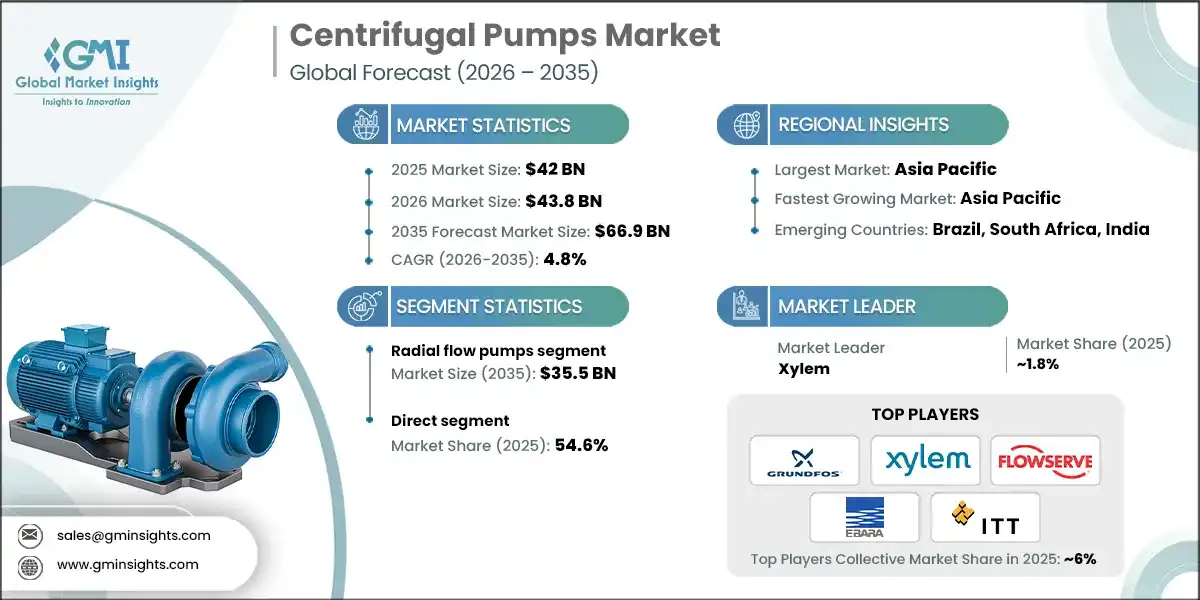
The global centrifugal pumps market was estimated at USD 42 billion in 2025. The market is expected to grow from USD 43.8 billion in 2026 to USD 66.9 billion in 2035 at a CAGR of 4.8% according to latest report published by Global Market Insights Inc.
To get key market trends
Due to the increased growth in urbanization and industrialization around the world, there is a massive increase in the need for water and wastewater treatment. Agriculture is responsible for approximately 70% of the total amount of freshwater used on a global scale, and industry utilizes approximately 20%, though this amount is growing rapidly as industry continues to expand throughout the world. Centrifugal pumps are used in many of these systems to help facilitate the movement of water in municipal water treatment plants and industrial facilities. Also, with nearly half the world's population beginning to face a severe water shortage at least part of the year, there is an ever-growing need for developing methods to reclaim and treat water. Thus, this driver demonstrates a growing trend of reducing the risk of using natural resources inefficiently as well as becoming more compliant with environmental regulations. The expected growth rate of approximately 50% for the need for water by 2030 creates a sense of urgency associated with developing ways to pump water more efficiently. Centrifugal pumps have been positioned as the primary means for transforming water infrastructure into a modernized entity due to their ability to pump high volumes of fluid at a relatively low cost.
Energy efficiency is now a centerpiece of industrial policy for many nations. Under the direction of the U.S. Department of Energy (DOE), manufacturers were asked in 2016 to begin designing, producing, and marketing Clean Water Pumps. More recently, the DOE has updated its Energy Conservation Standard for Clean Water Pumps for manufacturers to comply with the Clean Water Pump Energy Index (PEI) and has required manufacturers to develop new and improved products using less energy. Currently, pump systems consume approximately 40% of a facility's lifetime operating energy cost. Therefore, enhancing a facility's pump system efficiency will help a facility save on its operating costs throughout the life of the pump system. Because more businesses are focusing on sustainability, many companies are changing their purchasing strategies to improve the sustainability of their pump systems. Currently, based on studies, pump systems can achieve energy savings through improving both their designs and controls of 30%-50%. In addition to providing energy savings, this drive for increased energy conservation creates new opportunities for pump manufacturers to compete and thrive in this emerging marketplace.
Even with these ongoing trends towards energy transition, Oil & Gas continues to be a major contributor to world energy supply; oil & gas is projected to supply approximately 34% of total energy demand globally in 2024. Centrifugal Pumps play an essential role within both upstream/submerged drilling and downstream hydro-processing/refinery operations as the medium of transfer for crude oil, refined petroleum products, and water that is utilized for the drilling process. The IEA has indicated that upstream oil and gas activity will continue to receive investment, which will require a total increase in annual capital expenditures of USD 135 Billion by 2030 in order to maintain supply security. This indicator illustrates how the continued demand for hydrocarbons remains resilient, and continues to have a place within the world’s energy system; it illustrates the complexity associated with the handling of fluids used during the process of exploration and refinement of hydrocarbons. In terms of projected dimensions, total U.S. crude oil production is projected to average approximately 13.4 million barrels/day in 2025. With this high-level production anticipated, the need for large-capacity pumps will continue to exist for both the extraction and transportation of crude oil. As there will be a growing demand for petrochemical products, centrifugal pumps will continue to contribute to the reliability and efficiency of the entire process of manufacturing petrochemical products.
Centrifugal Pumps Market Report Attributes
| Key Takeaway | Details |
|---|---|
| Market Size & Growth | |
| Base Year | 2025 |
| Market Size in 2025 | USD 42 Billion |
| Market Size in 2026 | USD 43.8 Billion |
| Forecast Period 2026 - 2035 CAGR | 4.8% |
| Market Size in 2035 | USD 66.9 Billion |
| Key Market Trends | |
| Drivers | Impact |
| Rising Demand for Water and Wastewater Management | Accelerates adoption of high-capacity centrifugal pumps in municipal and industrial infrastructure, boosting global market penetration. |
| Energy Efficiency Regulations and Sustainability Mandates | Drives innovation toward advanced, energy-efficient pump designs, reshaping competitive dynamics and increasing premium product demand worldwide. |
| Expansion of Oil & Gas and Petrochemical Industries | Sustains strong demand for robust centrifugal pumps in upstream and downstream operations, reinforcing market growth in energy-intensive regions. |
| Pitfalls & Challenges | Impact |
| High Lifecycle and Maintenance Costs | Restrains adoption of advanced pump systems in cost-sensitive markets, limiting overall market expansion and modernization efforts. |
| Price Pressure from Low-Cost Manufacturers | Erodes profit margins for established players, reducing investment capacity for innovation and high-efficiency product development globally. |
| Opportunities: | Impact |
| Integration of IoT and Smart Monitoring Solutions | The adoption of IoT-enabled centrifugal pumps with predictive maintenance and real-time performance monitoring is gaining traction across industries. These smart solutions allow operators to optimize energy consumption, reduce downtime, and extend equipment life. |
| Expansion into Renewable Energy and Desalination Projects | Global investments in renewable energy (such as solar and wind farms) and large-scale desalination plants are increasing due to water scarcity and sustainability goals. Centrifugal pumps play a critical role in fluid handling for cooling systems, water circulation, and desalination processes. |
| Market Leaders (2025) | |
| Market Leaders |
Market share of ~1.8% |
| Top Players |
|
| Competitive Edge |
|
| Regional Insights | |
| Largest Market | Asia Pacific |
| Fastest growing market | Asia Pacific |
| Emerging countries | Brazil, South Africa, India |
| Future outlook |
|
What are the growth opportunities in this market?
Centrifugal Pumps Market Trends
Sustainability and digitalization have influenced the centrifugal pumps industry throughout the entire world, as there is now greater emphasis placed on both energy efficiency and smart technologies. more specifically, there is a growing push for using high-efficiency centrifugal pumps in combination with variable speed drive systems, supported through various government agencies including the United States government's department of energy as well as others, to help reduce energy consumption through increased life cycle cost saving (LCCS). Additionally, businesses and industries throughout the world are now utilizing IoT-enabled monitoring and predictive maintenance programme applications that are incorporated into centrifugal pumps that are intelligent assets which can enhance performance from increased efficiency and decrease unplanned downtime. this trend reflects resource efficiency and operational reliability. therefore, advanced centrifugal pumps are going to play a critical role in water management processes, industrial processing solutions, and energy infrastructure configurations.
- Recent advances in the field of industrial technology have seen the incorporation of IoT (Internet of Things) capabilities and sophisticated data analysis into centrifugal pump systems having both Sensor Data collection and Connection to External Networks. Consumers of these products (pumps) will be able to monitor the condition of their equipment (in real time) and be proactive regarding the maintenance of those products. Smart pumps utilizing variable-speed drives (VSD) in combination with Internet-based diagnostic tools enable the end-user to reduce energy utilization and minimize costly downtime. With the evolution of pumping technologies from mechanical devices to smart machines, there is significant opportunity to create service-based business model solutions (this shift is happening in all industries, but notably in wastewater treatment and oil & gas).
- Global energy efficiency mandates are prompting a seismic shift in pump design and selection due to regulatory and economic factors on a worldwide scale. As an example of this trend, the U.S. department of energy has developed a series of regulations requiring the development of pumps that meet or exceed designated energy performance indices (EPI). The regulations will create an opportunity for manufacturers to create high efficiency pump designs. In recent years there has been an increase in the use of variable speed pumping systems by industry to optimize flow rates and minimize energy costs. The adoption of variable speed pumping systems is not only favorable to the corporation's sustainability strategy, but they are now becoming a significant part of the strategy to reduce operational cost and carbon footprint by implementing energy-efficient pumping solutions.
- One of the many trends globally affecting the marketplace is the strategy of localizing supply chains as a means for mitigating risks from disruptions globally. The vulnerability of sourcing critical component parts, as evidenced by the shutdowns due to pandemics and geopolitical instability, has led pump manufacturers to consider investing in creating local production and/or partnership facilities in the respective regions to provide timely delivery and predictability of cost. For instance, companies that support projects through the Water Infrastructure sector in Asia-Pacific are establishing regional assembly plants to increase local market access while simultaneously decreasing dependence on imported products. The growing need for increased resilience and faster response times will continue to be a priority for end-users in industries with tight turnarounds for projects.
- Advanced composite materials and corrosion-resistant alloys are becoming increasingly popular in the manufacture of centrifugal pumps. The use of these types of materials extend the life of pumps, lessen maintenance costs, and improve the performance of pumps that deal with extreme conditions, such as chemical processing or the ocean environment of offshore oil platforms. Pumps made from engineered polymers or duplex stainless steels are being used more frequently in desalination and wastewater treatment systems where extensive exposure to hazardous fluids is involved. This evolution results in a greater degree of reliability and contributes towards sustainable practices by decreasing the number of replacement pumps and reducing the overall use of natural resources to produce replacements.
Centrifugal Pumps Market Analysis
Learn more about the key segments shaping this market
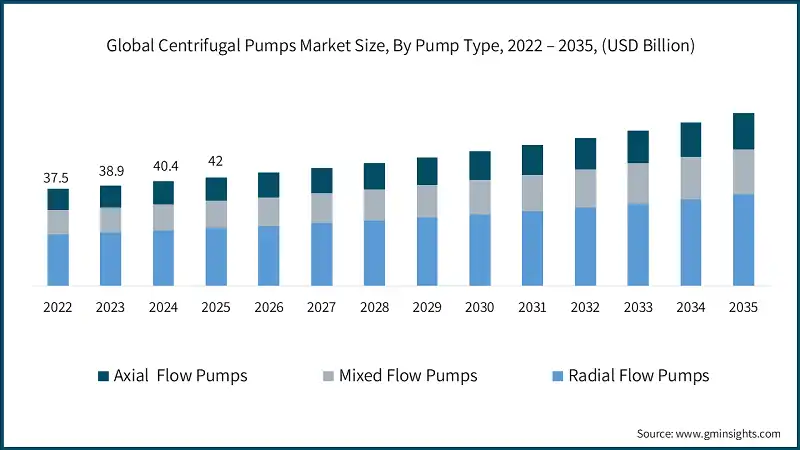
Based on the pump type, the market is segmented into axial flow pumps, mixed flow pumps, and radial flow pumps. The radial flow pumps segment was valued at USD 22.3 billion in 2025 and is projected to reach USD 35.5 billion by 2035.
- There are several reasons for the market dominance of radial flow pumps: primarily their ability to produce high pressures at relatively low flow rates. Radial flow pumps have many applications within the industrial community due to this high-pressure capability at low flow rates. While axial and mixed flow pump types are better suited for higher volume/low pressure applications, radial flow pump types are optimal for processes that require sustained pressure levels. Some of the industries that use radial flow pumps include chemical processing; water treatment; and boiler feed. Radial flow pumps also maintain their status as the top pump type for municipal water distribution systems, power generation plants, and oil and gas companies due to being extremely reliable with consistent pressure stability. An example of a radial flow pump application would be in the thermal power industry, where radial flow pumps continue to be the preferred choice for supplying high-pressure water to Boilers within these plants. Axial and mixed flow types of pump cannot efficiently provide this service due to their inherent design characteristics.
- Another reason for the dominance of radial flow pumps is that they are well-established as the only type used to pump many different types of fluids throughout the construction process in many types of infrastructure projects. As a result, radial flow pump sales are expected to continue to grow as infrastructure projects continue throughout the globe.
- Over the last few decades, advances in the radial flow pump design process through continuous innovation such as the introduction of variable speed drives as well as improved shapes and sizes of impellers have allowed radial flow pumps to operate much more efficiently while also providing better performance. Manufacturers are also focusing on developing new ways to improve the hydraulic design of the radial flow pump, thereby reducing overall energy consumption and improving overall life cycle cost based on the current global sustainability initiatives. These developments have not only provided additional value to radial flow pumps but have also made them the first choice of many industries for pumps with superior levels of performance and have secured their position as the leading centrifugal pump manufacturer in the world.
Learn more about the key segments shaping this market
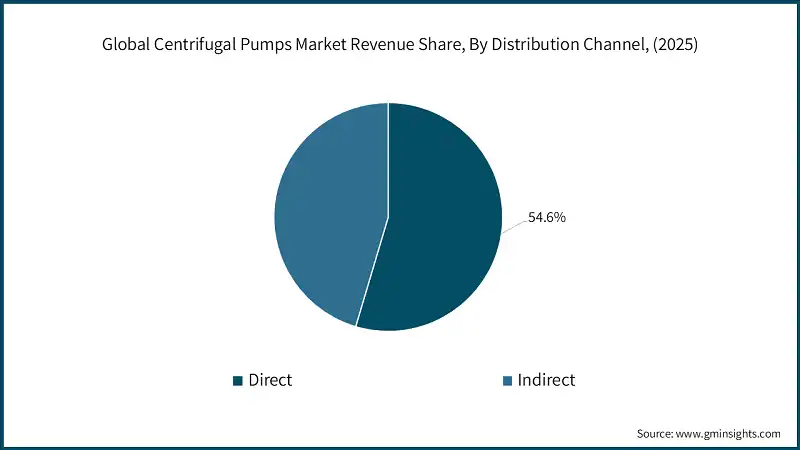
The centrifugal pumps market by distribution channel is segmented into direct and indirect. The direct segment was worth USD 23 billion and has a market share of around 54.6% in 2025.
- Because industrial pump buyers increasingly want customized pump solutions adapted to their specific needs, the majority of pump manufacturers still sell pumps directly to end-users. Buying directly provides end-users the ability to tell manufacturers what design features they want, what materials they prefer, and what performance parameters they want to achieve with their pumps, which ultimately leads to the greatest efficiency and reliability. The need for customized pump solutions is most important in industries such as oil and gas, power generation and water treatment, where many operational conditions can differ so greatly that standard product offerings are not able to meet those needs adequately.
- In addition, direct channels generally provide better technical support, installation assistance and after-sales service than do indirect channels. Buyers of high-value, high-reliability pump systems (such as centrifugal pumps) place a premium on reliability and lifecycle performance, and to achieve this, they need to work closely with pump manufacturers. By maintaining direct relationships with pump manufacturers, buyers can troubleshoot quickly and can integrate predictive maintenance into their day-to-day operations. Furthermore, end-users who buy from manufacturers directly have access to OEM spare parts, allowing for reduced downtime and less operational risk. This focus on the service aspect of buying from a manufacturer creates greater loyalty among customers and establishes a preference for purchasing items directly from a manufacturer versus an indirect channel.
- Big companies that build large factories or facilities typically order very large quantities of materials, and sign long-term contracts with suppliers to secure those materials at a lower cost than buying them one-by-one. The use of direct channels eliminates the need to deal with any middlemen; thus, allowing companies to negotiate for lower prices, favorable payment terms, delivery times, etc. As well as these pricing benefits, through direct channels, companies are able to communicate openly with the suppliers about the compliance with energy efficiency regulations and sustainability requirements on a global level. The combination of these benefits further strengthens the position of the direct distribution channel in the market.
Looking for region specific data?
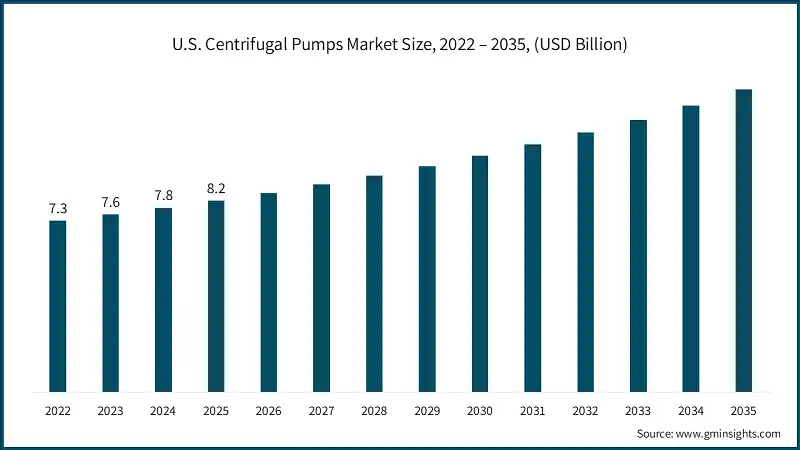
The U.S. centrifugal pumps market was valued at around USD 8.2 billion in 2025 and is anticipated to register a CAGR of 4.8% between 2026 and 2035.
- Due to the significant investments in America's infrastructure, the demand for centrifugal pumps in the United States will be on the increase unlike ever before along with the demand for more efficient ways to manage water. In fact, under the bipartisan infrastructure law that passed recently, $1.2 trillion worth of dollars are allocated toward projects that improve transportation and create jobs related to energy, climate-control, water utilities, and wastewater systems. According to the United States Geological Survey, public water supplies withdraw over 100 billion gallons of water from the ground annually, while industrial withdrawals (water used to cool and/or clean industrial processes) account for nearly 14,800 million gallons of water being used on any given day. This information indicates how much water is taken out for industrial purposes and therefore demonstrates how vital centrifugal pumps are in treating municipal water, cooling commercial industries, and water irrigation for agriculture. Also, as the world continues to grow into metropolitan cities and the workforce continues to grow, the demand for centrifugal pumps will also rise.
- Demand for oil and gas from the energy market continues to increase. U.S. crude oil production will reach a high-water mark in 2025 with an average of 13.5 million barrels per day, as reported by the U.S. energy information administration (EIA). Additionally, liquefied natural gas (LNG) exports from the U.S. are expected to grow by 10% within the next year (2026). As these markets continue to grow, there will be an increased need for high performance pump solutions to transport fluids through the entire life cycle of upstream and downstream oil and gas production operations. The Department of energy's energy efficiency standards for pumping systems, and the compliance requirements to meet these standards, are driving many oil and gas companies to seek out the latest technology for centrifugal pumping systems. Federal incentives to upgrade pumps to comply with these standards are providing additional incentives to pump manufacturers in the U.S. market. Collectively, these developments have driven the U.S. to be the fastest growing market for pumps in North America due to the continued growth of the infrastructure necessary for modernization, legislative requirements to support sustainable practices, and resilience in the energy marketplace.
The Asia Pacific centrifugal pumps market was valued at around USD 14.6 billion in 2025 and is anticipated to register a CAGR of 5.2% between 2026 and 2035.
- Asia and the Pacific continue to experience tremendous economic growth rates as well as urbanization, leading to large-scale infrastructure projects. There are currently two billion people throughout Asia Pacific region who do not have access to safe drinking water or proper sanitation according to ADB, thus, developing water infrastructure is one of the leading priorities for governments and private investors today. The structural deficit has been compounded by the growing impacts of climate change, including extreme weather events creating additional pressures on the limited supply of freshwater across the Asia and Pacific region. Therefore, ADB projects that in order for Asia to sustain economic growth and strengthen its resilience, it will need trillions of dollars invested in infrastructure, including water systems, over the next ten years. As such, due to the demographic pressures & the huge amounts of capital that will be invested into infrastructure, the Asia Pacific region will serve as the largest dynamic market for pumping solutions.
- The industrial and energy sectors in Asia are also increasing the demand for pumps. According to the U.S. energy information administration's international energy outlook, it is expected that Asia will account for almost 60% of the world's increase in energy demand from now until 2050, primarily due to continued income growth and the expansion of manufacturing operations. Nations such as China and India are investing significant amounts of money into their oil refining, petrochemical and LNG infrastructure, which will require high-capacity centrifugal pumps for process reliability and fluid handling. In addition, increased focus by countries in the region on improving their energy efficiency standards and modernizing their equipment will continue to support a sustained level of demand for advanced pump technology. The countries of Asia Pacific represent the majority of the world's economic growth and infrastructure development; therefore, centrifugal pumps will play a very important role in this continuing growth pattern.
Europe centrifugal pump market was valued at around USD 8.8 billion in 2025 and is anticipated to register a CAGR of 4.3% between 2026 and 2035.
- Aggressive sustainability targets and associated investments in climate-related projects support the continued growth of Europe. One of the most significant climate-related commitments made by the European Union is its legally binding commitment to replace 42.5% of its current energy consumption with renewable energy by the year 2030 and, by the year 2050, substantially reduce greenhouse gas emissions by 55% in comparison to the year 1990. These commitments lead Europe to modernize its wastewater treatment plants, industrial processes and energy systems, as all of them have a direct need for technologically advanced pump solutions. The European Investment Bank (EIB) is committed to providing financial support for climate adaptation projects and water resource management projects, which will ultimately provide municipalities with long-term financing for their water utility systems and wastewater treatment plants. As such, these policy-driven efforts to achieve increased levels of sustainable practices also create a strong level of demand for efficiency in the centrifugal pump industry both in utility and industrial sectors.
- While the industrial base of Europe has matured, it is now in the process of modernizing to increase the productivity and efficiency of their capital and energy usage. As a result of this modernization, many countries have invested heavily in Industry 4.0 Technology, including Automation and Advanced Manufacturing Systems, to compete in the global market. One example of how this modernization has improved pumping systems is by replacing older pumps with centrifugal pumps with a higher efficiency rating and also more advanced monitoring systems. Additionally, the EU has set energy savings standards for all industrialized pump equipment through their regulatory framework. Therefore, the relationship between industrial advancements and regulatory compliance is becoming increasingly synergistic, thus creating a demand for technologically advanced pumping solutions.
Centrifugal Pumps Market Share
- The top 5 companies in the centrifugal pumps industry, such as Grundfos, Xylem Inc., Flowserve Corporation, Ebara Corporation, and ITT Inc. hold a market share of 6%.
- Grundfos has established itself as a strong competitor by expanding into new markets around the world and creating new products. They want to continue to expand their business by acquiring companies in regions that show strong growth potential, such as the USA. Recently, they purchased a company in Canada (Newterra) and announced plans for a new manufacturing facility in Texas to further support expansion into North America. Grundfos has also created a new strategy called Ignite'27, which will focus on both sustainability and digitalization. The Ignite'27 strategy includes creating new product lines, such as TPE3 and ALPHA GO series, which contain integrated smart technology to help customers improve their energy usage. Together, these initiatives support Grundfos in overcoming competitive pressures by aligning the company with today's global priorities, including water security and climate change.
- Xylem has established itself as a leader in digital water management through its multi-year plan that combines digital solutions and environmental sustainability. The company has grown significantly since the acquisition of Evoqua, which adds to an already extensive portfolio of water treatment solutions, and Xylem Vue offers consolidated digital solutions for addressing more complex water challenges. The company’s goal of achieving superior growth and profitability above market levels will be achieved through simplification of the business model and discipline with regards to capital allocation. Xylem positions itself as a technology-driven leader in water management, and through its commitment to achieve sustainability goals by 2030 and the establishment of partnerships with utilities for smart water management, the company is uniquely positioned to compete in a marketplace being shaped by increasing environmental compliance and rapid digital transformation.
- Flowserve is leveraging its 3D growth strategy, which consists of three core pillars: decarbonization, diversification, and digitization, to remain a strong competitor in the Global Flow Control Industry. Flowserve has expanded its aftermarket services and has secured major contracts within the power and nuclear industries, taking advantage of current trends in the electrification of the global economy and the rapid growth of data centers. Excellent operational and customer service are part of Flowserve’s expanded portfolio in severe service valve products, due in large part to strategic acquisitions (e.g., MOGAS Industries) that contribute to the company’s growing presence in the mining and processing segments of the economy. Collectively, operational excellence initiatives guided by the Flowserve Business System enable Flowserve to create value for shareholders through increased margins and help the company mitigate the effects of price competition from other manufacturers on a global scale.
Centrifugal Pumps Market Companies
Major players operating in the centrifugal pumps industry are:
- Andritz AG
- Ebara Corporation
- Flowserve Corporation
- Grundfos
- ITT Inc.
- Kirloskar Brothers Limited
- KSB Group
- Pentair PLC
- Shakti Pumps (India) Ltd.
- SPX Flow, Inc.
- Sulzer Ltd.
- Torishima Pump Manufacturing Co., Ltd.
- Weir Group PLC
- Wilo SE
- Xylem Inc.
Ebara has established its long-term vision to achieve technological leadership and sustainability through the E-Vision 2030 and E-Plan strategic planning documents, which drive both the development of social value and environmental value, while exhibiting innovation in the fields of fluid systems and fluid machinery. In order to expand on the competitive advantage of its products, create next-generation technologies for water, the atmosphere, and the planet, and develop the technology base at Ebara, the company has developed a comprehensive research-and-development framework that includes both Ebara Open Innovation and Ebara Open Laboratory. The company's commitment to technology and it’s adherence to ethical business practices (the Ebara Way) will help it to weather any market fluctuations and will serve as a solid foundation for it to remain a trusted partner for creating sustainable infrastructure.
Through operational excellence, ITT differentiates itself from competitors, as well as through its investments into specific, high growth segments of industry. In particular, within the Industrial Process division, which includes Goulds Pumps, ITT has realized considerable margin improvement through the implementation of lean initiatives and on-time delivery capabilities to key areas of operation (for example), Saudi Arabia. Another avenue where ITT creates value through investment is organically, through invested funds of over 100 million dollars into innovation/capacity expansions (i.e. the new facility in Italy developed specifically to address the high-performance auto market). ITT is able to maintain its profitability by combining closeness to customers with innovative solutions and disciplined capital allocation to remain a strong competitor in the industrial and energy markets.
Centrifugal Pumps Industry News
- In May 2025, Grundfos announced a multi-million-dollar expansion of its Brookshire, Texas facilities to create a new state-of-the-art production plant. This expansion will help the company achieve double-digit annual growth in the US through 2030, strengthen regional manufacturing capabilities, and reduce lead times for North American customers.
- In April 2024, Sulzer invested over USD 12.4 million to expand US production capabilities at its Easley, South Carolina facility for ABS sewage and grinder pumps. This investment helps Sulzer meet Build America Buy America Act compliance requirements, reduce customer lead times, and capture growing federal infrastructure project demand.
- In April 2024, Grundfos launched its new SP 6-inch hydraulic pump designed for increased energy efficiency and cost savings in centrifugal pump applications. This product launch helps Grundfos meet growing energy-efficiency demands, reduce operational costs for customers, and strengthen its position in sustainability-focused industrial and municipal markets.
- In March 2024, ITT announced a USD 11 million investment to expand pump testing capabilities across facilities in Germany, India, and Saudi Arabia. This expansion helps ITT win larger complex centrifugal pump projects, particularly in carbon capture and decarbonization applications, while strengthening its "in region, for region" strategy.
The centrifugal pumps market research report includes in-depth coverage of the industry, with estimates & forecasts in terms of revenue (USD Billion) and volume (Million Units) from 2022 to 2035, for the following segments:
Market, By Pump Type
- Axial flow pump
- Mixed flow pump
- Radial flow pump
Market, By Design
- Horizontal centrifugal pump
- Vertical centrifugal pump
Market, By Type
- Portable
- Stationary
Market, By Stage
- Single-stage pump
- Multi-stage pump
Market, By Operation
- Electric-driven pump
- Engine-driven pump
Market, By End Use Industry
- Mining
- Building & construction
- Oil & das
- General industries
- Water & wastewater treatment
- Chemicals
- Power generation
- Others (agriculture etc.)
Market, By Distribution Channel
- Direct
- Indirect
The above information is provided for the following regions and countries:
- North America
- U.S.
- Canada
- Europe
- Germany
- U.K.
- France
- Italy
- Spain
- Asia Pacific
- China
- Japan
- India
- South Korea
- Australia
- Latin America
- Brazil
- Mexico
- Argentina
- MEA
- UAE
- Saudi Arabia
- South Africa
Frequently Asked Question(FAQ) :
Who are the key players in the centrifugal pumps market?
Key players include Grundfos, Xylem Inc., Flowserve Corporation, Ebara Corporation, ITT Inc., Andritz AG, Kirloskar Brothers Limited, KSB Group, Pentair PLC, Shakti Pumps (India) Ltd., SPX Flow Inc., Sulzer Ltd., Torishima Pump Manufacturing Co. Ltd., Weir Group PLC, and Wilo SE.
What are the upcoming trends in the centrifugal pumps market?
Key trends include incorporation of IoT capabilities and advanced data analysis for real-time monitoring and predictive maintenance, global energy efficiency mandates driving high-efficiency pump designs, localization of supply chains for risk mitigation, and use of advanced composite materials and corrosion-resistant alloys.
Which region leads the centrifugal pumps market?
The U.S. centrifugal pumps market was worth USD 8.2 billion in 2025, with a CAGR of 4.8% expected through 2035 supported by significant infrastructure investments and energy market demand.
What is the growth outlook for the Asia Pacific centrifugal pumps market from 2026 to 2035?
The Asia Pacific centrifugal pumps market is anticipated to register a CAGR of 5.2% between 2026 and 2035, fueled by rapid industrialization, urbanization, and large-scale infrastructure projects.
What was the market share of the direct distribution channel segment in 2025?
The direct segment was worth USD 23 billion and held a market share of around 54.6% in 2025, supported by demand for customized pump solutions and superior technical support.
How much revenue did the radial flow pumps segment generate in 2025?
The radial flow pumps segment was valued at USD 22.3 billion in 2025 and is projected to reach USD 35.5 billion by 2035, led by their ability to produce high pressures at relatively low flow rates.
What is the current centrifugal pumps market size in 2026?
The market size is projected to reach USD 43.8 billion in 2026.
What is the market size of the centrifugal pumps in 2025?
The market size was USD 42 billion in 2025, with a CAGR of 4.8% expected through 2035 driven by rising urbanization, industrialization, and increasing demand for water and wastewater treatment worldwide.
What is the projected value of the centrifugal pumps market by 2035?
The centrifugal pumps market is expected to reach USD 66.9 billion by 2035, propelled by infrastructure modernization, stricter energy efficiency regulations, rising investments in water management, and integration of IoT and smart monitoring technologies.
Centrifugal Pumps Market Scope
Related Reports