Summary
Table of Content

Car-Sharing Platform Technologies Market
Get a free sample of this report
Form submitted successfully!
Error submitting form. Please try again.
Thank you!
Your inquiry has been received. Our team will reach out to you with the required details via email. To ensure that you don't miss their response, kindly remember to check your spam folder as well!
Request Sectional Data
Thank you!
Your inquiry has been received. Our team will reach out to you with the required details via email. To ensure that you don't miss their response, kindly remember to check your spam folder as well!
Form submitted successfully!
Error submitting form. Please try again.
Car-Sharing Platform Technologies Market Size
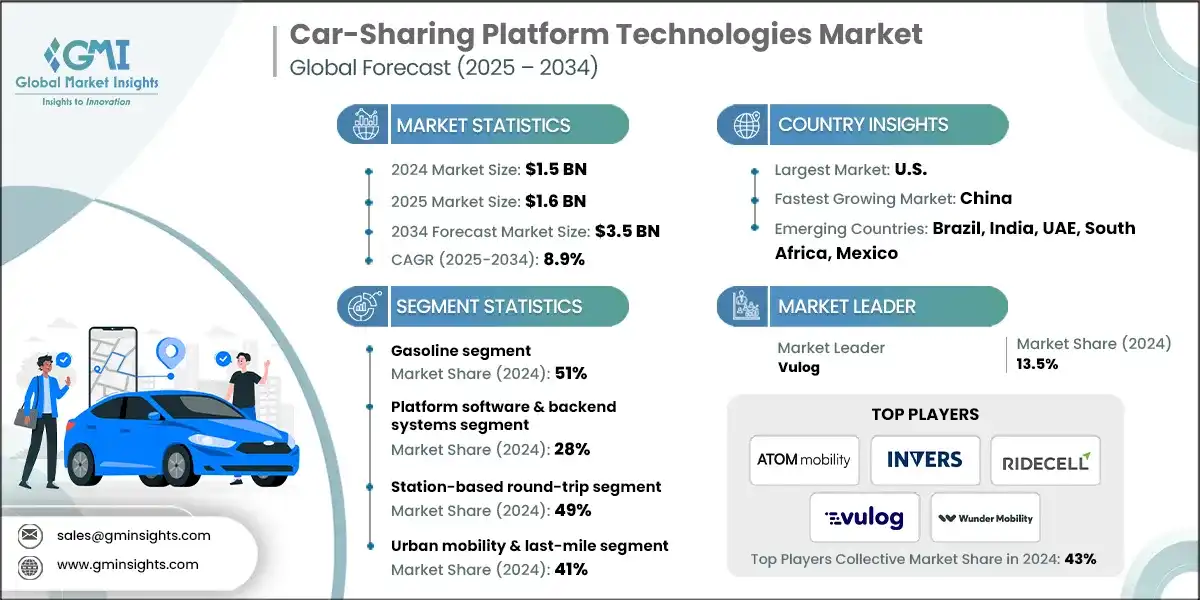
The global car-sharing platform technologies market size was estimated at USD 1.5 billion in 2024. The market is expected to grow from USD 1.6 billion in 2025 to USD 3.5 billion in 2034, at a CAGR of 8.9% according to latest report published by Global Market Insights Inc.
To get key market trends
Car-sharing platforms are motivated by the high rate of urbanization and the necessity to provide greater flexibility in movement. Cities are experiencing overcrowding and lack of parking, which has driven consumers and cities to shared fleets. Multimodal platforms, dynamic pricing and real-time analytics decrease reliance on private-cars, decrease user costs, and allow operators to scale economically - increasing platform growth in dense urban markets around the world and sustainability.
Technologies such as telematics, IoT connectivity, and AI-based vehicle management allow fleet management platforms to optimize the use of vehicles and maintenance, reducing operational expenses. Free-flowing analytics enhance spotting and moving cars and dynamic pricing, whereas on-the-fly upkeep and remote diagnostics enhance uptime. Such efficiencies enable car-sharing to both be economically viable to operators and interesting to investors, leading to a brisk development of features and penetration of the market in both urban and suburban areas.
In May 2025, Zoomcar announced a partnership with Wego. The agreement will integrate Zoomcar's self-drive rental options directly into Wego's platform. This will allow international tourists to book vehicles throughout India. The partnership lets Wego users access over 25,000 cars in 99 cities across India through Wego's website and mobile app.
The regulatory backing of low-emission areas, price congestion, and incentives of shared mobility motivate municipalities to collaborate with car-sharing companies. Grants and pilot programs bring entry barriers down, and policy alignment with climate targets drive public fleets toward common solutions. This enabling regulatory climate speeds up adoption through platform legitimization and opening up of public procurement and funding opportunities and funding across cities and regions throughout the country.
Request is driven by increasing consumer preference towards subscription and pay as you go mobility, and smartphone omnipresence. Fluent app experience, built-in payment, and social-proof networks reduce the resistance to adoption. The younger generations prefer access to ownership, and they make more and more trips and off-peak use. This change of behavior increases the number of people to whom services can be provided, promotes corporate mobility programs and finds partners with OEMs and ride-hailing services and subscriptions around the world.
North America has a high number of vehicles and a well established ride-hailing system. There is also plenty of venture funding available, which helps car-sharing platforms grow quickly. Collaborations with original equipment manufacturers, mobility programs from companies, and unified insurance and payment systems reduce operational challenges. Strong commuting patterns between urban and suburban areas, supportive regulations, and consumers willing to pay for convenience keep large fleets in place and ensure high usage. This approach helps North America maintain a leading market share through strategic partnerships and funding.
The high population density in APAC, young age segment, and high penetration of smartphones and digital payment technologies are good platforms where car-sharing can thrive. Governments are focusing on reducing urban congestion and improving air quality and investing in pilots and sharing mobility as a part of transit planning. In the emerging markets, because of low ownership of the other vehicles in the private category, and due to flexibility in financing and innovation of the local operators, the adoption and scale of users is quicker, and hence APAC is the fastest-growing market.
Car-Sharing Platform Technologies Market Report Attributes
| Key Takeaway | Details |
|---|---|
| Market Size & Growth | |
| Base Year | 2024 |
| Market Size in 2024 | USD 1.5 Billion |
| Market Size in 2025 | USD 1.6 Billion |
| Forecast Period 2025 - 2034 CAGR | 8.9% |
| Market Size in 2034 | USD 3.5 Billion |
| Key Market Trends | |
| Drivers | Impact |
| Urbanization & shift toward shared mobility | Congestion, parking scarcity, and sustainability policies push cities toward shared mobility solutions, driving rapid platform adoption. |
| Growth in connected vehicle technologies | IoT, telematics, and AI enhance fleet automation, lower downtime, and enable dynamic pricing & predictive maintenance. |
| Rising adoption of EV-based shared fleets | EV incentives and fleet electrification mandates fuel demand for EV-compatible shared mobility platforms. |
| Integration of multimodal mobility ecosystems | Unified apps combining car-sharing, bikes, scooters & transit boost user convenience and expand revenues. |
| Pitfalls & Challenges | Impact |
| High deployment & integration costs | Telematics hardware, insurance modules, and OEM integration raise initial investment for operators. |
| Regulatory compliance complexities | Parking rules, insurance mandates, and data privacy laws slow expansion in many cities. |
| Vandalism, misuse & asset damage risks | Shared fleets face high risk, requiring immobilization, geofencing & identity verification tools. |
| Low profitability at low utilization | Low-density regions experience weak trip frequency, affecting operator economics. |
| Opportunities: | Impact |
| Expansion into emerging smart-city markets | Digitalization in APAC, MENA, and Eastern Europe creates demand for turnkey shared mobility platforms. |
| EV and decarbonization mandates | EV-first shared fleets unlock opportunities for battery analytics, routing intelligence & charging integrations. |
| Corporate mobility programs | B2B shared fleets create high-margin subscription revenue streams. |
| MaaS and API monetization | Data APIs, analytics services, and platform-as-a-service create new revenue for tech providers. |
| Market Leaders (2024) | |
| Market Leaders |
13.5% market share |
| Top Players |
Collective market share in 2024 is 43% |
| Competitive Edge |
|
| Regional Insights | |
| Largest Market | US |
| Fastest growing market | China |
| Emerging countries | Brazil, India, UAE, South Africa, Mexico |
| Future outlook |
|
What are the growth opportunities in this market?
Car-Sharing Platform Technologies Market Trends
The drop in ownership of personal cars is being witnessed in cities around the world as congestion, lack of parking space, and the increase in fuel and maintenance prices are driving customers towards shared mobility. Demographics that are younger would like to have access rather than ownership, and there is high demand of app-based car-sharing services. This macro-shift encourages fast implementing scalable platform technology that can manage dynamic pricing, vehicle access, fleet visibility, and optimization of real-time utilization.
Intense innovations in the fields of telematics, IoT sensor and cloud connectivity provide platforms with an opportunity to monitor the health of vehicles, their position, driving style, fuel consumption, and the state of the battery remotely. These features minimize the downtime of operations, enhance predictive maintenance, and allow automatic balancing of the fleet. Increased data awareness boosts the effectiveness of operators, and car-sharing ecosystems become more stable, less expensive, and can expand in both urban and suburban, and campus settings.
Governments also enact policies to curtail emission, restrict personal car usage, and promote shared parenting by congestion pricing, low-emission zones, and city mobility incentives. These laws boost the transition to shared, electric, and low-impact transportation. Car-sharing apps are the beneficiaries of these mandates as cities focus on integrated mobility programs that would lead to traffic reduction, better air quality, and net-zero sustainability.
The emergence of Mobility-as-a-Service platforms, which are car-sharing, e-scooters, e-bikes, taxis, and public transit as single applications, stimulates the use of advanced platform services. Fluent multimodal integration not only makes the user experience more comfortable, but also better urban mobility planning and cross-mode trip replacement. API-based platforms, integrated payments, and multimodal analytics have become popular among cities and those mobility operators aiming to have a comprehensive transportation network.
With a decrease in the prices of EVs and the enhancements in the battery range, operators are deploying electric vehicles into shared fleets more and more, trying to lower the operating costs and meet the environmental requirements. Car-sharing services incorporating charging operations, battery monitoring, route optimization and energy cost prediction become necessary. These features evolve more effective EV operations, attracting sustainability-oriented users and inviting the cities to facilitate EV-based shared mobility ecosystems.
Corporations are using shared mobility solutions to lower employee travel costs, improve pool-car usage, and achieve sustainability goals. Car-sharing platforms provide automated booking, trip validation based on telematics, access control, and fleet usage analytics, which help manage corporate vehicles effectively. This change opens a profitable opportunity for platform providers and boosts adoption in logistics, tech parks, campuses, and business districts.
Car-Sharing Platform Technologies Market Analysis
Learn more about the key segments shaping this market
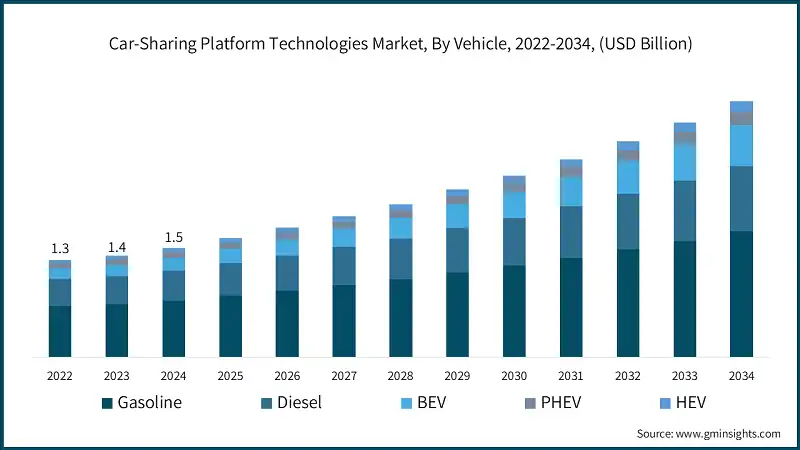
Based on propulsion, the car-sharing platform technologies market is divided into gasoline, diesel, BEV, PHEV, HEV. The gasoline segment dominated the market accounting for around 51% in 2024 and is expected to grow at a CAGR of over 8% from 2025 to 2034.
- Gas-powered vehicles are still very accessible and much cheaper to buy initially compared to their electric counterparts, which makes them appealing to those operators starting or adding cars into existing car-sharing services in cost-conscious cities. The reduced costs of acquisition also enable the operators to expand fleets easily whilst saving capital. The platform technologies also increase the use, which optimize routing, access control, and maintenance scheduling, as well as maximize the returns of the large gasoline-based shared fleets.
- The fact that gasoline cars have a fully developed refueling ecosystem lets users refuel fast without range restrictions. This extensive network reduces system interruptions and enables regular availability of trips on common systems. Car-sharing technologies simplify refueling processes with fuel monitoring, trip data and automatic reimbursements to become simpler to operate in both the densely populated urban and underserved suburban markets.
- Compared to most early electric vehicles, gasoline cars offer predictable performance and easier service than their counterparts, and operators are able to have higher uptime and fewer service disruptions. Car-sharing applications are based on telematics, which track engine health, identify diagnostic codes, and provide effective preventative maintenance. These consistency benefits make gasoline fleets attractive to operators who are interested in consistent supply, cost management, and daily high turnover.
- The majority of users are still very conversant with the process of driving and fueling gasoline cars, which will decrease the onboarding stress and customer care requirements of shared mobility operators. This recognition increases customer satisfaction and promotes impromptu visits. Car-sharing services are unified with smooth fuel monitoring, in-app payment systems, and trip validation services and allow gasoline fleets to provide these new and returning consumers with hassle-free, intuitive mobility experiences.
- Gasoline cars have good range, fast fueling and can work well in long mileage circumstances and are suitable during the usage of the long distance, tourist and corporate customers. This encourages the need to use gasoline-powered car-sharing fleets in the areas where there is a low density of charging equipment. Platform technologies improve performance visibility by means of real-time telematics, fuel consumption analytics and smart routing to optimize the lifespan of assets and the cost of operation.

Learn more about the key segments shaping this market
Based on technology, the car-sharing platform technologies market is segmented into platform software & backend systems, mobile & user interface applications, telematics & IoT hardware, vehicle access control systems, payment & billing systems, fleet operations & optimization systems, and others. The platform software & backend systems dominated the market with 28% share in 2024, and the segment is expected to grow at a CAGR of over 9.8% from 2025 to 2034.
- The operators of car-sharing are fully turning to the platform software and backup mechanisms to automate the dispatches of fleets, vehicle accessibility, route optimization, and driver authentication. Automation helps a lot in lowering the cost of labor, minimizing the possibility of human error, and increasing utilization rates. These smart back-end systems allow real-time decision making and predictive fleet balancing to make the whole ecosystem more reliable, scalable, and economical to operators entering competitive urban markets.
- The use of a strong API framework in the back end will enable the free flow of integrating the vehicle manufacturer, payment provider, insurance partners, and multimodal mobility platforms. This connection provides users with better experience, opens remote access control, and delivers the ability to retrieve EV batteries data. With cities moving towards Mobility-as-a-Service, tools that have scalable API ecosystems become of particular importance, as the world moves toward the adoption of advanced software-based car-sharing architectures.
- The interpretation of the telematics data, including the vehicle position, velocity, fuel consumption, battery status, and driving style, is relied upon by the modern operators with the help of the backend software. These are the insights that drive predictive maintenance, dynamic pricing and fraud detection. Real-time processing of high-volume data enhances operational availability, customer service, and creates an incentive to develop next-generation analytics and cloud-based backend systems to achieve shared mobility.
- The digital payment, KYC verification, license validation, and fraud prevention systems need secure backend systems. The stricter the identity and data protection policies imposed by the regulators, the more operators and users will trust platforms that have an encrypted payment gateway and a solid authentication process. The increasing demand of safe, compliant, and streamline transactions cause a high demand of sophisticated backend engines that help to support car-sharing activities throughout the world.
- The process of electrification of shared fleets presupposes the usage of the backend systems that track the charging status, battery health, energy usage, and optimal placement of the stations. Backend intelligence predicts charging patterns and eliminates range downtime. As EVs are increasingly used in car-sharing, operators are increasingly relying on advanced platform software to manage the logistics of charging, enhance EV utilization, and manage the cost of energy-improving demand of smart backend technologies.
Based on operational model, the car-sharing platform technologies market is segmented into station-based round-trip, station-based one-way, home-zone car-sharing, free-floating one-way, peer-to-peer. The station-based round-trip segment dominated the market, accounting for share of 49% in 2024.
- The use of station-based round-trip models provides certain parking and a known pickup-drop-off point, which offers very reliable user experience. This uniformity appeals to families, tourists and corporate users that demand more assurance than flexibility. Platform technologies increase this reliability by providing reservation guarantees, automated reservations, and real-time station occupancy analytics, enhancing customer satisfaction and facilitating consistent, recurring usage in densely inhabited metropolitan regions.
- Cities are becoming more cooperative with station operators to alleviate congestion and supplement the public transit network. Fixed stations simplify the process of integrating car-sharing with multimodal hubs (metro stations, bus terminals and bike-sharing points). Backend software facilitates smooth multimodal coordination, trip planning, and transit card integrations to support sustainability objectives at the city level and lead to the adoption of structured, station-based mobility ecosystems.
- Round-trip car-sharing reduces the vehicle imbalance issues that prevail in the free-floating models since all journeys are completed where they begin. This goes a long way in cutting down on the labor relocation, fleet redistribution expenses and inefficiencies in operation. The station-based model is operationally appealing because platform systems streamline the reservation windows, vehicle turnaround times, and station utilization, allowing the operators to keep the profits high and the number of employees decreased as well as maintenance overhead.
- The station-based round-trip services are preferred by the corporations, universities, and residential complexes due to their structure, accountability and predictable return patterns. The advantages of these institutions include reserved parking, restricted access and automated compliance and budget reporting. Platform technologies allow custom booking policies, trip verification, user access levels, and automatic billing, which contributes to the high adoption of station-centric shared fleets in campuses and business districts.
- The car-sharing round-trip is also appropriate in the long travel periods like weekend getaways or the day-long business trip where the cars have to be returned to the place where they were deposited. The predictability that a user is guaranteed a parking space on the return basis is a plus. Platform software augments these applications with longer reservations, fuel management, insurance connections, and cost-efficient trip planning of long trips.
Based on application, the car-sharing platform technologies market is segmented into urban mobility & last-mile, MaaS platform integration, corporate fleet management, and others. Urban mobility & last-mile segment is leading the market with 41% share in 2024.
- The trend of rising population in the megacities is pushing the demand of convenient, fast, and economical mobility within short distances. Car-sharing apps serve missing networks of poor or overburdened public transit by allowing commuters to travel the final mile stress-free. This makes shared vehicles a necessary tool of door-to-transit connectivity and congestion mitigation in cities.
- Companies in the congested business areas are turning to car-sharing as a solution to the employee commuting difficulties in areas where there are either problems with parking or transportation timetables. The key benefit of shared mobility fleets is that they help the organization to decrease transportation reimbursements, enhance punctuality, and contribute to achieving sustainability objectives. This increasing corporate usage of the stations and free-floating applications drives up the demand of the short-predictable last-mile employee routes station-based and free-floating applications.
- City administrations are implementing digital parking applications, urban hubs, and transport corridors using IoT applications that facilitate effective last-mile connections. These urban technologies enhance the positioning of the fleet, minimize turnaround time, and facilitate flawless interoperability among communal bikes, scooters, and vehicles. With cities dedicating a lot of resources to mobility optimization, car-sharing platforms are automatically affected with better efficiency of the operations and user experience.
- The people living in the cities are opting to use pay-as-you-drive rather than owning their vehicles due to increasing fuel costs, traffic jams, and high charges on parking. Car-sharing serves as a cost-effective, last-mile service that offers a flexible substitute for the short-lasting journeys that are not worth owning a car. This is a trend towards mobility that is cost-optimized that directly drives the demand of shared fleets that are located in transit stations and commercial areas.
- Mobility-as-a-Service (MaaS) platforms are being developed to connect car-sharing systems with other metro, bus, and BRT systems. This integration enables the customers to plan, book and pay multi-modes through a single interface. This type of interoperability can be a huge benefit to last-mile convenience, the adoption of multimodal transport, and positioning shared cars as an extension of existing public transport networks.
Looking for region specific data?
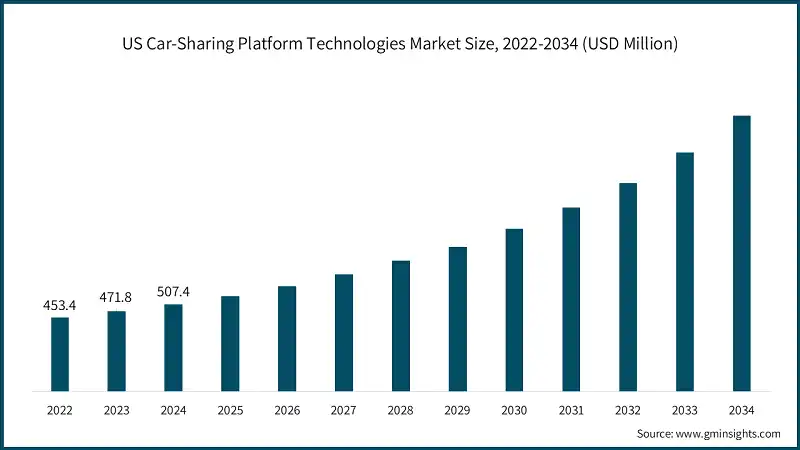
US dominated the car-sharing platform technologies market in North America with around 86% share and generated USD 507.4 million in revenue in 2024.
- Some of the larger metropolitan regions in the US, New York, Los Angeles, Chicago, Boston, and Seattle, are experiencing increased congestion, a growing shortage of parking and an ever-growing cost of traffic. This is straining people towards common mobility options. Technologies Car-sharing technologies are low-cost, flex-friendly, and less-dependent solutions. This dynamic is highly accelerating in big, dense American cities, that aim to find a sustainable and efficient way to move.
- One of the largest concentrations of corporate campuses and high mobility need universities is in the US. Car-sharing fleets help companies to decrease the cost of travel reimbursements, whereas at universities they benefit students who do not have cars. The institutional collaborations lead to platform growth, which allows technology providers to scale more rapidly employing high frequency and predictable usage in controlled settings.
- US has a very favorable mobile-based mobility service environment, with almost all individuals having access to smartphones and extensive use of digital payments. Car-sharing services enjoy the advantages of seamless onboarding, immediate identity authentication, and cashless payments. These will lower the user acquisition obstacles, optimize customer satisfaction, and increase the pace at which large cities in the United States adopt the ecosystems of technology-based car-sharing.
- US mobility sector is a good place to attract venture capital insourcing which has made it easy to build fast technology through telematics, AI-based fleet optimization and mobility-as-a-service. The ecosystem of investments leads to increased innovation around backend systems, predictive analytics, and automated fleet management. Competition improves the performance of platforms, reliability and geographic coverage as startups grow fast- thus creating a robust market development in the country.
- Huge insurance bills coupled with maintenance and uncertain fuel prices are making US consumers shun long-term ownership of vehicles. Car-sharing has an advantageous way of not having to invest in the purchasing of vehicles, along with being cheap and on-demand. The demand for car-sharing technologies and availability of fleets is sustained by this change in mobility, particularly among young professionals and urban residents, which is characterized by the motive of flexible mobility.
The car-sharing platform technologies market in Italy is projected to grow at a strong CAGR of 11% from 2025 to 2034, driven by rapid urban mobility digitalization, strong public-transit integration, and strict regulatory frameworks promoting shared mobility adoption, data transparency, and telematics-enabled fleet compliance across major Italian cities.
- Italian cities such as Rome, Milan, Florence, and Naples face severe congestion, limited parking, and narrow historic streets where owning a private car is becoming less practical. Car-sharing offers a flexible, cost-effective option that eases traffic and improves access to restricted areas. This issue with mobility increases the demand for technology-enabled shared mobility platforms in major urban areas.
- Italy’s national mobility policies focus on reducing urban pollution and meeting EU CO2 limits. Incentives for shared electric fleets, low-emission zones, and exemptions from congestion charges promote wider use of car-sharing solutions. These environmental rules make technology-enabled shared fleets more appealing than private cars, speeding up market growth and encouraging investments in digital fleet platforms and multimodal mobility hubs.
- Italy is a top tourist destination, with high visitor numbers in Rome, Venice, Florence, and its coastal regions. Tourists increasingly choose app-based, short-term mobility options that help them avoid parking issues and rental counter waiting times. Car-sharing platforms take advantage of this strong seasonal demand. This allows technology providers to optimize fleets, develop dynamic pricing models, and create instant-access booking systems that cater to the needs of tourists.
- Young Italians, especially in Milan, Turin, Bologna, and Rome, are moving away from owning cars due to rising insurance costs, maintenance expenses, and limited parking. This group prefers digital, pay-per-use mobility available through smartphones. Car-sharing technologies fit well with this trend, leading to quick adoption among students, young professionals, and households with low car ownership.
- Italy’s public transit systems metro, tram, bus, and regional rail—are increasingly working with Mobility-as-a-Service platforms. Car-sharing helps improve first- and last-mile connectivity, enhancing multimodal accessibility in cities. Regional transport authorities in Lombardy, Lazio, and Emilia-Romagna support digital ticketing, smart mobility hubs, and compatible platforms, raising the importance of car-sharing in Italy’s changing multimodal mobility scene.
China car-sharing platform technologies market reached over USD 145 million in 2024, propelled by rapid mobility digitalization, widespread integration of connected-car ecosystems, and strong government backing for intelligent transportation, V2X networks, and large-scale deployment of telematics-enabled shared fleets across major cities and domestic OEM partnerships.
- China’s significant investment in intelligent transportation systems, V2X infrastructure, and urban digitalization is speeding up the adoption of car-sharing platforms. The government’s Smart Mobility policies support connected vehicles, common data-sharing standards, and fleet compliance based on telematics. These initiatives improve platform interoperability, streamline fleet routing, and lessen congestion, creating strong demand for advanced car-sharing technologies in Tier 1 to Tier 3 cities.
- In China’s super-app ecosystem, including WeChat, Alipay, and Meituan, car-sharing platforms benefit from smooth app integrations, instant payments, and real-time route discovery. This digital ease lowers the barriers to adoption, allowing millions of users to access shared vehicles quickly. Compared with the country’s near-universal smartphone use, these platform technologies can grow rapidly, support AI-driven fleet allocation, and provide highly personalized mobility services.
- China’s large cities, such as Beijing, Shanghai, Shenzhen, and Guangzhou, deal with ongoing congestion, limited parking, and increasing vehicle restrictions. Policies like license plate quotas and traffic limits encourage consumers to use flexible shared mobility. Car-sharing platforms help close the mobility gap by offering affordable short trips, backed by real-time telematics, automated fleet balancing, and dynamic pricing tailored for crowded urban areas.
- Leading Chinese manufacturers like SAIC, BYD, and Geely are actively collaborating with mobility-tech companies to include telematics, connected ECUs, digital keys, and OTA capabilities. These built-in features support low-friction car-sharing deployment at a larger scale. This close partnership between OEMs and platforms lowers hardware costs, increases fleet uptime, and speeds up the nationwide adoption of car-sharing technologies for both electric and internal combustion engine vehicles.
- China’s strong EV ecosystem, featuring high battery capacity, extensive charging networks, and generous subsidies, supports cost-effective electric car-sharing fleets. EV-specific telematics, battery health monitoring, and smart-charging algorithms improve operational efficiency. As cities aim for zero-emission zones and sustainable mobility, car-sharing platforms emerge as vital mobility tools, boosting the demand for backend software, AI routing, and battery-optimized fleet management systems.
The car-sharing platform technologies market in Mexico reached over USD 28 million in 2024, driven by expanding shared mobility fleets, rising adoption of real-time telematics for tracking and driver safety, increasing theft-recovery technology penetration, and stronger integration of connected-vehicle services by both domestic and international OEMs across key urban centers.
- Major Mexican cities face severe congestion, high fuel costs, and limited parking. These challenges push people to move away from owning cars. Car-sharing platforms provide convenient, short-distance travel with clear pricing and app-based access. Municipal support for reducing the number of vehicles and expanding smart mobility zones is speeding up platform adoption and technology integration.
- Mexico’s growing middle class and the rise of smartphone use create strong demand for app-based car-sharing. Users increasingly prefer flexible travel options that spare them the financial strain of car ownership. This digital trend allows platforms to expand quickly, using telematics, real-time vehicle tracking, and dynamic trip pricing to boost usage and improve urban travel experiences.
- Mexico’s bus and metro systems struggle with last-mile connections. Car-sharing platforms address this gap by providing affordable, short-distance access near transit stops. Cities are encouraging the integration of shared mobility into transit plans. Technology platforms that support multimodal routing, app-based trip matching, and integrated payment options are gaining popularity across Mexico's urban areas.
- Growing concerns about road safety and vehicle theft are driving demand for telematics-equipped shared vehicle fleets in Mexico. Real-time tracking, geofencing, immobilization, and driver analytics lead to safer, more reliable car-sharing experiences. Providers that incorporate AI-based behavioral monitoring and secure digital access systems are seeing more users in both consumer and corporate mobility cases.
- Large Mexican companies are turning to shared fleet solutions to improve employee travel, cut leasing costs, and meet sustainability goals. Car-sharing platforms provide digital keys, usage analytics, automated billing, and telematics data that improve fleet efficiency. This rising demand from businesses is fueling investment in backend software, data platforms, and AI-driven vehicle usage tools.
The car-sharing platform technologies market in Saudi Arabia is projected to grow at a CAGR of 6.1% from 2025 to 2034, supported by high demand for vehicle tracking, insurance telematics expansion, and the country’s ongoing efforts to combat vehicle theft and improve fleet efficiency.
- Saudi Arabia’s Vision 2030 focuses on smart mobility, shared transportation, and updating digital infrastructure. Government-supported smart city projects, like NEOM, the Riyadh Metro integration, and advanced traffic systems, create a strong need for new car-sharing platforms. These projects speed up the use of telematics-enabled fleets, digital access systems, and mobility data platforms in quickly growing urban areas.
- Although many people own cars, the costs related to maintenance, insurance, and fuel subsidy reforms are pushing Saudis to consider shared mobility options. Car-sharing platforms offer affordable alternatives that fit urban lifestyle changes. Technologies for contactless access, usage analytics, and fleet optimization are attracting many young and tech-savvy users.
- Saudi Arabia has a large expatriate population that prefers flexible, pay-per-use options instead of long-term ownership or leases. Car-sharing platforms cater to these preferences with easy digital booking, multilingual apps, and reliable telematics. Demand is particularly rising in Riyadh, Jeddah, and Dammam, where expat mobility habits boost fleet use and help platforms grow.
- Major projects such as NEOM, King Salman Park, and Qiddiya are incorporating advanced mobility infrastructure, including IoT sensors, connected roads, and digital parking systems. These improvements provide great opportunities for telematics-enabled car-sharing fleets. Platforms can use real-time vehicle diagnostics, predictive maintenance, and AI-driven fleet management to meet the rising needs for urban mobility.
- Saudi Arabia has one of the youngest populations in the world, with very high smartphone and digital service usage. Younger consumers want flexible, app-based mobility options. Car-sharing platforms can take advantage of this demographic change by using digital ID verification, smart payments, and location-based fleet availability to gain wide acceptance in urban areas.
Car-Sharing Platform Technologies Market Share
- The top 7 companies in the car-sharing platform technologies industry are Vulog, INVERS, Ridecell, Wunder, ATOM, Unbound, and Smartcar, collectively contributing around 50% of the market in 2024.
- Vulog stays competitive by offering a modular white-label platform that speeds up operator launch times, integrates various services, and scales globally. It invests in AI-driven fleet optimization, real-time telematics, and partner APIs while supporting OEM integrations and local compliance. Continuous product updates and extensive operator support enable rapid geographic expansion and high uptime for shared fleets, along with dedicated 24/7 global support.
- INVERS remains competitive through strong hardware-software integration. It combines secure CloudBoxx telematics, immobilization, and remote diagnostics with scalable backend services. The company focuses on vehicle-level security, low-latency access control, and fleet recovery tools, targeting high-risk environments and corporate clients. Strategic partnerships with insurers and fleet operators, along with quick hardware deployment, enhance its market position and trustworthiness. Certified installers and global maintenance partners further strengthen its reliability.
- Ridecell competes by providing an API-first mobility orchestration platform that automates reservations, billing, compliance, and fleet operations. It emphasizes enterprise-grade scalability, custom workflows, and integrations with OEM telematics and payment providers. Advanced analytics, white-label apps, and workflow automation simplify operations for operators, enabling quicker rollout of corporate, rental, and shared mobility programs across different urban markets, plus onboarding.
- Wunder focuses on developer-friendly and customizable mobility software that facilitates rapid fleet deployment and B2B solutions for operators and municipalities. It prioritizes modular architecture, flexible pricing engines, and operational tools for maintenance, reservations, and user management. A focus on international expansion, professional services, and partnership networks helps Wunder adapt to local regulations and scale efficiently, along with ensuring local compliance.
- ATOM competes by offering a lightweight and fast-to-deploy mobility stack designed for emerging markets. It combines core fleet management, telematics integration, and payment workflows. It focuses on cost-efficiency, multi-modal support, and local feature sets to meet various regulations. ATOM’s quick implementation, lower total cost of ownership, and support for informal mobility providers help it reach underserved urban and peri-urban demand, along with local partnerships, training, and support.
- Unbound boosts competitiveness by providing real-time telematics, modular fleet management, and automation tools aimed at high-utilization operators. The company invests in predictive maintenance, driver behavior analytics, and solid API connections for OEMs and city platforms. A focus on operator dashboards, service-level agreement-driven uptime, and flexible integrations allows Unbound to support complex enterprise deployments and scale operations reliably, backed by global reliability guarantees.
- Smartcar competes with its universal vehicle API that gives OEM-authorized access to vehicle data and remote commands across many brands. It emphasizes secure authentication, seamless EV telemetry, and developer tools to speed up integrations for car-sharing apps. By simplifying vehicle connectivity, providing strong documentation, and prioritizing partnerships with automakers, Smartcar cuts integration time and unlocks advanced fleet capabilities, along with easy integrations.
Car-Sharing Platform Technologies Market Companies
Major players operating in the car-sharing platform technologies industry are:
- ATOM
- Convadis
- Fluctuo
- INVERS
- Karhoo
- Ridecell
- Smartcar
- Unbound
- Vulog
- Wunder
- The car-sharing platform technologies market is very competitive. It is fueled by fast digital growth, a rise in multimodal mobility, and greater connections between software platforms, OEMs, and telematics providers. Leading companies like Vulog, INVERS, Ridecell, Wunder, ATOM, Unbound, and Smartcar stand out with their fleet automation tools, secure API systems, real-time telematics, and scalable backend solutions. There is a strong focus on cutting operator costs, boosting fleet usage, and enhancing user experience, which shape product development and platform growth.
- Competition heats up as platforms expand into new regions, add EV-specific features, and support programs for businesses, consumers, and local governments. Companies are putting a lot of money into AI-based routing, predictive maintenance, digital key technology, fraud prevention, and managing multimodal mobility. Partnerships with car manufacturers, payment service providers, smart city projects, and mobility-as-a-service systems help strengthen market positions. This fast merging of hardware, software, and data platforms drives ongoing innovation and raises the technology barriers for new players.
Car-Sharing Platform Technologies Industry News
- In August 2025, Zoomcar collaborated with Google Cloud to integrate Generative AI (GenAI) and Machine Learning into its platform. This improves how guests’ books, hosts onboard, and how Zoomcar ensures safety at scale. Zoomcar uses Google Cloud's Gemini models and AI/ML platform to significantly reduce host onboarding time, reduce host-driven cancellations, and detect fraud on the platform.
- In July 2025, Zoomcar announced a partnership with CARS24 to enhance vehicle quality and safety in the self-drive car rental sector through tech-enabled inspections and tracking. As part of this collaboration, CARS24 will perform Pre-Delivery Inspections (PDIs) on new host vehicles and install GPS tracking devices to ensure transparency, safety, and improved guest experience, according to a company statement.
- In April 2025, Volkswagen and Uber Technologies announced a partnership to deploy a fleet of thousands of all-electric, fully autonomous ID. Buzz AD vehicles in multiple U.S. markets over the next decade, starting in Los Angeles. This collaboration marks an important milestone in the development of autonomous mobility and shows both Volkswagen's and Uber's commitment to shaping the future of transportation.
- In February 2025, Targa Telematics announced a partnership with Volkswagen Info Services AG to integrate real-time fleet data from six Volkswagen Group brands, including Volkswagen Passenger Cars, Audi, Škoda, SEAT, Cupra, and Volkswagen Commercial Vehicles, into Targa’s connected mobility platform. This integration allows fleet managers to access services such as maintenance tracking, EV monitoring, fraud detection, and claims management without needing additional hardware installations, while ensuring GDPR compliance.
The car-sharing platform technologies market research report includes in-depth coverage of the industry with estimates & forecasts in terms of revenue ($ Mn/Bn) from 2021-2034, for the following segments:
Market, By Technology
- Platform software & backend systems
- Mobile & user interface applications
- Telematics & IoT hardware
- Vehicle access control systems
- Payment & billing systems
- Fleet operations & optimization systems
- Others
Market, By Propulsion
- Gasoline
- Diesel
- BEV
- PHEV
- HEV
Market, By Operational model
- Station-based round-trip
- Station-based one-way
- Home-zone car-sharing
- Free-floating one-way
- Peer-to-peer
Market, By Application
- Urban mobility & last-mile
- MaaS platform integration
- Corporate fleet management
- Others
Market, By End Use
- Car-sharing operators
- Automotive OEMs
- Public transport authorities
- Technology platform providers & integrators
- Others
The above information is provided for the following regions and countries:
- North America
- US
- Canada
- Europe
- UK
- Germany
- France
- Italy
- Spain
- Russia
- Nordics
- Asia Pacific
- China
- India
- Japan
- South Korea
- ANZ
- Southeast Asia
- Latin America
- Brazil
- Mexico
- Argentina
- MEA
- South Africa
- Saudi Arabia
- UAE
Frequently Asked Question(FAQ) :
Who are the key players in the car-sharing platform technologies industry?
Key players include ATOM, Convadis, Fluctuo, INVERS, Karhoo, Ridecell, Smartcar, Unbound, Vulog, and Wunder.
What are the upcoming trends in the car-sharing platform technologies market?
Trends include EV-led shared fleets, smarter telematics and IoT, growth of MaaS platforms, data-driven multimodal planning, and supportive low-emission regulations.
Which region leads the car-sharing platform technologies sector?
The United States dominated the North American market with an 86% share, generating USD 507.4 million in revenue in 2024.
What is the growth outlook for the urban mobility and last-mile segment?
The urban mobility and last-mile segment led the market with a 41% share in 2024, led by the rising population in megacities and the need for convenient, short-distance mobility solutions.
What was the market share of platform software and backend systems in 2024?
Platform software and backend systems held a 28% market share in 2024 and are set to expand at a CAGR of over 9.8% till 2034.
What is the market size of the car-sharing platform technologies in 2024?
The market size was USD 1.5 billion in 2024, with a CAGR of 8.9% expected through 2034. Urbanization, parking shortages, and the demand for flexible mobility solutions are driving market growth.
What is the expected size of the car-sharing platform technologies industry in 2025?
The market size is projected to reach USD 1.6 billion in 2025.
How much revenue did the gasoline segment generate in 2024?
The gasoline segment accounted for approximately 51% of the market in 2024 and is expected to grow at a CAGR of over 8% from 2025 to 2034.
What is the projected value of the car-sharing platform technologies market by 2034?
The market is poised to reach USD 3.5 billion by 2034, driven by advancements in platform technologies, EV integration, and government policies promoting shared mobility.
Car-Sharing Platform Technologies Market Scope
Related Reports