Summary
Table of Content

Cancer Diagnostics Market
Get a free sample of this report
Form submitted successfully!
Error submitting form. Please try again.
Thank you!
Your inquiry has been received. Our team will reach out to you with the required details via email. To ensure that you don't miss their response, kindly remember to check your spam folder as well!
Request Sectional Data
Thank you!
Your inquiry has been received. Our team will reach out to you with the required details via email. To ensure that you don't miss their response, kindly remember to check your spam folder as well!
Form submitted successfully!
Error submitting form. Please try again.
Cancer Diagnostics Market Size
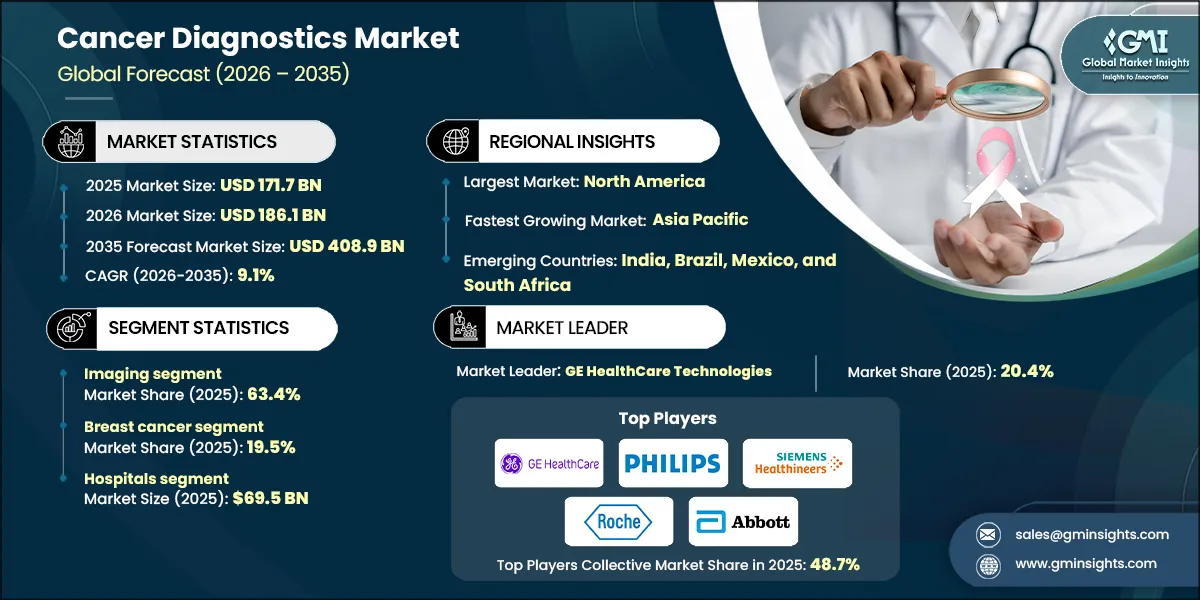
The global cancer diagnostics market size was valued at USD 171.7 billion in 2025. The market is expected to grow from USD 186.1 billion in 2026 to USD 408.9 billion in 2035, growing at a CAGR of 9.1%, according to the latest report published by Global Market Insights Inc.
To get key market trends
Cancer diagnostics refers to all the methods, processes, and technologies that identify and diagnose the disease. Accurate cancer diagnostics help the patient as the data point determines the type, location, and stage to initiate treatment. Major players in the cancer diagnostics industry include GE HealthCare Technologies, Koninklijke Philips, Siemens Healthineers, F-Hoffmann-La Roche, and Abbott Laboratories.
Cancer Diagnostics Market Report Attributes
| Key Takeaway | Details |
|---|---|
| Market Size & Growth | |
| Base Year | 2025 |
| Market Size in 2025 | USD 171.7 Billion |
| Market Size in 2026 | USD 186.1 Billion |
| Forecast Period 2026 - 2035 CAGR | 9.1% |
| Market Size in 2035 | USD 408.9 Billion |
| Key Market Trends | |
| Drivers | Impact |
| Rising prevalence of cancer globally | Increases demand for early detection, screening, and monitoring across modalities. Drives volume growth for diagnostic tests and pushes health systems to expand capacity and reimbursement coverage. |
| Several initiatives undertaken by government and other organizations to spread disease awareness | Awareness campaigns boost screening uptake and patient engagement, leading to earlier-stage diagnoses. Enhances funding, public–private partnerships, and guideline adoption that standardize diagnostic pathways. |
| Growing number of diagnostic laboratories in developing countries | Expands access to testing, reduces turnaround times, and localizes services. Encourages market penetration for reagents, instruments, and LDTs while improving health equity and data availability. |
| Technology advancements in cancer diagnostics | AI-assisted imaging, liquid biopsy, NGS, and digital pathology improve sensitivity/specificity and workflow efficiency. Accelerates personalized medicine and companion diagnostics, opening premium segments. |
| Pitfalls & Challenges | Impact |
| High capital investment coupled with high costs associated with diagnostic imaging systems | Limits adoption, especially in resource-constrained settings. |
| Risk related with high radiation exposure affecting use of CT scanner | Raises safety concerns and regulatory scrutiny, prompting dose-optimization protocols. |
| Opportunities: | Impact |
| Regional expansion in emerging markets | Untapped demand, improving infrastructure, and supportive policies create growth runway. |
| Integration of AI and digital pathology | Enhances diagnostic accuracy, triage efficiency, and workload balance, enables remote reads and collaboration. |
| Market Leaders (2025) | |
| Market Leaders |
20.4% Market share |
| Top Players |
|
| Competitive Edge |
|
| Regional Insights | |
| Largest Market | North America |
| Fastest Growing Market | Asia Pacific |
| Emerging Countries | India, Brazil, Mexico, and South Africa |
| Future outlook |
|
What are the growth opportunities in this market?
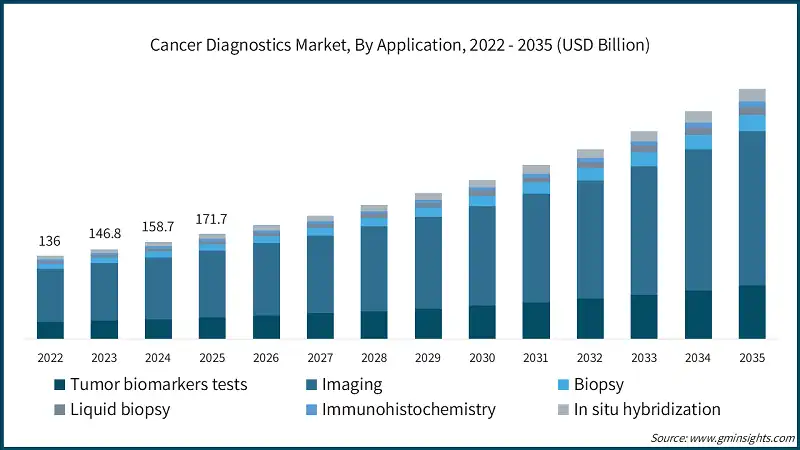
The global market increased from USD 136 billion in 2022 to USD 158.7 billion in 2024. The global market is experiencing significant growth, stimulated by the increasing prevalence of cancer. For instance, according to the data from the World Health Organization (WHO), globally, an estimated 20 million new cancer cases were reported in 2022, resulting in approximately 9.7 million deaths.
Moreover, as per the data from WHO, about 1 in 5 individuals will develop cancer during their lifetime, with around 1 in 9 men and 1 in 12 women succumbing to the disease. These trends highlight the urgent need for advanced cancer diagnostic technology to accelerate early detection, accurate diagnosis, personalized treatment, and improved monitoring of cancer progression and therapy outcomes.
Additionally, innovations in personalized medicine for cancer biomarkers are revolutionizing detection treatment and monitoring, which helps in escalating the market growth. Liquid biopsies have emerged as a non-invasive method for detecting tumor and other biomarkers in blood, which enables the early cancer diagnosis, real-time monitoring of treatment response. For example, according to the study published in the National Institute of Health (NIH) states that Guardant360 CDx has proven clinical validity in identifying patients with KRAS p.G12C–mutant non-small cell lung cancer (NSCLC).
Its effectiveness improves when used alongside tissue-based tests, as recommended in its approved product label, ensuring comprehensive and accurate mutation detection. Therefore, such technological advancements are driving the adoption of these tests among healthcare professionals, fostering market growth.
Cancer diagnostics involve the use of various techniques, such as imaging and laboratory tests, for accurate and precise cancer detection. Imaging modalities include ultrasound, radiology, mammography systems, which is estimated to reach USD 6 billion by 2032, MRI, PET, and CT scans, while laboratory tests include biopsies, liquid biopsy, tumor biomarkers, and other diagnostic methods.
Cancer Diagnostics Market Trends
- The market is witnessing a shift toward blood-based biomarker tests, liquid biopsies, and stool-based tests as more non-invasive methods are introduced. These methods enable early diagnosis, improve patient convenience, and enhance accessibility and compliance.
- Japan, Germany, the UK, and the US are focusing on promoting early detection by implementing nationwide cancer screening programs, such as colorectal cancer screening initiatives, along with awareness campaigns. Additionally, regulatory authorities in these countries are expediting the approval of new diagnostic tests to improve diagnostic outcomes.
- For instance, in October 2024, the U.S. FDA approved Exact Sciences Corporation's Cologuard Plus test for diagnosing colorectal cancer in high-risk patients aged 45 years or older.
- Additionally, numerous initiatives by governments and healthcare organizations to raise awareness about early cancer diagnosis, are expected to foster the progress of the market.
- A specific campaign targeted by the Pan American Health Organization, St. Jude Children's Research Hospital, and Childhood Cancer International seeks to equip parents, caregivers, and health professionals in some parts of Latin America and the Caribbean with knowledge on the earliest warning signs of the leading childhood and adolescent cancers.
- Furthermore, February 15th is celebrated as International Childhood Cancer Day to promote support for children suffering from cancer. This day aims to promote awareness among people about the most common forms of pediatric cancer.
- Therefore, as the awareness of cancer increases, so does the demand for effective and technologically advanced diagnostic tools such as imaging devices for the precise and early detection of cancer.
- Moreover, artificial intelligence in cancer diagnostics is growing rapidly, driven by the increasing adoption of AI-based imaging, predictive analytics, and precision oncology technologies. These advancements enhance diagnostic accuracy and reduce detection time.
- Progress in oncology information systems and AI-powered imaging is improving the detection of certain cancer types and enabling earlier interventions. This ultimately leads to better treatment outcomes, higher patient survival rates, and improved overall health. Studies indicate that integrating AI into mammogram screenings improves breast cancer detection rates compared to conventional methods. Thus, such technological advancements are accelerating the market growth.
Cancer Diagnostics Market Analysis
Learn more about the key segments shaping this market
The cancer diagnostics market was valued at USD 136 billion in 2022. The market size reached USD 158.7 billion in 2024, from USD 146.8 billion in 2023.
Based on application, the market is segmented into tumor biomarkers tests, imaging, biopsy, liquid biopsy, immunohistochemistry, and in situ hybridization. The imaging segment is further bifurcated into ultrasound and radiology, mammography, MRI scan, PET scan, CT scan, and SPECT and others imaging. The imaging segment dominated the market with the largest revenue share of 63.4% in 2025.
- Growing cases of cancer is increasing the need for diagnostic imaging tests and cancer detection at an early stage. For example, as reported by the Colorectal Cancer Alliance, 1 in 24 individuals is forecasted to be diagnosed with colorectal cancer at some point in their life.
- The large number of cancer cases being reported require advanced imaging techniques to be employed for supporting precise diagnosis and ensuring better treatment results, which is promoting the growth of the segment.
- Furthermore, the adoption of new technologies such as liquid biopsy-guided imaging and PET-CT scanning alongside AI-assisted imaging has increased the focus on achieving high accuracy in diagnosis, which has increased the demand for the imaging test significantly.
Based on cancer type, the cancer diagnostics market is segmented into bladder cancer, breast cancer, colon and rectal cancer, endometrial cancer, kidney cancer, leukemia, liver and lung cancer, melanoma, non-hodgkin lymphoma, pancreatic cancer, prostate cancer, thyroid cancer, and other cancer types. The breast cancer segment dominated the cancer type segment within the market, with a share of 19.5% in 2025.
- The increasing prevalence of breast cancer continues to be a major catalyst for the growth of the cancer diagnostics market. For instance, as per the data from the American Cancer Society, in the U.S. it is projected that in 2025 around 316,950 women will be diagnosed from the invasive breast cancer, about 59,080 women will be diagnosed with ductal carcinoma in situ and approximately 42,170 women will die due to the breast cancer across the nation.
- These alarming figures highlight the growing burden of breast cancer and underscore the critical need for early detection and advanced diagnostic solutions.
- Therefore, the rising incidence, coupled with increased awareness and screening programs, has significantly boosted the demand for breast cancer diagnostics, making this segment the largest contributor to the market.
Learn more about the key segments shaping this market
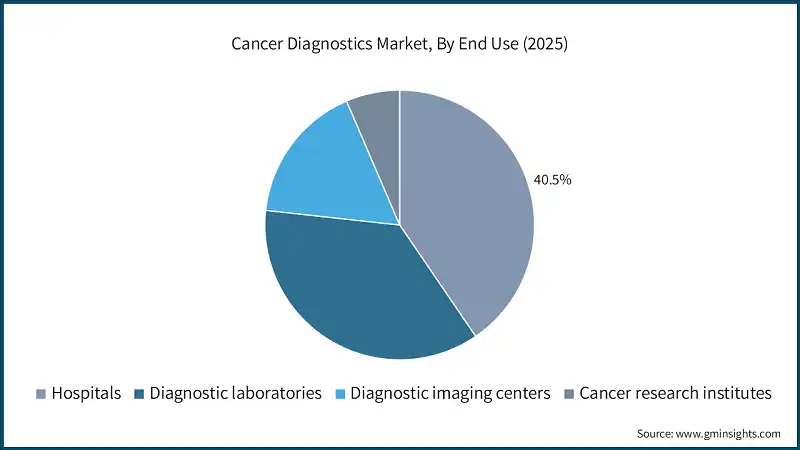
Based on end use, the cancer diagnostics market is segmented into hospitals, diagnostic laboratories, diagnostic imaging centers, and cancer research institutes. The hospitals segment dominated the market with the largest revenue of USD 69.5 billion in 2025.
- The growth of the segment is highly attributed due to the rising numbers of hospitals, stimulated by increasing cancer populations, urbanization, and innovations in diagnostic technology, which are boosting demand for advanced diagnostic technologies such as diagnostic imaging, liquid biopsy, biopsy, among others.
- Moreover, the high availability of skilled personnel to operate advanced imaging systems and other advanced diagnostic machines, as well as other procedures performed in hospitals, further strengthen the growth of the segment.
- Additionally, emerging markets in regions are experiencing significant investments in hospital infrastructure. Governments and private investors are focusing on building new hospitals and upgrading imaging departments to address the growing demand for advanced healthcare services.
- For instance, the UK's Department of Health and Social Care is investing EURO 15 million from its Official Development Assistance (ODA) budget to enhance healthcare infrastructure and workforce in Kenya, Nigeria, and Ghana. This investment, spanning from 2022 to 2025, aims to optimize and expand healthcare capacity in these African nations, thereby strengthening their resilience against global health threats.
- Therefore, as the healthcare investment increases for building and establishing new hospitals in various countries, so does the demand for technologically advanced cancer diagnostic devices to meet the growing patient need, propelling the segment’s growth.
Looking for region specific data?
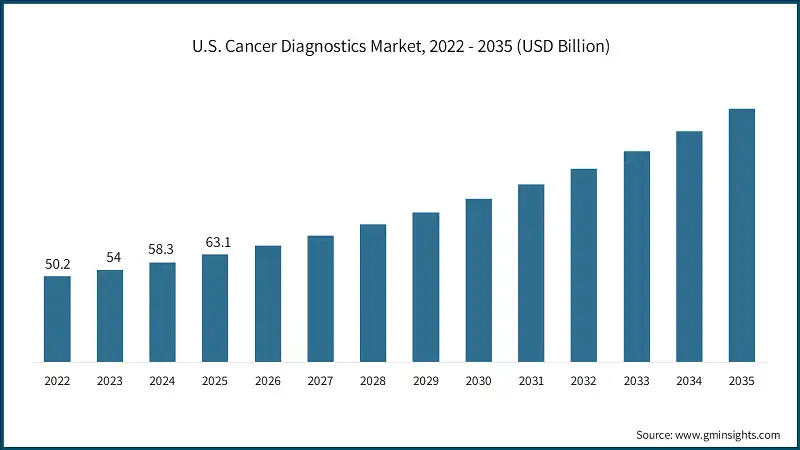
The North America dominated the market with a market share of 40.5% in 2025. The U.S. cancer diagnostics market is projected to grow significantly, from USD 63.1 billion in 2025 to USD 148.2 billion by 2035.
- The increasing prevalence of the cancer in the U.S. in the key driver for the growth of the market in the U.S.
- For instance, as per the data from the American Cancer Society in 2025, around 2,041,910 new cases of cancer were to be diagnosed, and 618,120 cases of cancer related deaths are projected to occur in the U.S.
- Thus, this rising burden of the cancer is propelling the market in the U.S. as many pharmaceutical and biotechnology companies, hospitals and research institutes are undertaking various research to develop advanced diagnostic solutions and therapies to combat the disease in the country.
Europe market accounted for USD 48.1 billion in 2025 and is anticipated to show lucrative growth over the forecast period.
- Rising cancer prevalence across European countries, driven by aging populations and lifestyle-related risk factors such as obesity, smoking, and alcohol consumption is significantly increasing the demand for advanced diagnostic solutions.
- Additionally, strong government initiatives promoting early cancer detection, coupled with widespread adoption of screening programs and improved healthcare infrastructure, are fueling market expansion.
- Technological advancements in molecular diagnostics, imaging modalities, and biomarker-based tests are further enhancing diagnostic accuracy and efficiency, making them integral to personalized treatment approaches.
The cancer diagnostics market in the UK is expected to experience significant and promising growth from 2026 to 2035.
- The rising aging population is one of the significant catalysts for the growth of the market in the country.
- According to the UK Parliament’s House of Commons, approximately 12.7 million senior citizens aged 65 and older resided in the UK in 2022, equated nearly to 19% of the entire population. The Office for National Statistics (ONS) estimates that the population of this group may reach 22.1 million by 2072, which will account for 27% of the overall population.
- Therefore, as the aging population increases, so does the prevalence of age-related health conditions such as cancer, stimulating the need for advanced cancer diagnostic systems tailored for the detection and diagnosis of various types of cancer conditions associated with the aging population, thereby fostering market growth.
The Asia Pacific market is anticipated to grow at the CAGR of 9.3% during the analysis timeframe.
- The growth in the region is primarily driven by the rising prevalence of chronic diseases such as cancer. For example, data from the Journal of Wiley indicates that in 2022, nearly 49.2% of all cancer cases were reported in Asia.
- Therefore, as the incidence of cancer continues to rise, the demand for effective diagnostic tools is anticipated to rise.
Japan cancer diagnostics market is anticipated to witness lucrative growth between 2026 – 2035.
- Japan has largest share of geriatric population in the world, that is resulting in a higher risk and prevalence of various types of cancer. For instance, as per the World Economic Forum, over 10% of the Japanese population is aged 80 years and older, which escalates the demand for effective diagnostic tools for early cancer diagnosis among high-risk individuals.
- Moreover, the implementation of community-based screening programs backed by the government of Japan is also contributing to the market growth.
The Brazil cancer diagnostics market is expected to experience significant and promising growth from 2026 to 2035.
- The rising prevalence of cancer is contributing to the growth of the market in the country.
- For instance, the Brazilian National Cancer Institute (INCA) reported to expect more than 704,000 new cancer cases annually from 2023 to 2025.
- Additionally, there has been growing awareness about the benefits of early disease detection and prevention, driven by public health initiatives and education campaigns, which is encouraging individuals to undergo health check-ups. This trend is expected to foster market growth through 2035.
The Saudi Arabia cancer diagnostics market is expected to experience significant and promising growth from 2026 to 2035.
- Saudi Arabia has experienced rise in early cancer detection due to growing awareness and improved screening programs. Thus, this trend encourages earlier treatment and heightens the demand for cancer diagnostic instrument and consumables.
- Further, Saudi Arabia’s advance healthcare infrastructure and rising investment in advanced healthcare technologies create opening for the development and adoption of advanced cancer diagnostic technologies tailored to the country’s patient specific needs.
Cancer Diagnostics Market Share
The cancer diagnostics industry is segmented and driven by a dynamic mix of international and domestic players delivering innovative solutions to meet the rising demand for advanced diagnostic tools that offer greater accuracy and faster turnaround times. Top 5 companies such as GE HealthCare Technologies, Koninklijke Philips, Siemens Healthineers, F. Hoffmann-La Roche, and Abbott Laboratories collectively account for approximately 48.7% of the market share, underscoring their dominance in this space. The market remains highly competitive, comprising both major corporations and emerging players.
Investment in cutting-edge technologies, including liquid biopsies, next-generation sequencing (NGS), and AI-powered imaging systems, is a core growth strategy for industry leaders. Additionally, collaborations with research institutions and healthcare providers are critical for accelerating the adoption of modern diagnostic solutions and expanding distribution networks, enabling companies to meet the growing demand for non-invasive, cost-effective cancer diagnostics.
Cancer Diagnostics Market Companies
Some of the eminent market participants operating in the cancer diagnostics industry include:
- Abbott Laboratories
- Becton, Dickinson and Company
- Biocare Medical
- Biocartis
- Biomerieux
- Bio-Rad Laboratories
- Danaher Corporation
- Exact Sciences Corporation
- F-Hoffmann-La Roche
- GE HealthCare Technologies
- Guardant Health
- Hologic
- Koninklijke Philips
- QIAGEN
- Siemens Healthineers
- Sysmex Corporation
- Thermo Fisher Scientific
- F-Hoffmann-La Roche
Roche is a global leader in vitro diagnostics and tissue-based cancer diagnostics, and remains at the forefront of diabetes management. The company has recently secured CE IVDR approval for its HER2 (4B5) companion diagnostic test, designed to identify patients with HER2-ultralow breast cancer and biliary tract cancer.
Thermo Fisher Scientific offers a comprehensive portfolio of diagnostic solutions for solid tumor biomarker testing, enabling clinicians to identify patients suitable for targeted therapies. These solutions leverage the proven capabilities of Ion Torrent and Oncomine NGS technologies to deliver fast, accurate, and actionable clinical insights.
Hologic focuses on the health of women and is an industry leader in the diagnosis of breast cancer with the aid of 3D mammography equipment. These are easily the best providers of breast cancer screening services due to their emphasis on digital imaging and early diagnosis.
Cancer Diagnostics Industry News:
- In September 2025, F. Hoffmann-La Roche’s VENTANA HER2 (4B5) test received CE-IVDR approval to support the assessment of HER2-ultralow status, enabling identification of metastatic breast cancer patients eligible for treatment with ENHERTU. The test also gained approval for identifying previously treated, unresectable, or metastatic HER2-positive biliary tract cancer (BTC) patients eligible for treatment with ZIIHERA. This achievement further strengthened Roche’s leadership in breast cancer diagnostics and enhanced access to personalized treatment options for patients.
- In March 2023, QIAGEN announced a strategic partnership with Servier, a global pharmaceutical group, to develop a companion diagnostic test for TIBSOVO, an isocitrate dehydrogenase-1 (IDH1) inhibitor indicated for the treatment of acute myeloid leukemia (AML). Under the Master Collaboration Agreement, QIAGEN will design and validate a real-time in vitro PCR assay to detect IDH1 gene mutations in AML patients using whole blood and bone marrow aspirates. This collaboration strengthened QIAGEN’s competitive position in the market.
- In February 2022, Becton, Dickinson and Company acquired Cytognos, a manufacturer and provider of solutions in cancer diagnostics. This acquisition helped the company to expand their product portfolio in blood cancer diagnostics, immune assessment tests and informatics. This acquisition helped the company to enhance their market presence and increase their business revenue.
The cancer diagnostics market research report includes an in-depth coverage of the industry with estimates and forecast in terms of revenue in USD Million from 2022 - 2035 for the following segments:
Market, By Application
- Tumor biomarkers tests
- Imaging
- Ultrasound and radiology
- Mammography
- MRI scan
- PET scan
- CT scan
- SPECT and other imaging
- Biopsy
- Liquid biopsy
- Immunohistochemistry
- In situ hybridization
Market, By Cancer Type
- Bladder cancer
- Breast cancer
- Colon and rectal cancer
- Endometrial cancer
- Kidney cancer
- Leukemia
- Liver and lung cancer
- Melanoma
- Non-Hodgkin lymphoma
- Pancreatic cancer
- Prostate cancer
- Thyroid cancer
- Other cancer types
Market, By End Use
- Hospitals
- Diagnostic laboratories
- Diagnostic imaging centers
- Cancer research institutes
The above information is provided for the following regions and countries:
- North America
- U.S.
- Canada
- Europe
- Germany
- UK
- France
- Italy
- Spain
- Netherlands
- Asia Pacific
- Japan
- China
- India
- Australia
- South Korea
- Latin America
- Brazil
- Mexico
- Argentina
- Middle East and Africa
- South Africa
- Saudi Arabia
- UAE
Frequently Asked Question(FAQ) :
What was the valuation of the breast cancer segment in 2025?
The breast cancer segment accounted for 19.5% of the market in 2025, propelled by the increasing prevalence of breast cancer globally.
What is the expected size of the cancer diagnostics industry in 2026?
The market size is projected to reach USD 186.1 billion in 2026.
How much revenue did the imaging segment generate in 2025?
The imaging segment generated the largest revenue share of 63.4% in 2025, led by the growing need for early cancer detection and diagnostic imaging tests.
What was the market size of the cancer diagnostics in 2025?
The market was valued at USD 171.7 billion in 2025, with a CAGR of 9.1% expected through 2035. The rising prevalence of cancer and advancements in diagnostic technologies are driving market growth.
What is the projected value of the cancer diagnostics market by 2035?
The market is poised to reach USD 408.9 billion by 2035, fueled by technological advancements, increasing awareness, and the adoption of AI-based diagnostic tools.
What is the growth outlook for the hospitals segment?
The hospitals segment dominated the market with a revenue of USD 69.5 billion in 2025. This growth is attributed to the rising number of hospitals, urbanization, and advancements in diagnostic technologies.
What is the projected growth of the U.S. cancer diagnostics sector?
The U.S. market is expected to grow significantly, from USD 63.1 billion in 2025 to USD 148.2 billion by 2035. The market is due to the increasing prevalence of cancer and advancements in diagnostic tools.
What are the upcoming trends in the cancer diagnostics market?
Key trends include wider use of non-invasive diagnostics such as liquid biopsies, AI-driven imaging, predictive analytics, precision oncology, better oncology information systems, and stronger awareness and regulatory support for early detection.
Who are the key players in the cancer diagnostics industry?
Key players include Abbott Laboratories, Becton, Dickinson and Company, Biocare Medical, Biocartis, Biomerieux, Exact Sciences Corporation, F-Hoffmann-La Roche, GE HealthCare Technologies, Guardant Health, Hologic, Koninklijke Philips, and QIAGEN.
Cancer Diagnostics Market Scope
Related Reports