Summary
Table of Content

Branded Food Staple Market
Get a free sample of this report
Form submitted successfully!
Error submitting form. Please try again.
Thank you!
Your inquiry has been received. Our team will reach out to you with the required details via email. To ensure that you don't miss their response, kindly remember to check your spam folder as well!
Request Sectional Data
Thank you!
Your inquiry has been received. Our team will reach out to you with the required details via email. To ensure that you don't miss their response, kindly remember to check your spam folder as well!
Form submitted successfully!
Error submitting form. Please try again.
Branded Food Staple Market Size
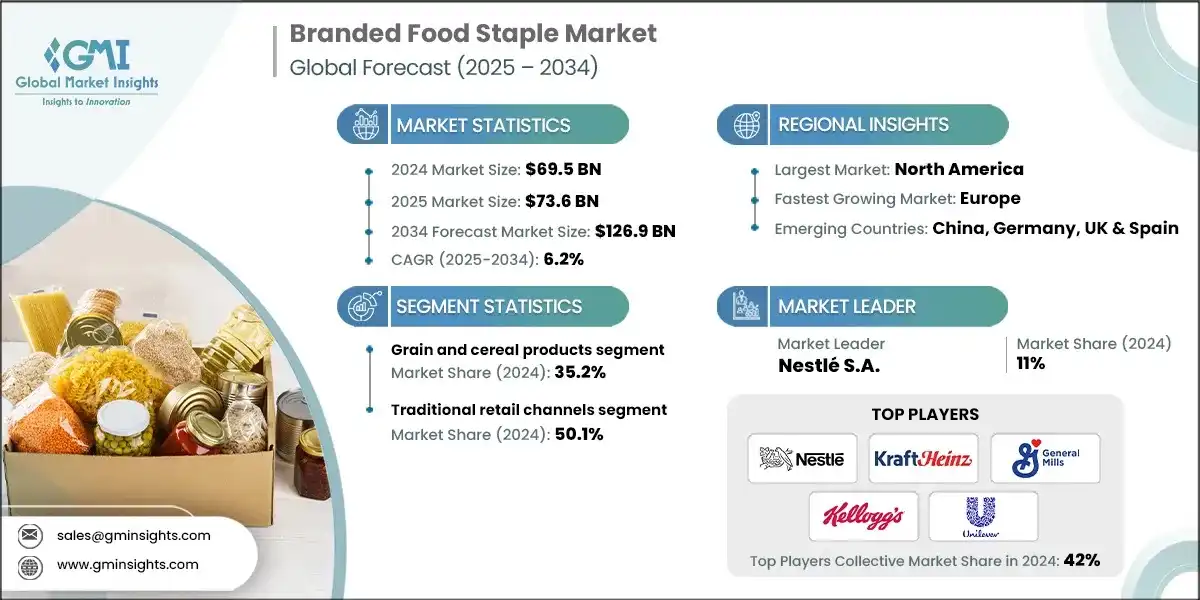
The global branded food staple market was estimated at USD 69.5 billion in 2024. The market is expected to grow from USD 73.6 billion in 2025 to USD 126.9 billion in 2034, at a CAGR of 6.2%, according to latest report published by Global Market Insights Inc.
Branded Food Staple Market Key Takeaways
Market Size & Growth
- 2024 Market Size: USD 69.5 Billion
- 2025 Market Size: USD 73.6 Billion
- 2034 Forecast Market Size: USD 126.9 Billion
- CAGR (2025–2034): 6.2%
Key Market Drivers
- Changing consumer lifestyles and dietary preferences.
- Brand recognition and trust.
- Increasing health and wellness awareness.
- Technological advancements in packaging and production.
Challenges
- Price volatility of raw materials.
- Intense competition from private labels.
Opportunity
- Health-oriented product innovation.
- Private label partnerships.
- Sustainable packaging solutions.
- Emerging market penetration.
Key Players
- Market Leader: Nestlé S.A. led with over 11% market share in 2024.
- Leading Players: Top 5 players in this market include Nestle S.A., Kraft Heinz Company, General Mills Inc., The Kelloggs Company, Unilever, which collectively held a market share of 42% in 2024.
Get Market Insights & Growth Opportunities
- Branded food staple consists of all essential, widely consumed packaged staples such as rice, flour, cooking oils, sugar and pulses, along with the consistency of quality, convenience, and trusted brand identity.
- The increasing global demand due to rapid urbanization and changing consumer lifestyles, which prioritize safe and reliable quality foods with clearly defined nutritional information rather than unbranded or bulk products is driving the market growth.
- The global transition toward healthier lifestyles and the increased awareness regarding food ingredients is a significant catalyst for the branded staple food market. Consumers are inclined toward products that have clear labels, few or no artificial additives, and often fortified choices. For instance, Kellogg's investment in organic and fortified cereal lines and Unilever's emphasis on plant-based cooking oils are examples that show how brands are adapting their portfolio of products to meet the needs of health-conscious consumers.
- North America is the largest market for branded food staples due to high awareness among consumers, developed retail infrastructures and demand for organic as well as clean-label products.
- Europe is the fastest growing region for branded food staple market, on account of increasing incomes among middle-class families, rapid urbanization and the cultural change in dietary preferences in countries such as Germany, UK, France and others.
To get key market trends
Branded Food Staple Market Trends
- Brands are now innovating staple foods reformulated into organic, non-GMO, low-sugar and fortified foods are in line with consumer demand for a healthier diet. For instance, companies such as Kellogg's have expanded their organic and fiber-rich cereal ranges.
- Consumers show increasing interest in trying diverse culinary experiences, a trend that is moving businesses toward making branded staples with flavors from international cuisines. This can be seen in the growing category of global-inspired spices, sauces, and ready-to-eat staples, as represented by new launches with ingredients inspired by Mediterranean, Thai and Latin American flavors.
- Nowadays, branded staples include alternative cereals, dairy substitutes, and even a type of seafood and eggs that is plant-based; their increasing market share has been attributed to health, environmental and ethical reasons.
- Brands are fast shifting to biodegradable, compostable and recyclable packaging, mostly of the time made from bioplastics or mono-materials in response to consumers' demand for environmentally friendly options. Companies such as Nestlé utilize smart packaging features such as freshness indicators or QR codes for sourcing transparency and design such that packaging uses less material or food waste.
- Rapid speed in online grocery shopping is reshaping the future of branded food staple distribution. This is where the direct-to-consumer model is leveraged by modern-day supermarkets and newer-generation brands, with online exclusive launches driving this as well. Digital marketing and collaboration with influencers increase reach and personalization. By 2025, e-commerce food sales are expected to be linked to 20% of total grocery sales.
- AI, for predictive maintenance and automated quality control, flavor optimization and real-time food safety assurance on production floors through smart vision, has made the whole landscape of automation cutting-edge.
Branded Food Staple Market Analysis
Learn more about the key segments shaping this market
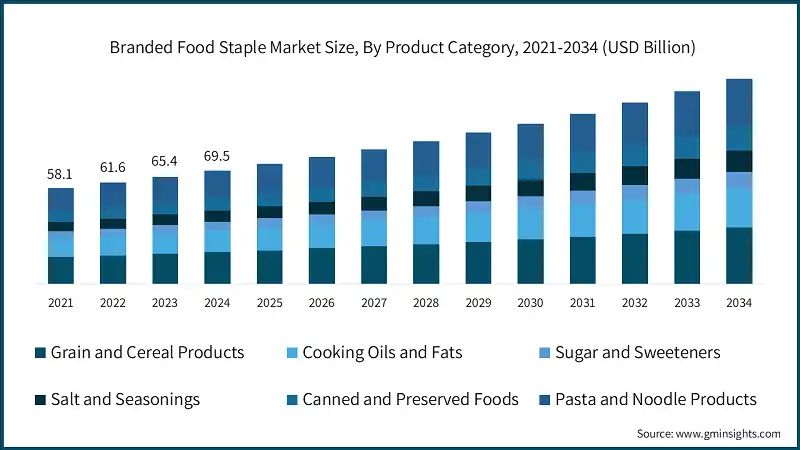
Based on product category, the market is segmented into grain and cereal products, cooking oils and fats, sugar and sweeteners, salt and seasonings, canned and preserved foods, and pasta and noodle products. The grain and cereal products dominated the market with share of 35.2% in 2024 and expected to grow with a CAGR of 6.5% till 2034.
- Grain and cereal products occupy the leading segment as a consequence of greater urbanization, enhanced consumer awareness regarding packaged and fortified grains and an increase in health consciousness.
- Cooking oils and fats continue their popularity due to the high demand for heart-healthy and plant-based oils. Healthier alternatives like cold-pressed plant-based oils and omega-3 enriched oils are gaining momentum, alongside avocado, flaxseed, and coconut oils, which are steadily being featured into branded portfolios.
- Sugar and sweeteners are struggling with reformulation attempts but remain a successful kitchen cupboard staple. Heightening consumer attention to sugar intake has let the branded staples develop low-calorie blends with natural sweeteners (stevia, monk fruit). Innovations in reduced-sugar offerings and substitutes for sugar continue in brands while effectively maintaining taste, often targeting consumers with diabetes and being conscious of their weight.
- Steady growth continues for salt and seasonings as interest in global flavors and convenient cooking increases. Artisanal, exotic and flavored salts (Himalayan pink, smoked, infused salts) are now being demanded as culinary experimentation trends evolve. In contrast, functional seasonings with extra vitamins, minerals and antioxidants are on the shopping list of health-aware consumers.
- Consumer demand for canned, preserved foods, as well as pasta and noodles, continues to prosper with extended convenience and shelf life, particularly in emerging markets. The reduction of preservatives and the introduction of clean-label methods present new opportunities for growth for branded products.
Learn more about the key segments shaping this market
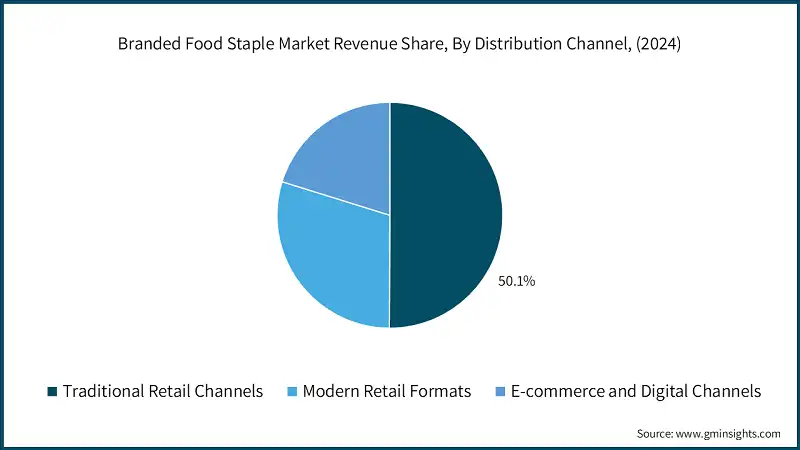
Based on distribution channel, the market is segmented into traditional retail channels, modern retail formats, and e-commerce and digital channels.
- Traditional retail channels hold the largest market share of 50.1% in 2024 and is expected to grow at a CAGR of 6.3% through 2034, the major force behind this being supermarkets, grocery stores, and neighborhood shops, which continue to dominate as the main source for buying staple food across the world. Store modernization effects should further enhance the in-store experience to include nutrition kiosks, sampling zones, and branded staples.
- Urban shifts such as hypermarkets and convenience stores from modern retail formats are emerging factors. For volume purchases and premium brand staples, hypermarkets and convenience stores have become the preferred place because they offer better variety and value packs. Integration of technologies such as self-checkout and digital signage improves shopper engagement.
- E-commerce is the fastest growing channel, facilitated by increasing household internet penetration, digital payment adoption, and the convenience of online transactions. Increasingly, companies employ social commerce and influencer marketing to boost consumer engagement, especially millennials and members of Gen Z. Online grocery platforms offer subscriptions for replenishing staples, making recommendations based on purchase history and bundling discounts.
Looking for region specific data?
North America Branded Food Staple Market
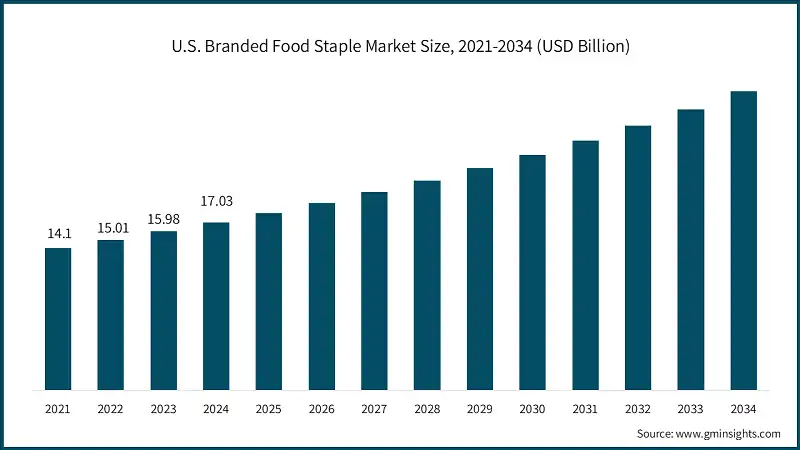
The North America dominated the U.S. market with a revenue share of 30.3% in 2024.
- The market for branded food staples in North America is on a steady growth trajectory, mainly due to the increase in consumer demands regarding healthier, organic, and natural products. Initiatives in sustainability determine how packages get designed and where the commodities come from. Therefore, with health and wellness, now the regions adapt to the changing consumer focus toward environmental responsibility in sustaining growth across the region.
U.S. dominates the North America branded food staple market, showcasing strong growth potential.
- The branded staple food market in the U.S. is robustly characterized by highly higher demands for health-related staples, coupled with convenience-oriented offerings. American consumers are increasingly opting for organic and non-GMO products, with most of them choosing minimally processed staples and even plant-based and functional foods that can boost their wellness. Also, online shopping complemented by online sales through DTC channels are also widening the boundaries of the market scope, while brands increasingly become sustainable in their practices to meet environmental concerns.
Europe Branded food staple Market
Europe branded food staple accounted for USD 17.5 billion in 2024 and is anticipated to show lucrative growth over the forecast period.
- Unlike in the past, consumer interest in health, sustainability, and natural ingredients today are driving the European branded food staple market's growth. Interestingly, European consumers are increasingly looking for organic, non-GMO, and ethically sourced products, thus encouraging brands to come up with such innovations in environmentally friendly packaging and transparent supply chains. Convenience remains an important consumer trend; popular ready-to-eat and minimally processed food products. Eco-conscious consumers are pushing for the adoption of sustainable practices, thus aligning the market with an environmentally friendly value system.
Germany dominates the European branded food staple market, showcasing strong growth potential.
- Germany, as one of the major contributors in Europe has a particularly strong emphasis on organic and sustainable food staples. The demand for organic grains, plant-based products and eco-friendly packaging is accelerating in Germany where consumers regard quality, transparency and environmental responsibility as priorities. A strong progressive health and sustainability stance informs product development and marketing strategies while the inclination toward functional food for wellness grows stronger.
Asia Pacific branded food staple Market
The Asia Pacific branded food staple is anticipated to grow at the highest CAGR of 5.8% during 2025 to 2034.
- In the Asia-Pacific region, the market is advancing rapidly, benefiting from increasing urbanization, disposable income, and changing consumer dietary habits. Consumers look for convenience value for money, and nutritious products, showing an increasing interest in health and wellness. Ultimately traditional flavors and local ingredients dominate the scene whereas international brands establish themselves region-wide through adaptation to local tastes.
China branded food staple is estimated to grow with a significant CAGR, in the Asia Pacific branded food staple.
- In China, the largest market in the Asia-Pacific region, a remarkable shift toward healthier and premium food options is taking place. The local consumers are increasingly looking for organic, non-GMO, and functional foods that support health and wellness. Rapid urbanization and the burgeoning middle class are stimulating demand for convenience food that includes ready-to-eat and packaged staples. Local flavors and traditional ingredients have always been popular, but an influx of international brands is adapting to Chinese tastes. E-commerce is on its way up, with digital platforms providing further thrust to market diversification and acceleration of food staple offerings.
Latin American Branded Food Staple Market
Latin America branded food staple accounted for USD 10.4 billion in 2024 and is anticipated to show lucrative growth over the forecast period.
- Urbanization, rising incomes, and a growing middle class contribute to increased demand for branded food staples in Latin America. Health-and-wellness consciousness is rising; consumers are increasingly looking for the convenient, low-cost, nutritious food options that fit this characteristic. On-trade flavors and local ingredients hold many consumers' loyalty, but there is mounting demand for fast-moving international commodities and premium brands. The modern retail and e-commerce channels of distribution support access to a wide variety of food staples, thereby contributing to the development of the market across the region.
Brazil leads the Latin American branded food staple market, exhibiting remarkable growth during the analysis period.
- With Brazil being the largest Latin American economy, it can be mandated that this country plays an important role in this market. The health-conscious Brazilian consumer has increasingly turned his attention toward organic, natural, and functional foods in this country. Demand continues for traditional staples produced locally, for example, rice, beans, and maize, but preference for convenience and healthier choices is on the rise among consumers. Sustainable packaging and transparency in sourcing are increasingly important to consumers. Brazilian market characteristics are a blend of standing for traditional preferences along with an openness for innovation when catering to nutritious and accessible food staples serving diversified consumer needs.
Middle East and Africa Branded food staple Market
Middle East & Africa branded food staple accounted for USD 6.8 billion in 2024 and is anticipated to show lucrative growth over the forecast period.
- With population growth, urbanization and increased incomes, the branded staples market in the Middle East and Africa (MEA) is expected to grow. The consumers were drawn by convenience, affordability, and nutrition but are increasingly becoming health-conscious with their consumption options. Traditional tastes and local sourcing are still in high demand, while the international brands are increasing their footprints with the adaptation of regional tastes. The role played by e-commerce and modern retail formats has made the availability of a broader range of foods across urban and developing markets.
Saudi Arabia branded food staple market to experience substantial growth in the Middle East and Africa in 2024.
- Saudi Arabia has a food staple industry with many characteristics of an emerging and dynamic market, both of which have highly urbanized areas and an increasingly growing middle class. It is most probably found that consumers preferred foods associated with health, convenience, and high quality, including those classified as organic or functional. Basic commodities such as rice, wheat, and dates form the backbone in households, but there is a trend toward the acceptance of healthier substitutes and imported brands. Thus, in Saudi Arabia as well as MEA, health concerns, convenience, and taste preferences deriving from various regional influences would drive the market.
Branded Food Staple Market Share
The top 5 companies in the branded food staple industry include Nestlé S.A., Kraft Heinz Company, General Mills Inc., The Kellogg’s Company, Unilever, Mars Incorporated, and Mondelez International Inc. These are prominent companies operating in their respective regions covering 42%-43% of the market share. These companies hold strong positions globally due to their extensive experience in branded food staple market. Their diverse product portfolios, backed by robust production capabilities and distribution networks, enable them to meet the rising demand across various regions.
- Nestlé maintains its leadership as a strong multi-category portfolio and ceaseless innovations. These highly delve into the extension of its reach among core and emerging markets. Furthermore, continuous investment in product expansion and recent strengthening in e-commerce allows Nestlé to propel a sustainable market leadership and flexibility with changing global consumer demands. In May 2025, Nestlé put out a wider range of air fryers for consumers' convenience.
- Kraft Heinz market leadership is supported by an extensive range of popular staples, including Heinz ketchup, Kraft cheese, sauces, and other related products. Kraft Heinz has also strived to invest in digitalization and sustainability. In 2025, the company is accelerating its direct online consumer platforms and in 2024, announced its plants with upgrades that will reduce carbon emissions and improve energy efficiency.
- General Mills differentiate itself through innovation in cereals, grains, and packed meal solutions alongside a strong commitment to health and wellness of consumers.
- Kellogg's remains in the popularity positioning through re-innovation in cereal and snacks. In 2025, Kellogg's launched new cereals under the high fiber plant-protein enhancement as per emerging dietary trends. Kellogg's is able to maintain healthy consumer loyalty across well-established as well as developing markets due to use of agile marketing techniques and their innovation hubs.
- Unilever has a great presence with a priority positioned on sustainable sourcing and their plant-based alternatives. In 2025, Unilever launched traceable digitally interactive packaging for staple items, providing full transparency from farm to table thus enjoying peoples' demand for food safety and authenticity.
Branded Food Staple Market Companies
Major players operating in the branded food staple industry include:
- Associated British Foods plc (ABF)
- Danone S.A.
- General Mills Inc.
- Kraft Heinz Company
- Mars Incorporated
- McCormick & Company, Inc.
- Mondelez International Inc.
- Nestlé S.A.
- PepsiCo Inc.
- The Coca-Cola Company
- The Hershey Company
- The Kellogg’s Company
- Unilever
Branded Food Staple Market Report Attributes
| Key Takeaway | Details |
|---|---|
| Market Size & Growth | |
| Base Year | 2024 |
| Market Size in 2024 | USD 69.5 Billion |
| Market Size in 2025 | USD 73.6 Billion |
| Forecast Period 2025 - 2034 CAGR | 6.2% |
| Market Size in 2034 | USD 126.9 Billion |
| Key Market Trends | |
| Drivers | Impact |
| Changing consumer lifestyles and dietary preferences | Increase demand for convenient, branded food staples tailored to health trends, |
| Brand recognition and trust | Boost sales of branded staples for quality, safety, and consistency over unbranded or generic products. |
| Increasing health and wellness awareness | Encourages demand for fortified, organic, or clean-label branded food staples. |
| Technological advancements in packaging and production | Enhance shelf life, improve convenience, and enhances product appeal, attracting eco-conscious consumers. |
| Pitfalls & Challenges | Impact |
| Price volatility of raw materials | Fluctuating commodity prices affect cost structures and retail pricing stability. |
| Intense competition from private labels | Forces branded players to innovate and differentiate aggressively. |
| Opportunities: | Impact |
| Health-oriented product innovation | Attracts health-conscious consumers and premium market segments. |
| Private label partnerships | Increases distribution, market reach, strengthens retail relationships and diversifies revenue streams. |
| Sustainable packaging solutions | Appeals to eco-aware consumers, enhances brand image and supports circular economy goals. |
| Emerging market penetration | Drives volume growth and international brand recognition. |
| Market Leaders (2024) | |
| Market Leaders |
11% market share |
| Top Players |
Collective market share 42% in 2024 |
| Competitive Edge |
|
| Regional Insights | |
| Largest Market | North America |
| Fastest Growing Market | Europe |
| Emerging Country | China, Germany, UK & Spain |
| Future Outlook |
|
What are the growth opportunities in this market?
Branded Food Staple Industry News
- In April 2025, the Kraft Heinz Company upgraded some of its direct-to-consumer platforms, along with upgrading its manufacturing plants with energy-efficient technologies targeted at reducing emissions, with some new launches in clean-label essentials with direct sourcing.
- In March 2025, General Mills grew its cereals and grain business to include organic and gluten-free offerings following the global trend toward health and wellness.
- In February 2025, Kellogg's introduced cereals rich in fiber and supplemented with plant proteins, pledging sustainable sourcing of ingredients and recyclable packaging under its global Better Days program.
- In Dec 2024, Unilever announced selling the food brands Unox and Zwan to Zwanenberg Food Group, aiming to have a sharper focus on fewer but bigger brands in food, thereby thinning its food portfolio.
This branded food staple market research report includes in-depth coverage of the industry, with estimates & forecasts in terms of revenue (USD Million) and volume (Units) from 2025 to 2034, for the following segments:
Market, By Product Category
- Grain and cereal products
- Rice and rice products
- Wheat and wheat-based products
- Oats and oat-based products
- Specialty and ancient grains
- Cooking oils and fats
- Vegetable oils
- Olive oil and premium oils
- Specialty and functional oils
- Butter and margarine products
- Sugar and sweeteners
- Refined sugar products
- Natural and alternative sweeteners
- Honey and maple products
- Artificial sweetener systems
- Salt and seasonings
- Table salt and specialty salts
- Spice and seasoning blends
- Herbs and natural seasonings
- Ethnic and international seasonings
- Canned and preserved foods
- Canned vegetables and fruits
- Preserved meat and seafood
- Pickled and fermented products
- Pasta and noodle products
- Traditional pasta products
- Specialty and artisanal pasta
- Alternative and gluten-free pasta
Market, By Distribution Channel
- Traditional retail channels
- Supermarkets and hypermarkets
- Convenience stores
- Specialty food stores
- Modern retail formats
- Discount retailers
- Organic and natural food stores
- Gourmet and premium retailers
- E-commerce and digital channels
- Online grocery platforms
- Direct-to-consumer sales
- Subscription services
The above information is provided for the following regions and countries:
- North America
- U.S.
- Canada
- Europe
- Germany
- UK
- France
- Spain
- Italy
- Rest of Europe
- Asia Pacific
- China
- India
- Japan
- Australia
- South Korea
- Rest of Asia Pacific
- Latin America
- Brazil
- Mexico
- Argentina
- Rest of Latin America
- Middle East and Africa
- Saudi Arabia
- South Africa
- UAE
- Rest of Middle East and Africa
Frequently Asked Question(FAQ) :
What is the market size of the branded food staple in 2024?
The market size was USD 69.5 billion in 2024, with a CAGR of 6.2% expected through 2034 driven by rapid urbanization, changing consumer lifestyles, and increasing demand for quality packaged staples.
What is the projected value of the branded food staple market by 2034?
The branded food staple market is expected to reach USD 126.9 billion by 2034, propelled by health-oriented innovation, e-commerce growth, and rising awareness of nutritional transparency.
What is the current branded food staple market size in 2025?
The market size is projected to reach USD 73.6 billion in 2025.
How much revenue did the grain and cereal products segment generate in 2024?
Grain and cereal products dominated the market with 35.2% share in 2024 and are expected to grow at a CAGR of 6.5% through 2034.
What was the valuation of traditional retail channels segment in 2024?
Traditional retail channels held the largest market share of 50.1% in 2024 and are expected to grow at a CAGR of 6.3% through 2034, supported by supermarkets and grocery stores.
Which region leads the branded food staple market?
The North America dominated 30.3% share of the U.S. branded food staple market in 2024., supported by high consumer awareness, developed retail infrastructure, and strong demand for organic and clean-label products.
What are the upcoming trends in the branded food staple market?
Key trends include health-oriented product reformulation with organic and fortified options, sustainable biodegradable packaging, plant-based alternatives, digital commerce expansion, and AI-driven production automation.
Who are the key players in the branded food staple market?
Key players include Nestlé S.A., Kraft Heinz Company, General Mills Inc., The Kellogg's Company, Unilever, Mars Incorporated, Mondelez International Inc., Associated British Foods plc, Danone S.A., PepsiCo Inc., The Coca-Cola Company, The Hershey Company, and McCormick & Company Inc.
Branded Food Staple Market Scope
Related Reports