Summary
Table of Content

Botanical Supplements Market
Get a free sample of this report
Form submitted successfully!
Error submitting form. Please try again.
Thank you!
Your inquiry has been received. Our team will reach out to you with the required details via email. To ensure that you don't miss their response, kindly remember to check your spam folder as well!
Request Sectional Data
Thank you!
Your inquiry has been received. Our team will reach out to you with the required details via email. To ensure that you don't miss their response, kindly remember to check your spam folder as well!
Form submitted successfully!
Error submitting form. Please try again.
Botanical Supplements Market Size
- The term botanical supplements describe products which people use to maintain their health that come from plant sources which include herbal and plant-based supplements. Users consume the product which contains various plant parts including leaves and roots and flowers and seeds and extracts through different methods of ingestion which include capsules and powders and teas and tinctures.
- People use botanical supplements as natural health solutions which address various health issues through their marketing which promotes products to treat digestive problems and immune system issues and stress reduction and energy boosting.
- The botanical supplement market has witnessed significant growth because people now understand natural health alternatives and preventive care better. Consumers prefer products which deliver both nutritional value and therapeutic effects while lacking any artificial chemical components.
- Botanical supplement companies have been transformed through modern technology which improved their extraction processes, product formulation methods and quality assessment techniques. Plant-derived compounds achieve their highest purity, potency and authentic identity by supercritical CO₂ extraction and high-performance liquid chromatography and DNA barcoding techniques. Digital platforms and e-commerce systems enable customers to track their product usage while receiving personalized product suggestions and ordering products directly from manufacturers.
- The health benefits of botanical supplements remain promising, but their effectiveness and safety depend on multiple factors, which include the plant used the method of preparation and how each person reacts to it. The regional regulatory systems determine different labeling requirements and marketing rules and quality control methods.
The global botanical supplements market was valued at USD 34.4 billion in 2025. The market is expected to grow from USD 37.3 billion in 2026 to USD 67.2 billion in 2035, at a CAGR of 7.6% according to the latest report published by Global Market Insights Inc.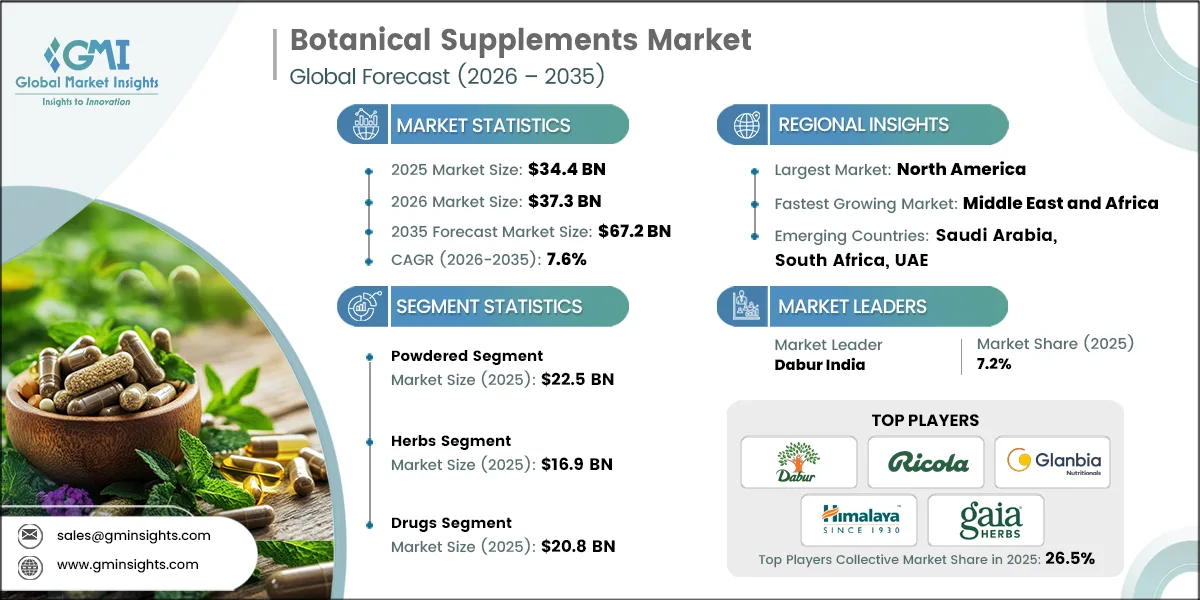
Botanical Supplements Market Key Takeaways
Market Size & Growth
- 2025 Market Size: USD 34.4 Billion
- 2026 Market Size: USD 37.3 Billion
- 2035 Forecast Market Size: USD 67.2 Billion
- CAGR (2026–2035): 7.6%
Regional Dominance
- Largest Market: North America
- Fastest Growing Region: Middle East and Africa
Key Market Drivers
- Rising health awareness.
- Scientific validation.
- Digital & e-commerce expansion.
Challenges
- Regulatory variability.
- Quality & safety concern.
Opportunity
- Personalized nutrition.
- Innovative formulations.
Key Players
- Market Leader: Dabur India led with over 7.2% market share in 2025.
- Leading Players: Top 5 players in this market include Dabur India, Ricola AG, Glanbia Nutritionals, Himalaya Wellness Company, Gaia Herbs, which collectively held a market share of 26.5% in 2025.
Get Market Insights & Growth Opportunities
To get key market trends
Botanical Supplements Market Trends
- The market for botanical supplements grows because people worldwide now prioritize preventive healthcare and wellness. Consumers prefer plant-based solutions as they want to maintain their health through natural methods. People make this change because they now understand how their lifestyle choices affect their health and because they want to achieve total body wellness.
- Clinical studies and research progress have proven the effectiveness of different botanical remedies through their scientific findings. Scientific verification gives consumers confidence which enables them to accept herbal supplements as part of standard medical treatment. The standardization process for extract products and evidence-based product development helps establish trust within the healthcare industry.
- Botanical supplements become more readily available to customers as online platforms have expanded their reach. Companies use digital marketing and e-commerce platforms to connect with customers worldwide which caters to more product adoption and sales revenue. Consumers compare products, read reviews, and receive personalized recommendations about any product.
- Natural health products have become part of daily life for younger consumers who belong to the Millennial and Gen Z age groups. The combination of urbanization and rising disposable incomes and people wanting to live wellness-focused lifestyles has led to continuous demand growth for botanical supplements across different demographic groups.
- The product market has expanded to attract more customers through continuous development of new product types, which include gummies and ready-to-drink beverages and powders and functional blends. Traditional botanicals now work with modern formulations, which enables companies to create specific health solutions that provide them a competitive edge for continuing market growth.
Botanical Supplements Market Analysis
Learn more about the key segments shaping this market
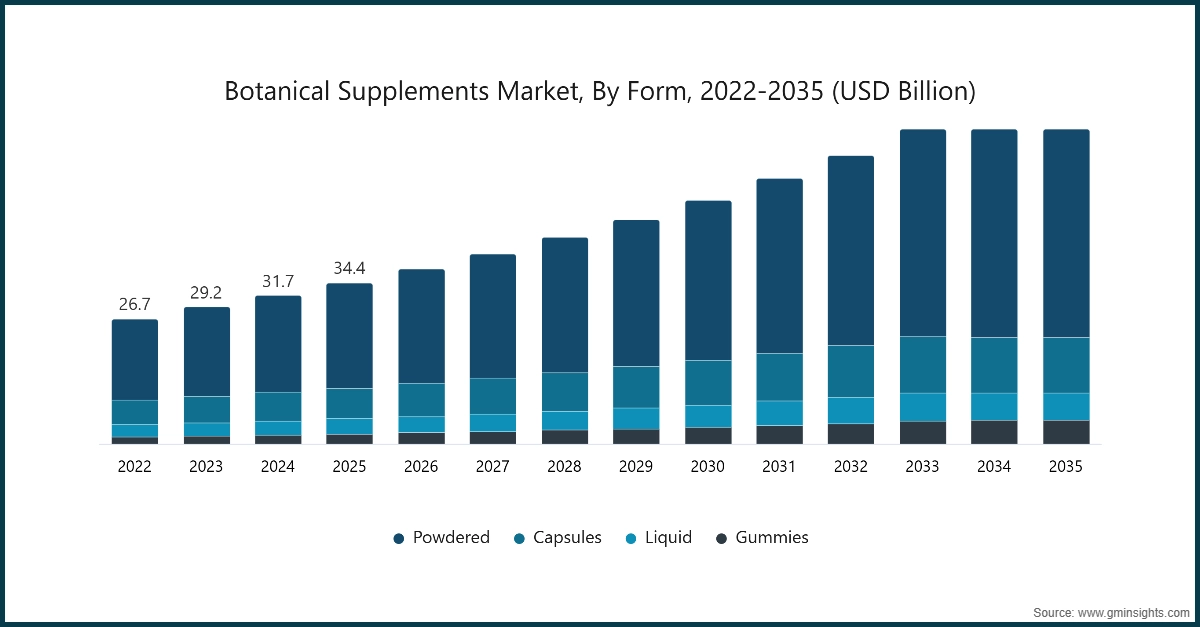
The botanical supplements market by form is segmented into powdered, capsules, liquid, and gummies. Powdered segment hold the largest market value of USD 22.5 billion in 2025.
- The rising demand for powdered botanical supplements comes from their ability to be easily mixed into various drinks and wellness products. The products serve multiple purpose because users can adjust their dosage in fitness, detox, and adaptogen products. Daily herbal supplements are most consumed in capsule form which provides users with two essential benefits of precise dosage and extended product shelf life.
- Liquid botanical supplements are increasingly adopted because they provide two main benefits of faster absorption and easier consumption for people who need to take herbal extracts and tonics. Gummies are quickly becoming a popular choice because their appealing flavor and convenient usage make them especially attractive to younger consumers who want an enjoyable way to take botanical supplements for their wellness needs.
The botanical supplements market by sources is segmented into herbs, roots and rhizomes, fruits & berries and others. Herbs segment holds the largest market value of USD 16.9 billion in 2025.
- Herbs are among the most widely used sources in botanical supplements because their long history in traditional medicine and wellness practices. People use these products to support their immune system and digestive system and manage their stress levels. The industry values roots and rhizomes as essential ingredients because they provide concentrated bioactive compounds which manufacturers use to create products that enhance energy and reduce inflammation and support overall health.
- Botanical supplements now feature fruits and berries as popular ingredients because their high antioxidant levels help boost immunity and maintain healthy skin. The products are commonly available in three forms which include powders and extracts and gummies. The botanical supplement market offers various products because seeds and bark and flowers serve as additional plant parts which provide distinct functional traits.
Learn more about the key segments shaping this market
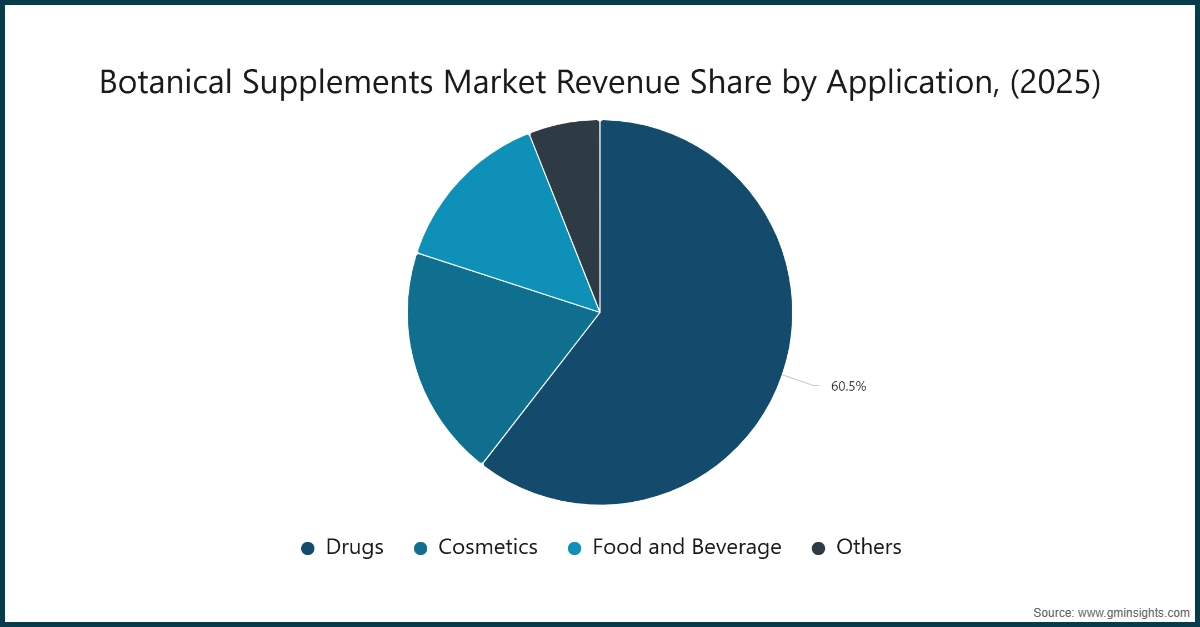
The botanical supplements market by application is segmented into drugs, cosmetics, food & beverage and others. Drugs segment hold the largest market value of USD 20.8 billion in 2025.
- Botanical ingredients are increasingly used in drugs due to their therapeutic properties and role in traditional and modern herbal medicine. They are incorporated into pharmaceutical formulations targeting conditions such as inflammation, digestion issues, and immunity support. In cosmetics, botanical extracts are widely utilized for their natural benefits in skincare and haircare products, including anti-aging, hydration, and soothing effects.
- In the food and beverage sector, botanical ingredients are gaining traction in functional foods, herbal teas, and wellness drinks as consumers seek natural and health-enhancing options. Other applications include dietary supplements and nutraceutical products, where plant-based ingredients are used to promote overall wellness, energy support, and preventive healthcare solutions.
The botanical supplements market by distribution channel is segmented into pharmacies and specialty stores, supermarkets and hypermarkets, online retail / e-commerce and others. Pharmacies and specialty stores segment hold the largest market value of USD 12.8 billion in 2025.
- Pharmacies and specialty stores provide trusted guidance and access to botanical supplements, while supermarkets and hypermarkets offer convenience and high visibility. The distribution channels enable customers to make both regular and frequent purchases while accessing a complete selection of herbal and wellness products.
- The online retail and e-commerce platforms enable customers to shop with greater ease because they access a wider selection of products which includes subscription services. The "Others" category includes direct sales, wellness clinics and other networks which enables niche botanical products to reach specific market segments through specialized distribution channels.
Looking for region specific data?
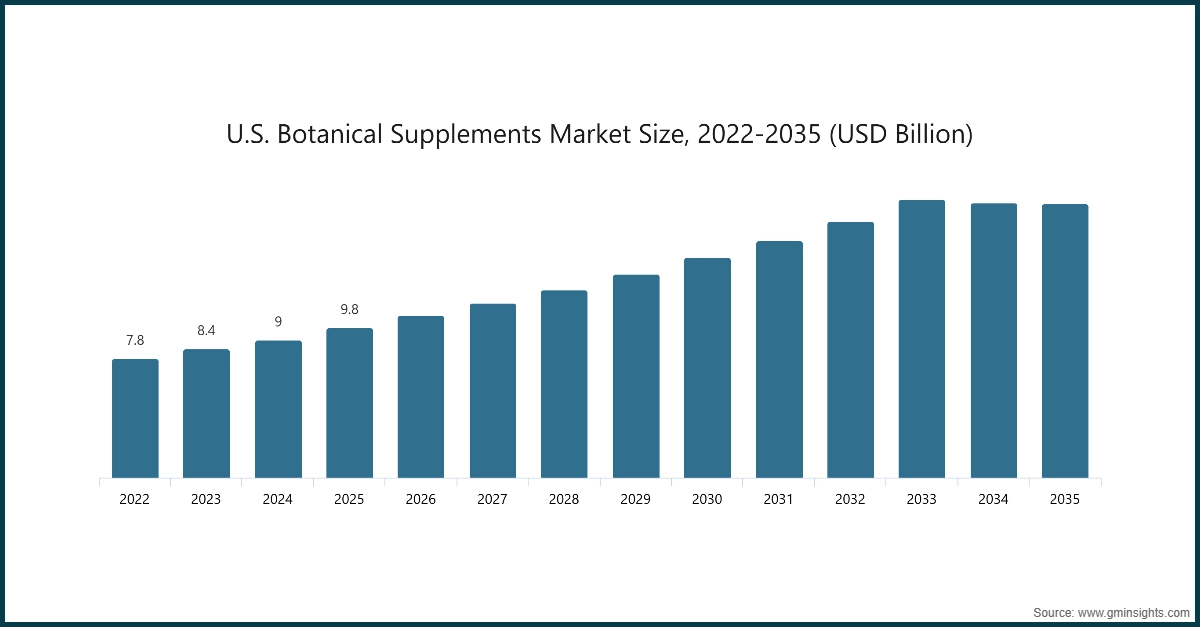
The market in the North America is expected to experience significant and promising growth from USD 11.5 billion in 2025 to USD 21.1 billion in 2035. The U.S. botanical supplements market accounted for USD 9.8 billion in 2025.
- The market for botanical supplements in North America has achieved maturity because people maintain high health awareness and preventive healthcare practices and regulatory agencies have developed advanced rules. The public develops a stronger preference for natural remedies and functional foods and supplements because e-commerce and retail networks provide strong support for their availability. The United States holds the largest botanical supplement market worldwide because its population experiences rising disposable incomes and follows wellness-based lifestyles and scientific research confirms the effectiveness of herbal products. The market experiences substantial growth because immunity boosters and adaptogens and personalized nutrition solutions draw multiple age groups and health-conscious customers.
The market in the Europe is expected to experience significant and promising growth from USD 8.3 billion in 2025 to USD 15.2 billion in 2035.
- Botanical supplements experience consistent growth because Europe combines its herbal medicine heritage with its strict quality and safety regulation requirements and its existing herbal medicine traditions. Consumers value products which provide both scientific evidence and standardized quality and which display information through clear product labels and trustworthy product sourcing. Germany leads the European market because it possesses historic roots in both phytotherapy and herbal medicine. The demand for botanical supplements has expanded in Germany because of three factors: regulatory support for natural remedies, consumer confidence in those remedies, and the rising interest in preventive healthcare.
The botanical supplements market in Asia Pacific is expected to experience increasing growth from USD 9.3 billion in 2025 to USD 17.2 billion.
- Botanical supplements experience important growth in the Asia-Pacific region because traditional medicine systems serve as the foundation of traditional medicine systems. The rising demand for preventive healthcare grows stronger through urbanization and disposable income growth and preventive healthcare awareness. The market in China operates as a worldwide center for botanical supplement consumption because people fully accept herbal products and local people possess extensive knowledge about herbal remedies and the market uses advanced manufacturing methods.
Middle East & Africa market is expected to experience significant and promising growth from USD 1.4 billion in 2025 to USD 4.6 billion in 2035.
- The Middle East and Africa region now serves as an emerging market for botanical supplements because rising health consciousness and young populations and preventive care interest increase in these areas. The public now adopts natural remedies as their primary method to achieve lifestyle wellness. The botanical supplement market in the UAE experiences growth because high-income urban residents and advanced retail systems and awareness about global wellness trends create better conditions for growth. The UAE serves as the main gateway for herbal supplement adoption throughout the region because demand for immunity boosters and energy enhancers and stress-relief products has reached extremely high levels.
Latin America is expected to experience significant and increasing growth from USD 4 billion in 2025 to USD 9.2 billion in 2035.
- The Latin America region sees increasing consumer interest in natural health products through rising wellness and preventive health care activities among consumers. The market grows through expanded retail networks and rising urban populations and increased health awareness. The Brazilian economy which stands as one of the largest economies in the region sees its population adopt botanical supplements because disposable income growth and wellness-oriented lifestyles. Daily routines now feature herbal and plant-based products because people increasingly choose immunity supplements and energy supplements and stress-related supplements which reflect both traditional knowledge and modern health trends.
Botanical Supplements Market Share
- The markets are moderately consolidated with players Dabur India, Ricola AG, Glanbia Nutritionals, Himalaya Wellness Company, Gaia Herbs holding 26.5% market share and Dabur India being the market leader holding the market share of 7.2% in 2025.
- The companies establish their market advantage through their product development procedures which emphasize both product authenticity and superior product quality. The combination of scientific plant extract validation with standardized product formulations creates safe and effective products which establish trust with consumers.
- Product development innovation functions as a vital element for success. Companies create various product forms which include gummies and powders and capsules and teas and ready-to-drink beverages to meet the different preferences and lifestyles of their customers.
- Technology functions as an essential component. Companies use advanced extraction techniques and AI-powered personalized recommendations and digital marketing methods to create customized solutions which provide better results to a wider customer base.
- Strong branding with transparent communication practices creates trust while establishing credibility, thus help companies to maintain their competitive edge. Consumers use clear product labels together with ethical sourcing practices and regulatory compliance to make their brand choices between competing products in a market that contains many options.
- Companies maintain their position in the market through customer interactions and ongoing trend analysis activities. The botanical supplements industry requires businesses to understand customer needs while using feedback to develop products which align with active wellness trends.
Botanical Supplements Market Companies
Major players operating in the botanical supplements industry are:
- Dabur India
- Nature's Way Products LLC
- Ricola AG.
- Mondelez International
- Procter and Gamble
- Nutraceuticals Group Europe Ltd UK
- Gaia Herbs
- Himalaya Wellness Company
- Glanbia Nutritionals
- Botanicalife International of America, Inc.
- Blackmores Limited
- Gaia Herbs
Dabur India stands as the top Indian company that produces consumer goods and herbal health products with its extensive range of Ayurvedic and natural health offerings. The company operates throughout Asia, Middle East and Africa, North America through its well-known brands that provide products for digestive health and immune support and herbal dietary solutions. Its dedication to developing traditional Ayurvedic products together with contemporary scientific research has made it a leading company in the worldwide market for botanical dietary supplements.
Ricola AG produces herbal products which include natural throat lozenges and herbal wellness items made from Alpine herbs. The company obtains its herbs through Swiss mountain farms while establishing its commitment to natural ingredient usage and environmentally friendly farming methods. The company distributes its products to over 50 countries and establishes its main market presence through its herbal cough and throat relief products which receive widespread recognition.
Glanbia Nutritionals serves as the global nutrition division of Glanbia plc which maintains its headquarters in Ireland by delivering nutritional ingredients and performance nutrition solutions to food and beverage and supplement manufacturers around the world. The company provides customers with a complete product range that contains plant-based proteins together with botanical extracts and vitamins and minerals and functional ingredients which customers use in dietary supplements and functional foods. The company uses its research and innovation capabilities together with its global manufacturing operations to deliver premium botanical and nutraceutical components needed by health and wellness industry organizations.
Himalaya Wellness Company operates as a worldwide healthcare organization which focuses on producing herbal and Ayurvedic products. The company deals in botanical supplements and pharmaceuticals and personal care products and animal health products which derive from medicinal plants. The company uses traditional Ayurvedic knowledge together with modern scientific research and clinical studies to develop its products which it sells in more than 100 countries. The company produces popular herbal products which enhance liver function and strengthen the immune system and improve digestion and promote general wellness.
Gaia Herbs is a U.S.-based herbal supplement company that provides plant-based wellness products which use organically grown herbs and botanical extracts for their products. The company produces high-quality herbal supplements which include liquid extracts and capsules and teas and powders for immunity and stress relief and digestion and overall health support. The company has established itself as a North American botanical supplements brand because of its dedication to product purity and its implementation of strict quality control procedures.
Botanical Supplements Market Report Attributes
| Key Takeaway | Details |
|---|---|
| Market Size & Growth | |
| Base Year | 2025 |
| Market Size in 2025 | USD 34.4 Billion |
| Market Size in 2026 | USD 37.3 Billion |
| Forecast Period 2026-2035 CAGR | 7.6% |
| Market Size in 2035 | USD 67.2 Billion |
| Key Market Trends | |
| Drivers | Impact |
| Rising health awareness | Consumers are increasingly prioritizing preventive healthcare and natural remedies, fueling demand for plant-based supplements. |
| Scientific validation | Advances in research and clinical studies provide evidence for the efficacy of certain botanicals, boosting consumer trust. |
| Digital & e-commerce expansion | Online platforms make botanical supplements more accessible, offering convenience, personalized recommendations, and global reach. |
| Pitfalls & Challenges | Impact |
| Regulatory variability | Inconsistent regulations across countries create challenges in standardization, labeling, and marketing compliance. |
| Quality & safety concern | Variability in plant sources, contamination, and adulteration can affect product safety and efficacy. |
| Opportunities: | Impact |
| Personalized nutrition | Integrating AI and data analytics to offer tailored botanical supplements for individual health needs. |
| Innovative formulations | Developing functional blends, gummies, and ready-to-drink botanicals to appeal to modern consumers. |
| Market Leaders (2025) | |
| Market Leader |
Market share 7.2% |
| Top Players |
Collective market share of 26.5% in 2025 |
| Competitive Edge |
|
| Regional Insights | |
| Largest Market | North America |
| Fastest growing market | Middle East and Africa |
| Emerging countries | Saudi Arabia, South Africa, UAE |
| Future outlook |
|
What are the growth opportunities in this market?
Botanical Supplements Industry News
- In October 2025 MartinBauer announced its acquisition of American Botanicals to expand its agricultural operations and improve its international supply chain network.
- In April 2024 Glanbia plc completed its purchase of Flavor Producers LLC to develop Glanbia Nutritional's natural and organic plant-based flavoring, which will boost research and development and create access to existing U.S. customers and enable expansion in the organic and natural flavor market.
The botanical supplements market research report includes an in-depth coverage of the industry with estimates and forecast in terms of revenue in USD Billion and volume in terms of kilo tons from 2022–2035 for the following segments:
Market, By Form
- Powdered
- Capsules
- Liquid
- Gummies
Market, By Sources
- Herbs
- Roots and Rhizomes
- Fruits and Berries
- Others
Market, By Application
- Drugs
- Cosmetics
- Food and Beverage
- Others
Market, By Distribution Channel
- Pharmacies and Specialty Stores
- Supermarkets and Hypermarkets
- Online Retail / E-commerce
- Others
The above information is provided for the following regions and countries:
- North America
- U.S.
- Canada
- Europe
- Germany
- UK
- France
- Spain
- Italy
- Rest of Europe
- Asia Pacific
- China
- India
- Japan
- Australia
- South Korea
- Rest of Asia Pacific
- Latin America
- Brazil
- Mexico
- Argentina
- Rest of Latin America
- Middle East and Africa
- Saudi Arabia
- South Africa
- UAE
Frequently Asked Question(FAQ) :
What was the botanical supplements market size in 2025?
The market was valued at USD 34.4 billion in 2025, driven by a global shift toward preventive healthcare and natural remedies.
What is the projected value of the botanical supplements market by 2035?
The market is expected to reach USD 67.2 billion by 2035, growing at a steady CAGR of 7.6%.
What is the projected market size for the year 2026?
The botanical supplements market is expected to grow to USD 37.3 billion in 2026.
Which form segment held the largest market value in 2025?
The Powdered segment held the largest market value, accounting for USD 22.5 billion in 2025.
How much revenue did the herbs source segment generate?
Herbs, being the most widely used source, held a market value of USD 16.9 billion in 2025.
Which region is expected to be the fastest-growing market?
The Middle East and Africa region is anticipated to be the fastest grower, with its market size increasing from USD 1.4 billion in 2025 to USD 4.6 billion in 2035.
Who are the key players and the market leader in this industry?
The market is led by Dabur India (7.2% share), followed by Ricola AG, Glanbia Nutritionals, Himalaya Wellness Company, and Gaia Herbs.
Botanical Supplements Market Scope
Related Reports