Summary
Table of Content

BOPET Packaging Films Market
Get a free sample of this report
Form submitted successfully!
Error submitting form. Please try again.
Thank you!
Your inquiry has been received. Our team will reach out to you with the required details via email. To ensure that you don't miss their response, kindly remember to check your spam folder as well!
Request Sectional Data
Thank you!
Your inquiry has been received. Our team will reach out to you with the required details via email. To ensure that you don't miss their response, kindly remember to check your spam folder as well!
Form submitted successfully!
Error submitting form. Please try again.
BOPET packaging films Market Size
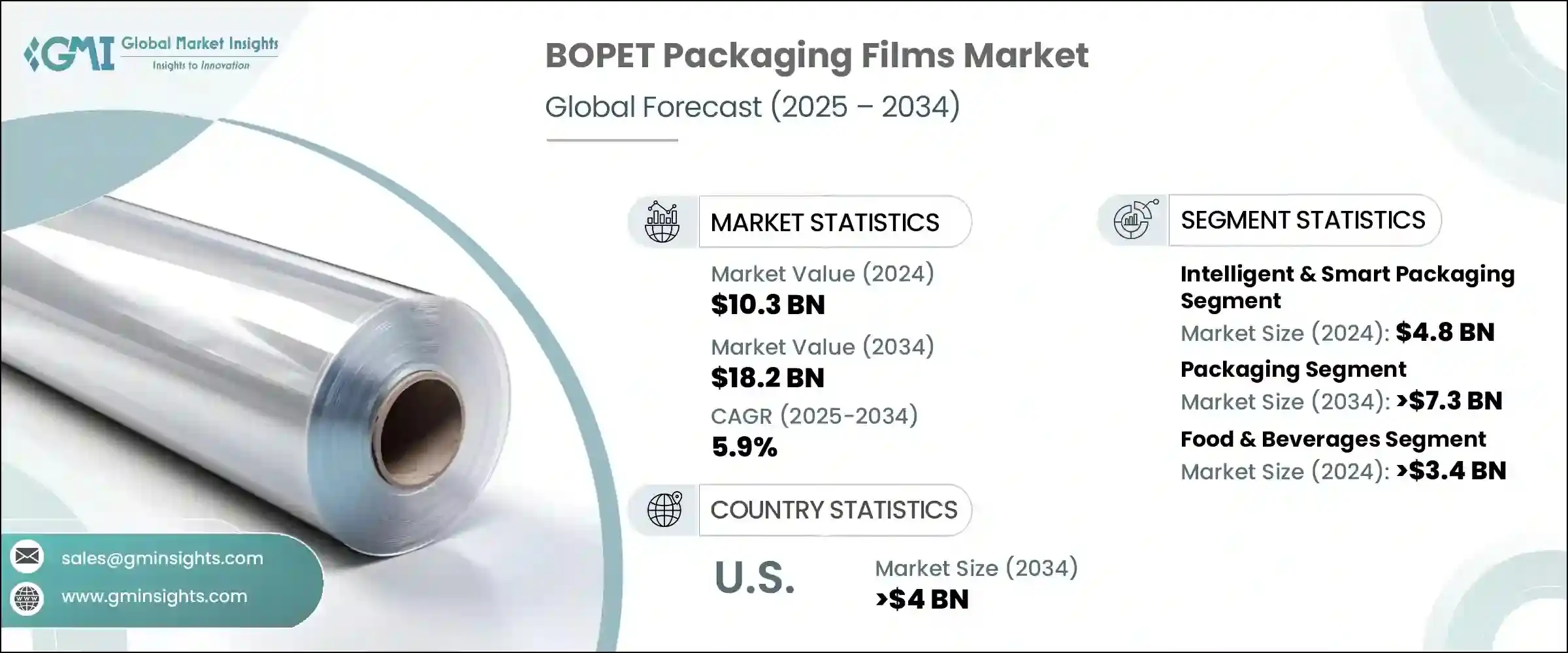
The global BOPET packaging films market size was valued at USD 10.3 billion in 2024 and is estimated to grow at CAGR of 5.9% to reach USD 18.2 billion by 2034. The market is driven by expansion of e-commerce and last-mile delivery infrastructure and sustainability initiatives and regulatory push for eco-friendly packaging.
BOPET Packaging Films Market Key Takeaways
Market Size & Growth
- 2024 Market Size: USD 10.3 billion
- 2034 Forecast Market Size: USD 18.2 billion
- CAGR (2025–2034): 5.9%
Key Market Drivers
- Growth in food & beverage and pharmaceutical industries.
- Increasing use in high-performance insulation and lamination applications.
- Rising demand for flexible and lightweight packaging solutions.
- Surge in sustainable and recyclable packaging materials.
- Excellent barrier properties of BOPET films against moisture and gases.
Challenges
- Recycling challenges due to multi-layer film structures.
- Volatility in raw material prices (e.g., PTA and MEG).
Get Market Insights & Growth Opportunities
The ongoing retaliatory tariff war started by Trump administration directly impacts the BOPET packaging films market as the key players operating in this market relied heavily on import of manufacturing inputs. Trump’s tariffs directly affect the cost of these inputs as importers will shift the cost to consumers. The U.S. manufacturers are set to face higher production costs unless they can source domestically at competitive prices.
According to the Global Data Change Lab, the global greenhouse gas emissions directly from the food systems are in the range from 25 to 35%. With this impact on nature, there are implementation plans in the food packaging industry to reduce emissions from by introducing BOPET packaging solutions. To cater for the emissions issues companies are shifting towards a biodegradable and compostable packaging solution. The study from Metsä Board which conducted Life Cycle Assessment (LCA) in March 2025, highlighted that the shift from white-lined chipboard (WLC) to Metsä Board’s folding boxboard would help reduce the carbon footprint by over 60%.
Market requirements that focus on providing lightweight, low-cost, and easily adjustable protective solutions will require BOPET packaging films. BOPET packaging films formats are preferable over rigid protective formats because BOPET packaging films formats can easily accommodate a broad spectrum of product sizes and shapes while efficiently minimizing volumetric weight, yielding reduced shipping costs. Amazon and regional competitors such as Flipkart in India and Lazada in Southeast Asia, are known for extensive use of these flexible packages to enhance logistical operations and improve client satisfaction. As an illustration, Flipkart banned the usage of single-use plastics in 2021 and adopted the use of fully recyclable rigid flexible mailers composed of paper and biodegradable films.
In addition, hyperlocal delivery systems and quick commerce (Q-commerce) are further motivating innovations in packaging. In India, Zepto and Blinkit offer 10–15-minute deliveries, which requires FMCGs and food items to be properly packaged with minimal weight. Meituan and JD Logistics in China are also adopting this trend. These broad changing trends are forcing these converters and suppliers of material packagings to increase their production due to the rapid demand growth and requirements towards more sustainable solutions.
Sustainability concerns are becoming increasingly relevant to the BOPET packaging films market due to the regulatory and consumer concern related to the environmental impacts of packaging. Policymakers in this region are adopting plastic reduction, recyclability increase, and sustainability promotion policies. For example, China’s Plastic Pollution Control Plan (2020–2025) enforces a drastic decrease in the usage of single-use plastics in select cities and industries, resulting in quick adoption of recyclable and compostable flexible packaging. Like this, India’s Plastic Waste Management Rules (2022) also bans specific single-use plastics and advocates Extended Producer Responsibility (EPR) for packaging waste.
These regulations are providing companies with the drive to abandon rigid plastic packaging systems for lightweight, recyclable, bio-based flexible formats. Huhtamaki and Amcor, for example, manufacture plant-based flexible solutions and mono-material laminates that are compliant to the region’s guidelines. In India, Amcor partnered with Nestlé to launch snack and dairy product pouches that are fully recyclable and achieved 30% material reduction while maintaining performance integrity, published in the Amcor Sustainability Report 2023. These innovations are now allowing brands to achieve their local mandates while meeting their global ESG objectives.
To get key market trends
BOPET Packaging Films Market Trends
- The growing preferences of packaging solution which has less impact on the environment is one of the key trends for the rapid development of the flexible paper packaging market. The packaging manufacturers are making innovative food packaging solutions. For example, Companies like Nestlé and Unilever have introduced paper-based packaging for items like chocolates and ice creams, providing a green solution to plastic wraps. Likewise, PepsiCo's efforts in launching compostable and recyclable packaging for its entire line of products are pushing the market forward. Flexible paper packaging is also consistent with customers' demands for products with low environmental footprint, providing firms with a competitive advantage to win over customers' loyalty.
- Sustainable measures as well as the reduction of transportation costs are promoting the adoption of lightweight materials. This includes refine strength-thinner films, resin-minimized bubble wraps, and inflatable packaging. This trend is mainly prevalent in e-commerce and FMCG sectors where cost-efficient volume reduction is crucial.
- Enhanced Food, pharmaceutical, and electronics safety standards are achieved through smart protective packaging like QR code trackers, temperature indicators, and tamper-evident seals. These measures are improving the transparency of the supply chain and helping in the premium positioning of products.
BOPET Packaging Films Market Analysis
Learn more about the key segments shaping this market
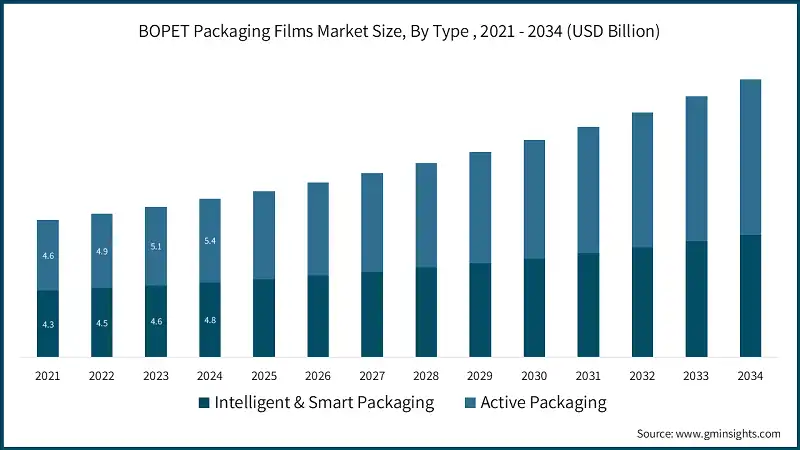
Based on type, the market is divided into intelligent & smart packaging, active packaging.
- The intelligent & smart packaging market is valued at 4.8 billion in 2024. The use of active packaging in the BOPET packaging films market is gaining momentum with rising demand for extended shelf life, improved product safety, and consumer interaction. BOPET films are a good substrate for intelligent packaging solutions due to their excellent barrier properties, thermal stability, and chemical resistance. Active packaging adds functional additives or ingredients that can interact with the package's internal environment to keep or enhance the quality of the product. BOPET-based active packaging used in food & beverage, pharma, and personal care products contains oxygen scavengers, antimicrobial agents, and moisture control agents, ensuring longer freshness and less spoilage.
- The active packaging held a significant market share of 52.8% in 2024. The smart and intelligent packaging segment of the BOPET packaging films market is fuelled by growing need for real-time product tracking, traceability, and consumer interaction. Growing utilization of connected packaging technologies like RFID, QR codes, and sensors improves supply chain transparency and fights counterfeiting, especially in food and pharma industries. BOPET's higher mechanical strength, clarity, and barrier properties make it highly suited for inclusion of smart features. Also, changing regulations for food safety and traceability, and increasing consumer demand for tailored experiences, are fuelling the push towards intelligent packaging solutions, which is placing BOPET film at the centre of next-generation packaging.
Learn more about the key segments shaping this market
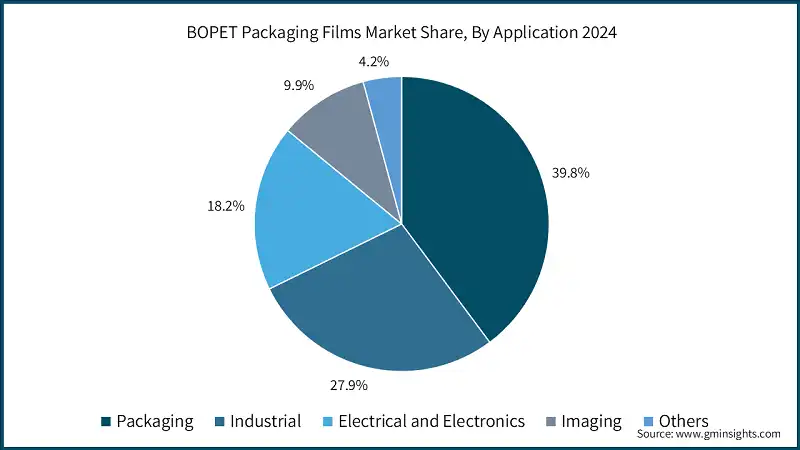
Based on application, the BOPET packaging films market is divided into packaging, industrial, electrical and electronics, imaging, others.
- The packaging market is expected to reach over USD 7.3 billion by 2034. The packaging application leads the BOPET films market, spurred by growing demand for lightweight, high-barrier, and tough materials in food, beverage, pharmaceutical, and personal care markets. BOPET films possess superior mechanical strength, transparency, and barrier to moisture and gases, which makes them suitable for flexible and multilayer packaging structures. Growing consumer demand for sustainable and recyclable materials, along with tighter food safety regulations, is driving adoption. In addition, the expansion of e-commerce and the demand for tamper-evident and extended-shelf-life packaging are driving the application of BOPET in primary and secondary packaging in various end-use markets.
- The industrial market is valued at over USD 2.8 billion in 2024. Demand for BOPET films in the industrial segment is driven by their tensile strength, thermal stability, and chemical resistance, which allow them to be used as insulation, lamination, and protective coverings. Automotive, construction, and heavy machinery industries increasingly depend on BOPET for stress-exposed components and environmental conditions. The transition to lightweight and long-lasting materials in industrial design, coupled with growing usage of BOPET for capacitor insulation, labels, and protection shields, favors industry expansion.
Based on end use, the BOPET packaging films market is divided into food & beverages, pharmaceuticals & personal care & cosmetics, consumer, industrial and others.
- The food & beverages market is valued at over USD 3.4 billion in 2024. The food and beverage industry extensively utilizes BOPET packaging films because of the need to maintain product safety, freshness, and quality after distribution. Temperature control is achieved through Foam and plastic films along with insulated wraps, while fragile goods such as bottles and jars are kept safe through temperature control. Additionally, this sector is driven by the growing need for environmentally friendly packaging and is thus innovating towards more sustainable solutions like recyclable and biodegradable materials.
- The pharmaceutical market is valued at CAGR of over 7% during 2025-2034. The pharmaceutical segment holds the third-largest end-use share, driven by the need for superior barrier performance in blister packs, pouches, and strip packaging to protect against moisture, oxygen, and contaminants. Stringent regulatory standards, the growth of biologics and cold-chain logistics, and rising global drug consumption spurred by aging populations and expanding generic production are accelerating adoption of high-strength, high-clarity OPET films that ensure product integrity, extend shelf life, and facilitate serialization
Looking for region specific data?
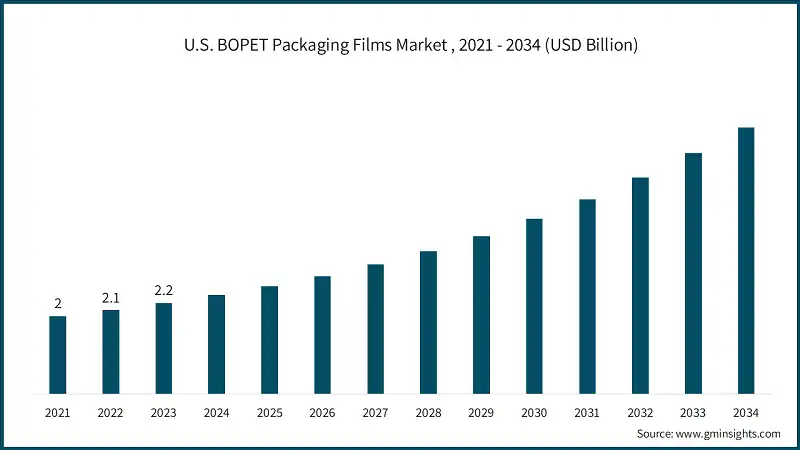
The U.S. BOPET packaging films market is projected to grow significantly, reaching over USD 4 billion by 2034. BOPET packaging films remains a relatively mature market in the U.S. The Federal demand and e-commerce penetration, as well as the increasing needs from food, pharmaceuticals, and electronics services, drives significant innovation in the sector. Additionally, consumer pressure and industry mandates have led to the rapid adoption of paper-based cushions, recyclable mailers, and bio-based flexible formats. Leaders in the eco-conscious protective packaging sector including Mitsubishi Polyester Film GmbH Worldwide are developing lightweight solutions that cater to omni-channel distribution models.
The UK BOPET packaging films market is predicted to grow at a CAGR of 5.6% in the forecast period. The country has been focusing on sustainable measures in food packaging to reduce the impact on the environment.
The China BOPET packaging films is projected to grow significantly, reaching over USD 3.2 billion by 2034. Due to massive export driven e-commerce activity the China market is both the largest and fasted growing in BOPET packaging films. The government priorities on recyclability and plastic reduction have led to innovations in more affordable and biodegradable plastics. Global and local companies like are expanding their business to China to meet the increasing demand for protective mailers, air pillows and pouches domestically and internationally.
Japan held a market size of 500 million in 2024. Japan's market is characterized by quality control in terms of automation, and compact functional packages. The aged population and urban lifestyles are increasing demand for ergonomic packaging that is easy to open and resealable, as well as requiring hygiene standards. There is growing acceptance of multifunctional flexible packaging in precision equipment, electronics, and convenience food industries.
South Korea BOPET packaging films is poised for significant growth, projected to reach over USD 800 million by 2034. South Korea’s market for BOPET packaging films is propelled by innovations in the export of personal care products and consumer electronics. Government initiatives to enhance eco-friendly packaging, in conjunction with consumer demand for high-quality appeal, are driving the production of lightweight recyclable protective packaging with enhanced value.
BOPET Packaging Films Market Share
The BOPET packaging films is highly competitive Mitsubishi Polyester Film GmbH, Polyplexare and SKC the top 3 companies accounting for a significant share of 23.7% in the market. Players operating in the global BOPET packaging films Market are actively adopting growth strategies such as new product launches, capacity expansions, strategic alliances, and acquisitions to enhance market penetration and technology capabilities. Key focus areas include development of recyclable mono-material films, biodegradable cushioning solutions, and lightweight packaging formats. Companies are increasingly investing in advanced converting technologies, digital printing, and automation systems to meet evolving sustainability demands and improve production agility. The increasing emphasis on sustainability and environmentally friendly packaging options is driving the adoption of flexible paper packaging. Government regulations and industry initiatives aimed at reducing plastic usage are encouraging the shift towards flexible paper packaging alternatives. The companies in the flexible paper packaging ensures that the packaging are meets the norms and standards set by the government
BOPET Packaging Films Market Companies
List of prominent players operating in the BOPET packaging films include:
- Mitsubishi Polyester Film GmbH
- Polyplex
- SKC
- SRF Limited
- UFlex Limited
Mitsubishi Polyester Film GmbH (hostaphan®) is a world-leading manufacturer of BOPET films, utilizing over 50 years of polymer-processing technology and vertically integrated feed-stock supply from Mitsubishi Chemical. Advanced product offerings of the company, such as high-barrier, anti-fog, heat-sealable and metallized films, meet stringent demands in packaging, electrical, imaging and industrial applications. With manufacturing facilities in Germany, the U.S., China and Japan, and an exclusive R&D facility in Germany, Mitsubishi Polyester Film bridges broad geographic coverage with swift new-product innovation to address changing performance and sustainability requirements in the OPET market.
Polyplex Limited is one of the world’s largest producers of BOPET and BOPP films, operating 13 manufacturing facilities across India, Turkey, Thailand, Indonesia and the U.S. Its global production capacity exceeds 1.2 million tons per annum, supported by recent expansions such as the 50,000-ton BOPET line in Decatur, Alabama. Polyplex focuses on technology-driven differentiation offering specialty films for barrier packaging, photovoltaic back-sheet applications and graphic arts while pursuing backward integration initiatives to secure PET-chip feedstock.
BOPET Packaging Films Market Report Attributes
| Key Takeaway | Details |
|---|---|
| Market Size & Growth | |
| Base Year | 2024 |
| Market Size in 2024 | USD 10.3 billion |
| Forecast Period 2025 - 2034 CAGR | 5.9% |
| Market Size in 2034 | USD 18.2 billion |
| Key Market Trends | |
| Growth Drivers |
|
| Pitfalls & Challenges |
|
What are the growth opportunities in this market?
BOPET Packaging Films Industry News
- In December 2024, UFlex Limited committed USD 200 million to a new Egyptian manufacturing complex designed to bolster backward integration and expand its regional footprint, with USD 70 million earmarked for the construction of a PET-chips facility a critical upstream asset for the production of BOPET films used in flexible packaging which will secure raw-material supply, reduce import dependencies and tariff exposure, and improve cost competitiveness in key markets.
- In November 2024, Polyplex commissioned a new 50,000-ton BOPET film production line at its Decatur, Alabama plant and increased overall resin capacity to 86,000 tons, significantly shortening lead times for PET films in the U.S. market, enhancing supply reliability for key end-use segments, and mitigating risks associated with import delays and cost volatility.
The BOPET packaging films market research report includes an in-depth coverage of the industry with estimates and forecast in terms of revenue (USD Billion) from 2021 – 2034 for the following segments:
Market, By Type
- Intelligent & smart packaging
- Active packaging
Market, By Application
- Packaging
- Industrial
- Electrical and electronics
- Imaging
- Others
Market, By End Use
- Food & beverages
- Pharmaceuticals
- Personal care & cosmetics
- Consumer electronics
- Others
- Others
The above information is provided for the following regions and countries:
- North America
- U.S.
- Canada
- Europe
- Germany
- UK
- France
- Spain
- Italy
- Netherlands
- Asia Pacific
- China
- India
- Japan
- Australia
- South Korea
- Latin America
- Brazil
- Mexico
- Argentina
- Middle East and Africa
- Saudi Arabia
- South Africa
- UAE
Frequently Asked Question(FAQ) :
How big is the BOPET packaging films market?
The market size for BOPET packaging films was valued at USD 10.3 billion in 2024 and is projected to reach USD 18.2 billion by 2034, growing at a CAGR of 5.9% during the forecast period.
What is the size of the packaging segment in the BOPET packaging films industry?
The packaging segment is expected to generate over USD 7.3 billion in revenue by 2034.
What is the projected market size of BOPET packaging films in the U.S. by 2034?
The U.S. BOPET packaging films market is projected to exceed USD 4 billion by 2034.
Who are the key players in the BOPET packaging films industry?
Major players in the industry include Mitsubishi Polyester Film GmbH, Polyplex, SKC, SRF Limited, and UFlex Limited.
BOPET Packaging Films Market Scope
Related Reports