Summary
Table of Content

Blockchain In Supply Chain Finance Market
Get a free sample of this report
Form submitted successfully!
Error submitting form. Please try again.
Thank you!
Your inquiry has been received. Our team will reach out to you with the required details via email. To ensure that you don't miss their response, kindly remember to check your spam folder as well!
Request Sectional Data
Thank you!
Your inquiry has been received. Our team will reach out to you with the required details via email. To ensure that you don't miss their response, kindly remember to check your spam folder as well!
Form submitted successfully!
Error submitting form. Please try again.
Blockchain In Supply Chain Finance Market Size
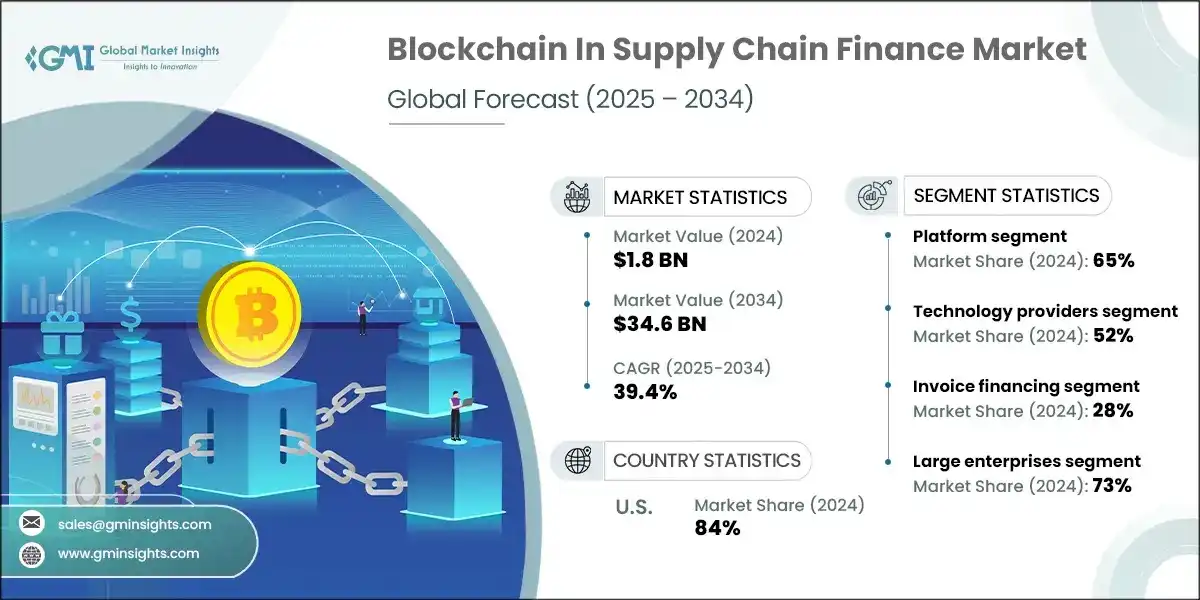
The global blockchain in supply chain finance market size was estimated at USD 1.8 billion in 2024. The market is expected to grow from USD 2.4 billion in 2025 to USD 34.6 billion in 2034, at a CAGR of 39.4%, according to latest report published by Global Market Insights Inc.
Blockchain In Supply Chain Finance Market Key Takeaways
Market Size & Growth
- 2024 Market Size: USD 1.8 Billion
- 2034 Forecast Market Size: USD 34.6 Billion
- CAGR (2025–2034): 39.4%
Key Market Drivers
- Rising need for transparency and fraud prevention.
- Increasing cross-border trade and globalization.
- Adoption of smart contracts and automation.
- Integration with AI, IoT, and ERP systems.
- Government and regulatory support for digital finance.
Challenges
- High implementation and integration costs.
- Scalability and interoperability issues.
Opportunity
- Integration of AI and advanced analytics in blockchain platforms.
- Expansion into emerging markets with growing trade volumes.
- Partnerships between financial institutions and technology providers.
- Sustainability and ESG-driven supply chain financing.
Key Players
- Market Leader: IBM led with over 13% market share in 2024.
- Leading Players: Top 5 players in this market include Amazon Web Services, IBM, Microsoft, R3, SAP SE, which collectively held a market share of 49% in 2024.
Get Market Insights & Growth Opportunities
- The blockchain in supply chain finance (BSCF) market is quickly evolving into one of the more essential foundations of present-day trade and logistics, dramatically changing the way financial transactions, supplier payments, and supply-chain working capital flows are managed. Through its ability to minimize inefficiencies, greatly limit fraud and increase transparency, blockchain is leading a revolutionary change in the use of outdated paper-intensive systems, turning to modern trust-based finance-based models.
- Growing customer demand around security, real-time transaction facilitation, smart contract automation, and multi-party visibility is driving growth in banks and fintech’s, manufacturers and logistics companies. Cost savings, shorter settlement cycles and risk avoidance are business priorities and blockchain-enabled supply chain finance is a strategic initiative.
- In 2021, the market of the blockchain in supply chain finance was USD 800 million and is estimated to be USD 10 billion in 2030, with a CAGR of 39.4%. This is improved by the increasing demand for secure, transparent and efficient financial transactions within financial chains within supply chains. Blockchain is being adopted due to the benefits it offers such as increase in traceability and limited fraud.
- The post-pandemic development of the blockchain in the supply chain finance market is centered on the security, regulatory compliance, and intertwined technologies. By the year 2024, the use of blockchain by businesses grew, as they began to use it to efficiently conduct business transactions, stem the level of fraud, and increase their level of transparency. Technology allows real-time records, automates the financial contracts, speeds up trade finance, catalyzing efficiency and innovation in the ecosystem.
- The market of blockchain in supply chain finance is growing with rapidity due to the usage of AI-enabled analytics, smart contracts, and safe distributed ledger technologies. Technology majors such as IBM, Microsoft and SAP are at the fore front in the innovations aimed at streamlining transactions and eliminating fraud.
- For instance, in March 2024, IBM introduced an upgraded supply chain finance blockchain platform that combined AI-based risk evaluation, transaction monitoring in real-time, and the portfolio to connect with multiple financial institutions to streamline working capital and minimize fraud.
- Global trade and digitalization are some of the factors changing the blockchain supply chain finance (SCF) market at a rapid rate. Companies are implementing blockchain to increase transparency and decrease processing time, and compliance. Large companies and financial institutions prefer those solutions to have traceability and instant verification of the documents, along with ERP interfacing.
- North Americans are leading blockchain in SCF market due to the pioneering adoption of technology, field financial infrastructure and positive regulatory conditions. For instance, in May 2025, IBM launched its trade finance platform in US to blockchain that includes AI-powered risk analysis and real-time monitoring of transactions and has generated significant interest among major global firms and financial institutions.
- Asia-Pacific is leading the way in terms of market development due to increases in cross-border transactions, expansion in e-commerce and government initiatives to promote digital finance. Swift adoption is also being witnessed in countries such as China, India and Singapore mainly on supply chain-linked financing solutions underpinned by blockchain, which facilitate greater clarity and reduced risk of fraud.
- For instance, in February 2025, Infosys is one of the first global companies to launch a blockchain SCF platform in India that targets both SMEs and large enterprises to provide faster payment, end-end traceability and is highly compatible with existing ERP systems, so the big leap to adoption also occurred in the emerging markets.
To get key market trends
Blockchain In Supply Chain Finance Market Trends
- Early in 2024, major blockchain vendors including IBM, R3, and SAP started to include AI-powered predictive analytics and cloud-based platform into their SCF offerings to supplement risk management, fraud detection, and proactive credit evaluation. This is part of an industry-wide transformation into smarter, more connected financial environments that are more resistant to the realities of dynamic trade environments and optimizing cash flow in real time.
- By 2026, as central bank digital currencies (CBDCs) and blockchain-based cross-border payment networks gain traction, blockchain adoption in supply chain finance (SCF) is poised for a significant leap. These advancements promise to simplify international trade, cut down on currency conversion expenses, and facilitate immediate settlements.
- By 2027 blockchain-based supply chain finance (SCF) platforms that will use IoT data feeds, digital identity verification, and traffic exchange smart contracts, should become standard. Such innovations will make operations more efficient, minimize expenses, and maximize the value of supply chain financing investment.
- Increased awareness of sustainability makes blockchain-enabled SCF a prime candidate to spearhead green finance because it is transparent and presents no threat to ESG compliance. Blockchain-sustainable trade certification carbon tracking along with government support are contributing to this shift, and the estimates are that it will grow exponentially by 2030.
- SF solutions currently promise sophisticated functions such as tokenized pay, online verification of trade documentation and immediate settlement. As an example, in May 2025, R3 was allied with banking institutions across the world to integrate Corda-based trade finance capabilities that ensure faster, more secure and transparent transactions.
- Customized blockchain solutions with tailored blockchain solutions, tailored risk scoring automobile financing terms and compliance oversight are also demanded by lenders. For instance, in May 2025, Microsoft added customizable smart contract templates to its Azure Blockchain Service so that it could be used by banks to provide bespoke supply chain finance to their customers.
- Digital ecosystems are finding popularity in international commerce. Exporters and importers and logistics players are gaining interest in acquainting blockchain base technologies which cut down fraud, optimized working capital, competent transaction clarity. For instance, in April 2025, VeChain introduced a blockchain SCF solution where the product traceability was combined with the financing blocks, reflecting the rising interest within the sphere of supply chain finance toward transparency and sustainable values.
Blockchain In Supply Chain Finance Market Analysis
Learn more about the key segments shaping this market
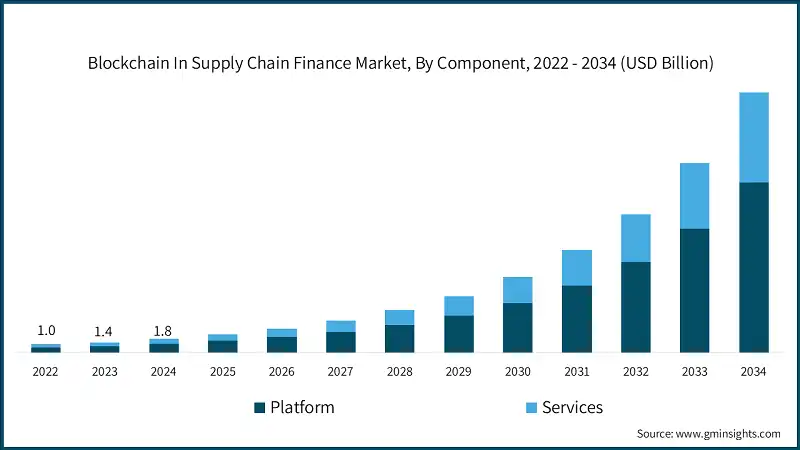
Based on components, the blockchain in supply chain finance market is divided into platform and services. The platform segment dominated the market accounting for around 65% in 2024 and is expected to grow at a CAGR of around 40% from 2025 to 2034.
- The Platform segment is the major shareholder in the international Blockchain in SCF market because of its capability to offer secured, transparent, and real-time processing of the transactions. Smart contracts, decentralization of ledgers, avoidance of errors, delays, and mishandling of information in trade finance operations occur because of blockchain platforms that allow automated verification.
- The ability of essential platforms like IBM Blockchain, Microsoft Azure Blockchain Service, R3 Corda to scale, the many levels of privacy they offer, and compatibility with ERPs make them popular with multinational corporations and financial establishments and facilitate cross-border trade, trade documents verification and document risk assessment.
- For instance, in March 2024, IBM enhanced its blockchain platform to supply chain finance with AI-based predictive analytics and real-time monitoring to support more accurate transactions and minimize credit risk. The innovation will enable the enterprises to take control of payments in advance, minimizing disputes, and maximizing cashflow.
- Applications such as VeChain and TradeLens are beginning to take off in areas where logistics form a greater part of the chain due to their ability to provide end-to-end traceability and tracking of a product throughout its life. These solutions facilitate regulatory compliance, ESG reporting and assistance in secure solutions of supply chain financing to the emerging markets of rising trade volumes.
- The Services segment is smaller than platforms, but it is significantly important in allowing the implementation of blockchain in terms of supply chain finance. The services are consulting, system integration, customization, maintenance, and training, which implies that blockchain solutions will suit the needs of the enterprise.
- For instance, in February 2025, Accenture joined a group of banks in Asia-Pacific to roll out a blockchain SCF system and subsequently offered end-to-end implementation services, smart contract configuration, and personnel training. This approach based on services decreased the deployment time, lowered the errors and fast-tracked the adoption of blockchain based finance.
- The role of services is growing in importance to SMEs and organizations in developing markets, where technical expertise is less widespread, and where smooth-running implementation services are needed to harness fully the advantages of blockchain platforms.
Learn more about the key segments shaping this market
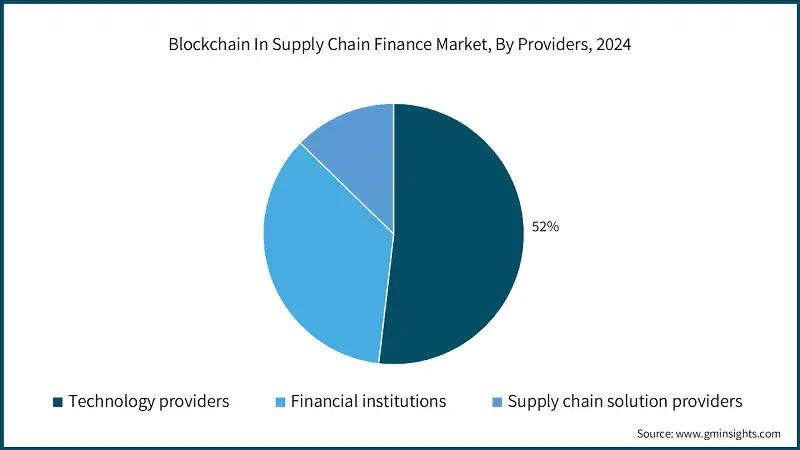
Based on providers, the blockchain in supply chain finance market is segmented into technology providers, financial institutions, and supply chain solution providers. The technology providers segment dominates the market with 52% share in 2024, and the segment is expected to grow at a CAGR of around 40% from 2025 to 2034.
- The technology providers segment is the largest in blockchain in SCF market, and it has been facilitated by the growth of sophisticated blockchain technology platforms, smart contracts frameworks and artificial intelligence-based analysis platforms. Other companies such as IBM, Microsoft, R3, and SAP are on the cutting edge of innovations facilitating transparent, secure, real time financial transactions of complex supply chains across the world.
- Technology providers are enabling SCF solutions in key markets like North America, Europe, China, and India by offering blockchain platforms to meet regulatory compliance and financial transparency needs. For instance, in March 2024, IBM enhanced its blockchain capabilities with real-time monitoring and predictive analytics to ensure compliance and reduce financial risks.
- Technology advances like tokenized payments, IoT integration, risk scoring based on AI, and ERP connectivity are becoming the norm, as organizations want balanced, safe, and automated financing services. For instance, in April 2025, when R3 introduced a Corda-based SCF platform that incorporates smart contracts and real time document verification, allowing corporates and banks to speed up trade finance procedures.
- The financial institutions segment will continue growing with a CAGR of 39% from 2025 to 2034. Its use of blockchain-enabled SCF services, and banks and fintech’s are using technology to improve working capital efficiency, lower fraud, and access cross-border trade. Financial institutions are very important stakeholders although this process is slower relative to the technology providers, simply because the financial institutions directly fund the operations of trade and derive benefits of increased transparency and efficiency.
- Logistics and manufacturing firms are turning towards blockchain-driven supply chain solutions to offer greater traceability, minimize risks and transaction verification. These solutions establish a connection between the movements of goods and financing procedures where the payments are matched to the delivery points. This segment has been underpinned by the development of supply markets that are adopting the idea of blockchain in their supply chain-based finance services.
Based on applications, the blockchain in supply chain finance market is divided into invoice financing, inventory financing, trade & export finance, dynamic discounting, and factoring & reverse factoring. Invoice financing segment dominated the market accounting around 28% in 2024 and is expected to grow at a CAGR of around 44% from 2025 to 2034.
- Invoice financing grows in the blockchain in SCF market as it gives instant liquidity to suppliers, which accounts for its dominating presence in the market alongside other benefits of transparency and lower fraud rates. Banks and financiers can easily and safely simply cross-check invoices in real-time, something which is only possible through blockchain platforms.
- For instance, in March 2024, IBM collaborated with a group of SME banks and a group of SMEs in Europe to deploy a blockchain-based invoices financing service. This solution opened faster payment to suppliers on verified invoices but gave financiers real-time audit trial and risk analytics, creating higher confidence and cutting operational expenses.
- Inventory financing promotes the use of blockchain with a CAGR of 39% from 2025 to 2034, where participating businesses can validate their inventory ownership, place and condition and be assured of accurate collateral to obtain loans. It is possible to establish connectivity between physical inventory and digital records so that financiers can minimize risks and make faster decisions to lend.
- Applications in trade and export finance are also increasing at a rapid pace as cross-border transactional behavior is possible with documentation that is not hidden. Verification of trade documents can be automated by means of smart contracts, meaning that payment to exporters can be made on a faster and more reliable basis.
- With dynamic discounting, buyers and suppliers can also retain the benefits of early payment at discount and achieve transparency and computer automation of approvals. Such platforms eliminate conflict and enhance the management of cash flow.
- For instance, in February 2025, SAP SE introduced a blockchain based dynamic discounting solution to a multinational consumer goods company. Through a blockchain-based ledger of supplier invoices and payment schedules, the platform allowed the buyer to negotiate supplier discounts in real time, enabling faster supplier cash collections, and that maximized the working capital of the buyer.
- Factoring and reverse factoring are also catching on across all industries with an estimated CAGR of over 17% between 2025 to 2034 to create transparency and speed within 24-hour window to raise receivables financing with blockchain. The blockchain can lessen the dangers of fraud through invoice legitimacy verification and settlement automation, improving the trust between financing parties (buyers, suppliers and financiers).
Based on enterprise size, the blockchain in supply chain finance market is divided into large enterprises and small & medium enterprises (SMEs). The large enterprises segment dominated the market accounting for around 73% in 2024 and is expected to grow at a CAGR of around 40% from 2025 to 2034.
- The large enterprises segment is the largest in the blockchain SCF market as it has higher units of transactions, complex supply chains and more financial adequacy. Blockchain platforms benefit large companies by improving operating transparency, decreasing the risk of fraud and increasing the velocity of multi-tier supply chaining in their cross-continental operations.
- Such businesses tend to combine blockchain with their ERP solutions, IoT products and analytics powered by artificial intelligence to streamline their cash management, supplier financing, and international trade regulations compliance. Blockchain technology allows a company to monitor several suppliers simultaneously, which can be considered an attractive solution to operations on a large scale.
- For instance, in March of 2024, IBM collaborated with a North American multinational automotive company to roll out a supply chain finance solution that was powered using blockchain technology. The system allowed the real-time verification of the invoices to be made, automated payments, and risk evaluations among hundreds of suppliers; this helped the company stave off operational hiccups and managed the liquidity quite effectively.
- Large enterprises continue to be the primary adopters as they have the resources to invest in more sophisticated infrastructure, achieve better harmonization with current system, and lead the innovation in the field of finance functions. With the evolution in the blockchain platforms, organizations are considering tokenized payments and asset financing in digital assets that can further automate trade finance.
- SMEs segment is steadily embracing blockchain in supply chain financing with a CAGR of more than 38% between 2025 to 2034 and it is driven by slower working capital accessibility requirement, low risk of fraud and easier trade finance supporting odysseys. Lack of trust by financiers and complex documentation can be some of the problems faced by SMEs creating barriers to financing but which can easily be solved by blockchain.
- Platform-as-a-service (PaaS) models also facilitate blockchain solutions to SMEs and see greater allowance of low implementation costs, simple interfaces, and reduced integration needs. This will further complicate blockchain to when used by smaller companies that do not have many IT resources.
Looking for region specific data?
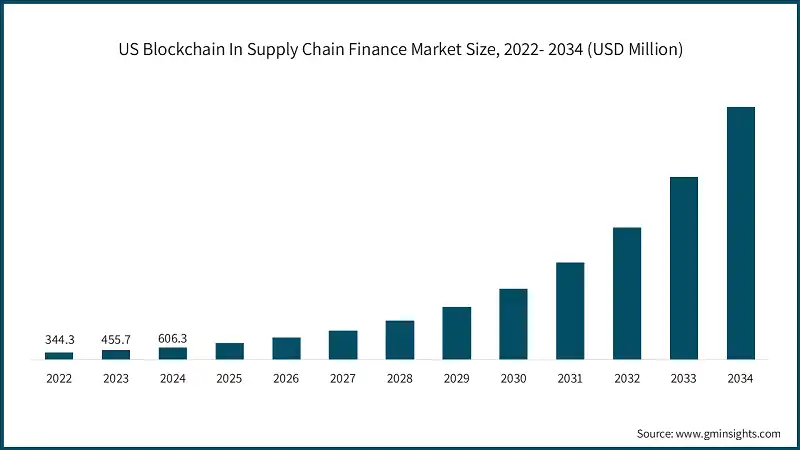
The US dominated the blockchain in supply chain finance market in North America with around 84% share and generated USD 606.3 million in revenue in 2024.
- The US market is at the forefront of Blockchain in SCF industry because of the developed financial ecosystem, a high level of digital finance adoption, and the existence of complexity of multinational corporations, such as complex supply chain. Its area is one of the biggest users of blockchain systems, as well as solid research and development centers and integration of AI, Smart-contracts, and real-time transaction tracing.
- The US has a well-developed regulatory environment to facilitate digital finance, and there are well defined policies on anti-fraud, data privacy, and cross-border payments. The regulators can promote the use of blockchain-enabled SCF solutions by banks, fintech and enterprises to enhance transparency, mitigate risk of transactions, and speed up trade finance processes by creating this regulatory clarity.
- The US SCF market has innovation as one of its motive forces, and such features as AI-supported risk assessment, IoT-supported chain tracking, automation of smart contracts contribute to the increased efficiency and safety of the processes. As an example, in May 2025, IBM introduced an enhanced SCF blockchain platform that provides predictive analytics and real-time invoice checks built into large US firms and enhanced liquidity controls and delays.
- The market of Canadian SCF is growing steadily, and its compounded annual growth is estimated to sit at 39% from 2025 to 2034. The main driver of the growth is growing cross-border trade, small and mid-sized enterprises adopting blockchain platforms, and financial and logistical systems modernization. Providers are broadening their services to those industries, size which require safe, straightforward and conformant SCF services and institutions which these solutions would support overall security and transparency of the service.
The blockchain in supply chain finance market in Germany is projected to witness strong and sustained growth from 2025 to 2034, driven by increasing adoption of digital trade finance solutions, growing demand for transparent and secure cross-border transactions, and the country’s robust industrial and export-oriented economy.
- German, considered as the industrial giant and exporter in Europe, will record beneficial growth in its blockchain-enabled SCF market with a robust compound annual growth rate of over 39% between 2025 and 2034. The world of global corporations in Germany has automotive, manufacturing, and logistics enterprises with its top companies quickly integrating blockchain platforms to conduct trade finance by promoting transparency, security, and efficiency through complex supply chains.
- The regulatory framework of Germany, such as directives on digital finance, anti-fraud policies and compliance scrambling over the global market, help to use blockchain in SCF massively. This strong structure not only ensures the safety of its financial activities, but it also promotes further advancements in technology in smart contracts, real-time verification of invoices and paying through tokens.
- The factor that further strengthens Germany market leadership is the fact that blockchain is combined with new technologies like AI, IoT, and ERP systems. These platforms allow enterprises to utilize them to support predictive risk modelling, automate trade finance processes, and increase supply chain visibility, which boosts their financial operations and operational efficiency.
- For instance, in April 2025 R3 launched a Corda based SCF application with a consortium of German manufacturing and logistics companies. The platform offered real time invoice verification, smart-contract automation and safe cross-border financing, which showed the leading position of Germany in terms of blockchain adoption and innovation in supply chain finance.
- France, Italy, Spain, and the UK are also developing blockchain SCF markets in the rest of Europe. France and Italy have performed well with robust industrial and export markets increasing its uptake, whereas Spain and the UK are growing as SME usage of e-trade in general is on the rise as well as government support and growing need to optimize secure transparent and efficient trade finance solutions.
The blockchain in supply chain finance market in China is expected to experience significant and promising growth from 2025 to 2034.
- The fastest growing region in blockchain SCF market is Asia Pacific, expanding to over 40% of the global market in 2024. China has one of the highest growth potentials in the SCF market, recording a growth of approximately 41% from 2025 to 2034 mainly due to the rapid industrialization, the adoption of digital finance, and large-scale manufacturing and export in the country. Exports China is the biggest exporter globally and is increasingly supplementing blockchain-powered SCF solutions to promote transparency and decrease fraud, as well as streamline overseas payments.
- China is prioritizing digital trade, high-tech logistics and fintech revolution and this uptake is boosting SCF. The emergence of blockchain-based real-time check verification systems, smart contracts, and tokenized payments are allowing banks and corporate organizations to optimize and manage working capital and credit risk. Also, efforts made by the government to stimulate safe, trackable and efficient trade finance are increasing the demand for blockchain applications.
- Blockchain solutions providers and technology companies are also investing a lot in China, in terms of expanding their platforms, increasing their R&D efforts and partnering with banks and other large companies. These activities respond to the rising need in scalable, cost-neutral, and compliant SCF services that can be used to trade within complex networks of domestic and international trade.
- India, Japan, and South Korea, together with China are market leaders in the SCF market in APAC. Blockchain use cases are accelerated by the increasing number of SMEs in India together with state-wide policies on online finance. Japan is ahead of offerings in SCF technologies and large corporations combine AI-driven analytics and IoT-based supply chain monitoring. The emphasis on digital trade, especially in fintech innovation and export-leading industries in South Korea also contributes to the promotion of blockchain-based SCF solutions in the region
Blockchain in supply chain finance market in UAE is expected to experience significant and promising growth from 2025 to 2034.
- The United Arab Emirates (UAE) SCF market is dominated by the blockchain-enabled segment that benefits due to their progressive digital finance regulations, advanced fintech infrastructure, and considerable adoption by large and small enterprises. The many strengths of the UAE to play its role as regional logistics and trade centre, banking and fintech hub, support its role in leading the blockchain-based SCF solutions.
- The SCF market in the UAE is estimated to grow at a healthy CAGR of more than 32% between the years 2025 and 2034 due to rising cross-border trade, the need to have transparent and secure financing and due to awareness of risk mitigation with use of blockchain technology. Big and small businesses are implementing systems that combine real-time invoice checking, smart contracts and automated payments.
- Dubai is on top of the market with governmental efforts to enhance digital trade and financial innovation. In March 2024, one of the key fintech consortiums launched a blockchain-based SCF toolset in Dubai that allows banks and corporates to automate trade financing, minimize processing delays, and enable real-time visibility of receivables and payables.
- Abu Dhabi and Sharjah SCFs are coming as vital sources of SCF, growth, with broadening commercial industries, a flourishing corporate population with the epitomized necessity to access secure efficient financing options. The emirates are promoting the use of next-generation blockchain, such as AI-based risk analysis, the Internet of Things-powered supply chains, and cloud-based platform integration, to streamline trade finance activities.
- Emerging opportunities in the MEA SCF market are also appearing in countries such as Saudi Arabia, Egypt, South Africa, and Morocco. These markets benefit from rising trade volumes, growing SME activity, and government initiatives to modernize finance and logistics infrastructure. Increasing awareness among businesses about transparent, secure, and efficient supply chain finance is driving adoption of blockchain solutions, creating strong potential for market expansion in these regions.
The blockchain in supply chain finance market in Brazil is expected to experience significant and promising growth from 2025 to 2034.
- Brazil will dominate the Latin America blockchain-enabled SCF market by 2024 with a forecasted CAGR of 32% between 2025 and 2034. The reason behind the growth is the growing cross-border trade, growing demand in transparent and secure trade finance, and growing use of digital financial solutions by both large businesses and SMEs. The need to provide faster payment, less fraud, and working capital management also increases the demand in blockchain platforms.
- Local service and deployment International and regional blockchain solution providers, including IBM, R3, and SAP SE, are already extending their activity in Brazil with local deployments, platform-specific customizations and collaborations with banks and corporates. These scaled services off real-time invoice validation, smart contract automation and integration with ERP systems, but they make Brazil one of the main emerging territories in Latin America in terms of blockchain-enabled SCF implementation and innovation.
- Other emergent markets in the Latin American SCF market include Mexico and Argentina who rely on SME adoption growth, rising industrial trade, and well-managed regulatory environments that enable digital finance. The investment is directed towards affordable and scalable blockchain solutions to provide secure financing of invoices and factoring as well as cross-border payments and opportunities to small and medium-sized enterprises.
- New opportunities emerge in Chile, Colombia and Peru with the growth in the volume of trade, the growing logistics and manufacturing businesses, and the state program to modernize the financial infrastructure. These nations are experiencing an increase in current demand of blockchain-based supply chain finance solutions, and this provides an ample environment to embrace technologies that enhance visibility of transactions, credit risks and streamlining of the trade finance processes.
Blockchain In Supply Chain Finance Market Share
- The top 7 companies in the blockchain in supply chain finance market are IBM, Microsoft, Amazon Web Services, SAP SE, R3, ConsenSys and TradeIX contributed around 49% of the market in 2024.
- IBM is a leader in IBM blockchain applications to supply chain finance, where it provides enterprise level platforms to support secure, transparent, and real time trading transactions. The systems offered by IBM combine AI-enabled analytics, Internet of Things data, and smart contracts to improve invoice verification, automate payments and mitigate risks. Their solutions address the needs of large business and financial organizations to various industries globally.
- Microsoft offers SCF platforms with blockchain implementation through Azure Blockchain Service with an emphasis on scalability, cloud connectedness and simplicity of provision. The solutions provided by Microsoft enhance the automation of smart contracts, real-time monitoring of transactions and connections to ERP systems, enabling enterprises and banks to optimize the efficiency of working capital and reduce fraud in long and complex supply chains.
- Amazon Web Services (AWS) provide blockchain-as-a-service (BaaS) platforms to supply chain finance, so that companies can run secure, scalable, and highly available SCF networks. AWS solutions incorporate AI and analytics to offer predictive insights to simplify invoice financing, improve the visibility of cross-border trade activities.
- The SAP SE focuses on financial and supply chain management and blockchain-enabled solutions, providing platforms to integrate smart contracts, invoice financing automation, and ERP. The systems provided by SAP allow large corporations and SMEs to enhance liquidity, minimize disputes and fulfill compliance requirements of the regulatory framework on international trade finance.
- R3 offers Corda-based blockchain systems that are purpose built to support supply chain finance use cases, and can support secure, private and interoperable transactions across multiple parties. The solutions offered by 3Ts R3 make it easy to finance invoices, factors, and dynamically discount them and at the same time ensure that verification is immediate, the transaction can be audited, and the counterparty risk is minimized.
- ConsenSys builds enterprise blockchain software products at the intersection of trade and supply chain finance, and focus on Ethereum-based solutions capable of automating payments and smart contracts and related use cases e.g. tokenized payments, traceable transactions using Zero-Knowledge proofs, etc. The platforms of ConsenSys enable banks, corporates and fintech’s to add greater transparency, efficiency and trust throughout multi-tier supply chains.
- TradeIX has blockchain-enhanced SCF solutions enabling efficient invoice financing, reverse factoring and dynamic discounting on global networks of trade. TradeIX platforms enable real time Tracking, secure documentation and automation of financing processes, enhancing liquidity and minimizing operational risk to both suppliers and buyers, integrating with ERP systems and banking systems.
Blockchain In Supply Chain Finance Market Companies
Major players operating in the blockchain in supply chain finance industry are:
- Amazon Web Services
- ConsenSys
- Contour
- IBM
- JPMorgan Chase & Co.
- Microsoft
- R3
- SAP SE
- TradeIX
- we.trade
- Amazon Web Services (AWS) and IBM lead the SCF market by offering scalable blockchain-as-a-service platforms. AWS focuses on cloud-enabled solutions with real-time invoice verification and AI-powered analytics for predictive insights, while IBM emphasizes enterprise-grade security, smart contract automation, and IoT integration to optimize trade finance processes for global corporations.
- ConsenSys and Contour provide blockchain platforms that enhance transparency, automation, and efficiency in cross-border trade finance. ConsenSys leverages Ethereum-based networks for tokenized payments and secure transaction tracking, while Contour specializes in digital letter-of-credit solutions, enabling faster, fraud-resistant cross-border financing.
- JPMorgan Chase & Co. and Microsoft deliver enterprise-focused SCF solutions that combine blockchain with existing financial infrastructure. JPMorgan emphasizes secure and compliant digital payments and invoice financing for large corporate clients, while Microsoft Azure Blockchain Service enables seamless ERP integration, smart contract automation, and real-time monitoring of supply chain finance activities.
- R3 and SAP SE focus on providing robust, interoperable platforms for supply chain finance. R3’s Corda-based solutions enable private, auditable transactions for invoice financing, factoring, and dynamic discounting, while SAP offers integrated blockchain-ERP solutions that streamline trade finance, improve liquidity, and enhance regulatory compliance for large enterprises and SMEs alike.
- TradeIX and we.trade specialize in blockchain-enabled SCF networks that simplify financing for SMEs and corporates. TradeIX platforms provide automated invoice verification, reverse factoring, and dynamic discounting with full visibility, while we.trade focuses on secure, digital trade networks connecting banks, buyers, and suppliers to accelerate payments and reduce counterparty risk.
Blockchain In Supply Chain Finance Market Report Attributes
| Key Takeaway | Details |
|---|---|
| Market Size & Growth | |
| Base Year | 2024 |
| Market Size in 2024 | USD 1.8 Billion |
| Forecast Period 2025 - 2034 CAGR | 39.4% |
| Market Size in 2034 | USD 34.6 Billion |
| Key Market Trends | |
| Drivers | Impact |
| Rising need for transparency and fraud prevention | Blockchains immutable ledgers are reducing risks of fraud, errors, and disputes in global trade finance. |
| Increasing cross-border trade and globalization | Demand for faster, more secure, and traceable cross-border transactions is fueling blockchain adoption in SCF. |
| Adoption of smart contracts and automation | Automated contract execution is cutting delays, improving efficiency, and reducing operational costs in supply chain finance. |
| Integration with AI, IoT, and ERP systems | Real-time data sharing and analytics are enabling predictive risk management and seamless financial workflows. |
| Government and regulatory support for digital finance | Initiatives promoting secure digital ecosystems are accelerating blockchain-enabled supply chain finance solutions. |
| Pitfalls & Challenges | Impact |
| High implementation and integration costs | The complexity of integrating blockchain with legacy financial and ERP systems increases upfront investment, limiting adoption by SMEs. |
| Scalability and interoperability issues | Global supply chains face delays in widespread deployment due to the absence of standardized protocols and cross-platform compatibility. |
| Opportunities: | Impact |
| Integration of AI and advanced analytics in blockchain platforms | AI enhances risk assessment, fraud detection, and predictive financing in supply chain finance. |
| Expansion into emerging markets with growing trade volumes | Rising cross-border commerce in Asia-Pacific, Africa, and Latin America drives blockchain-enabled SCF adoption. |
| Partnerships between financial institutions and technology providers | Collaborations drive blockchain adoption in banking and trade finance, enhancing reach and trust. |
| Sustainability and ESG-driven supply chain financing | Blockchain traceability aids green financing and attracts eco-conscious investors. |
| Market Leaders (2024) | |
| Market Leaders |
13% Market Share |
| Top Players |
Collective market share in 2024 is Collective Market Share is 49% |
| Competitive Edge |
|
| Regional Insights | |
| Largest Market | North America |
| Fastest Growing Market | Asia Pacific |
| Emerging Country | India, China, Mexico, Brazil, South Africa |
| Future Outlook |
|
What are the growth opportunities in this market?
Blockchain In Supply Chain Finance Industry News
- In February 2025, IBM launched an upgraded blockchain SCF platform integrating AI-powered analytics and IoT-enabled supply chain monitoring. The system enhances real-time invoice verification, automates trade finance processes, and reduces counterparty risk for large enterprises and financial institutions.
- In October 2024, ConsenSys introduced an Ethereum-based tokenized payment solution for supply chain finance. This platform enables secure cross-border transactions, automates smart contract execution, and increases transparency for SMEs and corporates engaging in international trade.
- In July 2024, TradeIX announced a strategic partnership with Natixis to join the Marco Polo Network, a blockchain-based trade finance platform. This collaboration aims to streamline supply chain finance processes, enhance transparency, and reduce fraud risks for SMEs and corporates engaged in international trade.
- In June 2024, R3 deployed a Corda-based SCF solution for a consortium of multinational manufacturing and logistics firms. The platform provides real-time verification of invoices, automated payments, and auditable transaction records, improving working capital efficiency and reducing settlement times.
- In May 2024, TradeIX announced the launch of an enhanced blockchain-enabled platform for reverse factoring and dynamic discounting. The solution integrates with ERP systems, allowing suppliers and buyers to automate financing workflows, improve cash flow visibility, and reduce operational delays.
The blockchain in supply chain finance market research report includes in-depth coverage of the industry with estimates & forecasts in terms of revenue ($ Mn) from 2021 to 2034, for the following segments:
Market, By Components
- Platform
- Services
- Consulting & advisory services
- Integration & deployment services
- Support & maintenance services
Market, By providers
- Technology providers
- Financial institutions
- Supply chain solution providers
Market, By Application
- Invoice financing
- Inventory financing
- Trade & export finance
- Dynamic discounting
- Factoring & reverse factoring
Market, By Enterprise Size
- Large enterprises
- Small & medium enterprises (SMEs)
Market, By Industry Vertical
- Manufacturing
- Retail & e-commerce
- Food & beverages
- Pharmaceuticals & healthcare
- Automotive
- Electronics & technology
- Oil & gas
- Logistics & transportation
The above information is provided for the following regions and countries:
- North America
- US
- Canada
- Europe
- Germany
- UK
- France
- Italy
- Spain
- Russia
- Nordics
- Portugal
- Croatia
- Asia Pacific
- China
- India
- Japan
- Australia
- South Korea
- Singapore
- Thailand
- Indonesia
- Latin America
- Brazil
- Mexico
- Argentina
- MEA
- South Africa
- Saudi Arabia
- UAE
Frequently Asked Question(FAQ) :
What is the market size of the blockchain in supply chain finance in 2024?
The market size was estimated at USD 1.8 billion in 2024, with a CAGR of 39.4% expected through 2034. The market growth is driven by the adoption of blockchain to enhance transparency, reduce inefficiencies.
What is the projected value of the blockchain in supply chain finance market by 2034?
The market is projected to reach USD 34.6 billion by 2034, fueled by advancements in blockchain technology, integration with AI, and the adoption of central bank digital currencies (CBDCs).
What is the current blockchain in supply chain finance industry size in 2025?
The market size is projected to reach USD 2.4 billion in 2025.
How much revenue did the platform segment generate in 2024?
The platform segment accounted for approximately 65% of the market in 2024 and is expected to observe around 40% CAGR till 2034.
What was the valuation of the technology providers segment in 2024?
The technology providers segment held a 52% market share in 2024 and is set to expand at a CAGR of around 40% up to 2034.
What is the growth outlook for the invoice financing segment from 2025 to 2034?
The invoice financing segment, which accounted for 28% of the market in 2024, is likely to witness 44% CAGR through 2034.
Which region leads the blockchain in supply chain finance sector?
The United States leads the market in North America, capturing 84% of the regional revenue and generating USD 606.3 million in 2024.
What are the upcoming trends in the blockchain in supply chain finance market?
Key trends include AI-driven predictive analytics, CBDCs, blockchain-based cross-border payments, IoT smart contracts, sustainable blockchain solutions, and expanding digital ecosystems.
Who are the key players in the blockchain in supply chain finance industry?
Major players include Amazon Web Services, ConsenSys, Contour, IBM, JPMorgan Chase & Co., Microsoft, R3, SAP SE, TradeIX, and we.trade.
Blockchain In Supply Chain Finance Market Scope
Related Reports