Summary
Table of Content

Bioplastic for Interior Market
Get a free sample of this report
Form submitted successfully!
Error submitting form. Please try again.
Thank you!
Your inquiry has been received. Our team will reach out to you with the required details via email. To ensure that you don't miss their response, kindly remember to check your spam folder as well!
Request Sectional Data
Thank you!
Your inquiry has been received. Our team will reach out to you with the required details via email. To ensure that you don't miss their response, kindly remember to check your spam folder as well!
Form submitted successfully!
Error submitting form. Please try again.
Bioplastic for Interior Market Size
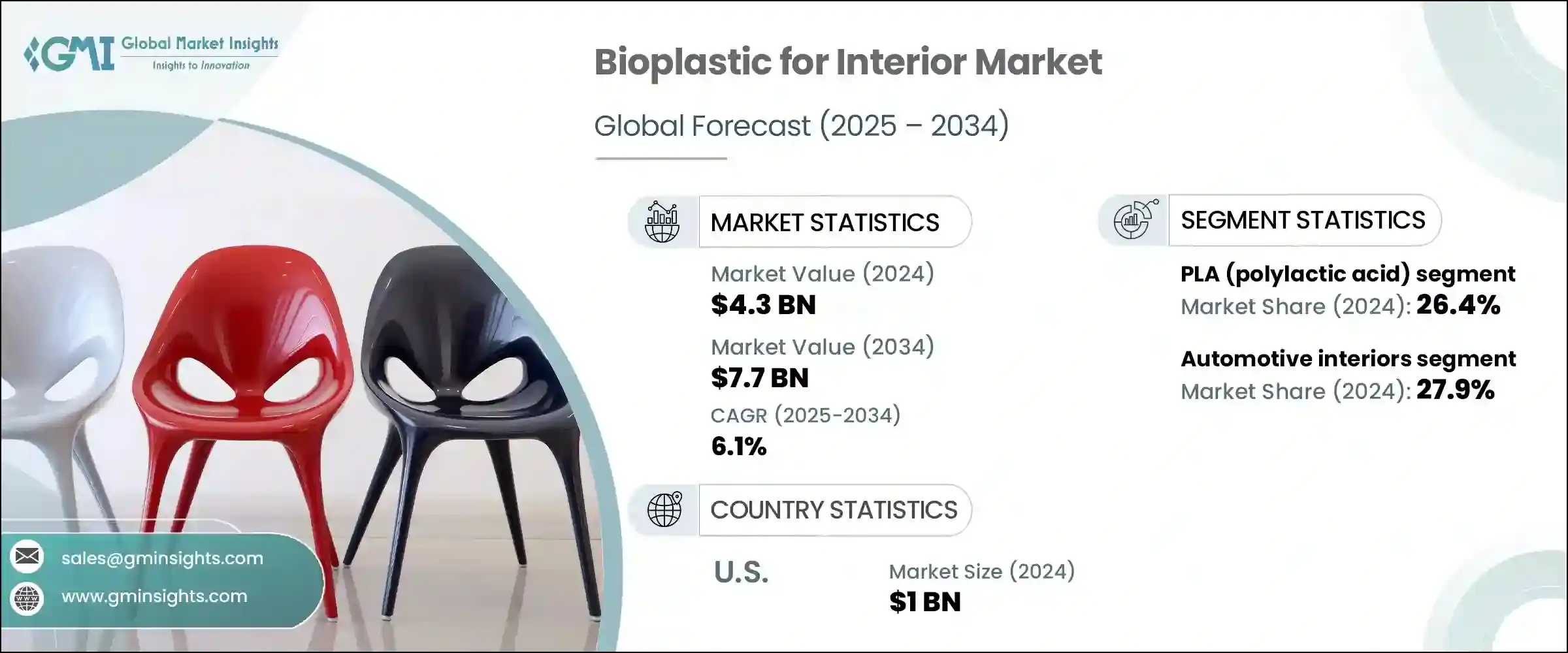
The global bioplastic for interior market was valued at USD 4.3 billion in 2024, with expectations to reach USD 7.7 billion by 2034, growing at a CAGR of 6.1%. The interior market is shifting towards using sustainable and eco-friendly materials as more people and businesses become aware of environmental issues.
Bioplastic for Interior Market Key Takeaways
Market Size & Growth
- 2024 Market Size: USD 4.3 Billion
- 2034 Forecast Market Size: USD 7.7 Billion
- CAGR (2025–2034): 6.1%
Key Market Drivers
- Rising demand for sustainable interior materials.
- Increasing consumer awareness of eco-friendly products.
- Growth in green building and automotive sectors.
Challenges
- Higher cost compared to conventional plastics.
- Performance limitations in certain applications.
Get Market Insights & Growth Opportunities
Bioplastics, made from renewable sources like corn, sugarcane, and cellulose, are becoming a popular alternative to traditional plastics in interior design. These materials are biodegradable, have a lower carbon footprint making them a good choice for many interior products.
The growing demand for sustainable materials is one of the main reasons bioplastics are gaining popularity in the interior market. People want products that are better for the environment, and bioplastics meet this need by offering eco-friendly options for furniture, wall panels, flooring, and decorations. With stricter global rules on waste and plastic use, manufacturers are using bioplastics to meet these standards and attract eco-conscious customers.
Green building projects and eco-friendly car manufacturing are also helping bioplastics grow in the interior market. Green building standards like LEED encourage using sustainable materials, including bioplastics, for interior finishes. At the same time, the car industry is focusing on lightweight, recyclable, and eco-friendly materials for car interiors, which boosts the use of bioplastics. These trends not only increase the demand for bioplastics but also drive innovation to create better biodegradable materials for different interior uses.
To get key market trends
Bioplastic for Interior Market Trends
- Adoption of circular economy principles in bioplastics: Companies are increasingly adopting circular economy principles. This approach involves designing products that can either be recycled or are biodegradable, which helps in reducing waste and promoting sustainability. By focusing on the entire product lifecycle, these companies aim to minimize environmental impact while meeting consumer demand for eco-friendly solutions.
- Advancements in bioplastic technology for interior applications: Continuous advancements in bioplastic formulations have significantly improved the properties of these materials. Modern bioplastics now offer enhanced durability, better aesthetic qualities, and improved thermal resistance. These advancements make bioplastics more suitable for a variety of interior applications, including furniture, decorative panels, and other design elements, providing both functionality and visual appeal.
- Government support boosting bioplastic adoption: Governments in several countries are actively supporting the adoption of renewable and biodegradable materials through policies, subsidies, and incentives. These measures are designed to encourage the use of sustainable materials, which in turn drives the growth of the bioplastic interior market.
- Collaborations fueling innovation in bioplastics: The bioplastic interior market is witnessing a growing trend of collaborations among bioplastic producers, interior product manufacturers, and research institutions. These partnerships aim to develop customized, high-performance bioplastic materials specifically designed for interior use. By working together, these stakeholders are expanding the range of bioplastic options available in the market, addressing specific needs, and driving innovation in the industry.
Bioplastic for Interior Market Analysis
Learn more about the key segments shaping this market
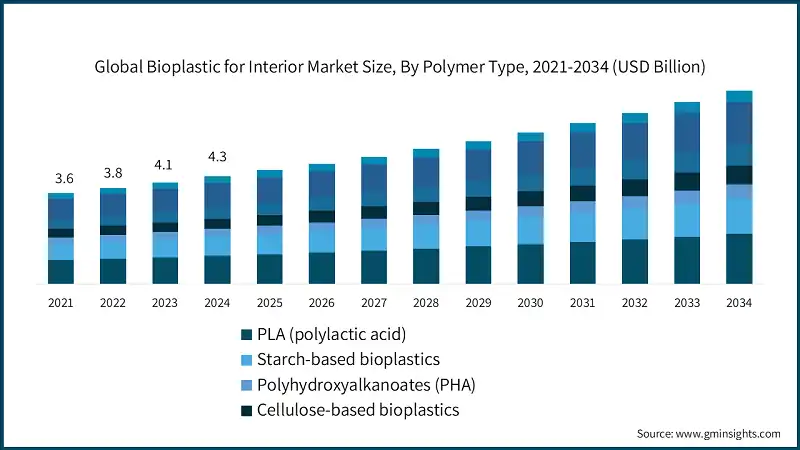
The market by polymer type is segmented into PLA (polylactic acid), starch-based bioplastics, polyhydroxyalkanoates (PHA), cellulose-based bioplastics, bio-PE (bio-polyethylene), bio-PET (bio-polyethylene terephthalate) and others. PLA (polylactic acid) accounted for 26.4% of the market share in 2024.
- PLA (polylactic acid) is currently the most widely used polymer in the market because of its excellent biodegradability, renewable sourcing, and versatile properties. It is made from renewable plant sugars such as corn starch, sugarcane, or cassava, which makes it an environmentally friendly alternative to traditional plastics. This aligns well with the growing demand for sustainable materials in interior design.
- PLA has a clear and glossy appearance with good transparency, making it a great choice for decorative panels, furniture components, and packaging used in interior spaces.
Learn more about the key segments shaping this market
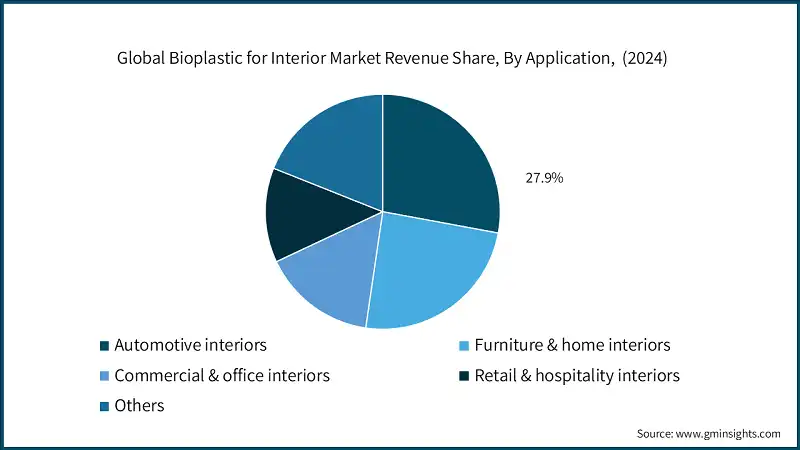
Based on application, the bioplastic for interior market is segmented into automotive interiors, furniture & home interiors, commercial & office interiors, retail & hospitality interiors and others. Automotive interiors up 27.9% of the market in 2024.
- The automotive interiors segment is leading in the market, primarily due to the growing consumer demand for materials that are both sustainable and lightweight. Bioplastics are increasingly being used in various interior components of vehicles, such as dashboards, door panels, seat frames, and trims.
- These materials offer several advantages, including reduced weight, which helps improve fuel efficiency, and enhanced environmental benefits, making them an attractive choice for manufacturers and consumers alike.
- One of the key reasons for their suitability in automotive applications is their ability to be molded into complex shapes, along with their compatibility with eco-friendly manufacturing processes. This makes them a practical and sustainable option for modern vehicle interiors.
Based on end user, the market is segmented into automotive OEMs, furniture manufacturers, interior design firms, retailers & showrooms, contractors & builders and others. Building construction hold the dominant position the market in 2024.
- Automotive OEMs are the biggest users in the bioplastics interior market because they are actively looking for ways to make vehicle interiors more sustainable. Companies are using bioplastics in dashboards, trims, and upholstery. This helps reduce the weight of vehicles and lowers their environmental impact. Many leading automotive companies around the world are investing heavily in research and development partnerships with suppliers of bio-based materials, which helps them maintain their strong position in this market.
- Furniture manufacturers are the second-largest group of users in this market. They are increasingly turning to bioplastics for modular furniture, ergonomic designs, and eco-friendly home décor. Interior design firms are also using bio-based materials for custom projects, especially in luxury homes and buildings that have green certifications. Retailers and showrooms are adding bioplastic elements to their fixtures and displays to show their commitment to sustainability. Similarly, contractors and builders are using bioplastics in commercial interiors, particularly for cladding, partitions, and panels that meet green building standards.
Looking for region specific data?
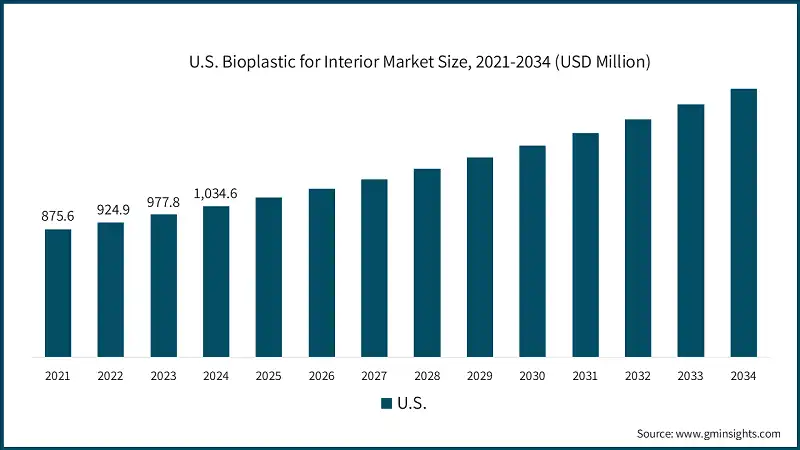
U.S. bioplastic for interior market is accounted for USD 1 billion in 2024.
- The U.S. bioplastic interior market is experiencing significant growth driven by increasing environmental awareness and stringent regulations promoting sustainable automotive solutions.
- Major automakers are adopting bioplastics for interior components like dashboards, door panels, and trims to reduce vehicle weight and carbon footprint. Consumer demand for eco-friendly vehicles further accelerates this trend. The availability of advanced bioplastic materials, coupled with technological innovations, supports the integration of bioplastics into mainstream automotive manufacturing.
Bioplastic for Interior Market Share
The global bioplastic interior market is characterized by a concentrated landscape, with several key players focusing on specialized applications within sustainable automotive and interior design solutions. Competition centres around proprietary biopolymer formulations, innovative processing techniques, and integration of bio-based materials into existing manufacturing workflows.
Companies emphasize control over raw material supply chains, often through strategic partnerships and vertical integration to enhance cost efficiency and supply reliability. Innovation in aesthetic customization, durability, and eco-friendly certifications further drive differentiation in the market. As sustainability mandates and consumer preferences shift towards greener interiors, these players invest in R&D to develop advanced bioplastic solutions that meet environmental standards and high-performance requirements.
Bioplastic for Interior Market Companies
Arkema S.A. develops bio-based polymers for interior applications, focusing on the integration of renewable raw materials into high-performance bioplastics. The company's research emphasizes improving the sustainability profile of their materials, targeting automotive and consumer interior markets.
BASF SE offers a range of bioplastics designed for interior use, utilizing plant-based feedstocks to produce environmentally friendly materials. Their focus is on combining durability with biodegradability, supporting sustainable construction and interior design solutions.
Covestro AG is involved in producing biobased polycarbonates and other polymers for interior applications, emphasizing circular economy principles. The company invests in developing sustainable raw material sourcing and recycling processes.
Evonik Industries AG develops specialty bioplastics and bio-based materials for interior markets, including high-performance compounds that meet technical and aesthetic requirements. Their R&D centres on enhancing material properties while reducing environmental impact.
Mitsubishi Chemical Group produces bio-derived plastics used in interior components, focusing on expanding renewable material use. The company emphasizes integrating bioplastics into existing manufacturing processes to improve sustainability credentials.
Bioplastic for Interior Market Report Attributes
| Key Takeaway | Details |
|---|---|
| Market Size & Growth | |
| Base Year | 2024 |
| Market Size in 2024 | USD 4.3 Billion |
| Forecast Period 2025 - 2034 CAGR | 6.1% |
| Market Size in 2034 | USD 7.7 Billion |
| Key Market Trends | |
| Growth Drivers |
|
| Pitfalls & Challenges |
|
What are the growth opportunities in this market?
Bioplastic for Interior Industry News
- In January 2025, Simple Flying reported that future airplane seats would be made from bioplastics, aiming to improve sustainability. However, high costs and industry profit margins had delayed widespread adoption of bioplastics in aircraft manufacturing.
- In June 2020, Covestro introduced Makrofol EC, a partially bio-based polycarbonate film with over 50% plant-derived carbon, significantly reducing its CO2 footprint and supporting sustainable product development as part of its circular economy strategy.
The bioplastic for interior market research report includes an in-depth coverage of the industry with estimates and forecast in terms of revenue in USD Billion and volume in terms of Kilo Tons from 2021–2034 for the following segments:
Market, By Polymer Type
- PLA (polylactic acid)
- Starch-based bioplastics
- Polyhydroxyalkanoates (PHA)
- Cellulose-based bioplastics
- Bio-PE (bio-polyethylene)
- Bio-PET (bio-polyethylene terephthalate)
- Others
Market, By Application
- Automotive interiors
- Furniture & home interiors
- Commercial & office interiors
- Retail & hospitality interiors
- Others
Market, By End Use
- Automotive OEMs
- Furniture manufacturers
- Interior design firms
- Retailers & showrooms
- Contractors & Builders
- Others
The above information is provided for the following regions and countries:
- North America
- U.S.
- Canada
- Europe
- Germany
- UK
- France
- Spain
- Italy
- Rest of Europe
- Asia Pacific
- China
- India
- Japan
- Australia
- South Korea
- Rest of Asia Pacific
- Latin America
- Brazil
- Mexico
- Argentina
- Rest of Latin America
- Middle East and Africa
- Saudi Arabia
- South Africa
- UAE
- Rest of Middle East & Africa
Frequently Asked Question(FAQ) :
What is the bioplastic for interior market size in 2024 and forecast for 2034?
The market was valued at USD 4.3 billion in 2024 and is projected to reach USD 7.7 billion by 2034, growing at a CAGR of 6.1%.
Which region leads the bioplastic for interior market?
The U.S. dominates with USD 1 billion in 2024, driven by green automotive demand and sustainability regulations.
Who are the key players in the bioplastic interior market?
Leading companies include Arkema, BASF, Covestro, Evonik, Mitsubishi Chemical, and NatureWorks, focusing on automotive and furniture interiors.
What are the main applications of bioplastics in interiors?
Major uses include automotive dashboards, furniture panels, partitions, trims, and retail displays across OEMs and furniture manufacturers.
Bioplastic for Interior Market Scope
Related Reports