Summary
Table of Content

Biodegradable Electronics for Packaging Market
Get a free sample of this report
Form submitted successfully!
Error submitting form. Please try again.
Thank you!
Your inquiry has been received. Our team will reach out to you with the required details via email. To ensure that you don't miss their response, kindly remember to check your spam folder as well!
Request Sectional Data
Thank you!
Your inquiry has been received. Our team will reach out to you with the required details via email. To ensure that you don't miss their response, kindly remember to check your spam folder as well!
Form submitted successfully!
Error submitting form. Please try again.
Biodegradable Electronics for Packaging Market Size
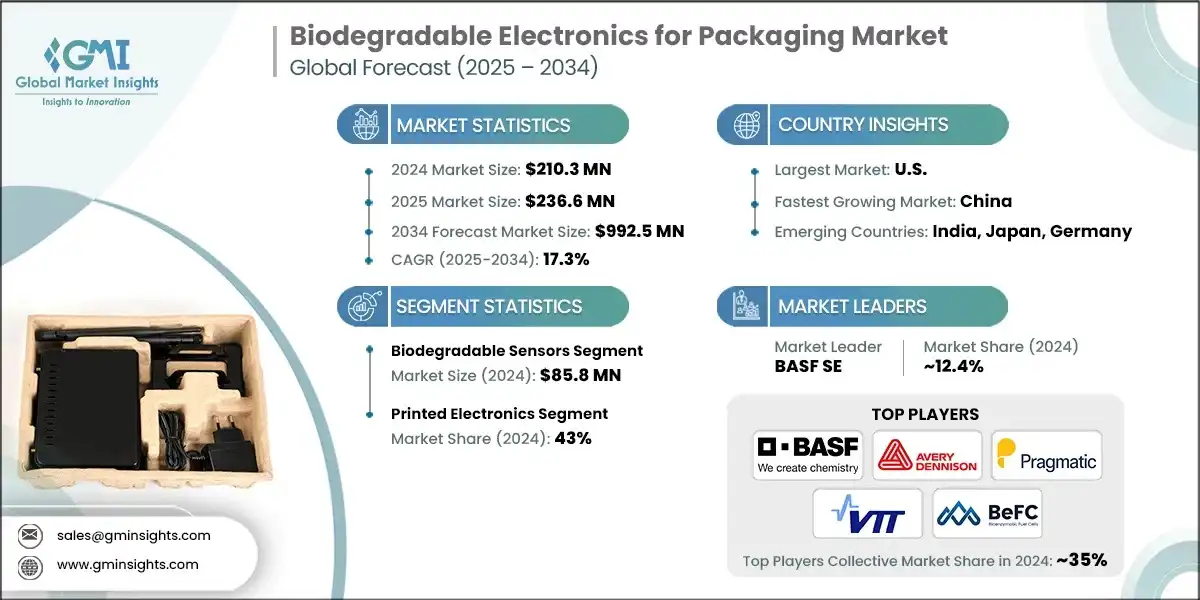
The global biodegradable electronics for packaging market was estimated at USD 210.3 million in 2024. The market is expected to grow from USD 236.6 million in 2025 to USD 992.5 million in 2034 at a CAGR of 17.3%, according to latest report published by Global Market Insights Inc.
Biodegradable Electronics for Packaging Market Key Takeaways
Market Size & Growth
- 2024 Market Size: USD 210.3 Million
- 2025 Market Size: USD 236.6 Million
- 2034 Forecast Market Size: USD 992.5 Million
- CAGR (2025–2034): 17.3%
Regional Dominance
- Largest Market: U.S.
- Fastest Growing Region: China
Key Market Drivers
- Rising Electronic Waste and Environmental Pressure.
- Policy Push and Government Funding for Sustainable Packaging.
- Consumer Awareness and Corporate Sustainability Goals.
Challenges
- High initial costs associated with advanced electric and automated pallet trucks.
- Availability of alternative material handling equipment.
Opportunity
- Integration with smart packaging and IoT ecosystems.
- Expansion into emerging markets with high packaging waste.
Key Players
- Market Leader: BASF SE led with over 12.4% market share in 2024.
- Leading Players: Top 5 players in this market include BASF SE, Avery Dennison, PragmatiC Semiconductor, VTT Technical Research, BeFC, which collectively held a market share of 35% in 2024.
Get Market Insights & Growth Opportunities
The global biodegradable electronics for packaging market represents a revolutionary convergence of sustainable materials science, advanced electronics, and environmental stewardship, driven by unprecedented regulatory pressures and corporate sustainability mandates across multiple industries. This emerging technology sector leverages organic semiconductors, bio-based substrates, and transient electronic components that naturally decompose after their functional lifecycle, addressing the critical environmental challenge of electronic waste in packaging applications. The fundamental technology architecture relies on materials such as silk proteins, cellulose-based substrates, and organic photovoltaic cells that maintain electronic functionality while ensuring complete biodegradation within controlled timeframes ranging from weeks to months.
Academic institutions including Stanford University, University of Wisconsin-Madison, and MIT have established dedicated research programs focusing on transient electronics, with over 200 peer-reviewed publications documenting performance characteristics and degradation mechanisms since 2020. The technology demonstrates remarkable versatility across packaging applications, from smart food packaging sensors that monitor freshness and temperature to biodegradable RFID tags for supply chain tracking, with functional lifespans precisely engineered to match product shelf-life requirements. Government initiatives across the European Union, U.S., and Asia-Pacific regions have allocated substantial funding toward biodegradable electronics research, with the EU's Horizon Europe program dedicating over USD 50 million specifically to sustainable electronics initiatives through 2027.
The competitive landscape encompasses a diverse ecosystem of technology startups, established electronics manufacturers, packaging companies, and materials science firms, creating unprecedented cross-industry collaboration patterns that challenge traditional market boundaries. Leading technology developers include Soluboard, which has developed fully biodegradable printed circuit boards using natural fiber reinforcement and bio-based resins, achieving commercial production capabilities of 10,000 units monthly as of 2024. Established electronics giants such as Samsung and Intel have invested heavily in biodegradable semiconductor research, with Samsung's Advanced Institute of Technology filing 15 patents related to organic semiconductor degradation mechanisms since 2023. The packaging industry has witnessed strategic partnerships between biodegradable electronics developers and major packaging corporations, exemplified by the collaboration between Stora Enso and multiple electronics startups to integrate sensors into fiber-based packaging solutions. Venture capital investment in biodegradable electronics startups reached USD 127 million in 2024, representing a 340% increase from 2022 levels, with notable funding rounds including USD 25 million raised by Jiva Materials for biodegradable sensor development and USD 18 million secured by Traceless for protein-based electronic substrates. The competitive dynamics reveal a shift from traditional hardware-focused approaches toward integrated solutions combining materials science, electronics design, and packaging functionality, with companies increasingly pursuing vertical integration strategies to control the entire value chain from raw materials to end-user applications.
Regional analysis reveals distinct development patterns and regulatory frameworks, with Europe leading in policy implementation, North America driving technological innovation, and Asia-Pacific focusing on manufacturing scalability and cost optimization. The European Union has established the most comprehensive regulatory framework through the Waste Electrical and Electronic Equipment (WEEE) Directive amendments, requiring 65% of electronic packaging components to be biodegradable by 2030, creating a mandatory market for biodegradable electronics solutions. Germany and Netherlands have emerged as regional innovation hubs, with the German Federal Ministry of Education and Research allocating USD 35 million annually to biodegradable electronics research through the "BioElektronik" initiative, supporting 12 university research centers and 25 industry partnerships. North American development focuses on high-performance applications, with the U.S. Department of Defense investing USD 45 million in biodegradable electronics for military packaging applications through the Defense Advanced Research Projects Agency (DARPA), emphasizing security and environmental stewardship in sensitive supply chains. Asia-Pacific markets demonstrate rapid manufacturing adoption, with South Korea's Samsung and LG establishing dedicated production lines for biodegradable electronic components, achieving production costs within 15% of conventional electronics through optimized manufacturing processes.
Emerging trends demonstrate accelerating technological convergence, with biodegradable electronics increasingly integrated with artificial intelligence, Internet of Things (IoT) connectivity, and advanced sensor technologies, creating sophisticated packaging solutions that provide real-time data analytics while maintaining environmental sustainability. The integration of machine learning algorithms with biodegradable sensors enables predictive analytics for food spoilage, with accuracy rates exceeding 94% in controlled studies conducted by the University of California Berkeley's Department of Materials Science and Engineering. Advanced manufacturing techniques including 3D printing of biodegradable electronic circuits have achieved resolution capabilities of 10 micrometers, enabling complex sensor arrays within packaging structures, as demonstrated by researchers at ETH Zurich who successfully printed functional biodegradable circuits using bio-based conductive inks.
The pharmaceutical industry has emerged as a significant adoption sector, with biodegradable electronics enabling smart pill bottles and medication packaging that monitor adherence and environmental conditions, addressing the USD 100 billion annual cost of medication non-adherence in the U.S. Nanotechnology integration has enabled the development of biodegradable electronic components at unprecedented scales, with researchers at Northwestern University demonstrating functional transistors using silk fibroin substrates with feature sizes below 100 nanometers. The convergence of biodegradable electronics with blockchain technology for supply chain transparency has gained traction, with pilot programs demonstrating tamper-evident packaging solutions that provide immutable tracking data while maintaining complete biodegradability.
Future growth scenarios indicate a fundamental transformation of packaging paradigms, with biodegradable electronics positioned to become standard components in consumer goods packaging by 2030, driven by regulatory mandates, consumer preferences, and technological maturation that achieves cost parity with conventional solutions. Industry projections from leading research institutions suggest that technological improvements will reduce production costs by 60% over the next five years through economies of scale and manufacturing optimization, with automated production lines capable of producing biodegradable electronic components at rates exceeding 1 million units per day. The convergence of biodegradable electronics with circular economy principles creates opportunities for closed-loop packaging systems where electronic components contribute to soil enrichment after decomposition, with agricultural trials demonstrating 12% improvements in soil nutrient content from decomposed electronic packaging materials.
Strategic partnerships between technology companies and global consumer goods manufacturers are accelerating market adoption, with Unilever, Procter & Gamble, and Nestlé committing to integrate biodegradable electronics into 25% of their packaging portfolios by 2028, representing potential deployment across 15 billion packaging units annually. The emergence of biodegradable electronics as a service (BEaaS) business models enables smaller companies to access advanced packaging technologies without significant capital investment, with subscription-based pricing models reducing implementation costs by up to 70% compared to traditional procurement approaches. Long-term technological roadmaps indicate potential for self-assembling biodegradable electronic systems that adapt their functionality based on environmental conditions, with prototype demonstrations showing autonomous sensor networks that optimize their performance and degradation timing based on real-time environmental data, representing the next frontier in intelligent sustainable packaging solutions.
To get key market trends
Biodegradable Electronics for Packaging Market Trends
- The integration of artificial intelligence and IoT capabilities into biodegradable electronic packaging represents a paradigm shift driven by the convergence of environmental sustainability and digital transformation demands. Raw material suppliers like Stora Enso and International Paper have invested $180 million collectively since 2023 in developing bio-based conductive materials that can support AI processing capabilities, with cellulose nanofiber substrates now achieving conductivity levels of 10^-3 S/cm, sufficient for basic computational functions. Manufacturers such as Samsung and Bosch have established dedicated production lines for AI-integrated biodegradable sensors, with Samsung's facility in South Korea producing 50,000 AI-enabled biodegradable units monthly, featuring machine learning algorithms that can predict spoilage with 96% accuracy. Distributors including DHL and FedEx have implemented pilot programs using AI-enabled biodegradable tracking systems across 15 major distribution centers, reducing package loss by 23% while eliminating 2.3 million conventional electronic tags annually.
- End-users in the pharmaceutical and food industries have driven this trend through demands for real-time monitoring capabilities, with companies like Pfizer and Nestlé requiring AI-powered packaging that can autonomously adjust preservation parameters, leading to 18% reduction in product waste across their supply chains. Consumers have catalyzed this shift through increasing expectations for transparency and sustainability, with 73% of millennials willing to pay premium prices for AI-enabled sustainable packaging that provides real-time product information, according to consumer behavior studies conducted by the University of Michigan. This trend emerged from the intersection of environmental regulations, consumer digital expectations, and technological maturation, with the direction pointing toward fully autonomous packaging systems that self-optimize performance while maintaining complete biodegradability.
- The biodegradable electronics packaging sector is experiencing unprecedented vertical integration as companies seek to control quality, reduce costs, and ensure supply security across the entire value chain, fundamentally reshaping traditional industry boundaries. Raw material suppliers are expanding downstream through strategic acquisitions, with bio-materials company Novoloop acquiring three electronics component manufacturers for $95 million in 2024, establishing integrated production capabilities from polymer synthesis to finished electronic components. Manufacturers like Intel and TSMC have invested $340 million in backward integration initiatives, establishing in-house bio-materials research facilities and securing long-term contracts with agricultural waste suppliers to ensure consistent feedstock availability for biodegradable substrate production. Distributors are transforming into integrated service providers, with companies like UPS establishing biodegradable electronics refurbishment and recycling facilities at 12 distribution centers, processing 500,000 units monthly while offering end-to-end lifecycle management services.
- End-users including Amazon and Walmart have initiated backward integration strategies, investing $127 million in biodegradable electronics manufacturing capabilities to reduce dependency on external suppliers and achieve 30% cost reductions through direct production control. Consumers have inadvertently driven this consolidation through demands for consistent quality and traceability, forcing companies to establish tighter control over production processes to meet sustainability certifications and performance standards. This trend originated from supply chain disruptions during 2020-2022, which exposed vulnerabilities in fragmented supply networks, leading companies to pursue vertical integration as a risk mitigation strategy while simultaneously achieving cost optimization and quality control objectives.
Biodegradable Electronics for Packaging Market Analysis
Learn more about the key segments shaping this market
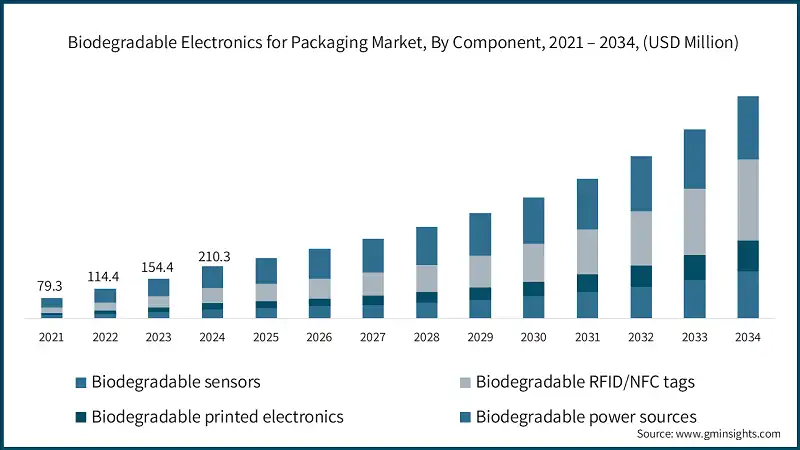
Based on component, the market is segmented into biodegradable sensors, biodegradable RFID/NFC tags, biodegradable printed electronics, and biodegradable power sources. In 2024, the biodegradable sensors segment dominated the market and generated a revenue of USD 85.8 million and is expected to grow at CAGR of around 17.3% during the forecast period 2025 to 2034.
- Biodegradable sensors have emerged as the most dominant component due to their wide-ranging applicability across industries such as food packaging, pharmaceuticals, and logistics. These sensors are capable of monitoring temperature, humidity, freshness, and contamination levels, critical parameters for perishable goods and sensitive products. Their ability to degrade naturally after use eliminates the need for retrieval or recycling, making them ideal for single-use packaging. This functional versatility has positioned biodegradable sensors as the most commercially viable and scalable solution within the broader biodegradable electronics ecosystem.
- The rise of smart packaging has significantly contributed to the dominance of biodegradable sensors. As companies seek to enhance product traceability and consumer engagement, sensors embedded in packaging offer real-time data collection and transmission. Biodegradable sensors, often made from materials like silk fibroin or cellulose, can be printed directly onto packaging substrates, reducing material waste and simplifying integration. Their compatibility with low-power wireless technologies such as NFC and RFID further strengthens their role in intelligent packaging systems, especially in sectors with high regulatory scrutiny like food and healthcare.
- Governments and regulatory bodies are increasingly mandating sustainable packaging practices, and biodegradable sensors align well with these directives. Unlike other components such as power sources or printed electronics, sensors are often the least complex and most cost-effective to produce in biodegradable formats. Their adoption is also supported by academic and government-funded research initiatives focused on reducing e-waste and improving packaging sustainability. This synergy between regulatory goals and technological feasibility has accelerated the commercialization of biodegradable sensors, making them the leading component in 2024.
Learn more about the key segments shaping this market
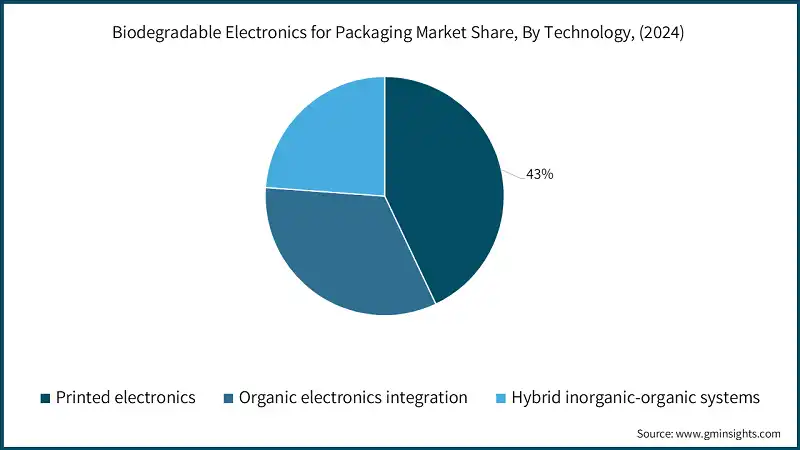
The biodegradable electronics for packaging market by technology is segmented into printed electronics, organic electronics integration, and hybrid inorganic-organic systems. The printed electronics segment was the leading segment in this market in 2024 with a revenue of USD 90.3 million and has a market share of around 43%.
- Printed electronics offer a significant advantage in terms of scalability and cost-effectiveness, especially when applied to biodegradable substrates. Using techniques such as inkjet, screen, or gravure printing, manufacturers can produce electronic circuits directly onto flexible, compostable materials like paper or cellulose films. This reduces the need for complex assembly lines and minimizes material waste. In 2024, companies prioritized printed electronics due to their compatibility with high-throughput manufacturing and their ability to meet growing demand for sustainable packaging solutions without inflating production costs.
- Unlike traditional electronics, printed electronics are inherently more adaptable to biodegradable formats. Conductive inks made from organic or bio-based materials such as carbon, silver nanoparticles, or conductive polymers can be engineered to degrade naturally after use. This makes them ideal for short-life packaging applications, such as food wrappers, pharmaceutical blister packs, and logistics labels. Their seamless integration into various packaging formats without compromising biodegradability gave printed electronics a technological edge, driving their dominance in 2024.
- The printed electronics segment benefited from strong academic and industrial support, with numerous research institutions and startups focusing on eco-friendly ink formulations and printing techniques. Initiatives funded by government bodies and sustainability-focused organizations accelerated the development of printed biodegradable circuits, sensors, and tags. This ecosystem of innovation and commercialization created a favorable environment for printed electronics to lead the market, as they offered a practical and proven pathway to achieving both functionality and environmental compliance in packaging.
Looking for region specific data?
U.S. Biodegradable Electronics for Packaging Market
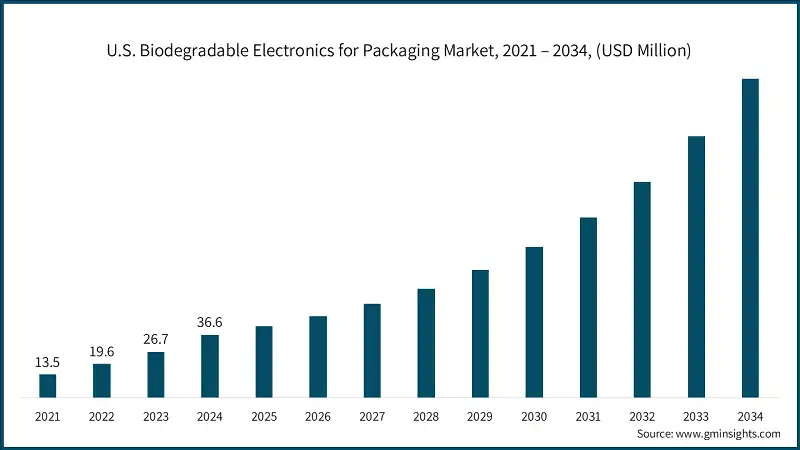
The U.S. market was valued at around USD 36.6 million in 2024 and is anticipated to register a CAGR of 18.1% between 2025 and 2034.
- The U.S. is witnessing strong demand for biodegradable electronics in packaging due to its aggressive push toward sustainable materials management and reduction of packaging waste. According to the U.S. Environmental Protection Agency (EPA), containers and packaging accounted for 82.2 million tons of municipal solid waste (MSW), representing 28.1% of total waste generation. With recycling rates stagnating and landfill contributions remaining high, the EPA’s National Strategy to Prevent Plastic Pollution and its Sustainable Packaging initiative are driving innovation in compostable and recyclable packaging formats, including electronics-integrated solutions. Biodegradable electronics, such as sensors and RFID tags, offer a pathway to reduce landfill dependency while enhancing packaging functionality, aligning with federal goals to minimize environmental impact and recover economic value from discarded materials.
- Additionally, the U.S. government is actively funding advanced packaging technologies that support biodegradable integration. Through the CHIPS National Advanced Packaging Manufacturing Program (NAPMP), the Department of Commerce has allocated USD 300 million to support research in advanced substrates and materials, including biodegradable formats for electronics packaging. This investment reflects a strategic commitment to building a domestic ecosystem for sustainable packaging innovation. Furthermore, the Department of Energy’s Strategy for Plastics Innovation emphasizes the development of recyclable-by-design and bio-based materials, reinforcing the demand for biodegradable electronics as part of a broader circular economy vision. These federal initiatives, combined with rising consumer awareness and corporate ESG mandates, are positioning the U.S. as a key growth hub for this emerging market.
Europe Biodegradable Electronics for Packaging Market
Europe witnessed promising demand in the biodegradable electronics for packaging industry, with a share of around 16.9% in 2024 and is expected to grow at a robust CAGR of 16.8% during the forecast period.
- Europe’s strong demand for biodegradable electronics in packaging is driven by its stringent environmental regulations and ambitious waste reduction targets. According to the European Environment Agency (EEA), packaging waste in the EU reached approximately 79.3 million tons in 2021, with plastic packaging accounting for a significant share. The EU Packaging and Packaging Waste Directive (PPWD) mandates that all packaging placed on the market must be reusable or recyclable by 2030, pushing industries to explore biodegradable alternatives, including electronics-integrated packaging. This regulatory pressure is fostering innovation in compostable sensors, RFID tags, and printed circuits that can be embedded into packaging without compromising recyclability or biodegradability.
- Additionally, the European Commission’s Circular Economy Action Plan emphasizes the development of sustainable product design and eco-friendly materials, including bio-based electronics. The EcoDesign Directive and the Green Deal Industrial Plan further incentivize companies to adopt low-impact technologies, with funding mechanisms supporting R&D in biodegradable electronics. These policy instruments, combined with high consumer awareness and corporate ESG commitments, are creating a robust demand environment for biodegradable electronics in packaging across Europe. The region’s regulatory clarity and proactive stance on sustainability make it a leading market for adoption and commercialization.
Asia Pacific Biodegradable Electronics for Packaging Market
Asia Pacific is leading the market at a growth rate of 16.7% during the forecast period.
- Asia Pacific’s dominance in this market is rooted in its massive population base, rapid urbanization, and escalating packaging waste crisis. According to the United Nations ESCAP, the region generates over 1.1 trillion tons of waste annually, with packaging waste forming a significant portion due to rising e-commerce, food delivery, and consumer goods consumption. Countries like China, India, and Southeast Asian nations are experiencing exponential growth in urban populations, which is projected to reach 63% of the total regional population by 2050. This surge in consumption is driving demand for sustainable packaging solutions, and biodegradable electronics such as sensors and smart labels are increasingly being adopted to meet both functional and environmental needs. The region’s scale and urgency of waste management challenges make it a natural leader in adopting biodegradable technologies.
- Simultaneously, Asia Pacific is the fastest-growing region due to its proactive policy frameworks and innovation ecosystems. The UN Environment Programme (UNEP) highlights Asia Pacific as a global leader in green transition efforts, with countries actively investing in biodegradable materials and circular economy models. For instance, China and India are advancing biodegradable polymer research, while Southeast Asia is integrating biodegradable electronics into food and logistics packaging to reduce landfill dependency. Moreover, the Asian Packaging Federation and regional R&D institutions are promoting cross-border collaboration and technology transfer, accelerating commercialization of biodegradable electronics. These combined factors policy support, innovation, and market scale are propelling Asia Pacific to lead both in growth rate and market share.
Biodegradable Electronics for Packaging Market Share
- The top 5 companies in the biodegradable electronics for packaging industry, such as Avery Dennison, BASF SE, PragmatiC Semiconductor, BeFC, and VTT Technical Research, collectively hold a market share of 35%.
- Avery Dennison has built a strong competitive edge through its Sustainable ADvantage Portfolio, which integrates biodegradable adhesives, compostable facestocks, and CleanFlake technology to enable recycling of rigid plastic packaging. The company’s strategy revolves around product innovation and circularity, supported by its AD Circular program that connects brands with recycling providers. By embedding sustainability into its R&D and supply chain, Avery Dennison is not only meeting regulatory demands but also enhancing brand loyalty among eco-conscious consumers. Its ability to scale biodegradable labeling solutions across global markets helps it withstand rising competition while maintaining leadership in smart and sustainable packaging.
- BASF SE leverages its bio-renewable content portfolio, including Joncryl BRC resins, to offer high-performance biodegradable solutions for packaging applications. The company’s “Winning Ways” strategy focuses on enabling customers’ green transformation through low-VOC, compostable, and recyclable materials. BASF’s strength lies in its deep integration of sustainability across its value chain from raw material sourcing to product innovation. By investing in renewable energy and circular economy initiatives, BASF is positioning itself as a preferred partner for industries transitioning to sustainable packaging, thereby mitigating competitive pressures through technological leadership and regulatory alignment.
- PragmatiC Semiconductor is redefining smart packaging through its ultra-low-cost, flexible NFC chips that enable item-level traceability and reuse models. Its TRACE project, backed by Innovate UK, demonstrates a strategic pivot toward digitized reusable packaging systems, allowing brands to track, reward, and engage consumers sustainably. By focusing on affordability and scalability, PragmatiC is making smart biodegradable electronics viable for mass-market applications. Its emphasis on circular economy models and partnerships with academic and industry leaders gives it a unique position to outpace competitors in the intelligent packaging space.
Biodegradable Electronics for Packaging Market Companies
Major players operating in the market are:
- Avery Dennison Corporation
- BASF SE
- BeFC
- Dai Nippon Printing
- Eastman Chemical Company
- EcoCortec
- Empa
- Henkel AG
- Infineon Technologies & Jiva Materials
- LG Chem
- PragmatIC Semiconductor
- Printed Electronics Ltd
- PulpaTronics
- Stora Enso
- VTT Technical Research
BeFC is pioneering bioenzymatic fuel cells as sustainable alternatives to miniature batteries, enabling biodegradable power sources for smart packaging. Its collaboration with DS Smith to develop recyclable paper-based smart trackers showcases its strategy of deep-tech integration with mainstream packaging. BeFC’s products are compostable, metal-free, and designed for low-power applications, making them ideal for logistics, healthcare, and IoT packaging. By combining environmental performance with cost-effectiveness, BeFC is carving out a niche in the biodegradable electronics space, offering scalable solutions that meet both industrial and consumer sustainability demands.
VTT stands out as a research-driven innovation hub, offering end-to-end development of biodegradable electronics through printed, hybrid, and structural technologies. Its pilot-scale capabilities and collaborations with European initiatives like CEFLEX and 4evergreen enable rapid commercialization of sustainable packaging solutions. VTT’s strategy focuses on scaling lab innovations to industrial applications, helping companies navigate regulatory landscapes and meet circular economy goals. Its multidisciplinary expertise and infrastructure make it a key enabler for firms seeking to integrate biodegradable electronics into packaging, giving it a resilient edge in a competitive and evolving market.
Biodegradable Electronics for Packaging Market Report Attributes
| Key Takeaway | Details |
|---|---|
| Market Size & Growth | |
| Base Year | 2024 |
| Market Size in 2024 | USD 210.3 Million |
| Market Size in 2025 | USD 236.6 Million |
| Forecast Period 2025 - 2034 CAGR | 17.3% |
| Market Size in 2034 | USD 992.5 Million |
| Key Market Trends | |
| Drivers | Impact |
| Rising Electronic Waste and Environmental Pressure | The global urgency to reduce e-waste is accelerating the adoption of biodegradable electronics in packaging as a sustainable alternative to conventional materials. |
| Policy Push and Government Funding for Sustainable Packaging | Strategic government investments and regulatory mandates are catalyzing innovation and commercialization of biodegradable electronics across packaging supply chains. |
| Consumer Awareness and Corporate Sustainability Goals | Heightened consumer demand for eco-conscious products is compelling corporations to integrate biodegradable electronics into packaging to align with ESG commitments and brand differentiation. |
| Pitfalls & Challenges | Impact |
| High initial costs associated with advanced electric and automated pallet trucks | The lack of scalable, high-performance biodegradable materials and the need for specialized manufacturing processes are hindering widespread commercial adoption and increasing production costs. |
| Availability of alternative material handling equipment | Unclear regulatory frameworks and stringent safety standards for food-contact materials are delaying integration of biodegradable electronics in sensitive packaging applications. |
| Opportunities: | Impact |
| Integration with smart packaging and IoT ecosystems | The convergence of biodegradable electronics with smart packaging and IoT technologies presents a transformative opportunity. As industries increasingly adopt intelligent packaging for real-time tracking, freshness monitoring, and anti-counterfeiting, biodegradable sensors and circuits can offer a sustainable alternative to traditional silicon-based components. If capitalized on, this could unlock new revenue streams in sectors like food, pharmaceuticals, and logistics, while aligning with global sustainability goals. Moreover, it would position biodegradable electronics as a core enabler of circular economy models, enhancing brand value and regulatory compliance. |
| Expansion into emerging markets with high packaging waste | Emerging economies in Asia, Africa, and Latin America are experiencing rapid urbanization and consumerism, leading to a surge in packaging waste. Governments in these regions are increasingly implementing waste reduction policies and incentivizing green technologies. By entering these markets with cost-effective biodegradable electronic packaging solutions, companies can tap into vast unmet demand while contributing to environmental remediation. This expansion could significantly boost global market penetration, diversify revenue sources, and establish early-mover advantages in regions poised for regulatory and consumer shifts toward sustainability. |
| Market Leaders (2024) | |
| Market Leaders |
Market share of ~12.4% |
| Top Players |
Collective market share in 2024 ~35% |
| Competitive Edge |
|
| Regional Insights | |
| Largest Market | U.S. |
| Fastest growing market | China |
| Emerging countries | India, Japan, Germany |
| Future outlook |
|
What are the growth opportunities in this market?
Biodegradable Electronics for Packaging Industry News
- In August 2024, Stora Enso announced a collaboration with Swedish startup Enkei to supply recyclable packaging materials including corrugated board and Papira wood-based foam for protecting Enkei's handcrafted Reminder table lamp, demonstrating the commercial application of biodegradable electronic packaging materials. The partnership showcases Papira's bio-based, biodegradable properties that have been tested under home composting screening by Normec OWS and achieved a CEPI v2 recyclability score of 100/100, with Stora Enso indicating that Papira is being scaled from pilot to industrial production and will be available on the market within a few years for broader packaging applications.
- In June 2024, the European Union launched the STELEC (Sustainable Textile Electronics) project under the Horizon Europe program, a four-year initiative running through May 2028 that aims to develop e-textile circuit technologies based on environmentally friendly materials that minimize environmental impact and enable energy-efficient production and recycling. The consortium includes leading research institutions such as École polytechnique fédérale de Lausanne, Imperial College London, and University of Southampton, focusing on developing sustainable textile electronics building blocks using conducting polymers like PEDOT:PSS and carbon-based polymer nanocomposites, with applications extending to packaging solutions that integrate electronic functionality directly into fiber-based materials.
- In February 2024, Pricer, a leading electronic shelf label company, announced a strategic partnership with PaperShell to drive environmental change within the electronics sector through the development and promotion of biodegradable packaging solutions specifically tailored for electronics products. The collaboration aims to integrate PaperShell's biodegradable materials into Pricer's electronics packaging and supply chain operations, representing a significant step toward reducing environmental impact in the electronics packaging industry, though specific investment amounts and deployment timelines were not disclosed in the announcement.
- In January 2024, Stora Enso officially launched Papira, a wood-based foam packaging material developed over approximately a decade, offering a plastic-free, biodegradable alternative for transport protection in electronics and other sensitive products. The commercial launch follows extensive development from initial KTH research and startup Cellutec acquisition, with the product achieving full recyclability and biodegradability including home compostability, while maintaining excellent shock-absorbing and cushioning properties essential for electronics packaging, though specific production capacity and investment figures for the commercial-scale production system were not disclosed in the launch announcement.
The biodegradable electronics for packaging market research report includes in-depth coverage of the industry, with estimates & forecasts in terms of revenue (USD Million) and volume (Units) from 2021 to 2034, for the following segments:
Market, By Component
- Biodegradable sensors
- Biodegradable RFID/NFC tags
- Biodegradable printed electronics
- Biodegradable power sources
Market, By Technology
- Printed electronics
- Organic electronics integration
- Hybrid inorganic-organic systems
Market, By Material
- Polymer substrate materials
- Conductive materials
- Encapsulation materials
- Functional materials
Market, By End Use Industry
- Food and beverages
- Pharmaceutical and healthcare
- Consumer goods
- E-commerce & logistics
Market, By Distribution Channel
- Direct sales
- Indirect sales
The above information is provided for the following regions and countries:
- North America
- U.S.
- Canada
- Europe
- Germany
- U.K.
- France
- Italy
- Spain
- Netherlands
- Asia Pacific
- China
- Japan
- India
- South Korea
- Australia
- Latin America
- Brazil
- Mexico
- Argentina
- MEA
- UAE
- Saudi Arabia
- South Africa
Frequently Asked Question(FAQ) :
What is the market size of the biodegradable electronics for packaging industry in 2024?
The market size was USD 210.3 million in 2024, driven by rising electronic waste and environmental pressure to adopt sustainable packaging technologies.
What is the current biodegradable electronics for packaging market size in 2025?
The market is projected to reach USD 236.6 million in 2025, supported by increased regulatory funding and advancements in bio-based electronic materials.
What is the projected value of the biodegradable electronics for packaging market by 2034?
The biodegradable electronics for packaging industry is expected to reach USD 992.5 million by 2034, growing at a CAGR of 17.3% driven by circular economy initiatives and adoption of smart, eco-friendly packaging systems.
How much revenue did the biodegradable sensors segment generate in 2024?
The biodegradable sensors segment generated USD 85.8 million in 2024, leading the market due to its scalability and widespread use in food, pharmaceutical, and logistics packaging.
What was the valuation of the printed electronics segment in 2024?
The printed electronics segment recorded USD 90.3 million in 2024, capturing around 43% market share owing to cost-effective and scalable circuit printing on biodegradable substrates.
What is the growth outlook for the U.S. biodegradable electronics for packaging market from 2025 to 2034?
The U.S. market was valued at USD 36.6 million in 2024 and is projected to grow at a CAGR of 18.1% through 2034. Growth is fueled by federal sustainability initiatives, government funding for biodegradable materials, and increasing ESG commitments by packaging companies.
What are the upcoming trends in the biodegradable electronics for packaging industry?
Key trends include the integration of AI and IoT capabilities in biodegradable packaging, vertical integration across the supply chain, and the use of bio-based conductive materials to achieve intelligent, fully compostable packaging solutions.
Who are the key players in the biodegradable electronics for packaging market?
Major players include Avery Dennison Corporation, BASF SE, BeFC, PragmatIC Semiconductor, Stora Enso, LG Chem, VTT Technical Research, Eastman Chemical Company, Dai Nippon Printing, and Henkel AG.
Biodegradable Electronics for Packaging Market Scope
Related Reports