Summary
Table of Content

Biobased Plasticizers Market
Get a free sample of this report
Form submitted successfully!
Error submitting form. Please try again.
Thank you!
Your inquiry has been received. Our team will reach out to you with the required details via email. To ensure that you don't miss their response, kindly remember to check your spam folder as well!
Request Sectional Data
Thank you!
Your inquiry has been received. Our team will reach out to you with the required details via email. To ensure that you don't miss their response, kindly remember to check your spam folder as well!
Form submitted successfully!
Error submitting form. Please try again.
Biobased Plasticizers Market Size
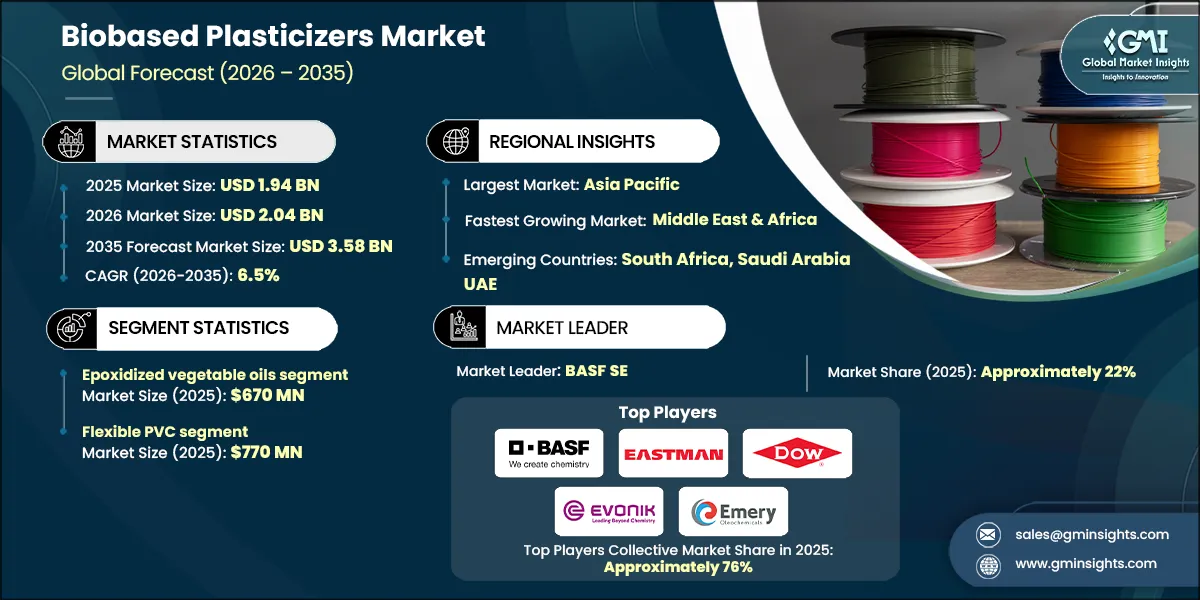
The global biobased plasticizers market was valued at USD 1.94 billion in 2025. It is projected to grow from USD 2.04 billion in 2026 to USD 3.58 billion by 2035, representing 6.5% CAGR from 2026 to 2035, according to latest report published by Global Market Insights Inc.
Biobased Plasticizers Market Key Takeaways
Market Size & Growth
- 2025 Market Size: USD 1.94 Billion
- 2026 Market Size: USD 2.04 Billion
- 2035 Forecast Market Size: USD 3.58 Billion
- CAGR (2026–2035): 6.5%
Regional Dominance
- Largest Market: Asia Pacific
- Fastest Growing Region: Middle East & Africa
Key Market Drivers
- Regulatory pressure on phthalate based plasticizers.
- Rising adoption of bio PVC in flexible applications.
- Brand sustainability commitments among polymer processors.
- Improved performance parity with petroleum alternatives.
Challenges
- Higher input costs versus conventional plasticizers.
- Feedstock availability volatility for bio based raw materials.
- Limited thermal stability in extreme processing conditions.
Opportunity
- Food contact and medical grade polymer formulations.
- Automotive lightweight interior material transition.
- Asia Pacific biopolymer capacity expansions.
- Customized ester blends for specific polymer systems.
Key Players
- Market Leader: BASF SE led with over market share approximately 22% in 2025.
- Leading Players: Top 5 players in this market include BASF SE, Eastman Chemical, Dow Chemical, Evonik Industries, Emery Oleochemicals, which collectively held a market share of 76% in 2025.
Get Market Insights & Growth Opportunities
The market is undergoing gradual growth because industries are switching to renewable and sustainable solutions in terms of materials. Increase in environmental consciousness and an ever-increasing worry about the environmental consequences of petroleum based plasticizers is compelling manufacturers to substitute bio-derived plasticizers (based on vegetable oil and other renewable feedstocks). The materials fit the corporate sustainability objectives and the circular economy corpus, which is why they are both appealing to manufacturers and the final consumers. Consequently, the demand is growing in various value chains.
Largely, regulatory encouragement is a key aspect that is enhancing market growth. Regulations on the use of phthalates and other toxic plasticizers by governments and regulatory agencies in the developed and the developing regions are becoming tight due to the health and environmental hazards. This has forced manufacturers to redesign products with non-toxic biobased plasticizers which are safe to be used in sensitive products like food packaging, medical appliances, toys and childcare products. The compliance requirements are directly converted into increased adoption rates.
Increase in end-use sectors also helps market development. Biobased plasticizers are being used more and more in the packaging, construction, automotive and consumer goods industries to enhance their sustainability profiles without compromising flexibility and performance. In packaging, the increase in the application of biodegradable and compostable plastics has resulted in demand whereas in the construction and automobile sectors, the plasticizers are used to achieve the green building goals and the emission requirements. The market momentum is still increasing with this expansion in application scope.
The market is also sustained to grow due to technological developments and continuous research and development. The manufacturers are putting emphasis on enhancing the performance properties of biobased plasticizers such as thermal stability, durability, and compatibility with different polymers. The trend is that biobased plasticizers are becoming increasingly commercially viable and a wide market penetration can be supported with long-term expansion as the production processes have become more efficient and the costs are gradually falling.
To get key market trends
Biobased Plasticizers Market Trends
The trend that has been instrumental in determining the market of biobased plasticizers is the growing tendency to use the high-performance bio-based formulations that are relatively similar to the functional properties of the traditional plasticizers or even beyond them. Players in the industry are working on the enhancement of thermal stability, migration resistance, and durability in the long term to make them fit in harsh applications. This trend can be seen as an extension of a wider industry shift towards the incorporation of sustainability into the industry without a reduction in technical performance. Consequently, biobased plasticizers are not placed anymore as niche solutions but as mainstream material solutions.
The increasing conformity of the biobased plasticizers to the recycled and biopolymers is another crucial trend. Manufacturers are also working on plasticizers that can work with recycled PVC and biodegradable plastics that allow closed-loop material systems. This represents a broad industry trend of moving to material circularity with additives required to be active within recycled material streams. The trend is changing the direction of product design strategies and bringing about a closer interaction between polymer manufacturers and additive suppliers.
There is also the localization and regionalization of production in the market. The firms are moving towards formulations that suit the regulatory requirements, climatic conditions as well as end-use requirements in the region, especially in Asia-Pacific and emerging markets. This trend of localization is also affecting supply chain designs and is stimulating investment in local manufacturing capacity. It allows the company to be more responsive to the market and helps to optimize costs in price-sensitive areas.
Another trend that is quite prominent is the growth in non-traditional and value-added applications. The use of biobased plasticizers is also finding high acceptance in medical equipment, eco-friendly textile, floor covering, and green building materials. This is an indication of a change in end-user industries to holistic integration of sustainability instead of separate modifications of materials. The competitive environment is slowly being redefined due to the diversification of areas of application, and this is expanding the long-term addressable market.
Biobased Plasticizers Market Analysis
Learn more about the key segments shaping this market
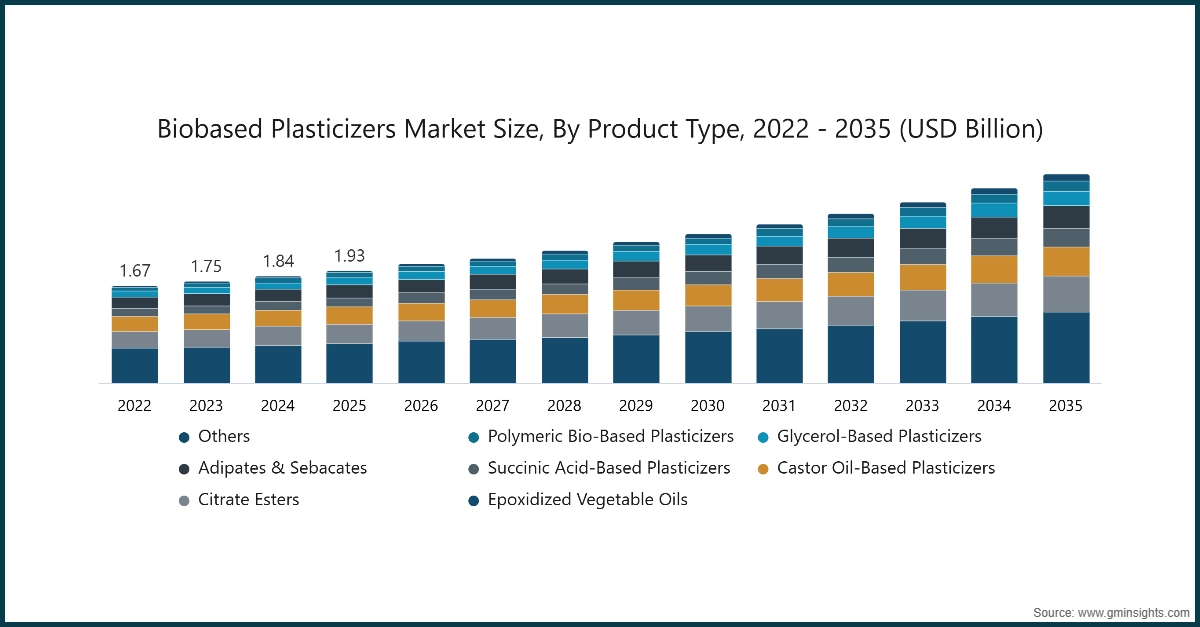
Biobased plasticizers market based on product type is segmented into epoxidized vegetable oils, citrate esters, castor oil-based plasticizers, succinic acid-based plasticizers, adipates & sebacates, glycerol-based plasticizers, polymeric bio-based plasticizers, and others. The epoxidized vegetable oils segment was valued at USD 0.67 Billion in 2025, and it is anticipated to expand to 6.2% of CAGR during 2026-2035.
Market is growing in terms of product type with the manufacturers matching biobased plasticizers more and more with the functional requirements. The use of epoxidized vegetable oils and citrate esters is increasing because of their flexibility, stability and low toxicity especially in PVC and packaging. The use of Castor oil-based and succinic acid-based plasticizers is increasing because the industries are focusing more on renewable feedstocks that have predictable supply and performance. This is a focused adoption that boosting product level demand in various industries.
Simultaneously, adipates, sebacates, glycerol-based, and polymeric biobased plasticizers are increasing in the field of applications that need durability and low migration. Polymeric biobased plasticizers find more applications in automotive and construction applications because they are in service over long time. The ever-improved formulation is enabling suppliers to span a wider scope of performance.
Biobased plasticizers market based on grade is segmented into food grade, medical grade, industrial grade, technical grade, and others. The industrial grade segment was valued at USD 1.06 billion in 2025, and it is anticipated to expand to 6.3% of CAGR during 2026-2035.
There is growth by grade which implies that there is differentiation according to the level of safety and regulation. Biobased plasticizers used in food packaging are growing because food packaging manufacturers are moving towards non-toxic and compliant additives. Medical-grade plasticizers are also ticking the market since the use of biocompatible plasticizers is also essential in medical equipment. These premium grades are generating value-based expansion in the market.
Meanwhile, industrial and technical grades remain important volumes of consumption. The grades find extensive use in construction, automotive and general industrial applications where cost effectiveness and performance balance are required. Their extensive usage is favorable to massive adoption. Existence of high end and industrial grade is facilitating margin and volume expansion.
Biobased plasticizers market based on bio-based content is segmented 100% bio-based, partially bio-based (>50% bio-based content), and partially bio-based (<50% bio-based content). The partially bio-based (>50% bio-based content)segment was valued at USD 0.96 billion in 2025, and it is anticipated to expand to 6.1% of CAGR during 2026-2035.
The market is expanding at various levels of bio-based contents with the end users embracing diverse sustainability approaches. Plasticizers based entirely on renewable sources are starting to be used in renewable-based applications and in emphasizing environmentally friendly labels. They are being used more in consumer-friendly and environmentally friendly products. This segment is defining the high-end sustainability segment of the market.
The capabilities to balance between cost, performance, and renewable content are making partially bio-based plasticizers grow faster. The more bio-based share the products are, the more they find use as transition products in the industries and automobile sector. Reduced bio-based content versions are still in favor of gradual replacement in price-sensitive markets.
Learn more about the key segments shaping this market
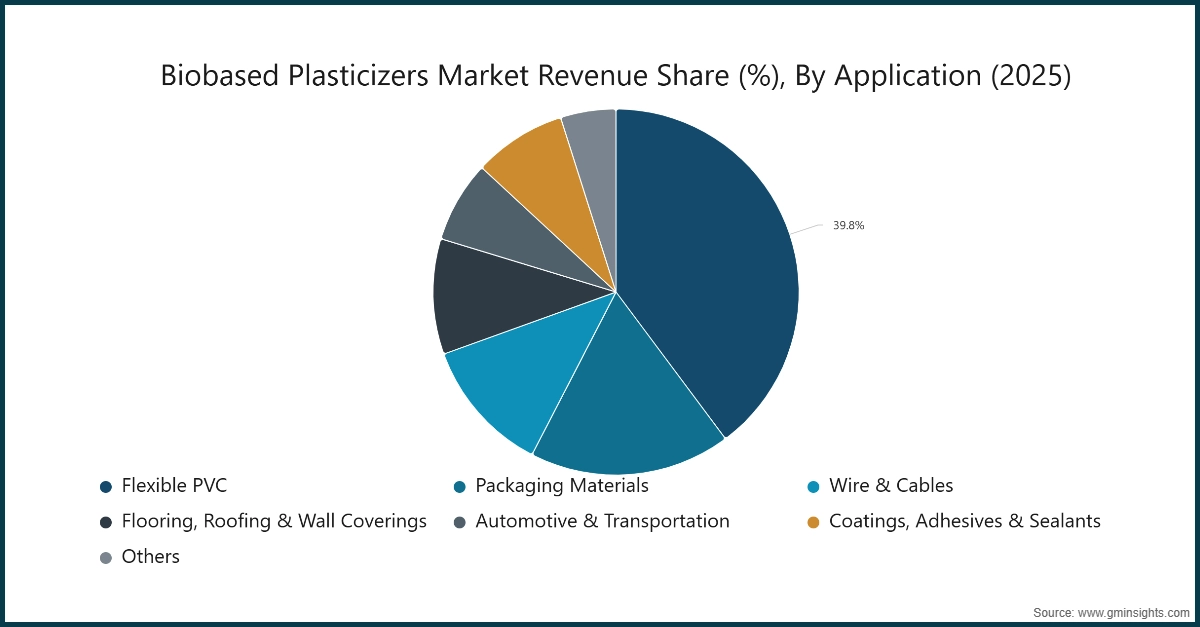
Biobased plasticizers market based on application is segmented into flexible PVC, packaging materials, wire & cables, flooring, roofing & wall coverings, automotive & transportation, coatings, adhesives & sealants, and others. The flexible PVC segment was valued at USD 0.77 billion with a market share of with a market share of 39.7% in 2025, and it is anticipated to expand to 6.3% of CAGR during 2026-2035.
The flexible PVC is the most popular consumption segment of biobased plasticizers that drives the application-based growth. The packaging materials are also shifting to the use of these plasticizers to address sustainability and safety expectation. Flooring, wall coverings and wire and cable insulation are also being used to drive demand based on regulatory and performance standards. These applications offer sustainable growth.
The automotive and transport applications are continuing to increase as companies incorporate sustainable materials in the interior parts. Biobased plasticizers (also used in coatings, adhesives, and sealants) are also becoming popular, since they can be used alongside low-emission formulations. The groundbreaking uses are minimizing dependence on the conventional end usages. All in all, the diversification of the application is enhancing the growth profile of the market.
Looking for region specific data?
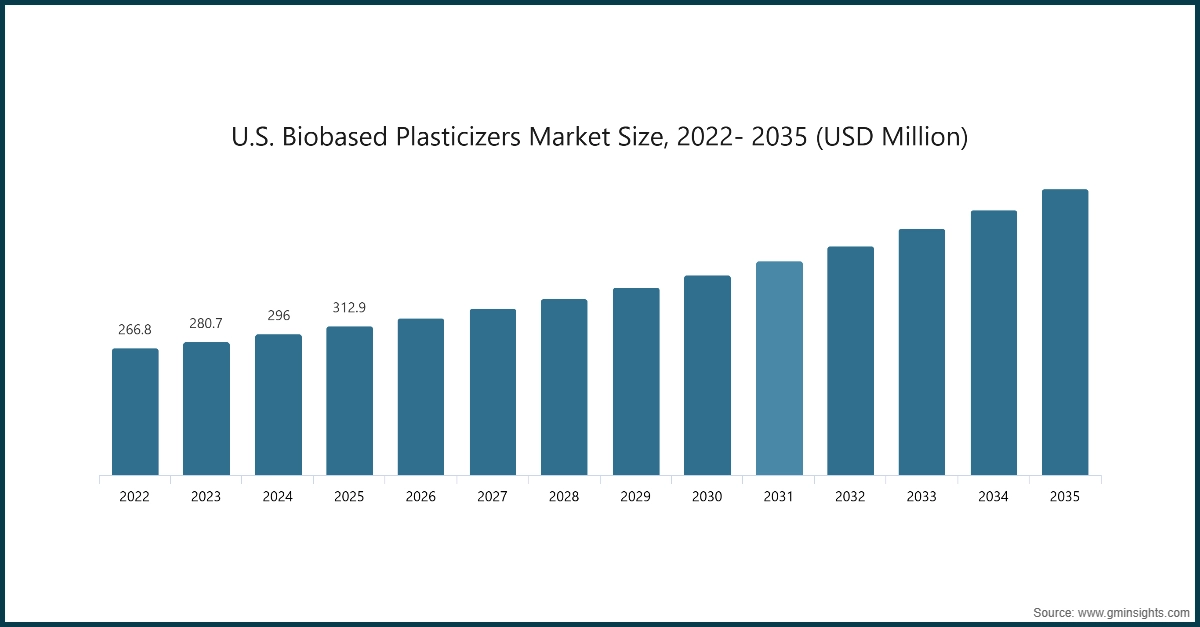
The North America biobased plasticizers market accounted for USD 0.35 billion in 2025 and is anticipated to show lucrative growth over the forecast period.
In North America, there is a slow but constant use of biobased plasticizers, which is backed by the concept of sustainability integration in the packaging, construction, and automotive sectors. The United States contributes to regional demand by being more regulatory aware and demanding more flexible PVC and food-contact uses whereas Mexico contributes to the demand by its growing manufacturing and export industries. The market is developing based on innovation-based supply chains and circular material strategies. Comprehensively, growth is compliant and slow-paced.
The Europe biobased plasticizers market accounted for USD 0.54 Billion in 2025 and is anticipated to show lucrative growth over the forecast period.
Europe is a well-developed and regulation-oriented market of biobased plasticizers, where environmental safety and renewable resources are of high priority. Germany, France, and Italy are all important players, which are brought about by automotive interiors, packaging and construction uses. The market is inclined towards high bio-based content and low-migration plasticizers which are in line with the green building and sustainability requirements. The region still leads with the standards of quality and sustainable material use.
Asia Pacific biobased plasticizers market accounted for 44.5% market share in 2025 and is anticipated to show lucrative growth over the forecast period.
The Asia-Pacific market is a fast developing market that is endorsed by massive industrialization and various end-use need. China leads in the consumption of the region because of its large PVC, packaging and construction industries whereas India is rapidly emerging with the increased sustainability awareness. Japan is contributing via the high-performance and specialty applications. The area has a favorable uptake of semi- bio based plasticizers as scalable transition options.
Latin America biobased plasticizers market is anticipated to grow at a CAGR of 8% during the analysis timeframe.
Latin America is a developing market, and the biobased plasticizers are gradually picking up. Brazil is a leader because of good availability of agricultural feedstock and increasing packaging needs whereas in Mexico and Argentina, the countries facilitate regional consumption by building and industrial use. Market penetration is moderate with an improvement. Material decisions are slowly being affected by sustainability alignment.
Middle East & Africa biobased plasticizers market is expected to grow at a CAGR of 8.1% during the analysis timeframe.
In the Middle East & Africa region, there is selective usage of biobased plasticizers, mostly in the construction and infrastructure oriented usage. The UAE and Saudi Arabia have high demand due to huge development projects, whereas South Africa has demand in industrial use. Limitations to local production and sensitivity to cost are still weaknesses. Nevertheless, the growing attention to sustainable materials is allowing the expansion into the market gradually.
Biobased Plasticizers Market Share
- BASF SE, Eastman Chemical, Dow Chemical, Evonik Industries, and Emery Oleochemicals are a significant part of the global market and with further standing of being highly consolidated with the top five players steadily holding 76% market share in the year 2025.
- The fierce competition is conditioned by the high attention to research and development processes and made the companies to enhance the performance features like durability, low volatility, and compatibility with other polymer systems. Product innovation enables the market actors to meet new technical and regulatory provisions and maintain differentiation in the competitive market.
- Entrant companies keep a presence by providing their diversified portfolios which provide food-grade, medical-grade and industrial uses, which cover both high-value and high-volume areas. This portfolio diversification minimizes reliance on one end use industry and promotes predictable revenue flows.
- Renewable raw material sources is secured, and selective backward integration assist companies to deal with risk in supply and fluctuation in prices. Through tightening the grip on the supply of feedstock, players can ensure the quality of the products and ensure competitiveness in price.
- Compliance and sustainability certifications are important in terms of competitive positioning especially in areas where there are strict environmental regulations. These credentials will raise customer confidence and allow better infiltration into regulated applications.
- Cooperation with polymer producers and the end-users promotes quicker application innovation and uptake of biobased plasticizers. Through these alliances, the companies are able to affect formulation decisions and install their products during the initial stages of product development.
- Localization of products and regional manufacturing growth can keep the players competitive with emerging and price elastic markets. This will enhance responsiveness in supply and alignment of products to the regional needs with regard to regulation and performance.
- The optimization of processes and scale efficiencies provide the balancing of the sustainability objectives with the sustenance cost competitiveness. With such combined strategies, the market leaders have played a huge role in terms of altering the direction towards biobased plasticizers and enhancing the market maturity at large.
Biobased Plasticizers Market Companies
The major players operating in biobased plasticizers industry include:
- BASF SE
- Eastman Chemical
- Dow Chemical
- Evonik Industries
- Emery Oleochemicals
- Others
• BASF SE maintains its competitiveness in the biobased plasticizers markets with high competencies in R&D and extensive array of bio-based and non-phthalate plasticizers. Supported by integrated production and global reach, premium, regulatory-compliant packaging, automotive, and construction solutions are the specialty of the company.
• Eastman Chemical has retained its position of leadership by providing high-quality biobased and non-phthalate plasticizers that possess high safety and performance profiles. The company is competitive in regulated and industrial segments due to continuous innovation, application-specific formulations, and close association with the end users.
• Dow Chemical develops its competitive edge in the market by material science and incorporation of biobased plasticizers into larger sustainable polymer packages. The company focuses on scalability, reliability of supply and compatibility with recycled and bio-based polymers to facilitate long-term adoption.
• Evonik Industries concentrates on specialty and high-value biobased plasticizers using its strengths in additives and specialty chemicals. Some of the methods the company uses to differentiate include customized formulations, high technical support, and adherence to stringent environmental and health standards.
• Emery Oleochemicals is a major competitor because of its intensive knowledge regarding oleochemicals based plasticizers using renewable feedstocks. The business focuses on bio-based material, sustainability of supply chain and customization of PVC and flexible material use.
Biobased Plasticizers Market Report Attributes
| Key Takeaway | Details |
|---|---|
| Market Size & Growth | |
| Base Year | 2025 |
| Market Size in 2025 | USD 1.94 Billion |
| Market Size in 2026 | USD 2.04 Billion |
| Forecast Period 2026-2035 CAGR | 6.5% |
| Market Size in 2035 | USD 3.58 Billion |
| Key Market Trends | |
| Drivers | Impact |
| Regulatory pressure on phthalate based plasticizers | Accelerates substitution toward biobased formulations |
| Rising adoption of bio PVC in flexible applications | Expands volume demand across coatings, films, and cables |
| Brand sustainability commitments among polymer processors | Drives long term supply agreements for biobased inputs |
| Improved performance parity with petroleum alternatives | Reduces technical switching barriers for manufacturers |
| Pitfalls & Challenges | Impact |
| Higher input costs versus conventional plasticizers | Limits adoption in price sensitive end use markets |
| Feedstock availability volatility for bio based raw materials | Creates supply inconsistency and margin pressure |
| Limited thermal stability in extreme processing conditions | Restricts use in high temperature polymer applications |
| Opportunities: | Impact |
| Food contact and medical grade polymer formulations | Unlocks high‑margin, compliance‑driven application segments |
| Automotive lightweight interior material transition | Increases uptake in durable, low‑fogging plastic components |
| Asia Pacific biopolymer capacity expansions | Enables regional scaling and cost competitiveness |
| Customized ester blends for specific polymer systems | Strengthens supplier differentiation and pricing power |
| Market Leaders (2025) | |
| Market Leader |
Market Share Approximately 22% |
| Top Players |
Collective Market Share Approximately 76% |
| Competitive Edge |
|
| Regional Insights | |
| Largest Market | Asia Pacific |
| Fastest growing market | Middle East & Africa |
| Emerging countries | South Africa, Saudi Arabia, UAE |
| Future outlook |
|
What are the growth opportunities in this market?
Biobased Plasticizers Market News
- In March 2024, BASF SE increased its bio-based and non-phthalate plasticizer production capacity in Europe to reinforce its supply to the packaging and construction sectors to ease the scaling of sustainable plasticizers solutions and enhance their presence in the market.
- In February 2024, Dow Chemical Company introduced a new generation of greener plasticizer technology to use in flexible PVC applications, driving the strategy of Dow to add bio-based additives to its larger polymer range and accelerate the usage of lower-impact plasticizers in key end markets.
The biobased plasticizers market research report includes in-depth coverage of the industry with estimates & forecasts in terms of revenue (USD Billion) & (Kilo Tons) from 2022 to 2035, for the following segments:
Market By Product Type
- Epoxidized Vegetable Oils
- Epoxidized Soybean Oil (ESBO/ESO)
- Epoxidized Linseed Oil
- Other Epoxidized Vegetable Oils
- Citrate Esters
- Tributyl Citrate (TBC)
- Acetyl Tributyl Citrate (ATBC)
- Other Citrate Esters
- Castor Oil-Based Plasticizers
- Succinic Acid-Based Plasticizers
- Adipates & Sebacates
- Glycerol-Based Plasticizers
- Glycerin/Glycerol
- Glycerin Acetate
- Polymeric Bio-Based Plasticizers
- Others
Market By Grade
Food Grade
- Medical Grade
- Industrial Grade
- Technical Grade
- Others
Market By Bio-Based Content
- 100% Bio-Based
- Partially Bio-Based (>50% Bio-Based Content)
- Partially Bio-Based (<50% Bio-Based Content)
Market By Application
- Flexible PVC
- Packaging Materials
- Food & Beverage Packaging
- Consumer Goods Packaging
- Compostable & Biodegradable Packaging
- Wire & Cables
- Flooring, Roofing & Wall Coverings
- Automotive & Transportation
- Interior Trim & Dashboard Films
- Under-Hood Components
- Seals & Gaskets
- Coatings, Adhesives & Sealants
- Others
The above information is provided for the following regions and countries:
- North America
- U.S.
- Canada
- Europe
- UK
- Germany
- France
- Italy
- Spain
- Rest of Europe
- Asia Pacific
- China
- India
- Japan
- South Korea
- Australia
- Rest of Asia Pacific
- Latin America
- Brazil
- Mexico
- Argentina
- Rest of Latin America
- MEA
- UAE
- Saudi Arabia
- South Africa
- Rest of Middle East and Africa
Frequently Asked Question(FAQ) :
What was the market size of the biobased plasticizers market in 2025?
The market size was USD 1.94 billion in 2025, with a CAGR of 6.5% expected from 2026 to 2035, driven by the demand for sustainable and high-performance plasticizer solutions.
What is the projected value of the biobased plasticizers market by 2035?
The market is expected to reach USD 3.58 billion by 2035, fueled by advancements in bio-based formulations and increasing adoption in various applications.
What is the projected size of the biobased plasticizers market in 2026?
The market is expected to reach USD 2.04 billion in 2026.
How much revenue did the epoxidized vegetable oils segment generate?
The epoxidized vegetable oils segment generated USD 0.67 billion in 2025 and is projected to grow at a CAGR of 6.2% from 2026 to 2035.
What was the valuation of the industrial grade segment?
The industrial grade segment was valued at USD 1.06 billion in 2025 and is anticipated to grow at a CAGR of 6.3% from 2026 to 2035.
Which application segment leads the biobased plasticizers market?
The flexible PVC segment led the market with a valuation of USD 0.77 billion and a 39.7% market share in 2025. It is projected to grow at a CAGR of 6.3% from 2026 to 2035.
Which region leads the biobased plasticizers market?
North America accounted for USD 0.35 billion in 2025 and is expected to exhibit lucrative growth during the forecast period, driven by increasing adoption of sustainable materials.
What are the upcoming trends in the biobased plasticizers industry?
Key trends include the development of plasticizers compatible with recycled PVC and biodegradable plastics, a focus on material circularity, and advancements in thermal stability, migration resistance, and durability.
Who are the key players in the biobased plasticizers market?
Key players include BASF SE, Eastman Chemical, Dow Chemical, Evonik Industries, and Emery Oleochemicals.
Biobased Plasticizers Market Scope
Related Reports