Summary
Table of Content

Bioactive Peptide from Food Waste Market
Get a free sample of this report
Form submitted successfully!
Error submitting form. Please try again.
Thank you!
Your inquiry has been received. Our team will reach out to you with the required details via email. To ensure that you don't miss their response, kindly remember to check your spam folder as well!
Request Sectional Data
Thank you!
Your inquiry has been received. Our team will reach out to you with the required details via email. To ensure that you don't miss their response, kindly remember to check your spam folder as well!
Form submitted successfully!
Error submitting form. Please try again.
Bioactive Peptide from Food Waste Market Size
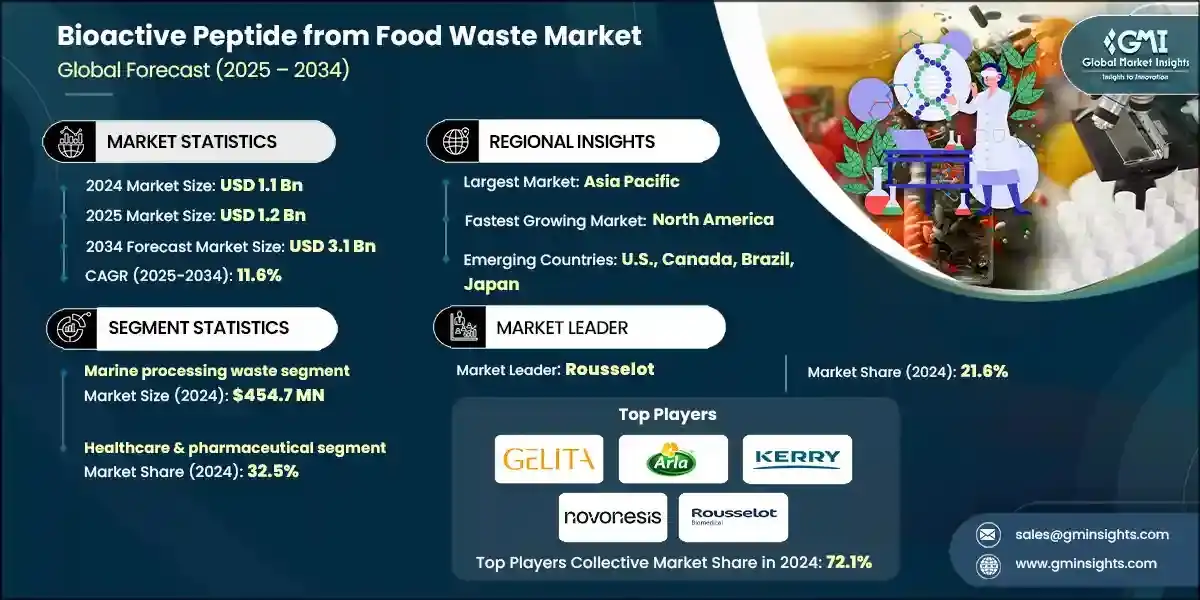
The global bioactive peptide from food waste market size was valued at USD 1.1 billion in 2024. The market is expected to grow from USD 1.2 billion in 2025 to USD 3.1 billion in 2034, at a CAGR of 11.6%, according to latest report published by Global Market Insights Inc.
To get key market trends
- Biologically active protein derived from food processing by-products and waste streams, which are increasingly being processed to develop health-promoting products such as functional foods, nutraceuticals, and pharmaceuticals, are termed as bioactive peptide from food waste. With increasing emphasis on sustainable resource utilization prompted by environmental concerns revolving around the globe, waste valorization strategies are being adopted in line with the principles of a circular economy.
- Governments all over the world endorse such initiatives through policies encouraging reduction and valorization of food waste; for instance, the European Union Circular Economy Action Plan aims at waste minimization and resource efficiency, directly serving the interests of the bioactive peptides market. According to the Food and Agriculture Organization of the United Nations, loss and waste of food worldwide is estimated to be around one-third of food produced for human consumption, with a total of about 1.3 billion tons a year. Staggering potential exists to convert them to high-value products such as bioactive peptides.
- North America is currently fastest growing market, with its advanced manufacturers' infrastructures and supporting regulatory framework that favor innovation and commercialization. Meanwhile, with a steady increase in food waste generation and a growing focus on sustainable practices, Asia-Pacific constitutes the largest market.
Bioactive Peptide from Food Waste Market Report Attributes
| Key Takeaway | Details |
|---|---|
| Market Size & Growth | |
| Base Year | 2024 |
| Market Size in 2024 | USD 1.1 Billion |
| Market Size in 2025 | USD 1.2 Billion |
| Forecast Period 2025 - 2034 CAGR | 11.6% |
| Market Size in 2034 | USD 3.1 Billion |
| Key Market Trends | |
| Drivers | Impact |
| Growing focus on circular economy & waste valorization | The increasing focus on circular economy and waste valorization accelerates the development and adoption of bioactive peptides derived from food waste, promoting sustainable industry growth |
| Rising demand for natural & clean-label ingredients | This demand drives innovation and market expansion for natural bioactive peptides sourced from food waste, aligning with consumer preferences for transparency and healthfulness |
| Supportive regulatory framework for food waste utilization | A favourable regulatory environment facilitates easier approval, commercialization, and scaling of bioactive peptides from food waste, boosting market potential |
| Pitfalls & Challenges | Impact |
| Consumer perception issues with waste-derived ingredients | Negative perceptions pose barriers to market acceptance, potentially slowing down the adoption and commercialization of waste-derived bioactive peptides |
| Quality control & contamination management | Challenges in maintaining quality and safety standards can hinder product development, restrict market entry, and impact consumer trust in bioactive peptides from food waste |
| Opportunities: | Impact |
| Untapped food waste streams in emerging markets | Exploiting these opportunities can lead to significant market growth by creating new sources of bioactive peptides and expanding the industry footprint |
| Integration with personalized nutrition trends | Aligning bioactive peptides from food waste with personalized nutrition strategies can open new avenues for targeted health solutions, driving market expansion |
| Market Leaders (2024) | |
| Market Leaders |
21.6% |
| Top Players |
Collective market share in 2024 is 72.1% |
| Competitive Edge |
|
| Regional Insights | |
| Largest Market | Asia Pacific |
| Fastest Growing Market | North America |
| Emerging Country | U.S., Canada, Brazil, Japan |
| Future Outlook |
|
What are the growth opportunities in this market?
Bioactive Peptide from Food Waste Market Trends
- Advancements in green extraction technologies such as supercritical fluid extraction or enzymatic hydrolysis are revolutionizing the biosynthesis of bioactive peptides in terms of increased yield and purity and reduced environmental footprint. The uptake of these innovations is expected to become a driving force in accelerating the market, as they adhere to sustainability objectives and consumer acceptance concerning clean-label products.
- Peptides derived from food waste are becoming cornerstones of functional food formulations, whereby they are lauded for their health benefits: antioxidant, anti-inflammatory, and antimicrobial. Driven by preventive health-related awareness, manufacturers are striving to innovate the products that can fulfil these emerging customer expectations.
- Sustainability movement globally is pushing companies to adopt circular economy principles by converting food wastes into bioactive ingredients of commercial value. Such a trend will not only avert environmental harm but also confer economic value to disposable substances. Governments and institutions are fostering programs that advocate waste minimization and resource utilization, which in sum boost the awareness and acceptance of bioactive peptides from food waste.
Bioactive Peptide from Food Waste Market Analysis
Learn more about the key segments shaping this market
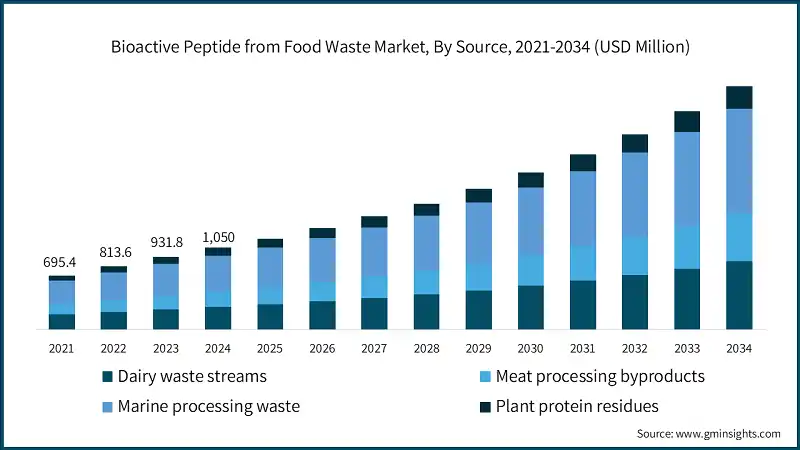
Based on source, the bioactive peptide from food waste market is segmented into dairy waste streams, meat processing byproducts, marine processing waste and plant protein residues. Marine processing waste generated USD 454.7 million in 2024.
- Marine processing waste-mainly fish waste, shellfish waste, aquaculture waste-dominates the market. They are highly concentrated by bioactive compounds such as omega-3 fatty acids, collagen, and bioactive peptides, all with proven health benefits. In fact, the potential of marine waste streams into high-purity bioactive peptides is becoming increasingly valuable for applications such as nutraceuticals, cosmetics, and functional foods.
- Increased demand for marine-based products from health-conscious consumers, coupled with increased activities from the expanding aquaculture sector, further intensifies this high demand in growing segments of markets and hence makes marine processing waste the major source for bioactive peptides extracted from food waste.
- Rising behind marine sources, dairy waste streams such as whey processing residues besides those from cheese and milk waste stand in second place due to their high protein content and proven health benefits from dairy-derived peptides.
- Meat processing byproducts-from blood, plasma, skin, bones, to organ waste-account for most of the value because of the richness in collagen, gelatin, and other bioactive peptides. Plant protein residues from oilseed meals, grains byproducts, and pulse residues have been increasingly recognized as an appealing source as plant-based diets continue to trend upward. They are on an upward trajectory in terms of their application in functional foods and supplements due to growing consumer interest in more natural ingredients that are also sustainable.
Learn more about the key segments shaping this market
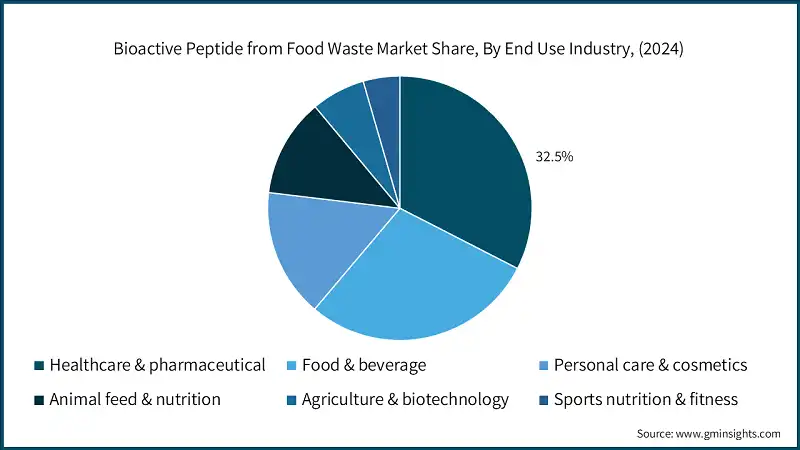
Based on end use industry, the bioactive peptide from food waste market is segmented into healthcare & pharmaceutical, food & beverage, personal care & cosmetics, animal feed & nutrition, agriculture & biotechnology and sports nutrition & fitness. Healthcare & pharmaceutical segment accounted for the market share of 32.5% in 2024.
- Healthcare and pharmaceutical industry dominates due to its high demand for bioactive compounds having therapeutic benefits, like anti-inflammatory, antioxidant, antihypertensive, etc. These trends feed into the formulations of drugs, medical nutrition, and clinical research because of the increasing number of chronic diseases and elderly consumers looking for natural and effective options.
- The nutraceuticals and supplements industries are evolving rapidly for the additional consumer preferences in natural health products, functional foods, and dietary supplements for the prevention and overall improvement of their wellness. The capacity of bioactive peptides to enhance immunity and metabolic health makes them highly enthralling for formulations fueling innovation and market penetration.
- The food and beverage sector is another significant end-user, with applications in functional foods, protein fortification, natural preservatives, flavor enhancement, and beverage fortification. Rising consumer health consciousness and demand for clean-label products are the forces boosting the growth of this segment, thus prompting food manufacturers to incorporate bioactive peptides and meet consumer demands.
- Bioactive peptides are grabbing a space in personal care and cosmetics applications like anti-aging, moisturizing, and wound healing. The consumers are bringing out the need for personal care products that are effective but natural alternatives to skincare remedies.
- While smaller, the animal-feed and nutrition industry and agriculture are growing segments, receiving a thrust from the global drive for sustainable farming and animal health, which demand healthier and sustainable feed alternatives and crop health enhancers, respectively.
Looking for region specific data?
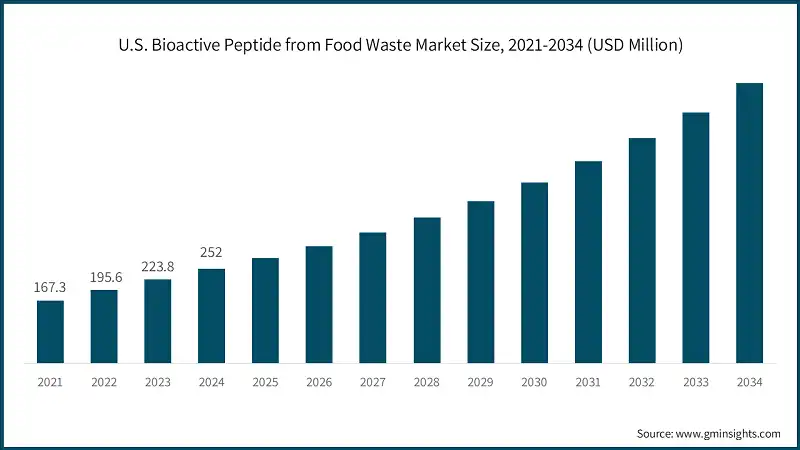
The bioactive peptide from food waste market in North America will grow at a CAGR from approximately 11.5% between 2025 and 2034.
- The key growth factors are healthy and natural ingredient trends manifesting in increasing consumer awareness about health and wellness, and the consequent demand for natural and sustainable dietary ingredients. This happens due to health-conscious consumers, bioactive peptides are introduced in functional foods and dietary supplements, as well as nutraceutical formulations, by food and beverage industries.
- Improvement innovations in extraction and purification techniques have improved efficiency and yield of bioactive peptides in such a way that their availability for different applications has been encouraged. This, in turn, has given rise to innovative products and supports market development.
The bioactive peptide from food waste markets in Europe, especially in a few countries like Germany, are expected to grow with a rapid pace in the coming years, especially from 2025 to 2034 and expected to mark a notable CAGR of 11.4%.
- The sustainable practices and circular economy that have gained traction in this region have facilitated the valorization of food waste for bioactive peptides extraction.
- Innovation in extraction technologies, green for organic and natural ingredients take centre stage toward the market, supported by high R&D investments from companies for developing efficient and eco-friendly processes.
- An increasing consumer inclination toward health-enhancing food products and the rising application of bioactive peptides in functional foods and dietary supplements are contributing factors for market growth in the region.
The bioactive peptide from food waste market in China and India is expected to have lucrative growth between 2025 and 2034.
- Rapid urbanization, industrialization, and a huge population base have increased food waste, now valorized for bioactive peptide extraction to satisfy the rising demand.
- Current functionalization of food waste for bioactive peptides must be encouraged by the upsurge of health and wellness enthusiasts in combination with the growing availability of functional foods and supplements.
- The market has only improved, and this trend in high investment for modern extraction technologies and sustainable environment-friendly practices is also what underpins the shift towards natural and plant-based ingredients.
Between 2025 and 2034, the market for bioactive peptide from food waste in the UAE and the Middle East is projected to grow significantly during this period with a CAGR of 10.1% from 2025-2034.
- Infrastructure development, smart cities, and industrialization have raised the profile of sustainable practices, including the use of food waste for bioactive peptide extraction.
- More and more conscious consumers are learning about health benefits and acquiring preferences for natural ingredients in food and personal care products. This market growth is further driven by advances in the pharmaceutical and nutraceutical sectors, increased disposable incomes, and the changing focus of companies toward exploring novel ingredients based on waste.
Brazil and Argentina are expected to witness promising growth for the bioactive peptide from food waste sector between 2025 and 2034.
- The green vision in the direction of sustainable manufacturing and waste minimization is aiding local producers in developing eco-friendly extraction methods of bioactive peptides.
- The increasing scale of agricultural and food processing activities has created monumental food waste, which, in turn, is now being exploited in production for value-added bioactive ingredients.
- Urbanization trends and infrastructural developments, coupled with the higher degree of health consciousness, are creating demand for functional foods and supplements containing bioactive peptides thereby propelling regional growth.
Bioactive Peptide from Food Waste Market Share
- Bioactive peptide from food waste industry is moderately consolidated with players like GELITA, Arla Foods Ingredients Group, Kerry Group plc, Novonesis and Rousselot accounts for 72.1% market share in 2024.
- The bioactive peptide from food waste market consists of such leading companies operating in their regional areas. Their long years of experience with peptide allow these companies to maintain a strong market position worldwide. Their product offerings are diverse and majorly supported by production capacities and distribution networks, which can serve the increasing demand for bioactive peptide from food waste in various regions.
Bioactive Peptide from Food Waste Market Companies
Major players operating in the bioactive peptide from food waste industry includes:
- Arla Foods Ingredients Group
- DSM-Firmenich
- Fonterra (NZMP)
- GELITA
- Glanbia plc
- Kerry Group plc
- Novonesis
- PB Leiner
- Rousselot
- Tessenderlo Group
Rousselot operates through extensive collagen and gelatin peptide production capabilities. Rousselot has a global footprint for developing, establishing, and maintaining customer relationships in pharmaceutical, nutraceutical, and food industries, which provide competitive advantages in terms of market access and product development.
GELITA is dynamic market players with diversified peptide portfolio and extensive manufacturing around the world. The potential of bioactive collagen peptides focus on health and nutrition applications and consequently drives growth on nutraceuticals and functional food segments. GELITA's spearhead research and development also contributes to product innovation and clinical verification for bioactive nature.
Arla Foods Ingredients Group produces the bioactive peptides from whey and the various other waste streams present in dairy processing. The connected supply chain directly stretches from the dairy farm into finished peptide ingredients and enables quality and traceability throughout the production processes. Furthermore, the capability of R&D in Arla is highly productive for clinical validation of bioactive properties and for novel ingredient regulatory approval processes.
Kerry Group plc combines its food ingredients expertise with biotechnology capabilities to develop bioactive peptides from a variety of waste streams. The company's profile is pervasive and contains well-established customers that create multiple avenues for entering markets across application areas.
DSM-Firmenich, produce bioactive peptides from different waste streams. Peptide discovery, characterization, and application development are supported by the company's global research network across a plethora of industries/ends.
Bioactive Peptide from Food Waste Industry News
- May 2025, Arla Foods Ingredients launched its "Maximum Yield, no Acid Whey" campaign, using Nutrilac HighYield to avoid acid whey in dairy production so that dairy can be fully exploited.
- February 2025, GELITA showcased its "BE ACTIVE!" initiative in Natural Products Expo West, which emphasizes the bioactive supplements of collagen peptides and gelatin. The effort highlighted creating sustainable functional ingredients from food waste to support active lifestyles, healthiness, and wellness with eco-friendly bioactive peptide applications.
- February 2025, Rousselot achieved Upcycled Certified for its Peptan collagen peptides, as a mark of its commitment to sustainable practices and waste minimization. This certification emphasizes the use of food by-products coming out of the food industry so these can be turned into valuable bioactive components with health benefits and circular and responsible supply chains.
- December 2024, Nuritas from Ireland partnered with Series C investors raising a total of USD 42 million to invest , for its developing bioactive peptides from plant sources, even food waste, by AI
The bioactive peptide from food waste market research report includes an in-depth coverage of the industry with estimates and forecast in terms of revenue in USD Million and volume in terms of Kilo Tons from 2021–2034 for the following segments:
Market, By Source
- Dairy waste streams
- Whey processing residues
- Cheese manufacturing byproducts
- Milk processing waste
- Meat processing byproducts
- Blood & plasma fractions
- Skin & hide processing waste
- Bone & cartilage residues
- Organ meat processing byproducts
- Marine processing waste
- Fish processing residues
- Shellfish processing byproducts
- Aquaculture waste streams
- Plant protein residues
- Oilseed processing meals
- Grain processing byproducts
- Pulse processing residues
- Fruit & vegetable processing waste
Market, By End Use Industry
- Healthcare & pharmaceutical
- Nutraceutical & dietary supplement
- Therapeutic drug development
- Medical nutrition
- Clinical research & development
- Over-the-counter (OTC) medicine
- Food & beverage industry
- Functional food ingredient
- Protein fortification
- Natural preservative
- Flavor enhancement
- Fermented product
- Beverage fortification
- Personal care & cosmetics
- Anti-aging skincare
- Moisturizing & hydration
- Hair care & scalp health
- Wound care & healing
- Sun protection
- Men's grooming
- Animal feed & nutrition
- Aquaculture feed
- Livestock feed supplement
- Pet food & treats
- Poultry feed
- Swine feed
- Ruminant feed
- Agriculture & biotechnology
- Bio-stimulant
- Plant growth promoter
- Soil health enhancement
- Crop protection
- Seed treatment
- Sports nutrition & fitness
- Pre-workout supplement
- Post-workout recovery
- Protein powder
- Energy bar & snack
- Hydration product
The above information is provided for the following regions and countries:
- North America
- U.S.
- Canada
- Europe
- Germany
- UK
- France
- Spain
- Italy
- Rest of Europe
- Asia Pacific
- China
- India
- Japan
- Australia
- South Korea
- Rest of Asia Pacific
- Latin America
- Brazil
- Mexico
- Argentina
- Rest of Latin America
- Middle East and Africa
- Saudi Arabia
- South Africa
- UAE
- Rest of Middle East & Africa
Frequently Asked Question(FAQ) :
Who are the key players in the bioactive peptide from food waste industry?
Key players include Arla Foods Ingredients Group, DSM-Firmenich, Fonterra (NZMP), GELITA, Glanbia plc, Kerry Group plc, Novonesis, PB Leiner, Rousselot, and Tessenderlo Group.
What was the market share of the healthcare and pharmaceutical segment in 2024?
The healthcare and pharmaceutical segment accounted for 32.5% of the market share in 2024, led by the demand for bioactive compounds with therapeutic benefits.
What is the growth outlook for the North American bioactive peptide from food waste sector?
The North American market is expected to grow at a CAGR of approximately 11.5% between 2025 and 2034, propelled by increasing consumer awareness about health and wellness.
What are the upcoming trends in the bioactive peptide from food waste market?
Trends include advancements in green extraction technologies, the integration of bioactive peptides into functional food formulations, and the adoption of circular economy principles to convert food waste into valuable bioactive ingredients.
What is the expected size of the bioactive peptide from food waste industry in 2025?
The market size is projected to reach USD 1.2 billion in 2025.
How much revenue did the marine processing waste segment generate in 2024?
The marine processing waste segment generated USD 454.7 million in 2024, dominating the market due to its high concentration of bioactive compounds like omega-3 fatty acids, collagen, and bioactive peptides.
What is the projected value of the bioactive peptide from food waste market by 2034?
The market is poised to reach USD 3.1 billion by 2034, fueled by advancements in green extraction technologies and the adoption of circular economy principles.
What was the market size of the bioactive peptide from food waste in 2024?
The market size was valued at USD 1.1 billion in 2024, with a CAGR of 11.6% expected through 2034. The growth is driven by increasing emphasis on sustainable resource utilization and the rising demand for health-promoting products.
Bioactive Peptide from Food Waste Market Scope
Related Reports