Summary
Table of Content

Bio Vanillin Market
Get a free sample of this report
Form submitted successfully!
Error submitting form. Please try again.
Thank you!
Your inquiry has been received. Our team will reach out to you with the required details via email. To ensure that you don't miss their response, kindly remember to check your spam folder as well!
Request Sectional Data
Thank you!
Your inquiry has been received. Our team will reach out to you with the required details via email. To ensure that you don't miss their response, kindly remember to check your spam folder as well!
Form submitted successfully!
Error submitting form. Please try again.
Bio Vanillin Market Size
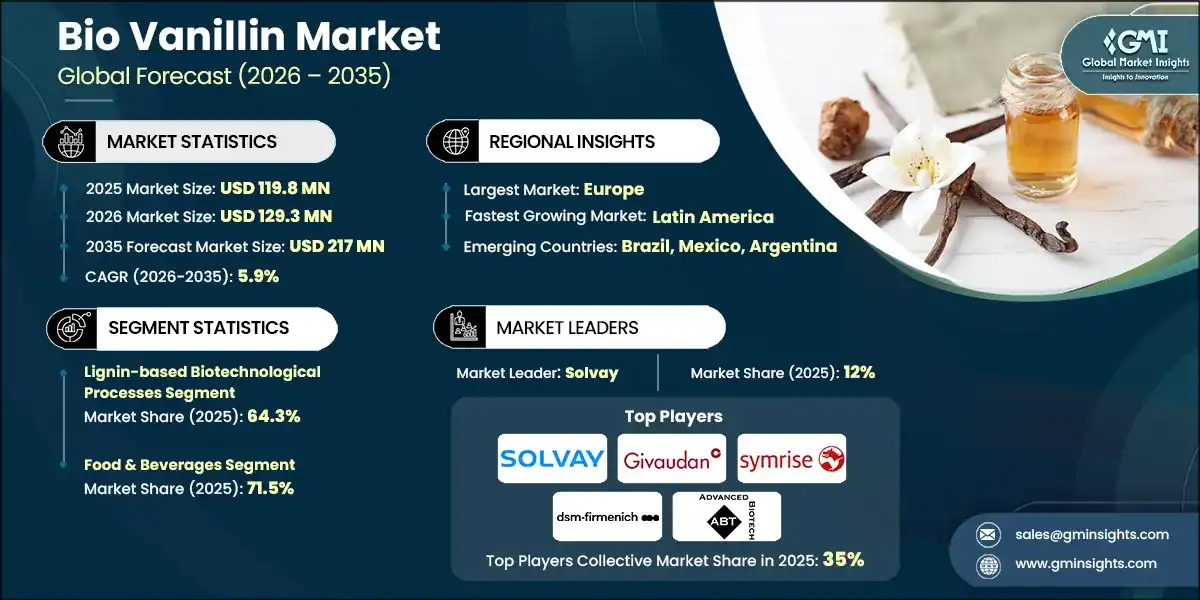
The global bio vanillin market size was valued at USD 119.8 million in 2025. The market is expected to grow from USD 129.3 million in 2026 to USD 217 million in 2035, at a CAGR of 5.9% according to latest report published by Global Market Insights Inc.
Bio Vanillin Market Key Takeaways
Market Size & Growth
- 2025 Market Size: USD 119.8 Million
- 2026 Market Size: USD 129.3 Million
- 2035 Forecast Market Size: USD 217 Million
- CAGR (2026–2035): 5.9%
Regional Dominance
- Largest Market: Europe
- Fastest Growing Region: Latin America
Key Market Drivers
- Rising consumer demand for natural & clean-label ingredients.
- Regulatory pressure on synthetic vanillin.
- Sustainability commitments by F&B giants.
Challenges
- Vanillin toxicity to microbial hosts.
- High production costs vs synthetic vanillin.
Opportunity
- Geographic expansion in emerging markets.
- Novel substrate utilization (waste biomass).
Key Players
- Market Leader: Solvay led with over 12% market share in 2025.
- Leading Players: Top 5 players in this market include Solvay, Givaudan, Symrise AG, DSM Firmenich, Advanced Biotech, which collectively held a market share of 35% in 2025.
Get Market Insights & Growth Opportunities
- Bio vanillin market is focusing on becoming one of the important segments of specialty chemicals due to the present properties that were obtained from sustainable and natural sources. With the latest biotechnological processes, Bio Vanillin is produced as an eco-alternate for synthetic vanillin, where it conforms to all sustainable details of the 'global reduced environmental footprint' campaigns thriving worldwide. The high performance and sustainability of Bio Vanillin have made it popular in various applications.
- Growing emphasis on sustainability is mainly driving this market. Green chemistry is at the top priority for industries all over the world with the demarcation of less dependence on petrochemical-based ingredients. This scenario will create ample demand for bio-based applications that will naturally propel adoption in the industry. Consumers tend to increase their shift towards natural and clean-label products in food, beverages, and also personal care, thus rushing to adopt Bio Vanillin as these increases.
- Bio vanillin is broadly applicable across different industries: in food and beverages, it is introduced as a flavoring agent in high-end organic consumables whereby consumer satisfaction concerning the authentic taste profile is achieved. In fragrance and cosmetics products, their olfactory properties and good fitting to sustainable compositions make it a preferred candidate for marketers.
To get key market trends
Bio Vanillin Market Trends
- The bio vanillin industry is dynamically witnessing a shift, with sustainability and innovation redefining the role of bio vanillin across industries. This transformation is brought about by an increasing consumer demand for authenticity and commitments from companies to reduce their carbon footprints. Therefore, Bio Vanillin is becoming a catalyst for the development of eco-friendly products.
- Advancements in technology such as breakthroughs in fermentative processes, enzymatic synthesis, and integrated production models-will determine what the future of this market looks like. Not only do these improvements enhance yield and purity, but they are also integrated into the principles of the circular economy, employing renewable feedstocks and reducing waste.
- Another opening trend is the diversification of the applications beyond food and beverages. Cosmetics, fragrances, and pharmaceuticals are adopting bio vanillin, matching the increasing need for ethical and transparent sourcing, as the material is naturally derived and has functional benefits.
- The market trends increasingly demonstrate influences from global sustainability frameworks and decarbonization goals, motivating manufacturers to consider including bio vanillin within their product portfolios for differentiation. The gradual shift in paradigm is changing bio vanillin from merely a bulk product to a strategic ingredient in performance, safety, and environmental stewardship across multiple sectors.
Bio Vanillin Market Analysis
Learn more about the key segments shaping this market
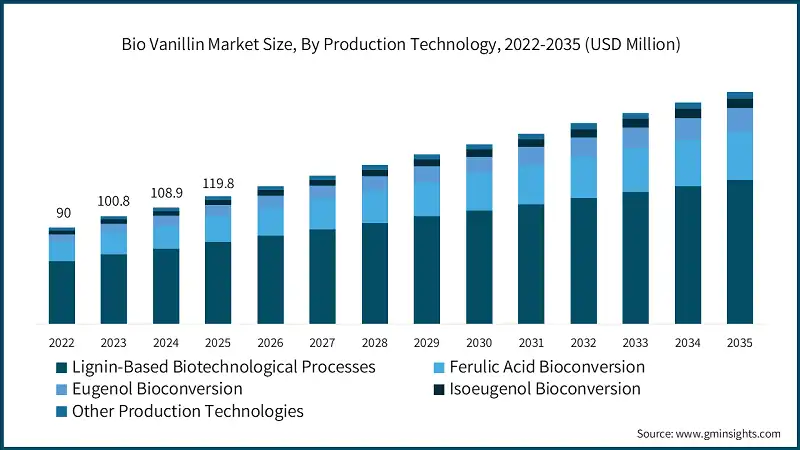
Based on production technology, the bio vanillin market is segmented into lignin-based biotechnological processes, ferulic acid bioconversion, eugenol bioconversion, isoeugenol bioconversion, and other production technologies. Lignin-based biotechnological processes dominated the market with an approximate market share of 64.3% in 2025 and is expected to grow with a CAGR of 5.5% till 2035.
- The lignin-based biotechnological processes implement renewable lignocellulosic materials according to the principles of the circular economy. In addition to reducing reliance on petrochemical sources, it also favours the bioconversion of ferulic acid, which remains the most dominant pathway due to its efficiency and capability to produce high-purity vanillin using microbial fermentation. Bioengineering based on fermentation can also be used to convert eugenol and isoeugenol, both produced naturally by clove oil derivatives, into vanillin, thereby creating alternate pathways to provide flexibility in feedstock options of choice for the manufacturers.
Learn more about the key segments shaping this market
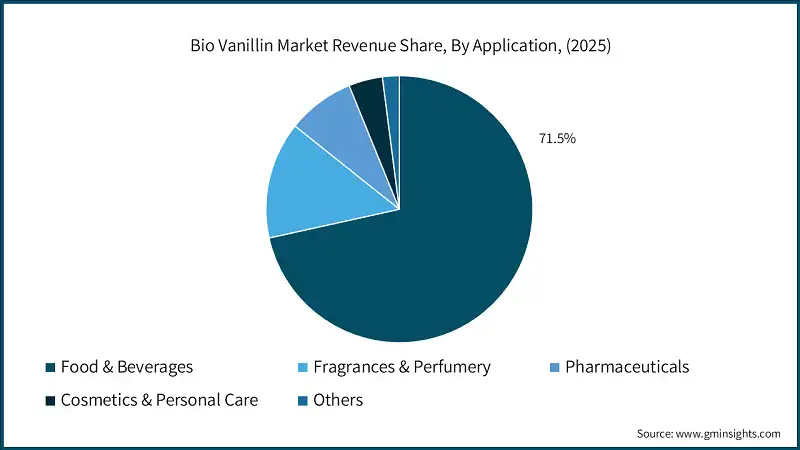
Based on application, the bio vanillin market is segmented into food & beverages, fragrances & perfumery, pharmaceuticals, cosmetics & personal care, others. Food & beverages held the largest market share of 71.5% in 2025 and is expected to grow at a CAGR of 5.7% during 2026 to 2035.
- In food and beverages, bio vanillin is used as a premium flavoring agent in clean-label and natural formulations to comply with increasing consumer demand authenticity and sustainability. In fragrance and perfumery, bio vanillin is characterized by its aromatic richness, which is used to create eco-friendly scents according to green chemistry principles.
- It is used in the pharmaceutical sector for both functional benefits in drug formulations and nutraceuticals, thus supporting health-focused innovations. The personal care and cosmetics segment uses bio vanillin not just for its sensory appeal, but also due to its suitability with natural product lines that reaffirm brand commitments to ethical sourcing.
Looking for region specific data?
The North America bio vanillin market is growing rapidly on the global level with a revenue share of 27.5% in 2025.
- North America would stand out as a strategic growth area for the bio-vanillin market supported with advanced manufacturing capabilities, robust sustainability frameworks, and demand for natural and clean-label products by consumers in the region.
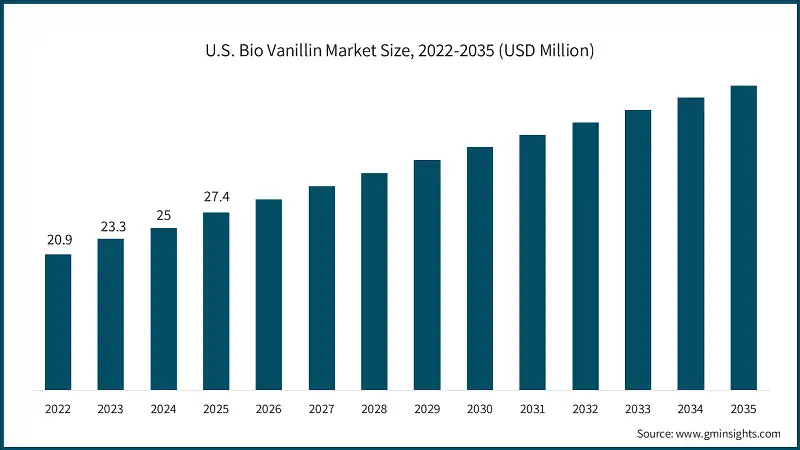
U.S. dominates the North America bio vanillin market with USD 27.4 million in 2025, showcasing strong growth potential.
- The North American market is dominated by the U.S. due to its policies on the use of renewable raw materials and the incorporation of clean-label formulations.
Europe Market leads the industry with revenue of USD 49.8 million in 2025 and is anticipated to show lucrative growth over the forecast period.
- Europe remains the prime bio vanillin market since stringent sustainability policies, greater consumer preference, and advanced biotechnological capabilities drive this region. The commitment of this region to green chemistry and clean-label formulations generates favorable conditions for bio-based flavor solutions.
Germany dominates the European market, showcasing strong growth potential.
- Germany is the superior monopolist within the European market due to avid and robust research and development infrastructure base coupled by leadership in sustainable manufacturing practices.
The Asia Pacific Market is anticipated to grow at a CAGR of 6.9% during the analysis timeframe.
- Asia-Pacific is emerging as the most dynamic growth region for the bio vanillin market, fueled by rapid industrialization, strong consumer demand for natural ingredients, and increasing acceptance of sustainable solutions.
China market is estimated to grow with a significant CAGR in the Asia Pacific region.
- Initiatives by the government to promote sustainability and natural sources along the lines of consumer goods further reinforce China's leadership role in the regional and global market trends.
Latin America accounted for 4.2% market share in 2025 and is anticipated to show highest growth over the forecast period.
- Latin America is fast emerging as a favorable region for the market, backed by sustainability-oriented initiatives and enabling regulatory regime.
Brazil leads the Latin American market, exhibiting remarkable growth during the analysis period.
- Brazil holds leadership in the market in Latin America due to the existing strong industrial base and the rapidly growing consumer goods sector.
Middle East & Africa accounted for 2% market share in 2025 and is anticipated to show lucrative growth over the forecast period.
- The regional platform of the Middle East and Africa for the bio vanillin market is fast gaining attention due to sustainability-related policies and economic diversification measures favoring bio-sustainable alternatives.
Saudi Arabia industry to experience substantial growth in the Middle East and Africa market in 2025.
- Saudi Arabia is seen as a key growth driver for Bio Vanillin, in the Middle East and Africa, leveraging its industrial transformation agenda and sustainable development vision.
Bio Vanillin Market Share
The top 5 companies in bio vanillin industry include Solvay, Givaudan, Symrise AG, DSM Firmenich, Advanced Biotech. These are prominent companies operating in their respective regions covering approximately 35% of the market share in 2025. These companies hold strong positions due to their extensive experience in bio vanillin market. Their diverse product portfolios, backed by robust production capabilities and distribution networks, enable them to meet the rising demand across various regions.
- Solvay is a multinational company in specialty chemicals with special emphasis on sustainable solutions. Within the Bio Vanillin framework, it depends on renewable feedstocks and advanced biotechnological processes to provide pure ingredients for food, flavor, and personal care applications.
- Givaudan establishes sustainability on value chain and partnership which is then helpful to nurture demand globally for natural ingredients complying as well with the environmental standard across food, beverage, and personal care.
- Symrise AG's naturalness and sustainability have guided initiatives in flavor, fragrance, and nutrition. Bio Vanillin offers environmentally friendly alternatives to synthetic vanillin based on the bioconversion of renewable raw materials.
- DSM Firmenich company contributes toward bio-based development efforts using advanced extraction and biotechnological methods towards generating natural flavoring agents for food, fragrance, and cosmetic applications that are particularly traceable, ethically sourced, and comply with internationally recognized sustainable frameworks.
- Advanced Biotech is focused on natural flavor and fragrance ingredients while presently concentrating on fermentation-based production of Bio Vanillin. The company offers certified products as natural for food, beverage, and personal care applications.
Bio Vanillin Market Companies
Major players operating in the bio vanillin industry include:
- Solvay
- Givaudan
- Symrise AG
- DSM Firmenich
- Advanced Biotech
- Evolva
- Ennolys
- Comax Flavors
- Omega Ingredients Ltd
- Beijing LYS Chemicals Co., Ltd
- Aurochemicals
- Borregaard
- Alfrebro, LLC
- IFF (International Flavors & Fragrances)
- Lesaffre
Bio Vanillin Market Report Attributes
| Key Takeaway | Details |
|---|---|
| Market Size & Growth | |
| Base Year | 2025 |
| Market Size in 2025 | USD 119.8 Million |
| Market Size in 2026 | USD 129.3 Million |
| Forecast Period 2026 - 2035 CAGR | 5.9% |
| Market Size in 2035 | USD 217 Million |
| Key Market Trends | |
| Drivers | Impact |
| Rising consumer demand for natural & clean-label ingredients | Adoption of Bio Vanillin as brands are moving toward true and sustainable formulations |
| Regulatory pressure on synthetic vanillin | Speed up the transition towards bio-based alternatives and generate growth in a compliance-driven market |
| Sustainability commitments by F&B giants | Enhancements strategize Bio Vanillin in global decarbonization and ESG initiatives |
| Pitfalls & Challenges | Impact |
| Vanillin toxicity to microbial hosts | Production tonnage is limited and requires advanced strain engineering and process optimization |
| High production costs vs synthetic vanillin | Limit scalability and price competitiveness to restrain mainstream adoption |
| Opportunities: | Impact |
| Geographic expansion in emerging markets | Demand have opened with an increasing disposable income and demand for natural products |
| Novel substrate utilization (waste biomass) | Reduce input costs and enhance sustainability for competitive advantage |
| Market Leaders (2025) | |
| Market Leaders |
12% market share |
| Top Players |
|
| Competitive Edge |
|
| Regional Insights | |
| Largest Market | Europe |
| Fastest growing market | Latin America |
| Emerging countries | Brazil, Mexico, Argentina |
| Future outlook |
|
What are the growth opportunities in this market?
Bio Vanillin Industry News
- In January 2023, Solvay, the leading global supplier of vanillin, introduced the first mass-balanced ISCC PLUS-certified vanillin. The company disclosed that its Rhovanil vanillin plant in Saint-Fonnes, France, was certified under the International Sustainable Carbon Certification (ISCC) PLUS program for complying with the public accounting process.
- In May 2022, Solvay announced that it is making investments in Suanpharma's Sipan facility in Lisbon, Portugal to enhance its biotech expertise and enhance biological products like vanillin.
These bio vanillin market research report includes in-depth coverage of the industry, with estimates & forecasts in terms of revenue (USD Million) and volume (Kilo Tons) from 2022 to 2035, for the following segments:
Market, By Production Technology
- Lignin-based biotechnological processes
- Ferulic acid bioconversion
- Eugenol bioconversion
- Isoeugenol bioconversion
- Other production technologies
- Caffeic acid bioconversion
- Glucose fermentation
- Veratraldehyde biotransformation
Market, By Application
- Food & beverages
- Ice cream & frozen desserts
- Chocolate & cocoa products
- Confectioneries & baked goods
- Beverages
- Dairy products (yogurt, flavored milk)
- Others (cereals, snacks, sauces)
- Fragrances & perfumery
- Fine fragrances
- Personal care products
- Household products
- Pharmaceuticals
- Oral medications
- Topical formulations
- Nutraceuticals & dietary supplements
- Cosmetics & personal care
- Skincare products
- Haircare products
- Color cosmetics
- Others
- Industrial applications
- Animal feed additives
The above information is provided for the following regions and countries:
- North America
- U.S.
- Canada
- Europe
- Germany
- UK
- France
- Spain
- Italy
- Rest of Europe
- Asia Pacific
- China
- India
- Japan
- Australia
- South Korea
- Rest of Asia Pacific
- Latin America
- Brazil
- Mexico
- Argentina
- Rest of Latin America
- Middle East and Africa
- Saudi Arabia
- South Africa
- UAE
- Rest of Middle East and Africa
Frequently Asked Question(FAQ) :
What was the market size of the bio vanillin in 2025?
The market size was valued at USD 119.8 million in 2025, with a CAGR of 5.9% expected through 2035. The growth is driven by sustainability initiatives and advancements in biotechnological processes.
What is the projected value of the bio vanillin market by 2035?
The market is poised to reach USD 217 million by 2035, fueled by increasing demand for eco-friendly products and diversification into new applications such as cosmetics and pharmaceuticals.
What is the expected size of the bio vanillin industry in 2026?
The market size is projected to reach USD 129.3 million in 2026.
What was the market share of lignin-based biotechnological processes in 2025?
Lignin-based biotechnological processes dominated the market with a 64.3% share in 2025 and is expected to grow at a CAGR of 5.5% through 2035.
What was the market share of the food and beverage segment in 2025?
The food and beverage segment held the largest market share of 71.5% in 2025 and is set to expand at a CAGR of 5.7% till 2035.
Which region led the bio vanillin sector in 2025?
North America led the market with a revenue share of 27.5% in 2025. The market is led by advanced manufacturing capabilities, strong sustainability frameworks, and consumer demand for natural and clean-label products.
What are the upcoming trends in the bio vanillin market?
Key trends include advances in fermentation and enzymatic synthesis, expansion into cosmetics and pharmaceuticals, alignment with sustainability frameworks, and adoption of circular economy principles.
Who are the key players in the bio vanillin industry?
Key players include Solvay, Givaudan, Symrise AG, DSM Firmenich, Advanced Biotech, Evolva, Ennolys, Comax Flavors, and Omega Ingredients Ltd.
Bio Vanillin Market Scope
Related Reports