Summary
Table of Content

Bio-Based Solvents for Coatings and Cleaning Market
Get a free sample of this report
Form submitted successfully!
Error submitting form. Please try again.
Thank you!
Your inquiry has been received. Our team will reach out to you with the required details via email. To ensure that you don't miss their response, kindly remember to check your spam folder as well!
Request Sectional Data
Thank you!
Your inquiry has been received. Our team will reach out to you with the required details via email. To ensure that you don't miss their response, kindly remember to check your spam folder as well!
Form submitted successfully!
Error submitting form. Please try again.
Bio-Based Solvents for Coatings and Cleaning Market Size
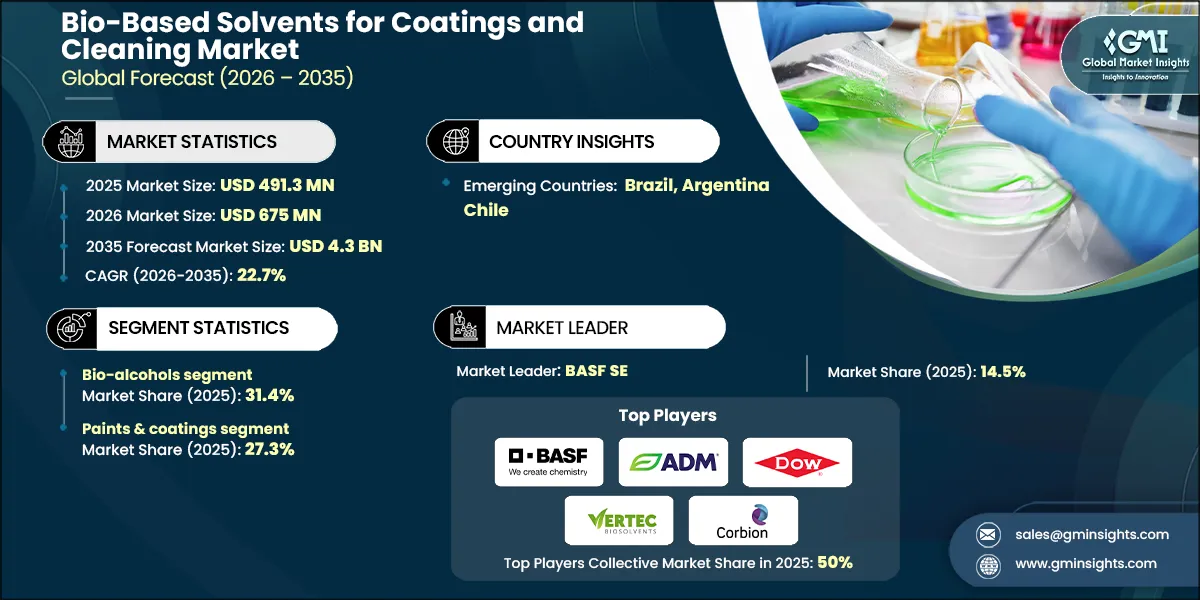
The global bio-based solvents for coatings and cleaning market was valued at USD 491.3 million in 2025. The market is expected to grow from USD 675 million in 2026 to USD 4.3 billion in 2035, at a CAGR of 22.7% according to latest report published by Global Market Insights Inc.
Bio-Based Solvents for Coatings and Cleaning Market Key Takeaways
Market Size & Growth
- 2025 Market Size: USD 491.3 Million
- 2026 Market Size: USD 675 Million
- 2035 Forecast Market Size: USD 4.3 Billion
- CAGR (2026–2035): 22.7%
Key Market Drivers
- Stringent Environmental Regulations.
- Rising Demand for Sustainable Manufacturing Practices.
- Technological Advancements in Bio-Solvent Production.
Challenges
- High Production and Raw Material Costs.
- Technical Performance Limitations Compared to Petro-Solvents.
Opportunity
- Expansion in Electronics and High-Tech Cleaning Applications.
- Integration into Circular and Bio-Based Economy Ecosystems.
Key Players
- Market Leader: BASF SE led with over 14.5% market share in 2025.
- Leading Players: Top 5 players in this market include BASF SE, Archer Daniels Midland Company (ADM), Dow Inc., Vertec BioSolvents, Inc., Corbion N.V., which collectively held a market share of 50% in 2025.
Get Market Insights & Growth Opportunities
- The global market is in a state of rapid change due to an increased consumer demand for more sustainable, non-toxic, and lower volatile organic compound products across many different industries.
- One of the main sources of growth for the market is the continued pressure by Governments, globally, to create safer chemical formulations to prevent health and safety risks to humans and the environment. The introduction of environmental regulations such as REACH in Europe, TSCA (Toxic Substances Control Act) in the US, and the Globally Harmonized System (GHS) of classification and labeling has placed restrictions on the use of high VOC solvents in both manufacturing and cleaning. The demand for bio-based solvents such as lactate esters, D-limonene, bio-alcohols, and glycerol derivatives has increased significantly because these products provide the same or better performance characteristics as traditional solvents while also greatly reducing the environmental impact compared to their traditional counterparts.
- The application of coatings and cleaning products in the industrial manufacturing, automotive refinishing, aerospace MRO, and high-performance architectural coatings sectors are expanding significantly as a significant end-use market. These sectors generally need solvents that have a very high solvency power, controlled rates of evaporation, and compatibility with various types of surfaces. Bio-based solvents presently fulfill a substantial portion of the requirements for these solvents due to the advancements in green chemistry and the development of enzyme technologies.
- For example, the recent commercialization of 2-Methyltetrahydrofuran (2-MeTHF) and next-generation lactate esters are enabling superior performance for cleaning electronic and optical equipment. In addition, the development of technologies that allow for the direct conversion of agricultural feedstocks to high-purity solvents has greatly reduced the reliance on petroleum-derived materials and decreased the carbon footprint of the production process. BASF, Circa Group, Corbion, and Vertec BioSolvents have made considerable progress toward the commercialization of bio-refining technologies and entered long-term contracts to supply global coatings manufacturers.
- As far as future market growth is concerned, it will mainly result from innovations in the use of specific biobased solvent formulations designed for either high-performance coatings or special niche cleaning applications. For example, companies are now designing solvent blends intended for specific uses, including lower viscosity type cleaning solvents for precision cleaning of electronic components or types of solvents that evaporate at slower rates for automotive refinishing purposes, which not only perform at high levels but also will meet all environmental regulations and be attractive to those buying finished goods based on green environmental certification factors.
To get key market trends
Bio-Based Solvents for Coatings and Cleaning Market Trends
- The integration of green chemistry and biocatalysis into solvent production represents an important trend in increasing yield, purity, and versatility of solvents manufactured. Advances in biocatalytic and fermentation processes enable manufacturers to produce solvent materials from renewable resources with higher yields and greater environmental compatibility. Eastman, Corbion, and Circa Group are just a few examples of companies heavily investing in producing higher-yielding solvent products while reducing their overall carbon footprint through improved production processes.
- Due to increasing government and regulatory pressure globally to control the emission of VOCs and HAPs, manufacturers are transitioning to bio-based, low-toxicity solvent alternatives to comply with regulations such as the EU REACH regulations, California’s South Coast Air Quality Management District rules, and various ISO-compliant industry standards. Many countries, through tax incentives and R&D funding, are encouraging the transition to bio-based chemical alternatives to create a policy-driven marketplace.
- Due to safety and performance-related issues, businesses are increasingly opting for custom-built bio-solvents in the electronics, aerospace, and precision coatings sector, thus creating a need for such solutions. Unfortunately, there are still areas of unmet need regarding the availability of solvent options that meet the desired evaporation rate, polarity, and compatibility with substrates. The development of custom-built bio-solvents will provide both a challenge and an opportunity for innovative solutions for solvent manufacturers.
- As part of their efforts to create environmentally sustainable (ESG) solvents, many manufacturers are turning to alternative sources for raw materials, such as non-food biomass, agricultural waste, and waste glycerin, which will provide more stability in terms of feedstock costs and fit into a ‘cradle to cradle’ system. Additionally, by developing environmentally sustainable products that complement the current trend of global ESG investment, these companies will continue to meet the demands of the markets for environmentally friendly products.
Bio-Based Solvents for Coatings and Cleaning Market Analysis
Learn more about the key segments shaping this market
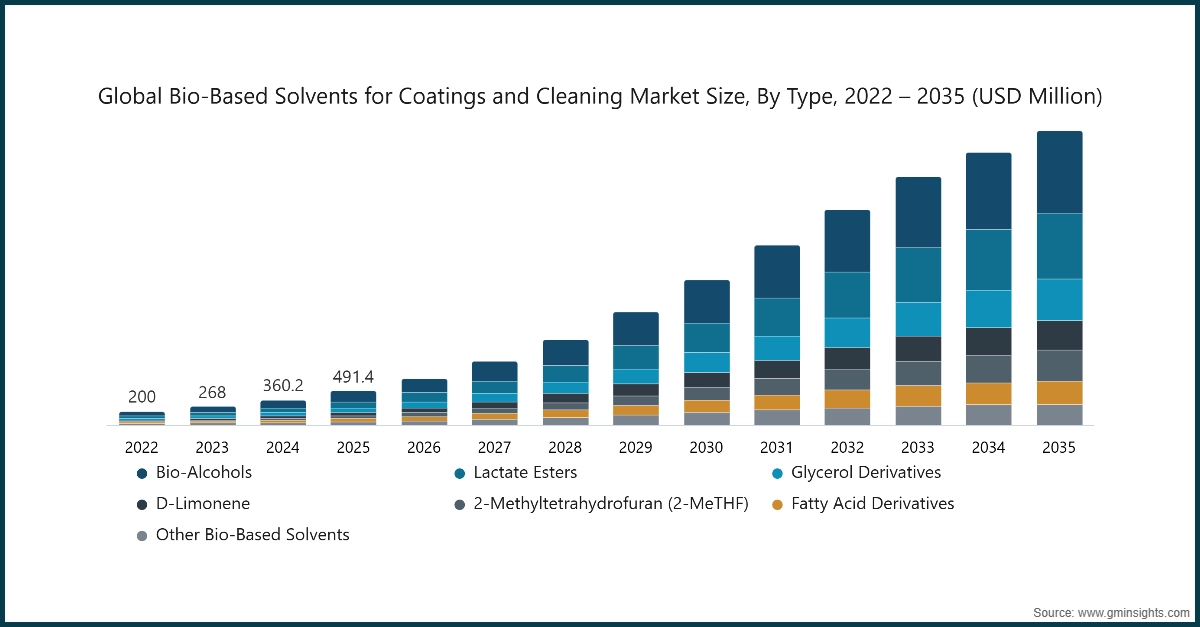
Based on type, the market is segmented into bio-alcohols, lactate esters, glycerol derivatives, D-Limonene, 2-Methyltetrahydrofuran (2-MeTHF), fatty acid derivatives, and other bio-based solvents. Bio-alcohols dominated the market with an approximate market share of 31.4% in 2025 and is expected to grow with a CAGR of 21.3% by 2035.
- Bio-alcohols are very versatile in their functionality, have broad application potential, and have the potential to reduce costs as compared to petrochemical solvents. Products such as bioethanol, bio-butanol, and bio-isopropanol serve as excellent solvent sources for paints, coatings, industrial degreasers, and cleaning solutions, because of their high solvency power and controlled evaporation rates.
The large market share of this segment can be attributed to the availability of established production methods and feedstocks, such as sugarcane, corn, and biomass, globally. The established bioethanol industry, particularly in the U.S. and Brazil, provides significant economies of scale to produce bio-alcohols, enabling them to be among the lowest priced Bio-Based Solvents for Coatings and Cleaning. The fact that bio-alcohols can be used in existing formulations of petrochemical solvent systems reduces the costs of converting to alternative bio-based formulations for end-users. - On the innovation side, significant improvements in fermentation processes, enzymatic conversion processes, and catalytic upgrading processes have resulted in higher purity and yield for bio-alcohols, thus making them appropriate candidates for use in high-performance coatings and cleaning agents classified as electronic grade. The high miscibility and low volatility of bio-butanol are encouraging its use in both automotive and industrial applications.
Learn more about the key segments shaping this market
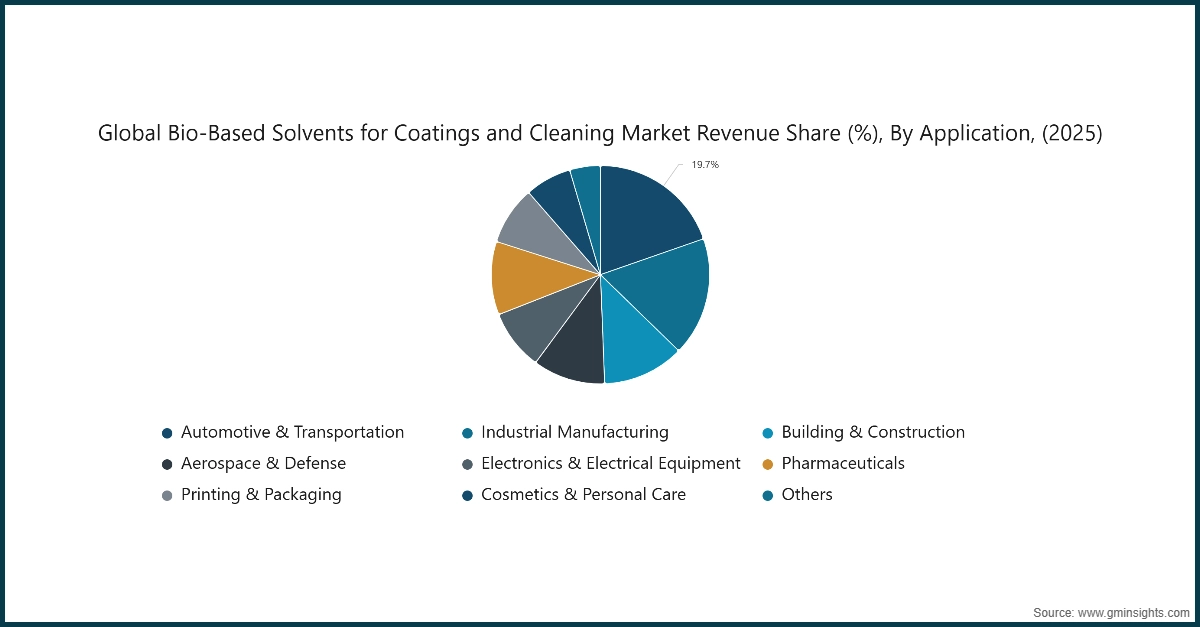
Based on end use industry, the bio-based solvents for coatings and cleaning market is segmented into paints & coatings manufacturing, automotive & transportation, industrial manufacturing, building & construction, aerospace & defense, electronics & electrical equipment, pharmaceuticals, printing & packaging, cosmetics & personal care, others. Paints & coatings manufacturing held the largest market share of 27.3% in 2025 and is expected to grow at a CAGR of 21.7% during 2026-2035.
- Manufacturers of paints and coatings dominate the market share for the bio-based solvents used in coatings and cleaning because of the high dependency of the industry on Solvents for Formulation, Dispersion, Viscosity Control and Drying. Increased use of bio-based solvents in this space due to manufacturers seeking to comply with stringent government regulations such as REACH in Europe and TSCA in the U.S. and to reduce overall VOC emissions.
- The shift towards environmentally-friendly solutions by using Low-toxicity coatings has allowed for the accelerated transition of many of the traditional petrochemical solvent products into bio-based alternative products such as Bio-Alcohols, Lactate Esters and Glycerol Derivatives. In most cases, they provide equal or better performance compared to existing products in drying times, flow characteristics and film formation, while also providing equivalent performance, in terms of finish quality and durability.
- Leading manufacturers of coatings have continued to increase the integration of green chemistry principles within their R&D efforts to be proactive with the ever-changing nature of the regulatory environment and changes in consumer preference towards sustainable products made from sustainable construction and industrial materials. Bio-Based Solvents can also comply with many of the certification requirements established by LEED, Green Seal and other recognized sustainability labeling organizations, making them even more attractive to many consumers.
Looking for region specific data?
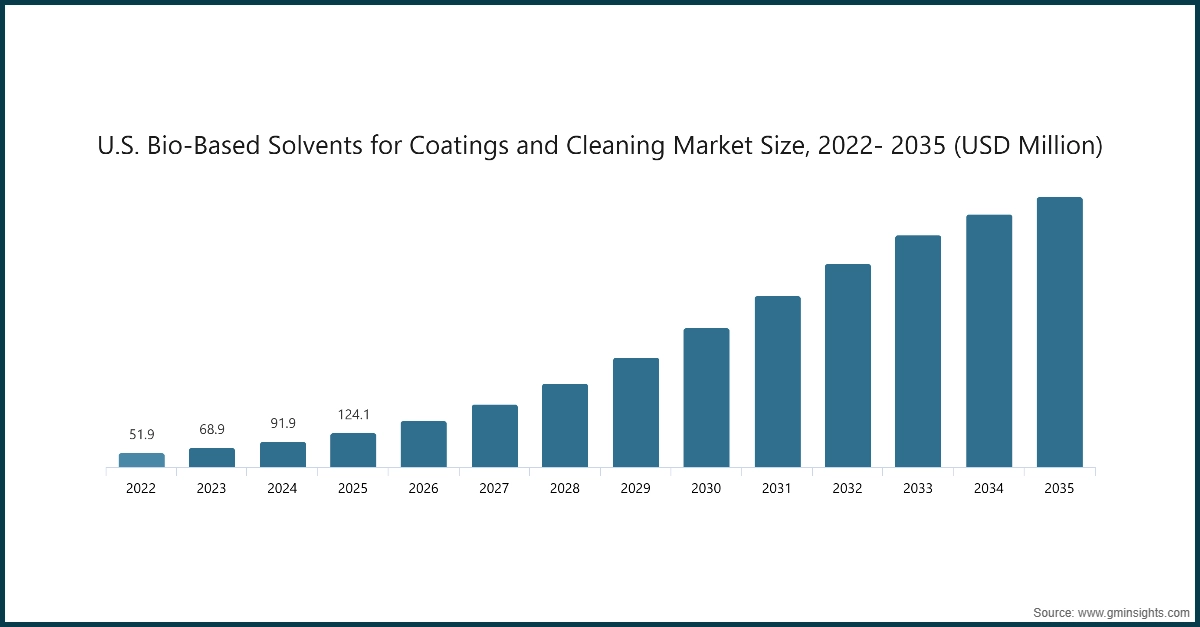
The North America Bio-based solvents for coatings and cleaning market is growing rapidly on the global level with a market share of 31.2% in 2025.
- The North American market has an industrial base that is developed, strong environmental advocacy, and aggressive regulatory enforcement. Air-quality regulations in both Canada and the U.S. restrict the use of high-VOC solvent for manufacturing and maintenance. Additionally, there is a significant amount of bio-refining capacity on a regional basis for bio-alcohol and glycerol variations, which allows for local supply chains. The Canadian Clean Technology Strategy and the North American Green Chemistry initiatives have increased the uptake of renewable solvents used in the coatings and chemical-processing sectors.
U.S. dominates the North America bio-based solvents for coatings and cleaning market, showcasing strong growth potential.
- The U.S. is also at the forefront of the innovation and uptake of bio-based solvents due to the combination of federal legislative frameworks, such as the EPA's Safer Choice Program, and specific state-based legislative frameworks. Furthermore, a significant number of multinational manufacturers of coatings and specialty chemicals have a strong presence in the U.S., along with several major R&D centers located in Illinois, California, and Texas, which makes the U.S. one of the leading countries for the advancement of green solvents.
Europe bio-based solvents for coatings and cleaning market held substantial position in the industry with revenue of USD 137.1 million in 2025 and is anticipated to show lucrative growth over the forecast period.
- Europe is leading the way for the adoption of bio-based solvents due to their implementation of stringent chemical safety regulations in accordance with REACH as well as ambitious goals under the Green Deal. Countries such as: Germany, Netherlands and France are taking an active role in the promotion of the circular economy as well as offering support for the development of biomanufacturing clusters. The European coatings industry is also reformulating its products to contain bio-based materials to comply with Ecolabel criteria and to prepare for the near-term implementation of limitations on petrochemical-based solvents.
The Asia Pacific bio-based solvents for coatings and cleaning market is anticipated to grow at a CAGR of 25.1% during the analysis timeframe.
- The Asia Pacific region is the fastest growing region for bio-based solvents primarily driven by regulatory tightening in China, industrial growth in India and sustainability mandates in South Korea and Japan. The Ministry of Ecology and Environment of the People's Republic of China has implemented regulations regarding Component VOC emissions which impact coatings and clean-ups that will result in an increase in the use of bio-based solvents. The Asia Pacific region has ready access to abundant bio feedstocks, such as sugarcane in India and palm waste in Southeast Asia.
Latin America bio-based solvents for coatings and cleaning market accounted for 7.8% industry share in 2025 and is anticipated to show highest growth over the forecast period.
- In Latin America, Brazil is leading in the adoption of bio-solvents because of its ethanol economy, supporting the production of bio-alcohols, and the government incentive programs to support clean/sustainable industrial practices as well as the availability of renewable feedstocks. The majority of Latin America remains limited in terms of penetration of bio-solvents in other countries due to cost sensitivities and limited regulations.
Middle East & Africa bio-based solvents for coatings and cleaning accounted for 6.7% market share in 2025 and is anticipated to show lucrative growth over the forecast period.
- In the Middle East, The MEA region is just beginning to implement bio-solvents into their industries, and much of the momentum for growth is generated from modernizing their industrial processes rather than by government regulation. Countries in the GCC have invested heavily in green initiatives as part of their Vision 2030 strategies, thereby creating downstream demand for sustainable/Eco-friendly coatings and cleaning chemicals. South Africa has provided some opportunities for the use of bio-solvents in the mining and manufacturing sectors through environmental compliance standards. However, price competitiveness continues to be one of the most significant barriers to widespread adoption in the region.
Bio-Based Solvents for Coatings and Cleaning Market Share
As of 2025, the global bio-based solvents for coatings and cleaning industry is a moderately consolidated industry consisting of at least five large competitors that comprise a greater than 50% market share, BASF, ADM, Dow, Vertic BioSolvents and Corbion. All companies utilize their global distribution networks, proprietary technology, and vertically integrated feedstocks to maintain their dominance and ensure steady supply and price stability.
Collaboration & vertical integration are the fundamental drivers of competition among the leading Companies. BASF and Dow are primarily focused on driving innovation through performance-enhancing products and support through large R&D investments.
The Companies ADM and Corbion leverage their ability to source and access agricultural feedstocks to deliver economies of scale and a differentiated bio-product portfolio, particularly in the areas of bio-alcohols and lactate esters. Vertec BioSolvents, while a small player, has developed a significant share of the sustainable materials market by capitalising on the specialty market of electronics and precision cleaning through its offerings of high-purity products.
The competition has now shifted towards an increased emphasis on innovation, Environmental Social Governance (ESG) compliance, and product customisation. All companies are making substantial investments in M&A, Joint Ventures, & Green Chemistry Partnerships as a means of enhancing their product portfolios and broadening production capacity.
- BASF SE: BASF is a leading manufacturer of bio-based solvents, using a Sustainable Solutions Platform that includes a variety of eco-friendly solvent options, including bio-alcohols and bio-based esters, which can be used in Coatings and in the Cleaning Industry. BASF also implements Green Chemistry into its research and development processes to create low-VOC and high-performing products that meet Regulatory Standards. Operating Globally with a Strong Distribution Network and CAPACITY for Customized Solution Delivery, BASF is a reliable partner for Formulators to develop and supply Bio-Based Solvents.
- Archer Daniels Midland Company (ADM): At ADM, bio-alcohols and Glycerol Derivatives are produced on a large scale through the vast agricultural processing activities that are done with Corn and Soybean feedstocks. ADM employs a vertically integrated strategy in its supply chain, allowing for increased efficiencies and traceability. Additionally, ADM creates Bio-Based Solvents in concentrations that satisfy the increasing demand for Industrial Cleaning and Coatings where there is a requirement for large volume, Safe Solvents.
- Dow Inc.: As the world’s leading manufacturer of Performance & Specialty Coatings, Dow combines its extensive experience in Materials Science with its goals related to Sustainability to create new and innovative Bio-based Solvents for Coatings. Dow collaborates with Coating Manufacturers within the Specialty Coating Sector to create customized Solvent Systems for their customers. Dow addresses its customers’ need for a Solvent that performs equally to Petrochemical products while having a minimal Environmental Impact.
- Vertec BioSolvents, Inc.: The company is a manufacturer of high purity lactate esters and bio-based blends for cleaning and coating applications, with a focus on performance-critical applications for its customers. Vertec's strength lies in their application specific formulation capabilities for Electronics, Aerospace, and Industrial customers, as well as their flexibility, technical service, and fast product development cycle to adapt to customer needs.
- Corbion N.V.: The company is a leading producer of lactic acid based solvents, specifically lactate esters for the coatings and green cleaning products markets. Corbion's business model is aligned with the concept of circularity, as they aim to develop products that are biodegradable, safe, and produced in a sustainable manner using reduced carbon emissions. Corbion provides a tailored system of solvents to meet the local regulatory requirements of their customers, while also providing them with the performance level they require.
Bio-Based Solvents for Coatings and Cleaning Market Companies
Major players operating in the bio-based solvents for coatings and cleaning industry include:
- BASF SE
- Archer Daniels Midland Company (ADM)
- Ashland Global Holdings Inc.
- Bio Brands LLC
- Circa Group
- Clariant AG
- Corbion N.V.
- Dow Inc.
- DuPont de Nemours, Inc.
- Eastman Chemical Company
- Evonik Industries AG
- Florachem Corporation
- LyondellBasell Industries N.V.
- Solvay S.A.
- Vertec BioSolvents, Inc.
Bio-Based Solvents for Coatings and Cleaning Market Report Attributes
| Key Takeaway | Details |
|---|---|
| Market Size & Growth | |
| Base Year | 2025 |
| Market Size in 2025 | USD 491.3 Million |
| Market Size in 2026 | USD 675 Million |
| Forecast Period 2026-2035 CAGR | 22.7% |
| Market Size in 2035 | USD 4.3 Billion |
| Key Market Trends | |
| Drivers | Impact |
| Stringent Environmental Regulations | Drives shift from VOC-heavy petrochemical solvents to bio-based alternatives. |
| Rising Demand for Sustainable Manufacturing Practices | Encourages adoption of green solvents in coatings and industrial cleaning. |
| Technological Advancements in Bio-Solvent Production | Improves efficiency, performance, and cost-competitiveness of bio-based formulations. |
| Pitfalls & Challenges | Impact |
| High Production and Raw Material Costs | Limits mass-scale adoption, especially in price-sensitive sectors. |
| Technical Performance Limitations Compared to Petro-Solvents | Restricts use in applications requiring extreme performance conditions. |
| Opportunities: | Impact |
| Expansion in Electronics and High-Tech Cleaning Applications | Opens pathways for specialized bio-solvents with low toxicity and residue-free properties. |
| Integration into Circular and Bio-Based Economy Ecosystems | Attracts investment and regulatory support for green manufacturing ecosystems. |
| Market Leaders (2025) | |
| Market Leader |
Approximate Market Share of 14.5% in 2025 |
| Top Players |
Collective Market Share of 50% in 2025 |
| Competitive Edge |
|
| Regional Insights | |
| Emerging countries | Brazil, Argentina, Chile |
What are the growth opportunities in this market?
Bio-Based Solvents for Coatings and Cleaning Industry News
- In December 2023, Vertec BioSolvents launched a new series of bio-based high purity solvent formulations specifically designed for automotive refinishing and aerospace coatings, which further strengthens their position in the performance-critical market.
- In September 2023, BASF SE has increased its production capacity for bio-based solvents in Ludwigshafen, Germany, thereby ensuring that they will be able to provide reliable supplies to their coating and industrial cleaning customers across Europe.
- In July 2023, Dow launched a co-innovation program with selected coatings formulators to develop special formulations of solvent systems from bio-isopropanol intended to be used in low-VOC industrial coatings.
- In May 2023, ADM announced the opening of a fermentation-based plant in Illinois that will produce bio-alcohol products from feedstock sources such as corn or wheat, to support their customers' needs for both coatings and pharmaceutical uses.
- In February 2023, Clariant AG announced the introduction of a new line of sugarcane-derived solvents for its ActiGreens™ line of eco-friendly paint and cleaning product formulations.
This bio-based solvents for coatings and cleaning market research report includes in-depth coverage of the industry, with estimates & forecasts in terms of revenue (USD Million) and volume (Kilo Tons) from 2026 to 2035, for the following segments:
Market, By Type
- Bio-Alcohols
- Lactate Esters
- Glycerol Derivatives
- D-Limonene
- 2-Methyltetrahydrofuran (2-MeTHF)
- Fatty Acid Derivatives
- Other Bio-Based Solvents
Market, By End Use Industry
- Paints & Coatings Manufacturing
- Architectural Coatings Manufacturers
- Industrial Coatings Manufacturers
- Specialty & Functional Coatings Manufacturers
- Automotive & Transportation
- Original Equipment Manufacturers (OEMs)
- Tier-1 & Tier-2 Suppliers
- Aftermarket & Refinishing Services
- Industrial Manufacturing
- Metal Fabrication & Metalworking
- Machinery & Equipment Manufacturing
- General Manufacturing & Assembly Operations
- Building & Construction
- Residential Construction
- Commercial & Institutional Construction
- Infrastructure & Civil Engineering
- Aerospace & Defense
- Commercial Aircraft Manufacturing
- Military & Defense Systems
- Maintenance, Repair & Overhaul (MRO)
- Electronics & Electrical Equipment
- Consumer Electronics Manufacturing
- Industrial Electronics & Controls
- Semiconductor & PCB Manufacturing
- Pharmaceuticals
- Active Pharmaceutical Ingredient (API) Manufacturing
- Medical Devices & Diagnostics
- Contract Manufacturing Organizations (CMOs)
- Printing & Packaging
- Commercial Printing
- Flexible Packaging
- Rigid Packaging & Labels
- Cosmetics & Personal Care
- Skincare & Haircare Products
- Color Cosmetics & Fragrances
- Natural & Organic Beauty Products
- Others
The above information is provided for the following regions and countries:
- North America
- U.S.
- Canada
- Europe
- Germany
- UK
- France
- Spain
- Italy
- Rest of Europe
- Asia Pacific
- China
- India
- Japan
- Australia
- South Korea
- Rest of Asia Pacific
- Latin America
- Brazil
- Mexico
- Argentina
- Rest of Latin America
- Middle East and Africa
- Saudi Arabia
- South Africa
- UAE
- Rest of Middle East and Africa
Frequently Asked Question(FAQ) :
What was the market size of the bio-based solvents for coatings and cleaning market in 2025?
The market size was USD 491.3 million in 2025, driven by advancements in green chemistry and biocatalysis.
What is the projected value of the bio-based solvents for coatings and cleaning market by 2035?
The market is expected to reach USD 4.3 billion by 2035, fueled by regulatory pressures, tax incentives, and innovations in bio-based production processes.
What is the projected size of the bio-based solvents for coatings and cleaning market in 2026?
The market is expected to grow to USD 675 million in 2026.
What was the market share of the bio-alcohols segment in 2025?
The bio-alcohols segment held the largest share, accounting for 31.4% of the market in 2025, and is projected to grow at a CAGR of 21.3% through 2035.
Which end-use industry dominated the market in 2025?
The paints & coatings manufacturing segment led the market with a 27.3% share in 2025 and is expected to grow at a CAGR of 21.7% during 2026-2035.
Which region leads the bio-based solvents for coatings and cleaning market?
North America was the largest market in 2025, with a market share of 31.2%. The region is experiencing rapid growth due to strong regulatory frameworks and industrial advancements.
What are the upcoming trends in the bio-based solvents for coatings and cleaning industry?
Key trends include the integration of green chemistry and biocatalysis, advancements in fermentation processes, and the transition to low-toxicity, bio-based solvent alternatives driven by regulatory compliance and environmental concerns.
Who are the key players in the bio-based solvents for coatings and cleaning industry?
Major players include BASF SE, Archer Daniels Midland Company (ADM), Ashland Global Holdings Inc., Bio Brands LLC, Circa Group, Clariant AG, Corbion N.V., Dow Inc., DuPont de Nemours, Inc., Eastman Chemical Company, and Evonik Industries AG.
Bio-Based Solvents for Coatings and Cleaning Market Scope
Related Reports